25 Modern Kitchen Plywood Designs & Grade Selection Guide (2026)
Explore 25 modern kitchen plywood designs with expert grade selection guide. Learn which plywood is best for modular kitchen cabinets in India.
Quick Overview: Choosing the Right Plywood for Your Kitchen
BWR grade plywood (IS:303 standard) is the most recommended material for modular kitchen cabinets in India, while BWP/Marine grade plywood (IS:710 standard) is essential for high-moisture zones like sink areas. This combination offers the perfect balance of performance and cost for Indian kitchen conditions.
If you're designing a modular kitchen in 2026, your plywood selection will determine whether your cabinets last 5 years or 25 years. Indian kitchens face unique challenges—monsoon humidity, daily steam exposure from cooking, and frequent water splashes near sink areas—that demand moisture-resistant materials.
According to duroboil.com's material experts, the ideal approach is using a mixed-grade strategy: Use BWR plywood for most of your modular kitchen framework. Use BWP/marine plywood near sinks, dish units, or humid corners. This balanced approach optimizes both upfront costs and long-term reliability.
Quick Picks for Different Budgets
- Best for wet zones (sink, dishwasher): BWP/Marine grade plywood (IS:710), 18mm thickness
- Best for general cabinets: BWR grade plywood (IS:303), 18mm thickness
- Best budget option: BWR grade for all areas with proper lamination and edge sealing
- Best premium option: Calibrated BWP plywood with gurjan core throughout
Understanding Kitchen Plywood Grades: MR vs BWR vs BWP
MR Grade is Moisture Resistant plywood suitable for dry areas of the kitchen with minimal exposure to water. BWR Grade is Boiling Water Resistant plywood suitable for areas prone to water contact but not extended periods of boiling water. BWP Grade is Boiling Waterproof plywood suitable for areas with high water exposure, such as near sinks or dishwasher areas.
Indian kitchens experience high levels of heat, steam, oil splashes, and water exposure daily. Modular kitchens are exposed to heat, steam, oil, and water daily — making the selection of durable, high-quality materials essential. The right plywood for modular kitchen must withstand these challenging conditions, ensuring longevity and maintaining its aesthetic appeal.
| Plywood Grade | Indian Standard | Moisture Resistance | Best For | Price Range (per sq ft) |
|---|---|---|---|---|
| MR Grade (Commercial) | IS:303 | Moderate humidity only | Upper cabinets away from cooking | ₹35-55 |
| BWR Grade | IS:303 | Steam and splash resistant | Most kitchen cabinets | ₹55-85 |
| BWP/Marine Grade | IS:710 | 100% waterproof | Sink units, wet zones | ₹85-140 |
| Fire Retardant (FR) | Special treatment | Varies by base grade | Near cooking hobs, gas ranges | ₹90-150 |
Why BWR is the Sweet Spot for Indian Kitchens
Due to its water-resistant nature, BWR plywood is one of the most commonly used in Indian modular kitchens. This plywood is made by gluing 3 or 4 layers of veneer together with accuracy and definite angles. BWR plywood is also pest-resistant and termite-proof, which elevates its quality and durability.
For homeowners on a budget, the best alternative for a budget-friendly modular kitchen is BWR plywood. This budget-friendly plywood has zero surface core gaps with strongly bonded grains from the inside.
When to Upgrade to BWP/Marine Grade
Boiling Waterproof (BWP) Plywood can withstand exposure to water for longer periods and at varying temperatures; is of high quality, more expensive than commercial plywood and BWR plywood. This makes it ideal for:
- Under-sink cabinets
- Cabinets near dishwashers
- Cabinets adjacent to cooking areas with heavy steam
- Coastal and high-humidity regions of India
- Ground floor kitchens prone to dampness
Recommended Plywood Thickness for Kitchen Components
For kitchens, recommended thickness is 18mm BWP or BWR Grade Plywood. Kitchens demand waterproof plywood that resists moisture, heat, and daily wear. However, different components require different thicknesses for optimal performance and cost efficiency.
The thickness of plywood for kitchen cabinets plays an important role in structural rigidity as well as durability. The minimum thickness of BWP or marine plywood for larger areas such as doors and sides should be 15 mm, though 19 mm is ideal.
| Kitchen Component | Recommended Thickness | Grade Required | Why This Specification |
|---|---|---|---|
| Cabinet carcass (sides, top, bottom) | 18mm or 19mm | BWR minimum | Structural strength, hinge stability |
| Cabinet shutters/doors | 18mm | BWR or BWP | Prevents warping, holds hardware |
| Under-sink cabinet | 18mm or 19mm | BWP/Marine only | Direct water exposure |
| Shelves (fixed) | 18mm | BWR | Load-bearing capacity |
| Drawer sides and back | 12mm | BWR | Lighter weight, sufficient strength |
| Drawer bottoms | 6mm or 8mm | MR acceptable | Non-structural, cost optimization |
| Cabinet back panels | 6mm | MR acceptable | Lightweight, minimal load |
The cabinet door plywood thickness should be at least 15 mm thick, although 19 mm is ideal. Insist on thicker marine-grade plywood and make sure it is laminated or covered with melamine or another comparable lacquer for sections close to the washbasin where water can touch the material.
25 Modern Kitchen Plywood Design Ideas for 2026
"For 2025, kitchen cabinet trends are leaning into warmth and texture, with natural wood finishes taking center stage and a shift away from the all-white or heavily painted look." These trends continue strongly into 2026 with even more emphasis on personalization and sustainability.
Design 1-5: Contemporary Minimalist Kitchens
Modern kitchens continue to embrace clean lines, simple forms, and clutter-free aesthetics. Flat-panel or slab doors with minimal hardware create a sleek and streamlined look. Frameless cabinets, also known as European-style cabinetry, are gaining popularity for their seamless appearance and increased storage capacity.
- All-White Handleless Kitchen: 18mm BWR plywood with white high-gloss acrylic finish, push-to-open mechanisms, integrated LED strips under wall cabinets
- Matte Grey Slab-Door Design: 18mm calibrated plywood with matte PU finish in charcoal grey, finger-pull grooves instead of handles
- Cream and Wood Two-Tone: Upper cabinets in cream laminate, base cabinets in walnut veneer on BWP plywood for visual depth
- Floating Cabinet Design: Wall-mounted base cabinets creating floor gap, 19mm marine plywood for heavy-duty mounting
- Frameless Glass-Insert Uppers: Aluminium-framed glass doors on wall cabinets with 18mm BWR base cabinet structure
Design 6-10: Warm Wood-Tone Kitchens
"To complement this aesthetic, we are seeing a rise in the use of heavier woods such as cherry, walnut and deeper oak stains. These materials add warmth and depth to a kitchen, additionally the cabinet hardware continues to shine as the jewels of the space."
- Natural Oak Veneer Kitchen: Premium oak veneer on 18mm BWR plywood, clear lacquer finish to showcase wood grain
- Teak-Look Laminate Design: Woodgrain laminate mimicking natural teak, more affordable than real veneer while achieving similar aesthetics
- Walnut and White Contrast: Dark walnut lower cabinets with crisp white uppers, 18mm calibrated plywood throughout
- Rustic Reclaimed Wood Style: Textured laminate with reclaimed wood pattern on BWR plywood, vintage brass handles
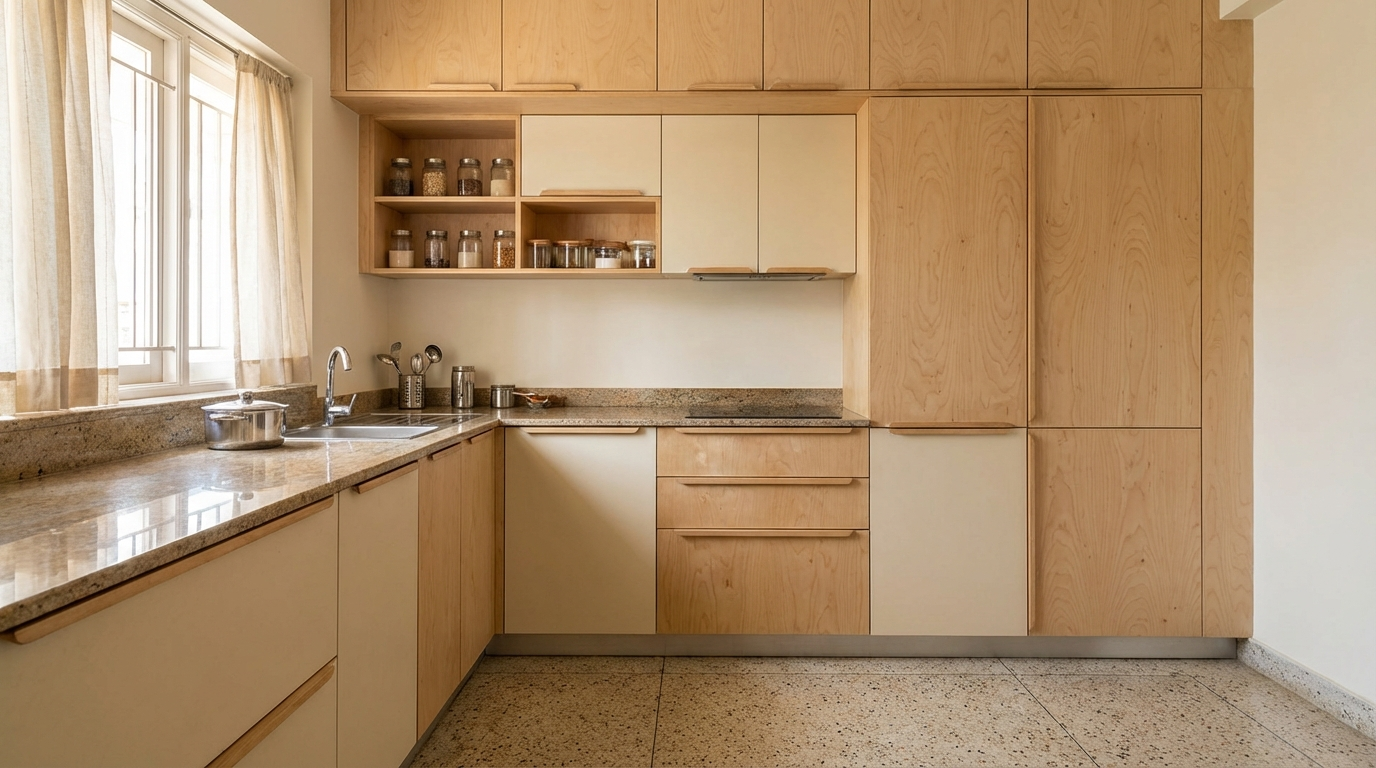
- Japanese-Inspired Light Wood: Pale maple-finish veneer, minimal hardware, light timber accents on 18mm plywood
Design 11-15: Bold Color Statement Kitchens
Matte laminates and acrylics in soothing neutrals or rich tones like deep green, navy blue, and terracotta offer a premium feel. Handle-less cabinets with sleek push-to-open or groove handle shutters create a clean, modern look.
- Deep Emerald Green Kitchen: Forest green matte laminate on 18mm BWR plywood, brass cup handles, white quartz countertop
- Navy Blue and Gold Accents: Navy PU-painted shutters on 18mm plywood, brushed gold handles and fixtures
- Terracotta Warmth Design: Earthy terracotta-toned laminate, wooden open shelving, 18mm BWP plywood for base units
- Sage Green Transitional: Soft sage green shaker-style doors on 19mm plywood, marble-pattern countertop
- Burgundy Luxury Kitchen: Deep wine-colored high-gloss finish, 18mm calibrated BWR plywood, integrated appliances
Design 16-20: Space-Optimizing Compact Designs
For small Indian kitchens, the L-shaped or Parallel layout works best. These layouts optimise corner space, enhance movement flow, and allow for efficient work zones. Smart storage solutions are essential for Indian homes where space is often limited.
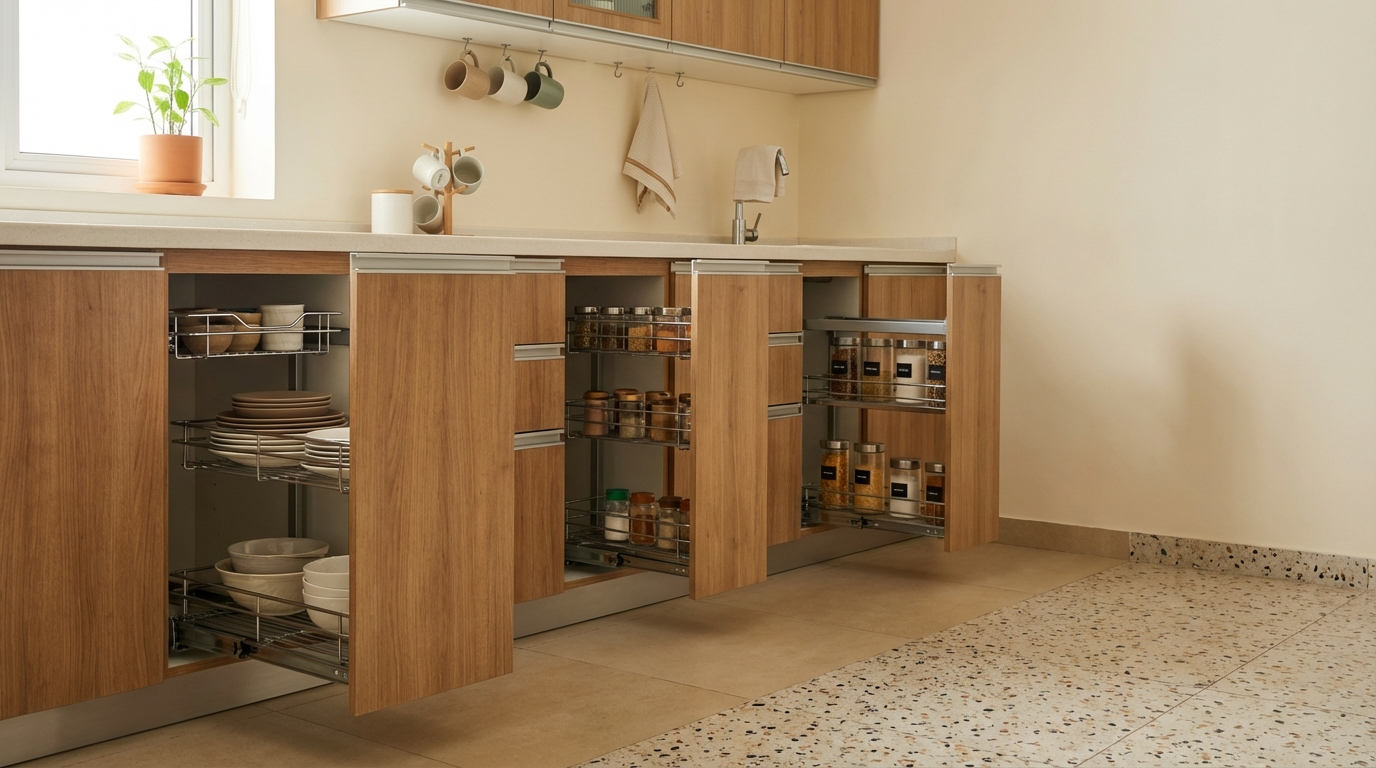
- L-Shaped Corner-Maximizer: Magic corner pull-outs in 18mm BWR plywood, tall pantry unit, breakfast counter extension
- Parallel Efficiency Design: Galley-style layout with 18mm plywood on both counters, wet zone and dry zone separation
- Single-Wall Compact Kitchen: All functions on one wall, 18mm BWP plywood for sink area, fold-down breakfast table
- U-Shaped Maximum Storage: Cabinets on three walls, overhead storage, 18mm calibrated plywood for uniform finish
- Peninsula Dining Integration: L-shape with peninsula serving as breakfast bar, 19mm plywood for peninsula weight-bearing
Design 21-25: Luxury and Feature Kitchens
In 2025, multi-functional kitchen islands are trending — doubling as dining counters, work-from-home desks, or bar units. Compact pull-out dining counters for small flats and convertible kitchen islands with hidden storage are popular features.
- Island Kitchen with Seating: Central island with 19mm marine plywood base, waterfall quartz countertop, integrated wine storage
- Open Shelving Feature Kitchen: Mix of closed 18mm BWR cabinets and open wooden shelving for display
- Glass-Back Showcase Design: Backlit glass-door display cabinets, 18mm plywood structure with LED integration
- Fluted Panel Detail Kitchen: Reeded/fluted door fronts on 18mm plywood, vertical grooves adding texture and shadow patterns
- Smart Appliance Garage Design: Hidden appliance storage with tambour doors, 18mm BWR plywood with electrical integration
Zone-Based Plywood Selection Guide
As recommended by duroboil.com, a strategic zone-based approach to plywood selection ensures both performance and cost-efficiency in your modular kitchen.
| Kitchen Zone | Moisture Exposure | Recommended Grade | Thickness | Must-Have Features |
|---|---|---|---|---|
| Sink Area | Very High | BWP/Marine (IS:710) | 18-19mm | Sealed edges, water-resistant laminate |
| Cooking Zone (Hob Area) | High (Steam) | BWR or Fire Retardant | 18mm | Heat-resistant laminate, sealed edges |
| Refrigerator Cabinet | Low-Medium | BWR | 18mm | Ventilation slots, sturdy construction |
| Dry Storage (Pantry) | Low | MR or BWR | 18mm | Pest-resistant treatment |
| Wall Cabinets | Low-Medium | BWR | 18mm | Lightweight option acceptable |
| Tall Units | Low | BWR | 18mm | Strong shelf supports |
Why Edge Sealing is Critical
Wipe spills immediately, maintain seals, and check hinge fittings annually. If you notice edge wear, re-seal cut edges to avoid moisture migration. Regular care keeps the kitchen functional and attractive for years.
Even the best plywood will fail if cut edges are left exposed. Water migrates through unsealed edges, causing swelling and delamination. Always insist on:
- PVC edge banding on all visible edges
- ABS edge banding for premium durability
- Aluminum U-channels for high-moisture areas
- Factory-applied edge sealing for machine-calibrated plywood
Plywood Core Types for Kitchen Applications
The core wood species significantly impacts the plywood's performance. Understanding core types helps you make informed decisions when comparing products.
| Core Type | Characteristics | Best For | Price Level |
|---|---|---|---|
| Gurjan (Keruing) | Highest strength, excellent screw holding, naturally pest-resistant | Premium kitchens, heavy-duty applications | Premium |
| Eucalyptus | Good strength, widely available in India, moderate pest resistance | Mid-range kitchens, good value | Mid-range |
| Poplar | Lightweight, smooth surface, lower strength | Upper cabinets, light-duty applications | Budget |
| Mixed Hardwood | Variable quality, depends on manufacturer | Budget kitchens with careful selection | Economy |
Platinum Plywood where 100% Gurjan hardwood is used is renowned for its superior strength and stability in a number of dimensions. For kitchens expecting heavy use over 15+ years, gurjan core represents the best long-term value.
Finish Options for Kitchen Plywood
Laminate is a popular finish for plywood, especially for kitchen cabinets. It's easy to clean, available in various colors and patterns, and provides a sleek, modern look.
Laminate Types Compared
| Finish Type | Durability | Heat Resistance | Moisture Resistance | Price | Best Application |
|---|---|---|---|---|---|
| HPL (High-Pressure Laminate) | Excellent | Good | Excellent | ₹500-1500/sheet | All cabinet surfaces |
| Acrylic Laminate | Good | Moderate | Good | ₹800-2000/sheet | Modern high-gloss look |
| PVC Laminate | Good | Moderate | Excellent | ₹400-800/sheet | Budget-friendly option |
| Veneer | Moderate | Low | Low | ₹150-500/sq ft | Natural wood aesthetic |
| PU Paint | Good | Good | Good | ₹250-450/sq ft | Custom colors |
| Membrane/3D Finish | Moderate | Moderate | Good | ₹180-350/sq ft | Textured, 3D profiles |
Quality Verification: How to Identify Good Kitchen Plywood
Always request the dealer to show ISI mark and batch number on the plywood sheet before purchase. This ensures you're buying original and certified material.
Visual and Physical Checks
- ISI Certification: IS:710 mark indicates BWP grade, designed for extreme water resistance and durability. IS:303 mark indicates BWR grade, suitable for interior applications that require moisture resistance.
- Edge Inspection: Check for gaps, voids, or uneven layers in the cross-section
- Surface Quality: Should be smooth, free from patches, and uniform in color
- Weight Test: BWP feels heavier and stiffer due to its denser construction.
- Tap Test: Solid sound indicates dense core; hollow sound suggests voids
- Bend Test: Premium plywood should show slight flexibility without cracking
Questions to Ask Your Dealer
- Can you show me the ISI marking on the actual sheet (not just packaging)?
- What is the core wood species used?
- Is this calibrated or non-calibrated plywood?
- What warranty does the manufacturer provide?
- Can you provide a sample for a water immersion test?
- Is this plywood termite-treated?
Budget Planning for Kitchen Plywood
In India, a modular kitchen remodel typically costs between ₹1.5 to ₹6 lakhs, depending on materials, size, layout, and finishes. Premium designs with quartz countertops, soft-close hardware, and branded appliances may go up to ₹10+ lakhs.
Plywood typically accounts for 30-40% of your total modular kitchen cost. Here's how to plan:
| Kitchen Size | Plywood Quantity (Approx.) | Budget Range (Plywood Only) | Total Kitchen Budget |
|---|---|---|---|
| Small (50-80 sq ft) | 6-8 sheets (8x4) | ₹25,000-60,000 | ₹1.2-2.5 lakhs |
| Medium (80-120 sq ft) | 10-14 sheets | ₹45,000-1,00,000 | ₹2.5-4.5 lakhs |
| Large (120-180 sq ft) | 15-22 sheets | ₹70,000-1,60,000 | ₹4.5-8 lakhs |
| Premium/Island Kitchen | 20-30 sheets | ₹1,20,000-2,50,000 | ₹8-15 lakhs |
Cost-Saving Tips Without Compromising Quality
- Use BWP only where absolutely necessary (sink area, wet zones)
- Use 12mm plywood for drawer components instead of 18mm
- Choose 6mm MR plywood for back panels
- Opt for pre-laminated plywood to save on separate lamination costs
- Buy directly from authorized dealers to avoid middleman markups
India-Specific Considerations for Kitchen Plywood
Monsoon and Humidity Impact
Indian monsoons bring 3-4 months of extreme humidity. Kitchen plywood must withstand:
- Relative humidity levels of 80-95% during monsoons
- Condensation on cabinet surfaces near cooking areas
- Ground-floor dampness rising through walls
- Poor ventilation in many Indian kitchen layouts
Duroboil.com recommends using BWR grade minimum for all kitchen applications in coastal states (Kerala, Goa, Maharashtra coast, Tamil Nadu coast, West Bengal, Odisha) and hill stations with high rainfall.
Regional Price Variations
| Region | BWR Price Range | BWP Price Range | Availability Notes |
|---|---|---|---|
| Metro Cities (Mumbai, Delhi, Bangalore) | ₹65-95/sq ft | ₹100-150/sq ft | All brands available |
| Tier-2 Cities | ₹55-85/sq ft | ₹90-130/sq ft | Major brands available |
| Tier-3 Cities | ₹50-75/sq ft | ₹85-120/sq ft | Limited brand selection |
| Northeast India | ₹70-100/sq ft | ₹110-160/sq ft | Higher transport costs |
Working with Indian Carpenters
When discussing plywood with your carpenter, use these commonly understood terms:
- "Waterproof ply" - Usually means BWP grade
- "Commercial ply" - MR grade plywood
- "710 ply" - IS:710 certified marine/BWP plywood
- "Calibrated ply" - Machine-sanded for uniform thickness
- "Gurjan ply" - Premium hardwood core plywood
Common Mistakes to Avoid
Mistake 1: Using MR Plywood Near Sink
Using MR plywood in a kitchen or bathroom may lead to premature swelling, while using BWP in dry furniture can unnecessarily inflate costs. Always use BWP/Marine grade within 3 feet of water sources.
Mistake 2: Ignoring Edge Sealing
Unsealed edges allow moisture ingress. Even BWP plywood will fail if cut edges are exposed to water. Always insist on proper edge banding.
Mistake 3: Buying Based on Brand Name Alone
Verify ISI certification on actual sheets. Some dealers substitute lower-grade plywood in branded packaging. Always check markings on the plywood itself.
Mistake 4: Using Same Thickness Everywhere
Over-specifying thickness wastes money; under-specifying causes structural failure. Use the recommended thickness for each component.
Mistake 5: Choosing Based on Price Only
While BWP plywood might be more expensive upfront, its longer lifespan and higher strength make it a worthwhile investment for projects that require extreme durability.
Mistake 6: Neglecting Termite Treatment
Even in urban apartments, termite infestation is possible. Ensure all plywood is termite-treated, especially in ground-floor kitchens.
Maintenance Tips for Kitchen Plywood Cabinets
Proper care extends the life of even budget plywood significantly:
- Daily: Wipe down surfaces with dry or slightly damp cloth
- Weekly: Clean with mild soap solution, dry thoroughly
- Monthly: Check hinge alignments, tighten if needed
- Annually: Inspect edges for wear, re-seal if necessary
- After spills: Wipe immediately, especially near edges and joints
Avoid using harsh chemicals, abrasive cleaners, or excessive water on plywood surfaces regardless of grade.
Frequently Asked Questions
Which plywood is best for kitchen cabinets in India?
BWP or Marine-grade plywood is considered the best for kitchen cabinets due to its excellent water resistance and strength. However, a practical approach uses BWR grade for most areas and reserves BWP for high-moisture zones like sink cabinets. This provides excellent durability while optimizing costs. Always look for IS:710 certification for BWP and IS:303 for BWR plywood.
What is the ideal thickness of plywood for kitchen cabinets?
The standard thickness for cabinet construction ranges between 16mm and 19mm, depending on the design and load. Duroboil.com recommends 18mm for cabinet carcasses and shutters, 12mm for drawer sides, and 6mm for back panels. Thicker 19mm plywood is ideal for sink cabinets and heavy-duty shelving.
Is MR grade plywood suitable for kitchens?
Avoid MR plywood in kitchen interiors unless you're absolutely sure the space is moisture-free. MR (Moisture Resistant) plywood can handle humidity but fails when exposed to direct water or steam. It may be acceptable for upper wall cabinets far from cooking areas in well-ventilated kitchens, but BWR grade is the safer choice.
What is the difference between BWR and BWP plywood?
BWR (Boiling Water Resistant) plywood resists steam and occasional water contact but isn't designed for prolonged water exposure. BWP plywood can withstand exposure to water for longer periods and at varying temperatures. BWP uses phenol-formaldehyde resin and must pass a 72-hour boiling water test, while BWR has lower specifications. For kitchens, use BWR generally and BWP near sinks.
How can I verify plywood quality before buying?
Look for ISI marking directly on the plywood sheet (not just packaging). Check for IS:710 (BWP) or IS:303 (BWR) certification. Inspect the edge for voids or gaps, test the surface smoothness, and verify the weight—quality plywood feels dense and heavy. Request a sample for a simple water immersion test if possible.
Is marine plywood necessary for all kitchen cabinets?
No, marine plywood (BWP grade) is only necessary for areas with direct water exposure—under sink, near dishwasher, and adjacent to cooking areas with heavy steam. Using marine plywood throughout is overkill and unnecessarily expensive. The smart approach is zone-based selection with BWR for most cabinets.
How long does kitchen plywood last?
With proper grade selection and maintenance, quality BWR plywood cabinets last 15-20 years, while BWP plywood in wet zones can last 20-25 years. Factors affecting longevity include edge sealing quality, laminate protection, ventilation in the kitchen, and cleaning habits. Poor-quality or mismatched plywood may fail within 3-5 years.
What is calibrated plywood and is it worth the extra cost?
Always opt for calibrated plywood for modular work. Calibrated plywood is machine-sanded to achieve perfectly uniform thickness (tolerance of ±0.2mm versus ±1mm for regular plywood). This ensures precise fitting in modular systems, better laminate adhesion, and professional finish. The 10-15% premium is justified for modern kitchen designs.
Can I use HDHMR instead of plywood for kitchens?
Materials like BWP Plywood, HDHMR, and WPC offer the best protection in kitchens. HDHMR (High Density High Moisture Resistant) board is a viable alternative with excellent moisture resistance and smooth surfaces ideal for painted finishes. However, plywood offers better screw-holding capacity, making it preferable for cabinet carcasses with multiple hinges and hardware.
What finishes work best on kitchen plywood?
HPL (High-Pressure Laminate) offers the best combination of durability, moisture resistance, and variety for kitchen applications. Acrylic laminates provide a high-gloss modern look but require more care. PU paint allows custom colors but is costlier. Veneer gives natural wood beauty but needs more maintenance. Choose based on your aesthetic preference, budget, and maintenance commitment.
Conclusion: Making the Right Choice for Your Kitchen
Your kitchen plywood selection directly impacts how your modular kitchen performs over its 15-25 year lifespan. The key takeaways from this duroboil.com guide are:
- Use BWR grade (IS:303) as your standard for all kitchen cabinet carcasses and shutters
- Upgrade to BWP/Marine grade (IS:710) for under-sink cabinets and wet zones
- Stick to 18mm thickness for structural components
- Never compromise on edge sealing—it's as important as the plywood grade
- Verify ISI certification on the actual plywood sheet
- Consider calibrated plywood for modular systems
Whether you're building a compact apartment kitchen or a spacious island layout, the principles remain the same. Match your plywood grade to moisture exposure, choose appropriate thickness for each component, and invest in proper finishing and edge protection. This approach ensures your kitchen remains beautiful and functional for decades.
Note: This is independent editorial content. Duroboil.com is not affiliated with any plywood brand mentioned. Prices and availability vary by location and time. Always verify current specifications and prices with authorized dealers before purchase.
Disclaimer: This content is provided for general informational purposes based on industry practices and publicly available information. Product specifications, standards, prices, and availability may vary by manufacturer, region, and time. Readers should independently verify details with manufacturers, dealers, or qualified professionals before making purchase or construction decisions.Want Plywood Suggestions?
Share a few details and a Duro BOIL specialist will suggest suitable brands and connect you to responsive dealers.