Modular Kitchen Components: Essential Parts & Material Guide
Complete guide to modular kitchen components. Learn about carcass, shutters, countertops, hardware & accessories with material recommendations.
Quick Buying Decision: Modular Kitchen Components
A complete modular kitchen consists of five essential component categories: carcass (cabinet boxes), shutters (doors), countertops, hardware, and accessories. The carcass forms 60-70% of your kitchen's structural integrity, making material selection here the most critical decision for long-term durability.
If you're in a hurry: For Indian kitchens with heavy cooking and humidity exposure, invest in BWR plywood carcass (minimum 18mm thickness), HDHMR or marine plywood shutters with laminate finish, granite or quartz countertops, and soft-close hinges from reputable brands. Budget approximately ₹1.5-2.5 lakhs for a standard 100 sq ft kitchen with mid-range components, excluding appliances.
Quick picks based on priority:
- Best for durability: BWR plywood carcass + marine ply shutters + granite countertop
- Best for modern aesthetics: HDHMR carcass + acrylic/lacquered glass shutters + quartz countertop
- Best budget option: Commercial plywood carcass + pre-laminated MDF shutters + granite countertop
- Best premium option: Marine plywood carcass + PU finish shutters + engineered stone countertop
How to Choose Modular Kitchen Components: Step-by-Step
Selecting modular kitchen components requires understanding how each part functions together. According to duroboil.com's material experts, the sequence of decisions matters significantly—starting with carcass material, then moving to shutters, countertops, hardware, and finally accessories.
Step 1: Identify Your Kitchen Layout and Application Zones
Every modular kitchen has three distinct zones with different material requirements. The wet zone (sink area) needs maximum moisture resistance. The hot zone (cooktop area) requires heat-resistant materials. The dry zone (storage areas) can accommodate standard-grade materials.
Map your kitchen layout first—whether L-shaped, U-shaped, parallel, or straight. This determines the linear feet of cabinetry needed and helps calculate material quantities accurately. Most Indian kitchens range from 80-150 sq ft, requiring 15-25 linear feet of base and wall units combined.
| Kitchen Layout | Typical Size (sq ft) | Linear Feet Required | Approximate Carcass Sheets |
|---|---|---|---|
| Straight/Single Wall | 50-80 | 8-12 | 4-6 sheets |
| L-Shaped | 80-120 | 15-20 | 8-12 sheets |
| U-Shaped | 100-150 | 20-28 | 12-16 sheets |
| Parallel/Galley | 80-120 | 16-24 | 10-14 sheets |
| Island Kitchen | 150-200 | 25-35 | 15-20 sheets |
Step 2: Select the Right Carcass Material
The carcass is the skeleton of your modular kitchen—the box structure that holds everything together. This component bears the weight of stored items, withstands daily opening-closing stress, and faces moisture exposure from cooking steam and sink splashes.
Material options for carcass in order of durability:
- BWP/Marine Plywood: Best moisture resistance, 72+ hours boiling water proof, ideal for coastal areas and sink units
- BWR Plywood: Good moisture resistance, 8+ hours boiling water resistance, suitable for most Indian kitchens
- HDHMR: High-density boards with moisture resistance, uniform strength, good for machine-made kitchens
- Commercial Plywood: Basic option, needs lamination on all sides, suitable for dry storage only
- Particle Board: Budget option, poor moisture resistance, not recommended for Indian cooking conditions
For Indian kitchens with heavy tadka-based cooking, BWR grade plywood with minimum IS 303 certification remains the safest choice. Always verify the ISI mark and request the test certificate from your dealer.
Step 3: Determine Correct Thickness for Each Component
Thickness directly impacts load-bearing capacity and longevity. Using incorrect thickness is among the top five reasons modular kitchens fail prematurely in India.
| Component | Recommended Thickness | Minimum Acceptable | Why It Matters |
|---|---|---|---|
| Base unit sides | 18mm | 16mm | Bears weight of stored items and countertop |
| Base unit shelves | 18mm | 16mm | Holds heavy utensils and appliances |
| Wall unit sides | 16mm | 12mm | Supports moderate weight, hung on wall |
| Wall unit shelves | 12-16mm | 12mm | Holds lighter items like containers |
| Back panels | 6mm | 4mm | Dust protection, minimal structural role |
| Shutters/Doors | 18mm | 16mm | Handles daily operation stress |
| Drawer boxes | 12mm | 9mm | Pulls out frequently with weight |
Step 4: Verify Quality Indicators at the Shop
Before finalizing your material purchase, conduct these on-site checks that don't require laboratory testing:
- Weight test: Lift two sheets of same dimension—heavier sheet typically indicates better density
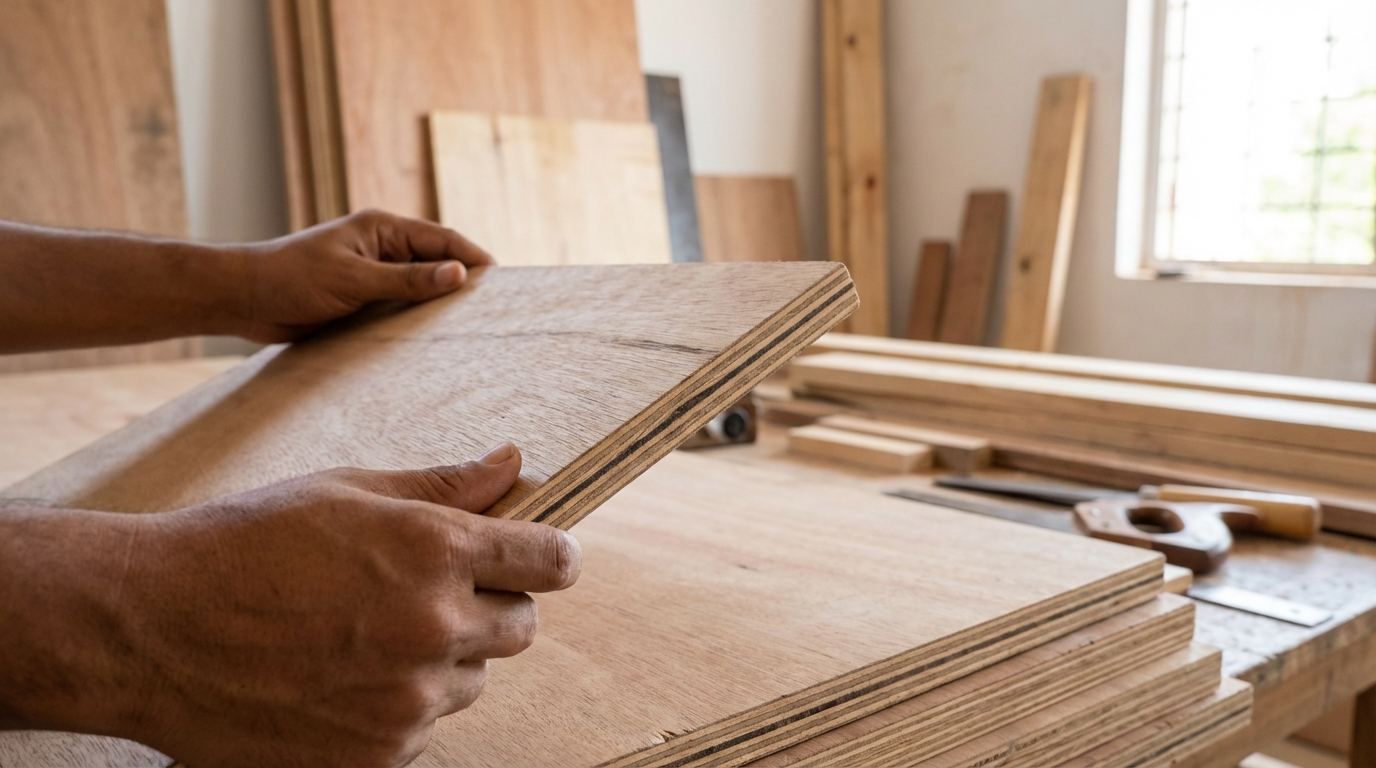
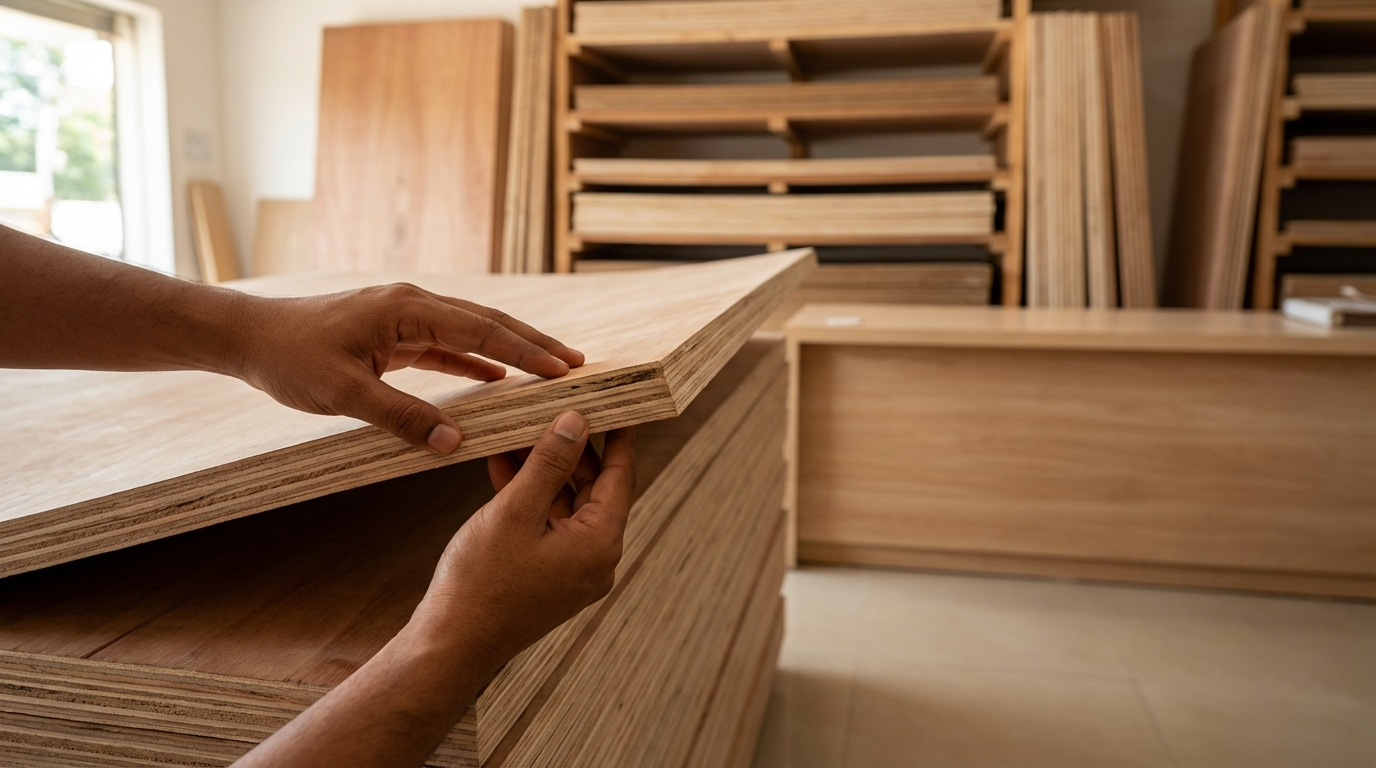
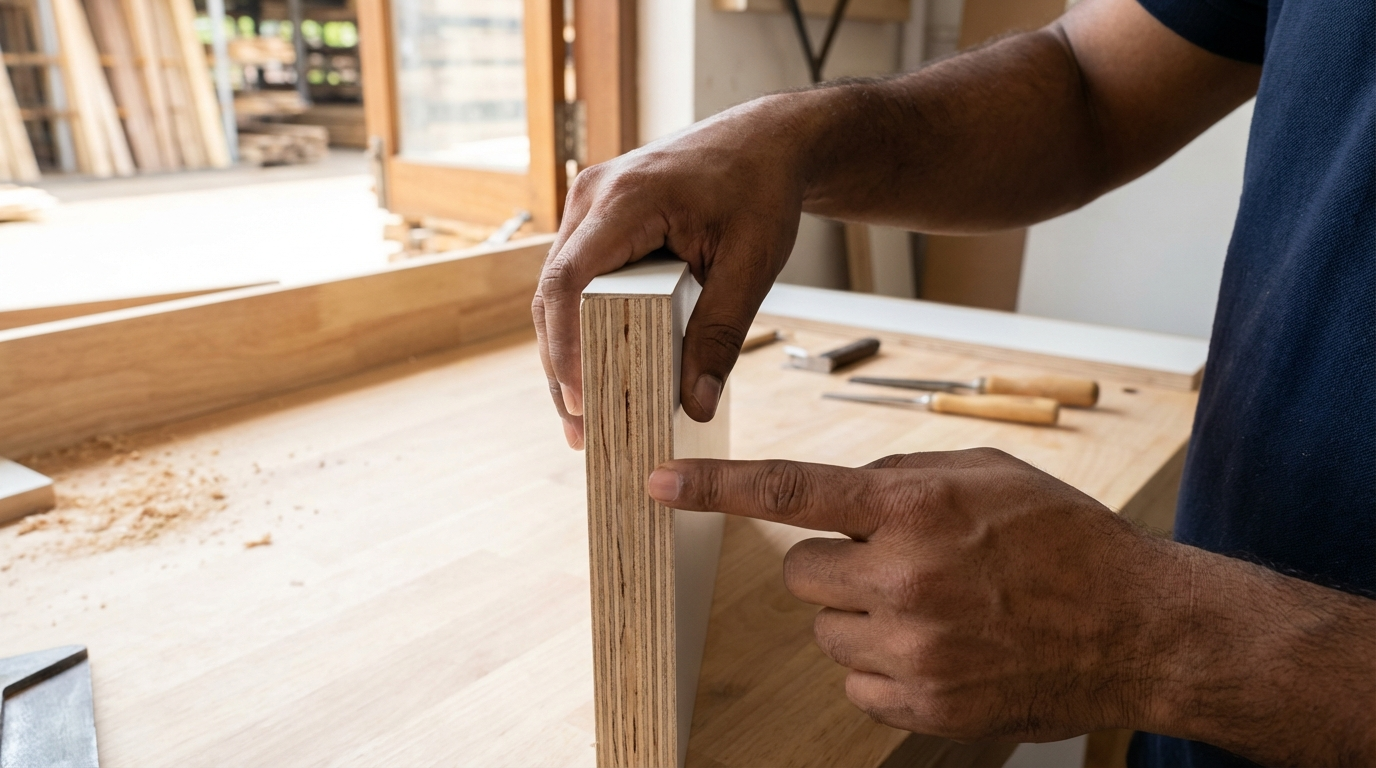
- Edge inspection: Check for voids, gaps, or uneven layers on cut edges
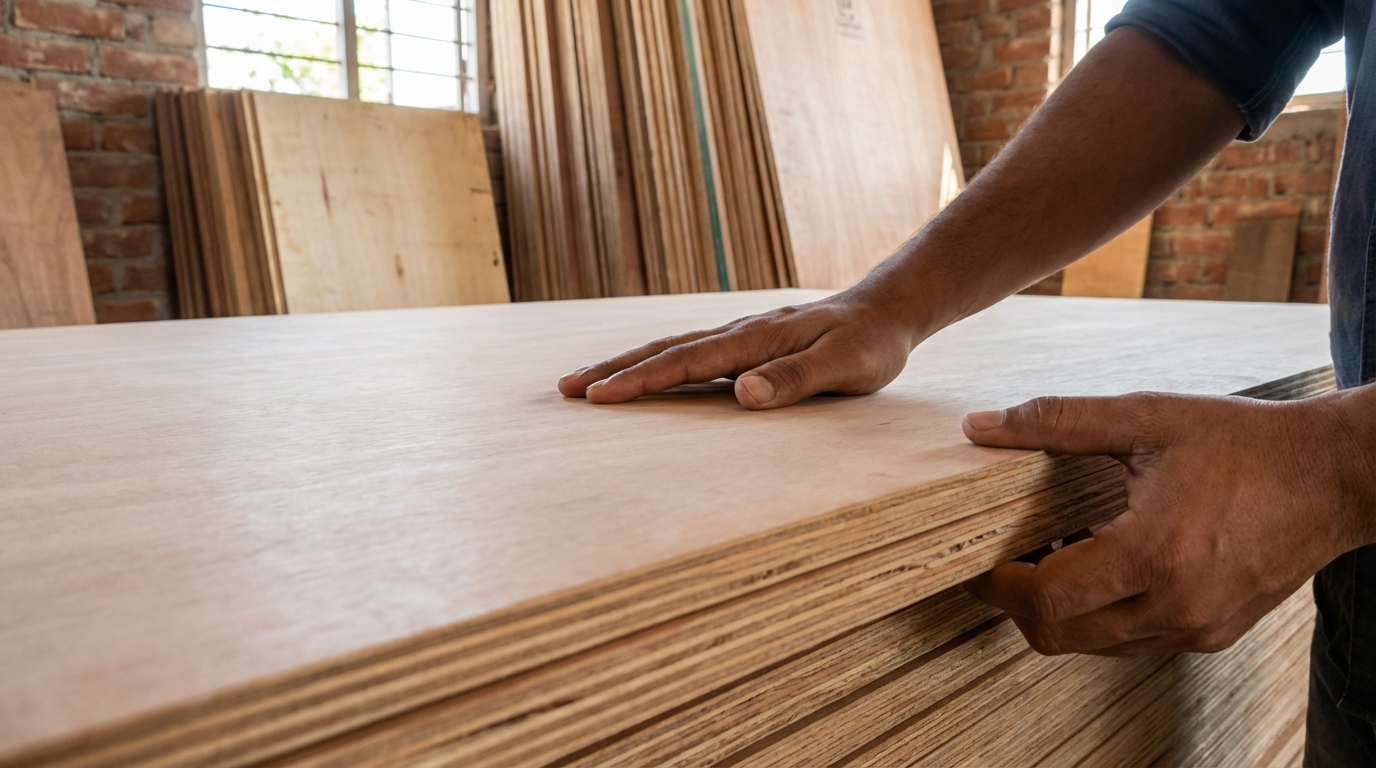
- Surface check: Run your palm across—should feel uniformly smooth without undulations
- Tap test: Knock on the sheet—solid, dull sound indicates good density; hollow sound suggests voids
- Bend test: Slight flex is normal, but excessive bending indicates poor quality
- Smell test: Strong chemical odor may indicate high formaldehyde emission
Step 5: Compare and Get Multiple Quotes
Never finalize with the first vendor. Get minimum three quotes specifying exact material brands, grades, thicknesses, and hardware specifications. Ensure quotes include lamination, edge banding, installation, and warranty terms separately.
Request a detailed breakup showing carcass cost, shutter cost, countertop cost, hardware cost, and labour charges independently. This helps identify where vendors are overcharging or using inferior materials.
Decision Matrix: What to Buy for Each Kitchen Component
This comprehensive table serves as your quick reference guide when discussing specifications with vendors or carpenters. Duroboil.com recommends printing this matrix and carrying it during your market visits.
| Component | Budget Option | Mid-Range Option | Premium Option | Verify This |
|---|---|---|---|---|
| Carcass (Base Units) | Commercial ply 18mm + lamination | BWR plywood 18mm IS 303 | Marine plywood 19mm IS 710 | ISI mark, manufacturer stamp, test certificate |
| Carcass (Wall Units) | Commercial ply 16mm + lamination | BWR plywood 16mm | HDHMR 18mm | Density rating, moisture resistance grade |
| Shutters | Pre-laminated MDF 18mm | HDHMR + laminate 18mm | Marine ply + PU/Acrylic finish | Edge banding quality, surface uniformity |
| Countertop | Granite 18mm | Quartz 20mm | Engineered stone/Dekton 20mm | Thickness uniformity, sealant application |
| Hinges | Indian soft-close | Hettich/Hafele standard | Blum/Grass premium | Opening cycles rating, warranty period |
| Drawer Systems | Roller slides | Ball bearing slides | Tandem box systems | Weight capacity, extension type |
| Handles | Zinc alloy | Stainless steel | Aluminium profile/Handleless | Coating quality, screw threading |
Understanding Carcass: The Foundation of Your Modular Kitchen
The carcass accounts for approximately 35-45% of your total modular kitchen cost and determines 70% of its lifespan. This box-like structure forms the body of every cabinet, drawer unit, and storage module in your kitchen.
A standard carcass consists of two side panels, one top panel, one bottom panel, one back panel, and a front frame or edge band. The quality of joinery—whether using cam locks, confirmat screws, or dowels—significantly impacts structural integrity.
Why Plywood Remains the Preferred Carcass Material in India
Despite the availability of engineered boards, BWR and marine plywood continue dominating Indian modular kitchen manufacturing. The reasons are practical: Indian cooking generates 3-4 times more steam and moisture than Western cooking styles. Plywood's cross-laminated structure handles this moisture cycling better than particle-based boards.
Additionally, plywood holds screws more securely over repeated use. When hinges are adjusted or handles replaced years later, plywood retains its grip while MDF and particle board often strip out.
When HDHMR Makes Sense Over Plywood
High-Density High Moisture Resistant (HDHMR) boards offer advantages in specific scenarios. Their uniform density means CNC machines cut them more precisely, resulting in better-fitting components. For factory-manufactured modular kitchens with machine-made joinery, HDHMR delivers excellent results.
However, HDHMR costs 15-25% more than equivalent BWR plywood and remains less forgiving of installation errors. For carpenter-assembled kitchens, plywood's tolerance for minor adjustments makes it more practical.
Shutter Selection: Balancing Aesthetics and Durability
Shutters are the visible face of your modular kitchen—what guests see and what you interact with daily. They constitute 25-35% of the total kitchen cost and significantly impact the overall aesthetic appeal. The shutter comprises two elements: the core material and the surface finish.
Core Material Options for Shutters
| Core Material | Moisture Resistance | Weight | Best Finish Options | Price Range (per sq ft) |
|---|---|---|---|---|
| BWR Plywood | Excellent | Heavy | Laminate, Veneer, PU Paint | ₹45-75 |
| Marine Plywood | Superior | Heavy | All finishes | ₹85-140 |
| HDHMR | Good | Medium | Laminate, Acrylic, Membrane | ₹55-80 |
| MDF | Poor-Moderate | Medium | Membrane, Paint, Laminate | ₹35-55 |
| HDF | Moderate | Heavy | Laminate, Paint | ₹50-70 |
Surface Finish Options Explained
High-Pressure Laminate (HPL): The most popular choice in India, offering excellent durability at moderate cost. Available in hundreds of designs mimicking wood, stone, and solid colors. Thickness ranges from 0.8mm to 1.5mm—thicker laminates resist impact better.
Acrylic Finish: High-gloss reflective surface that creates a premium, contemporary look. Costs 40-60% more than laminate but scratches more visibly. Best suited for kitchens with careful users.
Membrane/PVC: Allows three-dimensional designs and curved edges. The PVC film wraps around MDF substrate. Affordable but tends to peel in high-humidity environments over time.
PU (Polyurethane) Paint: Factory-applied paint finish offering smooth, seamless appearance. Highly durable and repairable—scratches can be buffed out. Premium option costing 2-3x laminate prices.
Lacquered Glass: Back-painted glass panels for ultra-modern aesthetics. Extremely durable surface but expensive and heavy. Requires careful handling during installation.
Countertop Materials: The Working Surface
Countertops endure the most abuse in any kitchen—hot vessels, knife cuts, acidic spills, and constant cleaning. This component typically costs 15-20% of your total kitchen budget. The right countertop balances durability, hygiene, aesthetics, and maintenance requirements.
Granite Countertops: The Indian Standard
Natural granite remains the most common countertop choice in Indian homes, with good reason. It withstands heat up to 250°C without damage, resists scratches from normal use, and comes in numerous natural patterns. Indian granite varieties like Black Galaxy, Tan Brown, and Kashmir White offer excellent value.
Thickness recommendation: Minimum 18mm for adequate strength; 20mm preferred for longer spans without support.
Maintenance note: Granite requires annual sealing to prevent staining from turmeric, oil, and acidic substances common in Indian cooking.
Quartz Countertops: The Premium Alternative
Engineered quartz (93% crushed quartz + 7% resins) offers more uniform appearance and better stain resistance than granite. It doesn't require sealing and resists bacterial growth. However, quartz cannot tolerate direct heat above 150°C—always use trivets under hot vessels.
Price comparison: Quartz costs 30-50% more than granite for equivalent quality.
Countertop Comparison Matrix
| Material | Heat Resistance | Scratch Resistance | Stain Resistance | Maintenance | Price (₹/sq ft) |
|---|---|---|---|---|---|
| Granite | Excellent | Very Good | Moderate (needs sealing) | Annual sealing | ₹150-400 |
| Quartz | Moderate | Excellent | Excellent | Minimal | ₹350-800 |
| Solid Surface (Corian) | Poor | Poor | Good | Can be refinished | ₹400-700 |
| Stainless Steel | Excellent | Poor (shows scratches) | Excellent | Regular cleaning | ₹300-500 |
| Dekton/Neolith | Superior | Superior | Superior | Minimal | ₹800-1500 |
Hardware Components: The Moving Parts
Hardware determines how smoothly your kitchen functions daily. Quality hardware can last 15-20 years while cheap alternatives fail within 2-3 years. This component typically represents 10-15% of kitchen cost but influences 50% of user satisfaction.
Hinges: The Most-Used Component
Kitchen cabinet doors open and close 10-20 times daily. Over a 10-year period, that's 35,000-70,000 cycles. Quality hinges are rated for 100,000+ cycles; budget hinges often fail at 20,000-30,000 cycles.
Hinge types:
- Soft-close hinges: Decelerate door closure, preventing slamming. Essential for longevity and noise reduction
- Auto-close hinges: Doors close automatically from any angle. Convenient but more expensive
- Clip-on hinges: Allow door removal without tools. Useful for cleaning and adjustment
- Concealed hinges: Hidden when door is closed. Standard for modern kitchens
Trusted brands in India: Hettich, Hafele, Blum, Grass, Ebco. Indian alternatives like Godrej and Sleek offer reasonable quality at lower prices.
Drawer Systems: Beyond Basic Slides
| Drawer Type | Mechanism | Weight Capacity | Extension | Best For |
|---|---|---|---|---|
| Roller Slides | Plastic wheels on metal track | 15-20 kg | Partial (75%) | Budget kitchens, light storage |
| Ball Bearing Slides | Steel balls in channel | 30-45 kg | Full (100%) | Most kitchen drawers |
| Tandem Box | Concealed runners + metal sides | 30-65 kg | Full + soft close | Premium kitchens |
| Grass/Blum Systems | Integrated dampening | 40-80 kg | Full + push-open option | High-end installations |
Basket and Organizer Systems
Internal organizers transform cabinet chaos into efficient storage. Essential basket types for Indian kitchens include:
- Cutlery organizer: Compartmentalized tray for spoons, forks, knives
- Thali basket: Vertical slots for storing plates efficiently
- Masala pullout: Narrow pullout for spice bottles near cooktop
- Grain trolley: Deep drawers for rice, dal, flour containers
- Corner carousel: Rotating trays for utilizing corner cabinet space
- Tall unit pullout: Full-height pantry storage with multiple shelves
Price Guide and Budget Planning
Modular kitchen costs in India vary significantly based on materials, brand, and city. As detailed in duroboil.com's research, the following ranges provide realistic expectations for 2026 pricing.
Cost Breakdown by Component
| Component | Budget Range | Mid-Range | Premium Range | % of Total Cost |
|---|---|---|---|---|
| Carcass | ₹600-900/sq ft | ₹900-1400/sq ft | ₹1400-2200/sq ft | 35-40% |
| Shutters | ₹400-700/sq ft | ₹700-1200/sq ft | ₹1200-2500/sq ft | 25-30% |
| Countertop | ₹150-250/sq ft | ₹350-600/sq ft | ₹700-1500/sq ft | 12-18% |
| Hardware | ₹15,000-25,000 | ₹35,000-60,000 | ₹80,000-1,50,000 | 10-15% |
| Accessories | ₹10,000-20,000 | ₹25,000-50,000 | ₹60,000-1,20,000 | 8-12% |
Total Budget Estimates by Kitchen Size
| Kitchen Size | Budget Kitchen | Mid-Range Kitchen | Premium Kitchen |
|---|---|---|---|
| Small (60-80 sq ft) | ₹1.2-1.8 lakhs | ₹2.5-4 lakhs | ₹5-8 lakhs |
| Medium (80-120 sq ft) | ₹1.8-2.8 lakhs | ₹4-6 lakhs | ₹8-12 lakhs |
| Large (120-180 sq ft) | ₹2.8-4 lakhs | ₹6-9 lakhs | ₹12-20 lakhs |
Why Prices Vary Between Dealers
The same specifications can cost 30-50% different across vendors due to several factors:
- Material sourcing: Direct manufacturer partnerships vs distributor purchase
- Manufacturing setup: Factory-made vs carpenter-assembled on site
- Brand premium: Established brands vs local manufacturers
- Customization level: Standard modules vs fully custom designs
- Installation quality: Experienced teams vs subcontracted labor
- Warranty coverage: Comprehensive vs limited warranty terms
Red Flags: When to Walk Away from a Vendor
Protect your investment by recognizing warning signs during the selection process. These red flags indicate potential quality or service issues:
- No material samples: Reputable vendors always show actual material samples, not just catalogue images
- Vague specifications: "Good quality plywood" instead of specific grade, thickness, and brand
- Unusually low quotes: Prices 30%+ below market average typically mean compromised materials
- Pressure tactics: "This price valid only today" or "Last stock available"
- No written warranty: Verbal promises without documented warranty terms
- No site visit: Finalizing design without measuring your actual kitchen
- Cash-only payment: Reluctance to provide invoice or accept digital payment
- No reference projects: Unable to show completed kitchen installations
Common Buying Mistakes and How to Avoid Them
Mistake 1: Choosing Particle Board for Carcass
Why it happens: Particle board costs 40-50% less than plywood, making it attractive for budget-conscious buyers.
What goes wrong: Particle board absorbs moisture from cooking steam, causing swelling and disintegration within 2-4 years. Screws and hinges lose grip, leading to sagging doors and collapsed shelves.
What to do instead: Use minimum commercial grade plywood with all-side lamination. The marginal extra cost provides significantly longer lifespan.
Mistake 2: Ignoring Hardware Quality
Why it happens: Buyers focus on visible elements (shutters, countertops) while hardware seems like a minor detail.
What goes wrong: Cheap hinges fail within 18-24 months. Drawer slides jam or break. Replacing hardware in an installed kitchen is expensive and disruptive.
What to do instead: Allocate 12-15% of budget specifically for branded hardware. Request hardware specifications in writing.
Mistake 3: Not Accounting for Plumbing and Electrical
Why it happens: Buyers focus on cabinetry without coordinating with plumber and electrician.
What goes wrong: Cabinets need modification after installation, weakening structure and adding costs.
What to do instead: Finalize plumbing points, electrical outlets, and appliance positions before cabinet design begins.
Mistake 4: Selecting MDF for Sink Unit Carcass
Why it happens: MDF is specified for entire kitchen without zone-specific consideration.
What goes wrong: Sink area has highest moisture exposure. MDF swells and deteriorates despite lamination.
What to do instead: Use marine or BWR plywood specifically for sink cabinet, even if other units use engineered boards.
Mistake 5: Trusting 3D Renderings Without Material Verification
Why it happens: Beautiful 3D designs create emotional buy-in before material details are discussed.
What goes wrong: Final kitchen looks different from rendering due to different material textures and colors.
What to do instead: Insist on physical samples of exact materials before approving design.
Mistake 6: Neglecting Ventilation and Chimney Placement
Why it happens: Chimney selection happens as afterthought once cabinets are designed.
What goes wrong: Wall cabinet height compromises chimney efficiency. Ducting path blocked by cabinets.
What to do instead: Select chimney first, then design wall cabinets around it with proper clearances.
Mistake 7: Overlooking Edge Banding Quality
Why it happens: Edge banding seems like minor finishing detail.
What goes wrong: Poor edge banding peels within months, exposing core material to moisture.
What to do instead: Specify 2mm PVC edge banding with proper adhesive. Check edge banding on samples before ordering.
Mistake 8: Insufficient Storage Planning
Why it happens: Focus on aesthetics over functionality during design phase.
What goes wrong: Inadequate storage for Indian kitchen requirements—multiple cookers, large vessels, grain storage.
What to do instead: List all items you need to store. Design cabinets around actual storage requirements.
Questions to Ask Your Modular Kitchen Vendor
Use these specific questions to evaluate vendor quality and ensure you receive exactly what you're paying for:
- What brand and grade plywood/board do you use for carcass?
Good answer: Specific brand name + grade (e.g., "Century BWR IS 303" or "Greenply Club 300")
Concerning answer: "Premium quality plywood" without specifics - What thickness do you use for base unit panels?
Good answer: 18mm for sides and bottom, with specification of shelves
Concerning answer: "Standard thickness" or hesitation - Which hardware brand is included in the quote?
Good answer: Specific brand + model series (e.g., "Hettich Sensys soft-close hinges")
Concerning answer: "Imported hardware" without brand clarity - What warranty do you provide and what does it cover?
Good answer: Written warranty document specifying duration, coverage, and exclusions
Concerning answer: Verbal assurance or "standard warranty" - Can I visit your factory/workshop?
Good answer: Open invitation with suggested dates
Concerning answer: Reluctance or excuses - What is your installation timeline?
Good answer: Specific duration with milestones
Concerning answer: Vague timeframes or "depends on situation" - How do you handle post-installation issues?
Good answer: Defined process with response time commitment
Concerning answer: "We'll take care of it" without specifics - Can you provide references of recent installations?
Good answer: Multiple references with contact details
Concerning answer: Reluctance or very limited references - What is excluded from this quote?
Good answer: Clear list of exclusions (appliances, plumbing, electrical work)
Concerning answer: "Everything is included" without detailed breakup - What payment schedule do you follow?
Good answer: Stage-wise payment linked to delivery milestones
Concerning answer: Large advance payment without delivery guarantees
After Purchase: Transport, Storage, and Installation Tips
Transport Guidelines
Modular kitchen components require careful handling during transit. Ensure the vehicle is covered to protect from rain and dust. Panels should be transported horizontally, not vertically, to prevent warping. Stack components with protective padding between layers.
Storage Requirements
If installation isn't immediate, store components in a dry, ventilated space. Never store directly on floor—use wooden battens to create air gap. Avoid storing in partially constructed rooms with wet plaster or cement work, as moisture damages materials before installation.
Acclimatization Period
Allow materials to acclimatize for 48-72 hours in the installation space before beginning work. This is especially important for wood-based materials that expand or contract based on humidity levels.
Installation Sequence
Proper installation follows this sequence: base unit assembly → base unit leveling → countertop installation → wall unit mounting → shutter installation → hardware fitting → accessories installation → final adjustment.
Frequently Asked Questions
Which material is best for modular kitchen carcass in India?
BWR (Boiling Water Resistant) plywood with IS 303 certification is the best material for modular kitchen carcass in Indian conditions. It offers excellent moisture resistance needed for kitchens with heavy Indian cooking that generates significant steam and splashes. For coastal areas or sink cabinets specifically, marine plywood with IS 710 certification provides superior protection. HDHMR is a viable alternative for wall units in drier zones. Particle board should be avoided entirely for Indian kitchens regardless of budget constraints.
What is the ideal thickness for modular kitchen shutters?
The recommended thickness for modular kitchen shutters is 18mm, with 16mm being the minimum acceptable. This thickness provides adequate rigidity to prevent warping over time and ensures secure hinge anchoring. Thinner shutters (12mm or less) may seem cost-effective initially but tend to bow or warp within 2-3 years, especially in humid Indian conditions. For larger doors (above 500mm width), 18mm thickness becomes essential to maintain flatness.
How much does a modular kitchen cost in India in 2026?
Modular kitchen costs in India typically range from ₹1,500 to ₹3,500 per square foot depending on material quality and finish selection. For a standard 100 sq ft L-shaped kitchen, expect budgets of ₹1.5-2.5 lakhs for budget options, ₹3-5 lakhs for mid-range quality, and ₹6-10 lakhs for premium specifications. These estimates include carcass, shutters, countertop, hardware, and installation but exclude appliances, chimney, and electrical work.
What is the difference between MDF and HDHMR for kitchen cabinets?
MDF (Medium Density Fiberboard) and HDHMR (High Density High Moisture Resistant) differ primarily in density and moisture handling. HDHMR has approximately 20-30% higher density than standard MDF, providing better screw-holding capacity and structural strength. More importantly, HDHMR incorporates moisture-resistant resins throughout its composition, whereas standard MDF absorbs water readily. For Indian kitchens, HDHMR is acceptable for wall units and dry zones, while MDF should be limited to decorative panels away from moisture sources.
Which countertop material is better: granite or quartz?
Granite excels in heat resistance (up to 250°C) and is better suited for Indian cooking involving direct contact with hot vessels. Quartz offers superior stain resistance and requires no sealing maintenance. Cost-wise, granite ranges from ₹150-400 per sq ft while quartz costs ₹350-800 per sq ft. For Indian kitchens with heavy tadka-based cooking, granite is generally more practical. Choose quartz if you prioritize low maintenance and uniform aesthetics, but always use trivets under hot cookware.
How long does a modular kitchen last in India?
A well-constructed modular kitchen using BWR plywood carcass, quality hardware, and proper installation typically lasts 15-20 years in Indian conditions. Hardware components may need replacement around 8-10 years even with quality brands. Kitchens using particle board or low-quality MDF often deteriorate within 5-7 years, especially in humid coastal regions or poorly ventilated spaces. Regular maintenance, proper ventilation, and avoiding water accumulation significantly extend kitchen lifespan.
What hardware brands are recommended for modular kitchens?
Premium international brands include Blum (Austria), Grass (Austria), and Hettich (Germany), offering superior quality with 80,000-100,000+ cycle ratings. Mid-range reliable options include Hafele, Ebco, and Dorset. Indian brands like Godrej, Sleek, and Ozone provide decent quality at lower price points. For hinges specifically, investing in Hettich or Blum pays off through longer lifespan and better door alignment retention. Always verify authenticity as counterfeit hardware is common in Indian markets.
Is pre-laminated particle board acceptable for modular kitchens?
Pre-laminated particle board is not recommended for modular kitchens in Indian conditions. Despite the protective laminate layer, particle board's core absorbs moisture through edges, joints, and any surface damage. Indian cooking generates high humidity levels that accelerate deterioration. Particle board also has poor screw retention, causing hinges and handles to loosen over time. If budget is severely constrained, use particle board only for overhead units in well-ventilated kitchens, never for base units or sink cabinets.
What is the recommended depth for modular kitchen base units?
Standard depth for modular kitchen base units is 600mm (24 inches), which accommodates standard countertop depth of 600-650mm. This depth allows comfortable reach to the back of cabinets while providing adequate storage. For smaller kitchens, 500mm depth is possible but limits storage of larger utensils. Wall units typically use 300-350mm depth to avoid head-collision issues. Always maintain minimum 450mm clearance between countertop and wall unit bottom for comfortable working space.
How do I verify the quality of plywood for my modular kitchen?
Verify plywood quality through these checks: First, confirm ISI marking with license number—IS 303 for BWR grade, IS 710 for marine grade. Second, examine cut edges for void-free, evenly spaced layers without gaps. Third, check face veneer for smoothness without patches or repairs. Fourth, perform weight comparison—quality plywood feels heavier due to better density. Fifth, request the manufacturer's test certificate showing bonding strength and moisture resistance values. Reputable brands include Century, Greenply, Kitply, and SRG for plywood in India.
Note: This is independent editorial content. Duroboil.com is not affiliated with any brand mentioned in this article. Prices, specifications, and availability may vary by region and time. Always verify current information with authorized dealers before making purchase decisions.
Disclaimer: This content is provided for general informational purposes based on industry practices and publicly available information. Product specifications, standards, prices, and availability may vary by manufacturer, region, and time. Readers should independently verify details with manufacturers, dealers, or qualified professionals before making purchase or construction decisions.Want Plywood Suggestions?
Share a few details and a Duro BOIL specialist will suggest suitable brands and connect you to responsive dealers.