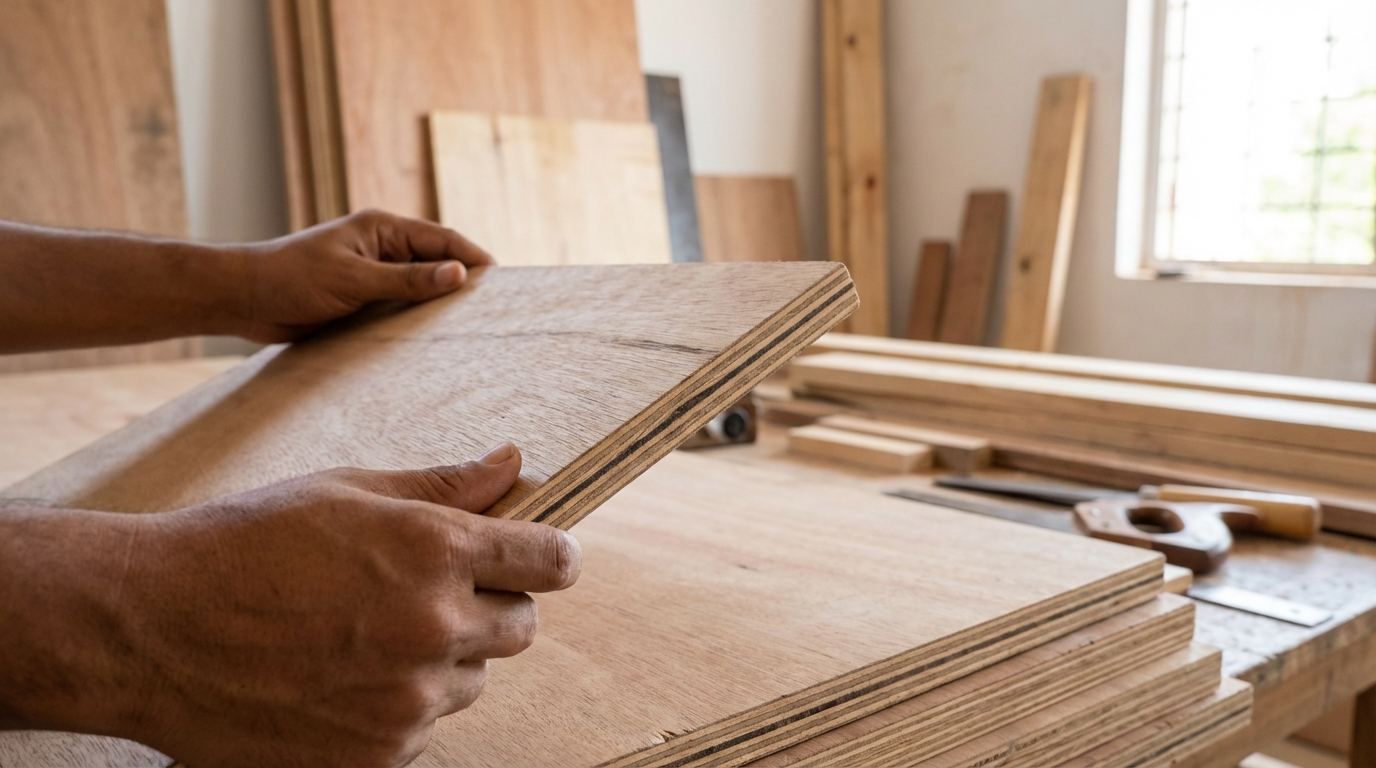
Plywood Price Guide 2026: City-wise Rates, Grade Comparison & Calculator
Latest plywood prices in India with city-wise rates. Compare MR, BWR, BWP & marine plywood costs per sq ft with our interactive price calculator.
Quick Buying Decision
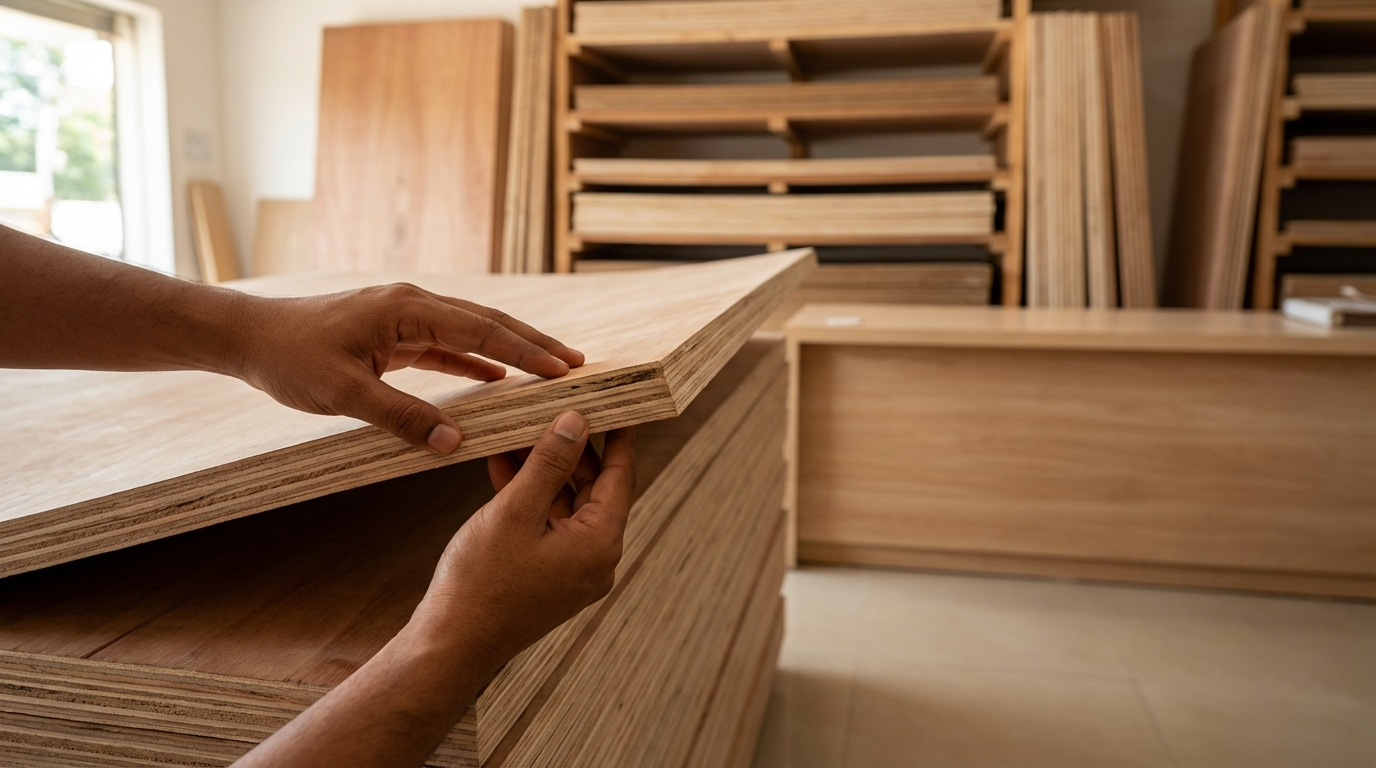
One-line recommendation: Plywood prices in India for 2026 range from ₹35–₹220 per square foot depending on grade, thickness, and city, with BWR grade at 18mm thickness (₹55–₹95 per sq ft) offering the best value for most residential furniture applications.
If you're in a hurry: For standard home furniture in 2026, budget ₹65–₹85 per sq ft for quality BWR plywood in metro cities. MR grade works for dry areas like bedrooms at ₹45–₹70 per sq ft, while BWP or marine grade is necessary only for wet zones and costs ₹90–₹180 per sq ft. Prices vary 15–25% between cities—Delhi NCR and Mumbai typically charge premiums, while Kolkata and Chennai offer better rates. Always verify ISI marking, request the boil test certificate, and negotiate for orders above 50 sheets. The total material cost for a 3BHK typically ranges ₹1.2–₹2.5 lakhs depending on grade selection.
- Best for kitchen cabinets: BWR grade 18mm at ₹60–₹95 per sq ft—handles humidity without marine-grade premium
- Best for wardrobes: MR grade 18mm at ₹45–₹75 per sq ft—sufficient for dry bedroom environments
- Best budget option: Commercial MR 12mm at ₹35–₹55 per sq ft—suitable for back panels and internal partitions
- Best premium option: Calibrated BWP 18mm at ₹110–₹160 per sq ft—ideal for modular kitchens with CNC routing
How to Choose Plywood Based on Price: Step-by-Step
Plywood pricing in India follows a logical hierarchy based on water resistance, core quality, and manufacturing precision. Understanding this hierarchy helps you avoid overspending on unnecessary grades while ensuring adequate performance for each application.
Step 1: Identify Your Application and Moisture Exposure
The single most important factor determining which plywood grade you need—and consequently which price range applies—is moisture exposure. Indian homes face unique challenges from monsoon humidity, cooking steam, and regional climate variations that directly impact material selection.
Dry areas (bedrooms, living rooms, studies): MR grade handles normal indoor humidity fluctuations. These spaces see minimal moisture except during extreme monsoon periods, making premium grades unnecessary.
Moderate moisture areas (kitchens, dining near kitchen): BWR grade withstands steam, occasional splashes, and elevated humidity from cooking. This represents approximately 60% of residential applications.
Wet areas (bathrooms, utility, balconies): BWP or marine grade becomes essential where direct water contact occurs regularly. However, only sink base units and areas directly exposed to water truly require this premium investment.
Step 2: Select the Right Grade Based on Price-Performance Ratio
Each grade represents a distinct price tier with specific performance characteristics. Duroboil.com's material analysis shows that grade selection accounts for 40–60% of price variation, making it the primary cost lever.
| Grade | Price Range (₹/sq ft) | Best Applications | Water Resistance | Value Assessment |
|---|---|---|---|---|
| Commercial MR | ₹35–₹55 | Back panels, internal shelves | Humidity only | Economy choice for hidden components |
| MR Grade (IS 303) | ₹45–₹75 | Wardrobes, beds, study tables | Indoor humidity | Best value for dry interiors |
| BWR Grade | ₹55–₹95 | Kitchen cabinets, TV units | Steam and splashes | Optimal for most residential work |
| BWP Grade | ₹85–₹140 | Bathroom vanities, utility areas | Prolonged moisture | Worth premium only for wet zones |
| Marine (IS 710) | ₹120–₹220 | Exterior, water tanks, coastal areas | Submersion capable | Essential only for extreme exposure |
| Calibrated BWR | ₹75–₹120 | Modular kitchens, CNC work | Steam and splashes | Premium for precision applications |
Step 3: Determine Correct Thickness and Its Price Impact
Thickness selection follows application requirements rather than preference. Using thinner plywood than required leads to sagging and premature failure, while excessive thickness wastes money without benefit. Thickness typically adds ₹8–₹15 per sq ft for each step up.
| Thickness | Price Addition vs 12mm | Required Applications | Not Suitable For |
|---|---|---|---|
| 4mm | Base (₹25–₹40) | Back panels only | Any structural use |
| 6mm | -₹10 to -₹15 | Drawer bottoms, light backing | Shelves, cabinet sides |
| 9mm | -₹5 to -₹10 | Internal partitions, light shelves | Load-bearing applications |
| 12mm | Baseline | Shelves, cabinet sides, partitions | Heavy countertops |
| 18mm/19mm | +₹15 to +₹25 | Cabinet carcass, wardrobe structure | Back panels (overkill) |
| 25mm | +₹35 to +₹50 | Table tops, heavy-duty shelves | Standard furniture construction |
Step 4: Verify Quality Indicators Before Finalizing Price
Price means nothing if quality doesn't match. Two sheets at identical prices can have vastly different lifespans. Before accepting any quoted price, verify these quality markers:
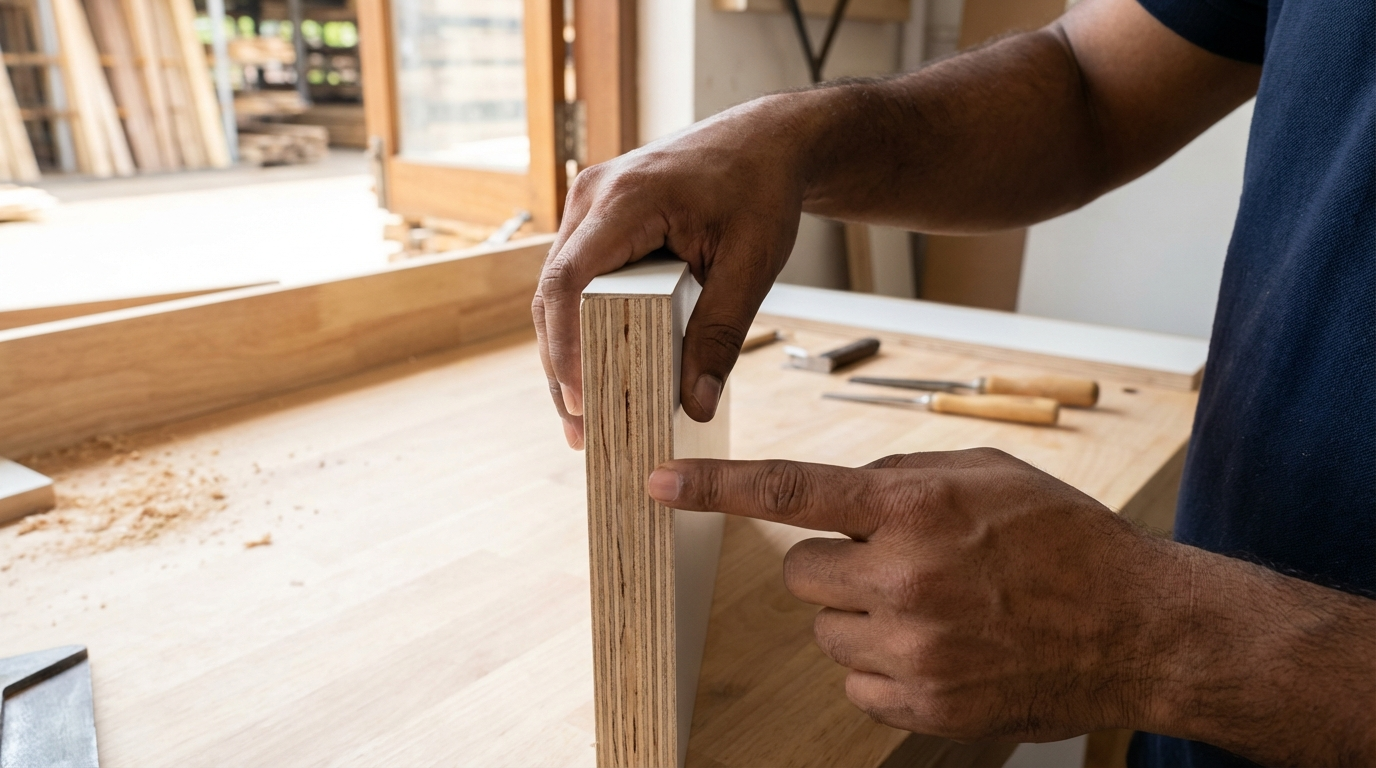
- ISI marking: Look for IS 303 (MR/BWR) or IS 710 (Marine) stamps—absence indicates non-certified product regardless of dealer claims
- Core inspection: Request a cut piece to examine veneer layers—gaps, overlaps, or uneven thickness indicate poor manufacturing
- Weight check: Quality 18mm BWR plywood weighs approximately 28–32 kg per 8x4 sheet—significantly lighter sheets suggest inferior core density
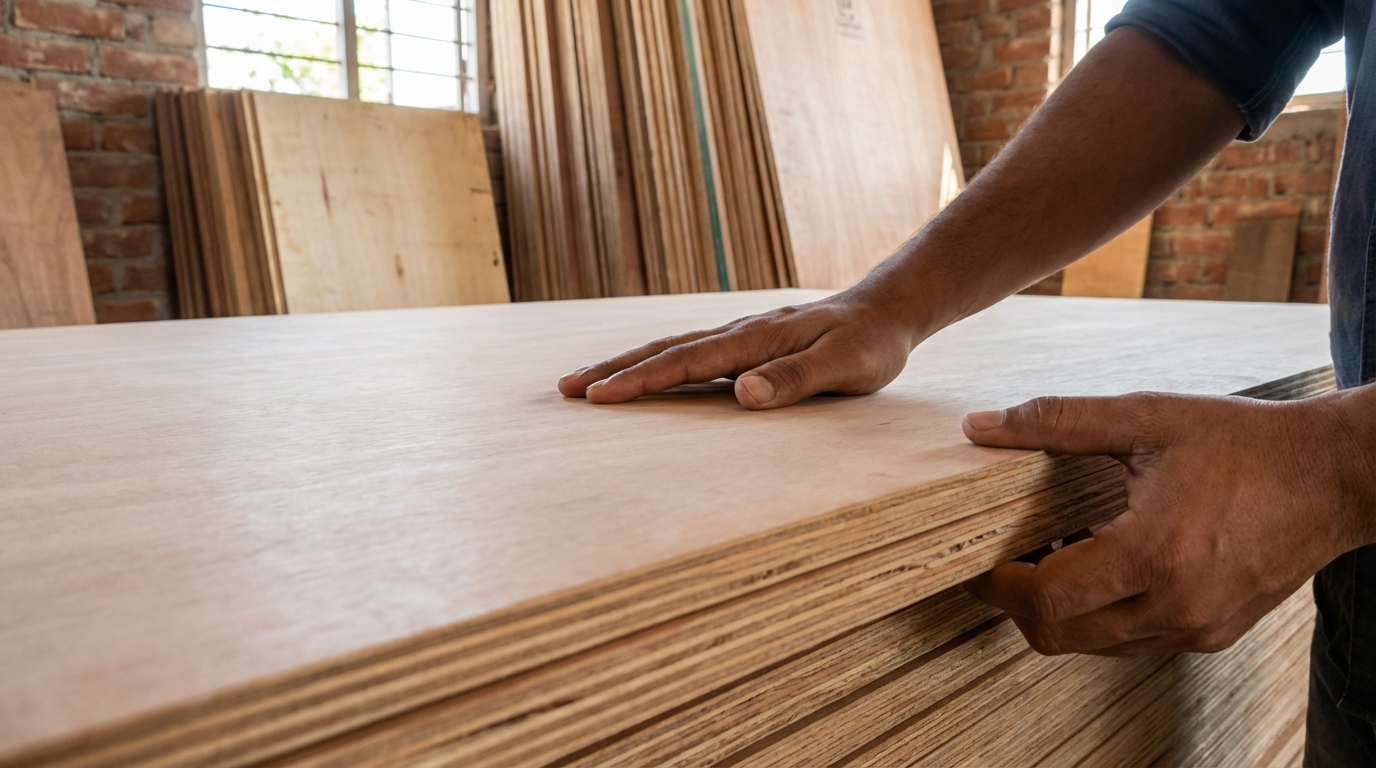
- Edge straightness: Warped or bowed sheets indicate improper storage or manufacturing defects—reject regardless of discount offered
- Surface finish: Face veneer should be smooth without patches, repairs, or excessive filler—these affect laminate adhesion
Step 5: Compare Prices and Negotiate Effectively
Plywood pricing has negotiation room of 8–15% in most markets. However, approaching negotiations requires preparation and reasonable expectations.
Get multiple quotes: Collect prices from at least 3–4 dealers for identical specifications. Ensure you're comparing same grade, thickness, and brand tier.
Quantity leverage: Orders above 50 sheets typically qualify for 5–10% discount. Full-home orders (100+ sheets) can command 12–15% reduction from list prices.
Timing advantage: Avoid peak construction season (October–March) when demand drives prices up. April–July typically offers better rates and dealer flexibility.
Brand flexibility: If specific brand isn't essential, ask dealers which comparable brand offers better current pricing—distributors often have promotional stock.
Decision Matrix: What to Buy for Each Situation
According to duroboil.com's analysis of residential furniture requirements, most homes can optimize costs by using different grades strategically rather than applying premium plywood uniformly. This matrix guides application-specific decisions.
| Situation | Recommended Grade | Thickness | Expected Price Range | Verify This |
|---|---|---|---|---|
| Master bedroom wardrobe | MR Grade | 18mm carcass, 12mm shelves | ₹50–₹75/sq ft | ISI 303 mark, no warping |
| Kitchen base cabinets | BWR Grade | 18mm throughout | ₹65–₹95/sq ft | Boil test certificate |
| Kitchen wall cabinets | BWR Grade | 12mm sides, 18mm frame | ₹60–₹85/sq ft | Phenolic resin confirmation |
| Sink base unit only | BWP/Marine | 18mm | ₹100–₹160/sq ft | IS 710 certification |
| Bathroom vanity | BWP Grade | 18mm | ₹90–₹140/sq ft | Phenolic bonding, dense core |
| TV unit in living room | MR or BWR | 18mm frame, 12mm back | ₹50–₹80/sq ft | Surface smoothness for laminate |
| Study table | MR Grade | 18mm top, 12mm structure | ₹45–₹70/sq ft | Calibration for flat surface |
| Modular kitchen (CNC) | Calibrated BWR | 18mm | ₹80–₹120/sq ft | Thickness tolerance ±0.3mm |
| Children's bedroom furniture | MR Grade | 18mm | ₹50–₹70/sq ft | E1 emission certification |
| Pooja room cabinet | MR Grade | 12mm | ₹40–₹60/sq ft | Good face veneer for polish |
| Balcony storage (covered) | BWP Grade | 18mm | ₹95–₹150/sq ft | Marine-grade if uncovered |
| False ceiling framing | Commercial MR | 6mm | ₹30–₹45/sq ft | Basic straightness check |
City-wise Plywood Price Guide 2026
Plywood prices vary significantly across Indian cities due to manufacturing proximity, transportation costs, local demand, and dealer competition. Metro cities typically pay 10–20% premium over tier-2 cities, while proximity to manufacturing hubs (Gujarat, Haryana, West Bengal) offers advantages.
Metro City Prices (January 2026 Estimates)
| City | MR 18mm (₹/sq ft) | BWR 18mm (₹/sq ft) | BWP 18mm (₹/sq ft) | Marine 18mm (₹/sq ft) | Price Trend |
|---|---|---|---|---|---|
| Delhi NCR | ₹55–₹80 | ₹70–₹100 | ₹105–₹155 | ₹145–₹200 | Stable to +5% |
| Mumbai | ₹60–₹85 | ₹75–₹105 | ₹110–₹160 | ₹150–₹210 | +8% YoY |
| Bangalore | ₹52–₹78 | ₹68–₹95 | ₹100–₹150 | ₹140–₹195 | +5% YoY |
| Chennai | ₹48–₹72 | ₹62–₹88 | ₹95–₹140 | ₹130–₹185 | Stable |
| Kolkata | ₹45–₹68 | ₹58–₹82 | ₹88–₹130 | ₹120–₹175 | -3% (local supply) |
| Hyderabad | ₹50–₹75 | ₹65–₹92 | ₹98–₹145 | ₹135–₹190 | +6% YoY |
| Pune | ₹55–₹78 | ₹70–₹98 | ₹102–₹152 | ₹142–₹198 | +5% YoY |
| Ahmedabad | ₹48–₹70 | ₹60–₹85 | ₹90–₹135 | ₹125–₹180 | Stable (mfg hub) |
Tier-2 City Prices (January 2026 Estimates)
| City | MR 18mm (₹/sq ft) | BWR 18mm (₹/sq ft) | BWP 18mm (₹/sq ft) | Availability Notes |
|---|---|---|---|---|
| Jaipur | ₹48–₹72 | ₹62–₹88 | ₹92–₹138 | Good variety, competitive pricing |
| Lucknow | ₹50–₹74 | ₹65–₹90 | ₹95–₹142 | Limited premium brands |
| Chandigarh | ₹52–₹76 | ₹68–₹95 | ₹100–₹148 | Good availability from Punjab mills |
| Kochi | ₹55–₹80 | ₹72–₹100 | ₹108–₹158 | Higher marine grade demand |
| Indore | ₹46–₹68 | ₹58–₹82 | ₹88–₹132 | Value pricing, limited calibrated stock |
| Coimbatore | ₹45–₹70 | ₹60–₹85 | ₹90–₹135 | Strong local manufacturing presence |
| Nagpur | ₹48–₹72 | ₹62–₹88 | ₹92–₹140 | Central location, moderate transport costs |
| Vadodara | ₹45–₹68 | ₹58–₹82 | ₹85–₹128 | Excellent rates near Gujarat mills |
Why Prices Vary Between Cities
Manufacturing proximity: Cities near plywood manufacturing clusters (Yamuna Nagar in Haryana, Gandhidham in Gujarat, Kolkata region in West Bengal) benefit from lower transportation costs, resulting in 10–15% savings.
Real estate costs: Higher commercial rents in Mumbai and Delhi NCR force dealers to maintain higher margins, inflating retail prices by 8–12% compared to smaller cities.
Competition density: Markets with numerous dealers (Kirti Nagar in Delhi, Hindmata in Mumbai) offer better negotiation scope than areas with limited options.
Regional demand patterns: Coastal cities show higher marine grade demand, while North Indian markets consume more BWR grade for kitchen applications.
Price Guide and Budget Planning
Effective budget planning requires understanding both material costs and realistic project estimation. The following calculations help you anticipate actual expenditure rather than face surprises during execution.
Cost Estimation by Room Type
| Room/Application | Typical Plywood Required | Recommended Grade Mix | Material Cost Range |
|---|---|---|---|
| Modular Kitchen (10x10 ft) | 25–35 sheets | 80% BWR, 20% BWP (sink area) | ₹45,000–₹75,000 |
| Master Wardrobe (8x8 ft) | 12–16 sheets | 100% MR Grade | ₹18,000–₹30,000 |
| TV Unit (8 ft wide) | 4–6 sheets | 100% MR or BWR | ₹6,000–₹12,000 |
| Study Table with Storage | 3–4 sheets | 100% MR Grade | ₹4,500–₹8,000 |
| Bathroom Vanity | 2–3 sheets | 100% BWP Grade | ₹6,000–₹12,000 |
| Full 2BHK Furniture | 60–80 sheets | 60% MR, 35% BWR, 5% BWP | ₹90,000–₹1,60,000 |
| Full 3BHK Furniture | 90–120 sheets | 55% MR, 40% BWR, 5% BWP | ₹1,35,000–₹2,40,000 |
Hidden Costs to Factor In
Raw plywood cost represents only 50–60% of total furniture expenditure. Budget for these additional expenses:
- Laminates: Add ₹25–₹80 per sq ft depending on quality (economy sunmica to premium Merino/Greenlam)
- Hardware: Hinges, channels, handles add ₹8,000–₹25,000 per kitchen
- Edge banding: PVC edge banding adds ₹3–₹8 per running foot
- Labour: Carpenter charges range ₹350–₹600 per sq ft for complete work
- Transportation: Delivery charges of ₹500–₹2,000 depending on distance and quantity
- Wastage allowance: Add 8–12% to material estimate for cutting waste
Price Calculation Formula
For quick estimation, use this formula:
Total Plywood Cost = (Area in sq ft × Price per sq ft × 1.10 wastage factor)
For a kitchen cabinet: Front face area + side panels + shelves + back panel = total sq ft needed. Multiply by grade-appropriate price and add 10% wastage buffer.
Getting Accurate Quotes
When requesting dealer quotes, provide these specifications for accurate pricing:
- Exact grade required (not just "waterproof"—specify BWR or BWP)
- Thickness for each application
- Quantity in number of 8x4 sheets or total sq ft
- Brand preference or acceptable alternatives
- Delivery location and timeline
- Whether you need ISI-certified material specifically
Why Prices Vary Between Dealers
Identical plywood can show 15–25% price variation between dealers due to:
- Direct vs distributor sourcing: Authorized brand dealers may have fixed pricing, while multi-brand dealers negotiate better from manufacturers
- Inventory age: Older stock may be discounted; very old stock may have quality degradation
- Location overhead: Prime market locations charge premium; slightly interior shops offer better rates
- Volume focus: Contractor-focused dealers price lower expecting large orders; retail-focused dealers maintain higher margins
- Brand authorization: Exclusive brand showrooms often price higher than multi-brand dealers carrying same products
Red Flags: When to Walk Away from a Deal
Low prices often signal compromised quality. Recognizing warning signs prevents costly mistakes that manifest months after installation when warranty claims become difficult.
Pricing Red Flags
- 30%+ below market rate: Legitimate dealers cannot profitably sell quality plywood at massive discounts—this indicates B-grade, rejected, or mislabeled material
- No price variation by grade: If MR and BWR are priced similarly, the BWR is likely relabeled MR
- Reluctance to provide written quotation: Verbal-only pricing allows later price changes and indicates informal operation
- Cash-only transactions with no receipt: Prevents warranty claims and indicates possible tax evasion with questionable sourcing
Quality Red Flags
- Missing or illegible ISI marking: Genuine certified plywood has clear, permanent ISI stamps—stickers or faded marks suggest counterfeit
- Unwillingness to show cut piece: Legitimate dealers allow core inspection; refusal indicates something to hide
- Inconsistent thickness across sheet: Press calibration issues cause this—affects furniture alignment and laminate adhesion
- Strong chemical odor: Excessive formaldehyde smell indicates poor-quality adhesive and potential health hazard
- Visible gaps in core layers: Air pockets reduce strength dramatically and indicate manufacturing defects
- Bowed or twisted sheets: Warping indicates improper seasoning or storage—will cause furniture alignment problems
Dealer Red Flags
- Pressure to buy immediately: "Price valid today only" tactics indicate desperation rather than genuine offers
- Brand switching suggestions: If asked for Brand A and dealer pushes unknown Brand B aggressively, question motivations
- No physical stock shown: Dealers claiming to "arrange" material may be middlemen adding unnecessary cost
- Avoiding direct answers: Vague responses about certification, warranty, or specifications indicate knowledge gaps or intentional deception
Common Buying Mistakes and How to Avoid Them
Mistake 1: Choosing Entirely by Price
Why it happens: Budget constraints and unfamiliarity with quality indicators make lowest price appear attractive.
What goes wrong: Cheap plywood delaminates within 2–3 years, especially in humid kitchens. Replacement cost exceeds initial savings by 3–4x when including labor.
What to do instead: Compare prices within same grade and certification level. A ₹15/sq ft premium for quality BWR over economy MR provides 10+ years additional service life.
Mistake 2: Using MR Grade in Kitchens
Why it happens: Dealers sometimes label MR as "moisture-proof" and buyers don't understand grade implications. MR costs 20–30% less, making it tempting.
What goes wrong: MR grade swells and delaminates with regular cooking steam exposure within 18–24 months. Kitchen cabinets near sink and stove fail first.
What to do instead: Insist on BWR minimum for all kitchen applications. For sink base, upgrade to BWP. This targeted approach costs only 15–20% more than all-MR but prevents failures.
Mistake 3: Ignoring Thickness Requirements
Why it happens: Thinner plywood costs less, and visual difference between 12mm and 18mm seems minimal. Some carpenters prefer thinner material for easier cutting.
What goes wrong: Undersized shelves sag within months. Wardrobe sides bow under weight. Kitchen cabinets with 12mm carcass cannot support heavy vessels without visible flexing.
What to do instead: Follow application-based thickness guidelines strictly. Save money on grade selection for hidden components rather than compromising structural thickness.
Mistake 4: Not Verifying ISI Certification
Why it happens: ISI marking looks similar across genuine and fake products. Verification requires attention most buyers don't invest.
What goes wrong: Non-certified plywood lacks guaranteed specifications. Moisture resistance claims are unverified, leading to premature failure.
What to do instead: Check ISI license number format, verify stamping is permanent (not sticker), and request test certificates from manufacturer for large orders.
Mistake 5: Buying Based on Brand Alone
Why it happens: Premium brands provide quality assurance, and buyers assume all products from known brands are equally good.
What goes wrong: Even premium brands have economy lines with lower specifications. Buying "Brand X" without specifying grade can result in commercial-grade material at premium-brand prices.
What to do instead: Specify both brand AND grade/product line. "CenturyPly BWR 710" is clearer than just "CenturyPly plywood."
Mistake 6: Skipping Multiple Quotes
Why it happens: Visiting multiple dealers takes time. First dealer's price seems reasonable without comparison context.
What goes wrong: Overpaying by 15–25% is common when buying from single source. Miss volume discounts and promotional offers available elsewhere.
What to do instead: Get minimum 3 quotes for identical specifications. Phone/WhatsApp quotes work for comparison; visit shortlisted dealers for quality inspection.
Mistake 7: Not Accounting for Wastage
Why it happens: Buyers calculate exact square footage needed without considering cutting patterns and unusable pieces.
What goes wrong: Running short mid-project requires emergency purchases at higher prices. Different batches may have slight color variations.
What to do instead: Add 10–12% wastage allowance to calculated requirements. For complex designs with many small pieces, increase to 15%.
Mistake 8: Ignoring Storage Conditions
Why it happens: Plywood appears durable and solid. Buyers assume any covered space is adequate storage.
What goes wrong: Moisture absorption causes warping before installation. Sheets stored flat without support develop permanent bends. Direct sunlight causes surface checking.
What to do instead: Store vertically with support, in dry covered area, away from ground moisture. Allow 48–72 hours acclimatization at installation site before cutting.
Questions to Ask Your Dealer
These specific questions help evaluate dealer reliability and product quality. Note the responses—hesitation or vagueness indicates potential issues.
| Question | Good Answer | Concerning Answer |
|---|---|---|
| What grade is this plywood—MR, BWR, or BWP? | Specific grade with IS standard reference | "It's waterproof" without specifying grade |
| Can you show me the ISI marking on the sheet? | Immediately shows permanent marking | Points to sticker or says "marking is inside" |
| What is the manufacturer and product line name? | Specific brand and series (e.g., "Greenply Green Club BWR") | "It's imported" or just brand name without series |
| Can I see a cut piece to inspect the core? | Shows cross-section willingly | Refuses or offers only finished samples |
| What warranty applies and how do I claim it? | Specific years, written documentation process | "Full warranty" without details or paperwork |
| What is the exact thickness of this sheet? | Precise measurement, offers to verify | Approximate answer, discourages measurement |
| Is this calibrated or non-calibrated? | Clear answer with thickness tolerance specified | Doesn't understand question or claims all plywood is same |
| What core wood species is used? | Specific answer (poplar, eucalyptus, gurjan) | "Mixed" or "imported timber" vagueness |
| Do you provide GST invoice? | Yes, standard practice | Offers lower price without invoice |
| What is your return policy for defective sheets? | Clear replacement timeline and process | "We don't take returns" or hesitation |
After Purchase: Transport and Storage Guidelines
Plywood quality can degrade between purchase and installation if handling is improper. Following transport and storage protocols protects your investment.
Transportation Tips
- Vehicle selection: Use vehicles with flat beds long enough to support full sheets without overhang bending
- Stacking: Stack sheets flat, face-to-face and back-to-back to protect surfaces
- Weather protection: Cover loads with tarpaulin even in dry weather to prevent dust and moisture
- Securing: Tie down firmly without over-tightening straps that can indent edges
- Handling: Carry sheets on edge with two people, never drag across surfaces
Storage Requirements
- Location: Indoor, dry, covered area with good ventilation—never outdoors or in damp basements
- Position: Store flat on minimum 3 cross-supports or vertically in racks with even support
- Ground clearance: Minimum 4 inches from floor using wooden battens to prevent moisture wicking
- Spacing: Allow air circulation between stacks; avoid tight wrapping
- Duration: Use within 2–3 months of purchase; extended storage risks moisture absorption
Acclimatization Period
Before cutting and installation, allow plywood to adjust to site conditions:
- Minimum period: 48–72 hours at installation location
- Condition: Remove protective wrapping, maintain spacing for airflow
- Why it matters: Prevents post-installation warping as material equilibrates with ambient humidity
- Monsoon consideration: Extend acclimatization to 5–7 days during humid monsoon periods
Frequently Asked Questions
What is the current price of plywood per square foot in India?
Plywood prices in India range from ₹35 to ₹220 per square foot depending on grade and thickness. MR grade 18mm costs ₹45–₹75 per sq ft, BWR grade 18mm costs ₹55–₹95 per sq ft, and BWP/Marine grade 18mm costs ₹85–₹180 per sq ft. These prices vary by city, with metros like Mumbai and Delhi typically 10–20% higher than tier-2 cities. According to duroboil.com's market tracking, prices have increased 5–8% annually over the past three years due to raw material and logistics cost escalation.
How much does an 8x4 plywood sheet cost?
An 8x4 feet plywood sheet (32 square feet) costs between ₹1,400 and ₹6,500 depending on grade and thickness. MR grade 18mm sheets typically cost ₹1,600–₹2,400, BWR grade 18mm costs ₹2,000–₹3,200, and BWP/Marine 18mm costs ₹3,000–₹5,500. Premium brands command 15–25% higher prices, while lesser-known local brands may be 20–30% cheaper but with quality trade-offs. Always calculate per-square-foot price for accurate comparison since sheet sizes vary slightly between manufacturers.
Which plywood grade offers best value for money?
BWR grade plywood offers the best value for most Indian homes, balancing moisture resistance with reasonable pricing. At ₹55–₹95 per sq ft for 18mm, BWR handles kitchen humidity, cooking steam, and bathroom-adjacent installations without the 40–60% premium of BWP or marine grade. For dry areas like bedrooms, MR grade provides adequate performance at lower cost. The strategic approach is using BWR for approximately 60% of furniture (kitchens, humid areas), MR for 35% (dry rooms), and BWP only for 5% (direct water contact zones like sink bases).
Why is plywood cheaper in some cities than others?
Plywood prices vary 15–25% between Indian cities due to manufacturing proximity, transportation costs, and local market competition. Cities near manufacturing hubs—Kolkata (West Bengal mills), Ahmedabad (Gujarat mills), and Chandigarh (Haryana mills)—enjoy lower prices due to reduced logistics expenses. Metro cities like Mumbai and Delhi have higher prices due to real estate costs forcing dealer margins upward, plus higher demand allowing premium pricing. Additionally, cities with concentrated plywood markets (Kirti Nagar in Delhi, Hindmata in Mumbai) offer better rates due to dealer competition.
How do I calculate plywood quantity needed for my home?
Calculate plywood quantity by measuring all furniture surfaces (front faces, sides, shelves, backs) in square feet, then add 10–12% wastage allowance. For a typical kitchen cabinet, measure external dimensions and multiply height × width for front and back panels, add side areas, and include all shelf areas. Divide total by 32 (sq ft per 8x4 sheet) to get sheet count. For a 3BHK with complete furniture, expect 90–120 sheets. Use thicker 18mm for structural components and 12mm for shelves; 4-6mm suffices for back panels, reducing overall cost.
Is calibrated plywood worth the extra cost?
Calibrated plywood costs 15–25% more but is worth the premium for modular furniture, CNC machining, and any application requiring precise dimensions. Standard plywood has thickness variation of ±1–1.5mm across a sheet, causing uneven laminate adhesion and alignment issues. Calibrated plywood maintains ±0.3mm tolerance, enabling factory-style modular construction with consistent results. For traditional carpenter-made furniture, standard plywood suffices as manual techniques accommodate variation. For modular kitchens with soft-close mechanisms and machine-cut components, calibrated BWR is the recommended choice.
How can I identify genuine ISI-certified plywood?
Genuine ISI-certified plywood has permanent marking stamped or branded directly onto the sheet surface—not adhesive stickers that can be transferred from one sheet to another. Look for IS 303 (for MR/BWR grades) or IS 710 (for marine grade), the manufacturer's license number, and the ISI logo. The marking should be legible and consistent across multiple sheets from the same batch. For high-value purchases, request the manufacturer's test certificate and verify the license number on BIS (Bureau of Indian Standards) website. Dealers selling certified plywood should readily provide this documentation.
What causes plywood price fluctuations throughout the year?
Plywood prices fluctuate 8–15% seasonally based on construction demand, raw material costs, and monsoon impact. Prices peak during October–March wedding and construction season when demand surges. Monsoon months (June–September) see reduced harvesting and transportation challenges, sometimes causing supply-driven price increases. Timber costs, which constitute 50–60% of plywood manufacturing expense, vary with forest department auctions and import regulations. Fuel price changes affect transportation costs, particularly for buyers in locations distant from manufacturing hubs. Long-term trends show 5–8% annual increase due to inflation and environmental compliance costs.
Should I buy plywood online or from local dealers?
Local dealers are generally preferable for plywood purchases due to the ability to physically inspect material before buying. Quality variations exist even within same grade and brand, making visual and tactile inspection valuable. Local purchase also simplifies returns for defective sheets and provides immediate availability. Online platforms work for standardized products like pre-cut panels or when specific brands aren't locally available. If buying online, choose sellers with clear return policies, verified ISI certification claims, and customer reviews specifically mentioning product quality upon receipt. Transportation damage risk is higher with online purchases.
How much can I negotiate on plywood prices?
Plywood prices typically have 8–15% negotiation room depending on quantity, dealer type, and season. Bulk orders (50+ sheets) command 5–10% discounts; full-home orders (100+ sheets) can negotiate 12–15% off list prices. Authorized brand dealers have less flexibility (5–8%) compared to multi-brand distributors (10–15%). Off-season purchases (April–July) offer better negotiation scope as dealers push inventory. Cash payments may unlock additional 2–3% discount but sacrifice warranty documentation benefits. Always get written quotes and compare across multiple dealers before negotiating—knowledge of market rates strengthens your position significantly.
Final Considerations for 2026 Purchases
The Indian plywood market continues evolving with increasing emphasis on certification, sustainability, and precision manufacturing. While prices have risen steadily, quality improvements and longer service life offer better overall value for informed buyers.
Key strategies for 2026 purchases include specifying grades precisely rather than accepting vague "waterproof" claims, verifying ISI certification independently, using grade-mixing strategically to optimize budgets without compromising performance, and building relationships with reliable dealers who prioritize documentation and accountability.
For the most current prices and availability in your specific location, visit local authorized dealers with the specifications outlined in this guide. The investment in proper plywood selection—choosing right grade for each application, verifying quality before purchase, and following installation best practices—determines whether your furniture provides 5 years or 25 years of service.
Disclaimer: This content is provided for general informational purposes based on industry practices and publicly available information. Product specifications, standards, prices, and availability may vary by manufacturer, region, and time. Readers should independently verify details with manufacturers, dealers, or qualified professionals before making purchase or construction decisions.Want Plywood Suggestions?
Share a few details and a Duro BOIL specialist will suggest suitable brands and connect you to responsive dealers.