40 Veneer Design Ideas: Wood Patterns, Finishes & Applications (2026)
Discover 40 stunning veneer design ideas for interiors. Natural wood patterns, matte vs glossy finishes & wall panelling applications with price guide.
Quick Overview: Veneer Design Ideas for 2026
Wood veneer is a thin slice of real wood (typically 0.5mm to 4mm thick) bonded to substrates like plywood, MDF, or blockboard to achieve the authentic beauty of solid wood at a fraction of the cost. Veneer sheets are thin slices of real wood, peeled or sliced from logs and then glued to solid wood material to make decorative surfaces for furniture, cabinets, shelves, and walls.
In 2026, veneer designs are moving towards natural textures, earthy tones, and sustainable sourcing. Light oak and ash tones for bright, airy interiors, rich walnut and teak finishes for a warm, premium feel, and matte and open-grain textures are trending this year.
Whether you're designing a luxurious living room, upgrading your modular kitchen, or creating a statement wall in your bedroom, this duroboil.com guide covers 40 veneer design ideas with practical applications, finish recommendations, and India-specific price guidance.
What this guide covers:
- 40 veneer design ideas organized by wood type, pattern, and application
- Complete breakdown of matte, glossy, and textured finishes
- Wall panelling applications with room-wise recommendations
- Price ranges for Indian markets (₹50-300+ per sq ft)
- Installation and maintenance guidelines for Indian climate
- Expert tips from duroboil.com's material specialists
Material Requirements: What Makes Quality Veneer?
A wood veneer is like the stylish cover page of a book but for furniture and surfaces. It's a thin slice carefully layered onto furniture surfaces, floors, and walls. This gives your home all the cozy and warm vibes of wooden tones without using a chunk of solid wood. Think of it as the budget-friendly, more eco-friendly and versatile option of wood that comes in multiple patterns and styles.
Key specifications for quality veneer:
| Parameter | Standard Range | Premium Range | Why It Matters |
|---|---|---|---|
| Thickness | 0.5mm - 1mm | 2mm - 4mm | Thicker veneers allow re-sanding and last longer |
| Sheet Size | 8 x 4 feet | 10 x 4 feet | Larger sheets reduce joints in applications |
| Backing Type | Paper-backed | Fleece/Wood-backed | Better backing improves flexibility and adhesion |
| Grain Consistency | Random match | Book-matched | Premium matching creates symmetrical patterns |
| Moisture Resistance | Standard (MR) | BWR Grade | Critical for Indian humidity and monsoon conditions |
Performance requirements by application:
For wet areas like kitchens and bathrooms, always specify BWR (Boiling Water Resistant) grade veneer-faced panels. Bonded to solid supports, wood veneer sheets create a durable, long-lasting finish, resistant to warping and cracking. In humid coastal cities like Mumbai, Chennai, or Kochi, this becomes even more critical.
For dry areas like bedrooms, living rooms, and study areas, standard MR grade veneer works well and offers cost savings of 15-25% compared to BWR variants.
Best Veneer Materials for Interior Applications
Natural veneers are produced from logs that retain wooden grains, textures, and colours. The most popular options include oak, walnut, maple, teak, mahogany, and cherry.
Top 10 veneer wood species for Indian interiors:
| Wood Species | Colour Profile | Grain Pattern | Best For | Price Range (₹/sq ft) |
|---|---|---|---|---|
| Teak | Golden-brown | Straight to wavy | Premium furniture, main doors | ₹150-350 |
| Walnut | Chocolate-brown | Bold, dramatic | Luxury wardrobes, TV units | ₹180-400 |
| Oak | Light to medium brown | Strong cathedral | Contemporary kitchens, offices | ₹120-280 |
| Ash | Creamy white to light tan | Clean, straight | Scandinavian/Japandi interiors | ₹100-220 |
| Mahogany | Reddish-brown | Interlocked, ribbon | Classic furniture, panelling | ₹140-300 |
| Rosewood | Deep reddish-brown | Dramatic striations | Statement pieces, accent walls | ₹200-450 |
| Cherry | Warm pinkish-brown | Fine, uniform | Bedrooms, dining areas | ₹130-260 |
| Maple | Pale cream to light reddish | Fine, subtle | Modern minimalist spaces | ₹110-240 |
| Ebony | Deep black to dark brown | Fine, tight | Luxury accents, contrast elements | ₹300-600 |
| Engineered/Recon | Various (customized) | Uniform, consistent | Large-scale projects | ₹70-150 |
Natural vs Engineered Veneer: Which to choose?
Reconstituted veneers, aka engineered veneers, are created by cutting and dyeing rapidly growing wood species like Poplar and Obeche, which are glued together to imitate more expensive or rare woods. They are cost-effective and great for the environment.
Choose natural veneer when:
- You want unique, one-of-a-kind grain patterns
- The application is high-visibility (living room feature wall, main door)
- Budget allows for premium materials
- Authenticity matters more than uniformity
Choose engineered veneer when:
- Consistent colour and pattern across large areas is required
- Budget is constrained but wood look is essential
- Sustainability is a priority (uses fast-growing species)
- Exotic wood species are desired but natural versions are restricted
40 Veneer Design Ideas by Category
Natural Wood Grain Patterns (Ideas 1-10)
Walnut veneer offers rich, chocolate-brown tones with bold grain patterns — perfect for warm, sophisticated interiors. Oak veneer is light and versatile, bringing timeless charm and works beautifully with both minimalist and rustic styles.
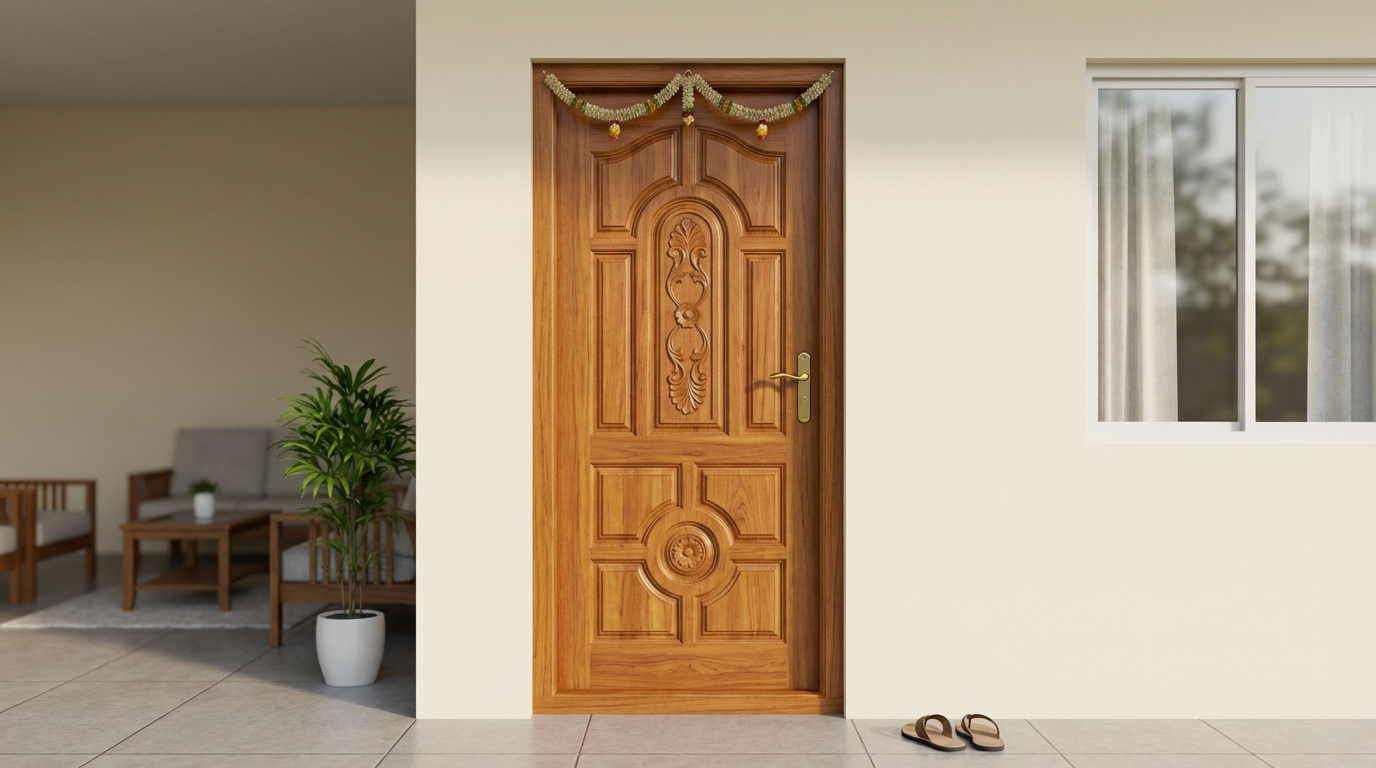
1. Classic Teak Cathedral: The quintessential Indian favourite. Features prominent V-shaped grain patterns ideal for traditional and transitional interiors. Best for: wardrobes, main doors, TV units.
2. Walnut Book-Match: Symmetrical grain patterns created by opening consecutive veneer sheets like a book. Creates dramatic focal points. Best for: headboard walls, statement furniture.
3. European Oak Quarter-Cut: Ash veneer features clean, straight grains and light coloring ideal for Scandinavian or Japandi themes. Oak offers similar benefits with more pronounced flake figure. Best for: modern kitchens, office furniture.
4. Ash Straight Grain: Light, airy appearance with minimal grain variation. Perfect for spaces requiring visual expansion. Best for: compact apartments, minimalist bedrooms.
5. Rosewood Ribbon Stripe: Rosewood is known for its luxurious appeal and unique reddish-brown striations, adding drama and depth to any space. Best for: luxury living rooms, premium office cabins.
6. Cherry Heartwood: Warm pinkish tones that deepen with age and light exposure. Adds warmth without overwhelming. Best for: dining rooms, master bedrooms.
7. Maple Bird's Eye: Rare pattern featuring distinctive swirling "eyes" throughout the grain. Highly prized for premium applications. Best for: specialty furniture, accent panels.
8. Mahogany Interlocked Grain: Ribbon-like patterns that catch light differently from various angles. Classic elegance. Best for: study rooms, classic furniture restoration.
9. Olive Ash Crown Cut: Combines the lightness of ash with dramatic figuring. European origin, increasingly popular in India. Best for: contemporary wall panels, designer furniture.
10. White Oak Rift Cut: For a modern and contemporary space, rift-cut veneers are an ideal choice. They have a much cleaner and underemphasized grain pattern. Best for: modular kitchens, office workstations.
Exotic and Statement Patterns (Ideas 11-20)
Burls are abnormal or deformed growths on a tree caused by some type of environmental stress. Burls produce swirling grain patterns around clusters of eyes or elliptical forms and are highly sought after for their beauty and unique character.
11. Walnut Burl: Swirling, chaotic patterns that create instant visual drama. Each piece is unique. Best for: luxury console tables, bar counters, accent panels.
12. Elm Burl: Similar to walnut burl but with warmer, lighter tones. Organic and artistic appearance. Best for: bedroom accent walls, designer furniture pieces.
13. Madrone Burl: Reddish-brown with distinctive clustering patterns. Rare and premium. Best for: high-end residential projects, specialty installations.
14. Camphor Burl: Light-coloured with aromatic properties. Unique combination of aesthetics and natural fragrance. Best for: wardrobes (adds natural moth repellent properties).
15. Eucalyptus Pommele: Quilted, bubble-like appearance creating three-dimensional visual effects. Best for: feature panels, designer ceiling applications.
16. Sapele Pommele: Deep reddish-brown with pronounced quilted figure. African origin, luxurious appearance. Best for: premium office interiors, hotel lobbies.
17. Lacewood (Silky Oak): Flake figure is predominantly noticed in species which have heavy medullary ray growth such as Oak, Lacewood or American Sycamore. The knife cut produces this "flakey" appearance in the grain. Best for: contemporary feature walls, designer furniture.
18. Zebrawood: Dramatic black and tan stripes creating bold, contemporary patterns. Best for: accent panels, statement furniture, modern spaces.
19. Bocote: Complex patterns with dark veining on golden-brown background. Mexican origin, increasingly available in India. Best for: luxury interiors, specialty applications.
20. Figured Anigre: Block mottle is an irregular variegation in the cellular structure of the wood which appears as blotchy patches across the grain. This type of anomaly is commonly found in Makore and Anigre and is highly desirable. Best for: large wall installations, commercial lobbies.
Dyed and Coloured Veneers (Ideas 21-26)
Natural wood veneers can be dyed with colours like grey, blue, black, white and yellow to produce a uniform colour consistency. The process is carried out by first bleaching the wood to lose its natural colour and then applying dyes under high temperature and/or pressure.
21. Grey-Washed Oak: Natural oak bleached and stained to achieve sophisticated grey tones. Brown has become important, "almost becoming a nice substitute to using black, or using charcoal, because it has a little bit of a softer warmth to it." Grey offers similar versatility. Best for: modern Scandinavian interiors, urban apartments.
22. Charcoal Black Ash: Deep black finish on ash veneer retaining visible grain texture. Dramatic and contemporary. Best for: accent walls, luxury wardrobes, designer kitchens.
23. White-Washed Maple: Bleached and whitened to create airy, light appearance. Expands visual space. Best for: compact apartments, beach-themed interiors, minimalist spaces.
24. Smoked Oak: Smoked veneer, also called fumed veneers, are treated with ammonia vapours to obtain a smoky effect. This process is typically done on oak and maple wood varieties. Best for: contemporary living rooms, premium office interiors.
25. Blue-Dyed Tulipwood: Fashion-forward choice for bold, contemporary spaces. Indian designers increasingly using coloured veneers for accent applications. Best for: children's rooms, creative offices, accent panels.
26. Green-Dyed Sycamore: Natural, biophilic feel with coloured enhancement. Perfect for bringing outdoor vibes indoors. Best for: wellness spaces, nature-inspired interiors.
Textured and 3D Patterns (Ideas 27-32)
Textured veneer is your best bet if you want a tactile and visual experience because it is designed to mimic natural or artificial patterns. The finishes bring depth and character to your interior spaces.
27. Wire-Brushed Oak: For an exotic and luxury look with a touch of drama and pop of color, burl veneers or veneers with a wire brushed texture is the perfect choice. They can add unique visual interest and give a magnifying look. Best for: rustic-modern interiors, farmhouse kitchens.
28. Sandblasted Teak: Raised grain texture created by removing softer wood fibres. Adds tactile dimension. Best for: wall panels, TV unit backing, headboard walls.
29. Saw-Cut Veneer: Unlike other types of veneers (which have a smooth finish), saw-cut has rough-cut edges formed by running a blade roughly over its surface. Such veneer sheets are generally more expensive. Best for: premium rustic applications, statement pieces.
30. Embossed 3D Patterns: Mechanically created three-dimensional patterns on veneer surface. Geometric or organic designs available. Best for: feature walls, contemporary installations.
31. Crocodile Texture: For a more casual and organic feel, you can experiment with crocodile veneers or flat-cut veneers in lighter warm wood tones. Best for: luxury furniture details, accent panels.
32. Open-Grain Textured: Open-grain texture emphasizes raw, tactile finishes; this trend celebrates imperfection and nature's detail. Best for: contemporary organic interiors, biophilic design applications.
Geometric and Pattern Veneers (Ideas 33-40)
Geometric patterns create a unique and contemporary look. These designs require skilled craftsmanship and are typically premium-priced but create stunning visual impact.
33. Herringbone Pattern: Herringbone, chevron, and Versailles patterns are showing up more often, especially in renovations where we can draw from classic architectural language. Best for: flooring transitions, feature walls, cabinet doors.
34. Chevron Pattern: Similar to herringbone but with continuous V-shapes. More dynamic and modern appearance. Best for: accent walls, contemporary wardrobes.
35. Diamond Inlay: Contrasting veneer species arranged in diamond formations. Requires precise joinery. Best for: luxury furniture, premium wall panels.
36. Sunburst Pattern: Radial arrangement creating dramatic centrepiece effect. Complex but visually stunning. Best for: ceiling medallions, circular furniture tops, statement walls.
37. Parquetry Squares: Traditional pattern using alternating grain directions in square formations. Classic elegance. Best for: flooring, table tops, cabinet panels.
38. Basket Weave: Interlocking rectangular patterns mimicking woven texture. Subtle yet distinctive. Best for: classic interiors, study room panelling.
39. Marquetry Art: Intricate pictorial designs created using multiple veneer species. Highest craftsmanship level. Best for: luxury furniture pieces, art installations, heritage restorations.
40. Mixed Species Stripes: Alternating strips of contrasting veneer species creating bold linear patterns. Best for: contemporary feature walls, modern furniture.
Design Considerations for Indian Homes
The natural grain patterns, warm tones, and subtle textures of real wood help create spaces that feel calm, balanced, and close to nature—something modern homes are increasingly leaning towards in 2026.
Functional requirements by room:
| Room/Application | Recommended Veneer Type | Finish Preference | Key Considerations |
|---|---|---|---|
| Modular Kitchen | Oak, Ash, Engineered | Matte/Textured | BWR grade substrate, moisture resistance |
| Master Bedroom | Walnut, Cherry, Teak | Matte/Satin | Warm tones, subtle patterns |
| Living Room | Rosewood, Walnut, Burl | Any | Statement-worthy, book-matched panels |
| Children's Room | Maple, Ash, Dyed veneers | Matte | Light colours, durable finish |
| Study/Office | Oak, Mahogany, Teak | Matte/Satin | Professional appearance, low glare |
| Pooja Room | Teak, Rosewood | Matte | Traditional wood species, natural finish |
| Bathroom (dry areas) | Engineered with BWR backing | Matte | Strict moisture protection required |
Climate considerations across India:
Coastal and humid regions (Mumbai, Chennai, Kochi, Kolkata): Always use BWR grade substrate with moisture-resistant finish. Avoid open-grain textures that trap humidity. Seal all edges. Consider engineered veneers for better stability.
Dry northern regions (Delhi, Jaipur, Ahmedabad): Humidity fluctuations can cause veneer movement. Ensure proper acclimatization before installation (minimum 48-72 hours). Use flexible backings for large panels.
Hill stations and cold regions (Shimla, Manali, Darjeeling): Temperature variations require veneer with good dimensional stability. Quarter-cut and rift-cut options perform better than flat-cut.
Matte vs Glossy vs Textured Finishes: Complete Guide
Veneer finish refers to the final treatment applied to the veneer surface to achieve a specific look and feel. The finish can improve the natural beauty of veneer, protecting it from wear and tear and aligning it with contemporary design trends.
Matte Finish Veneers
Matt is generally subtle and understated offering a smooth non-reflective surface. Matte finishes are known for their soft muted appearance. You can choose matte finish if you want modern yet understated elegance. The best part is that it helps hide fingerprints, smudges and dust better compared to glossy surfaces.
Advantages of matte finish:
- Hides fingerprints, smudges, and minor scratches
- Reduces glare in well-lit spaces
- Showcases natural wood grain authentically
- Lower maintenance than glossy finishes
- Works with both traditional and contemporary interiors
Best applications: Matte veneer is perfect for coffee tables, TV units and bookshelves. It helps create a seamless and clean look for modern kitchens. It's ideal for wardrobes, headboards and bedside tables.
Polish types for matte finish: The basic and much preferred polish given to veneered wood is Melamine polish. This polish gives a matt finish look—it doesn't shine like a glossy surface. Glossy polish is not preferred by homeowners as it takes away from its natural look and charm.
Glossy Finish Veneers
Glossy veneer finish offers a high shine surface that reflects light making spaces appear bright and more vibrant. They are often linked with luxury. It can help elevate the look of your room instantly. Generally it is ideal for small or dimly lit spaces as it can enhance brightness.
Advantages of glossy finish:
- Creates luxurious, high-end appearance
- Makes small spaces appear larger by reflecting light
- Enhances the depth and richness of dark wood species
- Easy to clean with appropriate products
- Creates dramatic visual impact
Best applications: Glossy veneer is a prominent choice for upper cabinets or island surfaces. It can create a striking focal point in your living room. It can add a sleek polished look to compact spaces.
Considerations: For glossy finishes it is vital to use quality polish to retain the shine. Shows fingerprints and dust more readily. Requires regular cleaning to maintain appearance.
Textured Finish Veneers
Textured veneer offers a tactile and visual experience designed to mimic natural or artificial patterns. The finishes bring depth and character to interior spaces. It offers one-of-a-kind design that helps you stand out. You can add an element of interest to plane surfaces; textured veneer can be used to create statement walls.
Types of textured finishes:
- Wire-brushed: Soft wood fibres removed, leaving raised hard grain
- Sandblasted: More aggressive texture than wire-brushed
- Open-pore: Natural wood pores emphasized without filling
- Embossed: Mechanical patterns pressed into surface
- Hand-scraped: Artisanal distressed appearance
Finish Comparison Table
| Factor | Matte | Glossy | Textured |
|---|---|---|---|
| Fingerprint visibility | Low | High | Very Low |
| Maintenance effort | Low | High | Low |
| Light reflection | Minimal | Maximum | Varied |
| Scratch visibility | Low | High | Low |
| Cost (relative) | Standard | Premium | Premium |
| Best for high traffic | Yes | No | Yes |
| Recommended rooms | All rooms | Living, dining | Feature walls |
Wall Panelling Applications: Room-by-Room Guide
Wood veneer is most popular for decorative wall paneling due to its high quality, refined style, and modern appeal. With wood veneers, creating accent walls is achievable in living rooms, bedrooms, and commercial areas such as lobbies and boardrooms. Wood veneer panels can be extended to the ceiling, complementing and enhancing the atmosphere while unifying the room.
Living Room Wall Panelling
Premium living-room panels typically use species like walnut, oak (European oak), teak (select cuts), rosewood (Indian rosewood/sheesham), and cherry, chosen for rich grain, depth and natural variation.
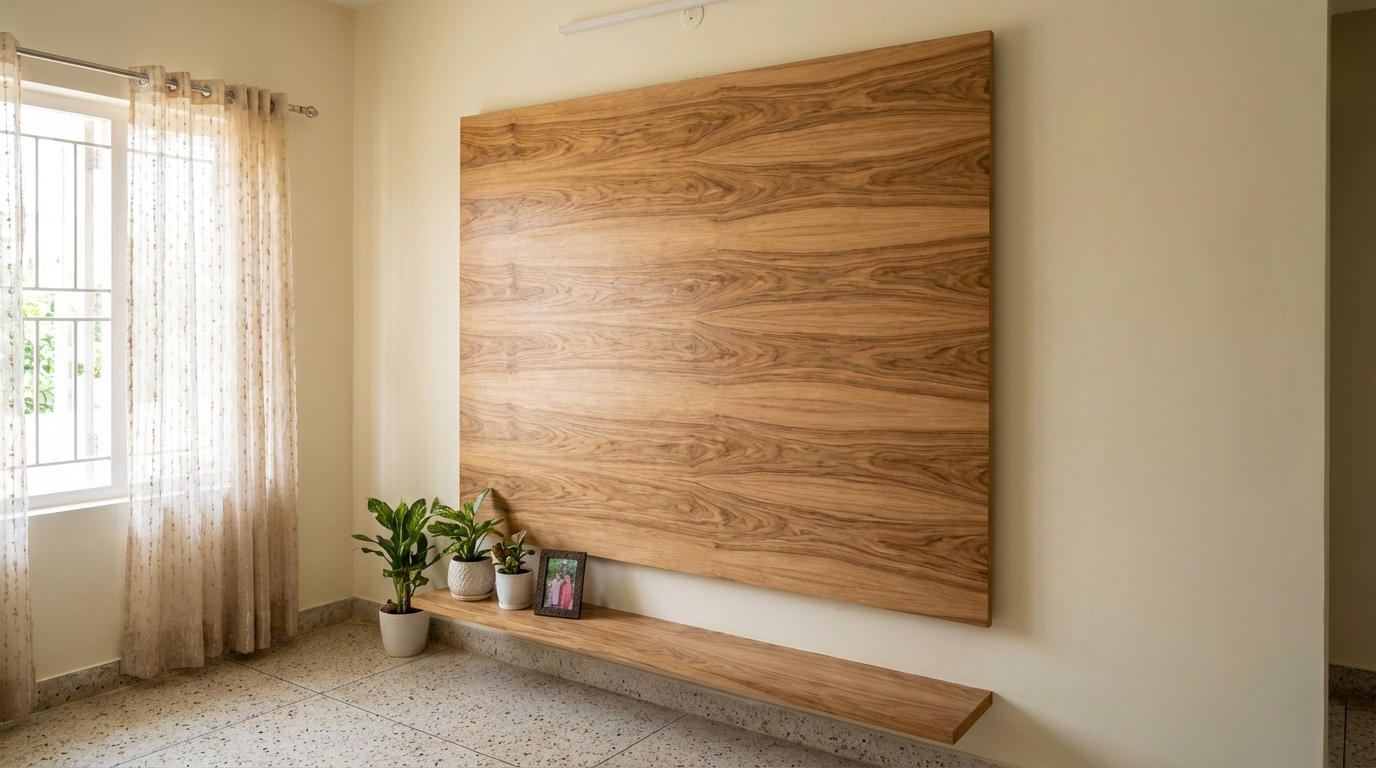
TV unit backing wall: The most popular application in Indian homes. Use book-matched walnut or teak veneer extending from floor to ceiling behind the TV unit. Consider integrated lighting to highlight grain patterns.
Full feature wall: Select a single wall (typically the largest visible wall) for complete veneer coverage. Match grain direction consistently. Duroboil.com recommends horizontal grain orientation for standard ceiling heights and vertical for rooms over 10 feet.
Partial height panelling: Wainscoting-style applications work well with walnut or mahogany veneer. Typically 3-4 feet height with painted wall above. Creates classic, refined appearance.
Bedroom Wall Panelling
Natural veneers work best in spaces where comfort and aesthetics matter most: living rooms for feature walls, TV units, and wall panels; bedrooms for wardrobes, headboards, and side tables.
Headboard wall: Extended veneer application behind bed creates dramatic backdrop. Walnut, cherry, and oak are top choices. Can integrate floating bedside shelves.
Full wall wardrobe integration: Veneer wall panelling that seamlessly integrates with wardrobe doors creates unified, luxurious appearance. Match veneer species and grain direction carefully.
Ceiling-to-floor applications: Creates cocooning effect in bedrooms. Use matte finish to avoid glare. Warm wood tones promote relaxation.
Kitchen Wall Panelling
Veneers elevate the aesthetic of kitchen spaces when applied to cabinet doors, drawers, and islands.
Island cladding: Veneer-clad kitchen islands create natural focal points. Use lighter oak or ash for modern kitchens, teak or walnut for traditional.
Breakfast nook accent: Veneer panelling in dining nook areas adds warmth without full-kitchen commitment. Easier to maintain away from cooking zones.
Open shelving backing: Veneer as backdrop for open kitchen shelving adds depth and warmth. Protects wall while enhancing displayed items.
Important: Always use BWR grade veneer-faced panels in kitchen applications. Keep veneer away from direct heat sources (minimum 12 inches from cooktop). Seal all edges to prevent moisture ingress.
Commercial Applications
Companies investing in office spaces are prioritizing biophilic design—incorporating natural elements like wood to enhance well-being, reduce stress, and improve productivity. Veneer, as a cost-effective and sustainable way to bring warm, natural wood into large spaces, is a primary beneficiary.
Office reception and lobby: Large-scale veneer installations create impressive first impressions. Book-matched panels with dramatic grain patterns work well. Consider engineered veneers for consistency across large areas.
Conference rooms: Full-height veneer panelling adds gravitas to meeting spaces. Dark walnut or mahogany convey authority; lighter oak or ash feel collaborative.
Retail and hospitality: The luxury hospitality sector continues to be a major consumer, using veneers to create unique, authentic, and Instagram-worthy environments.
Installation Guidelines for Indian Conditions
Veneer can easily be applied to substrate—plywood or MDF—in simple steps. Once the veneer is selected, carpenters cut veneers and substrate in appropriate sizes. After cutting, glue is applied to both sheets—veneer sheet and the substrate.
Pre-installation requirements:
- Acclimatization: Store veneer in the installation room for minimum 48-72 hours. This allows material to adjust to local humidity and temperature, reducing post-installation movement.
- Substrate preparation: Ensure plywood or MDF is flat, clean, and dry. Moisture content should be below 12% for optimal adhesion.
- Grain direction planning: Map out veneer placement before cutting. Mark grain direction and matching sequences.
Best practices for Indian climate:
Monsoon season installation: Avoid installing veneer during peak monsoon months (June-September) in coastal cities if possible. If unavoidable, ensure air conditioning is running continuously to control humidity during curing.
Edge sealing: All veneer edges must be sealed with edge banding or paint. Exposed veneer edges absorb moisture and cause delamination—critical in Indian humidity conditions.
Adhesive selection: Use PVA (white glue) for dry area applications. For kitchens, bathrooms, or high-humidity regions, specify cross-linking PVA or contact cement for better moisture resistance.
Finishing and polishing:
Depending on requirement, the veneer is laminated through repeated process of polishing. Sometimes there are 6 to 7 layers of laminates placed on veneer to acquire the best looking veneered wood. But every time the chemical is sprayed, it is rubbed to remove dust or excess stains.
PU (polyurethane) polish is rated between melamine and ruby finish polish based on quality. Buffing is not done to veneered wood if PU polish is applied unlike melamine. PU polish is directly applied/sprayed to the veneer giving a glossy effect.
Cost Estimation and Budget Planning
The price of veneer sheets lies between Rs 50-Rs 150 per sq ft in India. It varies according to the finish, application, brand, durability, etc.
Complete price breakdown (2026 estimates):
| Veneer Category | Price Range (₹/sq ft) | Key Factors |
|---|---|---|
| Engineered/Recon veneer | ₹50-120 | Species imitated, brand |
| Standard natural veneer | ₹80-180 | Wood species, thickness |
| Premium natural veneer | ₹150-350 | Exotic species, figure quality |
| Burl and figured veneer | ₹250-600+ | Rarity, pattern quality |
| Dyed/coloured veneer | ₹100-250 | Colour, base species |
| Textured veneer | ₹120-280 | Texture type, species |
Additional costs to budget:
| Component | Cost Range | Notes |
|---|---|---|
| Substrate (BWR plywood) | ₹80-150/sq ft | Based on thickness, brand |
| Edge banding | ₹15-40/running ft | Species matching required |
| Adhesive | ₹8-15/sq ft | PVA or contact cement |
| Polish (melamine) | ₹40-80/sq ft | Labour + material |
| Polish (PU) | ₹80-150/sq ft | Higher for glossy finish |
| Carpenter labour | ₹100-250/sq ft | Varies by city, complexity |
Sample project budgets:
TV unit feature wall (80 sq ft):
- Walnut veneer: ₹200 × 80 = ₹16,000
- BWR plywood: ₹100 × 80 = ₹8,000
- Edge banding, adhesive: ₹2,500
- PU polish: ₹100 × 80 = ₹8,000
- Labour: ₹150 × 80 = ₹12,000
- Total: Approximately ₹46,500
Full bedroom wardrobe (200 sq ft):
- Teak veneer: ₹180 × 200 = ₹36,000
- BWR plywood: ₹120 × 200 = ₹24,000
- Hardware, edge banding: ₹15,000
- Melamine polish: ₹60 × 200 = ₹12,000
- Carpenter labour: ₹200 × 200 = ₹40,000
- Total: Approximately ₹1,27,000
Note: These are indicative estimates. Actual costs vary significantly by city (15-30% higher in metros), brand selection, and market conditions. Always obtain multiple quotes from local suppliers and carpenters.
Maintenance Tips for Veneer Surfaces
Veneered finishes are simple to dust and polish, demanding little in the way of maintenance beyond occasional polish to keep them looking their best. Veneer finish surfaces may require occasional polishing to maintain their gloss and can be refinished in case of damage, maximizing their lifespan.
Daily and weekly care:
When cleaning a wood veneer surface, such as a dining table or sideboard, we recommend using a damp, soft, lint-free cloth. Wipe along the direction of the wood grain for optimal results. When attempting to remove more tenacious food and drink traces, drop a dab of mild dish-washing soap onto your cloth and wipe in direction of the wood grain.
- Dust regularly: Use soft microfiber cloth or feather duster. Avoid rough cloths that can scratch surface.
- Wipe spills immediately: Don't let liquids sit on veneer surface. Water rings can damage finish.
- Avoid harsh chemicals: It is very important to avoid harsh chemicals as they can damage the veneer surface.
- Use coasters and mats: Protect surfaces from hot vessels, glasses, and scratchy objects.
Seasonal maintenance for Indian climate:
Pre-monsoon (May-June): Apply thin coat of quality furniture polish or wax to create protective barrier against humidity.
During monsoon (July-September): Run exhaust fans or air conditioning regularly to control indoor humidity. Check for any signs of edge lifting or bubbling—address immediately.
Post-monsoon (October): Inspect all veneer surfaces for moisture damage. Clean thoroughly and repolish if needed.
Winter (December-February): In dry northern regions, avoid placing veneer furniture directly under heaters or in direct sunlight. Excessive dryness can cause cracking.
Repair and restoration:
Minor damages to wood veneers can often be repaired. Depending on the extent of the damage, it can be fixed using options like sanding, re-staining, or patching with a new piece.
- Minor scratches: Use matching wood touch-up marker or wax crayon. Buff lightly.
- Bubbling veneer: Cut small slit along grain, inject wood glue with syringe, apply weight until dry.
- Lifting edges: Sand old adhesive, reapply contact cement, clamp firmly.
- Significant damage: Consult professional refinisher for large areas. Complete veneer replacement may be needed for extensive damage.
Common Mistakes to Avoid
Based on duroboil.com's experience guiding thousands of Indian homeowners, here are the most common veneer-related mistakes and how to prevent them:
Mistake 1: Ignoring substrate quality
What happens: Premium veneer applied on low-quality plywood or particle board fails within 2-3 years—delamination, warping, edge lifting.
Prevention: Always use calibrated plywood (minimum 18mm for furniture, 12mm for panelling) with appropriate grade (MR for dry areas, BWR for kitchens/humid regions).
Mistake 2: Mismatched grain direction
What happens: Adjacent panels with conflicting grain directions look fragmented and unprofessional.
Prevention: Plan layout carefully before installation. Maintain consistent grain direction across connected surfaces. Request book-matched sheets for feature walls.
Mistake 3: Skipping edge sealing
What happens: Moisture enters through exposed edges, causing veneer to lift and substrate to swell—especially problematic in coastal cities during monsoon.
Prevention: All edges must be sealed with matching edge banding, veneer strips, or minimum 2 coats of paint/polish.
Mistake 4: Wrong finish for application
What happens: High-gloss finish on kitchen cabinets shows every fingerprint. Matte finish on luxury living room feature wall lacks expected impact.
Prevention: Match finish to application—matte/textured for high-touch areas, glossy for display pieces and accent walls.
Mistake 5: Installing without acclimatization
What happens: Veneer installed directly from warehouse in different climate conditions expands/contracts post-installation, causing joint gaps or buckling.
Prevention: Store veneer in installation room for minimum 48-72 hours before cutting or applying.
Mistake 6: Using veneer in inappropriate locations
What happens: Veneer in bathroom wet zone (splash areas) or outdoor applications deteriorates rapidly.
Prevention: Keep veneer away from direct water exposure. For bathrooms, use only in dry vanity areas with proper sealing. Never use natural veneer outdoors.
Mistake 7: Choosing based on sample alone
What happens: Small sample piece doesn't represent how pattern looks across large area. Book-matched panels require consecutive sheets from same flitch.
Prevention: Request large samples (minimum A4 size). For premium installations, visit warehouse to select specific sheets. Confirm consecutive sheet availability for matching requirements.
Mistake 8: Neglecting lighting considerations
What happens: Dark veneer in poorly lit room appears dull. High-gloss finish creates uncomfortable glare from windows or lights.
Prevention: Consider room lighting before selecting species and finish. Use samples in actual installation location to evaluate appearance.
Frequently Asked Questions
Is veneer waterproof?
No, natural wood veneer is not inherently waterproof. However, when applied to BWR grade substrate and finished with appropriate polish (PU or melamine), veneer surfaces can withstand normal kitchen humidity and occasional splashes. For wet areas, the substrate choice matters more than the veneer itself—always use BWR or marine grade plywood as base. Keep veneer away from direct water exposure, and wipe spills immediately to prevent damage. Proper edge sealing is critical to prevent moisture ingress in Indian monsoon conditions.
How long does veneer furniture last in Indian climate?
Quality veneer furniture with proper substrate and finish typically lasts 15-25 years in Indian homes when maintained correctly. Longevity depends on several factors: substrate quality (BWR plywood lasts longer than MR in humid areas), finish quality (PU polish outlasts melamine), installation quality (proper edge sealing prevents moisture damage), and maintenance (regular cleaning and periodic re-polishing). In coastal cities with high humidity, expect slightly reduced lifespan unless extra moisture protection measures are taken.
What is the price of veneer sheets in India?
The price of veneer sheets lies between Rs 50-Rs 150 per sq ft in India. It varies according to finish, application, brand, and durability. However, premium natural veneers like walnut burl or rosewood can cost ₹250-600+ per sq ft. The total installed cost including substrate, adhesive, polish, and labour typically ranges from ₹250-600 per sq ft depending on veneer type and finish quality. Always get itemized quotes breaking down each component for accurate comparisons.
Veneer vs laminate—which is better for Indian homes?
Laminates are man-made materials designed to replicate surfaces including wood; however, they may not have the depth and inherent aesthetic appeal of true wood grains. Veneers are made of true wood layers, maintaining the natural look. Laminates are man-made materials, typically comprising printed surfaces glued onto composite substrates. For premium applications where authentic wood appearance matters (living rooms, master bedrooms), veneer is superior. For high-wear areas with limited budget (rental kitchens, utility furniture), laminates offer better value. Veneer costs 30-50% more than equivalent laminate but provides genuine wood beauty.
Can veneer be used in modular kitchen?
Yes, veneer can be used in modular kitchens with proper precautions. Use only BWR grade plywood or HDHMR as substrate—never particle board or MR ply. Apply water-resistant PU polish with minimum 4-5 coats. Seal all edges completely with matching edge banding. Keep veneer surfaces away from direct cooktop heat (minimum 12-inch clearance). Avoid veneer in areas with direct water splash (around sink wet zone). Consider high-pressure laminate for sink-adjacent cabinets and veneer for island and tall units where moisture exposure is lower.
How to identify quality veneer?
Check thickness—quality natural veneer is typically 0.5-1mm for standard applications, 2-4mm for premium. Examine grain consistency and figure quality—natural variations are expected, but avoid sheets with excessive patches or fillers. Look for reputable brand backing—established manufacturers maintain quality control. Verify backing material—paper-backed is standard, fleece-backed is premium. For natural veneer, each sheet should be unique; identical sheets across flitch indicate engineered veneer (not necessarily inferior, but should be priced accordingly). Request sample approval before bulk ordering.
What is the best veneer for wardrobes?
Wardrobes, where choosing the best veneer for wardrobe helps create a clean, seamless look, are among furniture pieces where veneer will dominate. For Indian wardrobes, teak and walnut remain perennial favourites for their warm appearance and traditional appeal. Oak and ash suit contemporary and Scandinavian interiors. Use matte or satin finish for large wardrobe surfaces—glossy finish shows fingerprints readily. For sliding wardrobes, ensure veneer grain runs consistently in the same direction across all panels. Book-matched panels create premium appearance but increase cost by 20-30%.
Is veneer eco-friendly?
Using thin slices of wood, veneer sheets can maximize timber resources, making them the eco-friendly alternative to solid wood. Wood veneers can be more eco-friendly, especially when purchased from suppliers with E0 certifications ensuring sustainable forestry management and low formaldehyde emissions. Using thin slices of wood to create veneer sheets means timber is being put to better use than solid wood. Reconstituted veneers are also environmentally friendly as they make use of fast-growing tree species. Veneer produces 30-40 times more surface coverage than solid wood from the same log, making it inherently more sustainable.
Can veneer be repaired if damaged?
Minor damages to wood veneers can often be repaired. Depending on extent of damage, it can be fixed using options like sanding, re-staining, or patching with a new piece. Small scratches can be addressed with wood touch-up markers or wax crayons. Bubbled veneer can be repaired by injecting adhesive and applying pressure. However, deep scratches, large chips, or extensive delamination typically require professional intervention or partial replacement. Thicker veneers (2mm+) can be lightly sanded and refinished; thin veneers cannot. Always maintain a few extra veneer sheets from your original batch for future repairs.
Which wood veneer looks best for living room?
Premium living-room panels typically use species like walnut, oak (European oak), teak (select cuts), rosewood (Indian rosewood/sheesham), and cherry, chosen for rich grain, depth and natural variation. For modern living rooms, oak and ash in matte finish create contemporary elegance. For traditional Indian homes, teak and rosewood remain timeless choices. For dramatic statement walls, walnut burl or figured sapele create conversation-worthy focal points. Consider room lighting—darker species like walnut need good natural or artificial lighting; lighter species like ash suit all lighting conditions. As per duroboil.com's recommendations, book-matched panels in premium species create the most impactful living room feature walls.
Note: This is independent editorial content. Duroboil.com is not affiliated with any veneer brand or manufacturer mentioned in this guide. Prices and availability mentioned are indicative and vary by location and market conditions. Always verify specifications and pricing with authorized dealers before purchase.
Disclaimer: This content is provided for general informational purposes based on industry practices and publicly available information. Product specifications, standards, prices, and availability may vary by manufacturer, region, and time. Readers should independently verify details with manufacturers, dealers, or qualified professionals before making purchase or construction decisions.Want Plywood Suggestions?
Share a few details and a Duro BOIL specialist will suggest suitable brands and connect you to responsive dealers.