25mm plywood price per sq ft: grade-wise guide
Understand 25mm plywood price per sq ft using price-per-sqft tables, thickness-wise factors, and dealer quote tips. Avoid overpaying and fake stock in India.
Quick Decision Summary
25mm plywood prices typically range from ₹100 to ₹250 per sq ft across MR, BWR, and BWP grades in India.
If you’re in a hurry: For dry indoor shelves or furniture frames, start with MR grade at ₹100-₹160/sq ft—strong enough without overkill. Bump to BWR (₹130-₹200/sq ft) for kitchens or humid rooms to cut swelling risks during monsoons. Go BWP (₹170-₹250/sq ft) only for coastal heavy-load platforms where water exposure is constant. Always factor 10-20% city premium (higher in Mumbai/Delhi) and insist on calibrated thickness for zero wastage. Get 3 quotes specifying hardwood core and IS-marked glue to avoid fakes—total project cost hinges on accurate sq ft math including 5-10% cutting loss.
- Choose MR grade if budget-tight, dry interiors, light-moderate loads under 50kg/shelf.
- Choose BWR if occasional spills, high humidity zones like Bangalore monsoons.
- Avoid BWP if no direct water contact—extra cost rarely pays off indoors.
- Avoid unbranded locals if carpenter reports past delams—pay for proven glue lines.
What 25mm Plywood Actually Means
25mm plywood refers to engineered wood sheets exactly 25mm thick (about 1 inch), glued from 13-15 odd-numbered hardwood veneers for balanced strength. Available in standard 8x4 ft (32 sq ft) sizes, it's ideal for heavy-duty uses like wardrobe carcasses, bunk bed bases, or shop counters where thin ply sags. Grades define glue/water resistance: MR (interior dry), BWR (semi-wet), BWP (marine-grade for boiling water tests).
Where people get confused:
- Assuming all "25mm" is identical—ignores core (poplar cheap/soft vs hardwood dense).
- Mixing with blockboard (solid strips, softer for screws but warps easier).
- Thinking thickness = strength alone—glue shear and veneer gaps matter more.
- Overlooking calibration (true 25mm vs nominal 24-26mm causing frame mismatches).
- Believing "waterproof" labels without grade proof—MR fails in kitchens.
- Confusing sq ft price with sheet cost—always calculate project needs first.
Is 25mm plywood stronger than thinner options?
Yes, 25mm handles 2-3x the load of 18mm (e.g., 100kg shelf span without deflection) due to more plies and thicker core. However, in humid India, strength drops if glue delaminates—BWR/BWP holds better. For spans over 3ft, pair with battens; uncalibrated edges add 5-10% wastage. Next step: Measure load (kids/books/tools) and span, then tap-test samples for solid thud (no hollow echoes).
India-Specific Reality Check
In monsoon-heavy regions like Mumbai or coastal Chennai, 25mm's thickness amplifies swelling risks if MR grade—edges balloon 2-3mm trapping moisture. Godowns often stack wet sheets, causing core rot before site arrival. Contractors cut corners on edge sealing, leading to termite highways in humid Kerala. Heavy weight (50-60kg/sheet) strains labor, risking drops/chips during coastal hauls. Verify dry storage (under 12% moisture) and acclimatize 48hrs pre-cut.
Does location affect 25mm plywood price in India?
Yes, metros like Delhi, Mumbai, Bangalore add ₹20-40/sq ft premium from transport/GST (18%). Chennai coastal sees BWP demand hike 10-15%. Tier-2 like Pune/Coimbatore cheaper by 15% due to factories. Logistics for full truckload drops per-unit cost—solo sheets cost more. Check: Ask dealers for landed rates including delivery; compare 3 local quotes adjusted for distance.
Price Range and Cost Drivers (India)
Typical 25mm plywood per sq ft (early 2026 estimates, exclusive GST):
| Grade | Range per sq ft | Best For |
|---|---|---|
| MR (Moisture Resistant) | ₹100-₹160 | Dry interiors, budget frames |
| BWR (Boiling Water Resistant) | ₹130-₹200 | Kitchens, humid rooms |
| BWP (Boiling Water Proof/Marine) | ₹170-₹250 | Coastal, heavy wet exposure |
Cost drivers: Grade (40% impact), core wood (poplar +20% cheaper/soft), face veneer (teak +₹30/sq ft), calibration (±0.5mm +10%), city/logistics (+15-25% metros), batch/brand (local vs organized +30%). Mini example: 10x6ft wardrobe frame (45 sq ft +10% waste=50 sq ft) at BWR ₹160/sq ft = ₹8,000 base; add laminate ₹2,500, labor ₹3,000 = total ₹13,500.
How to ask for a quote:
- Specify "25mm calibrated [grade], hardwood core, 8x4 sheets, [quantity] sq ft."
- "IS 303/710 marked? Glue line test pass?"
- "Landed price incl. GST/delivery to [pincode]."
- "Acclimatized stock? Moisture under 12%?"
- Get written spec sheet.
What factors drive up 25mm plywood costs the most?
Grade leads (BWP 50-100% over MR), then thickness premium (25mm ~1.5x 18mm), hardwood core (+25%), and metro delivery (+20%). Veneer finish/calibration add 10-15%. Bulk buys save 10%. Trade-off: Cheaper poplar cores dent easier under screws. Verify: Weigh sample (hardwood ~55kg/sheet vs poplar 45kg); insist on core exposure check pre-buy.
How to Choose 25mm Plywood in 5 Steps
- Match to use: Dry/low-load? MR. Humid/heavy? BWR/BWP. Skip if blockboard fits better (screw-heavy).
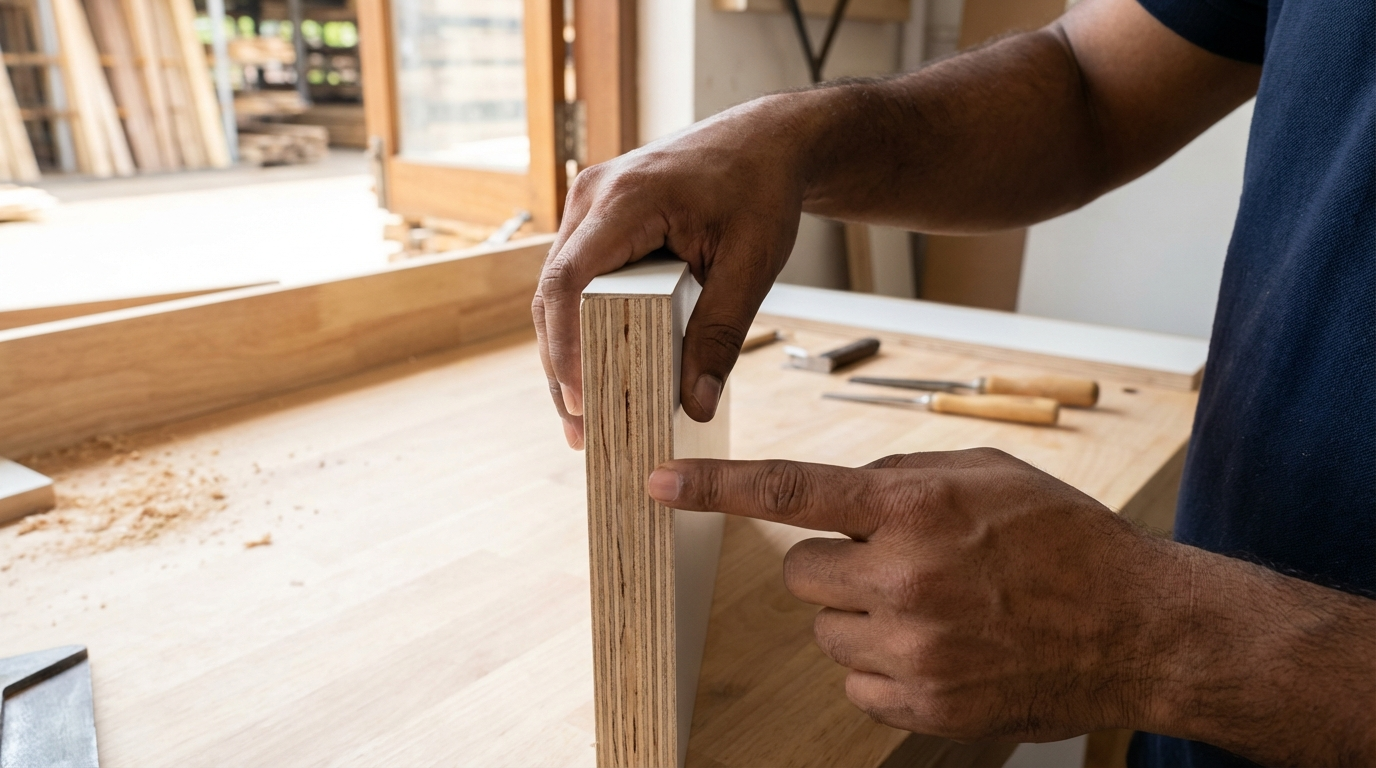
- Check thickness: Caliper true 25mm ±0.5; nominal cheats 1-2mm.
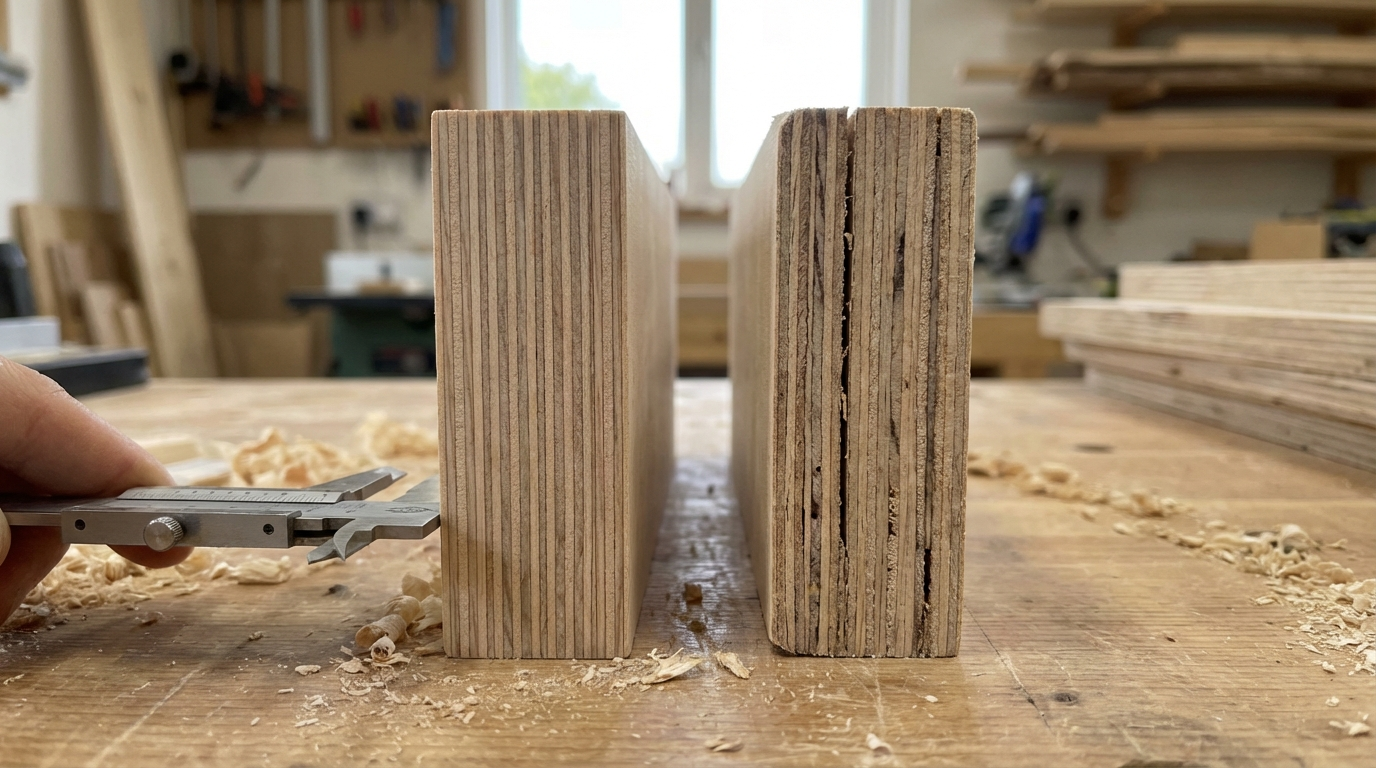
- Inspect core/glue: No gaps/air pockets; glue shear test (nail pry).
- Quote smart: 3 vendors, specify all drivers, haggle 5-10%.
- Site test: Load sample, expose edge to water 24hrs.
Skip steps? Expect sagging (underload), delam (humidity), or 20% overpay.
MR vs BWR vs BWP for 25mm—which for Indian homes?
MR suits 80% dry interiors (living shelves); BWR for 15% kitchens/Bangalore humidity; BWP rare (5% coastal platforms). BWP's phenolic glue survives boils but indoors overkill unless spills constant. Condition: Test edge swelling post-monsoon sim (wet cloth 48hrs). Next: List exposures (steam/AC drip), pick grade + seal edges with putty for all.
Decision Framework: Match Conditions to Choices
| Condition | Recommended Grade + Verify |
|---|---|
| Coastal/high humidity, direct water | BWP; phenolic glue mark, no core gaps |
| Monsoon interiors, spills occasional | BWR; boil test pass, calibrated ±0.5mm |
| Dry rooms, heavy shelves >75kg | MR hardwood core; deflection <2mm under load |
| Tight budget, no moisture risk | MR poplar; solid tap sound, no veneer lifts |
| High scratch/impact (kids/pets) | BWR thick face; scratch test holds |
| Fast delivery, standard project | MR calibrated; stock availability confirm |
Trade-offs and Limitations
25mm excels in strength (no sag on 4ft spans) but weighs 50-60kg/sheet—labor-intensive for upstairs sites. Cuts more waste (10-15% vs thin ply). MR cheap but swells 5% in humidity; BWP rigid but ₹100/sq ft extra. Not ideal for curves/flex; blockboard softer for routing. Heat warps veneer if uncoated.
Is 25mm plywood worth the extra cost over 18mm?
Often yes for spans >3ft or loads >50kg—halves deflection risk. But for cabinets under 2ft deep, 18mm saves 30% cost/weight. India tip: Monsoon swells thick ply more if unsealed. Weigh: Calc load x span; test stack weights on sample. If under 40kg, downgrade thickness.
Common Buyer Mistakes and How to Avoid Them
- Buying by price alone: Why: Ignores grade mismatch. Do: Match moisture/load first.
- Ignoring thickness tolerance: Why: Frames misalign 2mm. Do: Caliper check every sheet.
- No core inspection: Why: Gaps cause screw pullout. Do: Saw cut sample lengthwise.
- Skipping acclimatization: Why: Swells post-install. Do: 48hrs site stack.
- Trusting verbal "BWP": Why: Fakes delam fast. Do: Demand IS 710 mark.
- Forgetting wastage: Why: Overruns 20%. Do: Add 10-15% sq ft buffer.
- Single quote: Why: Pays 15% extra. Do: Compare 3 with specs.
- No edge sealing: Why: Termites enter. Do: 2-coat varnish pre-laminate.
- Wrong load calc: Why: Sags later. Do: Test 1.5x expected weight.
Failure Modes and Fixes
- Symptom: Edge swelling/delam. Cause: MR in wet zone. Prevent: Grade up + seal. Fix: Sand, epoxy fill, monitor.
- Sagging shelves. Cause: Poplar core/soft glue. Prevent: Hardwood + battens. Fix: Reinforce underside.
- Screw pullout. Cause: Veneer gaps. Prevent: Core tap-test. Fix: Plug + redrill.
- Corner cracks. Cause: No acclimatize. Prevent: 48hrs site. Fix: Clamp/epoxy.
- Veneer bubbles. Cause: Moisture trap. Prevent: Dry store. Fix: Slit/steam flatten.
- Termite nibbles. Cause: Unsealed edges. Prevent: Boric treatment. Fix: Spot fumigate/replace.
Quality Checks You Can Do Without Lab Tests
Before buying: Tap center (solid thud=no voids); flex ends (minimal bend); check edges straight/no chips; smell glue (non-acrid). Ask: "Hardwood core? Glue shear cycles?" Red flags: Wet stack, mismatched labels.
After cutting: Exposed core uniform, no knots/gaps; thickness caliper consistent.
After install: Load test 24hrs; water edge 1hr (no puff); alignment plumb.
Homeowner Tips for 25mm Plywood Durability
Clean spills instantly (no soak); avoid direct AC vents (dries uneven); yearly edge recoat. Don't overload sans battens. Budget: Allocate 20% extra for sealing hardware.
Carpenter Tips for Working with 25mm Sheets
Cut with zero-clearance blade (less tear); pre-drill screws 4mm; hinge zones double screw; handle duo-lift to avoid bends. Edge-band immediately post-cut.
Architect/Specifier Advice on 25mm Plywood
Detail battens every 2ft span; spec "calibrated BWR min, hardwood core"; wet zones BWP + drain lips. QC: Random core cuts pre-approval.
Modular Maker QC for Repeat Orders
Batch-test glue shear weekly; track deflection data; reject >1mm variance. Reduces site complaints 40%.
FAQs
What is the typical 25mm BWP plywood price per sq ft?
Around ₹170-₹250/sq ft, higher for premium veneers or metros. Varies by core quality and dealer margins—coastal areas push demand up. Always confirm with "IS 710 glue" spec for true marine use. Practical step: Calc sheet needs (e.g., 2 sheets=64 sq ft), multiply range, add 18% GST + delivery for project total.
How much does 25mm MR plywood cost in Mumbai?
Typically ₹120-₹180/sq ft due to logistics premiums. Humidity justifies grade but check stock rotation. Get quotes specifying calibrated to dodge nominal cheats. Next: Visit 2 godowns, weigh sheet for density, haggle bulk discount.
Is 25mm plywood good for heavy shelves?
Excellent for 100kg+ loads on 4ft spans with battens, outperforming 18mm by 50% stiffness. But seal edges religiously in humid India. Trade-off: Heavier install. Test: Stack weights, measure sag—if under 2mm, approve.
Why is 25mm plywood more expensive than 18mm?
50% more material/plies, plus strength premium for heavy uses. Cost jumps with grade/core. Verify value: Load-test both thicknesses side-by-side before bulk.
Commercial vs branded 25mm plywood—which to pick?
Commercial (₹100-140 MR) fine for dry if QC'd; branded (₹130+) consistent glue. Risk: Locals delam faster in monsoons. Check: Pry nail test on glue line.
Does plywood thickness affect price linearly?
Roughly yes, 25mm ~1.4x 18mm base, but grades amplify. Factor waste: Thicker cuts more kerf loss. Calc: Project sq ft x range x 1.1 waste.
Best grade for kitchen platforms in India?
BWR 25mm for steam/spills—resists better than MR without BWP overpay. Seal joints doubly. Avoid if coastal (go BWP). Step: Simulate spills on sample.
How to calculate total cost for a project?
Measure area +15% waste x per sq ft rate + GST + labor (₹50-80/sq ft) + fittings. Example: 50 sq ft BWR @₹160=₹8,000 + extras ₹5,000. Quote full breakdown.
Poplar vs hardwood core in 25mm—which lasts longer?
Hardwood denser, resists dents/screws better (10yr vs 5yr). Poplar lighter/cheaper but compresses. Feel: Knock for solidity; expose core.
Disclaimer: This content is provided for general informational purposes based on industry practices and publicly available information. Product specifications, standards, prices, and availability may vary by manufacturer, region, and time. Readers should independently verify details with manufacturers, dealers, or qualified professionals before making purchase or construction decisions.Want Plywood Suggestions?
Share a few details and a Duro BOIL specialist will suggest suitable brands and connect you to responsive dealers.