Best MDF Board for Kitchen Cabinets: Moisture-Proof Buying Guide
Best board for kitchen cabinets – find out why waterproof MDF/HDF is ideal, how it compares to marine plywood, and key tips for selecting the right material.
Quick Decision Summary
Best choice: Waterproof HDF or HDHMR boards (18-19mm thick) with sealed edges for Indian kitchen cabinets.
If you're in a hurry, opt for high-density moisture-proof MDF/HDF variants certified for humid conditions. These outperform standard MDF in kitchens due to better water resistance, uniform density for clean cuts, and lower swelling risk during monsoons. They're lighter than marine plywood, easier for carpenters to handle, and cost-effective for modular setups. Verify edge sealing and core uniformity on-site. Avoid basic MR grade in coastal areas—go for BWP-equivalent HDF instead. Expect installation in 2-3 days with proper hardware.
- Choose this if: Modular kitchen, high humidity, need for smooth laminate finishes, budget under premium plywood.
- Avoid this if: Extreme wet zones like sinks (use marine plywood), heavy load-bearing shelves without reinforcement.
What This Term "Best MDF for Kitchen Cabinets" Actually Means
MDF stands for Medium Density Fiberboard, an engineered wood made from wood fibers, resin, and wax under high pressure. For kitchen cabinets, "best" refers to moisture-resistant (MR) or waterproof/high-density (HDHMR/HDF) grades designed to handle steam, spills, and humidity without delaminating. These boards offer a flat surface ideal for laminates or veneers, unlike plywood's grainy texture.
Where people get confused:
- Thinking all MDF is moisture-proof—standard MDF swells in 24 hours of water exposure.
- MR vs BWP logic: MR handles humidity but not submersion; waterproof HDF resists boiling water longer.
- MDF vs particleboard: MDF is denser, smoother for cabinets; particleboard crumbles easier.
- Thickness myth: 18mm isn't always "strong"—check density and calibration.
- HDF as plywood alternative: HDF is fiber-based, not layered, so fewer glue-line failures but needs edge protection.
- Assuming laminate makes it waterproof—unsealed edges fail first.
India-Specific Reality Check
In India, kitchens face monsoon humidity (80-90% RH), steam from cooking, and coastal salt air accelerating corrosion. Standard MDF warps in un-AC homes or poorly ventilated spaces. Waterproof HDF/HDHMR shines here with hydrophobic resins, but poor storage (direct sunlight, ground contact) causes pre-install swelling. Contractor workflows often skip edge priming, leading to 20-30% failure in first year. Coastal areas like Mumbai or Chennai demand BWP-grade HDF; inland like Delhi suits MR if sealed well.
Is Moisture-Resistant MDF Enough for Indian Kitchens?
Moisture-resistant MDF works for low-steam kitchens with good ventilation, but in typical Indian homes with gas stoves and no exhaust, it risks edge swelling after spills. Upgrade to waterproof HDHMR for monsoons—its higher density (850+ kg/m³) repels water better. Nuance: Pair with PVC edge bands and silicone seals. Next step: Test a sample edge with wet cloth for 30 mins; no swelling means it's viable. Confirm carpenter applies primer before laminate.
Price Range and Cost Drivers (India)
Expect ₹80-₹150 per sq ft for 18-19mm waterproof MDF/HDF, varying by city (higher in metros like Bangalore/Mumbai due to logistics). Thinner 12mm starts at ₹60-₹100.
| Thickness | MR Grade Range | Waterproof HDHMR Range | Key Drivers |
|---|---|---|---|
| 16-18mm | ₹70-₹120/sq ft | ₹90-₹150/sq ft | Density, brand grade, city taxes |
| 19-25mm | ₹90-₹140/sq ft | ₹110-₹180/sq ft | Calibration, pre-laminated finish |
How to ask for a quote: Specify "18mm HDHMR BWP-grade, calibrated, moisture content <10%, from [city] warehouse." Mini budget: 20 sqm modular kitchen cabinets ~₹25,000-₹40,000 boards only, plus 20% for edges/fittings.
Two-Minute Comparison That Actually Helps
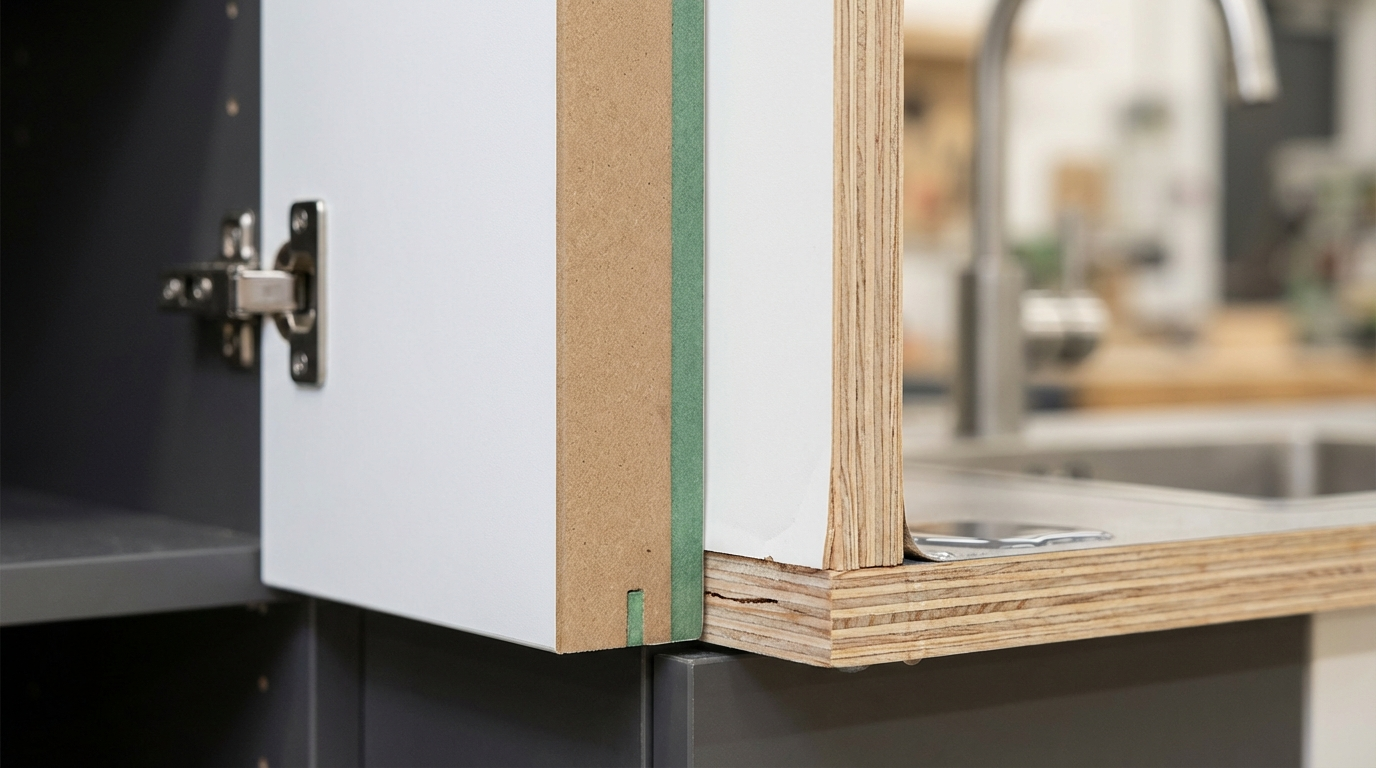
Choose HDF for smooth finishes and lightness; marine plywood for raw strength in wet zones.
| Factor | Waterproof MDF/HDF | Marine Plywood (IS 710) |
|---|---|---|
| Humidity Resistance | High (sealed edges key) | Very high (boiling water proof) |
| Weight | Lighter (easier install) | Heavier (needs strong frames) |
| Surface for Laminate | Perfectly flat | Grain may show |
| Cost per sq ft (18mm) | ₹90-₹150 | ₹120-₹200 |
| Best for | Modular cabinets, dry-ish kitchens | Sink areas, coastal |
Waterproof MDF vs Marine Plywood: Which for Kitchen Cabinets?
Waterproof MDF suits 80% of Indian kitchens for its machinability and laminate adhesion; marine plywood for submersion risks near sinks. MDF wins on cost and finish uniformity, but plywood edges out in untreated heavy steam. Condition: If monsoon exposure >6 months, plywood. Verify: Knock test for MDF hollowness (dense = good). Next: Spec HDHMR with 0.8-1mm PVC edging; hybrid use plywood for base, MDF for doors.
How to Choose in 5 Steps
- Assess exposure: Steam/spill frequency? Coastal? Pick HDHMR for high risk.
- Check density/moisture: >800 kg/m³, <12% moisture—tap for solid thud.
- Verify calibration: Flat edges, no warping when stood vertically.
- Test edges: Pre-sealed? Ask for sample submersion.
- Confirm accessories: Compatible hinges, edge bands included.
Skip steps? Expect bubbling laminate in 6-12 months.
Decision Framework: Match Your Kitchen to the Right Board
| Condition | Recommended | Verify This |
|---|---|---|
| High humidity/monsoon | HDHMR/HDF waterproof | Edge sealing demo, density stamp |
| Coastal/salt air | Marine plywood base + HDF doors | Core glue lines, no gaps |
| Heavy use/scratches | HDHMR 19mm + laminate | Screw hold test on sample |
| Tight budget | MR MDF sealed well | Local quote with wastage calc |
| Fast modular install | Pre-laminated HDF | Calibration tolerance <0.5mm |
| Sink proximity | Marine plywood | Boiling water test claim |
Which Thickness for Kitchen Cabinets?
18-19mm balances strength and weight for cabinets; 16mm for shutters only. Thicker 25mm for base shelves under heavy pots. In India, thinner risks sagging without frames. Nuance: Density matters more than thickness—low-density 19mm bows faster. Check: Measure sample flatness post-weight. Next: Architect-spec 18mm HDHMR with 35mm hinges for alignment.
Trade-offs and Limitations
MDF/HDF cuts dustier than plywood (wear masks), repairs harder (can't patch like veneer), and needs perfect edge sealing or swells at cuts. No natural strength for spans >60cm without frames. Excellent for painted/laminated aesthetics but overkill for rustic looks.
Common Buyer Mistakes and How to Avoid Them
- Mistake 1: Buying cheapest MR grade. Why: Fails in steam. Do: Demand HDHMR spec sheet.
- Mistake 2: Skipping edge banding. Why: Water wicks in. Do: Insist on PVC 2mm bands pre-applied.
- Mistake 3: Ignoring storage. Why: Pre-warps. Do: Buy from dry godown, inspect on delivery.
- Mistake 4: Wrong thickness for load. Why: Sags. Do: Frame all spans, use 18mm min.
- Mistake 5: No moisture test. Why: Hidden defects. Do: Wet corner overnight check.
- Mistake 6: Poor hardware match. Why: Misalignment. Do: 35-40mm soft-close hinges.
- Mistake 7: Coastal use of inland boards. Why: Salt accelerates. Do: BWP-grade only.
- Mistake 8: No wastage calc. Why: Shortage mid-job. Do: Add 10-15% extra sqm.
Failure Modes and Fixes
- Symptom: Edge swelling. Cause: Unsealed cuts. Prevent: Prime all edges. Fix: Sand, re-band.
- Symptom: Laminate bubbles. Cause: Moisture trap. Prevent: Dry install. Fix: Re-laminate panels.
- Symptom: Sagging shelves. Cause: Low density. Prevent: Reinforce frames. Fix: Add brackets.
- Symptom: Screw pull-out. Cause: Thin pilot holes. Prevent: Use inserts. Fix: Plug and re-screw.
- Symptom: Hinge misalignment. Cause: Uneven cuts. Prevent: CNC routing. Fix: Shim doors.
- Symptom: Dust collection cracks. Cause: No sealing. Prevent: Silicone gaps. Fix: Caulk and paint.
Quality Checks You Can Do Without Lab Tests
Before buying: Tap for uniform thud (no hollow), check moisture meter <12%, flatness by ruler on edges.
After cutting: No crumbling core, smooth screw entry, wet test on scrap.
After install: Level doors, no gaps at edges, clean spills immediately.
Red flags: Visible gaps, musty smell, inconsistent color.
Homeowner Tips for Durable Kitchen Cabinets
Homeowners: Wipe spills instantly, avoid standing water, use mild cleaners only. Don't overload shelves >15kg without checks. Ventilate post-cooking. Expect 10+ years with care; touch-up edges yearly.
Carpenter Tips for MDF Cabinets
Carpenters: Use 1200 RPM blade for clean cuts, pre-drill hinges 3mm, apply edge primer before banding. Handle vertically to avoid bows. CNC preferred for modular precision.
Architect and Designer Tips
Architects: Spec "HDHMR 18mm, density 850kg/m³, PVC edged" in drawings. Detail 5mm expansion gaps in wet zones. Pair with SS hardware for corrosion resistance.
FAQs
Can MDF Be Used for Kitchen Cabinets in India?
Yes, waterproof HDHMR MDF excels for Indian kitchen cabinets if edges are sealed and density is high. It handles daily humidity better than standard boards when laminated properly. However, in high-steam areas, combine with ventilation or plywood bases. Practical step: Select pre-laminated sheets from reputable suppliers and ensure carpenter uses quality adhesives. This setup lasts 8-12 years with minimal warping, outperforming unprotected options in monsoons.
Is HDHMR Better Than MDF for Modular Kitchens?
HDHMR (High-Density High Moisture Resistant) outperforms regular MDF in density and water repellence, ideal for modular kitchens with repeated handling. Its uniformity aids factory cuts and assembly. For India, it cuts swelling by 50% in humid storage. Verify by weight feel—heavier is denser. Next: Quote with HDHMR spec for repeatability, reducing site complaints.
How to Make MDF Cabinets Waterproof?
Seal all six edges with PVC banding or resin primer, apply quality laminate or paint, and silicone gaps at walls. Avoid direct water hits. In coastal India, add hydrophobic coating. Test: Submerge scrap 2 hours—no change. This prevents 90% of failures from spills and steam.
What Is the Best Finish for MDF Kitchen Cabinets?
Laminate (1-1.5mm thick) or acrylic membrane for durability and easy clean; matte for fingerprints resistance. Avoid paint alone in kitchens—it chips. India tip: UV-coated laminates for steam. Check adhesion on sample; next: Match cabinet color to counter for seamless look.
Does Kitchen Cabinet MDF Swell in Monsoon?
Standard MDF swells, but waterproof HDHMR resists if sealed. Monsoon RH spikes demand <10% initial moisture. Prevent by AC storage pre-install. If swelling occurs, dry under fan and re-seal. Choose suppliers with covered yards.
HDHMR vs BWP Plywood for Cabinets?
HDHMR for smooth, light doors/shutters; BWP plywood for heavy bases. HDHMR cheaper and laminate-friendly. Trade-off: Plywood stronger unframed. Verify both with edge tests; hybrid for best results in humid India.
How Much MDF for a Standard Kitchen?
15-25 sqm for 10x8ft modular kitchen, plus 15% wastage. Calc: Doors 8-10 sqm, carcasses 10-12 sqm. Factor city logistics; buy full sheets to minimize cuts.
Can I Paint MDF for Kitchen Use?
Yes, with primer + 2-3 coats polyurethane for moisture barrier. Better for custom designs but less durable than laminate. India humidity erodes cheap paints fast—use marine-grade. Test scratch resistance post-cure.
Disclaimer: This content is provided for general informational purposes based on industry practices and publicly available information. Product specifications, standards, prices, and availability may vary by manufacturer, region, and time. Readers should independently verify details with manufacturers, dealers, or qualified professionals before making purchase or construction decisions.Want Plywood Suggestions?
Share a few details and a Duro BOIL specialist will suggest suitable brands and connect you to responsive dealers.