Best plywood for kitchen cabinets: grade, thickness & core
Best plywood for kitchen cabinets: grade, thickness & core: a practical India-focused guide with checklists, FAQs and quick tables to help you choose the
Quick Decision Summary
Best choice: BWR or BWP grade plywood, 18mm thick with solid hardwood core, calibrated for uniform edges.
If you're in a hurry: For Indian kitchens facing spills, steam, and monsoon humidity, opt for BWR-grade (minimum) or BWP-grade plywood in 18mm thickness with a dense hardwood core like eucalyptus or poplar. This combo resists moisture delamination better than MR grade while supporting cabinet weight without sagging. Verify calibration (edges align flush post-cut) and face veneers (0.6mm+ thick for laminate adhesion). Avoid softwood cores or under-16mm sheets in humid zones—expect warping or failure within 2 years. Always check glue lines and core gaps on-site before buying.
- Choose BWR/BWP 18mm hardwood core if: High moisture (near sink/stove), heavy utensils, coastal/monsoon area, or modular cabinets needing repeatability.
- Avoid MR or thin sheets if: Direct water exposure, poor ventilation, or budget-only buys without quality checks—leads to bubbling/peeling.
India-Specific Reality Check
Indian kitchens endure unique stresses: monsoon humidity (80-95% RH), cooking steam, frequent spills, and uneven storage at dealers. Coastal areas like Mumbai or Chennai amplify risks, causing plywood to swell 10-15% if moisture grade is inadequate. Poor site handling—stacking in open godowns or during transport—introduces core gaps or glue weakening. Workmanship issues like improper edge sealing worsen failures. Solution: Prioritize boiling-water-resistant grades and insist on plastic wrapping during delivery.
Why does kitchen plywood fail faster in humid Indian homes?
Kitchen plywood fails from repeated moisture cycles—spills evaporate slowly in humid air, penetrating glue lines. In India, post-monsoon RH spikes soften MR-grade bonds, leading to delamination within 6-12 months. Dense cores and BWR/BWP glues hold up by minimizing water absorption. Check: Tap edges for hollow sounds (gaps) and sniff for chemical odors (weak glue). Next step: Test a sample sheet by wetting edges overnight; no swelling means it's viable. Pair with proper ventilation and silicone sealing for 5+ years durability.
How to Choose in 5 Steps
- Assess exposure: Sink/stove proximity? High steam/spills? Go BWP. Dry counter cabinets? BWR suffices.
- Pick thickness: 18mm for shutters/carcasses; 12mm for shelves if reinforced.
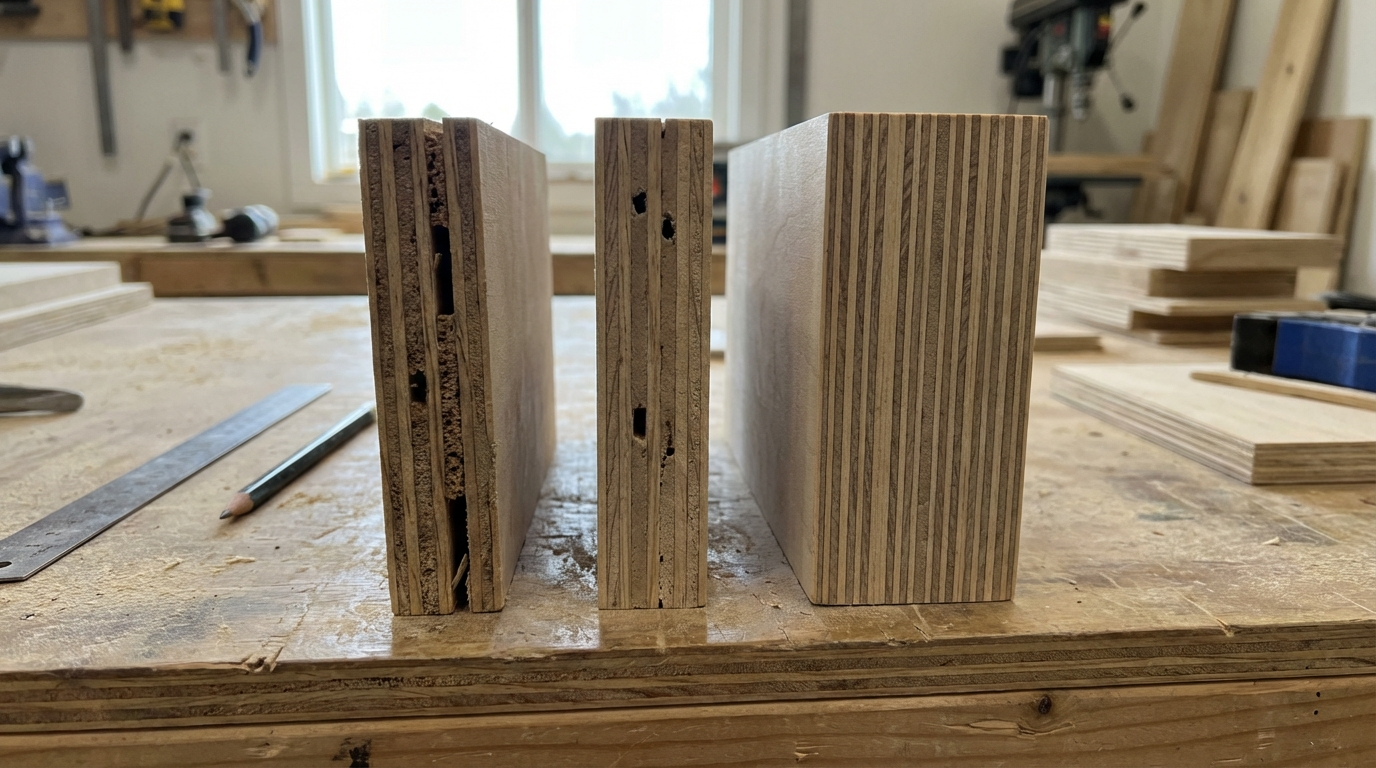
- Inspect core: Hardwood (poplar/eucalyptus), no visible gaps, uniform density.
- Verify grade & finish: BWR/BWP stamp, 0.6mm+ face veneer, calibrated edges.
- Test on-site: Knock test, edge straightness, weight handling. Reject if uneven.
Skipping steps risks sagging shelves or peeling laminates post-install—common in rushed contractor jobs.
What thickness is best for kitchen cabinet plywood?
18mm is ideal for most Indian kitchen cabinets—strong enough for 20-30kg utensil loads without deflection, yet not overly heavy for carpenters. Use 16mm for lighter modular units or upper cabinets; 12mm only for internal partitions with extra bracing. Thinner risks bowing under weight/humidity; thicker (19-25mm) adds cost unnecessarily unless heavy stone tops. In humid zones, thicker aids stability. Verify: Stack weights on a sample; no sag >1mm means good. Balance with budget—thicker often 20-30% pricier.
Best Plywood Grades for Kitchen Cabinets
MR (moisture resistant) suits dry interiors but fails in kitchens from steam ingress. BWR (boiling water resistant) handles spills/monsoon better via phenolic glues. BWP (boiling water proof, akin to IS 710 marine) excels in high-wet zones. For kitchens: BWR minimum; upgrade to BWP near sinks. Confusion arises as "MR" gets marketed broadly—always confirm boil test capability via seller demo.
Is BWR plywood good enough for kitchen cabinets?
Yes, BWR plywood works well for most Indian kitchens with moderate moisture—its glue withstands 4-6 hour boils, resisting delamination from daily spills. Better than MR, which bubbles in 1-2 hours. However, in coastal/high-steam setups, BWP outperforms with deeper glue penetration. Trade-off: BWR is often 15-25% cheaper. Verify: Ask for grade certificate or edge-wet test. Seal all cuts with putty/paint immediately post-cut to extend life. Expect 7-10 years with care.
Core Types: Hardwood vs Softwood for Kitchens
Hardwood cores (poplar, eucalyptus) offer density for screw-holding and sag resistance—essential for loaded cabinets. Softwood (pine) is lighter/cheaper but compresses under weight, causing loose hinges. Check: Core should feel heavy, uniform; no soft spots when pressed. Calibrated cores ensure flush laminates.
Which core is best for kitchen plywood?
Solid hardwood core like eucalyptus or mixed hardwoods—dense (500-600kg/m3), grips screws tightly, resists warping in humid kitchens. Avoid gap-filled or recycled softwood cores that sag or crack. Premium: 100% poplar for uniformity. Cost driver: Hardwood adds 10-20% premium. Inspect: Cut a small edge sample; tight annual rings, no voids. For carpenters: Pre-drill hinges in dense zones to avoid splits. This choice cuts returns by half in modular setups.
Price Range and Cost Drivers (India)
Expect Rs 80-160 per sq ft for 18mm BWR/BWP kitchen plywood—lower in inland hubs like Delhi (Rs 80-120), higher in coastal cities (Rs 110-160) due to logistics. Drivers: Grade (BWP +20-30%), core quality (+10-15%), thickness (+15% per mm), face veneer thickness, calibration/finish. Add 10-15% for delivery/wastage.
- Budget quote checklist: Specify "18mm BWR hardwood core, calibrated, 0.6mm veneer both sides."
Mini example: 10x6ft kitchen (60sqft carcass + shutters): Rs 6,000-11,000 base + Rs 1,000 fittings.
Decision Framework: Match Your Kitchen to Plywood
| Condition | Recommended Plywood | Key Verifications |
|---|---|---|
| High moisture (sink/stove) | BWP 18mm hardwood core | Boil-resistant stamp, dense core tap-test solid |
| Moderate humidity (inland) | BWR 18mm hardwood | 0.6mm veneer, calibrated edges align |
| Heavy load/utensils | 18-19mm dense core | Weight test: no sag under 25kg |
| Coastal/monsoon | BWP 18mm poplar core | Plastic-wrapped sheets, no storage gaps |
| Tight budget/light use | BWR 16mm hardwood | Glue line even, no chemical smell |
| Scratch-prone kids/pets | 18mm + HDHMR alt | Hard face, laminate-ready surface |
Trade-offs and Limitations
- BWP strongest but 20-30% pricier; overkill for dry corners.
- 18mm rigid but heavier (carpenter strain); 16mm easier handling, needs bracing.
- Hardwood cores screw-best but check seasonal shrinkage in AC shifts.
- All plywood warps if unsealed—needs immediate edge treatment.
MR vs BWR vs BWP: Which for kitchen cabinets?
BWR or BWP for kitchens—MR limits to dry zones. BWR balances cost/moisture (4hr boil); BWP for extremes (8hr+ boil). In India, BWR suffices 80% cases unless coastal. Trade-off: BWP harder to source inland. Choose by exposure: Spill-test sample. Next: Seal with epoxy putty; maintain exhaust fans. Lifespan: MR 2-4yrs wet; BWR/BWP 7-12yrs.
Common Buyer Mistakes and How to Avoid Them
- Mistake 1: Picking MR for kitchens (cheap lure). Why: Fails fast. Fix: Demand BWR+ demo.
- Mistake 2: Ignoring core (focus face only). Why: Sags later. Fix: Press-test density.
- Mistake 3: Thin sheets for shutters. Why: Warps. Fix: 18mm min.
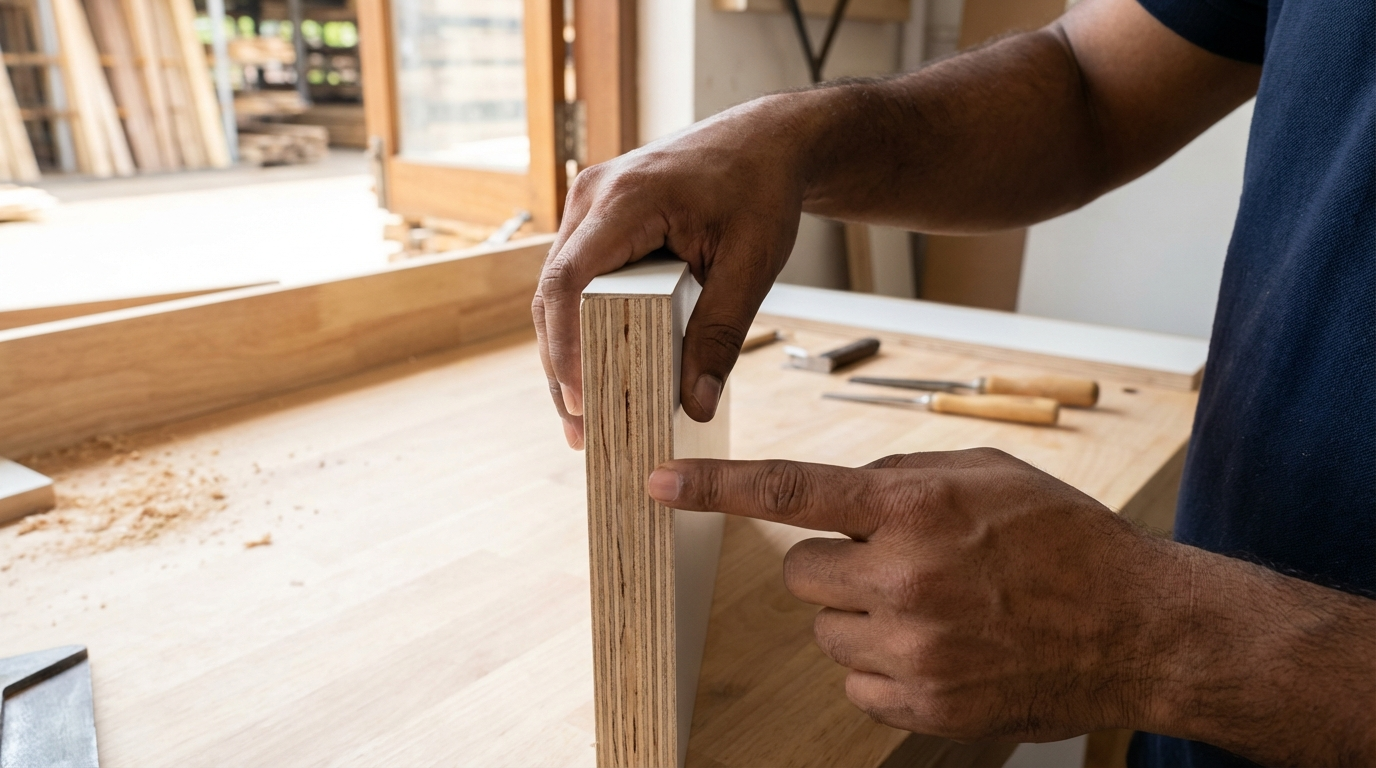
- Mistake 4: No calibration check. Why: Laminate bubbles. Fix: Ruler on edges.
- Mistake 5: Bulk buy without sample. Why: Batch variance. Fix: Test one sheet first.
- Mistake 6: Skipping edge sealing. Why: Water wicks in. Fix: Putty all cuts Day 1.
- Mistake 7: Coastal no-upgrade. Why: Humidity kills. Fix: BWP mandatory.
- Mistake 8: No ventilation plan. Why: Steam buildup. Fix: Exhaust + gaps.
Failure Modes and Fixes
- Symptom: Peeling laminate. Cause: Poor glue/veneer. Prevent: 0.6mm+ face. Fix: Re-laminate sealed edges.
- Symptom: Delamination layers. Cause: Moisture ingress. Prevent: BWR+. Fix: Dry out, epoxy reglue.
- Symptom: Sagging shelves. Cause: Weak core/thin. Prevent: 18mm hardwood. Fix: Add battens.
- Symptom: Loose hinges. Cause: Soft core. Prevent: Dense wood. Fix: Plug + re-screw.
- Symptom: Edge swelling. Cause: Unsealed cuts. Prevent: Immediate sealing. Fix: Trim + putty.
- Symptom: Warping bow. Cause: Humidity imbalance. Prevent: AC control. Fix: Clamp flatten.
Quality Checks You Can Do Without Lab Tests
- Before buying: Tap whole sheet (solid thud = good core); ruler edges (calibrated <0.5mm variance); press face (no dent).
- After cutting: Check glue lines even, no resin bleed, core tight.
- Post-install: Level cabinets, seal joints silicone, clean spills immediately.
Can I use 12mm plywood for kitchen cabinets?
12mm works for light shelves/partitions with metal bracing, but not shutters—risks deflection under pots. In India, pair with 18mm frames for stability. Avoid solo in humid spots. Upgrade to 16mm for balance. Verify: Load-test sample. Good for budget modular if reinforced.
For Homeowners: Durability Do's and Don'ts
- Do: Wipe spills instantly, use exhaust, annual edge check.
- Don't: Stack heavy wet items, skip sealing, overload shelves.
For Carpenters: Handling and Fitting Tips
- Pre-drill hinges 5mm from edge in dense core zones.
- Cut with fine blade; seal within hours.
- Fasten every 150mm; use SS screws.
For Architects: Spec Writing Essentials
Specify "BWR/BWP IS-compliant, 18mm hardwood core, calibrated ±0.3mm, 0.6mm veneer." Detail wet-zone BWP, ventilation min 10% open area.
FAQs
Which is better for kitchen: plywood or MDF?
Plywood edges out MDF for kitchens—stronger screw hold, better moisture resistance in BWR/BWP grades. MDF swells easier without sealing, suits dry cabinets only. In Indian humidity, plywood's cross-layers prevent warp. HDHMR MDF alternative for high-moisture if sealed. Choose plywood for load-bearing; verify core density. Cost similar, but plywood lasts longer with proper finish.
Is waterproof plywood necessary for kitchens?
Not fully "waterproof," but BWP (marine-grade) closest—handles prolonged wet exposure. BWR sufficient for spills if sealed. Indian kitchens need resistance over proof due to steam cycles. Avoid MR. Confirm via seller boil demo. Seal edges religiously; add chimney for steam control to hit 10-year mark.
How much plywood for a standard kitchen?
A 10x10ft L-shaped kitchen needs 80-120sqft (carcass, shutters, shelves)—varies by design depth. Add 15% wastage. Modular: Less due to panels. Measure precisely; consult carpenter for cut plan. Factor thickness: 18mm common.
Does plywood thickness matter for cabinets?
Yes—18mm prevents sag/flex under daily use; thinner bows with utensils. 16mm ok reinforced; 12mm niche only. Humidity amplifies issues. Test load; spec in drawings for contractors.
What veneer thickness for kitchen plywood?
0.6-1.2mm face/back—ensures laminate bonds without bubbling. Thinner peels easy. Check visually (shiny, even); reject wavy. Premium adds life to finishes.
Hardwood or softwood core for kitchens?
Hardwood (eucalyptus/poplar)—superior density, screw grip, humidity stability. Softwood cheaper but fails faster. Press-test; prefer 100% hardwood.
Calibrated vs non-calibrated plywood?
Calibrated mandatory for kitchens—uniform thickness (<0.5mm variance) for flush laminates/alignment. Non-calibrated causes gaps/swells. Ruler check edges; insist on it.
Best finish for kitchen plywood cabinets?
Laminate (2-3mm thick, moisture barrier) over veneer—scratch/stain resistant. Acrylic for premium shine. Seal edges first; avoid paint-only in wet zones.
Disclaimer: This content is provided for general informational purposes based on industry practices and publicly available information. Product specifications, standards, prices, and availability may vary by manufacturer, region, and time. Readers should independently verify details with manufacturers, dealers, or qualified professionals before making purchase or construction decisions.Want Plywood Suggestions?
Share a few details and a Duro BOIL specialist will suggest suitable brands and connect you to responsive dealers.