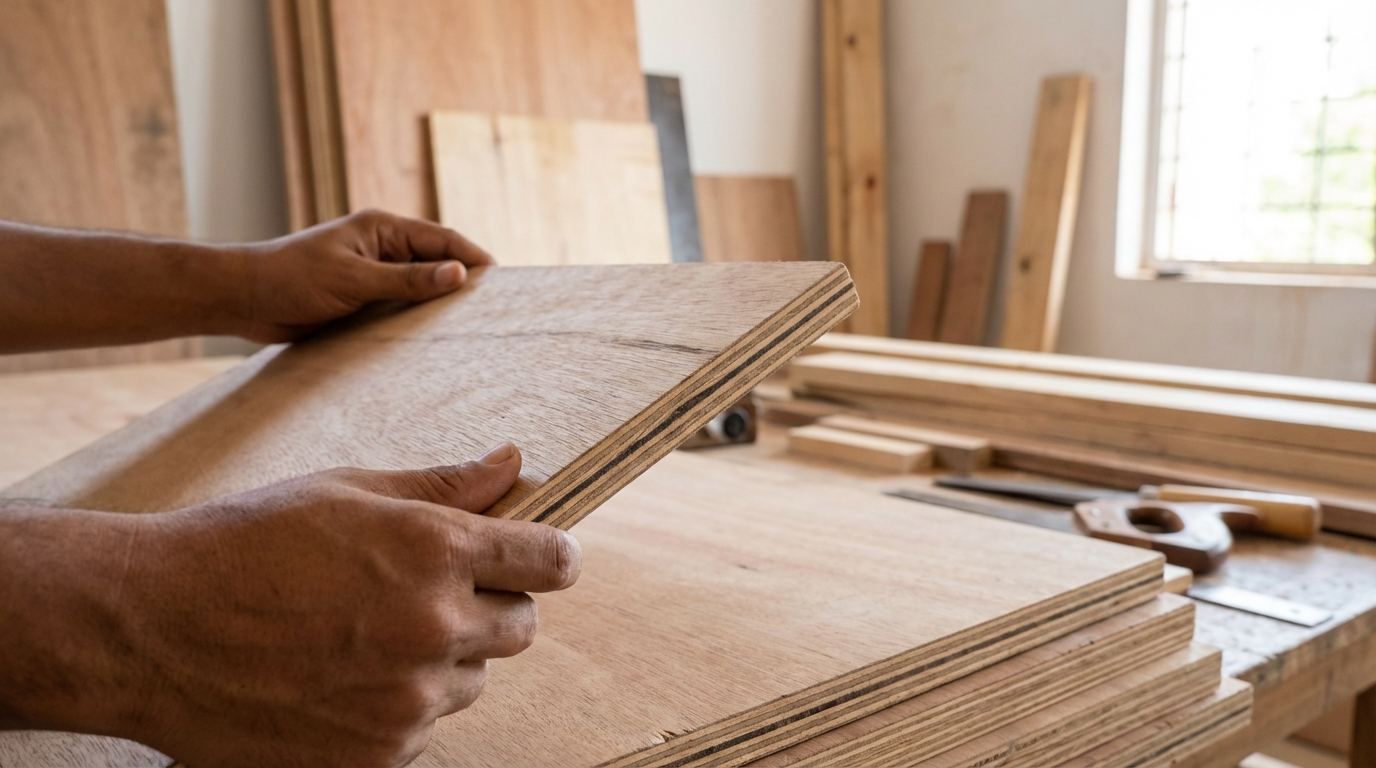
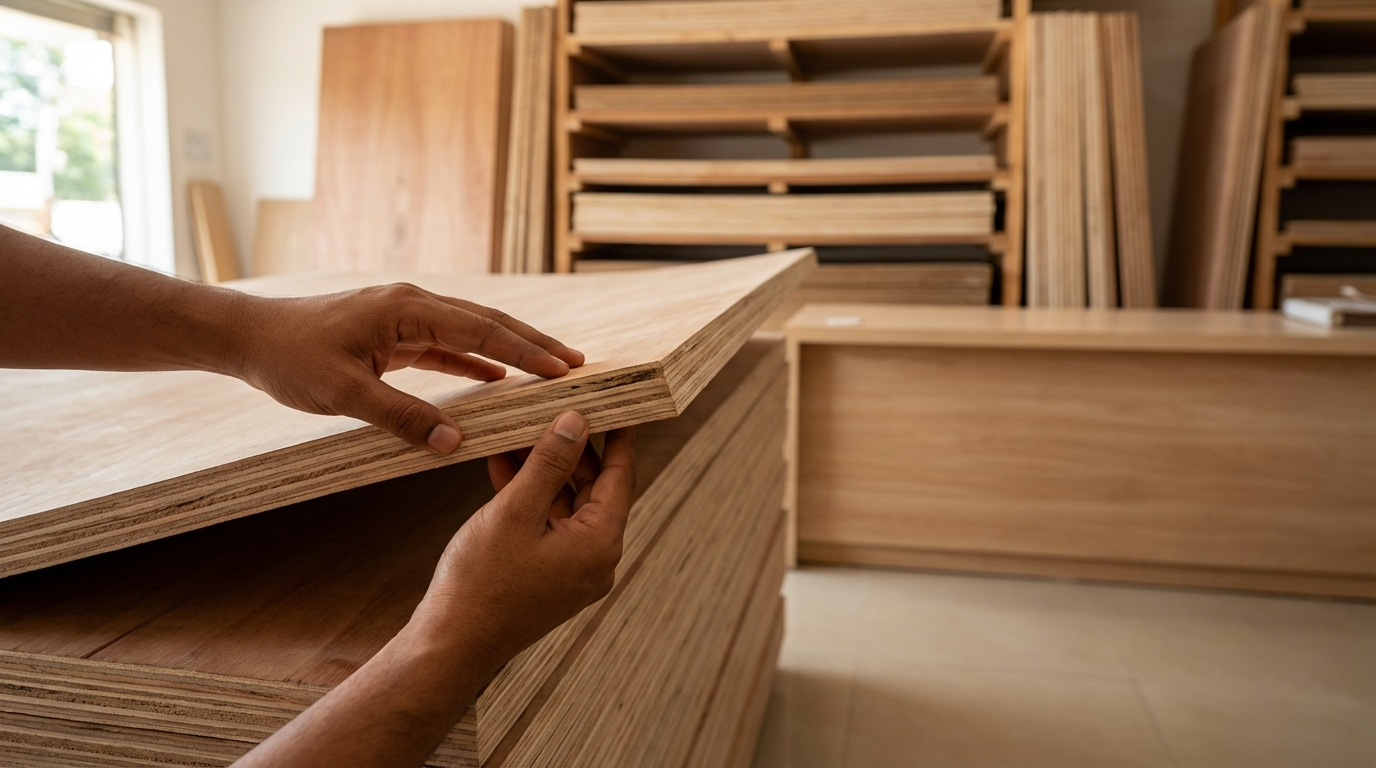
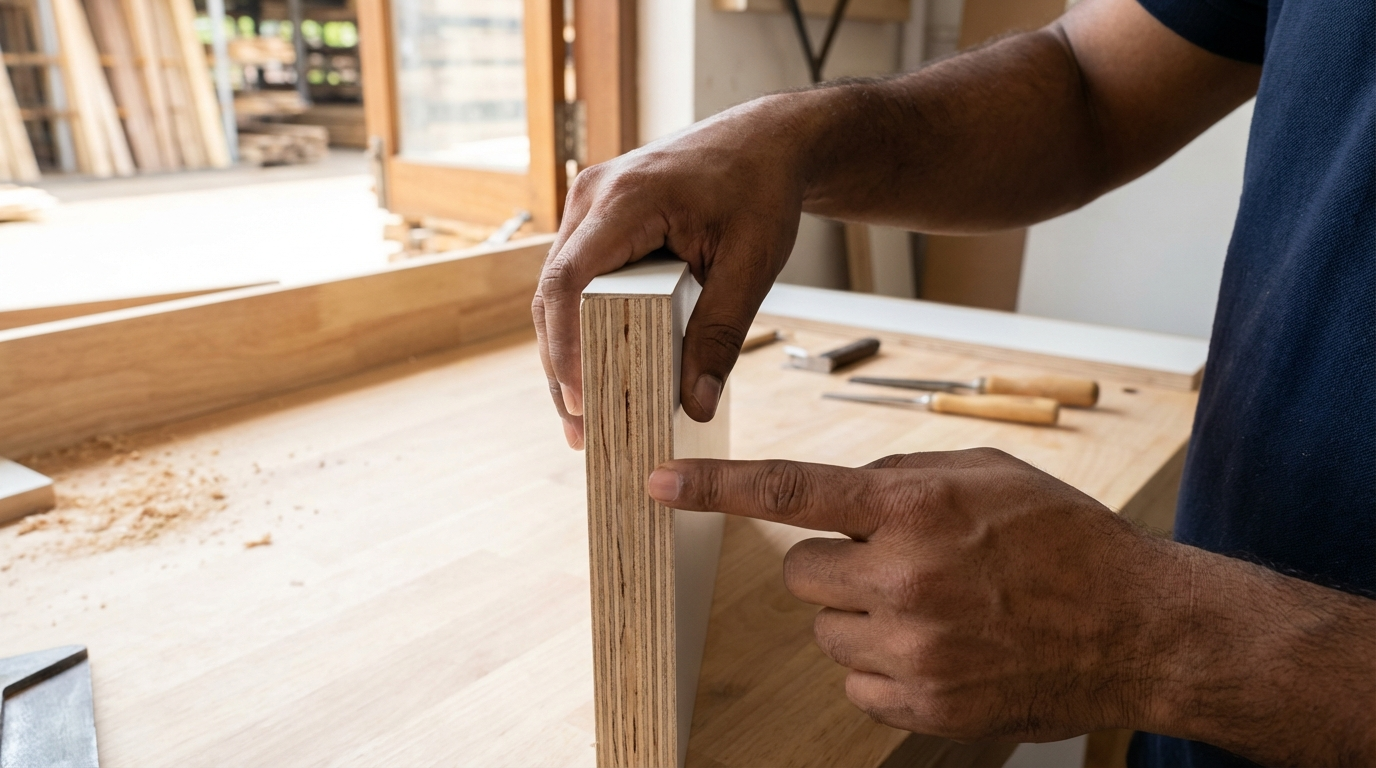
Blockboard Price: Per Sq Ft Rate + Thickness-wise Guide (8x4 Sheet Cost)
Blockboard price guide with thickness-wise rate ranges, 8x4 sheet cost examples, and a checklist to compare core quality and avoid warping issues.
Quick Decision Summary
Best answer in one line: Blockboard prices in India typically range from ₹28 to ₹75 per square foot depending on thickness, core timber species, and face veneer quality.
If you're in a hurry: For standard 19mm blockboard in 8×4 size, expect to pay between ₹1,400 and ₹2,800 per sheet for decent commercial-grade options, while premium hardwood-core variants with calibrated thickness can reach ₹3,500 or more. The price varies significantly based on whether the core uses softwood strips (poplar, pine) or hardwood (teak, sal), and whether the face veneer is decorative or plain. Always confirm core gap quality and face veneer thickness before finalising, as these affect both cost and long-term performance. City-wise logistics, GST, and dealer margins add another 8–15% variation.
- Choose blockboard if: You need wide, stable panels for flush doors, tabletops, or partitions where lightweight handling and screw-holding in edges matter.
- Avoid blockboard if: The application involves continuous moisture exposure, load-bearing shelves, or requires cutting into narrow strips (core strips may show at edges).
What Blockboard Actually Means (And Where Confusion Starts)
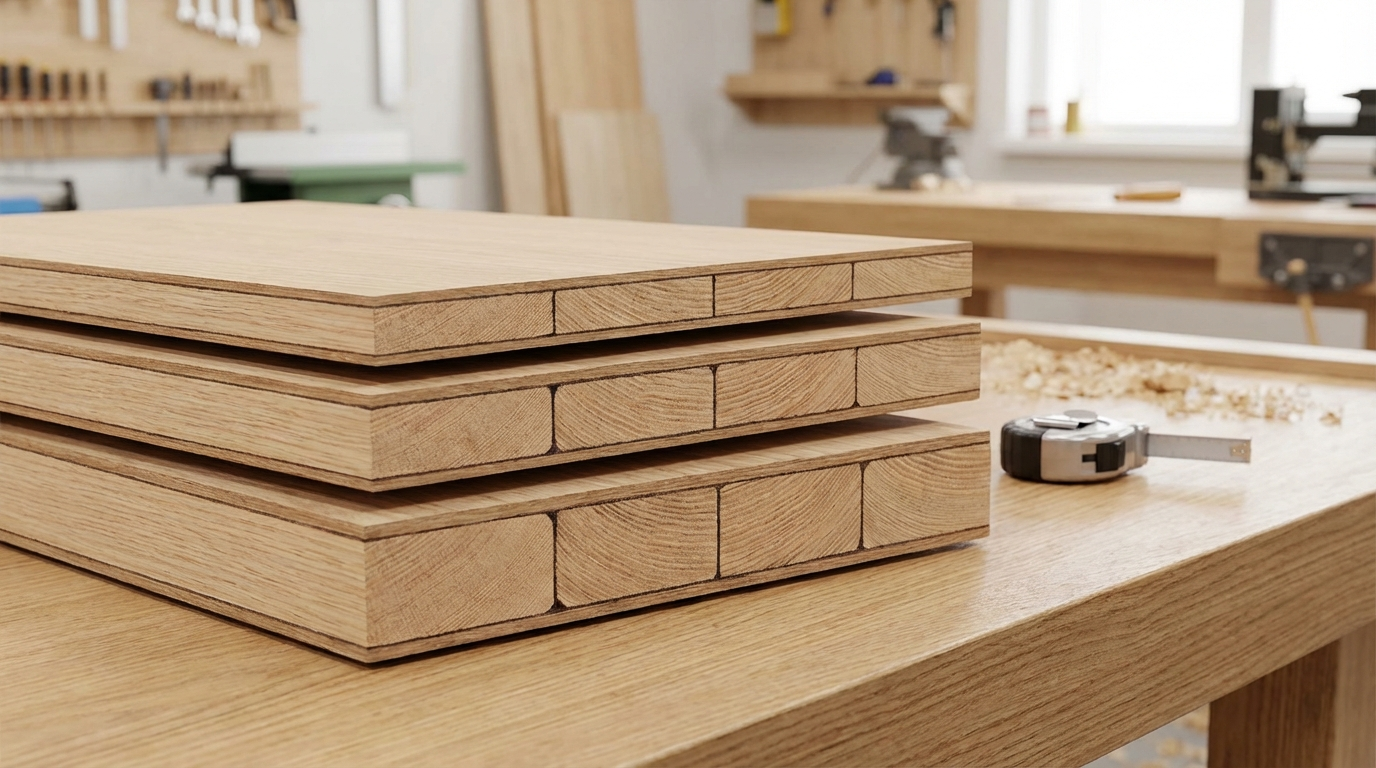
Blockboard is an engineered panel made by sandwiching solid timber strips (typically 25–30mm wide) between two outer veneer layers. The strips run in one direction, and the face veneers are cross-laminated for stability. This construction makes blockboard lighter than solid plywood of equal thickness while offering excellent screw-holding at edges—ideal for flush doors and large furniture panels.
Where People Get Confused About Blockboard
- Blockboard vs plywood: Many assume they're interchangeable. Blockboard has a solid-strip core; plywood has cross-laminated veneer layers throughout. Plywood is stronger for shelving and structural use; blockboard is better for wide, flat panels needing edge screwing.
- Thickness terminology: "19mm blockboard" often measures 18–18.5mm after sanding. Calibrated blockboard maintains true thickness, but costs more.
- Core species impact: Poplar-core blockboard is significantly cheaper than hardwood-core, but warps more easily in humid conditions. The label rarely specifies this clearly.
- Face veneer vs decorative veneer: Standard blockboard has plain veneer faces meant for lamination. Decorative-veneered blockboard (teak, oak face) costs 40–70% more and is meant for polishing.
- BWR/BWP claims: Some sellers market blockboard as "waterproof." Blockboard inherently has gaps between core strips; even with phenolic glue, it handles moisture worse than marine plywood. Verify the specific standard if moisture resistance is critical.
Price Range and Cost Drivers for Blockboard in India
Blockboard pricing depends on multiple factors that interact with each other. Understanding these helps you interpret quotes accurately and avoid overpaying for features you don't need—or underpaying and getting quality that fails within months.
Thickness-Wise Price Ranges (Per Square Foot)
| Thickness | Softwood Core (Poplar/Pine) | Hardwood Core (Mixed/Eucalyptus) | Premium Hardwood Core (Teak/Sal) |
|---|---|---|---|
| 12mm | ₹22–₹32 | ₹30–₹42 | ₹40–₹55 |
| 16mm | ₹28–₹38 | ₹36–₹50 | ₹48–₹65 |
| 19mm | ₹32–₹45 | ₹42–₹58 | ₹55–₹75 |
| 25mm | ₹38–₹52 | ₹50–₹68 | ₹65–₹90 |
Note: Rates vary by region, brand positioning, and market conditions. Confirm locally before budgeting.
8×4 Sheet Cost Examples (Indicative)
A standard 8×4 sheet equals 32 square feet. Using the ranges above:
- 19mm poplar-core commercial: ₹1,024–₹1,440 per sheet (32 × ₹32–₹45)
- 19mm mixed hardwood-core: ₹1,344–₹1,856 per sheet
- 19mm premium hardwood-core: ₹1,760–₹2,400 per sheet
Add 8–18% for GST, transport, and dealer margin depending on your city and order volume.
What Drives Blockboard Prices Up or Down?
- Core timber species: The single biggest cost factor. Poplar/pine cores are cheapest but warp-prone. Hardwood cores (eucalyptus, mixed tropical) cost 25–40% more but hold shape better.
- Face veneer thickness: Thin 0.3mm veneers reduce cost but show core telegraphing after lamination. Thicker 0.5–0.8mm veneers hide imperfections and improve finish.
- Calibration: Machine-sanded to exact thickness adds ₹3–₹8 per sq ft but ensures flush laminate application and consistent shutter alignment.
- Glue type: MR-grade (urea formaldehyde) is standard. BWR-grade (phenolic resin) adds 15–25% to cost and marginally improves humidity resistance.
- Core gap quality: Tightly packed strips with minimal gaps cost more but prevent surface undulation and improve screw-holding.
- Brand positioning: Established brands charge 10–20% premium for QC consistency and warranty backing.
- City and logistics: Metro cities have competitive pricing; tier-2/3 towns may see 8–15% higher rates due to transport costs.
How to Ask for a Blockboard Quote (Checklist)
When requesting quotes, specify these line items to get comparable pricing:
- Exact thickness required (in mm, not nominal)
- Core timber type (poplar, eucalyptus, mixed hardwood, etc.)
- Face veneer type (plain for lamination vs decorative)
- Glue grade (MR or BWR)
- Calibrated or non-calibrated
- Quantity (per-sheet price drops with volume)
- Delivery location and GST inclusion
Mini Budget Example: 10-Door Flush Door Project
For 10 flush doors (each door uses approximately 1.5 sheets of 19mm blockboard):
- Sheets needed: 15 sheets (including 10% wastage)
- Mixed hardwood-core 19mm at ₹1,600/sheet: ₹24,000
- Add laminate, edge banding, hardware: Varies separately
- With GST and transport: Budget ₹26,000–₹28,000 for blockboard alone
India-Specific Reality Check for Blockboard
Blockboard performs differently across India's climate zones. What works in Rajasthan may fail in Kerala within a year. Understanding these realities prevents costly replacements.
How Does Monsoon Humidity Affect Blockboard Performance?
Blockboard's core strips absorb moisture through exposed edges and any gaps between strips. During monsoons, especially in coastal areas and high-humidity zones (Mumbai, Chennai, Kolkata, Kerala), blockboard panels can swell unevenly, causing doors to jam and panels to bow. The face veneer may also bubble or delaminate if the underlying glue isn't phenolic-based.
Practical response: In high-humidity regions, always seal all edges (including hinge cutouts) with PU sealer or edge banding. Specify BWR-grade glue if budget permits. For critical applications like main doors, consider marine plywood instead.
Storage and Handling Problems on Indian Sites
Blockboard sheets stored flat on uneven surfaces or leaning at angles develop permanent warps. Site conditions—dust, rain exposure during construction, stacking with wet materials—damage boards before they're even installed.
What to do: Inspect sheets upon delivery. Reject visibly warped or water-stained sheets. Store flat on level supports, off the floor, with protective covering. Don't accept boards that have been stored outdoors.
Workmanship Variables That Affect Blockboard Longevity
Even premium blockboard fails if edges aren't sealed, hinges are mounted in weak zones, or panels are installed against wet walls without backing gaps. Carpenter skill and site supervision matter more than brand choice in many Indian projects.
How to Choose Blockboard in 5 Steps
Step 1: Define the Application
Blockboard excels for flush doors, large tabletops, partitions, and panels where edge screwing is needed. It's not ideal for narrow strips, shelving under load, or wet-zone applications. Match the application to the material's strengths.
Step 2: Select Core Timber Based on Location
For coastal or high-humidity areas, invest in hardwood cores (eucalyptus or better). For air-conditioned interiors in dry regions, poplar-core may suffice if budget is tight. The core species affects warping risk more than glue grade.
Step 3: Decide on Calibration Need
If you're using high-pressure laminates or veneers that show surface undulation, calibrated blockboard is worth the premium. For painted or low-gloss finishes, non-calibrated may work if core quality is good.
Step 4: Verify Core Gap Quality Before Buying
Ask to see a cut edge or request a sample. Wide gaps between core strips cause surface waviness, weak screw-holding, and early failure. Tight, uniform strips indicate better manufacturing.
Step 5: Confirm Edge Sealing Plan
Before purchase, plan how all exposed edges will be sealed—edge banding, PU sealer, or lipping. Unsealed edges are the primary moisture entry point and the most common cause of blockboard failure.
Trade-offs and Limitations of Blockboard
Blockboard isn't universally superior or inferior—it has specific strengths that come with corresponding limitations:
- Lightweight vs strength: Easier to handle than equal-thickness plywood, but lower bending strength for shelving applications.
- Edge screw-holding vs face screw-holding: Excellent for screws into edges (hinge zones), but face screwing into core strips can be inconsistent.
- Cost vs moisture resistance: Cheaper than marine plywood but handles humidity worse. The savings may not be worth it in wet zones.
- Large panel stability vs narrow strips: Great for wide doors and tabletops; cutting into strips below 100mm width exposes core gaps and looks unfinished.
- Plain face vs decorative finish: Standard blockboard needs lamination; decorative-veneered options cost significantly more.
Common Buyer Mistakes and How to Avoid Them
Mistake 1: Choosing Blockboard for Shelving
Why it happens: Buyers assume any thick board works for shelves. Blockboard's parallel core strips create weak points under distributed load, leading to sagging.
What to do instead: Use plywood (cross-laminated structure) for shelves over 600mm span, or add mid-supports if blockboard is unavoidable.
Mistake 2: Ignoring Core Species
Why it happens: Sellers rarely volunteer core timber information; buyers focus on thickness and price only.
What to do instead: Explicitly ask for core species. Inspect cut samples. Budget 20–30% more for hardwood cores in humid climates.
Mistake 3: Skipping Edge Sealing
Why it happens: Carpenters rush to finish; edge sealing adds time and cost. Unsealed edges look fine initially.
What to do instead: Include edge sealing in the work order and verify before final payment. Check hinge cutouts and back edges especially.
Mistake 4: Buying Based on Per-Sheet Price Alone
Why it happens: The cheapest quote wins without checking actual thickness, core quality, or calibration.
What to do instead: Compare cost per square foot at equivalent specifications. Request samples from shortlisted suppliers.
Mistake 5: Using Blockboard for Main Doors in Coastal Areas
Why it happens: Blockboard flush doors are common and affordable. Coastal humidity isn't considered during purchase.
What to do instead: For main doors in coastal/high-humidity zones, upgrade to marine plywood core or solid timber frame with plywood panel.
Mistake 6: Not Checking for Warps Before Accepting Delivery
Why it happens: Sheets are bundled; checking each one seems tedious. Warps only become obvious during installation.
What to do instead: Unbundle and sight along each sheet's length. Reject sheets with visible bowing. Document and photograph rejected sheets.
Mistake 7: Storing Blockboard Vertically for Extended Periods
Why it happens: Space constraints; vertical storage seems convenient.
What to do instead: Store flat on level supports. If vertical storage is unavoidable, ensure sheets are fully supported and used within days.
Mistake 8: Assuming BWR Label Means Waterproof
Why it happens: Marketing language conflates water-resistant with waterproof. Buyers expect bathroom-ready performance.
What to do instead: Understand that BWR improves glue-line humidity tolerance, not the core timber. For wet zones, marine plywood or WPC alternatives are safer.
Failure Modes and Fixes for Blockboard
Failure Mode 1: Surface Undulation (Telegraphing)
Symptom: Wavy surface visible through laminate, especially in raking light.
Root cause: Wide gaps between core strips or thin face veneer over uneven core.
Prevention: Use calibrated blockboard with tight core gaps; choose thicker face veneers.
Fix if already happening: Surface filling before re-lamination is possible but labour-intensive. For critical surfaces, replacement is often more practical.
Failure Mode 2: Edge Swelling
Symptom: Edges expand, laminate lifts, doors won't close.
Root cause: Moisture ingress through unsealed edges, especially in kitchens and bathrooms.
Prevention: Seal all edges before installation. Use edge banding or PU sealer on hinge cutouts.
Fix if already happening: Trim swollen edges, dry thoroughly, seal properly, and consider edge lipping for future protection.
Failure Mode 3: Panel Warping
Symptom: Door or panel bows, won't sit flat.
Root cause: Softwood core absorbing uneven moisture; improper storage before installation; one-sided lamination creating differential stress.
Prevention: Hardwood cores, proper storage, balanced lamination on both faces.
Fix if already happening: Minor warps may flatten under weight over time. Severe warps require replacement.
Failure Mode 4: Delamination of Face Veneer
Symptom: Face veneer bubbles or separates from core.
Root cause: Poor glue-line quality; moisture damage; heat exposure near cooking areas.
Prevention: Verify glue grade; keep away from direct heat; ensure edge sealing.
Fix if already happening: Small bubbles can be injected with adhesive and clamped. Large delamination usually requires panel replacement.
Failure Mode 5: Hinge Screws Pulling Out
Symptom: Door hinges loosen; screws no longer hold.
Root cause: Hinges mounted in weak core zones or into gaps between strips; wrong screw length.
Prevention: Check core strip alignment at hinge positions before mounting. Use longer screws with appropriate anchoring.
Fix if already happening: Plug holes with hardwood dowels and wood glue; re-mount hinges after curing.
Failure Mode 6: Laminate Lifting at Edges
Symptom: Laminate peels away from edges, especially on doors and tabletops.
Root cause: Inadequate edge preparation; impact damage; moisture cycling.
Prevention: Use proper edge banding adhesive; avoid placing hot objects near edges; seal properly.
Fix if already happening: Clean edge, reapply contact adhesive, clamp until cured, then seal.
Quality Checks You Can Do Without Lab Tests
Before Buying: Visual and Tactile Checks
- Sight along the sheet: Look from one end to spot bowing or twisting. Reject sheets with visible warps.
- Check edge quality: Look at cut edges for core strip uniformity. Gaps wider than 2–3mm indicate poor manufacturing.
- Tap test: Tap various spots across the surface. Hollow sounds suggest voids or poorly bonded areas.
- Face veneer inspection: Look for patches, cracks, or rough spots that will show through laminate.
- Measure thickness: Use a caliper at multiple points. Variations over 0.5mm indicate non-calibrated boards.
- Ask for certification: Request ISI mark details or manufacturer test reports. Absence of documentation is a red flag.
After Cutting: Workmanship Cues
- Core strip visibility: Clean cuts show tight, parallel strips. Ragged cuts with visible gaps indicate inferior core quality.
- Sawdust consistency: Fine, uniform sawdust suggests dense timber. Coarse, stringy dust indicates softer or poorly processed core.
- Edge stability: Cut edges should remain crisp. Crumbling or splintering edges suggest low-density core or poor bonding.
After Installation: Ongoing Checks
- Edge seal verification: Run your finger along all edges—any rough, unsealed areas need immediate attention.
- Door operation: Doors should open and close smoothly. Binding or gaps that change seasonally indicate moisture absorption.
- Surface check: After lamination, inspect in raking light for telegraphing. Address before final handover.
Decision Framework: Which Blockboard Specification for Which Condition
| Condition/Requirement | Recommended Specification | What to Verify |
|---|---|---|
| Air-conditioned interior, dry climate | MR-grade, poplar core acceptable | Core gap quality, calibration if using HPL |
| Humid interior, non-coastal | BWR-grade, mixed hardwood core minimum | Edge sealing plan, face veneer thickness |
| Coastal area, high humidity | BWR-grade, hardwood core mandatory | Consider marine plywood for main doors |
| Kitchen cabinets (base units) | BWR plywood preferred over blockboard | If blockboard used, seal all edges including cutouts |
| Flush doors, standard residential | 19mm calibrated, hardwood core for longevity | Core strip uniformity, warp check on delivery |
| Large tabletops, conference tables | 25mm calibrated, hardwood core | Surface flatness, balanced lamination both sides |
| Partitions, wall paneling | 12–16mm, MR-grade usually sufficient | Structural support independent of panel |
| Budget-constrained project | Poplar core, non-calibrated, skip decorative veneer | Accept trade-offs; plan for edge sealing |
Guidance for Homeowners
What Should Homeowners Know About Blockboard Durability?
Blockboard flush doors and furniture can last 15–20 years with proper specification and maintenance. The critical factors are core quality (hardwood lasts longer), edge sealing (prevents moisture damage), and avoiding wet-zone applications unless properly protected. Ask your contractor to show you the blockboard cross-section before approval.
Cleaning and Maintenance Do's and Don'ts
- Do: Wipe with dry or slightly damp cloth. Use mild soap for stubborn marks.
- Do: Check edges annually, especially in kitchens and bathrooms. Reseal if needed.
- Don't: Use excess water near edges or allow standing water on surfaces.
- Don't: Place hot vessels directly on laminated blockboard surfaces.
- Don't: Ignore swelling or jamming—early intervention prevents major damage.
Guidance for Carpenters
How Should Carpenters Handle Blockboard on Site?
Blockboard requires careful handling to prevent damage before installation. Store sheets flat, never on uneven surfaces. Acclimatise sheets to site humidity for 48–72 hours before cutting. When cutting, support the sheet fully to prevent core strip separation. Use sharp blades to avoid splintering.
Edge Preparation and Fastening Zones
- Hinge zones: Locate hinge positions to hit solid core strips, not gaps. Pre-drill to prevent splitting.
- Screw selection: Use 25–30mm screws for 19mm boards; longer screws for thicker boards. Avoid over-tightening.
- Edge banding: Apply edge band before final assembly. Use iron-on or PVC banding with proper adhesive for durability.
- Handle cutouts: Seal all cutout edges with PU sealer before fitting hardware.
Guidance for Architects and Designers
Specification Best Practices for Blockboard
When specifying blockboard, include: thickness (actual, not nominal), core species, glue grade, calibration requirement, and face veneer type. For wet-adjacent areas, specify marine plywood instead or mandate comprehensive edge sealing with waterproof sealant.
Detailing for Longevity
- Door schedules: Specify core type and edge treatment for each door type.
- Junction details: Where blockboard meets masonry, maintain 10mm gap with sealant or beading.
- Ventilation: For enclosed cabinets in humid areas, specify ventilation holes or gaps.
- Finish compatibility: Match calibration requirement to finish type—HPL and veneer demand tighter tolerances than paint.
Guidance for OEM and Modular Furniture Makers
Quality Control Checkpoints for Batch Production
- Incoming inspection: Sample-check thickness, core gaps, and warp on every batch. Reject non-conforming lots.
- Process control: Standardise edge sealing as part of production line, not site work.
- Finished goods check: Verify laminate adhesion, edge band quality, and hardware mounting before dispatch.
- Documentation: Maintain material traceability for warranty claims.
Reducing Returns and Complaints
Most blockboard-related complaints stem from moisture damage (unsealed edges), surface defects (non-calibrated boards with HPL), and hardware failure (screws in weak zones). Address these in design and production stages rather than relying on installation crews. Provide end-user care instructions with every delivery.
FAQs
What is the difference between blockboard and plywood?
Blockboard has a core of solid timber strips running in one direction, sandwiched between veneer faces. Plywood consists entirely of cross-laminated veneer layers throughout its thickness. This structural difference means plywood offers superior bending strength and is better for shelving, while blockboard is lighter and provides excellent edge screw-holding, making it ideal for flush doors and large panels. Plywood handles moisture better due to its cross-laminated construction, while blockboard's parallel strips can absorb moisture unevenly. Choose based on application—plywood for strength and moisture resistance, blockboard for lightweight panels needing edge fastening.
Why is hardwood core blockboard more expensive?
Hardwood core blockboard uses denser timber species like eucalyptus, sal, or teak for the internal strips. These hardwoods grow slower, cost more to source, and are heavier to process. However, they provide significantly better dimensional stability, resisting warping and moisture absorption more effectively than softwood cores like poplar or pine. In humid Indian climates, this premium often pays for itself by preventing premature failure. The price difference of 25–40% typically translates to 3–5 times longer service life in moisture-prone environments.
Can blockboard be used in bathrooms?
Blockboard is generally not recommended for bathroom applications due to its susceptibility to moisture damage through edge and core absorption. Even BWR-grade blockboard handles humidity worse than marine plywood because the core strips create moisture pathways. If budget constraints require blockboard use in bathroom vanities, ensure all edges are sealed with waterproof sealant, use BWR-grade minimum, and avoid direct water contact zones. For better longevity, marine plywood or WPC boards are more suitable alternatives for bathroom furniture.
How do I check blockboard quality without testing equipment?
Several practical checks reveal blockboard quality. First, sight along the sheet length to detect warping—reject bowed sheets. Second, examine cut edges for core strip uniformity; gaps wider than 2–3mm indicate inferior manufacturing. Third, perform a tap test across the surface—hollow sounds suggest voids or poor bonding. Fourth, measure thickness at multiple points with a caliper; variations exceeding 0.5mm indicate non-calibrated boards. Finally, check face veneer for patches, cracks, or rough spots that will telegraph through laminate. These checks catch most quality issues before purchase.
What causes blockboard doors to warp?
Blockboard door warping typically results from moisture absorption, improper storage, or unbalanced lamination. Softwood cores absorb moisture faster and unevenly, causing differential expansion. Storing sheets vertically or on uneven surfaces before installation creates permanent bows. Applying laminate to only one face creates stress imbalance as the board responds to humidity changes. Prevention requires hardwood cores in humid areas, flat storage on level supports, balanced lamination on both faces, and comprehensive edge sealing to block moisture entry.
Is calibrated blockboard worth the extra cost?
Calibrated blockboard maintains exact thickness throughout the sheet, achieved through precision sanding. This matters significantly when using high-pressure laminates, veneers, or any finish that shows surface undulation. Non-calibrated boards with thickness variations create visible waves under glossy finishes. For painted or low-gloss applications, calibration matters less. The premium of ₹3–₹8 per square foot is justified for modular kitchens, wardrobes with mirror-finish laminates, and any application where surface quality is critical. For basic partitions or painted furniture, non-calibrated boards may suffice.
How long does blockboard furniture typically last?
Well-specified and properly maintained blockboard furniture can last 15–20 years in Indian conditions. Longevity depends heavily on core species (hardwood outlasts softwood), edge sealing quality (unsealed edges fail within 3–5 years in humid areas), and usage environment (air-conditioned spaces preserve boards longer). Flush doors see the most variation—quality hardwood-core doors with sealed edges may outlast the building, while cheap poplar-core doors in humid areas may warp within 2–3 monsoon seasons. Investment in better core quality and proper edge protection pays returns in extended service life.
What thickness of blockboard is best for flush doors?
For standard interior flush doors, 19mm blockboard is the most common and appropriate choice, providing adequate rigidity and hinge-holding capacity. Main entrance doors or doors in high-traffic areas benefit from 25mm thickness for additional robustness. Lighter interior doors in dry areas may use 16mm if weight reduction is prioritised. Always use calibrated thickness when applying high-pressure laminates to avoid surface waviness. Ensure the door frame depth accommodates the chosen blockboard thickness plus laminate on both faces, typically 3–4mm total.
Why do laminate edges lift on blockboard?
Laminate edge lifting on blockboard commonly results from inadequate edge preparation, moisture ingress, impact damage, or thermal cycling. Edges need proper cleaning and adhesive application before banding. Unsealed edges absorb moisture that weakens the adhesive bond. Impact damage from daily use chips edges and creates entry points for further damage. Placing hot objects near edges causes thermal stress. Prevention includes proper edge band application with quality adhesive, sealing all edges including hardware cutouts, using protective edge profiles in high-traffic areas, and maintaining appropriate distances from heat sources.
How does city location affect blockboard prices in India?
Blockboard prices vary 8–15% between cities based on proximity to manufacturing clusters, local dealer competition, and logistics costs. Cities near major plywood manufacturing regions (Gujarat, Kerala, Uttar Pradesh, West Bengal) typically have lower prices due to reduced transport costs. Metro cities often have competitive pricing due to dealer competition despite higher operating costs. Tier-2 and tier-3 towns may see premium pricing due to longer supply chains. Additionally, GST is consistent nationwide, but local handling charges, loading/unloading costs, and last-mile delivery fees vary. Always compare delivered prices inclusive of all charges.
Can I use blockboard for modular kitchen cabinets?
Blockboard can be used for modular kitchen cabinet carcasses with caveats. Upper cabinets in relatively dry zones are acceptable with proper edge sealing. Base cabinets near sinks and cooking areas present higher moisture and heat exposure risks where BWR plywood typically performs better than blockboard. If using blockboard for kitchen cabinets, specify BWR-grade with hardwood cores, ensure comprehensive edge sealing including all cutouts and back panels, and consider plywood for base units under sinks. Many modular kitchen manufacturers prefer plywood throughout for warranty and longevity reasons.
What's the best way to store blockboard on construction sites?
Proper site storage prevents damage before installation. Store sheets flat on level supports at least 100mm off the ground. Use three or more supports along the length to prevent sagging. Cover with tarpaulin or plastic to protect from rain and dust while allowing air circulation. Never lean sheets against walls at angles for extended periods. Keep away from direct sunlight which causes differential drying. Acclimatise sheets to site humidity for 48–72 hours before cutting. Inspect each sheet before use—reject warped, water-stained, or edge-damaged sheets. Document and photograph storage conditions for quality disputes.
Disclaimer: This content is provided for general informational purposes based on industry practices and publicly available information. Product specifications, standards, prices, and availability may vary by manufacturer, region, and time. Readers should independently verify details with manufacturers, dealers, or qualified professionals before making purchase or construction decisions.Want Plywood Suggestions?
Share a few details and a Duro BOIL specialist will suggest suitable brands and connect you to responsive dealers.