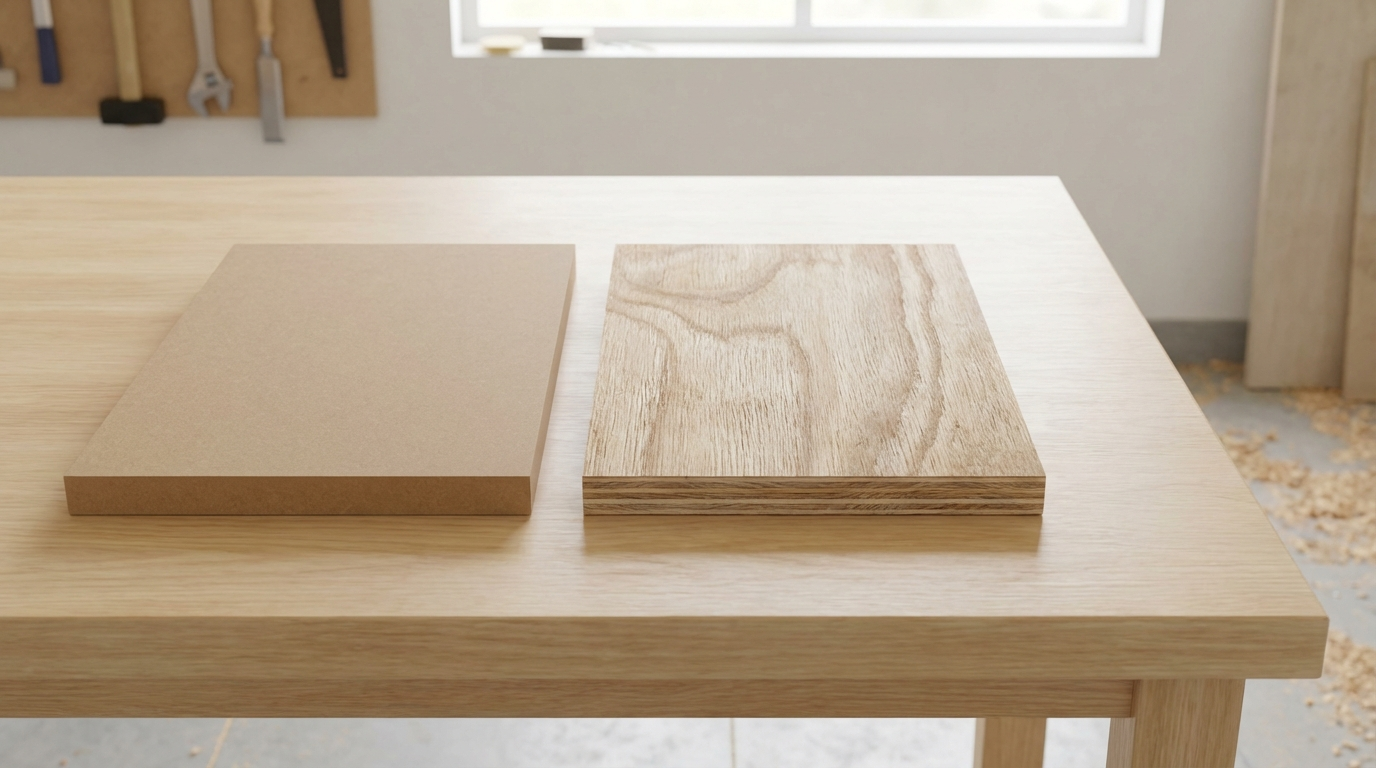
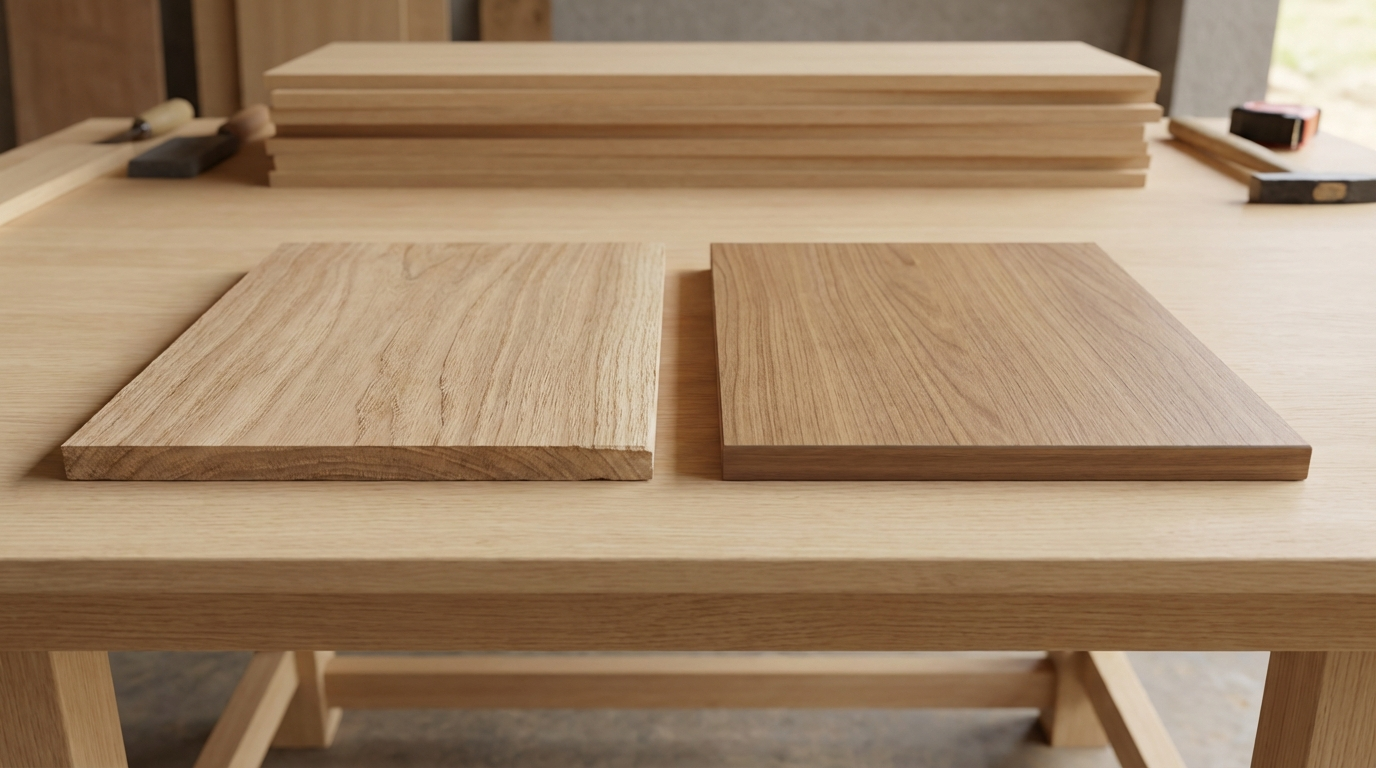
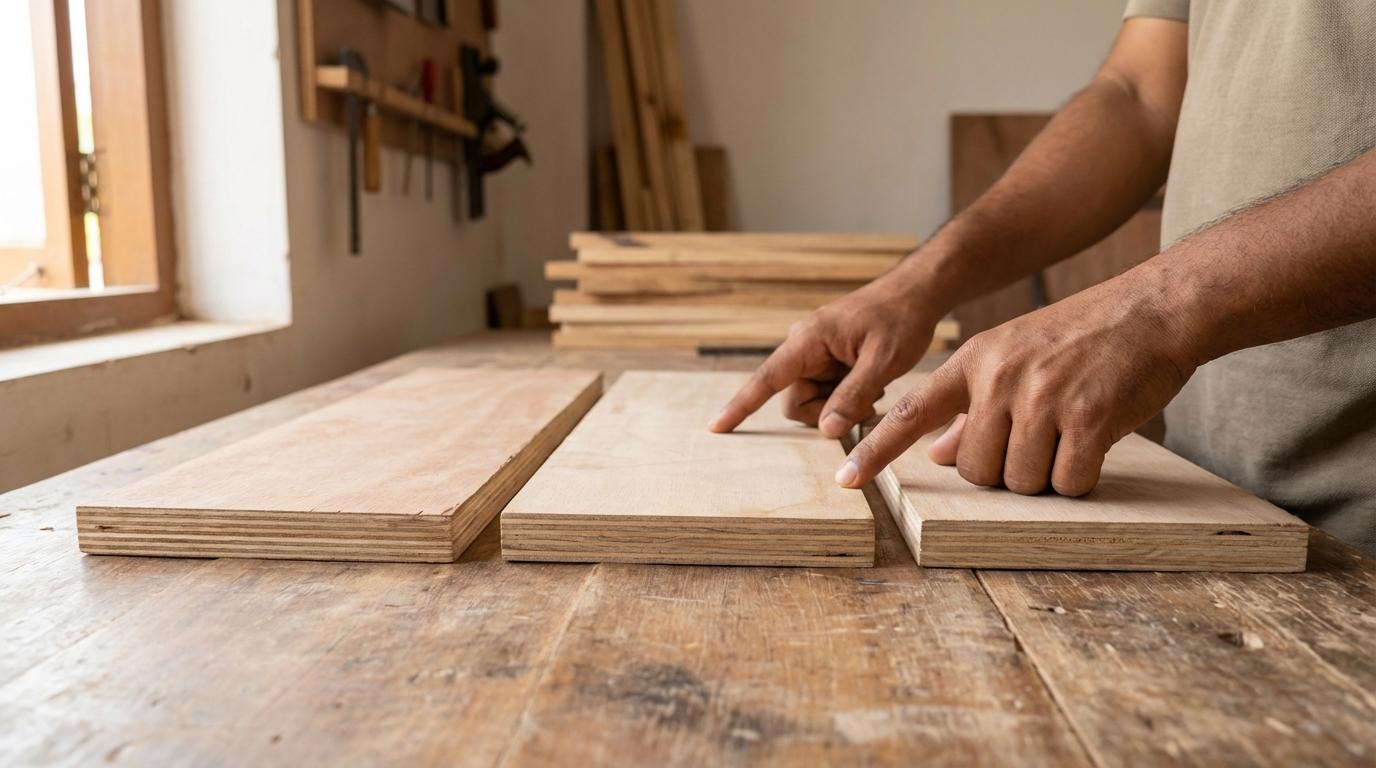
Blockboard vs Plywood: Which is Better for Furniture? Complete Guide
Blockboard vs Plywood comparison with prices, strength & applications. Learn when blockboard beats plywood for doors, shelves & long panels.
Quick Verdict
Blockboard is better for long panels, doors, and partitions where minimal sagging is critical, while plywood wins for heavy-duty applications, moisture-prone areas, and structural furniture. For Indian homes, plywood is the safer all-around choice, but blockboard offers significant cost savings for specific applications where its strengths shine.
If you're in a hurry, here's duroboil.com's bottom-line recommendation: Use plywood for kitchen cabinets, wardrobes, and load-bearing shelves. Choose blockboard for flush doors, wall panels, long bookshelves, and partitions. For the smartest approach, use both materials together—plywood for carcasses and blockboard for doors and large shutters.
- Choose Blockboard if: You need long doors (7+ feet), wall paneling, lightweight partitions, or budget-friendly interior shutters
- Choose Plywood if: You need moisture resistance, heavy load-bearing capacity, kitchen cabinets, or bathroom furniture
- Either works if: You're building dry-area wardrobes, study tables, or TV units with adequate support
Complete Comparison Table
Before diving into details, this comprehensive comparison table from duroboil.com covers all the essential factors you need to evaluate:
| Factor | Blockboard | Plywood | Winner |
|---|---|---|---|
| Core Construction | Softwood strips (25mm wide) sandwiched between veneers | Multiple veneer layers with alternating grain direction | Depends on application |
| Weight | Lighter (softwood core) | Heavier (dense cross-laminated layers) | Blockboard |
| Strength | Good for vertical applications | Superior tensile and load-bearing strength | Plywood |
| Sag Resistance (Long Spans) | Excellent—minimal sagging over long lengths | Moderate—may sag in long unsupported spans | Blockboard |
| Moisture Resistance | Poor (softwood absorbs moisture) | Better (cross-lamination distributes moisture) | Plywood |
| Water/Boiling Water Grades | MR and BWP grades available | MR, BWR, and BWP grades available | Plywood (more options) |
| Screw Holding | Good (into strips), weak at edges/gaps | Excellent across all areas | Plywood |
| Surface Quality | Smooth, paint-ready | Smooth, excellent for lamination | Tie |
| Cutting/Workability | Easy to cut, does not split | May split at edges when cut | Blockboard |
| Warping Resistance | Excellent dimensional stability | Good with proper cross-graining | Blockboard |
| Durability/Lifespan | Good (15-25 years with care) | Excellent (25-50+ years) | Plywood |
| Price (per sq ft) | ₹47-200 depending on grade/thickness | ₹40-300 depending on grade/thickness | Blockboard (slightly cheaper) |
| Available Thickness | 12mm to 50mm | 4mm to 25mm | Blockboard (thicker options) |
| Indian Standard | IS 1659:2004 | IS 303 (MR), IS 710 (BWR/BWP) | Both standardized |
What is Blockboard?
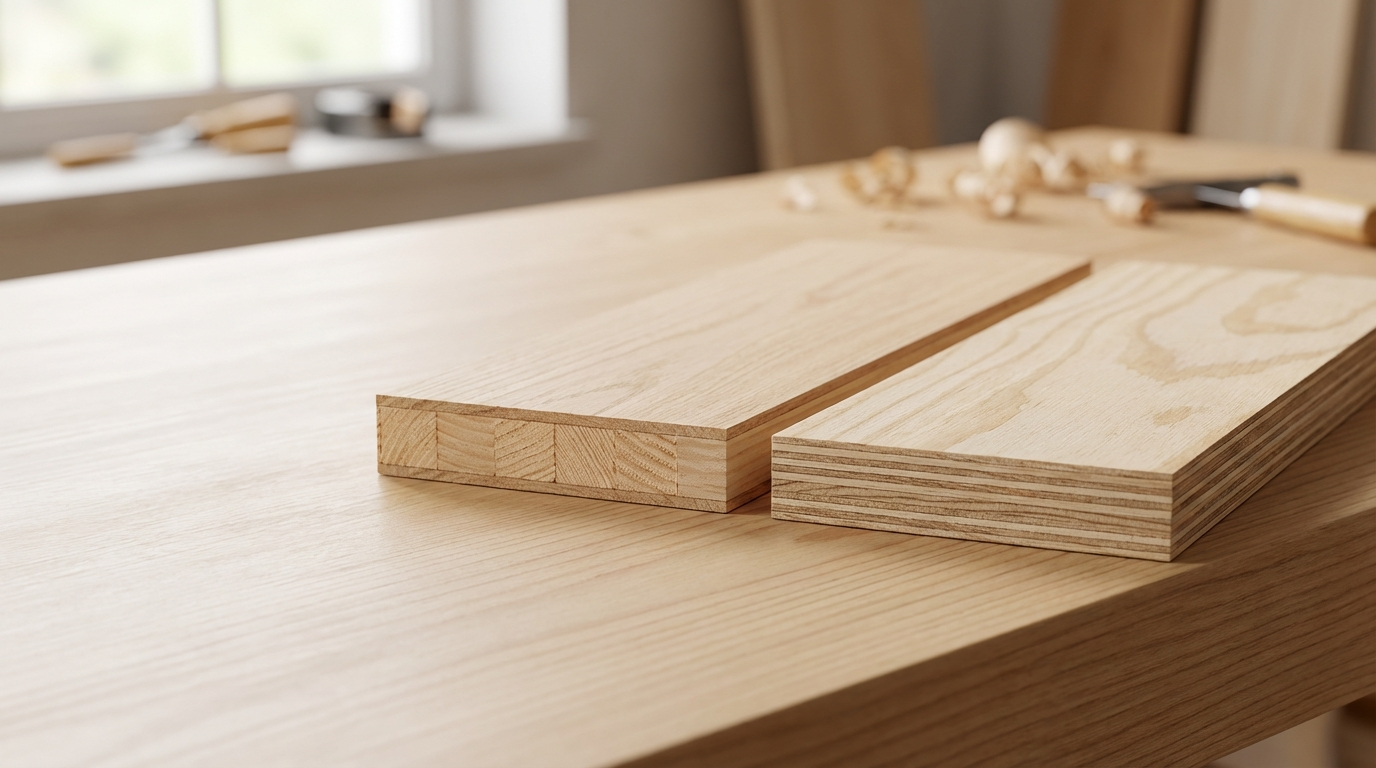
Blockboard is an engineered wood product made by sandwiching a core of softwood strips (usually pine or other fast-growing species) between two layers of hardwood veneer. These strips are arranged edge-to-edge and then bonded under high pressure with adhesives.
In simpler terms, imagine wooden strips (called battens) about 25mm wide, lined up next to each other like a row of dominoes lying flat. These strips are then covered on both sides with thin sheets of hardwood veneer and pressed together with strong adhesives. This creates a sandwich-like structure that's surprisingly strong yet lightweight.
This is because blockboard is stiffer and less prone to bending, unlike plywood. Blockboard is generally used for building long bookshelves, tables and benches, single and double beds, settees, and lengthy wall panels.
How Blockboard is Made
These are engineered wood panels made by sandwiching a core of wooden strips between two layers of veneer. The core strips are usually around 25mm wide and placed edge to edge. The entire board is then glued under high pressure to form a solid, smooth panel.
The manufacturing process involves:
- Cutting softwood timber into strips (typically 25-38mm wide)
- Arranging strips edge-to-edge to form the core
- Applying core veneer (1.5-2.5mm thick) on both sides
- Adding face veneer (0.25-0.45mm thick) for smooth finish
- Bonding under high pressure with adhesives
What is Plywood?
Plywood is a versatile material made by gluing together multiple layers (or 'plies') of thin wood veneers, with the grain of each layer running perpendicular to the next. This cross-graining gives plywood its strength and reduces the chances of warping or splitting.
Think of plywood like a stack of thin wood sheets, each rotated 90 degrees from the one below it. When these layers are glued together, they create a material that's stronger than a solid wood piece of the same thickness because the cross-grain construction distributes stress in all directions.
Plywood is composed of a number of thin layers, or plies of wood veneer glued together with each layer's grain direction rotated 90 degrees from the preceding one. This cross-graining technique provides plywood its strength and resistance to warping or cracking.
Plywood Grades Available in India
- MR Grade (Moisture Resistant): Ideal for indoor furniture
- BWR Grade (Boiling Water Resistant): For kitchens and bathrooms
- BWP/Marine Grade: Extreme water resistance
- Fire Retardant Grade: Great for offices, hotels, and public buildings
Detailed Comparison
Moisture and Water Resistance
This is where plywood clearly dominates. Plywood is less susceptible to moisture than blockboard, because cross-lamination forms a structure in the veneer. The alternating grain directions help distribute moisture evenly and minimize warping.
Moisture damage can be noticed more in blockboard, which has a softwood core, as compared to plywood. Moisture can penetrate the pockets of the softwood blocks and when it is exposed to moist air for sometime, the material will warp or swell.
Blockboard is more prone to water damage as it is known to retain moisture. This makes it unsuitable for kitchens, bathrooms, or any area with high humidity without proper sealing.
Winner: Plywood – For Indian conditions with monsoons and high humidity in many regions, plywood's moisture handling is critical. Always use BWR or BWP grade plywood for wet areas.
Strength and Durability
Plywood outperforms in tensile strength and structural integrity thanks to cross-graining. The layered construction creates exceptional strength that can handle heavy loads, making it ideal for furniture that needs to support weight.
Plywood furniture is stronger and lasts longer than blockboard furniture. If maintained properly, it can easily last up to 50 years or more.
However, blockboard has its own strength advantage. Blockboard, with its solid core, resists long-span sagging better than plywood. Unlike plywood, long panels of blockboard do not sag, which makes it a better choice for making long wall panels, doors, bookshelves, tabletops, benches, panels, flush doors, and partitions.
Winner: Plywood for load-bearing applications; Blockboard for long unsupported spans
Surface Quality and Finishing
Both materials offer excellent surface quality for finishing. Plywood is uniform throughout its length and breadth, and can be easily lacquered, painted, veneered and laminated.
Unlike plywood it does not split on cutting, and is easy to work with. It is available in various finishes such as plastic laminates, wood veneers, etc. It can also be painted and polished.
Winner: Tie – Both accept finishes well, though blockboard's cleaner cutting edges can be an advantage for visible edges.
Working and Machining
Blockboard is easy to cut and does not split, plywood is likely to split on edges when cut. Carpenters often prefer working with blockboard for doors and large panels because it machines cleanly.
Blockboard can be worked with standard tools: it is easily sawn and has good screw-holding and nail-holding properties.
For screw holding, there's a nuance to understand: Blockboard holds fasteners well when driven into the strips, though edge gaps may sometimes cause looseness. Plywood boasts excellent screw‑holding across its veneer layers and resists splitting.
Winner: Blockboard for cutting; Plywood for screw retention
Cost Comparison
Blockboards are cheaper than plywood. This is because the core blockboard uses softwood, which is cheaper than plywood and mainly consists of hardwood veneers.
Here's a practical price comparison based on current Indian market rates:
| Material Type | Price Range (₹ per sq ft) | Best For |
|---|---|---|
| Commercial Blockboard (MR) | ₹47-150 | Interior doors, partitions |
| Waterproof Blockboard (BWP) | ₹106-200 | Semi-wet areas |
| Commercial Plywood (MR) | ₹40-80 | Dry area furniture |
| BWR Plywood | ₹51-131 | Kitchens, moderate moisture |
| BWP/Marine Plywood | ₹90-300 | Bathrooms, outdoor use |
While the price of a blockboard is often lower than that of plywood, there are hidden costs that may affect your budget in the long run.
If well taken care of, plywood can last decades, whereas blockboard will need to be replaced much earlier, particularly in moist environments. This implies that although blockboard is less expensive initially, plywood is more valuable in the long term.
Winner: Blockboard for upfront cost; Plywood for long-term value
Application-Based Recommendations
Duroboil.com recommends choosing your material based on specific application needs rather than general preferences:
| Application | Better Option | Reason | Caution |
|---|---|---|---|
| Kitchen Cabinets | Plywood (BWR/BWP) | Moisture and heat resistance essential | Never use MR grade or blockboard in kitchen |
| Bathroom Furniture | Plywood (BWP) | Direct water exposure requires waterproofing | Marine grade mandatory |
| Flush Doors | Blockboard | Lightweight, no sagging, cost-effective | Use BWP grade for main doors |
| Wardrobe Shutters (7ft+) | Blockboard | Won't sag, lighter on hinges | Ensure quality hinge installation |
| Wardrobe Carcass | Plywood | Load-bearing, screw retention | Minimum 12mm for shelves |
| Bookshelves (long spans) | Blockboard | Superior sag resistance | Add vertical supports for heavy loads |
| TV Unit | Plywood | Screw holding for brackets/hinges | 18mm minimum for mounting brackets |
| Study Table | Either | Both work well for dry applications | Consider blockboard for large surface |
| Wall Paneling | Blockboard | Large panels, easy installation | Ensure proper wall preparation |
| Partitions | Blockboard | Lightweight, dimensional stability | Not for wet areas |
| Office Furniture | Blockboard | Budget-friendly for large panels | Use plywood for drawer boxes |
| Bed Frame | Plywood | Load-bearing capacity crucial | 19mm minimum recommended |
India-Specific Considerations
Monsoon Impact on Material Choice
India's humid climate, especially during monsoon season, significantly impacts material performance. Blockboard is appropriate for furniture to be used indoors and dry situations. In coastal areas and high-humidity regions (Kerala, Mumbai, Kolkata, Chennai), duroboil.com recommends using BWR or BWP grade plywood for most applications.
It should not come in contact with water. But plywood is water resistant. This makes plywood the default choice for any furniture that might be exposed to humidity.
Regional Availability and Pricing
Blockboard and plywood prices vary significantly across India:
- North India (Delhi-NCR, Punjab, Haryana): Better availability of both materials; Yamuna Nagar is a major manufacturing hub
- South India: Higher humidity demands BWR/BWP grades; slightly higher prices due to transport
- Coastal Areas: Avoid standard blockboard; use only marine-grade plywood
- Metro Cities: Premium brands readily available; prices 10-15% higher than tier-2 cities
Carpenter Preferences
Most experienced carpenters in India prefer plywood for structural work because of its consistent screw-holding ability. However, they appreciate blockboard for doors and large shutters due to its workability and lighter weight.
Indian Standards to Look For
Always look for IS standards (like IS:710 or IS:303) to ensure you're getting a certified product.
- IS 1659:2004 – The Indian Standard specification for blockboards
- IS 303 – For MR grade plywood
- IS 710 – For BWR and BWP grade plywood
BIS certification is mandatory for block boards as per Indian Standard IS 1659:2004.
Common Myths Busted
Myth 1: "Blockboard is just cheap plywood"
Reality: Blockboard and plywood are two popular types of engineered wood and two of the most commonly used alternatives to solid timber. The major difference between plywood and blockboard is their structure or how they are constructed. They're designed for different purposes—neither is inferior.
Myth 2: "Plywood always sags less than blockboard"
Reality: For long shelves or cantilevered furniture parts—where stiffening is crucial—blockboard often delivers a firmer, more beam-like support. Blockboard actually performs better for long unsupported spans.
Myth 3: "Waterproof blockboard is as good as marine plywood"
Reality: While BWP blockboard exists, the softwood core still absorbs more moisture than plywood's cross-laminated structure. For truly wet applications, marine plywood remains superior.
Myth 4: "Thicker material is always better"
Reality: The right thickness depends on application. 19mm plywood may outperform 25mm blockboard for shelves that need to hold heavy weight, while 19mm blockboard may be perfect for a door that needs to stay flat.
Myth 5: "You should use the same material throughout"
Reality: Use plywood for the internal structure – carcass, drawers, and shelves. Using both materials strategically—plywood for structure, blockboard for doors—is the most cost-effective and functional approach.
Using Both Together: The Smart Approach
Professional furniture makers and experienced interior contractors in India often use both materials in the same piece of furniture. Here's the optimal approach recommended by duroboil.com:
For Wardrobes
- Carcass (sides, top, bottom): 18mm BWR plywood
- Shelves: 12-18mm plywood
- Shutter doors (especially 7ft+ height): 19-25mm blockboard
- Back panel: 6mm plywood or MDF
For Modular Kitchens
- All components: BWR or BWP grade plywood (never blockboard)
- Minimum thickness: 18mm for carcass, 12mm for shelves
For Study Units with Long Desk
- Desk surface (if longer than 4 feet): 25mm blockboard
- Shelving and cabinets: 18mm plywood
- Drawer boxes: 12mm plywood
Quality Verification Tips
For Blockboard
- Check the edges: Core strips should be tight with no visible gaps
- Tap test: Should produce a solid sound, not hollow
- Look for ISI mark: IS 1659 certification
- Check for straightness: Place on flat surface to detect warping
- Verify thickness: Measure at multiple points
For Plywood
- Count the plies: More plies generally mean better quality
- Check core quality: No voids or gaps visible at edges
- Look for ISI mark: IS 303 or IS 710 certification
- Flexibility test: Quality plywood bends without cracking
- Weight check: Heavier usually indicates denser, better quality
Frequently Asked Questions
Is blockboard waterproof?
Standard blockboard (MR grade) is not waterproof. Blockboard is not resistant to water but can be made waterproof using Boiling Waterproof resin inside the core. BWP grade blockboard offers better water resistance but still cannot match marine plywood for prolonged moisture exposure. For kitchens and bathrooms, always use BWR or BWP grade plywood instead of blockboard.
Which is better for kitchen cabinets – blockboard or plywood?
In order to make customized furniture that can bear heavy loads in the kitchen plywood is the best. On the other hand, in order to make long furniture or shelves block board is the beat. For kitchen cabinets specifically, BWR or BWP grade plywood is the only recommended option due to moisture exposure from cooking steam and water splashes. Blockboard should never be used for kitchen carcasses or base units.
What is the price difference between blockboard and plywood?
Commercial blockboard typically costs ₹47-150 per sq ft while commercial plywood ranges from ₹40-80 per sq ft. MR Grade Plywood (Moisture Resistant): ₹60 – ₹150 per sq. ft. BWR Grade Plywood (Boiling Water Resistant): ₹95 – ₹125 per sq. ft. BWP Grade Plywood (Boiling Water Proof): ₹150 – ₹300 per sq. ft. While blockboard may seem cheaper initially, consider the long-term value as plywood generally lasts longer.
Can blockboard be used for wardrobes?
Blockboards are recommended where lightweight, large panels are needed, such as: Interior Doors: Especially large doors prone to bending — blockboard holds shape better here. Study Tables or Bookshelves: Offers a long, sag-resistant surface. Blockboard works excellently for wardrobe shutters and doors, especially tall ones (7 feet+), but use plywood for the carcass, shelves, and drawer components for better load-bearing and screw retention.
Which lasts longer – blockboard or plywood?
Blockboard is less strong and durable than plywood, but it can still last a few decades when maintained and protected correctly. If maintained properly, it can easily last up to 50 years or more. Plywood generally outlasts blockboard, especially in humid conditions. However, both can serve well for 15-25 years with proper care and appropriate grade selection.
Is blockboard good for doors?
Yes, blockboard is excellent for doors. It is light in weight, and is used extensively for building interior and exterior doors. On large-format furniture like doors or wardrobe panels, the lighter blockboard reduces strain on hinges and frames, easing installation. Its dimensional stability prevents warping, and the lightweight nature reduces stress on door hinges.
What thickness of blockboard should I use for different applications?
As per I.S Code: 1659, the thickness of blockboards can be of 12mm, 15mm, 19mm, 25mm, 30mm, 35mm, 40mm, 45mm or 50 mm. For flush doors, 30-35mm is standard. For wardrobe shutters, 19-25mm works well. For partition panels, 19mm is sufficient. For tabletops requiring rigidity, 25-30mm is recommended.
Can I use blockboard in humid areas like coastal cities?
However, it's not appropriate for outdoor applications or areas with high moisture such as kitchens and bathrooms. In coastal cities with 75-85% humidity, standard blockboard is not recommended. If you must use blockboard, choose BWP grade and ensure proper sealing with laminate or veneer on all exposed surfaces including edges. However, BWR/BWP plywood remains the safer choice for humid regions.
How do I identify good quality blockboard?
This contributes to the dimensional stability of the board. The presence of softwood strips ensures that the board is able to hold nails and screws better than the other engineered boards. Look for tight core strips with no gaps, ISI mark with IS 1659 certification, uniform thickness throughout, flat surfaces without warping, and smooth face veneers. Reputable brands include CenturyPly, Greenply, and Duroply.
What's the difference between MR and BWP blockboard?
IS 1659 classifies block boards into two grades: BWP Grade and MR Grade, each with decorative and commercial types. These grades are made for indoor uses which are resistant to moisture and called MR (Moisture Resistant) eg. Furniture, door, window shutter. This variety of blockboard is manufactured for outdoor uses. These are called BWP (Boiling Water Proof) or as BWR (Boiling Water Resistant). MR grade is for dry interior applications only, while BWP grade can handle more moisture exposure but still isn't recommended for wet areas.
Note: This is independent editorial content. Duroboil.com is not affiliated with any plywood or blockboard brand mentioned in this article. Prices mentioned are indicative and vary by region, dealer, and market conditions. Always verify current prices and certifications with authorized dealers before purchase.
Disclaimer: This content is provided for general informational purposes based on industry practices and publicly available information. Product specifications, standards, prices, and availability may vary by manufacturer, region, and time. Readers should independently verify details with manufacturers, dealers, or qualified professionals before making purchase or construction decisions.
Want Plywood Suggestions?
Share a few details and a Duro BOIL specialist will suggest suitable brands and connect you to responsive dealers.