Bathroom Cabinets: BWP HDF vs Marine Plywood – Which is Better?
Bathroom cabinets see constant moisture. We compare BWP HDF vs marine plywood on water resistance, durability, and cost so you can choose the best option.
Quick Decision Summary
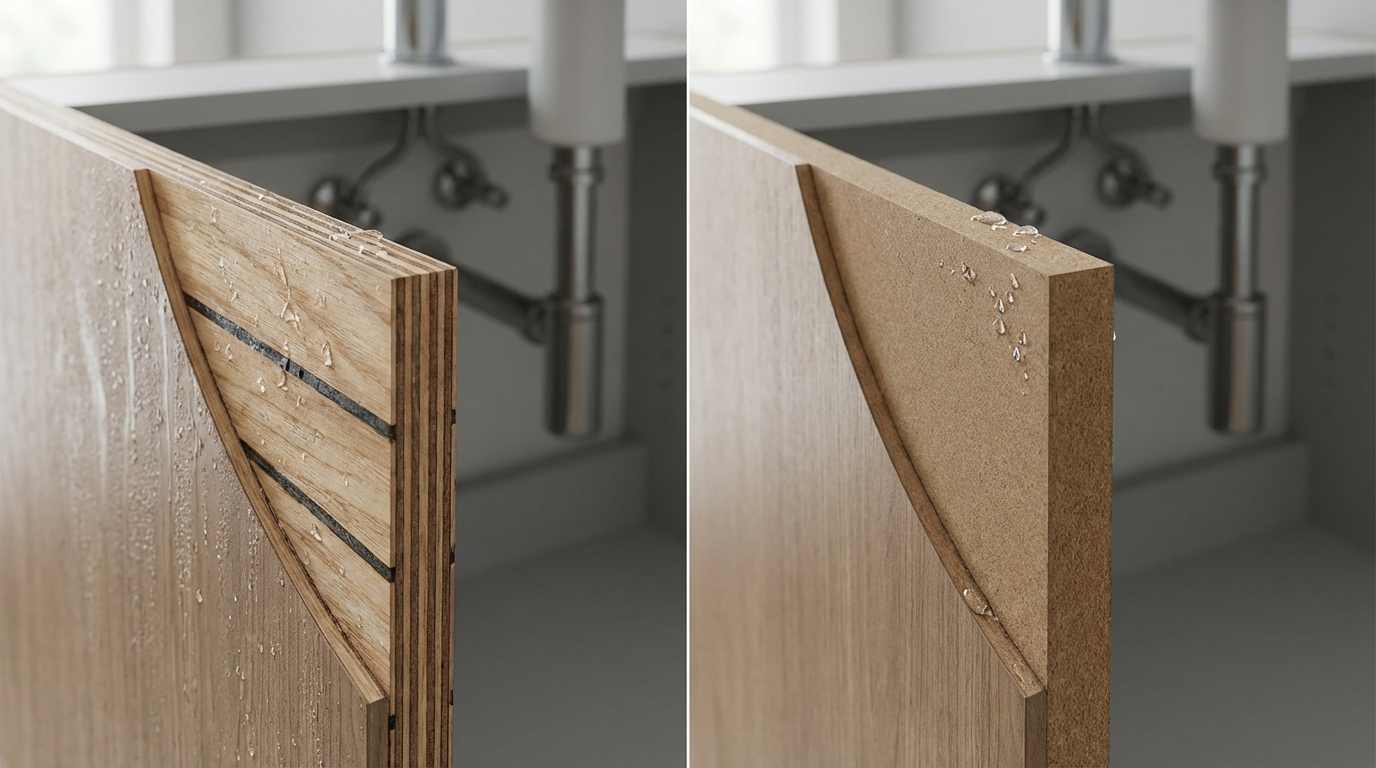
Marine plywood typically outperforms BWP HDF for heavy-load bathroom cabinets in high-humidity India zones.
If you’re in a hurry: Marine plywood handles constant steam, splashes, and structural stress better due to its layered hardwood construction, making it ideal for monsoon-prone or coastal bathrooms. BWP HDF offers a smoother finish at lower weight and cost, suiting lighter vanity units with laminates. Pick marine if cabinets hold towels or cleaners (load >20kg); go HDF for wall-mounted or decorative ones. Always verify glue lines and edge sealing on-site—poor workmanship fails both.
- Choose marine plywood if: heavy daily use, poor ventilation, coastal area, or structural shelves.
- Choose BWP HDF if: budget-tight, smooth laminate finish needed, light loads, or quick modular install.
- Avoid marine plywood if: weight-sensitive installs or ultra-sleek modern look required.
- Avoid BWP HDF if: extreme wet zones without perfect edge banding.
What These Materials Actually Mean
BWP HDF refers to High Density Fiberboard treated to Boiling Water Proof standards. HDF is denser than regular MDF (typically 800-1000 kg/m³), made from compressed wood fibers and resins for better screw-holding and smoothness. The BWP grade means it passes boiling water tests for delamination resistance, positioning it for moisture-exposed areas like bathroom cabinets.
Marine plywood is BWP-grade plywood engineered for water-heavy environments, often aligning with high standards like tropical hardwood cores and phenolic glue. It features thick face veneers (1.5-2.5mm) and void-free layers, built to resist warping under prolonged wet-dry cycles.
Where People Get Confused (Top 7 Misunderstandings)
- BWP HDF is "waterproof plywood"—no, it's engineered board; plywood has wood grain strength HDF lacks.
- Marine plywood never swells—poor core quality or unsealed edges fail in steam.
- All BWP labels guarantee performance—ignore unverified stamps; check glue shear visually.
- HDF is always cheaper and lighter—thicker BWP HDF rivals plywood costs.
- Both work identically in bathrooms—marine handles flex/load; HDF suits rigid frames.
- BWP means "maintenance-free"—edge sealing and ventilation are non-negotiable.
- Thinner sheets (6mm) suffice for cabinets—minimum 12-18mm for sag resistance.
India-Specific Reality Check
Bathrooms in India face year-round challenges: monsoon steam condensing on tiles, coastal salt air corroding fittings, and poor exhaust fans trapping humidity above 80%. Unsealed cabinets delaminate within 6-12 months. Storage at dealers exposes sheets to open yards—warped stock ruins projects. Contractor shortcuts like skipped edge banding amplify risks in humid Mumbai or Chennai. Ventilation gaps under doors help, but material choice dictates longevity.
Why Bathrooms Demand Special Materials in Monsoon India?
Steam from hot showers penetrates cabinets via tiny gaps, causing glue failure or fiber swelling. In coastal areas, salt accelerates rot. Unlike dry kitchens, bathrooms cycle wet-dry daily. Solution: prioritize BWP-rated options with sealed profiles. Check dealer storage—stacked horizontally under cover reduces warping risk. Install exhaust fans early; test humidity post-install (aim <70%).
Two-Minute Comparison That Actually Helps
| Factor | BWP HDF | Marine Plywood |
|---|---|---|
| Water Resistance | Good for splashes if edges sealed; swells if saturated | Excellent; withstands boiling/steam cycles |
| Strength/Load | High screw hold; sags under heavy shelves | Superior flex resistance; ideal for 30kg+ loads |
| Weight | Lighter (20-30% less) | Heavier, needs sturdy frames |
| Finish | Ultra-smooth for laminates | Grained; needs sanding/veneer |
| Thickness Options | 6-25mm uniform | 12-25mm calibrated |
Use this for wet-zone shelves (marine) vs vanity faces (HDF). Verify calibration tolerance (<0.5mm).
Price Range and Cost Drivers (India)
Expect Rs 90-180 per sq ft for 18mm BWP HDF, Rs 120-250 for marine plywood—varies by city (higher in metros), thickness, core (poplar vs hardwood), and finish. Thicker sheets (19mm+) add 20-30%; calibrated adds 10-15%.
How Much for a Standard 4x2 ft Bathroom Cabinet?
A 4-shelf unit (2x4 ft) uses 20-30 sq ft. BWP HDF totals Rs 3,000-6,000 material; marine Rs 4,000-8,000. Drivers: logistics (add 10% outside hubs), wastage (15% on cuts), labor (Rs 500-1,000/sq m). Ask quotes specifying "18mm BWP grade, calibrated, poplar core, monsoon warranty simulation."
How to Choose in 5 Steps
- Assess exposure: Steam-heavy? Marine. Light splashes? HDF.
- Check load: >15kg shelves? Plywood only.
- Inspect sheet: Tap for voids, measure thickness uniformity.
- Test edge seal: Wet a sample edge; no swelling in 24hrs.
- Confirm fixings: HDF for screws; plywood for nails too.
Skip load check? Sagging shelves in 6 months. Always prototype a small panel.
Decision Framework: Match Your Bathroom Conditions
| Condition | Recommended | Verify This |
|---|---|---|
| High steam, poor vent | Marine Plywood | Glue line shear (nail test) |
| Coastal humidity | Marine Plywood | Hardwood core, no softwood |
| Heavy loads (towels) | Marine Plywood | 18mm+ calibrated |
| Tight budget | BWP HDF | Uniform density, edge bandable |
| High scratch risk | BWP HDF | Smooth face, laminate-ready |
| Fast delivery | BWP HDF | Stock availability locally |
Tips for Homeowners: Durability and Maintenance
- Do: Wipe daily with dry cloth; ventilate post-shower.
- Don't: Use abrasive cleaners; store wet towels inside.
- Seal all edges yourself if carpenter skips.
- Cut HDF with fine blade to avoid chipping; plywood tolerates coarser.
- Pre-drill HDF screws 80%; plywood 100% depth.
- Edge-band HDF immediately; plywood veneers edges naturally.
- "BWP marine plywood 18mm, IS-grade equivalent, sealed profiles."
- Detail 2mm PVC edging all around; stainless hinges.
- Avoid HDF frames for freestanding units.
- Mistake: Picking by price alone. Why: Cheap MR grade sneaks in. Fix: Demand BWP demo test.
- Mistake: Ignoring thickness. Why: 12mm sags. Fix: Minimum 16-18mm shelves.
- Mistake: No edge sealing. Why: Steam entry. Fix: PVC/ABA mandatory.
- Mistake: Dealer stock without check. Why: Warped sheets. Fix: Inspect flatness on-site.
- Mistake: Wrong fixings. Why: HDF splits. Fix: Coarse screws + washers.
- Mistake: Overlooking ventilation. Why: Trapped moisture. Fix: 5mm gaps + exhaust.
- Mistake: Laminate on untreated face. Why: Peeling. Fix: Primer first.
- Mistake: Coastal no-salt check. Why: Corrosion. Fix: SS hardware only.
- Mistake: Bulk buy without sample. Why: Batch variance. Fix: Test one sheet first.
- Symptom: Swelling edges. Cause: Unsealed HDF. Prevent: Full edging. Fix: Trim + reseal.
- Symptom: Delamination. Cause: Weak glue. Prevent: Nail test pre-buy. Fix: Replace panel.
- Symptom: Sagging shelves. Cause: Thin HDF. Prevent: 18mm min. Fix: Add battens.
- Symptom: Warping. Cause: Plywood storage. Prevent: Vertical stack. Fix: Plane edges.
- Symptom: Screw pull-out. Cause: Repeated opens. Prevent: Dowels + screws. Fix: Epoxy anchors.
- Symptom: Finish bubbling. Cause: Moisture under laminate. Prevent: Dry install. Fix: Sand + relaminate.
- Symptom: Hinge sag. Cause: Heavy door. Prevent: 3 hinges/door. Fix: Reinforce frame.
- Tap sheet: uniform thud (no voids).
- Edge water test: no darkening in 30min.
- Measure 4 corners: flat within 2mm.
- Ask: "BWP test pass? Core material?"
- Check glue squeeze-out: even lines.
- Screw hold: 3 pulls without spin.
- Weight lift: no flex.
- Door alignment: <1mm gap.
- Humidity test: no changes in 48hrs wet sim.
- Clean test: mild soap only.
Carpenter Tips: Working with These Materials
Architect/Designer Specs to Specify
Trade-offs and Limitations
Marine plywood: Superior wet strength but heavier (install challenges), grainer finish needs extra work, higher cost for thickness. BWP HDF: Lighter/easier modular, flawless laminates, but edge-dependent (poor sealing fails fast), lower impact resistance (dents easier). Neither is fully waterproof—ventilation essential. Plywood warps if stored wet; HDF crumbles under overload.
Common Buyer Mistakes and How to Avoid Them
Failure Modes and Fixes
Quality Checks You Can Do Without Lab Tests
Before Buying
After Cutting
Post-Install
Which is More Durable for Indian Bathrooms?
Marine plywood usually lasts 8-15 years in steamy setups due to robust layers resisting flex and water ingress. BWP HDF manages 5-10 years if edges are impeccable but falters under load or saturation. In humid Kerala homes, marine reduces callbacks 40% per carpenter feedback. Next: prototype a door sample, expose to shower steam 24hrs, check swelling.
Can BWP HDF Replace Plywood Entirely?
Not always—HDF excels in flat panels but lacks plywood's shear strength for frames. Use HDF faces with plywood carcasses in hybrids. Trade-off: 20% cost save but needs precise machining. Verify by loading a sample shelf with 20kg water bottles; no sag = good. Ideal for modular wardrobes over full plywood.
FAQs
Is marine plywood worth the extra cost for bathroom cabinets?
Typically yes in high-use Indian bathrooms, as its boiling-resistant glue and hardwood core prevent delamination during monsoons. BWP HDF saves 20-30% but risks edge swelling without pro sealing. Cost driver: thickness/load. Homeowners report marine cabinets intact after 10 years vs HDF bubbling in 3-5. Confirm by asking for a boiled sample demo; if it holds, invest.
What's the minimum thickness for bathroom cabinets?
16-18mm for shelves to avoid sag under 15kg loads; 12mm max for backs/faces. Thinner risks failure in humid zones. Plywood calibrated better here. Check variance: stack two sheets, no gap >0.3mm. Contractors prefer 18mm marine for zero complaints.
How to seal edges on BWP HDF cabinets?
Apply 2mm PVC/ABA banding post-cut, heat-activated for flush fit. Alternative: epoxy paint twice. Prevents 90% moisture entry. Skip? Swells in weeks. Carpenters: use 180°C iron; test adhesion on scrap.
Does HDF work in coastal bathrooms?
Borderline—BWP grade resists but salt air corrodes fittings faster. Pair with marine plywood frames. Ventilate aggressively. Failures common without SS hardware. Test: mist saltwater on edge, dry 24hrs—no whiteout.
Which holds screws better for hinges?
BWP HDF grips screws tighter initially due to density, but plywood endures repeated stress without stripping. Use 40mm coarse screws + plugs for both. Architects spec plywood for heavy doors.
Can I paint directly on these materials?
Yes, after sanding (180 grit) and primer. HDF takes smoother coats; plywood hides grain better with filler. Avoid oil paints—use PU for wet zones. Dry 48hrs before use; test rub resistance.
How to store sheets before install?
Vertical racks, covered, away from ground. Humidity <60%. Warped plywood = crooked cabinets. Dealers often fail here—buy fresh.
Best hardware for moisture resistance?
SS 304 hinges/locks; soft-close for HDF to reduce slam stress. Distance 75mm from edge. Budget: add 15% material cost. Prevents 50% door issues.
Hybrid approach: HDF + plywood?
Smart for India—HDF faces for finish, plywood structure for strength. Cuts cost 15%, boosts durability. Seal junctions doubly. Popular in modular factories.
Disclaimer: This content is provided for general informational purposes based on industry practices and publicly available information. Product specifications, standards, prices, and availability may vary by manufacturer, region, and time. Readers should independently verify details with manufacturers, dealers, or qualified professionals before making purchase or construction decisions.Want Plywood Suggestions?
Share a few details and a Duro BOIL specialist will suggest suitable brands and connect you to responsive dealers.