BWP vs BWR vs MR plywood: grades explained with examples
Learn bwp vs bwr vs mr plywood in simple terms with examples, verification tips, and a quick checklist so you choose the right board for Indian conditions.
Quick Decision Summary
MR suits dry interiors, BWR handles kitchens and humidity, BWP excels in wet zones and exteriors.
If you're in a hurry: Pick MR plywood for bedrooms and wardrobes where moisture is minimal—it's the most budget-friendly for everyday use. Opt for BWR in kitchens or laundry areas exposed to splashes and steam, as it resists boiling water briefly without delaminating. Choose BWP for bathrooms, coastal homes, or structural work needing full waterproofing during monsoons. Always match to your site's humidity and water exposure to avoid swelling or warping later. Verify grade via resin type and edge tests before buying.
- Choose MR if: Low budget, dry rooms like living areas, no water contact.
- Choose BWR if: Moderate humidity, kitchens with spills, faster installation needed.
- Choose BWP if: High moisture like bathrooms, coastal regions, long-term durability essential.
- Avoid MR if: Any water exposure—swells quickly in Indian humidity.
- Avoid BWR if: Prolonged submersion or marine use—lacks full boil-proof strength.
What This Term/Material Actually Means
Plywood grades like MR, BWR, and BWP refer to moisture-handling ability based on glue (resin) quality and construction. MR uses basic urea-formaldehyde resin for interiors. BWR upgrades to phenol-formaldehyde for better water resistance. BWP employs premium phenol-formaldehyde layers, often called marine grade, for extreme conditions.
What Does MR Plywood Stand For?
MR means Moisture Resistant, designed for low-humidity zones. It holds up in air-conditioned rooms but degrades with direct water. In India, it's the go-to for cost-sensitive projects. Nuance: Short splashes might be okay if wiped immediately, but monsoon storage risks bubbling glue lines. Next step: Tap edges—if dull sound, poor bonding; insist on sealed storage.
What Does BWR Plywood Mean?
BWR stands for Boiling Water Resistant, glued to survive brief boiling tests. Ideal for semi-wet spots, it outperforms MR in humid climates. Conditions: Fine for kitchens but not submersion. Check: Smell resin (sharp phenolic scent indicates quality). Trade-off: Stronger than MR but needs edge sealing in coastal areas to prevent core rot.
What is BWP Plywood Exactly?
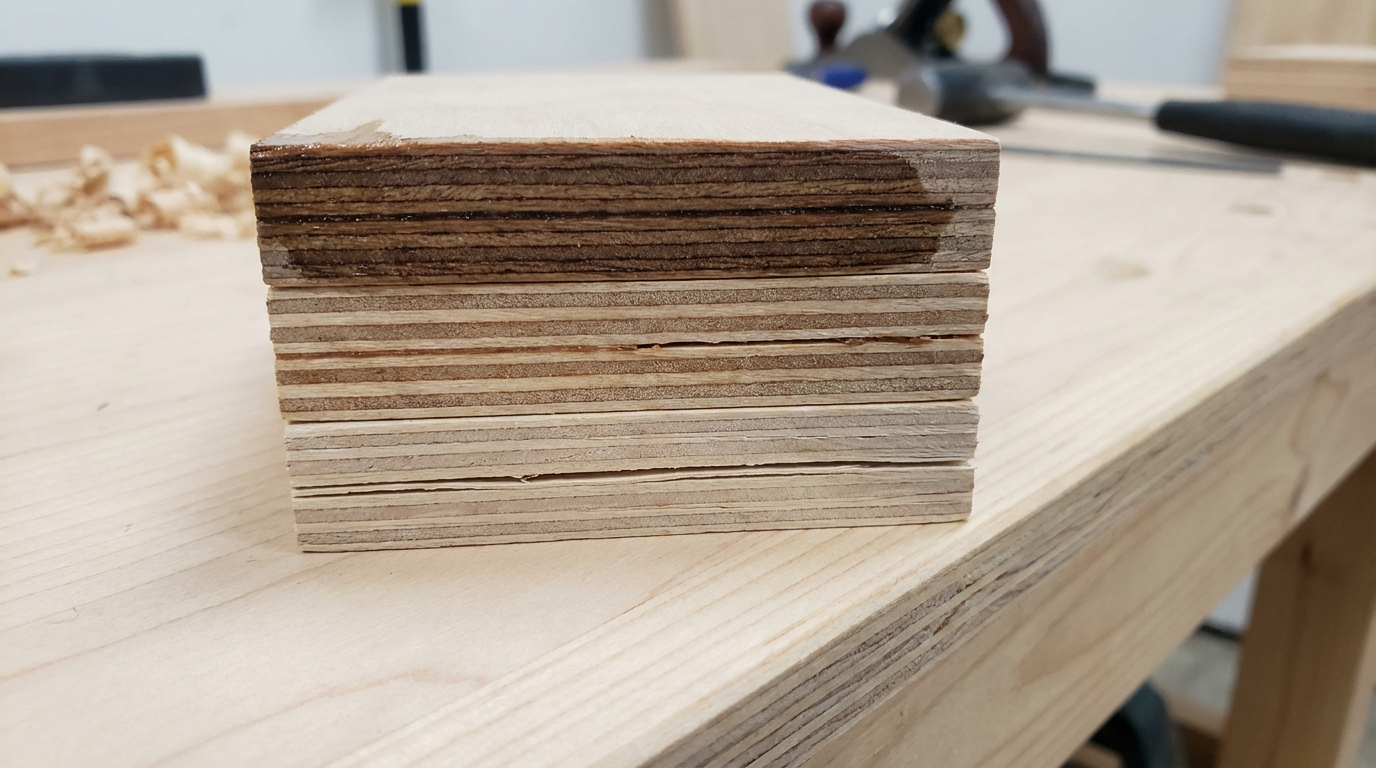
BWP is Boiling Water Proof, fully waterproof with multiple high-grade resin dips. Used in boats or heavy-exposure builds, it resists delamination longest. In India, vital for monsoons. Verify: Weight feels denser; no gaps in core when pried lightly. Limitation: Overkill for dry zones, adding unnecessary cost.
Where Do People Get Confused Between These Grades?
- Thinking "waterproof" applies to all—MR isn't even water-resistant long-term.
- Misreading BWR as fully proof like BWP—BWR fails after hours of boiling.
- Assuming thickness trumps grade—thin BWP beats thick MR in wet tests.
- Ignoring resin: Urea (MR) vs phenol (BWR/BWP) changes everything.
- Believing "commercial" equals MR—some label loosely.
India-Specific Reality Check
Monsoon humidity (80-100%), coastal salt air, and poor site storage amplify risks. MR warps in 2-3 months if stacked wet; BWR lasts 1-2 years in kitchens but edges peel without sealant. BWP shines here, resisting 6+ months submersion. Workmanship matters: Contractors often cut corners on edge banding, causing 50% failures. Store sheets flat, elevated, covered—unpaved godowns ruin even BWP cores.
Price Range and Cost Drivers (India)
For 18mm 8x4 sheets in major cities (2025 trends), MR typically Rs 45-80 per sq ft, BWR Rs 70-130, BWP Rs 110-200. Thinner (12mm) drops 20-30%; thicker (25mm) adds 40%. Drivers: Core wood (poplar cheaper, hardwood premium), face veneer quality, calibration (uniform thickness cuts waste), city logistics (Mumbai/Delhi 10-20% higher), batch/brand variance. Quote checklist: Specify grade, thickness, calibrated, termite-treated; ask for sq ft rate including transport.
Mini example: 100 sq ft kitchen (BWR 18mm) ~ Rs 8,000-13,000 material, varies by metro vs tier-2.
Two-Minute Comparison That Actually Helps
| Grade | Resin Type | Water Tolerance | Best For | Relative Cost |
|---|---|---|---|---|
| MR | Urea-Formaldehyde | Humidity only | Dry bedrooms | Lowest |
| BWR | Phenol-Formaldehyde | Splashes, brief boil | Kitchens, humidity | Medium |
| BWP | Premium Phenol | Prolonged boil/submersion | Bathrooms, exteriors | Highest |
Choose by exposure: Dry=MR (save 30-50%), moderate=BWR, heavy=BWP (worth premium for no callbacks).
How to Choose in 5 Steps
- Assess exposure: Dry (MR), splashes/humidity (BWR), constant wet (BWP).
- Check site: Monsoon/coastal? Upgrade one grade.
- Verify seller: Ask resin proof, see stamp (no claims, just visual).
- Test sample: Splash water, check swelling after 24hrs.
- Budget balance: Factor 20% extra for sealing/fasteners.
Skip steps? Expect delamination in year 1.
Which Plywood is Best for Indian Kitchens?
BWR grade balances cost and performance for kitchens with steam/spills. It resists daily moisture better than MR without BWP's premium. In humid cities, pair with laminate and edge tape. Next: Measure sink proximity—if <1m, consider BWP. Check core gaps pre-buy.
Is BWP Plywood Necessary for Bathrooms?
Yes for longevity—handles shower steam, leaks. MR fails fast here. Seal edges doubly. Verify: No core voids. Alternative: BWR if ventilated well, but riskier in monsoons.
Tips for Homeowners: Durability and Maintenance
- Do: Wipe spills immediately, use doormats in monsoons.
- Don't: Drag heavy items (scratches veneer), store cleaners on top.
- Annual: Check edges for lifting, re-seal if needed.
- Cut with fine blade to avoid chipping calibrated edges.
- Pre-drill hinges in BWP (denser).
- Fasten 6-8cm from edges; use SS screws in humid zones.
- Spec "BWR min for kitchens, BWP wet zones" in drawings.
- Detail edge returns 2cm min.
- Plan ventilation to downgrade grade safely.
- Mistake 1: Buying MR for kitchens—happens from low quotes. Instead: Splash-test sample.
- 2: Ignoring thickness variance—causes uneven cabinets. Check: Caliper measure.
- 3: No edge sealing—monsoon entry point. Do: Tape all cuts immediately.
- 4: Trusting verbal "waterproof"—fakes abound. Verify: Resin inquiry.
- 5: Storing wet outdoors—core rots fast. Elevate/cover sheets.
- 6: Skipping termite check—India staple issue. Ask treatment proof.
- 7: Overlooking core gaps—weak spots. Pry edge lightly.
- 8: Cheaping fasteners—screws rust. Use coated/SS.
- 9: No ventilation plan—traps humidity. Add exhaust specs.
- Symptom: Edge swelling. Cause: Water ingress post-cut. Prevent: Seal 24hrs pre-install. Fix: Sand, re-laminate.
- Bubbling glue. Cause: MR in humidity. Prevent: Grade match. Fix: Replace panel.
- Delamination layers. Cause: BWR overload. Prevent: BWP upgrade. Fix: Clamp dry, epoxy.
- Core voids cracking. Cause: Poor manufacturing. Prevent: Visual/tap test. Fix: Fill epoxy, reinforce.
- Termite trails. Cause: Untreated. Prevent: Treatment stamp. Fix: Fumigate, replace.
- Veneer peeling. Cause: Moisture + poor bond. Prevent: Quality face. Fix: Glue press.
- Warping bow. Cause: Uneven load/moisture. Prevent: Proper framing. Fix: Heat flatten.
Carpenter Tips: Handling and Installation
Architect and Designer Advice
Decision Framework: Match Conditions to Grade
| Condition | Recommended Grade | What to Verify |
|---|---|---|
| Dry bedroom/wardrobe | MR | Smooth face, no core gaps |
| Kitchen with spills | BWR | Phenolic smell, edge hardness |
| Bathroom/constant wet | BWP | Density/weight, boil test demo |
| Coastal/monsoon heavy | BWP | Termite treatment mark |
| Tight budget | MR/BWR hybrid | Calibration tolerance <0.5mm |
| High scratch/traffic | BWR+laminate | Veneer thickness >0.6mm |
Trade-offs and Limitations
MR: Cheap but swells easy—limit to AC rooms. BWR: Versatile but edges vulnerable without sealant. BWP: Durable/expensive, heavier (harder handling), overkill indoors (wasted spend). All: Formaldehyde off-gassing (ventilate new installs), termite risk if untreated.
Common Buyer Mistakes and How to Avoid Them
Failure Modes and Fixes
Quality Checks You Can Do Without Lab Tests
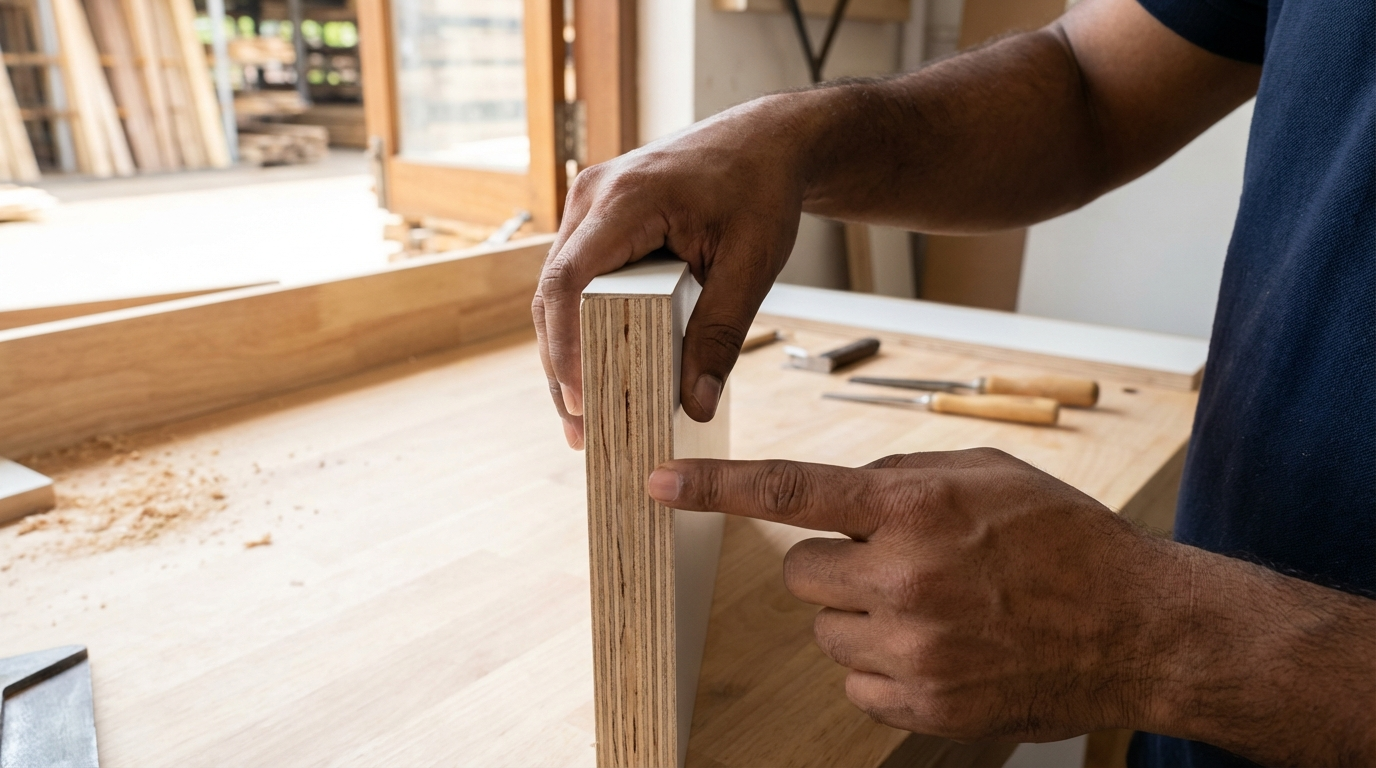
Before: Tap sheet (clear ring=good bond), check stamp/weight, splash edge (no absorb 30min). Questions: "Resin type? Boil hours?" Red flags: Light weight, gaps, urea smell. Post-cut: Uniform dust, no splinter. Installed: Flat level, tight hinges, dry cloth test.
Can MR Plywood Handle Monsoon Humidity?
Limited—needs AC/dry storage. Swells if splashed. Upgrade BWR for safety. Check: Store elevated.
What's Better: BWR or BWP for Modular Kitchens?
BWR sufficient if sealed well; BWP for sinks/heavy steam. Balance cost vs risk.
FAQs
Is BWP plywood worth the extra cost?
In wet zones yes—prevents costly redo in 2 years. Dry areas, no. Factors: Exposure level, site humidity. Step: Calculate total project; add 25% for BWP if coastal. Seal edges always for max life.
Which is cheapest: MR, BWR, or BWP?
MR lowest, then BWR (20-50% more), BWP highest (double MR). Varies by thickness/region. Quote multiple, specify needs to compare apples-to-apples.
Can BWR be used outdoors?
Short-term with sealant, but BWP preferred for rain exposure. Monsoon tests it hard. Alternative: Paint fully, monitor first year.
How to spot fake BWP plywood?
Light weight, soft edges, no phenolic scent. Test: Boil scrap (BWP holds). Buy stamped sheets, cross-check seller rep.
Best thickness for wardrobes?
18mm standard for strength without sag. 12mm shelves ok if framed. Match grade to room humidity.
Does plywood grade affect termite resistance?
Higher grades often treated better, but verify separately. All need protection in India. Check powder marks.
MR vs BWR: When to upgrade?
Upgrade at first splash risk (kitchens). MR for pure dry. Test site moisture first.
BWP for entire home interiors?
Overkill/expensive; hybrid: BWP wet, MR dry. Saves 30% budget. Spec wisely.
How long does each grade last in India?
MR 5-8 years dry; BWR 8-12 humid; BWP 15+ wet. Depends sealing/workmanship. Maintain to extend.
Calibration in plywood: Why care?
Uniform thickness=less waste, flat cabinets. Check variance <0.5mm. Saves carpenter time.
Disclaimer: This content is provided for general informational purposes based on industry practices and publicly available information. Product specifications, standards, prices, and availability may vary by manufacturer, region, and time. Readers should independently verify details with manufacturers, dealers, or qualified professionals before making purchase or construction decisions.Want Plywood Suggestions?
Share a few details and a Duro BOIL specialist will suggest suitable brands and connect you to responsive dealers.