BWR plywood price per sq ft: what you really pay for
Understand bwr plywood price per sq ft using price-per-sqft tables, thickness-wise factors, and dealer quote tips. Avoid overpaying and fake stock in India.
Quick Decision Summary
BWR plywood typically ranges from ₹60 to ₹130 per sq ft across common thicknesses in India.
If you’re in a hurry: Expect to pay ₹70-₹110 per sq ft for standard 12-18mm BWR sheets suitable for kitchens or bathrooms. Thinner options drop to ₹60-₹80, while thicker ones climb to ₹110-₹130. Factor in 10-20% extra for transport in metros like Mumbai or Delhi, plus 5-10% wastage during cutting. Always verify core density and glue lines on-site to avoid cheap MR passed off as BWR. For a 100 sq ft kitchen cabinet project, budget ₹8,000-₹12,000 total, confirming local quotes first.
- Choose BWR if: Moderate humidity exposure like Indian kitchens or wardrobes, balancing cost and moisture resistance.
- Avoid BWR if: Fully wet areas (go BWP) or bone-dry interiors (MR suffices to save 20-30%).
What This Term/Material Actually Means
BWR stands for Boiling Water Resistant plywood, a mid-tier grade using phenolic resins that handle short-term boiling water exposure without delaminating. In India, it meets IS:303 standards for interior applications with occasional moisture, like modular kitchens or bathroom vanities. Unlike basic MR (Moisture Resistant), BWR has stronger glue lines and denser cores for better humidity tolerance during monsoons.
Where people get confused:
- Thinking BWR is fully waterproof—it's resistant but swells if submerged long-term.
- Mixing it with BWP (Boiling Water Proof), which costs 30-50% more for marine use.
- Assuming all BWR is calibrated—many economy versions warp without machine-planed faces.
- Believing thickness alone determines quality—poor cores fail faster than premium faces.
- Overlooking face/back veneer grades—cheap imports use softwoods that dent easily.
- Confusing it with MR upgrades—dealers often upcharge basic MR as BWR without tests.
What Exactly Makes BWR Plywood Different from MR?
BWR uses boiling-water-tested bonds, holding up to 4-8 hours submersion per standards, while MR fails in 1-2 hours. This matters in humid Indian homes where steam from cooking hits cabinets. Nuance: BWR shines in semi-exposed spots but needs edge sealing in coastal areas. Next step: Knock samples—BWR sounds denser, less hollow than MR.
India-Specific Reality Check
In monsoon-heavy regions like Kerala or Mumbai, BWR handles 70-80% humidity spikes better than MR but demands proper storage—stack flat under cover, not on godowns with leaky roofs. Coastal salt air accelerates core rot if unsealed, so prioritize Gurjan-face options. Contractor workflows often cut corners on acclimatization, leading to 10-15% swelling post-install. Workmanship realities: Uneven plastering traps moisture, so insist on 24-hour site drying before fixing.
Price Range and Cost Drivers (India)
BWR plywood prices typically span ₹60-₹130 per sq ft, heavily influenced by thickness, core material, and location. Metro cities like Bangalore or Hyderabad add 10-15% for logistics, while tier-2 towns offer 5-10% lower rates due to local mills.
| Thickness | Typical Range per sq ft | Common Uses |
|---|---|---|
| 6mm | ₹60-₹85 | Partitions, shelves |
| 9mm | ₹65-₹95 | Wardrobes, backing |
| 12mm | ₹70-₹110 | Kitchen cabinets |
| 18mm | ₹90-₹130 | Heavy furniture bases |
Key cost drivers: Thicker sheets use more veneers (20-30% jump), premium faces like Gurjan add ₹10-20/sq ft, calibration shaves ₹5-10 off finishing costs later. Batch variations from wood sourcing swing prices 10%.
How to ask for a quote checklist:
- Specify thickness, size (8x4 ft standard), BWR grade with IS mark.
- Ask core type (hardwood vs mixed), face veneer grade.
- Request calibrated, both-side sanded; include transport to site.
- Compare 3 quotes: "Per sq ft landed cost for 10 sheets?"
Mini budget example: 150 sq ft wardrobe—₹12,000-₹18,000 plywood + ₹3,000 fittings = ₹15,000-₹21,000 total, assuming Delhi rates.
Why Does BWR Plywood Price Vary So Much by City?
Metro logistics inflate by 15% (fuel, unloading), while mill hubs like Punjab keep it low. Nuance: Monsoon stockpiles crash prices temporarily, but quality dips. Check: Visit 2 dealers, compare sheet weights—10-15% heavier signals better core.
Two-Minute Comparison That Actually Helps
| Feature | MR | BWR | BWP |
|---|---|---|---|
| Price/sq ft (12mm) | ₹45-₹75 | ₹70-₹110 | ₹110-₹170 |
| Moisture Tolerance | Dry interiors | Semi-wet (kitchen) | Fully wet (bath) |
| Monsoon Risk | High swell | Moderate | Low |
| Best For | Bedrooms | Kitchens | Coastal |
Choose based on conditions: BWR for typical urban humidity; upgrade BWP only if direct water contact expected.
How to Choose in 5 Steps
- Match exposure: BWR for indirect moisture; skip if pooling water.
- Pick thickness: 12mm for cabinets, 18mm load-bearing—test bend strength.
- Inspect faces: Uniform veneer, no knots; knock for solid core.
- Verify calibration: Flat edges, measures true 8x4 ft.
- Get samples: Boil test edge piece 2 hours—if no split, good.
Skip steps? Risk delam in 6-12 months from hidden gaps.
Is 12mm or 18mm BWR Better Value for Money?
12mm offers best value for most furniture at lower weight/cost, but 18mm justifies premium for floors/heavy tops. Nuance: Over-speccing thickness wastes 20-30%; under-speccing sags. Verify: Stack weights—quality 12mm feels like cheap 18mm.
Trade-offs and Limitations
BWR saves 20-40% over BWP but limits to non-submersion use—edges swell in prolonged steam. Calibration adds upfront cost but cuts carpenter time 30%. Limitations: Soft cores dent under impacts; not fire-rated, so pair with laminates for kitchens.
Quality Checks You Can Do Without Lab Tests
Before buying:
- Visual: Even color, no patches, straight edges.
- Weight: 20-25kg for 18mm sheet signals dense core.
- Glue smell: Mild phenolic, not chemical harshness.
- Questions: "IS:303 certified? Core wood source?"
After cutting: Check glue lines (clean, no voids), faces sand smooth.
Post-install: Edges sealed? No gaps at hinges.
Decision Framework: Match Your Project Conditions
| Condition | Recommended | Verify |
|---|---|---|
| Wet kitchen (steam) | 12-18mm BWR | Face veneer grade, calibration |
| Coastal humidity | 18mm calibrated BWR | Core density (weight test) |
| Heavy use wardrobe | 18mm BWR | Bend strength on sample |
| Tight budget | 9-12mm BWR | IS mark, no hollow knock |
| High scratch risk | BWR + laminate | Surface smoothness |
| Fast delivery | Local mill BWR | Stock availability quote |
Homeowner Tips for BWR Plywood
Durability do: Wipe spills immediately, use coasters. Don’t: Expose to direct water, store vertically. Check yearly for edge lifts.
Carpenter Tips for Working with BWR
Cut with fine blade to avoid tears; pre-drill screws in humid zones. Edge-band all cuts same day. Handle flat to prevent bows.
Architect Tips for Specifying BWR
Detail 5mm overhangs for drips; specify calibrated for modular fits. Wet-zone: Extra glue lines in drawings.
Common Buyer Mistakes and How to Avoid Them
- Buying by price alone: Why: Cheapest hides soft core. Do: Weight test 3 sheets.
- Ignoring thickness needs: Why: Thin sags under load. Do: Calculate spans first.
- No acclimatization: Why: Swells 5-10%. Do: 48hr site stack.
- Skipping edge sealing: Why: Moisture entry. Do: Laminate day-of-cut.
- Trusting verbal grades: Why: MR relabeled. Do: Demand IS stamp photo.
- Overlooking calibration: Why: Uneven fits. Do: Measure faces ruler.
- Forgetting wastage: Why: 10% loss. Do: Order 15% extra.
- No transport check: Why: Warps en route. Do: Flat load only.
- Post-monsoon buy: Why: Damp stock. Do: Smell for mold.
Failure Modes and Fixes
- Symptom: Edge swelling. Cause: Unsealed cuts. Prevent: Immediate banding. Fix: Sand, reseal.
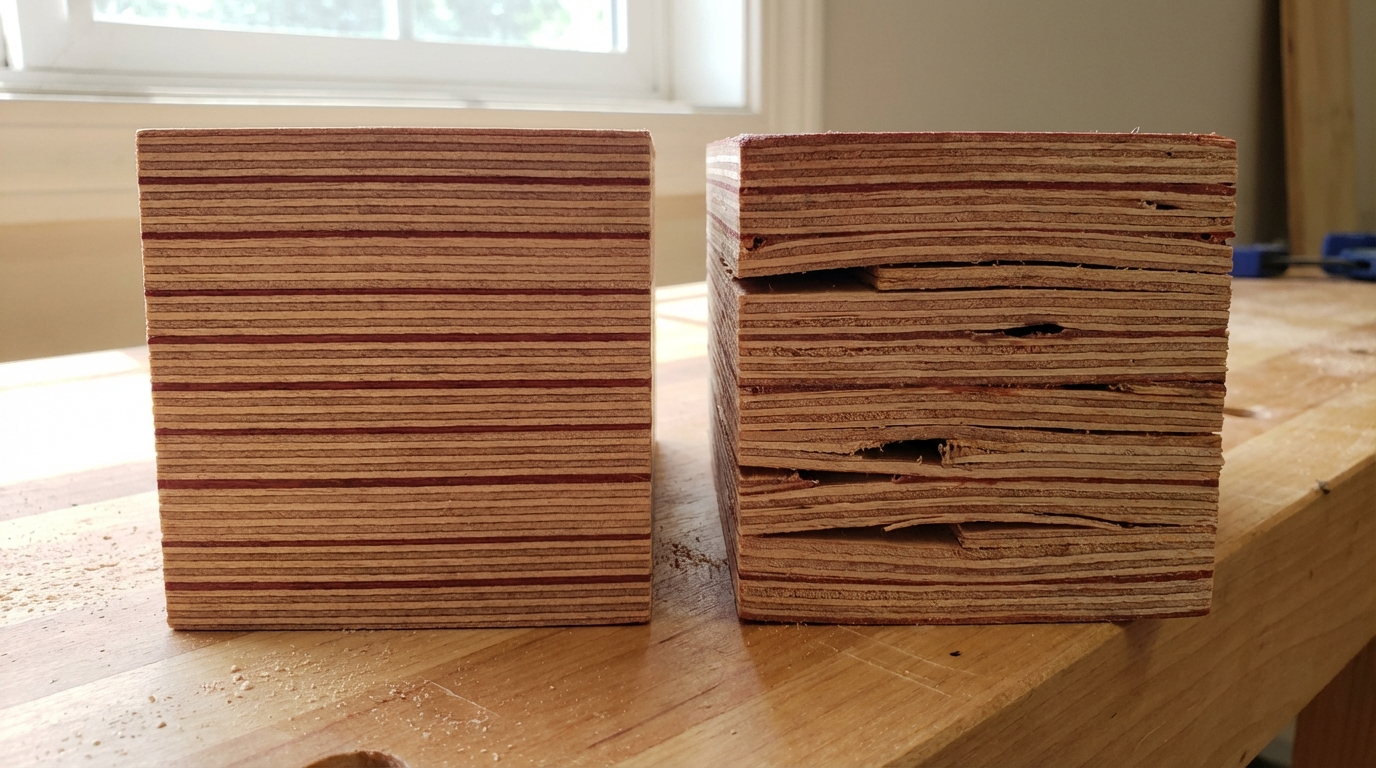
- Symptom: Delamination bubbles. Cause: Weak glue. Prevent: Boil test sample. Fix: Replace sheet.
- Symptom: Core crumbling. Cause: Softwood mix. Prevent: Heavy knock test. Fix: Reinforce frame.
- Symptom: Warping post-install. Cause: No acclimatization. Prevent: 2-day site dry. Fix: Shim alignment.
- Symptom: Face dents easy. Cause: Thin veneer. Prevent: Press fingernail test. Fix: Laminate over.
- Symptom: Hinge pull-out. Cause: Sparse screws. Prevent: Pilot holes. Fix: Epoxy anchors.
- Symptom: Monsoon fade. Cause: UV exposure. Prevent: Interior only. Fix: Repaint edges.
Can BWR Plywood Handle Indian Monsoons?
Yes for interiors if sealed, resisting 80% RH short-term. Nuance: Coastal needs BWP upgrade. Step: Seal all edges twice, ventilate rooms.
How Much Wastage to Expect with BWR Sheets?
Typically 8-12% from cuts/trimming. Nuance: Calibrated reduces to 5%. Buy extra: For 100 sq ft, order 110-115 sq ft.
FAQs
Is BWR plywood worth the extra cost over MR?
BWR justifies 20-30% premium in humid zones by preventing delam after 2-3 years, where MR fails. For dry bedrooms, MR saves without issue. Trade-off: BWR's denser build handles screws better long-term. Always test samples in your humidity—submerge edge overnight for real check.
What thickness BWR for kitchen cabinets?
12mm strikes balance for doors/shelves, 18mm for bases under sinks. Thinner risks sag over 60cm spans; thicker adds unneeded weight. Factor Indian steam: Pair with SS fittings. Confirm with carpenter span calc before quoting.
How to spot fake BWR at dealers?
Red flags: Too-light weight, hollow sound, no visible IS stamp. Genuine smells phenolic, holds nails tight. Dealers push fakes in peak season—bring magnet for metal-free check, insist on written grade spec.
Does calibration affect BWR price much?
Adds ₹10-15/sq ft but saves 20% labor on planing. Uncalibrated warps more in humidity. Worth it for modular projects. Ask upfront: "Both sides calibrated?" to compare quotes accurately.
BWR vs blockboard for wardrobes—which cheaper long-term?
BWR edges out on flatness/moisture, costing similar upfront but fewer repairs. Blockboard cheaper initially but cores rot faster unsealed. Choose BWR for coastal; hybrid for budget. Test screw hold in both.
Best finish for BWR to boost durability?
Laminate (1-2mm) seals best against spills, veneer for aesthetics. Avoid paint alone—absorbs moisture. Apply day after cut. Maintenance: Mild soap wipes only.
How many sq ft in standard BWR sheet?
8x4 ft = 32 sq ft exactly; 7x4=28 sq ft cut-size. Always measure delivered—short sizes common. Calculate projects in multiples to minimize waste.
Can BWR be used outdoors?
No, UV/moisture degrade in 6-12 months. Limit to covered patios max. Opt BWP for exposure. Seal heavily if must, but expect 2-year life.
Tips to negotiate better BWR prices?
Quote 3 dealers with exact specs, buy volume (5+ sheets), off-peak (post-monsoon). Ask "trade discount?" Push for free delivery. Track city lows via carpenter networks.
Disclaimer: This content is provided for general informational purposes based on industry practices and publicly available information. Product specifications, standards, prices, and availability may vary by manufacturer, region, and time. Readers should independently verify details with manufacturers, dealers, or qualified professionals before making purchase or construction decisions.Want Plywood Suggestions?
Share a few details and a Duro BOIL specialist will suggest suitable brands and connect you to responsive dealers.