Duroboil pre-lam MDF: finish quality + edge band checklist
A practical review of duroboil prelam mdf: specs checklist, pros/cons, best-use cases, warranty checks, and what to verify at the dealer in India.
Quick Decision Summary
Duroboil pre-lam MDF delivers reliable finish quality for dry interior furniture when edge bands are uniformly applied.
If you’re in a hurry: Opt for Duroboil pre-lam MDF sheets in 18mm thickness for wardrobes and TV units in low-humidity zones like bedrooms. It provides a factory-applied laminate finish that skips extra lamination costs and time, ideal for modular kitchens or cabinets if edges are properly banded to resist minor spills. Check for smooth laminate adhesion and flush edge bands at the dealer to avoid delamination risks in Indian monsoons. Expect competitive pricing driven by thickness and design, but always verify core density and edge sealing before loading.
- Choose this if: You need quick-assembly furniture panels with consistent wood-grain or plain finishes in controlled indoor spaces.
- Avoid this if: Your project faces direct water exposure, like bathrooms, without extra sealing.
What Pre-Lam MDF Actually Means
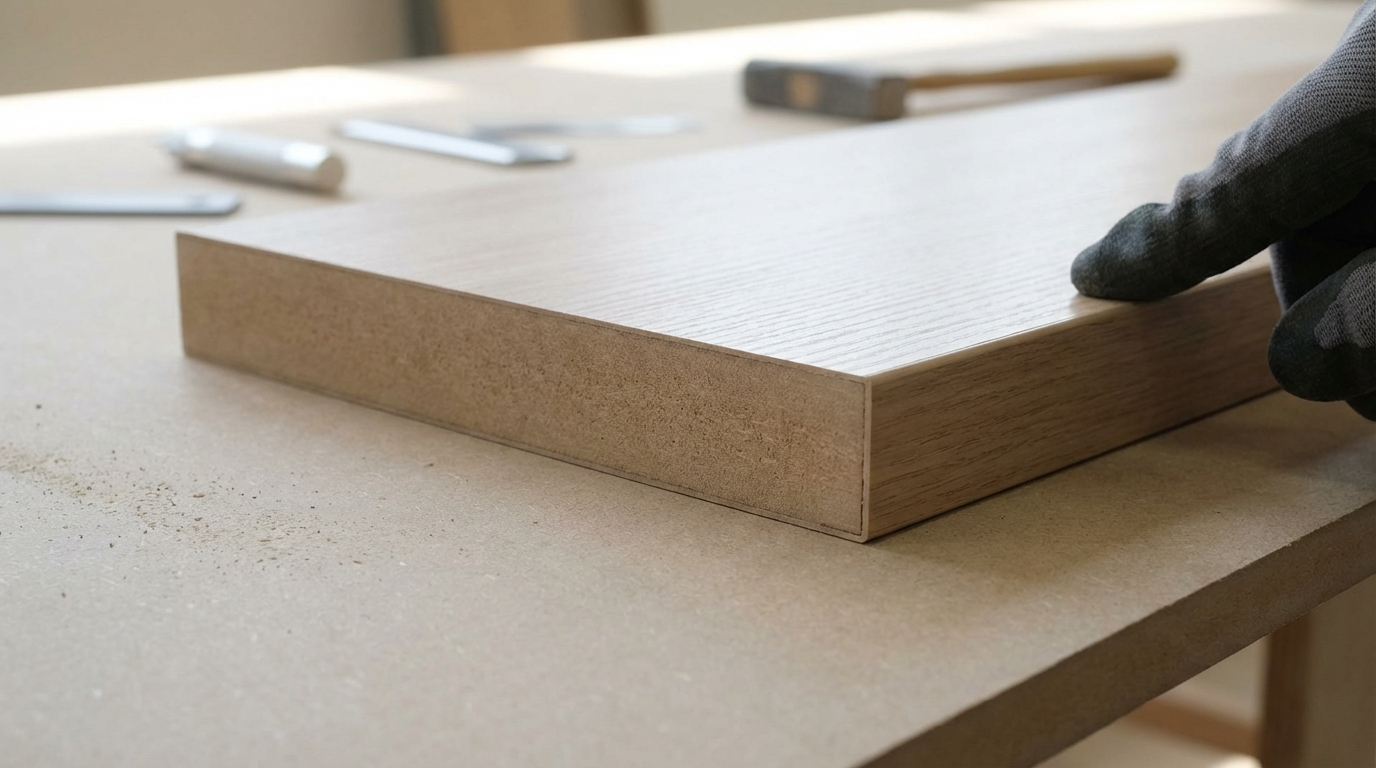
Pre-laminated MDF refers to medium-density fiberboard (MDF) with a thin decorative laminate sheet fused directly onto both faces at the factory. This creates a ready-to-use panel with a polished surface, eliminating the need for on-site lamination. The core is compressed wood fibers, denser than particleboard but softer than plywood, making it smooth for paints or laminates.
Where people get confused:
- Thinking pre-lam means "pre-finished edges" – edges still require separate banding.
- Mixing it with post-laminated boards, where laminate is applied later and risks bubbling.
- Assuming all MDF is moisture-proof – standard MDF swells without proper sealing.
- Believing thicker equals stronger – calibration and density matter more for sagging.
- Overlooking size standards – typically 8x4 ft, but verify cut-to-size options locally.
Why choose pre-lam over plain MDF?
Pre-lam MDF saves 20-30% on finishing labor since the surface is already protected and aesthetic. In India, this speeds up carpenter workflows for bulk furniture orders. Nuance: Plain MDF needs lamination, which can unevenly adhere in humid shops, leading to peeling. Next step: Tap the panel – a solid thud indicates good density; hollow sound flags air gaps.
India-Specific Reality Check
In monsoon-heavy regions like Mumbai or Kerala, MDF cores absorb humidity faster than plywood, causing edge swelling if bands loosen. Coastal salt air accelerates laminate yellowing without UV-stable films. Storage in open godowns leads to warping, so insist on covered transport. Contractor realities: Pre-lam reduces site dust but demands precise edge banding to prevent water ingress during assembly.
Does pre-lam MDF hold up in humid Indian climates?
It performs well in air-conditioned interiors but needs flawless edge sealing for monsoons. Nuance: Unsealed edges wick moisture, swelling up to 10-15% in 90% RH. Practical check: Press edges after 24 hours in damp cloth – no expansion means good sealing potential.
How to Choose in 5 Steps
- Assess project zone: Dry bedroom? Go pre-lam. Kitchen edge? Prefer HDHMR variants.
- Pick thickness: 18mm for shelves, 6-12mm for partitions – thicker resists sag but adds weight.
- Inspect faces: No scratches, bubbles; uniform color under light.
- Check edges: Pre-banded? Verify glue strength by peeling test.
- Negotiate specs: Confirm calibration (<0.5mm variation) for flush joints.
Skipping step 3 leads to visible defects post-install, wasting material.
Price Range and Cost Drivers (India)
Typically Rs 90-180 per sq ft for 18mm Duroboil pre-lam MDF, varying by laminate design (plain vs printed), thickness, and city (metros 15-20% higher). Cost drivers: Core density, edge banding quality, sheet size, transport from factory. For a 8x4 ft wardrobe panel set (10 sheets), budget Rs 8,000-15,000 excluding cutting.
How to ask for a quote:
- Specify thickness, design code, quantity.
- Ask for calibrated sheets, edge-banded samples.
- Factor 5-10% wastage for cuts.
- Mistake 1: Ignoring edge prep – happens in rush jobs. Instead: Insist on 2mm PVC banding pre-applied.
- Mistake 2: Storing sheets flat in godown – warps core. Stack vertically under cover.
- Mistake 3: Skipping calibration check – leads to gaps. Measure thickness at 4 corners.
- Mistake 4: Choosing thin gloss for kitchens – scratches fast. Opt 18mm matte.
- Mistake 5: Overloading shelves – sags over time. Limit 20-30kg per meter.
- Mistake 6: Poor cutting – chips edges. Use fine blade, zero clearance.
- Mistake 7: No sealing extras – monsoon fail. Apply silicone on joints.
- Mistake 8: Bulk buy without sample – color mismatch. Test one sheet first.
- Symptom: Edge swelling. Cause: Moisture ingress. Prevent: Full banding + silicone seal. Fix: Sand, re-band.
- Symptom: Laminate bubbles. Cause: Poor factory glue. Prevent: Torch test pre-buy. Fix: Replace sheet.
- Symptom: Surface scratches. Cause: Rough handling. Prevent: Felt pads on edges. Fix: Light sanding + polish.
- Symptom: Shelf sag. Cause: Undersized thickness. Prevent: 18mm min + brackets. Fix: Reinforce underside.
- Symptom: Color fade. Cause: UV exposure. Prevent: Indirect light placement. Fix: Relocate or overlay.
- Symptom: Joint gaps. Cause: Poor calibration. Prevent: Measure variance. Fix: Fill with putty.
What affects pre-lam MDF pricing the most?
Thickness and laminate grade drive 60% of costs, with printed designs adding 20-30%. Nuance: Bulk orders drop per-unit rates, but logistics from North India hikes South prices. Next: Request breakdown – core + lam + banding – to spot overcharges.
Two-Minute Comparison That Actually Helps
| Feature | Pre-Lam MDF | Post-Lam MDF | HDHMR |
|---|---|---|---|
| Finish Readiness | Factory-applied, uniform | Site-applied, variable | Moisture-resistant core |
| Moisture Risk | Medium (edge-dependent) | High if poor glue | Low |
| Cost per sq ft | Rs 90-180 | Rs 70-140 + labor | Rs 120-220 |
| Best For | Wardrobes, light cabinets | Custom colors | Kitchens |
Choose pre-lam for speed in dry areas; HDHMR for wet zones.
Quality Checks You Can Do Without Lab Tests
Before buying: Shine torch on face for bubbles/scratches; run nail on edge band – no lift-off. Ask core composition and calibration tolerance. After cutting: Check squareness, no chipping. Post-install: Wipe edges weekly to spot early delam.
How to check edge band quality on site?
Press thumb along band – flush with no gaps; tug gently – secure adhesion. Nuance: Poor glue fails in 6 months humidity. Next: Bend sheet slightly – band shouldn't crack.
What's a good finish quality benchmark?
Smooth to touch, no orange peel, color match across sheet. Nuance: Matte resists fingerprints better than gloss in dusty homes. Inspect under angled light for defects.
Trade-offs and Limitations
Pros: Instant aesthetics, lighter than plywood, easy routing. Cons: Swells in moisture without banding, dents easier than solid wood, limited load-bearing for heavy shelves. Not ideal for outdoor or floor-level cabinets prone to spills.
Common Buyer Mistakes and How to Avoid Them
Failure Modes and Fixes
Project Fit Guide: Decision Framework
| Condition | Recommended Choice | What to Verify |
|---|---|---|
| Dry bedroom wardrobe | Pre-lam MDF 18mm | Smooth finish, edge flushness |
| Coastal kitchen cabinet | HDHMR pre-lam | Core density, water test |
| Tight budget modular | Pre-lam MDF plain | Calibration, no defects |
| High scratch risk kids' room | Thick matte pre-lam | Band adhesion, thickness |
| Fast delivery project | Stock pre-lam designs | Availability, transport cover |
| Heavy shelf load | Blockboard alternative | Load test sample |
Tips for Homeowners: Durability Do's and Don'ts
Use coasters on tops; avoid wet mops near edges. Do: Dust with microfiber weekly. Don't: Drag heavy items. Nuance: Proper habits extend life 5+ years in AC homes.
Tips for Carpenters: Handling and Prep
Cut with 60-tooth blade; pre-drill screws 5mm from edges. Route hinge zones carefully. Nuance: Clamp securely to prevent vibration chips.
Tips for Architects: Spec Writing
Detail "18mm pre-lam MDF, 0.8mm laminate, 2mm edge band." Note wet-zone alternatives. Nuance: Include tolerance clauses for humidity.
FAQs
Is Duroboil pre-lam MDF good for wardrobes?
Yes, its uniform finish suits modern wardrobes, with easy routing for shutters. In Indian homes, pair with good ventilation to counter humidity. Check edge bands for seamless joints; poor ones lead to dust traps. For sliders, verify straightness to avoid misalignment.
Can pre-lam MDF be used in kitchens?
Suitable for upper cabinets if edges are sealed, but lower ones risk spills. Nuance: Monsoon exposure demands extra silicone. Inspect core for density before committing to wet zones.
How long does the laminate last?
Typically 7-10 years with care, fading slower in low-light areas. Nuance: Gloss shows wear faster in fingerprints-heavy homes. Clean gently to maintain.
What's the edge banding thickness to ask for?
1-2mm PVC/ABS for balance of seal and aesthetics. Thicker resists impacts. Verify glue line thickness visually – thin means weak hold.
Does it need extra finishing after cutting?
Yes, re-band exposed edges immediately to seal core. Use matching tape ironed on. Delaying invites swelling in humid storage.
How to spot fake or low-quality pre-lam?
Uneven color, easy peel edges, light weight. Tap for solid sound. Heavy core signals better compression.
Is it heavier than plywood?
Slightly, due to uniform density, but easier to machine. Factor in for door frames. Use trolleys for site handling.
Can carpenters paint over pre-lam?
Not recommended – laminate repels paint. Strip first or choose plain MDF. For custom colors, plan ahead.
What's best thickness for shelves?
18-19mm prevents sag under 25kg loads. Thinner for partitions only. Always add brackets 60cm apart.
Disclaimer: This content is provided for general informational purposes based on industry practices and publicly available information. Product specifications, standards, prices, and availability may vary by manufacturer, region, and time. Readers should independently verify details with manufacturers, dealers, or qualified professionals before making purchase or construction decisions.Want Plywood Suggestions?
Share a few details and a Duro BOIL specialist will suggest suitable brands and connect you to responsive dealers.