Engineered Wood vs Plywood: Which Is Better for Furniture (Strength, Cost, Lifespan)
Engineered wood vs plywood compared on strength, moisture resistance, cost, finishing, and lifespan—so you can pick the right material for each room.
Quick Decision Summary
Best answer in one line: Plywood outperforms engineered wood boards (MDF, particle board, HDHMR) for load-bearing furniture; engineered boards win on flat-surface finishing and budget panel work.
If you're in a hurry: For wardrobes, kitchen carcasses, and any furniture needing screw-holding strength, plywood (BWR or marine grade) is the safer long-term choice in Indian humidity. Engineered boards like MDF and HDHMR excel at smooth laminate finishes for shutters, decorative panels, and modular components where moisture exposure is controlled. Particle board suits only bone-dry, low-load applications. Your decision should hinge on moisture risk, load type, and budget—not brand claims.
- Choose plywood if: furniture will bear weight, face humidity, need strong screw joints, or last beyond 10 years.
- Choose engineered boards if: you need ultra-smooth surfaces for laminates, budget is tight for non-structural panels, or edges will be fully sealed in dry rooms.
- Avoid engineered boards if: the room has direct water exposure, poor ventilation, or if the piece must support heavy loads.
What These Terms Actually Mean
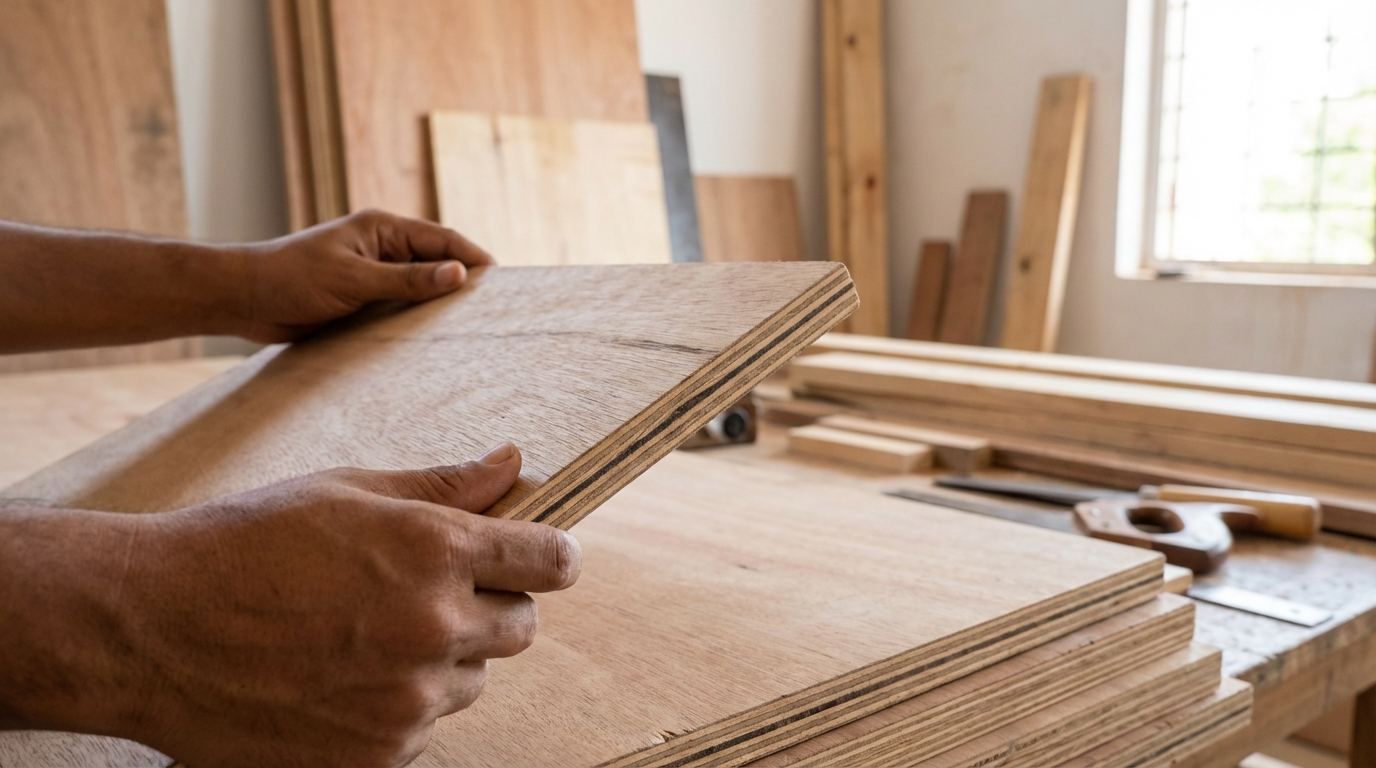
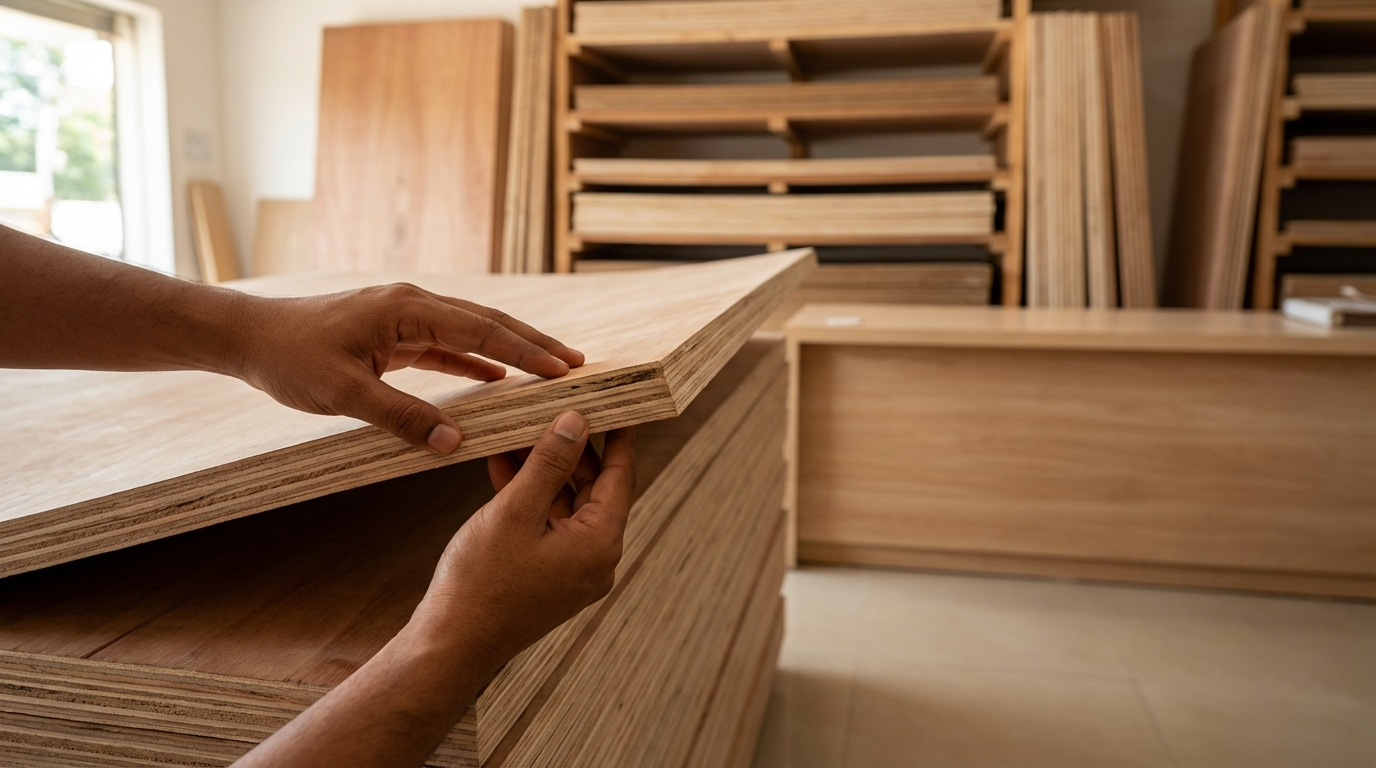
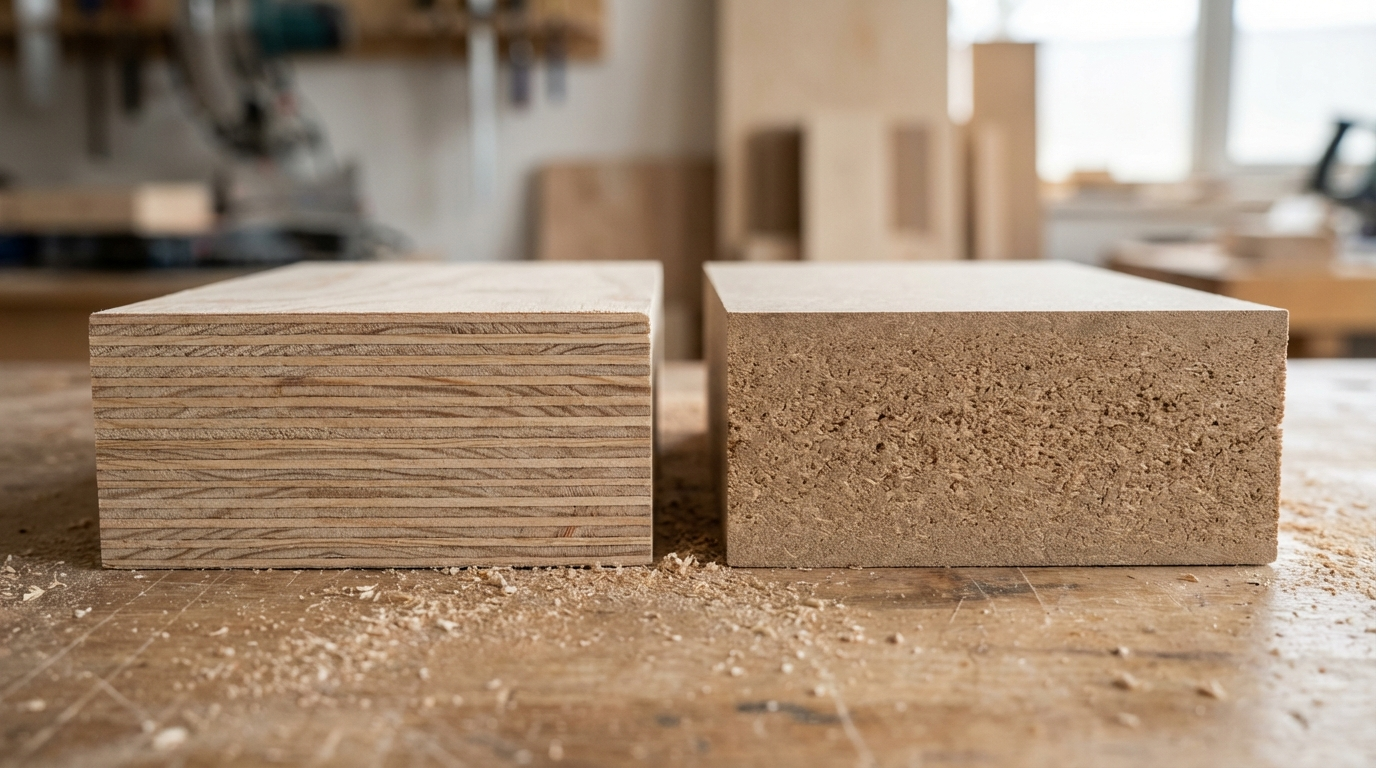
Plywood is made by cross-laminating thin wood veneers with adhesive under heat and pressure. The alternating grain direction gives it strength in multiple axes, making it resistant to splitting and able to hold screws firmly. Grades like MR (moisture-resistant), BWR (boiling water resistant), and BWP/marine (boiling waterproof) indicate the adhesive's water tolerance.
Engineered wood is an umbrella term covering several reconstituted wood products: MDF (medium-density fibreboard), particle board, HDF, and HDHMR (high-density high moisture resistance). These are made by binding wood fibres or particles with resins. They lack natural grain direction, so strength and moisture behaviour differ fundamentally from plywood.
Where People Get Confused
- "Engineered wood is just cheap plywood" — False. They are structurally different; engineered boards are fibre-based, plywood is veneer-based.
- "MDF is waterproof if it's green-coloured" — The green dye indicates moisture-resistant treatment, not waterproofing. Prolonged water contact still causes swelling.
- "HDHMR can replace marine plywood in kitchens" — HDHMR resists humidity better than standard MDF but cannot match marine plywood's performance under direct water or steam.
- "Plywood always warps, MDF stays flat" — Plywood can warp if poorly stored or unsealed; MDF stays flat initially but swells irreversibly when wet.
- "Thicker board means stronger furniture" — Core quality, grade, and adhesive matter more than raw thickness for load-bearing capacity.
India-Specific Reality Check
Indian homes face monsoon humidity, coastal salt air, and temperature swings that accelerate material failure. Engineered boards absorb atmospheric moisture through unsealed edges—common in rushed installations—leading to edge swelling within one or two monsoons. Plywood tolerates humidity fluctuations better because its cross-laminated veneers distribute stress, though poor-grade plywood with gaps in the core can still delaminate.
Storage conditions at dealer yards often expose sheets to rain or ground dampness. Boards stacked directly on cement floors absorb moisture from below. Always inspect sheets before purchase; reject any with soft spots, edge discolouration, or musty smell. Workmanship realities also matter: carpenters in humid cities often skip edge-sealing or use water-based paints on engineered boards, inviting early failure.
Two-Minute Comparison That Actually Helps
| Factor | Plywood (BWR/Marine) | MDF / HDHMR | Particle Board |
|---|---|---|---|
| Screw-holding strength | High (multiple re-screwing possible) | Moderate (pilot holes essential, limited re-screwing) | Low (screws loosen easily) |
| Moisture resistance | BWR handles kitchen humidity; marine handles wet zones | HDHMR resists humidity; standard MDF swells quickly | Very poor; swells irreversibly |
| Surface smoothness | Requires veneer or laminate for smooth finish | Factory-smooth; ideal for paint, laminate, membrane | Requires laminate; edges chip |
| Weight | Medium-heavy (density varies by core species) | Heavy (MDF denser than most plywood) | Light |
| Typical lifespan (India conditions) | 15–25+ years (marine grade, properly sealed) | 8–15 years (HDHMR, sealed edges, dry rooms) | 3–7 years (dry rooms only) |
| Cost range (8×4 ft, 18 mm) | ₹2,200–₹5,800 depending on grade | ₹1,400–₹3,200 depending on density | ₹900–₹1,500 |
| Best use | Carcasses, shelves, load-bearing, wet zones | Shutters, decorative panels, modular furniture fronts | Back panels, temporary fixtures |
How Do I Decide Based on Room Conditions?
Match material to moisture exposure first, then to load. Kitchens with under-sink cabinets need BWR or marine plywood for the carcass; HDHMR can work for upper shutters if edges are sealed with PU or ABS tape. Bedrooms with stable humidity can use MDF shutters on plywood carcasses. Bathrooms and utility areas should avoid all engineered boards unless fully waterproof coatings are applied—and even then, plywood is safer for structural parts.
Strength Comparison: What Holds Up Under Real Use?
Plywood's cross-grain structure distributes stress, so it resists bending under shelf loads and holds screws through repeated hinge adjustments. Engineered boards have uniform density, which helps with surface finishing, but screws rely on friction in compressed fibres—once loosened, the hole often strips permanently.
Can MDF Support Heavy Wardrobe Shelves?
Standard 18 mm MDF shelves spanning 600 mm or more will sag over time under heavy clothing loads. For wardrobes, use plywood shelves or limit MDF shelf spans to 400 mm with mid-support brackets. HDHMR performs slightly better but still cannot match plywood's long-span load tolerance. If you must use MDF for budget reasons, add aluminium edge channels or reduce shelf width.
Cost Drivers and Price Logic (India)
Prices fluctuate by city, brand premium, and supply chain. Use these ranges as directional guides—confirm locally before budgeting.
Plywood Price Drivers
- Grade: MR (lowest), BWR (mid), BWP/marine (highest).
- Core species: Poplar is lighter and cheaper; eucalyptus and gurjan/hardwood cores cost more but hold screws better.
- Calibration: Calibrated sheets (uniform thickness for modular work) add ₹150–₹400 per sheet over non-calibrated.
- Face veneer: Smooth, defect-free faces for paint or veneer finishing cost more.
- Thickness: 18–19 mm sheets cost roughly 25–35% more than 12 mm sheets of the same grade.
Engineered Board Price Drivers
- Density: HDF and HDHMR cost more than standard MDF; particle board is cheapest.
- Moisture treatment: Green-core or HDHMR variants add 15–30% over plain MDF.
- Pre-laminated vs plain: Pre-laminated boards save lamination labour but limit design flexibility.
- Brand and certification: ISI-marked or well-known brands command premiums of 10–25%.
How to Ask for a Quote (Checklist)
- Specify grade (BWR, marine, HDHMR, etc.) and IS code if applicable.
- State thickness and sheet size required.
- Ask whether price includes GST, transport, and unloading.
- Confirm edge-banding or sealing cost separately.
- Request batch samples before bulk purchase.
Lifespan: What to Expect Over 10, 15, 20 Years
Lifespan depends heavily on installation quality and maintenance. Poorly sealed plywood can fail faster than well-sealed HDHMR. However, under comparable conditions, plywood outlasts engineered boards because it tolerates moisture cycles without irreversible damage.
Does Engineered Wood Last Long Enough for Modular Kitchens?
HDHMR in modular kitchen shutters can last 10–12 years if edges are sealed with ABS or PU tape and the kitchen has proper ventilation. Carcasses made from HDHMR may show screw-loosening or edge swelling sooner if exposed to steam from cooktops or leaking sinks. For carcasses, BWR or marine plywood remains the safer choice; use HDHMR for shutter fronts where load and moisture exposure are lower.
Trade-offs and Limitations
Plywood Limitations
- Surface is not smooth enough for direct paint without veneer or laminate.
- Visible ply edges require edge-banding or lipping for a clean finish.
- Quality varies widely; core gaps and voids are common in lower grades.
- Heavier than particle board, increasing transport and handling cost.
Engineered Board Limitations
- Cannot be re-screwed reliably; hinge or handle adjustments risk stripping.
- Edges swell when exposed to water or even prolonged humidity if unsealed.
- Particle board and plain MDF are not suitable for any wet or semi-wet zones.
- Heavier than plywood of equivalent thickness, complicating wall-hung installations.
- Dust from cutting MDF is fine and hazardous; requires proper masks and extraction.
Common Buyer Mistakes and How to Avoid Them
Mistake 1: Choosing Material by Price Alone
Why it happens: Budget pressure leads to particle board or low-grade MDF for carcasses. What to do instead: Spend more on carcass material and economise on decorative shutters where load is lower.
Mistake 2: Ignoring Edge Sealing on Engineered Boards
Why it happens: Contractors skip edge-banding to save time or cost. What to do instead: Insist on ABS or PU edge tape for every exposed edge; inspect before final payment.
Mistake 3: Using MR Plywood in Kitchens
Why it happens: MR is cheaper and widely available; some dealers mislabel it. What to do instead: Verify BWR or marine grade by checking the IS code stamped on each sheet.
Mistake 4: Storing Sheets Flat on Cement Floors
Why it happens: Site storage is often makeshift. What to do instead: Store on raised battens, covered, in a ventilated area away from direct rain.
Mistake 5: Assuming "Green MDF" Is Waterproof
Why it happens: Marketing language conflates moisture-resistant with waterproof. What to do instead: Treat green MDF as humidity-tolerant only; avoid direct water exposure.
Mistake 6: Skipping Pilot Holes in MDF
Why it happens: Carpenters accustomed to plywood drive screws directly. What to do instead: Always drill pilot holes slightly smaller than screw diameter to prevent cracking.
Mistake 7: Over-Specifying Marine Plywood Everywhere
Why it happens: Fear of moisture leads to unnecessary cost. What to do instead: Reserve marine grade for wet zones (under-sink, bathrooms); BWR suffices for most kitchens.
Mistake 8: Ignoring Ventilation in Modular Cabinets
Why it happens: Design prioritises aesthetics over airflow. What to do instead: Add ventilation holes or grilles in back panels to reduce trapped humidity.
Failure Modes and Fixes
1. Edge Swelling on Engineered Boards
Symptom: Edges become soft, puffy, or discoloured. Root cause: Moisture ingress through unsealed or poorly sealed edges. Prevention: Apply ABS or PU edge tape on all exposed edges before installation. Fix if already happening: Trim swollen edge, seal with epoxy filler, re-apply edge tape; if swelling is severe, replace the panel.
2. Screw-Pull in MDF/Particle Board
Symptom: Hinges or handles loosen; screws spin without gripping. Root cause: Fibres around screw hole have compressed or stripped. Prevention: Use pilot holes, avoid over-tightening, choose coarse-thread screws. Fix if already happening: Fill hole with wood glue and toothpicks or dowel; re-drill after curing; consider adding hinge repair plates.
3. Delamination in Plywood
Symptom: Veneer layers separate, bubbling appears on surface. Root cause: Poor adhesive quality, water exposure, or manufacturing defects. Prevention: Buy ISI-marked BWR or marine grade; seal all cut edges. Fix if already happening: Inject wood glue under separated veneer, clamp overnight; severe cases require panel replacement.
4. Sagging Shelves
Symptom: Horizontal shelves bow in the centre under load. Root cause: Span too long for material thickness or weak core. Prevention: Use 18 mm plywood for spans over 500 mm; add mid-support for engineered boards. Fix if already happening: Install centre bracket or batten; replace with plywood if sagging is severe.
5. Surface Bubbling on Laminated MDF
Symptom: Laminate lifts from MDF substrate. Root cause: Heat or moisture weakened adhesive bond. Prevention: Use heat-resistant adhesive near cooktops; avoid placing hot vessels directly on surface. Fix if already happening: Re-glue with contact adhesive and clamp; prevent recurrence by adding trivets or heat pads.
6. Termite Damage in Plywood
Symptom: Hollow-sounding panels, visible bore holes, powdery residue. Root cause: Non-treated plywood or infestation from adjacent woodwork. Prevention: Buy termite-treated plywood; apply anti-termite spray on site before installation. Fix if already happening: Isolate affected panels, treat surrounding area, replace damaged sections with treated material.
Quality Checks You Can Do Without Lab Tests
Before Buying
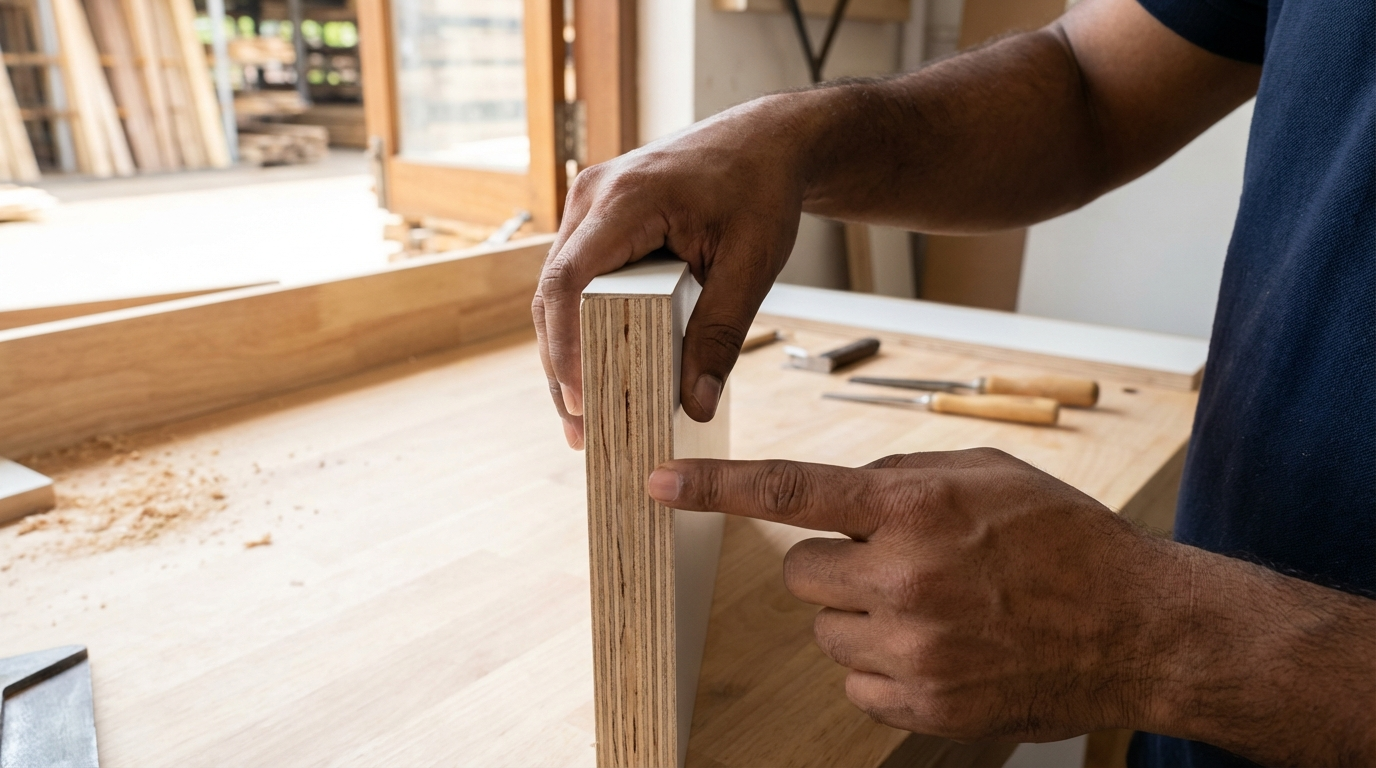
- Visual inspection: Look for voids, gaps, or uneven core when viewing the sheet edge.
- Tap test: Knock on the sheet surface; hollow sounds indicate internal gaps.
- Smell test: Musty or chemical odour suggests poor curing or moisture damage.
- Stamp verification: Check for ISI mark, grade code, and manufacturer name printed on the sheet.
- Weight comparison: Within the same grade and thickness, unusually light sheets may have lower density cores.
- Flexibility check: Gently flex the sheet corner; excessive flexibility in plywood suggests fewer plies or weak adhesive.
After Cutting
- Core inspection: Examine cut edges for continuous, gap-free core layers in plywood; uniform fibre density in MDF.
- Dust quality: MDF should produce fine, uniform dust; coarse or clumpy dust suggests poor fibre bonding.
- Edge hardness: Press a fingernail into the cut edge; it should resist indentation in quality boards.
After Installation
- Alignment check: Ensure shutter gaps are even and hinges do not bind.
- Edge seal verification: Run a finger along all edges; no exposed raw material should be visible.
- Cleaning habits: Wipe spills immediately; avoid soaking edges with wet cloth.
Decision Framework by Condition
| Condition | Recommended Material | What to Verify |
|---|---|---|
| Wet zone (bathroom vanity, under-sink) | Marine plywood | IS 710 stamp, sealed edges, waterproof adhesive claim |
| Kitchen carcass (humidity, occasional splash) | BWR plywood | IS 303 BWR stamp, termite treatment, calibration if modular |
| Wardrobe shutters (dry bedroom) | MDF or HDHMR | Edge sealing, smooth surface for laminate, density rating |
| Heavy-load shelves (books, utensils) | Plywood (BWR or hardwood core) | Core species, thickness ≥18 mm, no voids |
| Budget back panels | Particle board or thin MDF | Edge protection, dry room only, non-load-bearing |
| Coastal or high-humidity city | Marine plywood for structure; HDHMR for shutters | Extra edge sealing, ventilation in cabinets |
| Fast delivery / ready stock needed | MDF or pre-laminated particle board | Confirm moisture treatment if kitchen use |
| High scratch risk (children's room, office) | Plywood with high-pressure laminate | Laminate thickness ≥0.8 mm, scratch-resistant grade |
Persona-Specific Tips
For Homeowners: Durability and Cleaning
- Do: Wipe spills within minutes; use damp (not wet) cloth for cleaning; ensure cabinet ventilation.
- Don't: Place hot cookware directly on laminated MDF; leave cabinet doors closed for weeks in humid rooms; use abrasive cleaners on laminate surfaces.
- Ask your contractor to show you the grade stamp on every sheet before cutting begins.
- Keep a small quantity of matching edge tape for future repairs.
For Carpenters: Cutting, Fastening, Handling
- Use sharp TCT blades for clean MDF cuts; dull blades cause chipping.
- Pre-drill pilot holes in MDF and particle board—no exceptions.
- Handle plywood sheets with care; corner drops cause internal delamination invisible from outside.
- Seal all cut edges of engineered boards before installation, even if hidden inside cabinets.
- Avoid driving screws within 15 mm of MDF edges to prevent splitting.
For Architects and Designers: Specs and Detailing
- Specify grade (BWR, marine, HDHMR) and IS code in BOQ to avoid substitution.
- Include edge-sealing method in specifications; ABS tape or PU sealant for wet zones.
- Detail ventilation provisions for modular cabinets in kitchens and utility rooms.
- Consider hybrid construction: plywood carcass + MDF shutters for cost-effective performance.
- For high-humidity projects, specify marine plywood even for upper cabinets if ventilation is poor.
For OEM and Modular Furniture Makers: QC and Consistency
- Use calibrated plywood for carcasses to ensure consistent shutter alignment.
- Implement incoming inspection: measure thickness at multiple points; reject sheets outside ±0.5 mm tolerance.
- Standardise edge-sealing process with machinery rather than manual application for uniformity.
- Test screw-holding on sample pieces before mass production runs.
- Document material source and batch for warranty traceability; this reduces dispute resolution time.
Can I Mix Plywood and Engineered Wood in One Project?
Yes, and it is often the smartest approach. Use plywood for structural elements—carcasses, shelves, and frames—where screw-holding and moisture resistance matter most. Use MDF or HDHMR for shutter fronts, decorative panels, and surfaces requiring smooth finishes. This hybrid strategy balances cost, durability, and aesthetics. Ensure the carpenter understands the handling differences: plywood tolerates direct screws, while MDF needs pilot holes and gentle fastening.
Is HDHMR a Good Substitute for Plywood in Kitchens?
HDHMR works for kitchen shutters and upper cabinets where direct water exposure is minimal and edges are sealed. It should not replace plywood in sink cabinets, base units near dishwashers, or areas below cooktops where steam and heat concentrate. For base carcasses in Indian kitchens, BWR plywood remains safer because cooking habits involve water, steam, and oil splashes that HDHMR cannot withstand indefinitely.
How Does Humidity Affect Engineered Boards Over Time?
Engineered boards absorb moisture through exposed fibres, causing gradual swelling and weakening of the resin bond. In cities with extended monsoons or year-round humidity above 70%, even HDHMR can show edge softening within 3–5 years if edges are improperly sealed. Plywood's cross-laminated veneers distribute moisture stress, so it swells and shrinks more evenly without catastrophic failure. For coastal or high-humidity locations, prioritise plywood for all structural furniture.
What Thickness Should I Use for Wardrobe Carcass?
For wardrobe side panels and shelves, 18 mm is the standard recommendation whether using plywood or HDHMR. Thinner sheets (12 mm) can work for internal partitions or back panels but lack rigidity for sides bearing hinge stress. If shelves span more than 600 mm without mid-support, consider 19 mm plywood to prevent sagging. Drawer bottoms can use 6–9 mm material since load is distributed.
Does Plywood Need Edge Banding?
Technically, plywood edges can be left exposed or finished with paint or polish, unlike engineered boards where edge sealing is mandatory. However, edge banding improves aesthetics, prevents minor moisture ingress, and protects against chipping. For kitchen and bathroom furniture, seal all plywood edges—even those inside cabinets—using PU sealant or veneer lipping.
How Can I Identify Genuine BWR or Marine Plywood?
Look for the grade stamp printed on the sheet surface. BWR plywood should display "IS 303" with "BWR" or "MR Type II" designation. Marine plywood should show "IS 710". The stamp also includes the manufacturer name and licence number. Absence of a stamp, or stamps that rub off easily, suggest the sheet may not meet claimed standards. Ask dealers for test certificates if purchasing in bulk.
Why Does MDF Feel Heavier Than Plywood of the Same Size?
MDF is compressed wood fibre with higher uniform density throughout its thickness, typically 700–800 kg/m³. Plywood density varies by core species, ranging from 500–700 kg/m³. This weight difference affects wall-hung furniture: heavy MDF cabinets require stronger wall anchors and may not suit weak masonry. Factor in weight when designing tall bookcases or overhead kitchen units.
FAQs
Which is better for modular kitchen carcass: plywood or MDF?
Plywood, specifically BWR grade, is better for modular kitchen carcasses. Kitchens involve water, steam, and heat, all of which engineered boards handle poorly over time. BWR plywood's screw-holding strength also accommodates repeated hinge adjustments, which modular kitchens require during their lifespan. Use MDF or HDHMR only for shutter fronts where smooth laminate finishing is the priority and moisture exposure is controlled.
Can particle board be used for bedroom wardrobes?
Particle board can be used for wardrobe components in dry bedrooms if edges are sealed and loads are light. However, particle board's screw-holding is weak, so hinges may loosen within a few years. For wardrobes expected to last beyond 8–10 years, use plywood for the carcass and reserve particle board for back panels or internal dividers that bear no load.
How do I prevent MDF shutters from swelling in monsoon?
Seal all edges with ABS or PU tape before installation—this is non-negotiable. Ensure the kitchen or room has adequate ventilation to prevent humidity buildup inside closed cabinets. Avoid wiping shutters with dripping wet cloths; use damp microfibre instead. If shutters are near a sink or cooktop, consider HDHMR instead of standard MDF for better moisture tolerance.
Is marine plywood necessary for bathroom vanities?
Yes, marine plywood is strongly recommended for bathroom vanities because they face direct water splashes, high humidity, and poor ventilation. BWR plywood may suffice for bathrooms with exhaust fans and minimal splash exposure, but marine grade provides a safety margin that prevents costly replacements. Seal all edges and apply waterproof polish or laminate on exposed surfaces.
What is the typical lifespan of HDHMR in Indian conditions?
HDHMR in dry, well-ventilated rooms can last 10–15 years with proper edge sealing. In kitchens with moderate humidity, expect 8–12 years before edges or surfaces show wear. Coastal cities or poorly ventilated spaces may reduce this to 5–8 years. Plywood in similar conditions typically outlasts HDHMR by 5–10 years, making it more economical over the furniture's lifetime despite higher upfront cost.
Can I paint directly on MDF without primer?
No, MDF requires a sealing primer before painting. Raw MDF absorbs paint unevenly due to its porous surface, leading to blotchy finishes and excessive paint consumption. Apply one or two coats of MDF sealer or shellac-based primer, sand lightly, then proceed with topcoat paint. Edges absorb even more paint than faces, so seal them separately before priming.
Why do some plywood sheets have voids in the core?
Voids occur due to manufacturing defects: gaps between veneer pieces, insufficient adhesive application, or poor pressing. Lower-grade plywood often has more voids because manufacturers use smaller veneer offcuts. Voids reduce screw-holding strength and increase the risk of delamination. Always inspect the edge of plywood sheets before purchase; consistent, gap-free cores indicate better quality.
How do I choose between calibrated and non-calibrated plywood?
Calibrated plywood has uniform thickness achieved through precision sanding, making it essential for modular furniture where shutters must align perfectly. Non-calibrated plywood varies by 1–2 mm across a sheet, causing uneven gaps in fitted furniture. If you are using CNC machines or building frameless modular units, always specify calibrated sheets. For traditional carpentry with visible frames, non-calibrated plywood may suffice and cost less.
Disclaimer: This content is provided for general informational purposes based on industry practices and publicly available information. Product specifications, standards, prices, and availability may vary by manufacturer, region, and time. Readers should independently verify details with manufacturers, dealers, or qualified professionals before making purchase or construction decisions.Want Plywood Suggestions?
Share a few details and a Duro BOIL specialist will suggest suitable brands and connect you to responsive dealers.