HDMR Sheet Price per Sq Ft: 8x4 Sheet Cost + Thickness-wise Rate
HDMR sheet price guide with thickness-wise rates, 8x4 sheet cost examples, and the exact factors that change quotes across brands and cities.
Quick Decision Summary
Best answer in one line: HDMR sheet prices in India typically range from ₹28 to ₹85 per square foot depending on thickness, density grade, and city.
If you're in a hurry: For a standard 8x4 HDMR sheet (32 sq ft), expect to pay between ₹900 and ₹2,700 depending on thickness. The 18mm thickness commonly used for shutters and carcasses falls in the ₹55–₹75 per sq ft range in most metros. Always confirm density (typically 800–900 kg/m³ for genuine HDMR), surface calibration, and whether the quote includes GST and transport. Prices vary 10–20% between cities due to logistics and local demand. Get quotes from at least two dealers with matching specifications before finalizing.
- Choose HDMR if: You need a dense, screw-holding substrate for laminate-finished furniture, modular kitchens, or wardrobes where MDF feels too soft.
- Avoid HDMR if: Your application involves continuous water exposure (use BWP plywood instead), structural load-bearing, or you need the natural grain of solid wood or veneer-faced plywood.
What HDMR Actually Means (And Where Confusion Starts)
HDMR stands for High Density Moisture Resistant fibreboard. It sits between standard MDF and HDF in the density spectrum, typically manufactured at 800–900 kg/m³. The "moisture resistant" tag refers to melamine-fortified resins that improve humidity tolerance compared to plain MDF—but this is not waterproofing. HDMR swells when submerged or exposed to standing water for extended periods.
The material is made by breaking down wood fibres, mixing them with resin binders, and pressing them under heat and pressure into uniform sheets. This process eliminates grain direction, giving HDMR consistent strength in all directions—useful for routing, drilling, and edge profiling without splintering.
Where People Get Confused About HDMR
- HDMR vs HDF: Some dealers use these terms interchangeably. True HDF is denser (900+ kg/m³) and thinner (typically 3–6mm for flooring underlays). HDMR is the furniture-grade variant in 8–25mm thicknesses.
- Moisture resistant vs waterproof: HDMR handles humidity better than plain MDF but is not suitable for wet zones like under-sink cabinets or bathroom vanities without additional sealing.
- "Commercial" HDMR labels: This marketing term has no standardized meaning. Always ask for actual density specifications rather than relying on grade names.
- Thickness vs density pricing: A thicker sheet is not automatically higher density. Some economy HDMR sheets maintain thickness while using lower-density cores, which affects screw-holding and durability.
- Surface finish confusion: Raw HDMR requires laminate or paint finishing. Pre-laminated HDMR costs more but saves site labour and achieves factory-grade adhesion.
Price Range and Cost Drivers (India)
HDMR pricing in India follows a predictable pattern based on thickness, density grade, and regional logistics. The ranges below reflect 2024-2026 market observations across major cities. Confirm current rates locally as raw material costs fluctuate.
Thickness-Wise Price Ranges (Per Square Foot)
| Thickness | Typical Price Range (₹/sq ft) | Common Applications |
|---|---|---|
| 6mm | ₹28–₹42 | Back panels, drawer bottoms, light partitions |
| 8mm | ₹32–₹48 | Wardrobe backs, cabinet backs, internal shelving |
| 12mm | ₹42–₹58 | Shelves, loft panels, interior partitions |
| 16mm | ₹48–₹65 | Carcass sides, mid-duty shelving |
| 18mm | ₹55–₹75 | Shutter fronts, carcass, modular kitchen boxes |
| 25mm | ₹70–₹85 | Countertop substrates, heavy-duty furniture |
8x4 Sheet Cost Examples
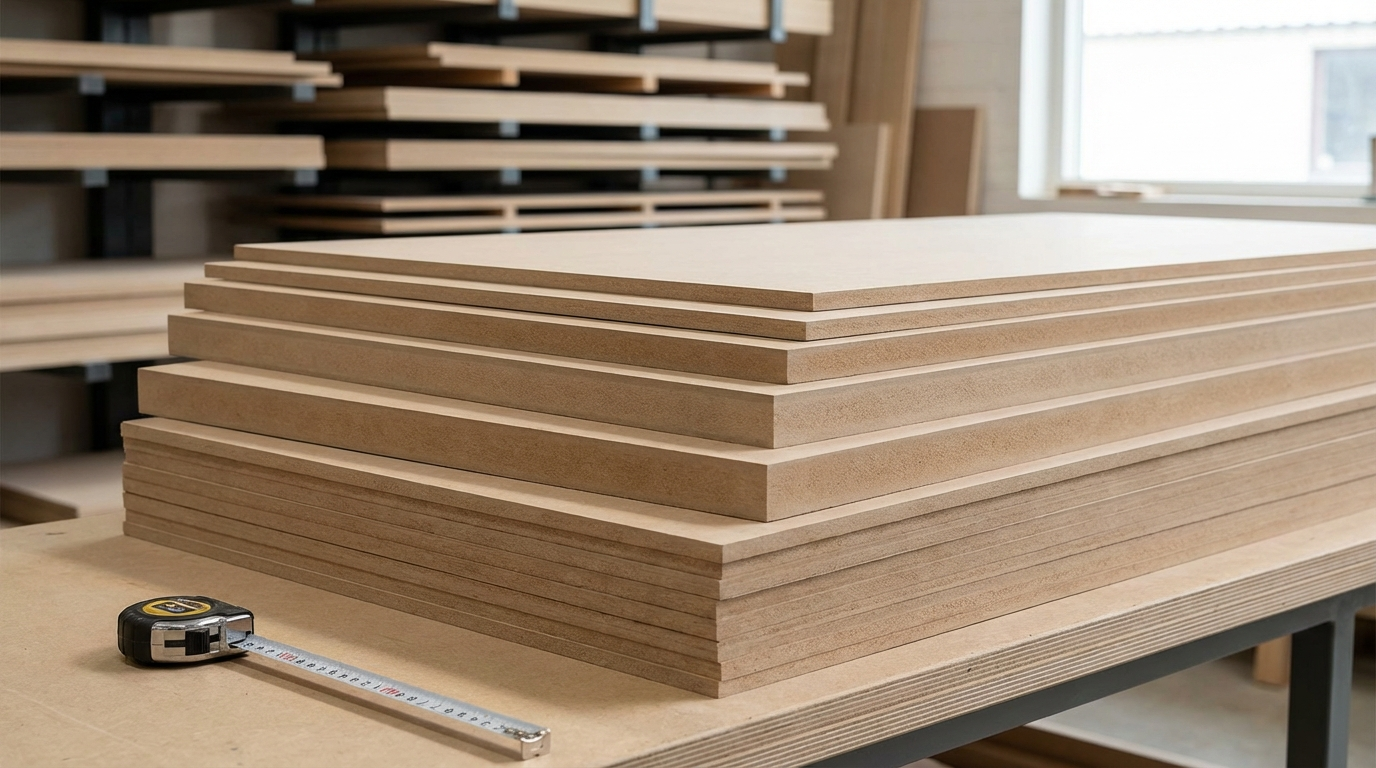
A standard 8x4 sheet covers 32 square feet. Using mid-range prices:
- 6mm sheet: ₹900–₹1,350
- 12mm sheet: ₹1,350–₹1,850
- 18mm sheet: ₹1,750–₹2,400
- 25mm sheet: ₹2,250–₹2,720
Pre-laminated HDMR adds ₹15–₹35 per sq ft depending on laminate quality and pattern. Solid colours cost less than woodgrain or textured finishes.
What Drives Price Variation?
- Density grade: Higher density (870+ kg/m³) sheets command 15–25% premium over standard grades.
- Calibration quality: Factory-sanded sheets with ±0.2mm tolerance cost more than rough-finished sheets that require site sanding.
- Brand positioning: Established manufacturers with consistent quality typically price 10–20% above regional brands.
- City and logistics: Prices in Tier-2 cities may be 8–15% higher than manufacturing hubs due to transport costs.
- Order volume: Bulk orders (50+ sheets) often qualify for 5–10% dealer discounts.
- GST inclusion: Always confirm whether quoted price includes 18% GST or is ex-factory.
How to Ask for a Quote Properly
When requesting HDMR quotes, specify these line items to get comparable numbers:
- Exact thickness required (in mm)
- Sheet size (8x4 or 8x3 or custom)
- Density specification (kg/m³)
- Raw or pre-laminated (if laminated, specify finish)
- Calibrated or standard surface
- Quantity needed
- Delivery location
- GST and transport inclusion
Sample Budget Calculation: 10x12 Bedroom Wardrobe
For a floor-to-ceiling wardrobe (8ft x 10ft face area) with internal shelving:
- Carcass and shelves: approximately 6 sheets of 18mm HDMR (₹1,750 x 6 = ₹10,500)
- Back panels: 2 sheets of 6mm HDMR (₹1,100 x 2 = ₹2,200)
- Shutter fronts: 3 sheets of 18mm HDMR (₹1,750 x 3 = ₹5,250)
- Laminate finishing: approximately ₹4,500–₹6,000
- Total material estimate: ₹22,500–₹24,000 (plus hardware, labour, edge banding)
This excludes wastage (typically 8–12% for complex designs) and site conditions that may require adjustments.
India-Specific Reality Check
HDMR behaviour in Indian conditions differs significantly from temperate climates. Understanding these realities prevents costly failures.
Monsoon and Humidity Factors
During monsoon months, ambient humidity in coastal and central India often exceeds 80%. HDMR absorbs atmospheric moisture gradually, causing minor expansion. Well-sealed edges and proper acclimatization (storing sheets flat in the installation space for 48–72 hours before cutting) minimize this issue. Unsealed edges in high-humidity kitchens can show visible swelling within 6–12 months.
Storage and Handling at Site
Many project delays stem from improper site storage. HDMR sheets stacked directly on concrete floors absorb ground moisture. Sheets stored vertically without support develop warps. Always store flat on wooden battens, covered with plastic sheeting, away from direct sunlight and rain exposure. Reject any sheet showing edge damage or visible moisture staining upon delivery.
Workmanship Realities
Carpenter skill levels vary dramatically across India. HDMR requires sharper tools and slower feed rates than plywood. Blunt router bits cause edge chipping. Overtightened screws strip easily because the material lacks wood grain for mechanical grip. Specify pilot holes and proper screw sizes in your work order to prevent these issues.
Temperature Extremes
In North Indian summers (45°C+), HDMR installed near windows or in direct sunlight can show laminate delamination if adhesive quality is poor. In hill stations with significant temperature swings, expansion gaps become critical. Leave 2–3mm clearance at fixed edges for thermal movement.
How Does HDMR Compare to Plywood and MDF?
HDMR occupies a middle position between MDF and plywood in terms of density, cost, and application suitability. The right choice depends on your specific conditions rather than absolute material superiority.
| Property | HDMR | BWR Plywood | Standard MDF |
|---|---|---|---|
| Density | 800–900 kg/m³ | 550–700 kg/m³ | 650–750 kg/m³ |
| Screw holding | Good (with pilot holes) | Excellent | Moderate |
| Water resistance | Humidity tolerant only | Good (IS 303 BWR) | Poor |
| Edge finishing | Excellent (smooth edges) | Requires veneer/banding | Good |
| Routing/profiling | Excellent | Limited | Good |
| Weight | Heavy | Moderate | Moderate |
| Price (18mm) | ₹55–₹75/sq ft | ₹70–₹110/sq ft | ₹38–₹52/sq ft |
Choose based on conditions: For modular kitchen carcasses in dry zones, HDMR offers excellent value. For under-sink cabinets or bathroom vanities, BWR or BWP plywood provides better moisture security. For painted furniture where routing detail matters more than structural load, HDMR outperforms plywood.
Is HDMR Good for Modular Kitchens?
HDMR has become the dominant substrate for modular kitchen carcasses in urban India due to its dimensional stability, smooth surface for laminate bonding, and cost-effectiveness compared to marine plywood. However, "good for kitchens" requires qualification.
Where HDMR works well: Upper cabinets, tall units, drawer boxes, internal shelving—anywhere that doesn't face direct water exposure. The material's uniform density ensures consistent cam-lock fitting and hinge screw retention across all panels.
Where HDMR fails: Sink base cabinets, areas below water purifiers, dishwasher surrounds, and any zone with plumbing leak risk. Even "moisture resistant" HDMR swells irreversibly when soaked. Use BWP plywood or marine plywood for these specific boxes, even if the rest of the kitchen uses HDMR.
Edge sealing is non-negotiable: All exposed HDMR edges in kitchens must have PVC or ABS edge banding. Unsealed edges absorb cooking steam and cleaning water, causing localized swelling that propagates over time.
Trade-offs and Limitations
Every material involves compromises. Understanding HDMR's limitations prevents disappointment and guides appropriate application.
- Weight penalty: HDMR is significantly heavier than equivalent plywood. An 18mm 8x4 sheet weighs 45–55 kg versus 30–38 kg for plywood. This affects installation difficulty, wall-mounting hardware requirements, and transport costs.
- No structural use: HDMR cannot be used for load-bearing applications like staircase treads, structural shelving, or floor decking. It lacks the tensile strength of cross-laminated plywood.
- Water vulnerability: Despite the "moisture resistant" label, prolonged water exposure causes irreversible swelling. There is no drying-out recovery like some plywoods offer.
- Fastener limitations: Edge screwing splits the material easily. Face screwing requires pilot holes. Repeated screw removal weakens the hole permanently.
- Machining dust hazard: HDMR cutting generates fine dust that requires proper respiratory protection and dust extraction. Carpenters working without masks face health risks.
- Repair difficulty: Damaged HDMR cannot be patched invisibly. Unlike solid wood or even plywood, you cannot sand out deep scratches or fill gouges seamlessly.
- Finish dependency: Raw HDMR looks industrial and absorbs stains. It requires laminate, veneer, or paint finishing to be usable in visible applications.
Common Buyer Mistakes and How to Avoid Them
Mistake 1: Buying Based on Brand Name Alone
Why it happens: Marketing creates brand recognition without explaining technical specifications. Buyers assume a known brand automatically means higher quality.
What to do instead: Ask for density specifications (kg/m³), check surface calibration tolerance, and physically inspect sample sheets. A lesser-known brand with 870 kg/m³ density may outperform a famous brand's economy line at 780 kg/m³.
Mistake 2: Ignoring Density and Trusting "Grade" Labels
Why it happens: Terms like "premium" or "commercial" grade have no standardized meaning. Dealers use them inconsistently.
What to do instead: Request the actual density figure. Genuine HDMR should be 800+ kg/m³. Below 780 kg/m³, screw-holding and edge stability drop noticeably.
Mistake 3: Using HDMR for All Kitchen Cabinets Including Sink Units
Why it happens: Modular kitchen installers standardize on one material for simplicity. Sink base cabinets get the same HDMR as dry zones.
What to do instead: Specify BWP plywood or marine plywood for sink base cabinet carcasses. The 20–30% cost increase for those 2–3 panels prevents expensive water damage repairs.
Mistake 4: Skipping Edge Banding to Save Cost
Why it happens: Edge banding adds ₹15–₹25 per running metre. Budget-conscious buyers skip it on hidden edges.
What to do instead: Seal all edges, including interior ones that face cabinet humidity. Unsealed HDMR edges in kitchens show swelling within 1–2 years.
Mistake 5: Storing Sheets Improperly at Site
Why it happens: Construction sites lack proper storage space. Sheets get stacked on wet floors or left uncovered.
What to do instead: Insist on flat storage on wooden battens, 6 inches above ground, covered with plastic. Reject any sheet showing moisture damage on delivery.
Mistake 6: Comparing Prices Without Matching Specifications
Why it happens: One dealer quotes pre-laminated sheets, another quotes raw sheets. Buyers compare headline prices without specification alignment.
What to do instead: Create a standard specification sheet listing thickness, density, surface finish, and GST inclusion. Get all quotes against identical specs.
Mistake 7: Ordering Exact Quantities Without Wastage Buffer
Why it happens: Budget calculations use theoretical panel requirements without accounting for cutting waste and defects.
What to do instead: Add 10–15% wastage buffer for complex furniture with many cutouts. Simple rectangular work can use 8% buffer.
Mistake 8: Assuming All 18mm Sheets Are Equal
Why it happens: Thickness is visible and measurable; density and resin quality are not.
What to do instead: Compare weight per sheet among options. A heavier 18mm sheet at the same dimensions indicates higher density. Check edge condition for porosity.
Failure Modes and Fixes
Edge Swelling Near Sink Areas
Symptom: Cabinet edges near water sources become puffy, soft, and discoloured.
Likely root cause: Unsealed edges absorbing splash water and humidity over months.
Prevention: Use PVC edge banding on all exposed edges. Apply silicone sealant at joints near water sources. Consider BWP plywood for sink-adjacent cabinets.
What to do if already happening: Cut away the swollen section (at least 50mm beyond visible damage), replace with fresh HDMR panel, and seal all edges before reinstalling.
Laminate Peeling at Edges
Symptom: Laminate lifts from substrate starting at corners and edges.
Likely root cause: Poor adhesive quality, insufficient pressing pressure during lamination, or moisture ingress under unsealed edges.
Prevention: Use factory-laminated panels where possible. For site lamination, ensure proper adhesive coverage and pressing. Seal all edges immediately after lamination.
What to do if already happening: For small areas, inject wood adhesive under the lifted section and clamp overnight. For extensive peeling, re-laminate the entire panel.
Screw Stripping in Hinge Zones
Symptom: Hinge screws spin freely without grip, causing doors to sag.
Likely root cause: Using screws too large for pilot holes, over-tightening, or HDMR density too low for repeated load cycles.
Prevention: Use proper pilot holes (2mm diameter for 4mm screws). Choose high-density HDMR (850+ kg/m³) for shutter panels. Use cup hinges with larger mounting plates.
What to do if already happening: Fill stripped holes with wood filler mixed with sawdust, let cure 24 hours, re-drill pilot hole, or relocate hinge position by 10–15mm to fresh material.
Panel Warping During Storage
Symptom: Sheets develop visible bow or twist before installation.
Likely root cause: Vertical storage without support, uneven humidity exposure, or moisture absorption from ground.
Prevention: Store flat on level surface with wooden battens. Cover with plastic. Acclimatize 48–72 hours before cutting.
What to do if already happening: Minor warps can be flattened by placing heavy weight uniformly across the sheet for 2–3 days. Severe warps require rejection or cutting into smaller usable pieces.
Surface Bubbling After Painting
Symptom: Painted HDMR surface shows small bubbles or rough texture.
Likely root cause: Moisture trapped in material, incompatible primer, or paint applied before sealer fully cured.
Prevention: Apply dedicated MDF/HDMR sealer first. Allow 24-hour cure before primer. Use moisture meter to verify substrate is below 12% MC before painting.
What to do if already happening: Sand affected area, apply sealer, and repaint. For persistent issues, check for moisture source behind the panel.
Drawer Box Bottom Sagging
Symptom: Thin HDMR drawer bottoms develop visible sag under load.
Likely root cause: Using 6mm HDMR for deep drawers, insufficient groove depth, or overloading beyond design capacity.
Prevention: Use 8mm minimum for drawer bottoms over 400mm depth. Ensure groove depth is at least 8mm. Add center support rail for drawers over 600mm width.
What to do if already happening: Add aluminum or wooden support rail under the sagging bottom. For severe cases, replace bottom panel with thicker material.
Quality Checks You Can Do Without Lab Tests
Before Buying
- Weight check: Lift the sheet. Heavier weight at same dimensions indicates higher density. An 18mm 8x4 sheet should feel noticeably heavy (45–55 kg for genuine HDMR).
- Edge inspection: Look at raw edges for uniform density. Porous, spongy edges indicate lower-quality material.
- Surface calibration: Run your palm across the face. Genuine calibrated sheets feel uniformly smooth. Waves or rough patches indicate poor sanding.
- Thickness consistency: Measure with a caliper at multiple points (corners and center). Variance should be under ±0.3mm for good sheets.
- Moisture staining: Check edges and faces for water marks, discoloration, or warping that indicates improper storage.
- Manufacturer marking: Look for density specification, production date, and batch number printed or stamped on the sheet.
After Cutting
- Cut edge quality: Sharp blade cuts through genuine HDMR cleanly. Excessive fraying or tear-out suggests low density or poor resin bonding.
- Dust quality: HDMR produces fine, uniform dust. Coarse particles or chunky debris indicate inconsistent material.
- Internal color: Core should be uniform colour throughout. Dark patches or colour variation may indicate contaminated raw material.
- Smell test: Strong formaldehyde odour immediately after cutting suggests higher emission levels. Properly cured HDMR has minimal smell.
After Installation
- Door alignment: Check that shutters hang level and close flush. Warped HDMR shows alignment problems within days of installation.
- Edge condition: Inspect all edge banding for secure adhesion. Run your finger along joints—gaps or lifting indicate bonding failure.
- Hardware stability: Gently test hinges and handles after one week. Any looseness suggests either poor screw selection or low-density substrate.
- Cleaning protocol: Wipe down surfaces weekly with slightly damp cloth. Never use dripping wet cloths that leave standing water.
Decision Framework: Which Substrate for Which Condition
| Condition | Recommended Option | What to Verify |
|---|---|---|
| Dry interior furniture (bedrooms, living areas) | Standard HDMR 18mm | Density 800+ kg/m³, calibrated surface |
| Kitchen carcasses (except sink base) | HDMR 18mm with full edge banding | Density 850+ kg/m³, PVC edge band quality |
| Sink base cabinet and wet zones | BWP plywood 18mm (IS 710) | IS 710 certification, marine-grade adhesive |
| Coastal city installation | HDMR with extra sealing or BWR plywood | Full edge sealing, humidity acclimatization |
| Heavy drawer loads | HDMR with metal drawer systems | Drawer bottom thickness 8mm+, support rails |
| Routed decorative shutters | High-density HDMR (870+ kg/m³) | Clean routing without edge chips |
| Tight budget with finish flexibility | Standard MDF with laminate | Accept lower screw-holding, lighter weight |
| Fast project delivery | Pre-laminated HDMR | Colour match across batches, edge band compatibility |
Tips for Homeowners
Your primary concerns are durability, maintenance ease, and avoiding expensive repairs. HDMR furniture serves homeowners well when installed correctly, but ongoing care matters.
Durability Expectations
- Well-made HDMR furniture lasts 10–15 years in dry zones with proper care.
- Kitchen cabinets may need shutter replacement in 8–12 years due to humidity wear—this is normal.
- Expect some minor hinge adjustment after the first year as panels settle.
Cleaning Do's
- Wipe with slightly damp (not wet) microfiber cloth.
- Use mild soap solution for grease spots.
- Dry immediately with clean cloth.
- Clean spills within minutes, especially on horizontal surfaces.
Cleaning Don'ts
- Never use dripping wet cloths or pour water on surfaces.
- Avoid abrasive scrubbers that damage laminate.
- Skip harsh chemical cleaners that attack laminate adhesive.
- Don't leave wet vessels on shelves—use trays or mats.
Tips for Carpenters and Fabricators
HDMR machines differently from plywood. Adjust your techniques for better results and fewer callbacks.
Cutting and Routing
- Use carbide-tipped blades designed for MDF/HDMR. Standard wood blades dull quickly.
- Reduce feed rate by 20–30% compared to plywood for cleaner cuts.
- Support full sheet during cutting to prevent breakout at exit point.
- For routing, use upcut spiral bits for edge profiles. Downcut bits cause surface tear-out.
Edge Preparation
- Sand cut edges with 120-grit before edge banding. HDMR edge porosity requires sealing.
- Apply edge band within 24 hours of cutting to prevent moisture absorption.
- Use hot-air edge banders for consistent adhesion. Manual ironing requires skill.
Fastening Zones
- Always pre-drill pilot holes. Direct screwing splits the material.
- Pilot hole diameter should be 60–70% of screw shank diameter.
- For hinge zones, consider pre-inserted dowels or metal inserts for heavy doors.
- Avoid edge screwing—use dowels, biscuits, or cam-lock systems instead.
Hinge Area Reinforcement
- For shutters over 600mm height, use 3 hinges instead of 2.
- Apply wood hardener to pilot holes in high-stress zones.
- Consider soft-close hinges that reduce slam impact on fasteners.
Tips for Architects and Interior Designers
Specify HDMR correctly in your tender documents to avoid site disputes and quality failures.
Specification Language
- Specify density range (e.g., "HDMR 850–900 kg/m³") not just "HDMR".
- Mention surface calibration tolerance (±0.2mm for precision work).
- Indicate moisture class (E1 or E0 for low formaldehyde emission where required).
- Specify edge treatment requirements (PVC 1mm minimum for kitchens).
Wet-Zone Detailing
- Detail BWP plywood use for all cabinets within 600mm of water sources.
- Specify silicone sealant at all counter-to-wall and counter-to-cabinet joints.
- Include drainage gaps in sink base cabinet floor (5mm holes or mesh bottom).
- Require waterproof membrane under wall-mounted cabinets in bathrooms.
Finish Integration
- Match HDMR thickness to laminate thickness for flush edge profiles.
- For painted finishes, specify sealer coat and sanding sequence.
- Note that pre-laminated HDMR limits on-site colour matching flexibility.
Tips for OEM and Modular Furniture Manufacturers
Production consistency and reducing returns require standardized processes and QC checkpoints.
Incoming Material QC
- Weigh sample sheets from each batch. Establish density threshold for rejection.
- Measure thickness at 5 points minimum per sheet. Reject variance over ±0.3mm.
- Visual inspect 10% of sheets for edge damage, moisture stains, surface defects.
- Maintain supplier scorecard tracking density consistency, defect rate, and delivery reliability.
Process Checkpoints
- Verify edge banding adhesion with peel test on first 3 panels of each production run.
- Measure pilot hole depths against specification before fastener insertion.
- Calibrate CNC machines weekly for consistent routing depth and edge quality.
- Document humidity levels in storage and production areas daily.
Reducing Returns and Complaints
- Most customer complaints trace to edge swelling (sealing failure) or hinge loosening (pilot hole issues). Focus QC resources on these areas.
- Include installation guidelines with every delivery specifying acclimatization, handling, and edge protection.
- Photograph finished units before dispatch as documentation against transport damage claims.
What Thickness of HDMR Should I Use for Wardrobes?
Wardrobe construction uses multiple thicknesses optimized for each component's structural role. Using single thickness throughout wastes material and increases cost unnecessarily.
For vertical sides and horizontal partitions that bear shelf loads, 18mm HDMR provides adequate strength and screw-holding. Back panels that face walls and carry no structural load work well with 6mm or 8mm sheets—the lighter weight reduces wall mounting stress. Internal shelves supporting clothing weight perform well at 18mm for spans up to 800mm; wider spans need additional support or thicker material.
Shutter fronts require 18mm for rigidity and hinge stability. Drawer fronts can use 16mm if hardware is appropriate. For high-end wardrobes with heavy mirror doors or sliding systems, consider 19mm for the structural frame.
Always confirm that your hardware (hinges, drawer slides, cam-locks) is rated for the thickness you select. Mismatched hardware causes installation failures regardless of panel quality.
Does HDMR Work for Bathroom Vanities?
HDMR can work for bathroom vanity carcasses only under specific conditions that most Indian bathrooms do not meet. The critical factor is consistent ventilation and absence of direct water contact.
In well-ventilated bathrooms with exhaust fans, wall-mounted vanities (not floor-standing) with fully sealed edges may last 5–8 years. However, the typical Indian bathroom—with floor-level plumbing, bucket bathing splash, and poor ventilation—creates conditions where HDMR fails within 2–3 years.
For bathroom furniture, BWP plywood (IS 710) or marine plywood offers significantly better performance. The 30–40% higher material cost is justified by avoiding early replacement and water damage to surrounding surfaces.
If you must use HDMR for budget reasons, elevate the vanity on metal legs (minimum 100mm clearance), seal all edges with PVC banding plus silicone, and ensure the room has functioning ventilation. Accept that this is a compromise solution with limited lifespan.
How Do I Know If HDMR Quality Is Genuine?
Genuine high-density HDMR is distinguishable from economy alternatives through physical inspection, though you cannot verify exact specifications without laboratory testing. Focus on observable indicators that correlate with quality.
Weight is the most reliable field indicator. An 18mm 8x4 sheet of genuine HDMR (850+ kg/m³) weighs 48–55 kg. Sheets under 40 kg at this size indicate lower density. Bring a bathroom scale to the dealer or ask for weight-per-sheet information.
Edge inspection reveals internal quality. Genuine HDMR shows uniform, dense edge texture. Economy boards show visible porosity, uneven colour, or spongy texture at cut edges. Press your fingernail into the edge—it should resist indentation.
Surface quality indicates processing care. Run your palm across the face. Genuine calibrated sheets feel uniformly smooth. Waves, rough patches, or thickness variation indicate poor sanding or inconsistent pressing.
Finally, reputable suppliers provide density specifications and batch documentation on request. Unwillingness to share this information suggests the product may not meet claimed specifications.
FAQs
What is the standard size of HDMR sheets available in India?
The most common HDMR sheet size in India is 8 feet by 4 feet (2440mm x 1220mm), which equals 32 square feet. Some manufacturers offer 8x3 feet sheets for specific applications, and custom sizes can be ordered in bulk quantities. The 8x4 format dominates because it optimizes cutting efficiency for standard furniture dimensions while fitting standard transport and storage configurations. When calculating requirements, use the 32 sq ft figure per sheet, then add 10–15% wastage buffer depending on your cutting pattern complexity.
Can HDMR be used for outdoor furniture?
HDMR is not suitable for outdoor furniture exposed to rain, direct sunlight, or ground moisture. Even "moisture resistant" HDMR absorbs water when subjected to outdoor conditions, leading to swelling, delamination, and structural failure within months. For outdoor furniture, use marine plywood with waterproof coating, WPC (wood-plastic composite), or treated solid wood. If you must use HDMR for covered outdoor spaces (like enclosed balconies), ensure complete edge sealing, elevate furniture off floors, and accept significantly reduced lifespan compared to indoor use.
How does HDMR compare to HDHMR?
HDHMR (High Density High Moisture Resistant) is a marketing term used by some manufacturers to indicate enhanced moisture resistance compared to standard HDMR. There is no standardized specification difference between HDMR and HDHMR—the terminology varies by manufacturer. When evaluating such claims, focus on measurable specifications: density (kg/m³), moisture content limits, and edge swelling test results. Ask for technical data sheets rather than relying on grade names. Both materials remain unsuitable for continuous water exposure regardless of the label.
What is the lifespan of HDMR furniture?
Well-made HDMR furniture in dry interior applications typically lasts 10–15 years with proper care. Kitchen cabinets face more humidity stress and may show edge wear or hinge loosening in 8–12 years, with shutter replacement often needed before carcass replacement. Factors affecting lifespan include initial material quality (density), edge sealing completeness, installation precision, ongoing maintenance, and environmental conditions. Coastal cities with high humidity reduce lifespan by 20–30% compared to dry climate regions. Regular inspection and prompt repair of edge damage extends useful life significantly.
Is HDMR termite-proof?
HDMR is not inherently termite-proof, but its processing reduces termite risk compared to solid wood. The high-temperature pressing and resin impregnation make HDMR less attractive to termites than natural wood. However, termites can still attack HDMR, especially in ground-contact installations or areas with severe termite pressure. Some manufacturers offer HDMR treated with anti-termite additives—verify such claims with documentation. For termite-prone areas, combine treated HDMR with building-level termite management (soil treatment, physical barriers) rather than relying solely on material treatment.
Can I paint HDMR directly without laminate?
Yes, HDMR accepts paint finishing, but requires proper surface preparation. Apply a dedicated MDF/HDMR sealer first to prevent the material from absorbing excessive paint and to ensure uniform finish. Follow with primer appropriate for your topcoat type (water-based or oil-based). Sand lightly between coats with fine-grit sandpaper. For high-quality painted finishes, factory spray application produces better results than site painting. Note that painted HDMR is more vulnerable to moisture than laminated HDMR, as paint film alone does not provide equivalent edge protection.
How much wastage should I factor when ordering HDMR?
Wastage depends on furniture design complexity and cutting optimization. For simple rectangular furniture (basic wardrobes, storage units), factor 8–10% wastage. For complex modular kitchens with many cutouts, angles, and irregular pieces, factor 12–15%. Designs with curved elements or extensive CNC routing may generate 15–18% waste. Experienced fabricators with cutting optimization software can reduce waste by 3–5%. Always round up your order—running short mid-project causes colour matching issues if the next batch varies slightly. Store leftover pieces flat for future repairs or small projects.
Does HDMR require acclimatization before installation?
Yes, HDMR benefits from acclimatization before cutting and installation. Store sheets flat in the installation environment for 48–72 hours before use. This allows the material to reach equilibrium moisture content with the room, reducing post-installation movement. Acclimatization is especially important when sheets move from warehouses (often poorly climate-controlled) to air-conditioned homes, or when installing during monsoon season. Skipping acclimatization increases risk of panel warping, joint gaps opening, and edge band failure as the material adjusts after installation.
Disclaimer: This content is provided for general informational purposes based on industry practices and publicly available information. Product specifications, standards, prices, and availability may vary by manufacturer, region, and time. Readers should independently verify details with manufacturers, dealers, or qualified professionals before making purchase or construction decisions.Want Plywood Suggestions?
Share a few details and a Duro BOIL specialist will suggest suitable brands and connect you to responsive dealers.