How to Buy MDF Board: Complete Purchasing Guide for Beginners
Learn how to buy MDF boards with confidence. Our guide covers types, sizes, quality checks, and tips for getting the best price on MDF boards.
Quick Buying Decision
One-line recommendation: For most home furniture projects, choose MR Grade MDF in 18mm thickness from a reputable brand with smooth, chip-free edges.
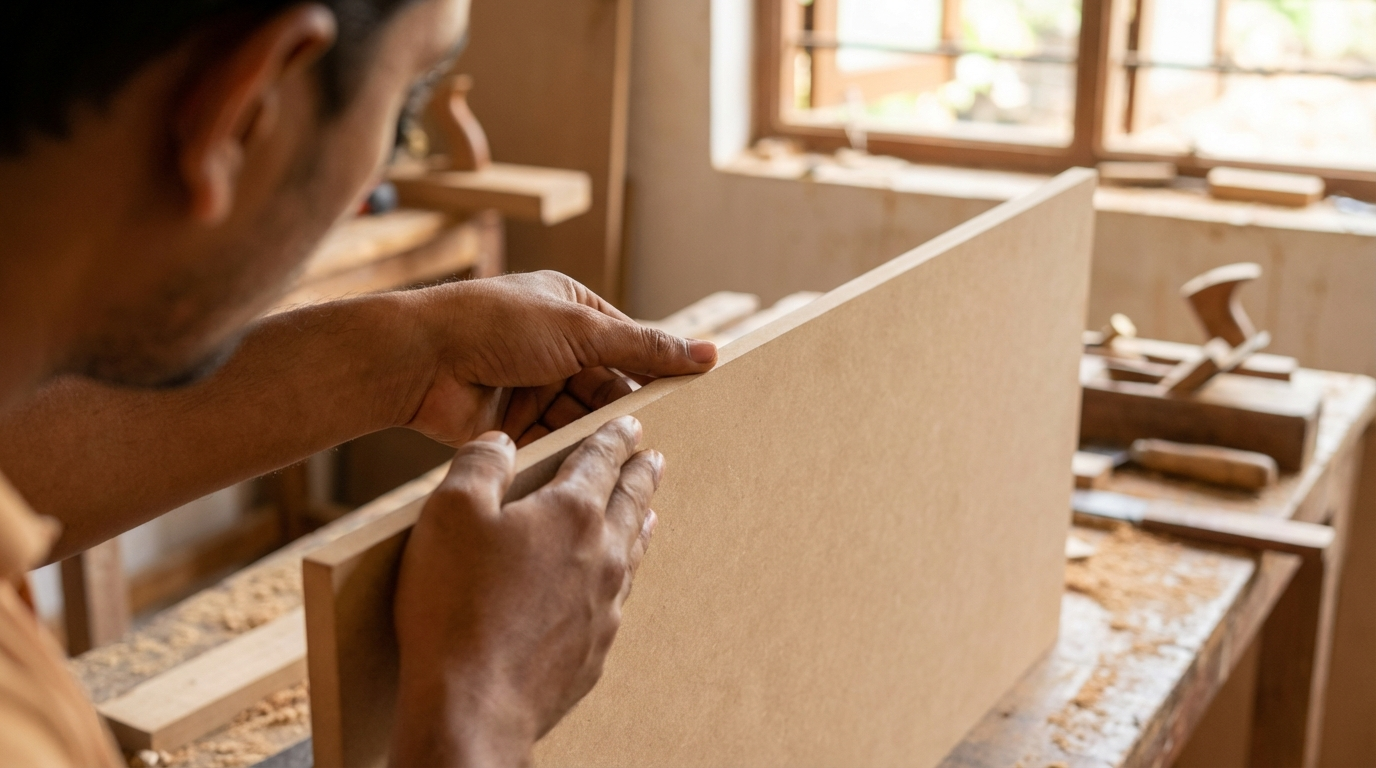
If you're in a hurry: Walk into any established plywood dealer and ask for "MR Grade MDF, 18mm thickness" for general furniture work. Check that the board surface is uniformly smooth without any rough patches, and ensure edges don't crumble when you press your fingernail against them. For kitchens or bathrooms, specifically request "HDHMR" or "Boiling Water Resistant MDF" to handle humidity. Expect to pay anywhere from ₹45-85 per square foot depending on grade and brand. Always buy 10% extra to account for cutting waste.
Quick Picks
- Best for kitchen: HDHMR or BWR Grade MDF — because kitchens face constant moisture from cooking steam, washing, and humidity fluctuations that standard MDF cannot handle
- Best for wardrobe: MR Grade MDF 18mm — because wardrobes need moderate moisture resistance for clothing storage without the premium cost of higher grades
- Best budget option: Standard Interior Grade MDF — because it works perfectly for dry-area furniture like TV units and study tables at significantly lower cost
- Best premium option: Pre-laminated HDHMR — because it combines moisture resistance with factory-finished surfaces, reducing fabrication time and ensuring consistent finish quality
How to Choose MDF Board in 5 Steps
Step 1: Identify Your Application
Before visiting any shop, clearly define where your MDF furniture will be installed. This single factor determines everything else about your purchase.
Wet Area vs Dry Area Decision:
- Wet areas include kitchens, bathrooms, balcony-adjacent furniture, and any space near water sources or high humidity zones. These require moisture-resistant grades
- Dry areas include bedrooms, living rooms, study rooms, and air-conditioned spaces where humidity remains controlled. Standard MDF works adequately here
Heavy Use vs Light Use:
- Heavy use: Kitchen base cabinets, wardrobe carcasses, shoe racks, children's furniture — choose higher density options
- Light use: Wall panels, decorative screens, back panels, drawer bottoms — standard density suffices
According to industry guidance, location of use should be your primary consideration — use moisture resistant MDF inside cabinets and carcasses where humidity exposure is likely (mdfdirect.co.uk).
Step 2: Determine the Right Grade/Type
MDF boards come in distinct grades, each engineered for specific conditions:
Interior Grade (Standard MDF): Suitable only for dry, climate-controlled interiors. Most economical option but swells rapidly with moisture exposure.
MR Grade (Moisture Resistant): Treated with moisture-resistant resins to handle moderate humidity. Ideal for most residential furniture applications in Indian conditions.
HDHMR (High Density High Moisture Resistant): Denser core with enhanced moisture protection. Recommended for kitchens, bathrooms, and coastal region homes.
BWR/Boil Proof Grade: Highest moisture resistance, can withstand direct water contact temporarily. Essential for sink areas and bathroom vanities.
Pre-laminated MDF: Factory-finished with decorative surfaces in various colours and textures. Saves time and ensures uniform finish quality.
As noted by greenply.com, for furniture in dry environments, regular MDF is adequate, but for kitchens or bathrooms, investing in MR MDF prevents swelling and damage.
Step 3: Choose Correct Thickness
Thickness directly impacts structural integrity, weight capacity, and overall durability of your furniture.
| Application | Recommended Thickness | Why This Thickness |
|---|---|---|
| Back panels | 3-6mm | Non-structural, only needs to cover space |
| Drawer bottoms | 6-9mm | Light load bearing, needs some rigidity |
| Shelves (light items) | 12mm | Adequate for books, clothes without sagging |
| Wardrobe carcass | 18mm | Standard structural thickness for stability |
| Kitchen cabinets | 18mm | Handles weight of utensils, hardware mounting |
| Heavy-duty shelving | 25mm | Prevents deflection under heavy loads |
| Table tops | 25-30mm | Provides substantial feel, resists warping |
Why thickness matters: A shelf that's too thin will sag over time, especially in Indian humidity. For wardrobe carcasses and kitchen units, 18mm MDF provides optimal strength and stability (mdfdirect.co.uk). Using thinner boards to save money often results in premature failure and costly replacements.
Step 4: Check Quality Indicators
Before finalizing any purchase, physically inspect the boards. Here's what to examine:
Visual inspection:
- Surface should be uniformly smooth without rough patches or undulations
- Colour should be consistent throughout — uneven colour suggests inconsistent bonding
- No visible chips, dents, or delamination at edges
Physical tests at the shop:
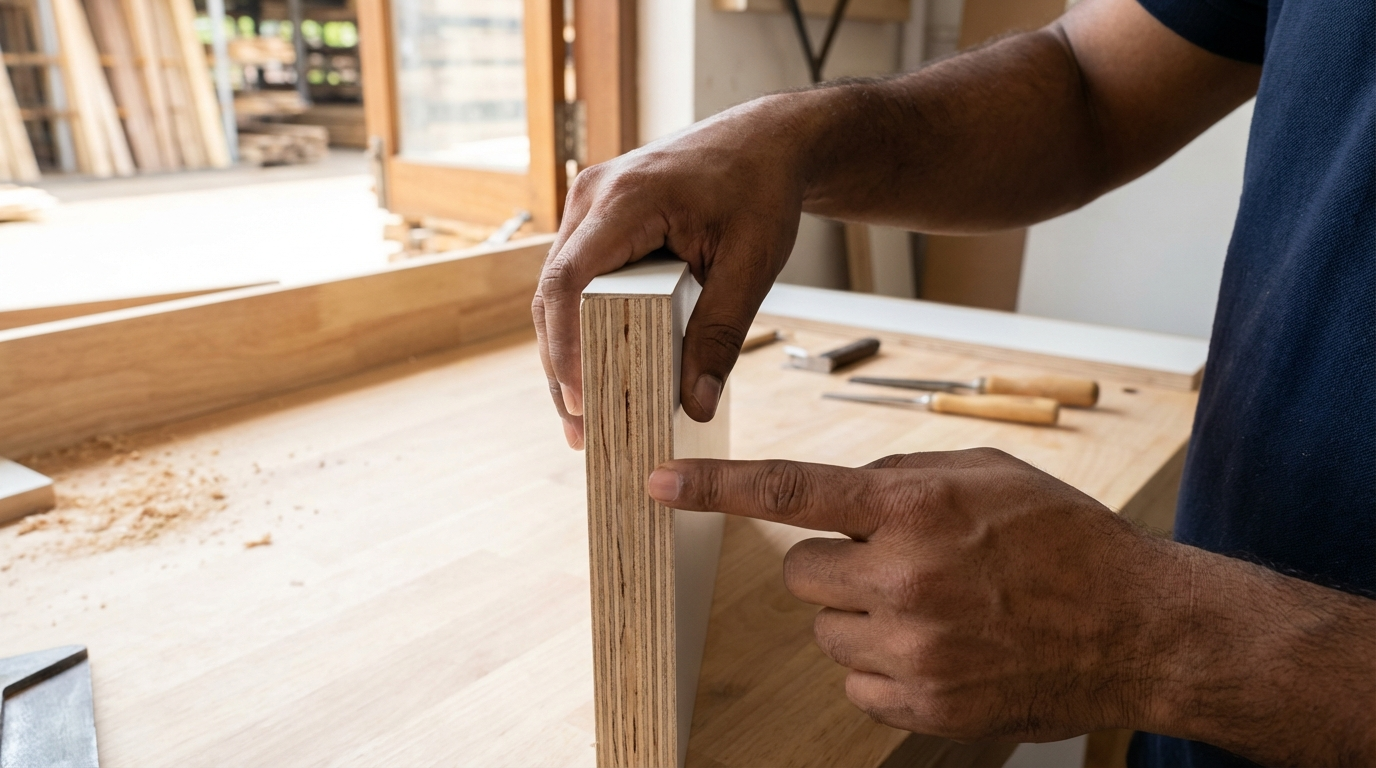
- Edge test: Press your fingernail firmly against the edge — quality MDF shouldn't crumble or show excessive fibre shedding
- Weight check: Lift the board — denser boards indicate better quality and strength
- Flex test: Gently flex a corner — excessive flexibility suggests lower density
- Surface scratch: Lightly scratch with fingernail — poor quality boards show immediate marks
Good quality MDF wood should have a smooth, faultless finish with even colour and smooth edges without chipping (greenply.com).
Step 5: Compare Prices and Get Quotes
How to ask for quotes properly:
- Specify exact grade (MR, HDHMR, BWR)
- Mention thickness required
- State quantity in number of sheets or total square feet
- Ask for both branded and unbranded options
- Request delivery charges separately
What should be included in your quote:
- Board grade and thickness clearly stated
- Brand name (if applicable)
- Price per sheet and total cost
- GST inclusion/exclusion
- Delivery charges to your site
- Return/replacement policy for damaged sheets
Get quotes from at least three dealers before deciding. Price variations of 15-25% for identical products are common across shops in the same city.
Decision Framework: What to Buy for Each Situation
| Your Situation | Recommended Option | Why | What to Verify |
|---|---|---|---|
| Kitchen cabinets | HDHMR 18mm | Handles cooking steam, water splashes, and humidity cycles | Green/blue core colour indicating moisture treatment |
| Bathroom vanity | BWR Grade MDF 18mm | Direct water exposure near sink requires highest moisture resistance | Boiling water test certification from manufacturer |
| Bedroom wardrobe | MR Grade MDF 18mm | Moderate humidity protection for clothing storage, cost-effective | Smooth surface for laminate adhesion |
| Living room furniture | Standard MDF 18mm | Air-conditioned, dry environment doesn't need moisture treatment | Density and surface smoothness |
| Coastal area home | HDHMR or Marine Grade | Constant salt-laden humidity requires maximum protection | Higher density rating, brand reputation |
| Tight budget | Interior Grade MDF with laminate | Lowest cost, works for dry areas when properly sealed | Edge sealing during fabrication essential |
| Premium quality need | Pre-laminated HDHMR | Factory finish ensures consistency, moisture protection built-in | Brand warranty, surface finish quality |
Price Guide and Budget Planning
MDF prices vary significantly based on grade, thickness, brand, and your city. Here are typical price ranges you might encounter:
Price ranges by type (per 8×4 feet sheet, approximate):
- Interior Grade MDF 18mm: ₹1,800-2,500
- MR Grade MDF 18mm: ₹2,200-3,200
- HDHMR 18mm: ₹3,000-4,500
- Pre-laminated MDF 18mm: ₹3,500-5,500
- BWR/Boil Proof 18mm: ₹4,000-6,000
What affects price:
- Thickness: Thicker boards cost proportionally more
- Brand: Established brands command 20-40% premium
- Grade: Each step up in moisture resistance adds 25-35% to cost
- City: Metro cities typically have more competitive pricing due to higher competition
- Quantity: Bulk purchases often attract 5-10% discounts
Budget estimation for common projects:
- 10×10 feet modular kitchen (MDF carcass only): Approximately ₹35,000-55,000 for HDHMR boards
- 6×8 feet wardrobe: Approximately ₹18,000-28,000 for MR Grade MDF
- TV unit with storage: Approximately ₹8,000-15,000 depending on size and grade
How to get accurate quotes checklist:
- Measure your space and calculate approximate square footage needed
- Add 10-15% for cutting waste
- List all components separately (carcass, shelves, back panels)
- Specify thickness for each component
- Get itemized quotes showing board quantity and rates
Why do prices vary so much between shops?
Several factors create significant price differences:
Sourcing: Dealers buying directly from manufacturers get better rates than those purchasing through distributors. This difference passes to customers.
Inventory costs: Shops in prime locations with higher rent factor this into pricing. Dealers in industrial areas often offer better rates.
Volume: High-volume dealers negotiate better manufacturer terms and can afford thinner margins per sheet.
Brand mix: Some shops stock only premium brands while others offer multiple tiers. Comparing across different brand categories isn't meaningful.
Services included: Some dealers include cutting, delivery, or returns in their pricing while others charge separately.
Red Flags: When to Walk Away
Protect yourself by recognizing these warning signs:
- No brand markings on boards: Legitimate manufacturers always stamp their products. Unmarked boards are either counterfeit or factory rejects
- Significantly below-market pricing: If the price seems too good, the quality usually matches. Cheap MDF often uses inferior resins that fail quickly
- Rough or uneven edges: Quality MDF cuts cleanly. Crumbly, fibrous edges indicate poor manufacturing or improper storage
- Musty smell or visible moisture damage: MDF stored improperly absorbs moisture. Once damaged, it never performs correctly
- Dealer refuses to show full sheets: Insisting you only see samples might hide quality inconsistencies in actual stock
- No invoice or GST billing offered: Legitimate businesses provide proper documentation. Cash-only deals often indicate questionable sourcing
- Pressure to buy immediately: "Special price only today" tactics usually indicate desperation to move problematic inventory
- Unable to specify manufacturer: Good dealers know exactly where their products come from and can provide this information
Common Buying Mistakes (And How to Avoid)
Mistake 1: Choosing Based on Price Alone
Why people make this mistake: Budget constraints naturally push buyers toward cheaper options without understanding long-term implications.
What goes wrong: Interior grade MDF used in kitchens swells within months. Repairs cost more than the initial savings.
What to do instead: Match grade to application. Save money on dry-area furniture, invest properly in moisture-prone areas.
Mistake 2: Ignoring Edge Quality
Why people make this mistake: Buyers focus on surface appearance, forgetting that edges take the most stress during handling and installation.
What goes wrong: Poor edges crumble during cutting, create weak joints, and fail to hold edge banding properly.
What to do instead: Always inspect edges before purchase. Good quality boards cut cleanly without excessive fibre shedding.
Mistake 3: Underestimating Quantity Needed
Why people make this mistake: Calculating exact requirements without accounting for cutting patterns and waste seems economical.
What goes wrong: Running short mid-project means buying additional sheets — often from different batches with slight colour variations.
What to do instead: Always order 10-15% extra. Leftover MDF stores well and proves useful for future repairs.
Mistake 4: Not Checking Storage Conditions
Why people make this mistake: Assuming shop inventory is properly maintained seems reasonable for established dealers.
What goes wrong: MDF stored in damp warehouses absorbs moisture, compromising structural integrity before installation.
What to do instead: Ask to see actual storage area. Boards should be stacked flat on supports in covered, dry spaces.
Mistake 5: Using Wrong Thickness for Shelving
Why people make this mistake: Thinner boards cost less and seem adequate for shorter shelf spans.
What goes wrong: Shelves sag over time under load, especially in Indian humidity. This ruins aesthetics and functionality.
What to do instead: Use minimum 18mm for shelves over 60cm span. Consider 25mm for heavy storage.
Mistake 6: Skipping Acclimatization
Why people make this mistake: Project timelines push for immediate fabrication after delivery.
What goes wrong: Boards expand or contract after installation as they adjust to room conditions, causing warping or joint failures.
What to do instead: Store boards flat at installation location for 48-72 hours before cutting.
Mistake 7: Not Sealing Cut Edges
Why people make this mistake: Edge sealing adds time and cost to fabrication, and its importance isn't immediately visible.
What goes wrong: Unsealed edges absorb moisture rapidly, causing swelling that spreads into the board body.
What to do instead: Insist your carpenter seals all cut edges with primer or edge banding, especially in kitchens.
Mistake 8: Buying from Unknown Online Sellers
Why people make this mistake: Online prices often appear significantly lower than local dealers.
What goes wrong: No physical inspection means quality issues only appear after delivery. Returns are complicated and costly.
What to do instead: Buy online only from manufacturer websites or authorized dealers. Physical inspection before purchase remains ideal.
Questions to Ask Your Dealer
- "What is the exact grade of this MDF?" — Good answer specifies (MR, HDHMR, BWR). Concerning: "It's moisture proof" without specifics
- "Which manufacturer made these boards?" — Good answer names specific company. Concerning: Vague responses or "local manufacturing"
- "What is the density of this board?" — Good answer provides kg/m³ figure (typically 700-850). Concerning: Unable to answer
- "How long has this batch been in storage?" — Good answer shows recent stock rotation. Concerning: Unknown or very old inventory
- "Can I see the storage area?" — Good answer allows inspection. Concerning: Refuses or makes excuses
- "What's your return policy for damaged sheets?" — Good answer has clear process. Concerning: "No returns" or unclear terms
- "Is this price including GST?" — Good answer provides clear breakdown. Concerning: Avoids direct answer
- "Do you provide delivery? What are the charges?" — Good answer gives specific rates. Concerning: "We'll see" or variable pricing
- "Can you provide manufacturer warranty documentation?" — Good answer offers to include. Concerning: Claims warranty but no paperwork
- "What thickness options do you have in this grade?" — Good answer lists available options. Concerning: Limited stock or only one option
After Purchase: Handling and Storage
How to transport without damage:
- Keep boards flat during transport — never stand them on edge for extended periods
- Support full length to prevent bending stress
- Protect corners with cardboard or padding
- Cover with tarpaulin if transporting in open vehicles
- Avoid transport during rain — even brief moisture exposure affects edges
Storage requirements before installation:
- Store horizontally on flat, level support at minimum three points
- Keep in covered, dry area away from direct sunlight
- Maintain minimum 4-inch gap from walls for air circulation
- Never store directly on concrete floors — use wooden battens underneath
- Stack with similar sizes — mixing can cause pressure points and warping
Acclimatization period:
Allow boards to rest at installation location for 48-72 hours before fabrication. This lets the MDF adjust to room temperature and humidity levels, significantly reducing post-installation movement and potential warping issues.
Frequently Asked Questions
Which brand is best for MDF boards?
Several reputable manufacturers produce quality MDF in India. Rather than fixating on brand names, focus on grade specifications, density ratings, and physical quality inspection. Established brands typically offer more consistent quality and better after-sales support. Ask your dealer about manufacturer reputation in your region, as availability and service quality vary by location. Local contractors can often recommend brands that have performed well in similar projects nearby.
How to identify original vs duplicate MDF?
Genuine MDF boards carry manufacturer stamps or stickers with grade, thickness, and production details. Check edge quality — authentic products have dense, uniform edges while counterfeits show loose fibres and inconsistent density. Ask for manufacturer documentation and GST invoices. Reputable dealers readily provide this information. If pricing seems unusually low compared to market rates, the product likely isn't what it claims to be.
What warranty should I expect on MDF?
Most established manufacturers offer warranties ranging from 1-7 years depending on grade. HDHMR and BWR grades typically carry longer warranty periods than standard MDF. Warranty usually covers manufacturing defects like delamination or density inconsistencies but excludes damage from improper handling, installation, or exposure conditions outside specifications. Always obtain warranty documentation at purchase — verbal assurances mean little later.
How much MDF do I need for my project?
Calculate total surface area of all components including carcass sides, shelves, back panels, and internal partitions. Standard MDF sheets measure 8×4 feet (32 square feet). Divide total required area by 32 for sheet count, then add 10-15% for cutting waste and potential errors. Professional carpenters or modular kitchen designers can provide accurate calculations based on your specific requirements and design.
Should I buy MDF online or from physical stores?
Physical stores allow essential quality inspection before purchase — checking surface smoothness, edge quality, and weight that determine actual performance. Online purchases from manufacturer websites or authorized e-commerce partners offer convenience but limit inspection ability. For first-time buyers, physical purchase from established local dealers remains advisable. Build relationships with reliable dealers for future requirements.
When is the best time to buy MDF?
Prices remain relatively stable throughout the year, though slight increases during peak construction season (October-February) occur in some regions. More important than timing is buying during dry weather — monsoon deliveries risk moisture exposure during transport. Ensure your storage space is ready before ordering. Avoid rushed purchases during festivals when dealers may push older inventory to clear stock.
How to negotiate the best price on MDF?
Gather quotes from multiple dealers before negotiating — knowledge of market rates strengthens your position. Buying complete project requirement from single dealer justifies requesting bulk discount (typically 5-10%). Cash payments sometimes attract additional discounts. However, prioritize proper GST invoices and warranty documentation over marginal price reductions. Building long-term relationships with dealers often yields better overall value than aggressive one-time negotiation.
What if I receive damaged material?
Inspect delivery thoroughly before signing acceptance. Photograph any damage immediately with delivery person present. Most reputable dealers replace damaged sheets within reasonable timeframes when reported promptly. Understand return policy before purchase and keep all documentation. For significant damage, refuse acceptance entirely rather than accepting with promises of later replacement — enforcing replacements becomes difficult once you've signed for receipt.
Disclaimer: This content is provided for general informational purposes based on industry practices and publicly available information. Product specifications, standards, prices, and availability may vary by manufacturer, region, and time. Readers should independently verify details with manufacturers, dealers, or qualified professionals before making purchase or construction decisions.
Want Plywood Suggestions?
Share a few details and a Duro BOIL specialist will suggest suitable brands and connect you to responsive dealers.