Marine plywood price per sq ft: what to ask the dealer
Understand marine plywood price per sq ft using price-per-sqft tables, thickness-wise factors, and dealer quote tips. Avoid overpaying and fake stock in India.
Quick Decision Summary
Marine plywood prices typically range ₹70–₹220 per sq ft in India, varying by thickness, core quality, and location—quote BWP/IS 710 specs to compare.
If you’re in a hurry: Focus on 18mm thickness for structural use (often ₹110–₹180/sq ft), insist on calibrated sheets with uniform glue lines, and ask for a breakdown including wastage/transport. True marine (BWP grade) costs 40–80% more than MR but lasts in wet zones like kitchens or coastal homes. Skip if not high-moisture; verify face veneer grain and knock-test for voids before loading. Get 3 quotes specifying thickness, face/back plies, and delivery terms to avoid 20–30% overpay.
- Choose this if: Heavy moisture exposure, coastal/monsoon areas, or load-bearing needs like partitions.
- Avoid this if: Dry interiors only—opt for cheaper BWR to save ₹30–₹70/sq ft.
What This Term/Material Actually Means
Marine plywood refers to Boiling Water Proof (BWP) grade plywood engineered for prolonged high-humidity and direct water contact, using phenolic resins in multiple glue lines that withstand boiling tests per IS 710 standards. It features dense hardwood cores, thick face/back veneers (1.0–1.4mm), and precise calibration to prevent warping under India's humid conditions.
Where people get confused:
- Thinks it's fully waterproof like plastic—it's moisture-resistant, not submersible long-term.
- Assumes all "marine" labels mean BWP—many shops sell mislabeled BWR as marine.
- Believes thickness alone defines quality—ignores core gaps or glue shear strength.
- Confuses with MR grade for kitchens—MR delaminates in steam/splashes.
- Expects it for all doors—overkill for bedrooms, inflating costs unnecessarily.
- Mixes up with film-faced shuttering plywood— that's for concrete forms, not interiors.
What makes marine plywood different from regular plywood?
Marine plywood uses fully synthetic phenolic glue (vs urea-formaldehyde in MR/BWR), surviving 72+ hours boiling without delamination, ideal for bathrooms or coastal kitchens. Regular types fail faster in humidity above 70%, common in Indian monsoons. Nuance: Even marine needs edge sealing and ventilation; it's not invincible. Next step: Tap sheet edges—if hollow sound, reject for voids; confirm dealer shows IS 710 mark.
India-Specific Reality Check
In India, marine plywood faces real tests from 80–95% monsoon humidity, coastal salt air, and poor godown storage causing pre-warping. Sheets often arrive with surface moisture, leading to 10–20% rejection if not aired 48 hours before use. Contractor workflows favor it for slow-pay projects, but open truck transport adds ₹5–15/sq ft logistics in Tier-2 cities vs metros.
Price Range and Cost Drivers (India)
Expect ₹70–₹220 per sq ft, with thin sheets (4–6mm) at lower end for paneling and thicker (18–25mm) higher for furniture/doors. Varies 20–40% by region—Mumbai/Chennai pricier due to import glues, inland cheaper but riskier quality.
| Thickness | Typical Range (₹/sq ft) | Common Use |
|---|---|---|
| 4–6mm | ₹70–₹110 | Wainscoting, shelves |
| 9–12mm | ₹90–₹140 | Cabinets, partitions |
| 15–18mm | ₹110–₹180 | Doors, heavy furniture |
| 21mm+ | ₹160–₹220 | Structural beams |
Cost drivers: Thicker plies (+30–50%), premium teak face veneer (+₹20–40), poplar core cheaper than hardwood (-₹15–25), calibration/finish (+₹10), city logistics (10–20% upcharge).
How to ask for a quote—checklist:
- Specify BWP/IS 710, exact thickness, face/back veneer type.
- Ask per sq ft inclusive of 5–10% wastage, transport to site.
- Request sample knock-test and glue-line count (min 3 for 18mm).
- Get breakdown: base + veneer + calibration + taxes.
- Compare 3 dealers: "Quote for 50 sheets 18mm BWP, teak face."
Mini budget example: 100 sq ft kitchen cabinets (18mm) at ₹140 avg = ₹14,000 material; add 15% wastage/transport = ₹16,000 total—confirm locally as batches vary.
Is marine plywood price per sq ft higher in coastal cities?
Yes, often 15–30% more in Mumbai, Chennai, or Kochi due to salt-resistant glues and faster stock turnover needs. Inland like Delhi/Lucknow sees lower due to generic sourcing. Condition: Bulk buys (50+ sheets) negotiate 5–10% off anywhere. Check: Ask "Coastal premium included?" and compare invoice lines for glue/veneer specs.
How to Choose in 5 Steps
- Match to exposure: Wet zone? BWP only. Dry? Skip to save.
- Pick thickness: Structural=18mm+, decorative=9–12mm.
- Inspect sheet: Uniform color, no gaps, heavy feel.
- Quote smart: List specs, get samples, haggle wastage.
- Verify post-buy: Cut test for straightness, seal edges immediately.
Skip steps? Risk delamination in 6–12 months, costing double rework.
What thickness of marine plywood is best for doors?
18mm for main doors (handles load/impact), 12–15mm for internal. Thinner warps faster under humidity swings. Nuance: Pair with solid frame; coastal add 21mm. Next: Measure door opening +2mm clearance, ask dealer for calibrated stock to avoid trimming losses.
Two-Minute Comparison That Actually Helps
| Grade | Moisture Tolerance | Price Premium | Best For |
|---|---|---|---|
| MR | Low (interior dry) | Base | Bedrooms |
| BWR | Medium (bath edges) | +20–40% | Kitchen cabinets |
| BWP/Marine | High (direct wet) | +40–80% | Bathrooms, coastal |
Choose marine if steam/splashes expected; BWR saves if ventilated well.
Decision Framework: Match Your Project Needs
| Condition | Recommended | Verify |
|---|---|---|
| Wet zone (kitchen/bath) | 18mm BWP | Glue lines, edge seal |
| Coastal/salty air | 21mm+ hardwood core | Face veneer thickness |
| Heavy use/impact | Thick calibrated | Known-tap solid |
| Tight budget | 12mm BWP selective | Batch consistency |
| High scratch risk | Teak face veneer | Grain uniformity |
| Fast delivery | Local stock BWP | Storage dryness |
Tips for Homeowners: Durability and Maintenance
- Do: Wipe spills instantly, ventilate post-monsoon.
- Don't: Expose raw edges, overload shelves.
- Budget extra 10% for sealing polish.
- Cut with fine blade to avoid veneer tears.
- Pre-drill hinges 5mm from edge.
- Store vertical 24hrs before work.
- Detail "BWP IS 710, 18mm min, 1.2mm veneer."
- Specify wet-zone edge banding.
- Plan 5% extra for site warping.
- Trusting labels blindly: Happens with verbal "marine" sales; ask for IS mark, knock-test.
- Ignoring thickness needs: Buys 12mm for doors; measure load first.
- No wastage quote: 10% surprise; specify inclusive.
- Skipping samples: Batch varies; insist on one sheet test-cut.
- Metro pricing inland: Local cheaper; check 2–3 yards.
- Forgetting transport: Rain damages en route; covered van clause.
- No edge prep plan: Absorbs humidity; budget sealant upfront.
- Bulk without QC: Voids hidden; inspect stack-by-stack.
- Monsoon buy rush: Stock spoils; air-dry 48hrs min.
- Symptom: Edge swelling Root: Poor sealing; Prevent: Tape all cuts; Fix: Sand, re-seal.
- Symptom: Delamination bubbles Root: Fake glue; Prevent: Boil test sample; Fix: Warranty claim, replace.
- Symptom: Warping bow Root: Uneven storage; Prevent: Vertical stack; Fix: Clamp flat, shim install.
- Symptom: Core voids crack Root: Low-density plies; Prevent: Heavy knock; Fix: Fill epoxy, reinforce.
- Symptom: Veneer peel Root: Thin face; Prevent: 1.2mm min spec; Fix: Re-veneer patch.
- Symptom: Screw pull-out Root: Soft core; Prevent: Hardwood ask; Fix: Larger plugs.
- Symptom: Color fade Root: UV exposure; Prevent: Polish coat; Fix: Re-finish.
Tips for Carpenters: Handling and Installation
Tips for Architects: Spec Writing
Trade-offs and Limitations
Marine excels in wet but weighs 20–30% more (harder handling), costs higher for dry areas, and needs sealing (raw edges absorb if skipped). Not scratch-proof—veneer chips under abuse. Heavier core limits screw hold vs lighter boards.
Common Buyer Mistakes and How to Avoid Them
Failure Modes and Fixes
Quality Checks You Can Do Without Lab Tests
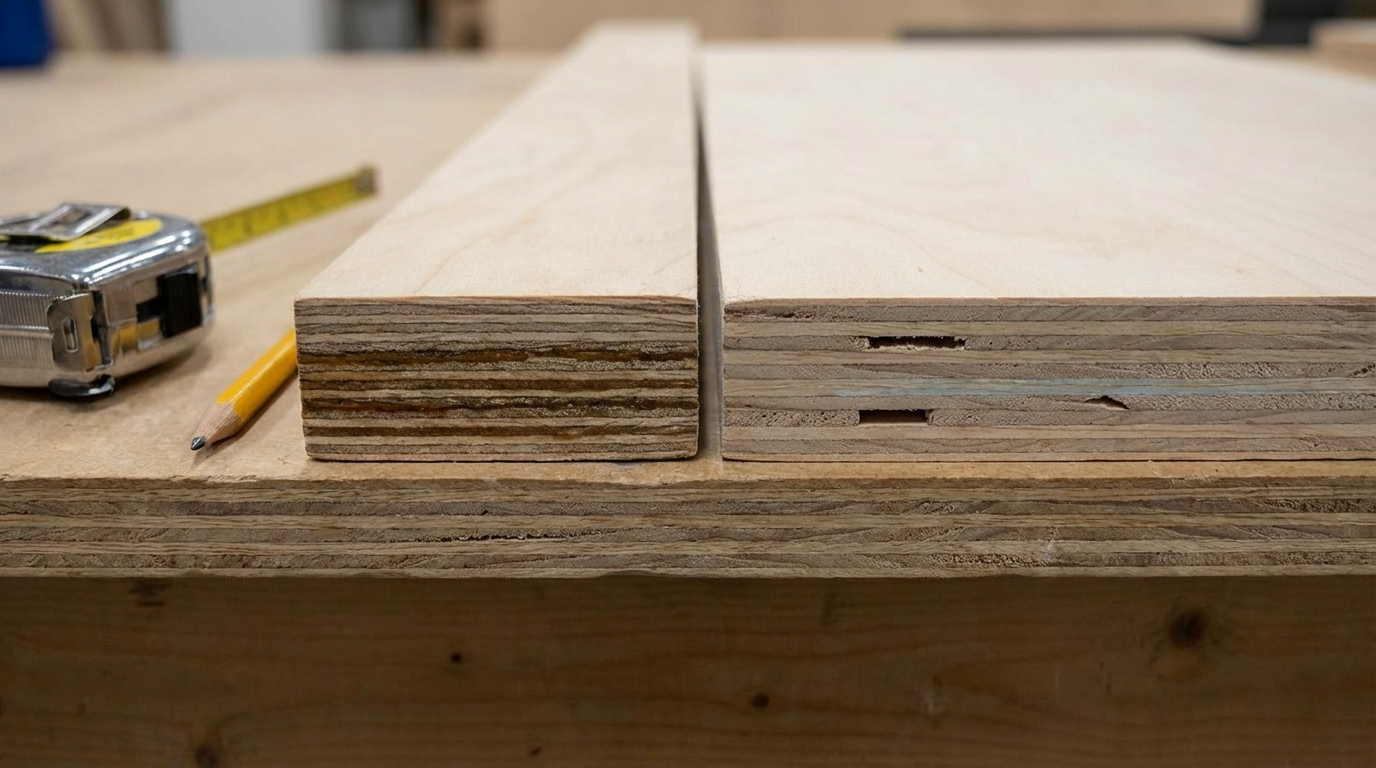
Before buying: Visual—straight edges, even grain; tap center/edges—solid thud; weigh sample—heavy= dense; flex test—minimal bend. Questions: "Glue type? Ply count?" Red flags: Light weight, patched veneers.
After cutting: Check squareness (<1mm variance), glue residue none. Post-install: Gaps <1mm, no moisture under edges.
How do I spot fake marine plywood at the dealer?
Fakes mimic labels but fail tap (hollow) or flex (bends easy). True BWP feels hefty, veneers thick/shiny. Nuance: Inland generics riskier. Step: Bring phone torch—check glue lines uniform; decline if patchy.
Why does marine plywood price vary by thickness so much?
Thicker needs more plies/glue (20–50% jump 12-to-18mm), stronger cores for stability. Nuance: 18mm for load, thin for overlay. Check: Quote per mm rise, add for calibration.
FAQs
What is the typical marine plywood price per sq ft for 18mm in India?
Typically ₹110–₹180 per sq ft for standard 8x4 sheets, but swings with veneer grade and city—metros higher. Thicker hardwood cores push upper end. Always quote full specs for apples-to-apples; add 10% for taxes/wastage. Local variation means check nearby yards for bulk deals.
Does marine plywood justify its higher price per sq ft?
Yes in wet zones (lasts 10–15 years vs 3–5 for MR), but overkill for dry rooms wasting 40–60%. Weigh exposure vs savings—coastal/kitchens yes. Verify by project humidity; hybrid use BWR where possible to balance.
How much extra for teak face on marine plywood?
Often ₹20–₹50 per sq ft premium over plain veneer, for better scratch/aesthetic resistance. Varies by grain quality. Spec it upfront; inspect sample for natural luster vs printed fakes.
Is marine plywood price per sq ft inclusive of GST?
Quotes usually exclude 18% GST—factor 15–20% total add-on. Ask breakdown; bulk buyers negotiate absorption. Regional transport another 5–10%.
What questions to ask dealer for marine plywood quote?
"BWP/IS 710 certified? Thickness/face ply details? Per sq ft with wastage? Delivery dry-covered?" Get written specs. Compare 3 for leverage.
Why is marine plywood cheaper in some cities?
Inland hubs have local mills cutting logistics; metros import specialty glues. Bulk stock turnover lowers holding costs. Still verify quality—cheaper not always inferior.
Can I negotiate marine plywood price per sq ft?
Yes, 5–15% off on 50+ sheets, cash, or repeat buys. Point to competitor quotes sans names. Wastage/transport bundling saves most.
How to calculate total cost beyond price per sq ft?
Sheets x sq ft rate + 8–12% wastage + transport + sealing/polish (₹10–20/sq ft). For 50 sqm doors: Base ₹7,000 + extras ₹1,500 typical. List all upfront.
Disclaimer: This content is provided for general informational purposes based on industry practices and publicly available information. Product specifications, standards, prices, and availability may vary by manufacturer, region, and time. Readers should independently verify details with manufacturers, dealers, or qualified professionals before making purchase or construction decisions.Want Plywood Suggestions?
Share a few details and a Duro BOIL specialist will suggest suitable brands and connect you to responsive dealers.