Top MDF Board Manufacturers in India: A Complete Guide
Discover the leading MDF board manufacturers in India. Compare quality, certifications, product range, and distribution to find the best supplier.
Quick Buying Decision
One-line recommendation: Choose established manufacturers with E1/E2 emission certifications and verify physical samples before bulk ordering.
If you're in a hurry: For most furniture and interior applications in India, focus on manufacturers offering consistent density boards (720-850 kg/m³), proper emission certifications, and reliable distribution in your region. Action Tesa, Greenply, and Century dominate market share with proven quality. However, regional manufacturers like Rushil Decor or Merino Industries often provide competitive alternatives with better local support. Always request physical samples, check edge density consistency, and confirm moisture resistance ratings before committing to bulk purchases for your project.
Quick Picks by Application
- Best for kitchen: HDF or HDHMR boards from established manufacturers - because kitchen environments demand superior moisture resistance and these high-density variants handle humidity better than standard MDF [castacabinetry.com]
- Best for wardrobe: Standard MDF (12-18mm) from any major manufacturer - because wardrobes in dry bedroom environments don't require premium moisture resistance, making standard boards cost-effective
- Best budget option: Regional manufacturer MDF with E2 certification - because pricing runs 15-25% lower than national brands while meeting basic quality standards for non-critical applications
- Best premium option: Imported European MDF or top-tier Indian HDF - because density consistency, formaldehyde emissions, and surface finish quality surpass standard offerings
How to Choose MDF Board Manufacturers in 5 Steps
Step 1: Identify Your Application Requirements
Before comparing manufacturers, clearly define where and how the MDF will be used. This determines which quality parameters matter most for your project.
Wet area vs dry area decision:
- Wet areas (kitchens, bathrooms, coastal homes): Require moisture-resistant MDF, HDHMR, or HDF variants. Standard MDF will swell and deteriorate
- Dry areas (bedrooms, living rooms, offices): Standard MDF performs adequately, allowing cost savings
Heavy use vs light use:
- Heavy use (shelving, kitchen cabinets, commercial furniture): Higher density boards (780+ kg/m³) with better screw-holding capacity
- Light use (decorative panels, backing boards, wall cladding): Standard density sufficient, prioritise surface finish quality
This classification narrows your manufacturer search to those producing the specific MDF variant your project demands.
Step 2: Determine the Right Grade and Type
Indian MDF manufacturers typically offer these categories:
- Standard MDF: General-purpose boards for furniture, suitable for dry interior applications
- Moisture Resistant MDF (MR): Green-core boards with water-repellent additives for moderate humidity areas
- HDF (High-Density Fiberboard): Denser boards (850+ kg/m³) for flooring and high-stress applications
- HDHMR: High-density, high moisture resistant - premium option combining both properties
Simple decision matrix:
- Dry room + light use = Standard MDF
- Dry room + heavy use = HDF
- Moderate humidity + any use = MR MDF
- High humidity + heavy use = HDHMR
Step 3: Choose Correct Thickness
Thickness guide by application:
| Application | Recommended Thickness | Rationale |
|---|---|---|
| Cabinet backs, drawer bottoms | 3-6mm | Minimal structural load, cost savings |
| Decorative wall panels | 6-9mm | Easy handling, adequate rigidity |
| Cabinet doors, drawer fronts | 12-18mm | Balanced strength and weight |
| Shelving, cabinet carcass | 18-25mm | Load-bearing capacity required |
| Heavy-duty shelving, countertops | 25-30mm | Maximum rigidity, prevents sagging |
Why thickness matters: Undersized thickness leads to sagging shelves and warped doors over time. Oversized thickness wastes money and adds unnecessary weight, stressing hinges and hardware. Most manufacturers offer standard metric thicknesses; confirm availability before finalising designs.
Step 4: Check Quality Indicators
What to inspect before buying:
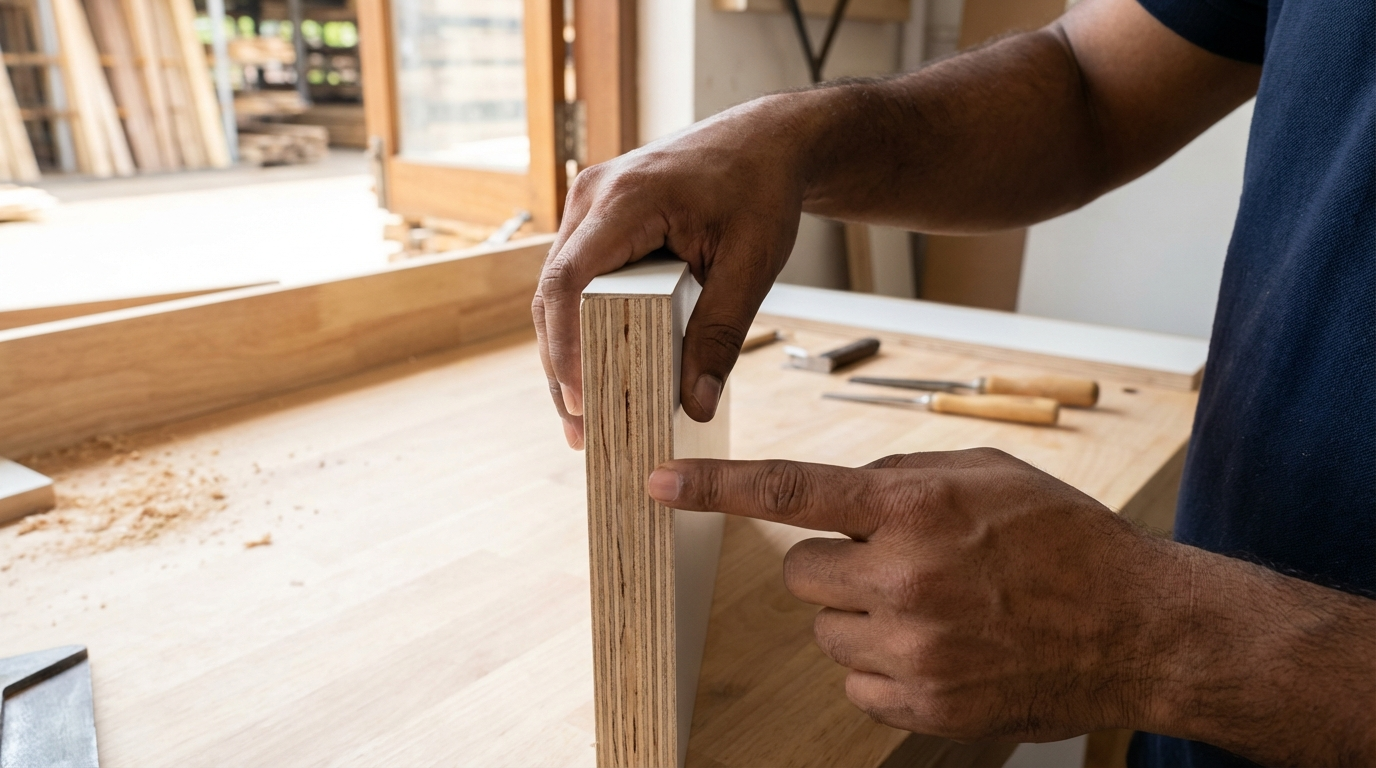
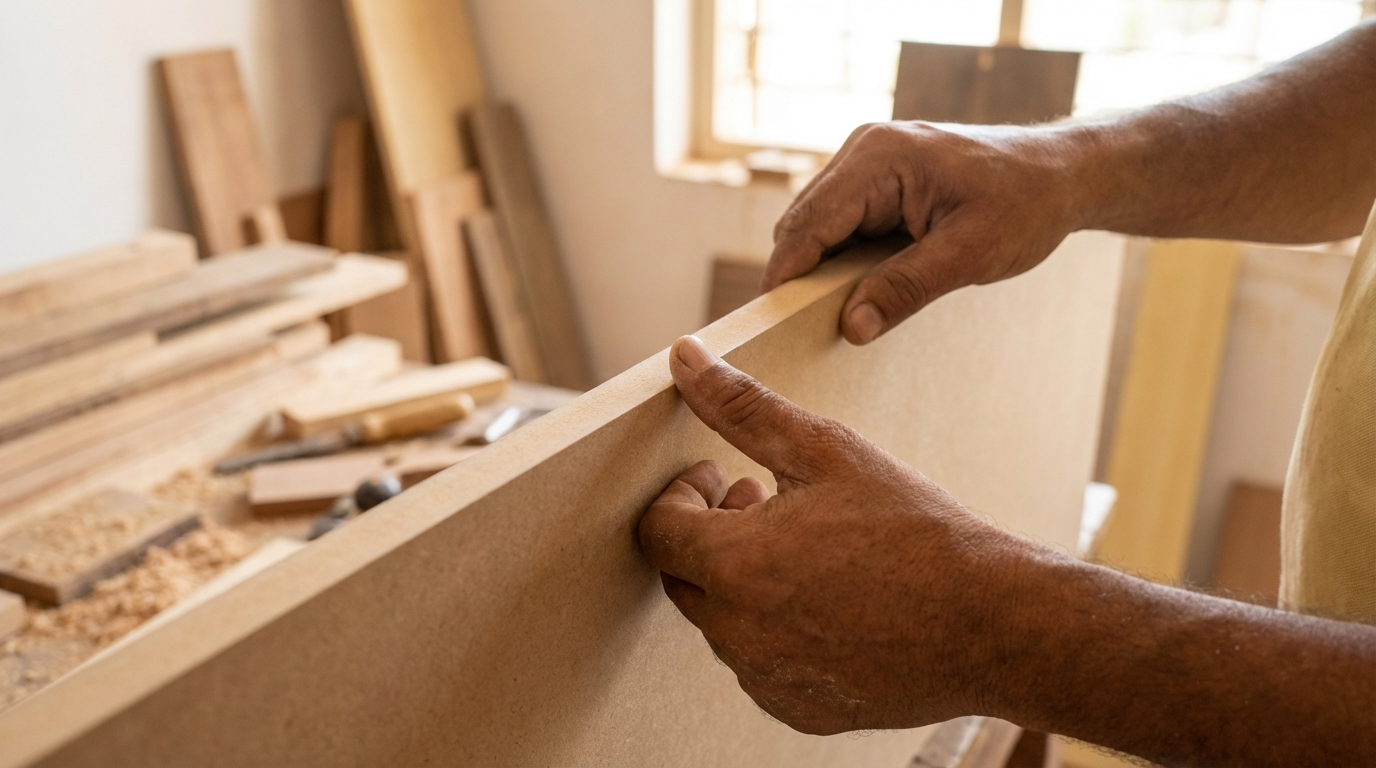
- Edge density: Cut edges should appear uniform without visible layers or voids
- Surface smoothness: Run your palm across—quality boards feel consistently smooth without rough patches
- Colour consistency: Uniform colour indicates consistent manufacturing; patchy colour suggests quality variations
- Weight: Heavier boards (for same size) typically indicate higher density and better quality
- Emission certification: Look for E1 or E0 ratings on packaging or documentation
Tests you can do at the shop:
- Thumbnail test: Press your thumbnail firmly into the edge—quality MDF resists indentation, poor quality dents easily
- Smell test: Strong chemical odour suggests high formaldehyde content
- Tap test: Solid boards produce a dull thud; hollow sounds indicate internal voids
- Visual edge inspection: Look for consistent fibre distribution without clumping
Step 5: Compare Prices and Get Quotes
How to ask for quotes properly:
- Specify exact dimensions, thickness, and quantity needed
- Mention the MDF type (standard, MR, HDF, HDHMR)
- Ask for both per-sheet and per-square-foot pricing
- Request quotes from minimum three suppliers for comparison
- Enquire about minimum order quantities and bulk discounts
What should be included in the quote:
- Material cost with GST breakdown
- Delivery charges to your location
- Loading and unloading responsibility
- Payment terms and advance requirements
- Delivery timeline
- Return policy for damaged or defective sheets
Decision Framework: What to Buy for Each Situation
| Your Situation | Recommended Option | Why | What to Verify |
|---|---|---|---|
| Kitchen cabinets | HDHMR or HDF from Action Tesa, Greenply | Superior moisture resistance handles cooking steam and splashes; high density ensures screw retention for heavy pans | Boiling water test on sample, edge density consistency |
| Bathroom vanity | Marine-grade plywood or HDHMR only | Standard MDF fails in bathroom humidity; even MR MDF struggles with direct water contact | Manufacturer's moisture resistance certification, edge sealing quality |
| Bedroom wardrobe | Standard MDF (18mm) from any established manufacturer | Dry environment doesn't require premium variants; cost savings significant on large wardrobes | Surface smoothness for laminate adhesion, consistent thickness |
| Living room furniture | Pre-laminated MDF or standard MDF with veneer | Aesthetic finish matters most; standard density adequate for display units and TV cabinets | Laminate bond strength, colour consistency across sheets |
| Coastal area home | HDHMR or consider marine plywood | Coastal humidity accelerates MDF deterioration; higher moisture resistance essential for longevity | Boron treatment certification, edge sealing before installation |
| Tight budget | Regional manufacturer standard MDF with basic certification | Significant cost savings; acceptable quality for dry, light-use applications | Physical sample inspection, local carpenter references |
| Premium quality need | Imported European MDF or premium Indian HDF | Superior density consistency, lower emissions, better machining results | E1/E0 certification documents, density specifications |
Price Guide and Budget Planning
MDF pricing in India varies significantly by type, thickness, brand, and location. Use these ranges for budget planning, but always confirm current rates with local dealers.
Approximate price ranges (per 8x4 ft sheet):
- Standard MDF (18mm): ₹1,800 - ₹3,200
- MR MDF (18mm): ₹2,400 - ₹4,000
- HDF (12mm): ₹2,800 - ₹4,500
- HDHMR (18mm): ₹3,500 - ₹5,500
- Pre-laminated MDF (18mm): ₹3,000 - ₹5,000
Factors affecting price:
- Thickness: Price scales roughly proportionally with thickness
- Brand: National brands typically command 15-30% premium over regional manufacturers
- Grade: Moisture-resistant variants cost 25-40% more than standard
- City: Metro prices usually higher; proximity to manufacturing hubs reduces costs
- Quantity: Bulk purchases (50+ sheets) often attract 5-10% discounts
Budget estimation for common projects:
- 10x10 kitchen (cabinets only): Approximately ₹25,000 - ₹55,000 for MDF/HDHMR material
- Standard 6-foot wardrobe: Approximately ₹8,000 - ₹18,000 for MDF material
- TV unit with storage: Approximately ₹4,000 - ₹10,000 for MDF material
Note: These estimates cover raw material only; labour, hardware, and finishing add significantly to total project cost.
Why Do Prices Vary So Much Between Shops?
Price variations of 20-40% for seemingly identical products confuse many buyers. Several legitimate factors explain these differences:
- Supply chain position: Direct manufacturer dealers versus multi-tier distributors have different margins
- Inventory age: Older stock sometimes sold at discount; verify production dates
- Grade mixing: Some sellers stock lower grades alongside premium products
- Service inclusion: Prices may or may not include cutting, delivery, or loading
- Location rent: Prime location dealers have higher overheads reflected in pricing
- Volume relationships: High-volume dealers negotiate better manufacturer rates
Red Flags: When to Walk Away
Recognising warning signs saves you from expensive mistakes. Consider these serious concerns:
- No proper labelling: Authentic manufacturer products carry clear branding, specifications, and batch information
- Reluctance to show samples: Quality dealers encourage inspection; hesitation suggests substandard stock
- Dramatically lower prices: Pricing 30%+ below market usually indicates inferior quality or counterfeit products
- No documentation: Legitimate products come with manufacturer warranty cards and quality certificates
- Visible edge inconsistencies: Uneven density visible on cut edges indicates manufacturing defects
- Strong chemical smell: Excessive formaldehyde odour suggests products failing emission standards
- Pressure tactics: "Today only" pricing or urgency creation typically masks quality concerns
- Cash-only insistence: Avoiding documented transactions often accompanies questionable products
Common Buying Mistakes (And How to Avoid)
Mistake 1: Choosing Standard MDF for Kitchen Applications
Why people make this mistake: Standard MDF costs significantly less, and the moisture resistance difference isn't immediately visible.
What goes wrong: Within 1-2 years, boards swell around sinks, near dishwashers, and under cooking areas. Swelling damages laminates and causes doors to misalign.
What to do instead: Always use HDHMR or at minimum MR MDF for any kitchen application. The upfront premium prevents costly replacements.
Mistake 2: Ignoring Emission Certifications
Why people make this mistake: Emission standards seem like technical jargon unrelated to furniture quality.
What goes wrong: High formaldehyde emissions cause respiratory irritation, especially in poorly ventilated rooms. Long-term exposure poses health risks.
What to do instead: Insist on E1 or E2 certified boards. E0 is ideal for bedrooms and children's furniture.
Mistake 3: Not Ordering Extra Material
Why people make this mistake: Tight budget calculations and assumption that carpenters won't make mistakes.
What goes wrong: Cutting errors, defective portions, and design modifications leave you short. Ordering additional sheets later often brings colour variation issues.
What to do instead: Order 10-15% extra from the same batch. Unused material can be stored for future repairs.
Mistake 4: Prioritising Price Over Density
Why people make this mistake: Density specifications seem technical, and cheaper boards look identical.
What goes wrong: Lower density boards (under 700 kg/m³) have poor screw retention, sag under load, and machine poorly [blueridgecabinetconnection.com].
What to do instead: Verify density specifications are 720 kg/m³ minimum for furniture applications.
Mistake 5: Skipping Physical Sample Inspection
Why people make this mistake: Brand name seems sufficient guarantee; visiting dealers feels time-consuming.
What goes wrong: Manufacturing batches vary; even reputed brands occasionally have quality inconsistencies.
What to do instead: Always inspect samples from the actual batch being delivered. This is non-negotiable for bulk orders.
Mistake 6: Not Confirming Delivery Condition Terms
Why people make this mistake: Assumption that delivered material will match showroom samples.
What goes wrong: Sheets arrive with edge damage, surface scratches, or moisture exposure. Responsibility disputes arise.
What to do instead: Written agreement on condition expectations, inspection rights upon delivery, and return procedures for damaged goods.
Mistake 7: Using Wrong Thickness for Shelving
Why people make this mistake: Thinner boards seem adequate for light items; cost savings attract.
What goes wrong: Shelves sag over time, even with moderate loads. MDF is more prone to sagging than plywood [kitchencabinetkings.com].
What to do instead: Use minimum 18mm for shelves under 60cm span; 25mm for longer spans or heavy items.
Mistake 8: Ignoring Regional Climate Considerations
Why people make this mistake: Standard recommendations don't account for local humidity conditions.
What goes wrong: Materials appropriate for Delhi may fail quickly in Chennai or Kolkata's higher humidity.
What to do instead: In coastal or high-humidity regions, upgrade specifications by one moisture-resistance level.
Questions to Ask Your Dealer
- "What is the density of this MDF?" - Good answer: Specific figure (e.g., 750 kg/m³). Concerning: Vague responses or inability to specify.
- "Can I see the emission certification?" - Good answer: Shows E1/E2 documentation. Concerning: Claims certification exists but cannot produce documents.
- "Which manufacturing plant produced this batch?" - Good answer: Specific plant location. Concerning: Doesn't know or gives inconsistent information.
- "What is your return policy for defective sheets?" - Good answer: Clear written policy with timeframe. Concerning: No returns or verbal-only promises.
- "Can you provide samples from the actual batch I'll receive?" - Good answer: Yes, offers samples readily. Concerning: Shows only display pieces, reluctant to provide batch samples.
- "How should this MDF be stored before installation?" - Good answer: Explains flat storage, climate control needs. Concerning: Dismissive response suggesting carelessness about material handling.
- "What thickness tolerance does this manufacturer maintain?" - Good answer: Specifies tolerance (e.g., ±0.3mm). Concerning: Doesn't understand the question.
- "Do you have consistent supply of this specific product?" - Good answer: Confirms regular stock, discusses lead times. Concerning: Admits sporadic availability.
- "What hardware and adhesives work best with this MDF?" - Good answer: Provides specific recommendations. Concerning: No knowledge beyond the board itself.
- "Can you provide references from recent large orders?" - Good answer: Shares contractor or project references. Concerning: Refuses or has no references available.
After Purchase: Handling and Storage
How to Transport Without Damage
- Transport sheets flat, never standing on edge for long distances
- Use proper supports—avoid single-point contact that causes bending stress
- Protect edges with cardboard or foam during loading and unloading
- Cover sheets during transport to prevent moisture exposure and surface scratches
- Avoid stacking excessively—maximum 15-20 sheets per stack during transport
Storage Requirements Before Installation
- Store in dry, covered area away from direct sunlight
- Keep sheets flat on level surface with adequate support
- Maintain minimum 100mm gap from floor using battens or pallets
- Avoid storing against walls where moisture migration can occur
- Ensure adequate ventilation around the stack
- Keep away from cement bags, wet materials, or chemical storage
Acclimatisation Period
MDF should acclimatise to the room environment for 48-72 hours before cutting and installation. This allows the material to reach equilibrium moisture content with the surrounding air, reducing post-installation movement. In highly air-conditioned spaces or during monsoon season, extend this period to 4-5 days. Stack sheets with spacer sticks between them to allow air circulation during acclimatisation.
Frequently Asked Questions
Which brand is best for MDF boards in India?
Action Tesa, Greenply, and Century are market leaders with consistent quality and wide distribution. However, "best" depends on your specific requirements. For budget projects in dry areas, regional manufacturers like Rushil Decor or Merino offer competitive quality. For premium applications, these national brands provide better consistency. Ultimately, physical sample inspection matters more than brand name alone—even top brands have occasional batch variations.
How do I identify original MDF versus duplicate products?
Authentic MDF carries clear manufacturer branding, batch codes, and quality certification stamps. Check edge consistency—genuine products show uniform fibre distribution without voids or layering. Weight consistency across sheets from the same batch indicates proper manufacturing. Request dealer invoices traceable to manufacturer records. Suspiciously low pricing often indicates rebranded or substandard products passing as premium brands.
What warranty should I expect on MDF boards?
Most Indian manufacturers offer limited warranties ranging from 1-5 years, typically covering manufacturing defects rather than installation issues. HDHMR products often carry longer warranties than standard MDF. Warranty terms usually require proof of proper storage and installation. Realistically, warranty claims on sheet materials are difficult—focus instead on buying quality products and proper installation rather than relying on warranty coverage.
How much MDF do I need for my project?
Calculate total surface area of all components, then add 15% for cutting waste and potential errors. Standard sheets measure 8x4 feet (32 square feet). For a typical 6-foot wardrobe, expect 3-4 sheets; for a modular kitchen, 12-20 sheets depending on design complexity. Consult your carpenter for precise estimates based on your specific design, as cutting layouts significantly affect material requirements.
Should I buy MDF online or from local dealers?
Local dealers remain preferable for MDF purchases. You can inspect physical samples, verify batch quality, and address delivery issues directly. Online purchases carry transportation damage risks and make returns complicated. However, for pre-laminated MDF where finish matters more than structural properties, online purchases from reputed sellers with good return policies can offer wider colour selection and competitive pricing.
When is the best time to buy MDF boards?
Avoid peak construction seasons (October-December) when demand inflates prices. Post-monsoon months (September-October) often bring fresh stock as dealers clear rain-affected inventory carefully. Financial year-end (February-March) sometimes offers discounts as dealers chase targets. However, availability of specific variants matters more than timing—confirm stock of your required specifications before planning purchase around seasonal pricing.
How should I negotiate MDF prices with dealers?
Get quotes from multiple dealers first to understand market rates. Bundle purchases—buying MDF, plywood, and hardware from same dealer strengthens negotiating position. Ask about payment term discounts; many dealers offer 2-5% reduction for advance payment. Enquire about off-cuts or slightly damaged sheets at reduced rates for non-visible applications. Volume commitments for future purchases can also secure better per-unit pricing.
What if I receive damaged MDF material?
Document damage immediately with photographs before unloading completes. Note damages on delivery receipt before signing. Contact dealer within 24 hours with evidence. Most reputable dealers replace damaged sheets without argument when damage is clearly transportation-related. For disputes, manufacturer customer service can mediate. Having written purchase terms specifying condition expectations strengthens your position significantly during such situations.
Disclaimer: This content is provided for general informational purposes based on industry practices and publicly available information. Product specifications, standards, prices, and availability may vary by manufacturer, region, and time. Readers should independently verify details with manufacturers, dealers, or qualified professionals before making purchase or construction decisions.
Want Plywood Suggestions?
Share a few details and a Duro BOIL specialist will suggest suitable brands and connect you to responsive dealers.