MDF Sheet Price (8x4): Thickness-wise Rate + How to Compare Dealer Quotes
See MDF sheet price ranges by thickness with 8x4 sheet cost examples. Includes a quick checklist to compare quotes and avoid low-density boards.
Quick Decision Summary
Best answer in one line: MDF 8×4 sheet prices in India typically range from ₹900 to ₹4,500+ depending on thickness, density grade, and surface finish.
If you're in a hurry: For standard interior furniture using 18mm plain MDF, expect to pay roughly ₹1,800–₹2,800 per 8×4 sheet in most cities. Pre-laminated or high-density boards cost more. Always ask dealers for the actual density (kg/m³), not just the thickness—a cheap 18mm board at 680 kg/m³ will sag and fail far sooner than one at 750+ kg/m³. Get quotes specifying thickness, density, finish type, and whether rates include GST and transport. Compare at least three dealers before ordering.
- Choose MDF if: You need smooth, paint-ready surfaces for wardrobes, cabinets, display units, or decorative panels in dry indoor areas.
- Avoid MDF if: The application involves bathrooms, kitchen sink zones, outdoor exposure, or structural load-bearing requirements.
What MDF Actually Means and Why Thickness Alone Misleads You
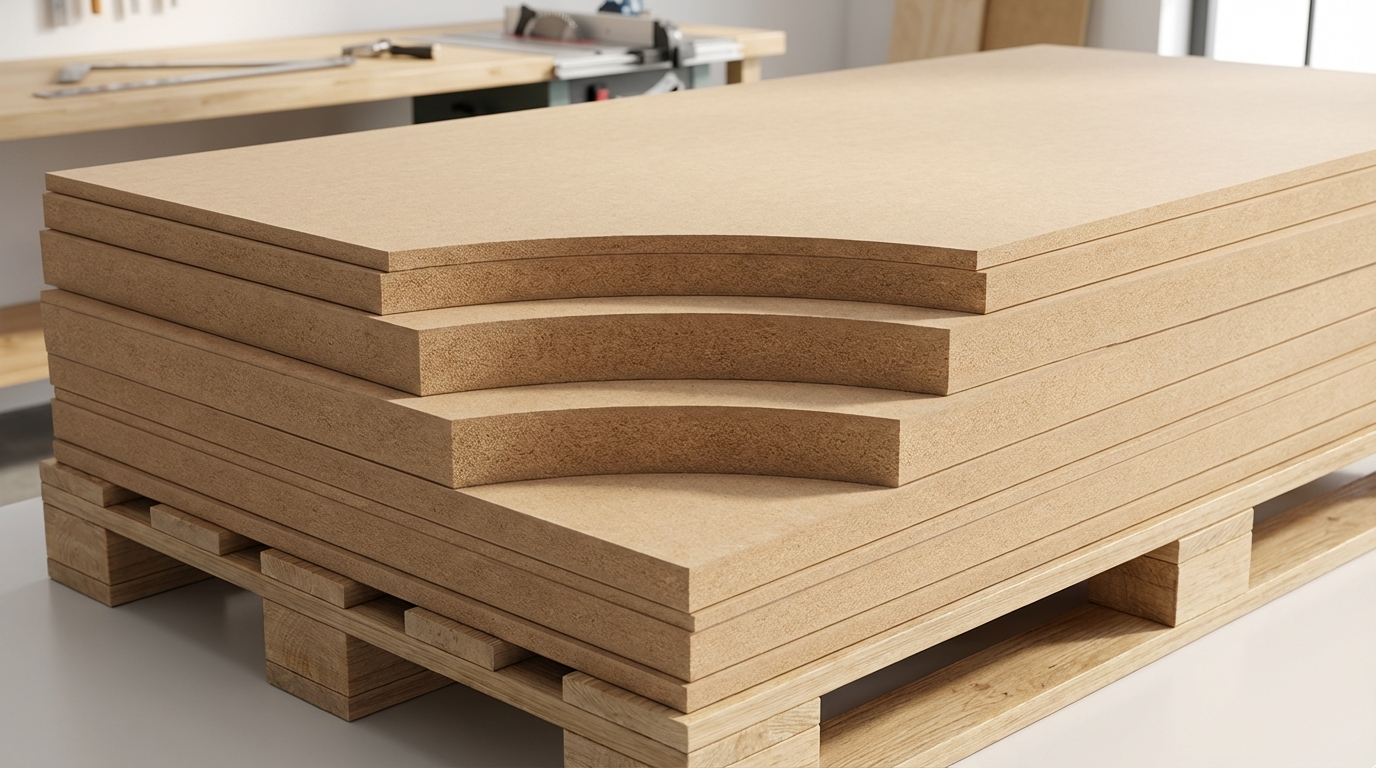
MDF (Medium Density Fibreboard) is an engineered wood panel made by breaking down hardwood or softwood residuals into fibres, combining them with resin, and pressing under heat. The result is a uniform, smooth sheet with no grain direction—ideal for lacquer finishes, CNC routing, and laminate application. In India, the standard commercial size is 8 feet × 4 feet (2440 × 1220 mm), though metric sizes vary slightly by manufacturer.
Thickness options typically include 3mm, 6mm, 9mm, 12mm, 18mm, 25mm, and sometimes 30mm. However, thickness alone tells you nothing about quality. Two 18mm sheets can differ dramatically in weight, edge hardness, and screw-holding—because density varies.
Where People Get Confused About MDF Pricing
- Assuming all 18mm MDF costs the same: A low-density 18mm board can be 30–40% cheaper than a high-density one, but it will dent, sag, and lose screws far sooner.
- Ignoring surface grade: Plain MDF, pre-laminated MDF, and lacquer-grade MDF have vastly different price points for the same thickness.
- Confusing MDF with HDF or HDHMR: HDF (High Density Fibreboard) and HDHMR (High Density High Moisture Resistant) are denser and more expensive—don't compare them directly to standard MDF.
- Forgetting GST and transport: Some dealers quote ex-factory rates; others include delivery. A seemingly cheaper quote may cost more after logistics.
- Not checking for formaldehyde emission class: E1 or E0 rated boards cost slightly more but are safer for bedroom and children's furniture. Budget boards may have higher emissions.
Price Range and Cost Drivers (India)
MDF prices in India vary significantly by thickness, density, finish, brand tier, and regional logistics. The following ranges represent typical market prices for standard 8×4 sheets in 2026—always confirm locally as rates fluctuate with raw material costs and demand cycles.
Thickness-wise Price Ranges for Plain MDF (8×4 Sheet)
| Thickness | Typical Price Range (₹) | Common Applications |
|---|---|---|
| 3mm | ₹900–₹1,400 | Drawer bottoms, cabinet backs, wall panelling underlays |
| 6mm | ₹1,100–₹1,700 | Cabinet backs, lightweight partitions, display boards |
| 9mm | ₹1,300–₹2,000 | Shelf liners, internal partitions, base for veneers |
| 12mm | ₹1,500–₹2,400 | Cabinet sides, lighter shelving, CNC cut decorative panels |
| 18mm | ₹1,800–₹2,800 | Wardrobe carcasses, table tops, modular furniture shutters |
| 25mm | ₹2,800–₹4,000 | Heavy-duty shelves, countertop substrates, commercial fixtures |
| 30mm | ₹3,500–₹4,500+ | Solid-feel doors, premium display counters, acoustic panels |
Note: Pre-laminated MDF (with melamine or PVC film on both faces) typically adds ₹400–₹900 per sheet. Lacquer-grade or moisture-resistant variants cost 15–30% more than plain MDF of the same thickness.
What Drives MDF Prices Up or Down?
- Density grade: Standard MDF runs 680–720 kg/m³; high-density boards exceed 780 kg/m³ and command premium pricing.
- Surface finish: Pre-laminated boards save labour but cost more upfront. Plain MDF requires laminate or paint application on site.
- Emission class: E0/E1 certified boards (lower formaldehyde) cost slightly more than uncertified economy boards.
- Moisture resistance: MR-grade MDF or HDHMR boards have resin additives that raise prices by 20–40%.
- Brand tier: Organized sector brands with ISI marking and consistent density cost more than unbranded mill boards.
- City and logistics: Prices in metros like Bengaluru, Mumbai, or Delhi may differ from tier-2 cities by ₹100–₹300 per sheet due to transport costs and dealer margins.
- Order volume: Bulk orders for projects often attract 5–15% discounts; single-sheet retail purchases carry higher per-unit costs.
How to Ask for a Quote (Checklist)
When requesting dealer quotes, specify these line items to get comparable numbers:
- Thickness required (in mm)
- Density grade (ask for kg/m³ or weight per sheet)
- Surface type: plain, pre-laminated, or lacquer-grade
- Moisture resistance: standard or MR-grade
- Emission class: E0, E1, or unspecified
- Quantity (number of sheets)
- Whether price includes GST (currently 18%)
- Delivery charges or ex-factory pricing
- Payment terms and lead time
How Much Does a Typical Wardrobe Project Cost in MDF?
For a standard 8-foot wide, floor-to-ceiling wardrobe with internal shelves, you might need approximately 6–8 sheets of 18mm MDF for carcass and shelving, plus 2–3 sheets of 6mm for backs. At mid-range pricing:
- 18mm sheets (7 × ₹2,200 avg) = ₹15,400
- 6mm sheets (3 × ₹1,400 avg) = ₹4,200
- Material subtotal: ~₹19,600 + GST + transport
Add laminate, edge banding, hardware, and labour separately. This gives you a baseline to compare dealer quotes—if a quote seems dramatically lower, verify density and finish specifications before assuming it's a good deal.
India-Specific Reality Check
MDF performs well in controlled indoor environments, but India's climate and site conditions create specific risks that affect both selection and installation.
Monsoon and Humidity Concerns
Standard MDF absorbs moisture readily. In coastal cities (Mumbai, Chennai, Kochi) or during monsoon months across India, improperly stored or unsealed MDF swells at edges and can develop a spongy texture. Pre-laminated boards offer some protection, but cut edges remain vulnerable unless sealed with PU primer or edge banding.
Storage and Handling on Indian Sites
MDF sheets stored flat on bare concrete floors absorb ground moisture within days. Stacking without spacers causes permanent bowing. Many project delays and quality complaints trace back to poor storage before installation. Always store MDF elevated on wooden battens, covered with plastic sheeting, in a ventilated indoor space.
Workmanship Realities
Not all carpenters are familiar with MDF's properties. Using wood screws without pilot holes splits the board. Over-tightening hinges strips the material. Edge routing without proper support causes chipping. These issues multiply when using low-density boards—the material simply cannot hold fasteners as well as higher-grade options.
How Does MDF Density Affect Price and Performance?
Density is the single most important quality indicator for MDF, yet it's rarely mentioned on price lists. Understanding this helps you decode why two 18mm sheets priced ₹500 apart can perform vastly differently.
Standard MDF in India ranges from 650–720 kg/m³. High-density boards (HDF territory) exceed 800 kg/m³. The denser the board, the better it holds screws, resists denting, and maintains edge integrity during CNC routing or laminate pressing.
Practical check: Ask the dealer for the weight of an 18mm 8×4 sheet. A standard-density 18mm plain MDF sheet weighs roughly 38–42 kg. If the sheet weighs significantly less (under 35 kg), the density is likely on the lower end—expect shorter lifespan and weaker screw-holding.
For furniture that will bear weight (bookshelves, wardrobe shelves spanning over 60cm), insist on boards weighing 40+ kg per 18mm sheet. The modest price premium pays off in longevity.
Trade-offs and Limitations
MDF is not a universal solution. Being honest about its limitations helps you avoid costly mistakes:
- Water vulnerability: Even MR-grade MDF is not waterproof. Prolonged water contact causes irreversible swelling. Never use standard MDF near sinks, in bathrooms, or for outdoor applications.
- Lower screw-holding than plywood: MDF's uniform fibre structure lacks the cross-grain strength of plywood. Edge screwing is particularly weak—always use inserts or pre-drill for better results.
- Heavier than plywood: An 18mm MDF sheet weighs 15–20% more than equivalent plywood, affecting transport costs and installation logistics, especially for overhead cabinets.
- Dust hazard during cutting: MDF produces fine, resin-laden dust that irritates airways. Proper masks (N95 or better) and dust extraction are essential during fabrication.
- Edge finishing mandatory: Raw MDF edges are porous and visually rough. Every exposed edge needs banding, paint, or PU sealing—factor this into your project cost and timeline.
- Not structural: MDF should not bear structural loads. It's a surface material, not a framing material. For carcass-heavy applications, combine with plywood frames or use thicker grades.
Common Buyer Mistakes and How to Avoid Them
1. Choosing Based on Price Per Sheet Alone
Why it happens: Buyers compare quoted prices without checking density, finish, or emission ratings. A ₹1,600 sheet sounds better than ₹2,200.
What to do instead: Calculate cost per kg or verify sheet weight. A lighter sheet at the same thickness indicates lower density and shorter service life.
2. Ignoring GST and Transport in Comparisons
Why it happens: Some dealers quote ex-factory; others include GST and delivery. Comparisons become meaningless.
What to do instead: Ask every dealer for "landed cost" including GST (18%) and delivery to your site address.
3. Ordering Exact Quantities Without Wastage Buffer
Why it happens: Project calculations assume perfect cuts. Reality involves edge trimming, defects, and cutting errors.
What to do instead: Add 10–15% wastage buffer to your sheet count. It's cheaper to return unused sheets than to halt work for a single missing piece.
4. Using Standard MDF in Kitchen Cabinets Near Sinks
Why it happens: Cost-cutting or unfamiliarity with moisture behaviour.
What to do instead: Use HDHMR or marine plywood for under-sink areas. Standard MDF will swell within months of exposure to splashes and condensation.
5. Skipping Edge Sealing on Cut Pieces
Why it happens: Time pressure or assumption that laminate alone protects.
What to do instead: Apply PU sealer or proper edge banding to every exposed edge, especially in humid climates.
6. Storing MDF Flat on Concrete Floors
Why it happens: Limited site space, carelessness, or lack of awareness.
What to do instead: Store on raised wooden battens, covered with plastic, away from direct ground contact and weather exposure.
7. Using Wood Screws Without Pilot Holes
Why it happens: Carpenters accustomed to solid wood skip pre-drilling.
What to do instead: Always drill pilot holes slightly smaller than screw diameter. Use coarse-thread screws designed for MDF or particle board.
8. Assuming All Brands Offer Same Quality
Why it happens: MDF looks similar across brands; differences are internal.
What to do instead: Check for ISI marking, ask for density specifications, and observe edge quality on sample sheets before bulk ordering.
Failure Modes and Fixes
Edge Swelling After Installation
Symptom: Edges become soft, spongy, or visibly expanded within weeks of installation.
Likely cause: Moisture ingress through unsealed cuts, especially in kitchens or humid rooms.
Prevention: Seal all cut edges with PU primer or edge banding before installation. Use MR-grade MDF in borderline humid areas.
If already happening: Minor swelling can be sanded and resealed. Severe swelling requires panel replacement—there's no reliable repair.
Shelf Sagging Under Load
Symptom: Horizontal shelves develop visible bow within months, especially near the centre.
Likely cause: Low-density MDF, excessive span without support, or inadequate thickness for the load.
Prevention: Use 18mm minimum for shelves; limit unsupported spans to 60cm for standard MDF, 75cm for high-density. Add vertical dividers or rear rail support.
If already happening: Add a centre support bracket or vertical divider. For severe cases, replace with thicker or denser board.
Screw Holes Stripping Out
Symptom: Hinges or handles become loose; screws spin freely without grip.
Likely cause: No pilot holes, over-tightening, or low-density board unable to hold fasteners.
Prevention: Pre-drill all screw holes. Use coarse-thread screws. Consider threaded inserts for high-stress points like hinges.
If already happening: Fill stripped holes with wood filler mixed with sawdust, let cure, re-drill. Or relocate hardware to fresh material.
Surface Bubbling Under Laminate
Symptom: Laminate develops bubbles or lifts from MDF substrate.
Likely cause: Moisture trapped during lamination, poor adhesive application, or MDF stored in humid conditions before lamination.
Prevention: Ensure MDF is dry and acclimatized before lamination. Use quality adhesive applied evenly. Press adequately during bonding.
If already happening: Small bubbles can sometimes be re-pressed with heat and weight. Large areas require stripping and re-lamination.
Edge Chipping During Routing
Symptom: CNC or router cuts produce ragged, chipped edges instead of clean profiles.
Likely cause: Dull router bits, incorrect feed speed, or low-density MDF that crumbles under tooling.
Prevention: Use sharp carbide-tipped bits. Reduce feed speed for detailed profiles. Choose higher-density boards for intricate CNC work.
If already happening: Sand and fill minor chips. Replace panels if damage is extensive or visible after finishing.
Formaldehyde Odour Persisting Indoors
Symptom: Strong chemical smell lingers weeks after furniture installation.
Likely cause: High-emission MDF (no E1/E0 certification) used in enclosed spaces like wardrobes.
Prevention: Specify E1 or E0 rated boards for bedroom and children's furniture. Ensure good ventilation during and after installation.
If already happening: Increase ventilation. Seal all exposed surfaces with low-VOC primer or lacquer to reduce off-gassing. Severe cases may require panel replacement.
Quality Checks You Can Do Without Lab Tests
Before Buying
- Weight check: Lift or ask the weight of sample sheets. An 18mm 8×4 plain MDF should weigh 38–45 kg. Significantly lighter indicates lower density.
- Edge inspection: Look at the cut edge under good light. Uniform colour and tight fibre structure indicates quality. Visible voids, layers, or crumbly texture signals poor pressing.
- Surface smoothness: Run your hand across the face. Quality MDF feels uniformly smooth with no rough patches or depressions.
- Smell test: Strong chemical odour suggests high formaldehyde content. E1/E0 boards have minimal smell.
- Ask for documentation: Request density specification (kg/m³), emission class (E0/E1), and any ISI marking details.
- Compare multiple dealers: Get quotes from at least three sources. Unusually low prices typically indicate compromised specifications.
After Cutting
- Clean cut edges: Well-pressed MDF produces clean cuts without crumbling or excessive fibre pullout.
- Dust character: Fine, uniform dust indicates good fibre bonding. Chunky or varied particle sizes suggest inconsistent pressing.
- Screw test: Drive a test screw into a waste piece. It should hold firmly without the material crumbling around it.
After Installation
- Check edge sealing: Verify all exposed edges have been sealed with edge band, PU primer, or paint.
- Hardware tightness: After a week of use, check hinges and handles—they should remain snug without loosening.
- Monitor humidity zones: In the first monsoon season, inspect edges near windows or kitchen areas for any signs of swelling.
Decision Framework: Which MDF Specification for Which Situation?
| Condition / Application | Recommended MDF Type | What to Verify |
|---|---|---|
| Bedroom wardrobes, study tables (dry zone) | Standard 18mm MDF, E1 rated | Density 700+ kg/m³, edge sealing done |
| Living room display units, TV panels | 18mm pre-laminated or lacquer-grade MDF | Surface finish quality, edge banding |
| Kitchen upper cabinets (away from sink) | 18mm MR-grade MDF or HDHMR | Moisture resistance rating, sealed edges |
| Under-sink cabinets, wet zones | Avoid MDF; use marine plywood or HDHMR | If MDF insisted, use HDHMR with full edge sealing |
| CNC-routed decorative panels | High-density MDF (780+ kg/m³) | Clean routing sample, minimal edge chipping |
| Cabinet backs, drawer bottoms | 6mm standard MDF | Flatness, no warping in stored sheets |
| Children's room furniture | E0 rated MDF, pre-laminated | Emission certification, rounded edge detailing |
| Budget project, short-term use | Standard MDF, lower density acceptable | Understand limited lifespan, avoid moisture exposure |
| Coastal city installation | MR-grade MDF minimum, HDHMR preferred | Extra edge sealing, dehumidifier consideration |
Tips for Homeowners
Durability and Maintenance
- MDF furniture in dry, air-conditioned rooms can last 15+ years with proper care.
- Avoid placing MDF furniture directly against exterior walls that may develop condensation during monsoons.
- Wipe spills immediately—MDF absorbs liquids quickly through any unsealed surface.
- Use coasters under planters and avoid placing hot objects directly on MDF surfaces.
- For cleaning, use a slightly damp cloth followed by a dry wipe. Avoid soaking.
What to Discuss with Your Contractor
- Ask specifically for density grade, not just thickness.
- Request E1 or E0 certification for bedroom and children's furniture.
- Confirm that all cut edges will be sealed before installation.
- For kitchens, insist on MR-grade or HDHMR, not standard MDF.
Tips for Carpenters and Fabricators
Cutting and Edge Preparation
- Use carbide-tipped blades for cleaner cuts and longer blade life.
- Score the cut line lightly before full-depth cuts to reduce surface chipping.
- Support the sheet fully during cutting to prevent breakout on the underside.
- Sand edges to 180-grit before applying edge band for better adhesion.
Fastening and Hardware
- Always pre-drill pilot holes—MDF splits easily under direct screw pressure.
- Use coarse-thread screws; fine-thread screws designed for hardwood don't grip MDF well.
- For hinge and handle zones, consider threaded inserts or cam-lock fittings for repeat adjustment capability.
- Face-frame construction distributes hinge stress better than frameless designs in MDF.
Handling and Storage
- Store sheets flat on raised battens with plastic cover in covered areas.
- Acclimatize MDF to site humidity for 48–72 hours before cutting, especially in humid climates.
- Handle edges carefully—they dent and chip more easily than plywood.
Tips for Architects and Interior Designers
Specification Writing
- Specify density (kg/m³) and emission class (E0/E1), not just "18mm MDF."
- For wet-adjacent areas, specify HDHMR or marine plywood explicitly—don't leave material choice to contractors.
- Include edge treatment requirements in specifications (PU sealer, ABS edge band thickness).
Detailing Considerations
- Design shelf spans under 60cm for standard MDF, or specify high-density boards for longer spans.
- Provide ventilation gaps behind MDF panels on exterior walls to prevent moisture accumulation.
- For lacquer finishes, specify lacquer-grade MDF with higher surface density.
Finish Compatibility
- MDF accepts paint, lacquer, veneer, laminate, and PU finishes well.
- For high-gloss lacquer, specify sanding sealer coats to prevent porosity show-through.
- Pre-laminated MDF saves site labour but limits finish customization.
Tips for OEM and Modular Furniture Manufacturers
Quality Control Checkpoints
- Establish incoming inspection for density (weight per sheet), surface defects, and dimensional tolerance.
- Reject batches with significant density variation—inconsistency causes warranty claims.
- Sample-test screw holding strength periodically, especially when changing suppliers.
Reducing Returns and Complaints
- Edge-band all exposed edges in-factory; site-applied edge banding is inconsistent.
- Use MR-grade or HDHMR for any kitchen or bathroom components, even at slightly higher cost.
- Include handling and storage instructions with delivered products—many complaints stem from post-delivery moisture damage.
- Specify hardware designed for board materials (not solid wood) to prevent early loosening.
How Do Pre-Laminated MDF Prices Compare to Plain MDF?
Pre-laminated MDF (also called melamine MDF or laminated MDF) comes with a factory-applied decorative surface on both faces, eliminating the need for separate laminate application on site. This convenience comes at a cost premium of approximately ₹400–₹900 per 8×4 sheet over plain MDF of the same thickness, depending on the laminate quality and pattern.
For projects where surface consistency matters and labour costs are high, pre-laminated boards can be more economical overall despite the higher material cost. However, pre-laminated MDF limits your finish options and requires careful edge treatment since the cut edges expose the raw MDF core. Always factor in edge banding material and labour when comparing total project costs.
Is MR-Grade MDF Worth the Extra Cost?
MR-grade (Moisture Resistant) MDF contains additives that improve resistance to humidity, though it is not waterproof. In coastal cities or homes without air conditioning, standard MDF in kitchen upper cabinets or wardrobes near bathrooms can develop edge swelling within 2–3 monsoon seasons.
The price premium for MR-grade MDF typically runs 15–25% over standard MDF. For kitchens, utility rooms, and any furniture in non-AC rooms of humid climates, this premium is generally justified by extended lifespan and reduced replacement costs. For fully air-conditioned bedrooms in dry climates, standard MDF with proper edge sealing may suffice.
What Questions Should You Ask When Comparing Dealer Quotes?
Price comparisons become meaningful only when you're comparing identical specifications. Beyond the basic price, confirm these details with each dealer:
- What is the actual density (kg/m³) or weight per sheet?
- Is this plain, pre-laminated, or MR-grade?
- What emission class (E0, E1, or unspecified)?
- Does the price include GST?
- What are delivery charges to my site?
- What is the minimum order quantity for this price?
- What is the lead time for delivery?
- Do you have ISI marking or third-party test reports available?
Document these answers and compare landed costs (including GST and transport) at the same specification level. A quote that's ₹200 cheaper per sheet but at lower density ends up costing more through earlier replacement or customer complaints.
FAQs
What is the price of 18mm MDF sheet (8×4) in India?
The price of 18mm plain MDF in 8×4 size typically ranges from ₹1,800 to ₹2,800 per sheet in most Indian cities, with variation based on density grade, brand, and whether the quote includes GST and transport. Pre-laminated 18mm MDF costs ₹400–₹900 more per sheet. MR-grade or high-density variants fall at the upper end of the range. Always compare quotes at the same specification level—a ₹1,600 sheet may be significantly lower in density and quality than a ₹2,400 sheet, affecting both longevity and screw-holding performance.
How do I know if MDF is good quality without lab testing?
Several practical checks help assess MDF quality without lab equipment. First, verify weight—an 18mm 8×4 plain MDF sheet should weigh 38–45 kg; lighter sheets indicate lower density. Examine the cut edge under good lighting for uniform colour and tight fibre structure; voids or crumbly texture signal poor pressing. Run your hand across the surface to feel for uniform smoothness. Smell the sheet—strong chemical odour suggests higher formaldehyde content. Finally, drive a test screw into a waste piece; quality MDF holds screws firmly without crumbling.
Can I use MDF for kitchen cabinets?
MDF can be used for kitchen upper cabinets and doors that don't face direct water exposure, provided you use MR-grade MDF or HDHMR and seal all cut edges thoroughly. However, standard MDF should never be used for under-sink cabinets, near dishwashers, or in areas with regular water splashes. These zones require marine plywood or HDHMR specifically designed for moisture resistance. Even with MR-grade boards, ensure edge banding and sealing are done properly—the edges remain the weakest point for moisture ingress.
What is the difference between MDF and HDHMR?
MDF (Medium Density Fibreboard) is a general-purpose engineered board with density typically ranging 680–750 kg/m³. HDHMR (High Density High Moisture Resistant) is a premium variant with higher density (780+ kg/m³) and added resins that significantly improve moisture resistance. HDHMR costs 30–50% more than standard MDF but offers better screw-holding, reduced swelling in humid conditions, and longer lifespan in kitchen and bathroom applications. For dry interior furniture, standard MDF works fine; for any moisture-adjacent application, HDHMR is the safer choice.
Why does the same thickness MDF have different prices at different shops?
Price variation for the same thickness stems from multiple factors: density grade (a 680 kg/m³ board costs less than 750 kg/m³), surface quality (lacquer-grade vs. standard), moisture resistance rating, emission class certification, brand reputation, and dealer margin. Additionally, some quotes exclude GST (18%) or transport charges while others include them. To compare meaningfully, request landed cost at identical specifications. The cheapest option often has compromised density or lacks certification—savings upfront may translate to earlier failure and customer complaints.
How much MDF do I need for a wardrobe project?
A standard 8-foot wide, floor-to-ceiling wardrobe typically requires 6–8 sheets of 18mm MDF for carcass (sides, top, bottom, shelves, partitions) and 2–3 sheets of 6mm MDF for back panels. Add 10–15% wastage buffer for cutting losses and potential defects. Door shutters may require additional sheets depending on design. For precise estimation, create a cutting list showing each component's dimensions and calculate how many pieces fit per sheet, accounting for saw blade thickness (usually 3–4mm per cut). Professional fabricators use cutting optimization software to minimize wastage.
Is thicker MDF always better quality?
Thickness and quality are separate parameters. A 25mm low-density MDF can perform worse than an 18mm high-density board in terms of screw-holding and sag resistance. Thickness determines structural capability for a given density—you need thicker boards for longer spans or heavier loads. But within the same thickness, density determines durability. A 25mm shelf at 680 kg/m³ density may sag sooner than an 18mm shelf at 780 kg/m³ with proper support. Always consider both thickness and density for structural decisions, not thickness alone.
How do I prevent MDF from swelling in humid weather?
Edge sealing is the primary defence against humidity-related swelling. All cut edges must be sealed with PU primer, edge banding (ABS or PVC), or paint before installation. Use MR-grade MDF or HDHMR in humid climates rather than standard MDF. Store sheets elevated off the floor on wooden battens with plastic covering until installation. Avoid installing MDF furniture directly against exterior walls that may develop condensation. In extremely humid environments, consider a dehumidifier in enclosed spaces like wardrobes. Even with precautions, standard MDF has limits—for persistently wet zones, use marine plywood instead.
What emission ratings should I look for in MDF?
Formaldehyde emission ratings indicate off-gassing levels that affect indoor air quality. E0 is the lowest emission category (safest), followed by E1 (acceptable for indoor use). Boards without emission certification may have higher formaldehyde content. For bedroom furniture, children's rooms, and enclosed wardrobes, specify E1 or E0 rated boards. The price premium is typically 5–10% over uncertified boards but significantly improves indoor air quality. During selection, boards with strong chemical odour likely have higher emissions. Proper ventilation during and after installation helps reduce initial off-gassing regardless of rating.
Can MDF be used for door shutters?
MDF is commonly used for interior door shutters, especially for painted or lacquered finishes where its smooth surface provides excellent results. However, MDF doors are heavier than hollow-core or engineered alternatives and require robust hinges. For exterior doors or bathroom doors with direct moisture exposure, MDF is not recommended—use solid wood, WPC, or marine plywood instead. For interior room doors, 18–25mm MDF works well when properly sealed and finished. Ensure hinge zones have threaded inserts or reinforcement to prevent screw stripping from repeated opening and closing.
Disclaimer: This content is provided for general informational purposes based on industry practices and publicly available information. Product specifications, standards, prices, and availability may vary by manufacturer, region, and time. Readers should independently verify details with manufacturers, dealers, or qualified professionals before making purchase or construction decisions.Want Plywood Suggestions?
Share a few details and a Duro BOIL specialist will suggest suitable brands and connect you to responsive dealers.