MDF vs plywood for office table: what to pick (India)
MDF vs plywood for office table: what to pick (India) with a clear decision table on grade, thickness, moisture performance, warranty and price factors. Made
Quick Decision Summary
Plywood wins for most Indian office tables due to better strength and humidity resistance.
If you're in a hurry, pick BWR-grade plywood (18mm thick) for office tables handling monitors, keyboards, and occasional spills—it's stronger against sagging and monsoon humidity creeping into non-AC zones. MDF suits tight budgets in fully air-conditioned setups with light loads and no moisture risk, offering a smoother base for laminates. Factor in your office's humidity, weight needs, and finish plans before deciding.
- Choose plywood if: heavy equipment, variable humidity, long-term durability needed.
- Choose MDF if: smooth finish priority, dry controlled environment, cost savings first.
- Avoid MDF if: spills possible, coastal area, budget allows strength upgrade.
- Avoid plywood if: ultra-smooth paint/laminate without sanding, very light use only.
What These Materials Actually Mean
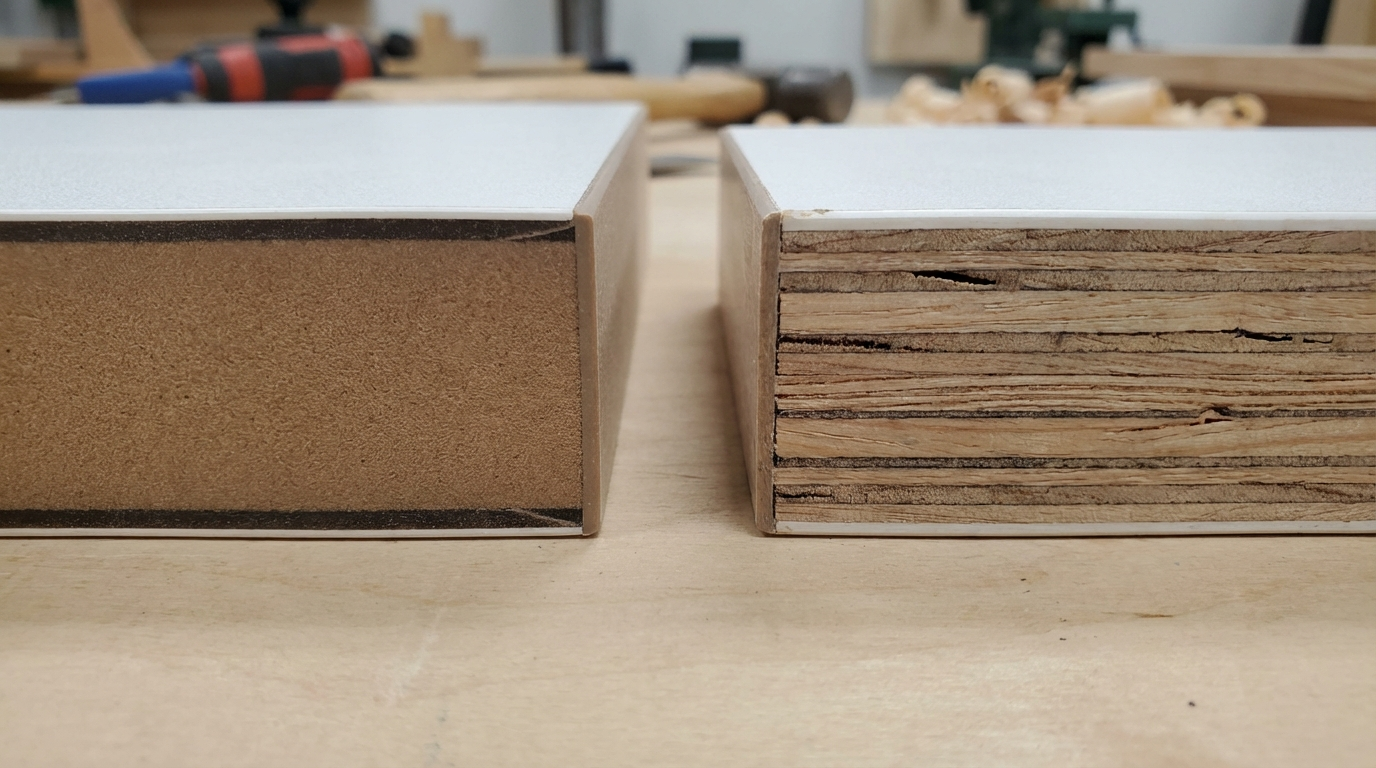
MDF stands for Medium-Density Fiberboard: tiny wood fibers mixed with resin, pressed into dense sheets under heat and pressure. It creates a uniform, knot-free surface ideal for painting or laminating, but its fiber structure absorbs moisture easily.
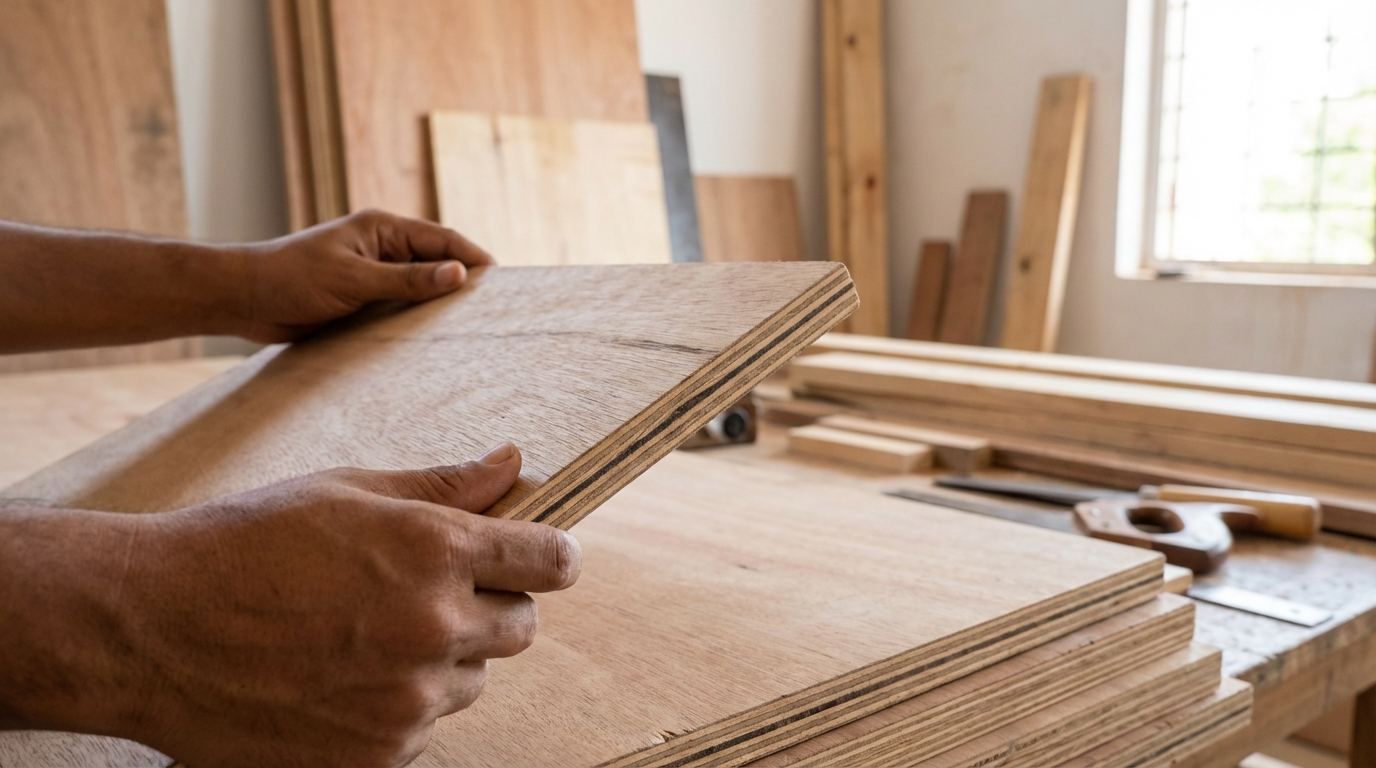
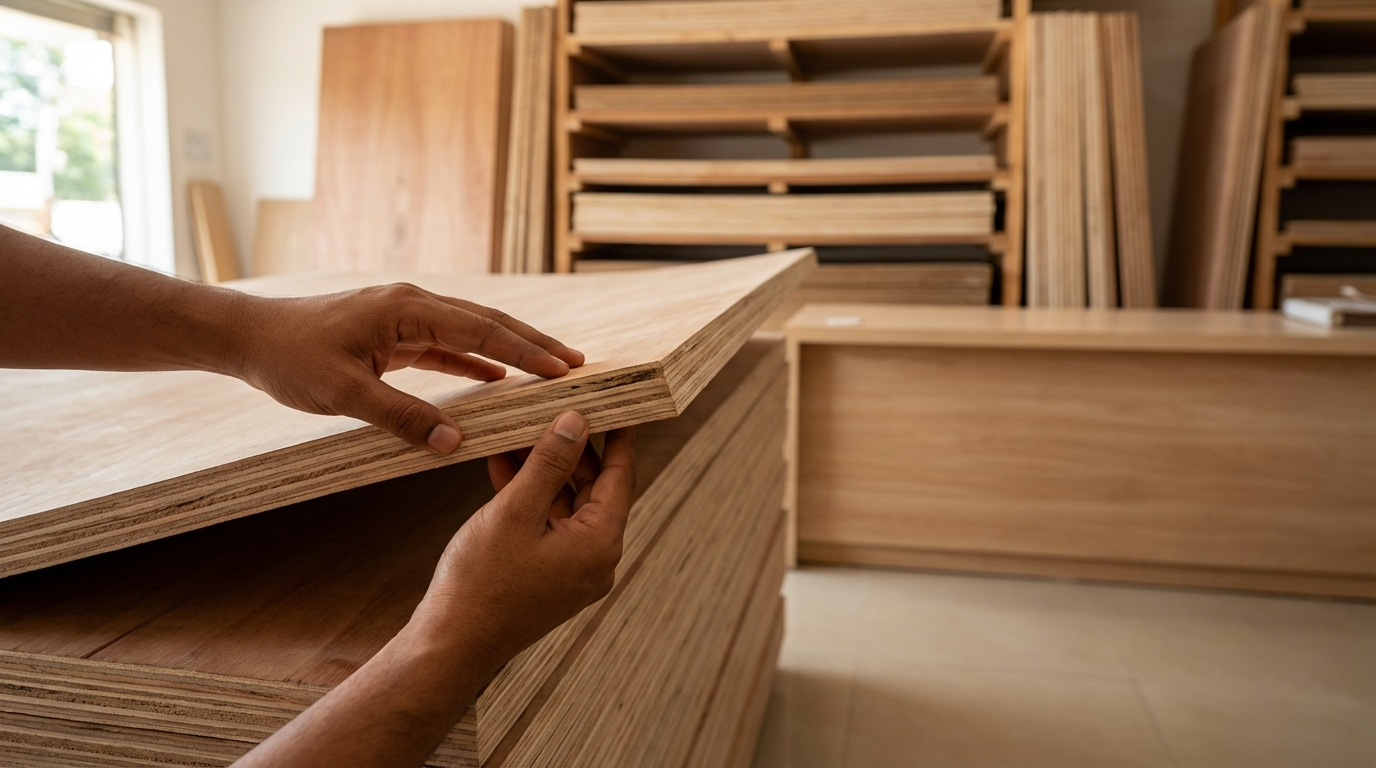
Plywood consists of multiple thin wood veneers glued together with grains running crosswise for strength. Grades like MR (moisture-resistant), BWR (boiling water-resistant), or BWP (boiling water-proof) define glue quality and moisture handling.
Where People Get Confused
- MDF as "fake wood"—it's engineered but stable if dry.
- All plywood being "strong"—ignores grades; MR fails in dampness.
- MDF always cheaper long-term—repairs from swelling add costs.
- Plywood edges always rough—calibrated versions match MDF smoothness.
- Thickness alone matters—core quality trumps mm rating.
- MDF for load-bearing—sags under sustained weight unlike plywood.
India-Specific Reality Check
Indian offices face monsoon humidity (70-90% RH), AC condensation drips, chai spills, and godown storage exposing sheets to rain. MDF swells visibly in 24-48 hours of dampness, warping tabletops. Plywood (BWR+) holds up better but needs edge-sealing. Coastal cities like Mumbai or Chennai amplify risks; inland Delhi AC offices favor MDF. Contractor delays mean pre-cut storage outdoors—test samples first.
Will office AC prevent MDF issues?
AC keeps RH low (40-50%), often making MDF viable for desktops, but breakdowns, door-open cycles, or window leaks introduce spikes causing edge swelling. Plywood shrugs off these better. Test by wetting a sample edge overnight; no warp means safe. Next, seal all edges with PU polish before lamination for extra buffer in variable Indian office climates.
Two-Minute Comparison That Actually Helps
| Aspect | MDF | Plywood |
|---|---|---|
| Strength (load on table top) | Good for light (10-20kg/sqft) | Excellent for heavy (30kg+/sqft) |
| Moisture Resistance | Poor; swells quickly | Varies (BWR/BWP best) |
| Smoothness for Finish | Superior, no sanding needed | Good if calibrated |
| Weight | Lighter | Heavier |
| Screw Holding | Weakens over time | Stronger |
| Cut Precision | Clean edges | May splinter; needs skill |
Use this for dry/light vs humid/heavy: plywood pulls ahead in real offices.
Price Range and Cost Drivers (India)
For 18mm sheets (common for table tops), MDF typically ranges ₹40-80 per sq ft; plywood ₹60-150 per sq ft depending on grade (MR lowest, BWP highest). Thickness jumps 20-30% per mm; city variation adds 15-25% (metros pricier). Drivers: core density/quality, face finish, calibration, transport from mill. Laminates add ₹20-50/sqft.
How much for an 4x2 ft office table top?
A basic 18mm MDF top costs ₹300-700 material-only; plywood ₹500-1200. Factor 20% cutting/wastage, plus labor ₹200-500. Get quotes specifying "18mm BWR calibrated, straight edges, no core gaps." Varies by tier-1 cities vs small towns—confirm with 2-3 local suppliers for your pincode.
How to Choose in 5 Steps
- Map your office use: Heavy monitors/printers? Plywood. Light laptop? MDF ok.
- Assess moisture risk: Near windows/AC? BWR plywood. Dry core? HD-MDF.
- Pick thickness/finish: 18mm min; laminate for scratches.
- Verify supplier sample: Tap for hollows, check screw hold.
- Seal and install: Edge-band fully; use proper fixings.
Skip moisture step? Expect swelling in first monsoon.
Decision Framework: Pick by Your Conditions
| Condition | Recommended | What to Verify |
|---|---|---|
| Dry AC office, tight budget | MDF (HD grade) | Uniform tap sound, no edge sag on sample load |
| Coastal/humid, heavy monitors | BWR Plywood | Glue lines intact after wet test, calibrated flatness |
| High scratch risk (kids/pets) | Plywood + Laminate | Face veneer quality, 1mm thick overlay |
| Fast delivery needed | Local MDF stock | Fresh batch (no storage warp), density consistency |
| Custom cuts heavy | Calibrated Plywood | Straight edges post-cut, no core voids |
| Modular/repeat orders | MDF Panels | Batch uniformity, screw pull-out test |
Trade-offs and Limitations
MDF: Super smooth but moisture magnet—limits to dry zones; screws loosen. Plywood: Tougher but pricier, potential veneer mismatches, heavier for handling. Both need edge protection; neither bulletproof against poor workmanship.
Tips for Homeowners
Focus on spill-proof tops: laminate both, but plywood lasts 5-10 years vs MDF's 2-5 in home offices. Clean with dry cloth; avoid water. Budget extra 20% for sealing.
Tips for Carpenters
Cut MDF dust-free; plywood needs sharp blade to avoid splinters. Pre-drill screws in MDF (1.5x diameter); plywood takes direct. Edge-band immediately post-cut.
Tips for Architects/Designers
Spec "18mm BWR calibrated plywood, phenolic resin" for elevations. Detail edge returns 10mm thick. Modular? MDF for prototypes, plywood for finals.
Is 18mm thickness enough for office tables?
Yes for spans up to 4ft with legs; handles 25kg/sqft. Thicker (25mm) for larger/heavier. Check by loading sample progressively. Prevents bounce/sag in daily use—India offices often overload, so verify leg bracing too.
Common Buyer Mistakes and How to Avoid Them
- Mistake 1: Ignoring humidity—happens in "AC will save it" hope. Fix: Wet-test sample 24hrs.
- Mistake 2: Cheapest MR grade—fine indoors dry. Fix: Step to BWR for offices.
- Mistake 3: No edge sealing—absorbs via cut sides. Fix: Band all exposed edges.
- Mistake 4: Skipping calibration check—uneven tops wobble. Fix: Ruler test flatness.
- Mistake 5: Light thickness for heavy use—sags fast. Fix: 18mm min, load-test.
- Mistake 6: Poor laminate match—peels in heat. Fix: 0.8mm+ thick, heat-tested.
- Mistake 7: Godown storage without cover—pre-warps. Fix: Inspect on delivery.
- Mistake 8: Wrong screws—weaken hold. Fix: 2x sheet thickness, countersunk.
Failure Modes and Fixes
- Symptom: Top swells/curves. Cause: Moisture ingress. Prevent: BWR grade + seal. Fix: Sand/refinish if mild.
- Symptom: Sagging center. Cause: Thin/poor core. Prevent: 18mm+ load-test. Fix: Reinforce underside.
- Symptom: Screw holes enlarge. Cause: Repeated removal. Prevent: Plywood + anchors. Fix: Toothpick glue plug.
- Symptom: Laminate bubbles. Cause: Air/moisture trapped. Prevent: Clean dry press. Fix: Slit/heat reglue.
- Symptom: Edge chips. Cause: No banding. Prevent: PVC lipping. Fix: Filler + sand.
- Symptom: Delamination layers. Cause: Low-grade glue. Prevent: Tap-test pre-buy. Fix: Clamp/reglue if small.
Quality Checks You Can Do Without Lab Tests
Before Buying
- Tap sheet: Solid thud = good; hollow = gaps.
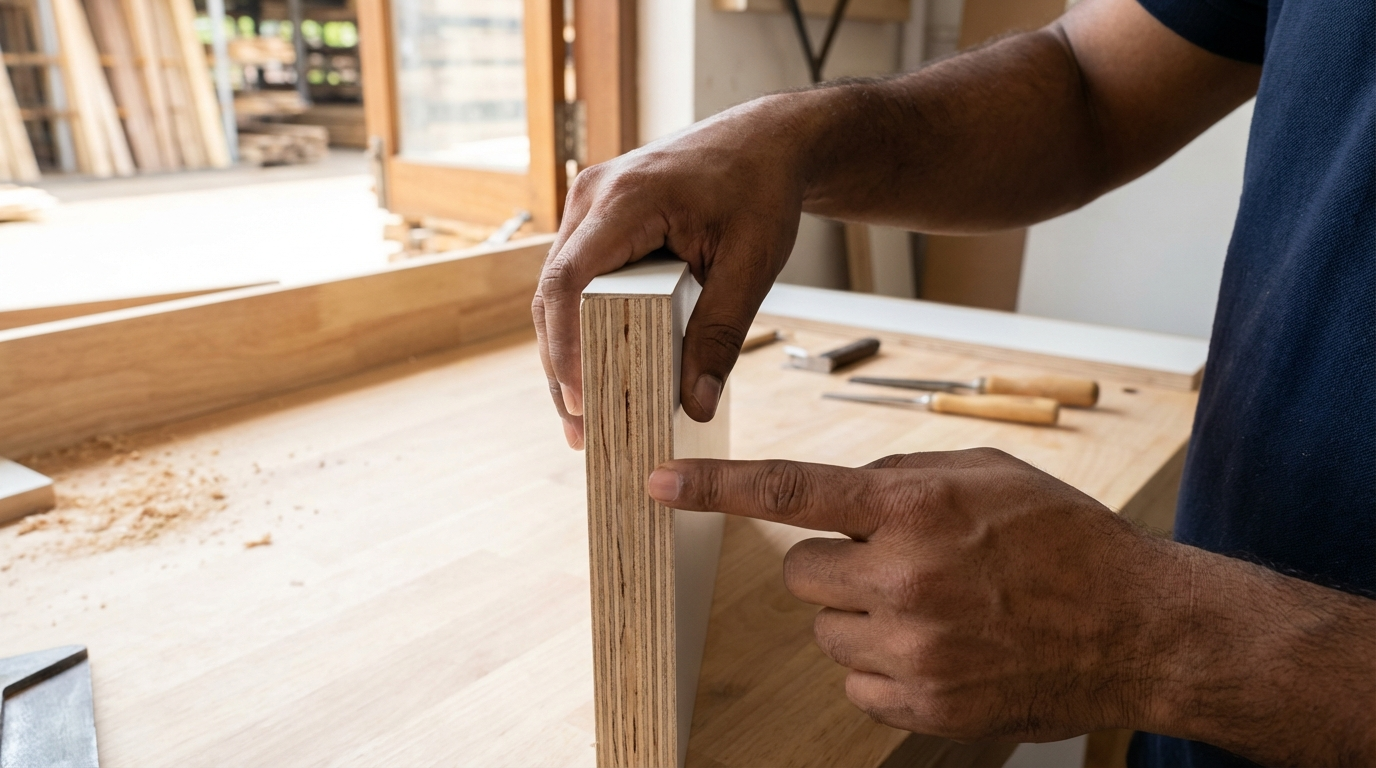
- Edge inspection: Smooth, no voids/swelling signs.
- Weight/lift: Uniform heft, no weak flex.
- Ask: "Fresh batch? Calibration report?"
After Cutting
- Measure flatness: <1mm variance over 1m.
- Screw test: 5 pulls, no spin.
- Wet edge 1hr: No color change/soften.
After Install
- Load 20kg center 48hrs: No dip.
- Edge seal check: Wipe test no absorb.
- Alignment: Level bubble pass.
Can I paint MDF directly for office tables?
Yes, its smoothness takes primer/paint well, hiding imperfections unlike plywood's grain. But two primer coats needed to block moisture/tannins bleeding. In humid India, top with PU varnish. Test small area first—lasts 3-5 years with dry cleaning. Avoid if heavy scratch risk; laminate instead.
Does plywood warp less than MDF?
Plywood's cross-layers resist warp better, especially calibrated BWR. MDF stays flat dry but bows in humidity. Store vertically, seal ends. For tables, plywood's edge stability shines in monsoons—check by flexing sample sheet.
FAQs
Which is better for office table tops: MDF or plywood?
Plywood generally outperforms for Indian office tables with its strength against loads and humidity tolerance via BWR grades. MDF excels in smooth, budget laminates for stable AC environments but risks swelling from spills or downtime. Weigh your setup: heavy use tips to plywood; light/dry to MDF. Always edge-seal and load-test samples for confidence.
Is MDF safe for heavy computer setups?
MDF handles 15-25kg/sqft short-term but fatigues under constant weight like PCs, leading to sag. Reinforce with battens underneath. Plywood takes 40kg+ easily. In offices, test by stacking weights 48hrs—if stable, proceed with HD-MDF; else switch.
How to prevent moisture damage on table tops?
Seal all edges/screws with PU or epoxy before finishing; use BWR plywood over MR/MDF in risky zones. Mats under drinks, quick spill wipes. In coastal India, add silica packs during storage. Inspect yearly for soft spots.
What thickness for a 120cm office desk?
18mm standard for stability without excess weight; 25mm for spans over 1.5m or heavy loads. Pair with sturdy legs. Check flex by pressing center—minimal bounce ideal. Thicker adds cost but cuts repair risks.
Can I use laminate on both?
Both work well; MDF needs less sanding, plywood more for grain. Choose 1mm thick for durability against keys/drags. Heat-press properly to avoid bubbles. In hot offices, UV-resistant laminates last longer.
Which is easier for carpenters to work with?
MDF cuts cleaner, less splintering; no grain tear-out. Plywood demands sharp tools, pre-drilling. Both machine well calibrated. For custom tables, MDF speeds prototypes; plywood finals.
Does weight matter for office tables?
Lighter MDF eases handling/install; heavier plywood adds stability. For wall-mount or mobile tables, MDF wins. Factor transport costs in multi-floor offices without lifts.
How long do they last in Indian offices?
Well-maintained plywood: 7-12 years; MDF: 4-8 years in AC, less humid. Failures from moisture cut halves. Proper sealing doubles life—annual checks key.
Any health concerns with MDF?
Formaldehyde from resins possible; choose E0/E1 low-emission grades. Ventilate during cutting. Plywood similar but natural veneers lower. Good airflow in offices mitigates.
Disclaimer: This content is provided for general informational purposes based on industry practices and publicly available information. Product specifications, standards, prices, and availability may vary by manufacturer, region, and time. Readers should independently verify details with manufacturers, dealers, or qualified professionals before making purchase or construction decisions.Want Plywood Suggestions?
Share a few details and a Duro BOIL specialist will suggest suitable brands and connect you to responsive dealers.