MDF vs plywood for tv unit: what to pick (India)
MDF vs plywood for tv unit: what to pick (India) with a clear decision table on grade, thickness, moisture performance, warranty and price factors. Made for
Quick Decision Summary
Plywood (BWR grade) usually wins for TV units in India over MDF for better load strength and humidity handling.
If you're in a hurry: For a typical living room TV unit with shelves holding TV, speakers, and decor, select 18mm BWR plywood. It resists indoor humidity spikes from monsoons or non-AC rooms better than standard MDF, holds heavier loads without sagging, and cuts cleaner for cabinets. MDF suits ultra-tight budgets in always-dry AC spaces but risks swelling edges if moisture creeps in. Always verify calibration and glue lines on-site. Expect plywood to cost 20-50% more but last longer without rework. Use the table below for your scenario.
- Choose plywood if: shelves need to hold 50kg+ TV/gear, room sees humidity/AC off time, or you want 10+ year durability.
- Choose MDF if: budget under Rs 60/sqft, finish is laminate-heavy in constant AC, and light loads only.
- Avoid MDF if: coastal/non-AC home or exposed edges without perfect sealing.
- Avoid plywood if: need mirror-smooth paint finish on curves (MDF excels here).
| Condition | Recommended Pick | Key Verification |
|---|---|---|
| Monsoon-prone/non-AC room | BWR Plywood (18mm) | Glue line test: soak edge 30min, no delam |
| Constant AC, light shelves | HDHMR or MDF (18mm) | Smooth faces, no lumps; tap for density |
| Heavy TV (50kg+), cabinets | BWR Plywood | Core gaps <1mm, calibrated thickness |
| Tight budget, laminate finish | MDF | Edge straightness, no swelling on touch |
| Coastal/high humidity | BWR Plywood | Face veneer quality, no soft core |
| Fast modular build | HDHMR | Pre-lam options, uniform density |
What MDF and Plywood Actually Mean for TV Units
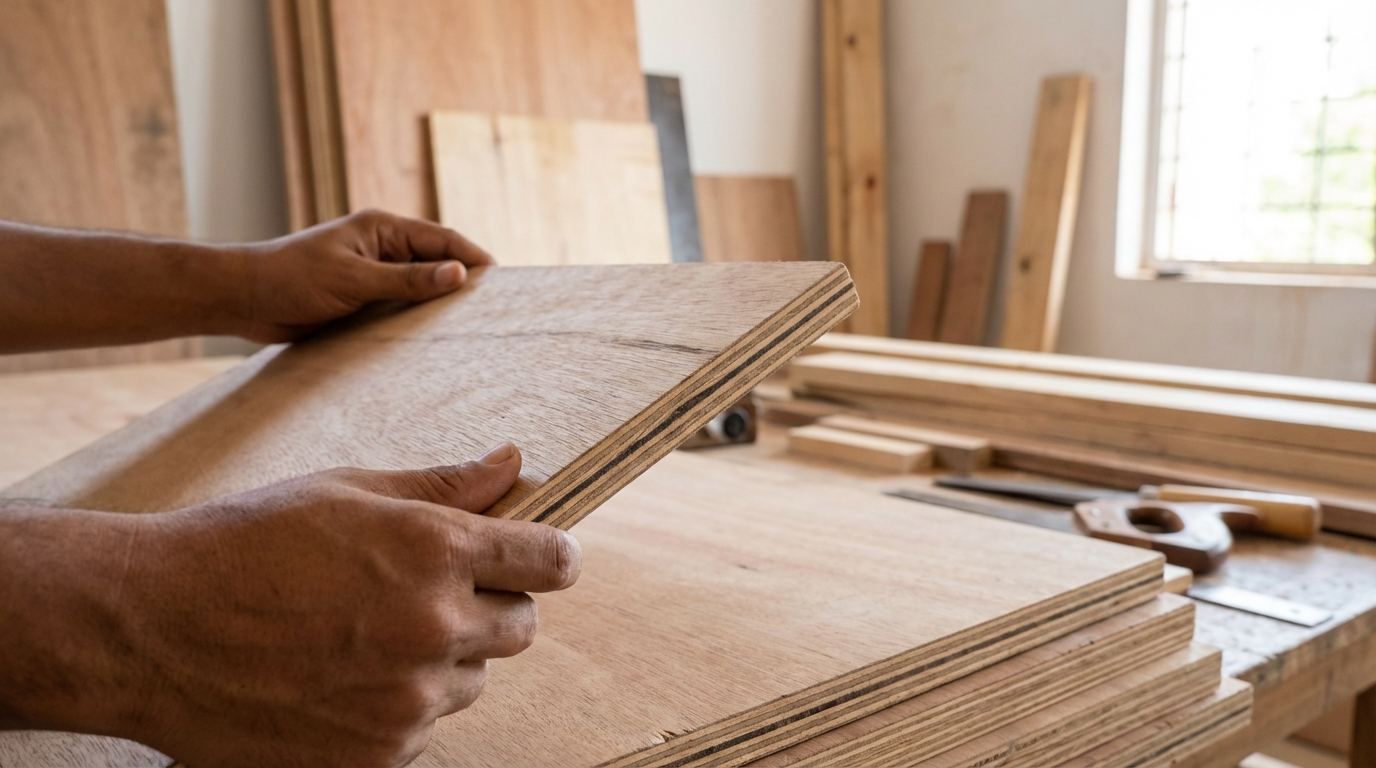
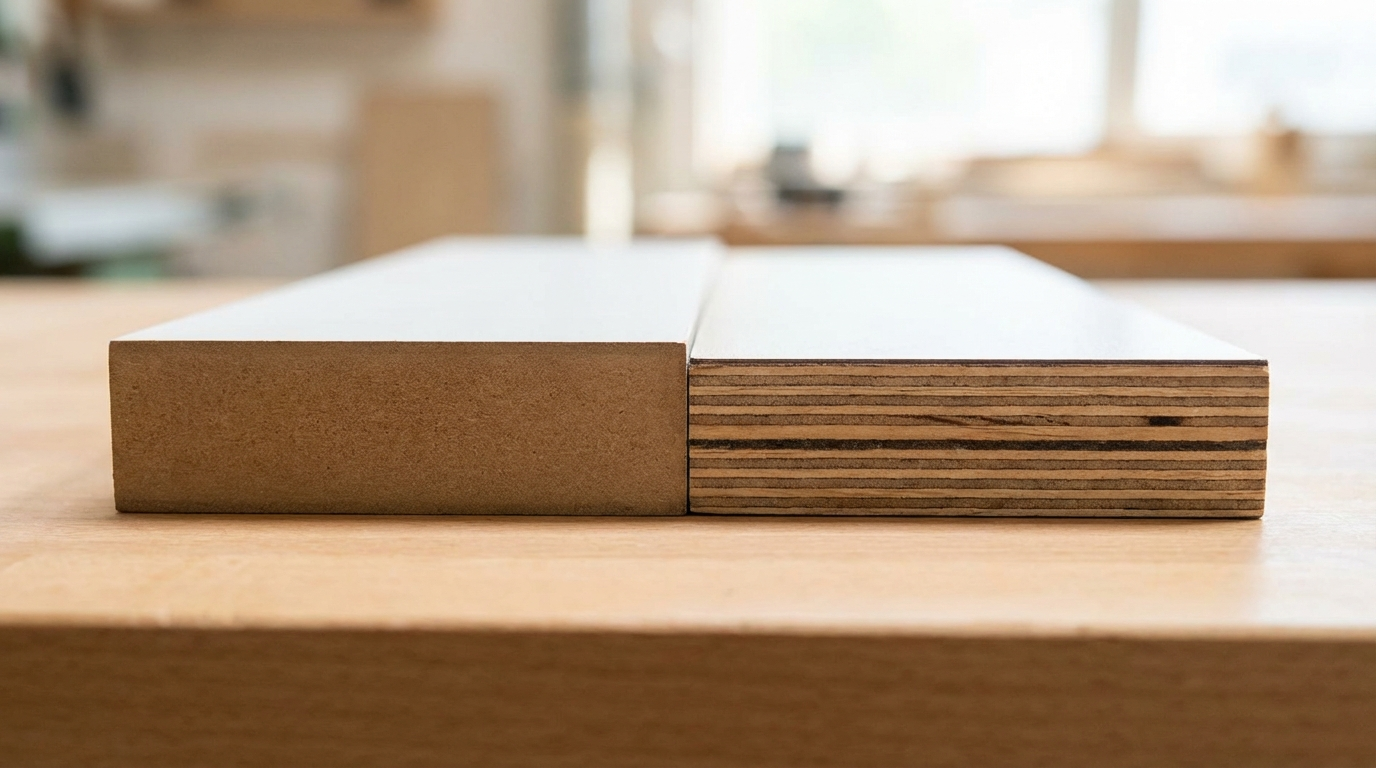
Plywood stacks thin wood veneers cross-grained and glued under pressure, creating strong panels ideal for shelves and frames. Grades like MR suit dry interiors, BWR handles humid boiling water resistance for Indian homes, while BWP offers top marine-level protection. For TV units, 18mm thickness supports TV weight without flex.
MDF compresses wood fibers into dense boards, perfect for smooth laminates or paints but weaker in layers. Standard MDF absorbs moisture easily; HDHMR variants add resins for better resistance. TV units use it for cabinets where finish matters over brute strength.
Where People Get Confused About MDF vs Plywood
- MDF is "fake wood" – it's engineered but holds screws better repeatedly than solid wood.
- Plywood always warps – only low-grade MR does in humidity; BWR stays flat.
- MDF can't bear weight – 18mm handles 30-40kg shelves if edges reinforced.
- All plywood is same strength – core gaps and glue lines vary hugely by mill.
- HDHMR = waterproof – it's moisture-resistant, not for direct water exposure.
- Thicker always better – 18mm sweet spot; over 19mm adds cost without gain for TV units.
India-Specific Reality Check
Indian living rooms face 70-90% humidity in monsoons, even indoors, plus dust and occasional spills. Non-AC homes amplify MDF swelling risks on unsealed edges. Plywood's cross-layers breathe better, reducing cupping. Coastal areas demand BWR minimum. Storage at dealers often exposes sheets to rain, so inspect on arrival. Contractor workflows favor plywood for easier sawing without chipping.
Does Humidity Ruin MDF TV Units in India?
Yes, standard MDF often swells 5-10% in edges after monsoon exposure if not sealed perfectly, leading to laminate peel or sagging shelves. HDHMR fares better with resin binders but still needs edge banding. In AC rooms (below 50% RH), it lasts fine. Practical step: Test by wiping edge with wet cloth; dry immediately and check next day. Switch to BWR plywood for non-AC reliability – it handles 80%+ RH without dimension change. Always seal all cuts on-site before assembly.
Price Range and Cost Drivers (India)
For 18mm sheets, MDF typically ranges Rs 45-85 per sq ft, HDHMR Rs 60-110. BWR plywood falls Rs 75-140, varying by city (higher in metros like Mumbai/Delhi due to logistics). Thickness jumps 20% per mm; premium faces add 15-25%. Core quality and calibration drive 30% variance – poor ones waste material in cuts.
How to Ask for a Quote Without Getting Ripped Off
- Specify "18mm BWR plywood calibrated, poplar core, no gaps."
- Ask "HDHMR vs BWR price per sqft delivered."
- Include "laminate-ready faces, edge sealed sample."
- Compare 3 quotes: thickness tolerance, moisture test demo.
- Budget example: 20sqft TV unit frame/shelves ~ Rs 2000-4000 material (excl labor/finish).
Two-Minute Comparison That Actually Helps
| Factor | MDF/HDHMR | BWR Plywood |
|---|---|---|
| Strength/Load (50kg shelf) | Good if dense; sags over time | Excellent; no flex |
| Humidity Resistance | Fair (HDHMR); swells edges | Strong; boiling-tested |
| Finish Ease (Lam/Veneer) | Best; ultra-smooth | Good; minor sanding |
| Weight | Heavier per strength | Lighter, easier handle |
| Cut/Shape Cleanliness | Chips if not sharp blade | Cleaner edges |
| Cost (18mm/sqft) | Rs 45-110 | Rs 75-140 |
Choose by conditions: wetter rooms or heavy loads = plywood; smooth curves/low cost = MDF.
How to Choose in 5 Steps
- Assess room/use: Humidity? TV weight? → BWR if yes.
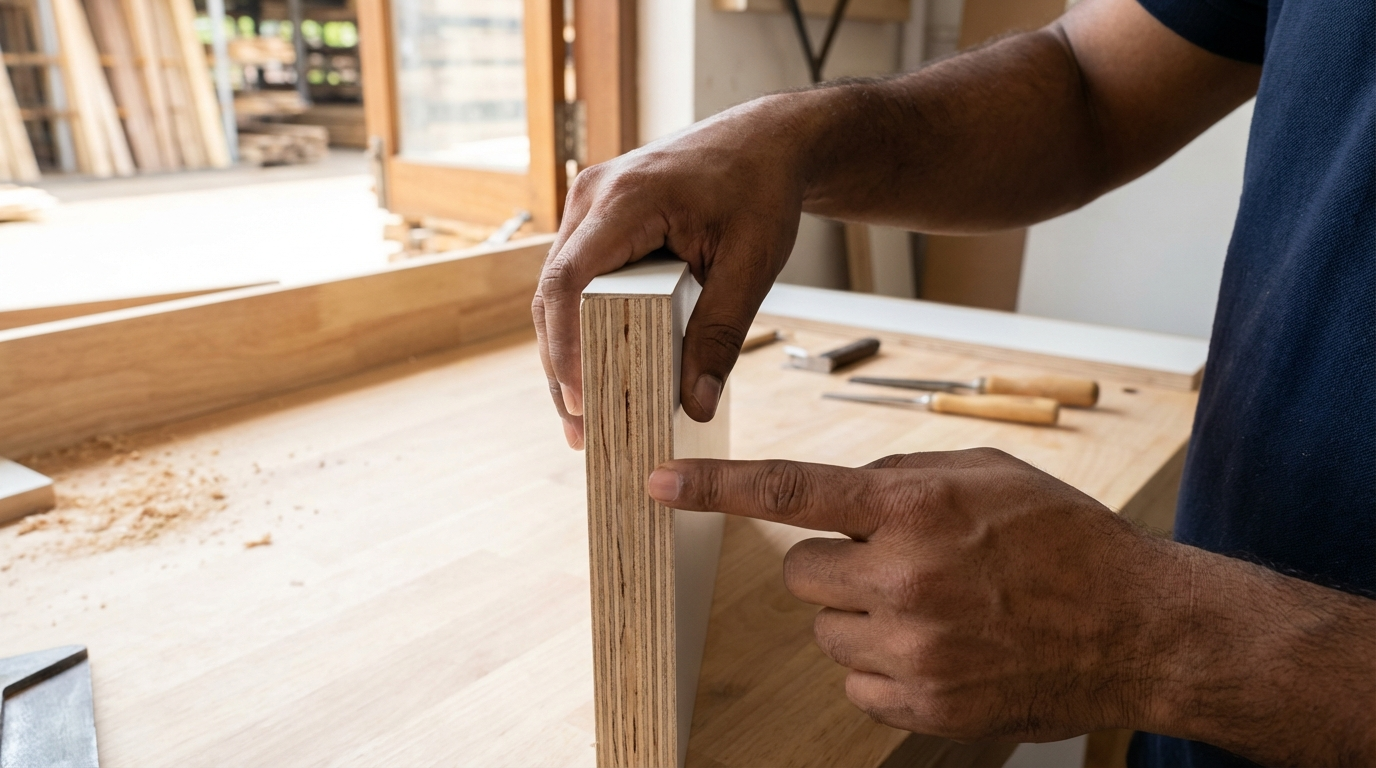
- Check sheet on-site: Tap for solid sound, measure thickness variance <0.5mm.
- Test moisture: Wet edge 20min; no bubbling/softening.
- Plan finish: Laminate? MDF shines; veneer? Plywood grips better.
- Confirm carpenter fit: Pre-cut sample for alignment. Skip = rework costs double.
Which Holds More Weight for TV Shelves?
BWR plywood typically supports 60-80kg per meter shelf at 18mm without sag, thanks to layered strength. MDF/HDHMR manages 40-50kg but needs center supports over 1m spans. For 55-inch TVs (20-30kg), both work; add speakers/books and plywood wins. Nuance: Poor core plywood fails faster than good HDHMR. Next step: Load test sample shelf with weights 24hrs; check deflection under 2mm.
Tips for Homeowners: Durability and Care
- Use coasters under remotes; dust weekly with dry cloth.
- Avoid direct AC drip on edges – seal extras.
- Don't overload open shelves beyond 30kg.
- Check alignment yearly; tighten screws.
For Carpenters: Working with Each
- MDF: Sharp 60-tooth blade, slow feed to avoid tear-out.
- Plywood: 40-tooth blade; seal cut edges same day.
- Fasten 50mm screws into plywood studs; pilot holes for MDF.
- Hinge zones: Reinforce plywood with blocks for heavy doors.
- Detail edge returns 25mm min for MDF.
- Spec BWR IS-marked for public projects.
- Modular: HDHMR for factory repeatability.
- Wet-zone buffers: Plywood frames even if MDF panels.
- Pick MR plywood for living room: Fails in humidity. Instead: Demand BWR grade.
- Ignore thickness calibration: Uneven cuts waste 10%. Measure 5 spots per sheet.
- Skip edge sealing on MDF: Swells post-monsoon. Seal all cuts with PVA.
- Overload MDF shelves: Sag after 2 years. Limit to 20kg or add supports.
- Buy unseen from pics: Core defects hidden. Visit yard, tap test.
- Cheapest laminate on plywood: Peels fast. Spec 0.8mm thick C-grade.
- No load planning: TV+gear exceeds. Sketch with weights first.
- Forget carpenter input: Wrong material for tools. Consult pre-buy.
- Sagging shelves: Weak core/load excess → Use 18mm BWR, center brace. Fix: Reinforce underneath.
- Edge swelling: Moisture on MDF → Seal missing. Fix: Sand, re-band, dry 48hrs.
- Laminate bubbling: Poor glue/heat → Low-grade faces. Fix: Replace section.
- Screw pull-out: Repeated doors → Wrong density. Fix: Larger screws + anchors.
- Door misalignment: Hinges loose/swelling → Humidity. Fix: Realign, upgrade soft-close.
- Cracks at joints: Poor assembly → No bracing. Fix: Dowels + glue, clamp 24hrs.
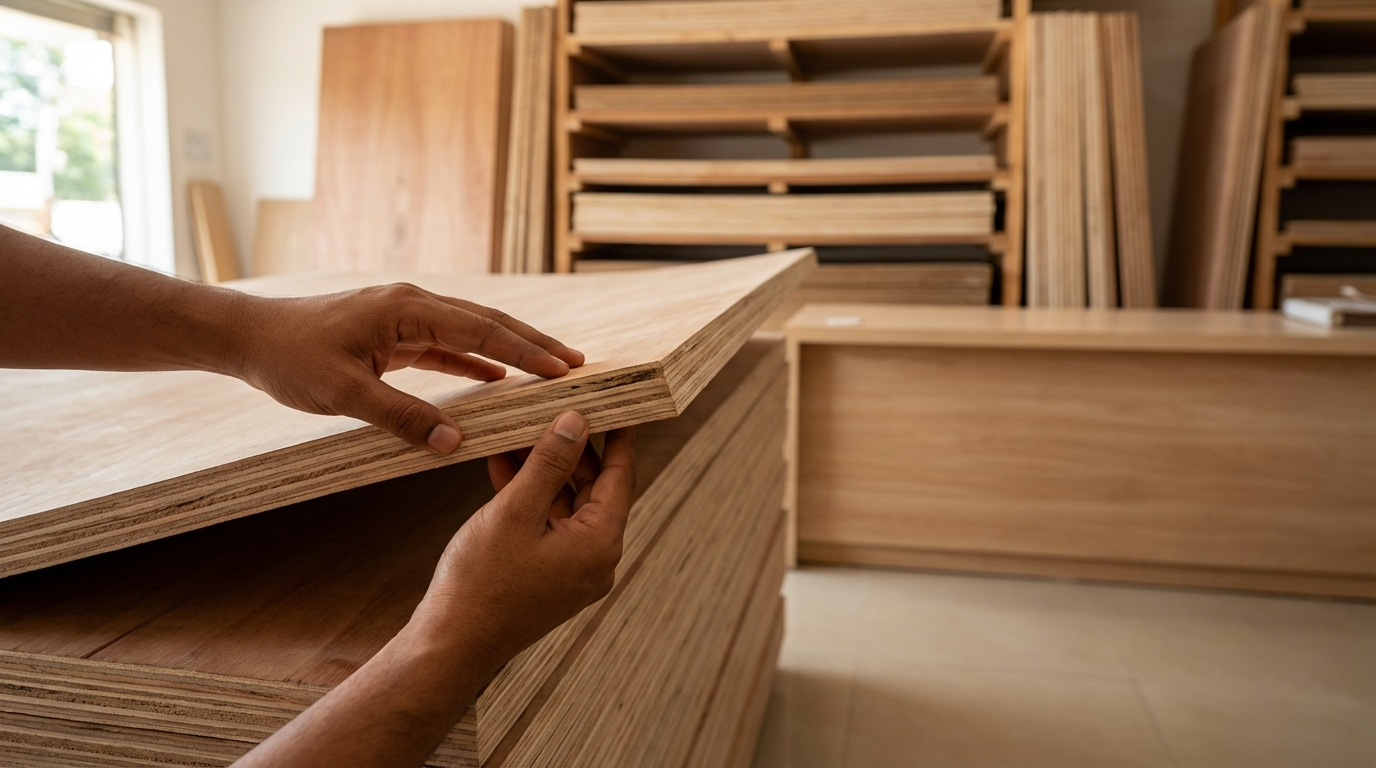
- Before buy: Weigh corner – heavy/soft = poor density. Flex sheet – no wave.
- Visual: Faces flat, no knots/blisters; core lines straight.
- Moisture hack: Plastic bag overnight on edge – condensation inside = bad.
- Post-cut: Edges crisp, no voids; sand smooth easy.
- Installed: Shelves level under load; doors swing free.
For Architects/Designers: Spec Right
Trade-offs and Limitations
Plywood: Higher cost, veneer matching effort. MDF: Moisture vulnerability, screw holes weaken faster. Both chip if mishandled; neither for outdoor. Plywood harder to curve; MDF paints easiest but yellows over time.
Can You Paint MDF for TV Unit?
Yes, MDF takes paint flawlessly for custom looks, sanding to 220 grit first. Plywood needs filler on grain. In India, use moisture-barrier primer on MDF to block humidity. Lasts 5-8 years indoors. Condition: Avoid semi-gloss in dusty rooms – flat hides imperfections. Step: Apply 2 primer + 2 top coats; test small area for adhesion.
Common Buyer Mistakes and How to Avoid Them
Failure Modes and Fixes
Why Do TV Unit Edges Swell in India?
Humidity penetrates unsealed MDF pores during monsoons, expanding fibers 8-15%. Plywood resists via glue bonds. Coastal homes see it faster sans AC. Prevention: Full edge banding + silicone seal. If happening: Dry room fully, sand swollen area, apply resin filler, repaint. Check vents for AC condensation too – relocate if direct hit.
Quality Checks You Can Do Without Lab Tests
Is 18mm Thickness Enough for TV Units?
Yes, 18mm handles standard 50kg setups with minimal sag over 1.2m spans. Thinner 12mm flexes; 19mm overkill unless custom heavy. Plywood at 18mm outperforms MDF equivalents. India tip: Factor carpenter span calcs. Verify: Stack books equaling TV weight; no bounce.
FAQs
Is plywood stronger than MDF for TV shelves?
Plywood's cross-layers provide superior bending strength for shelves holding TVs and gear, resisting sag better over time compared to MDF's uniform fibers. In Indian homes, BWR plywood at 18mm supports 60kg+ per meter reliably. MDF works for lighter decorative units but needs brackets. Trade-off: Plywood costs more but reduces callbacks. Always confirm with a load test on sample before full cut.
Can MDF be used for TV cabinets in humid areas?
HDHMR MDF can in controlled humidity but risks edge swelling in monsoons without perfect sealing. Standard MDF fails faster. Opt for it only in AC bedrooms. Plywood BWR is safer alternative. Seal all six sides and avoid floor storage. Monitor first monsoon; dry promptly if damp.
What thickness for TV unit plywood?
18mm is the go-to for frames and shelves balancing strength, cost, and weight. 12mm for backs/partitions only. Verify uniformity across sheet. In India, thicker suits heavy Indian oak TVs. Carpenter tip: Pair with 75mm screws for hold.
Does laminate stick better to MDF or plywood?
MDF's smoothness gives flawless laminate adhesion without bubbles, ideal for glossy TV units. Plywood needs light sanding and primer for grip. Both work with quality 0.6mm+ laminate. Avoid cheap press on plywood – peels in heat.
How to prevent sagging in TV unit shelves?
Use BWR plywood 18mm with front lip and center support for spans over 1m. MDF requires extra battens. Factor 1.5x expected load. Post-install, check level yearly and shim if settling. Common in soft-core boards.
Is HDHMR better than regular MDF for India?
HDHMR's resins boost moisture resistance 3x, making it viable for TV units in moderate humidity vs plain MDF's quick swell. Still below BWR plywood. Cost 20-30% more. Test: Spill water, wipe after 10min – no mark.
Which is lighter for wall-mounted TV units?
Plywood weighs less per strength ratio, easier for mounts. MDF denser, adds load on walls. 18mm plywood ~25kg/8x4 sheet vs MDF 35kg. Coastal: Lighter reduces sag risk.
Can you mix MDF and plywood in one TV unit?
Yes – plywood for load shelves/frames, MDF for painted panels/cabinets. Seal joints well. Saves 10-20% cost. Carpenter must match expansions or gaps form. Good for hybrid budgets.
Disclaimer: This content is provided for general informational purposes based on industry practices and publicly available information. Product specifications, standards, prices, and availability may vary by manufacturer, region, and time. Readers should independently verify details with manufacturers, dealers, or qualified professionals before making purchase or construction decisions.Want Plywood Suggestions?
Share a few details and a Duro BOIL specialist will suggest suitable brands and connect you to responsive dealers.