Ply Board: Meaning, Types (MR/BWR/BWP), Sizes & Price Guide (India 2026)
A practical guide to ply board: what it means, MR/BWR/BWP types, standard sizes & thickness, price ranges, and how to choose the right board for kitchen, wardrobe and furniture.
Quick Decision Summary
Best answer in one line: Ply board is layered wood sheeting—choose MR for dry interiors, BWR for kitchens, and BWP/Marine for wet zones or coastal areas.
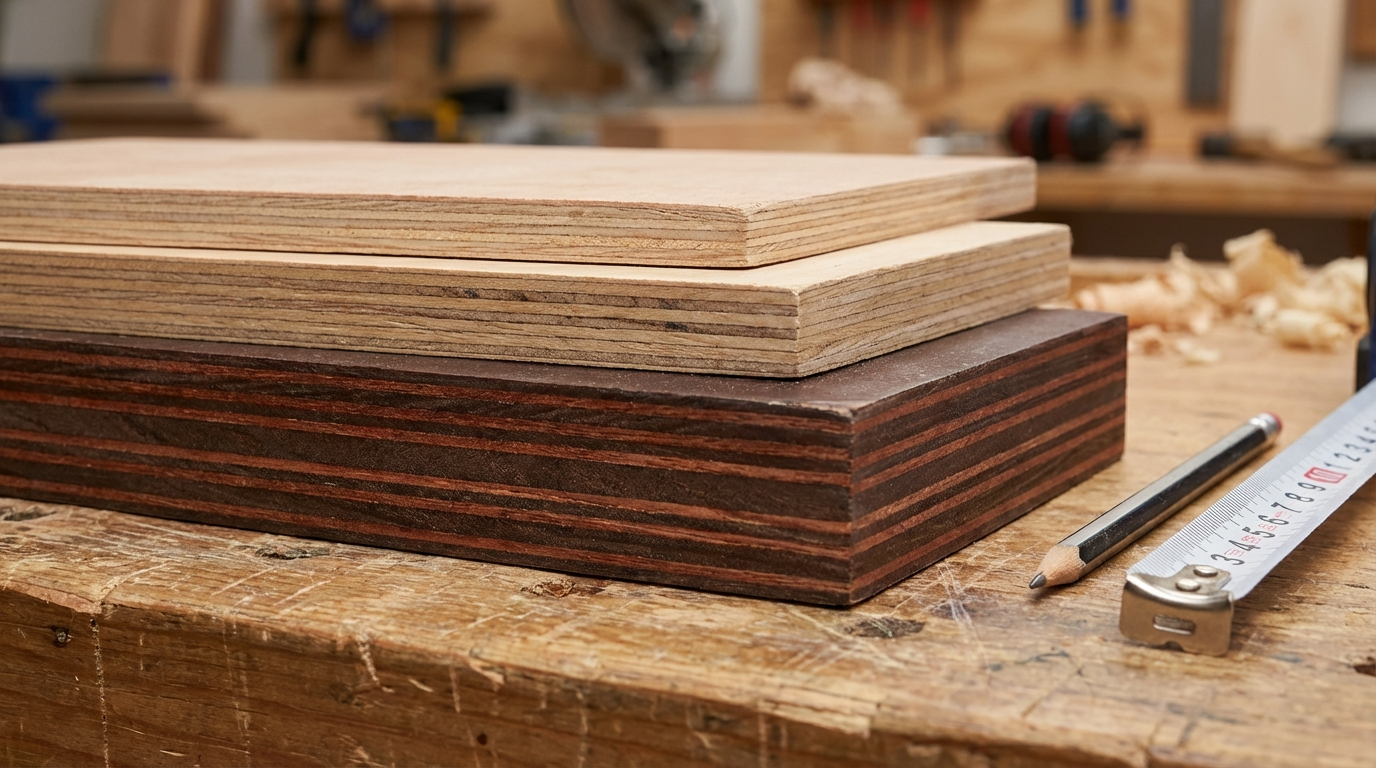
If you're in a hurry: For bedroom wardrobes and general furniture in non-humid rooms, MR grade ply board (18 mm) works well and costs less. For modular kitchens, bathroom vanities, or areas with frequent water splashes, upgrade to BWR grade. If you live in a coastal city or need under-sink cabinets, BWP or Marine grade prevents swelling and delamination. Always seal cut edges with edge-banding or PU sealant regardless of grade. Verify the IS mark on the sheet, check core layers for gaps, and confirm thickness with a vernier caliper before paying.
- Choose ply board if: You need structural strength for furniture carcasses, shutters, or panelling—and want screw-holding capacity superior to particle board or plain MDF.
- Avoid ply board if: You need perfectly smooth paintable surfaces (MDF is better) or ultra-budget temporary structures where blockboard or particle board suffices.
What Ply Board Actually Means in Indian Context
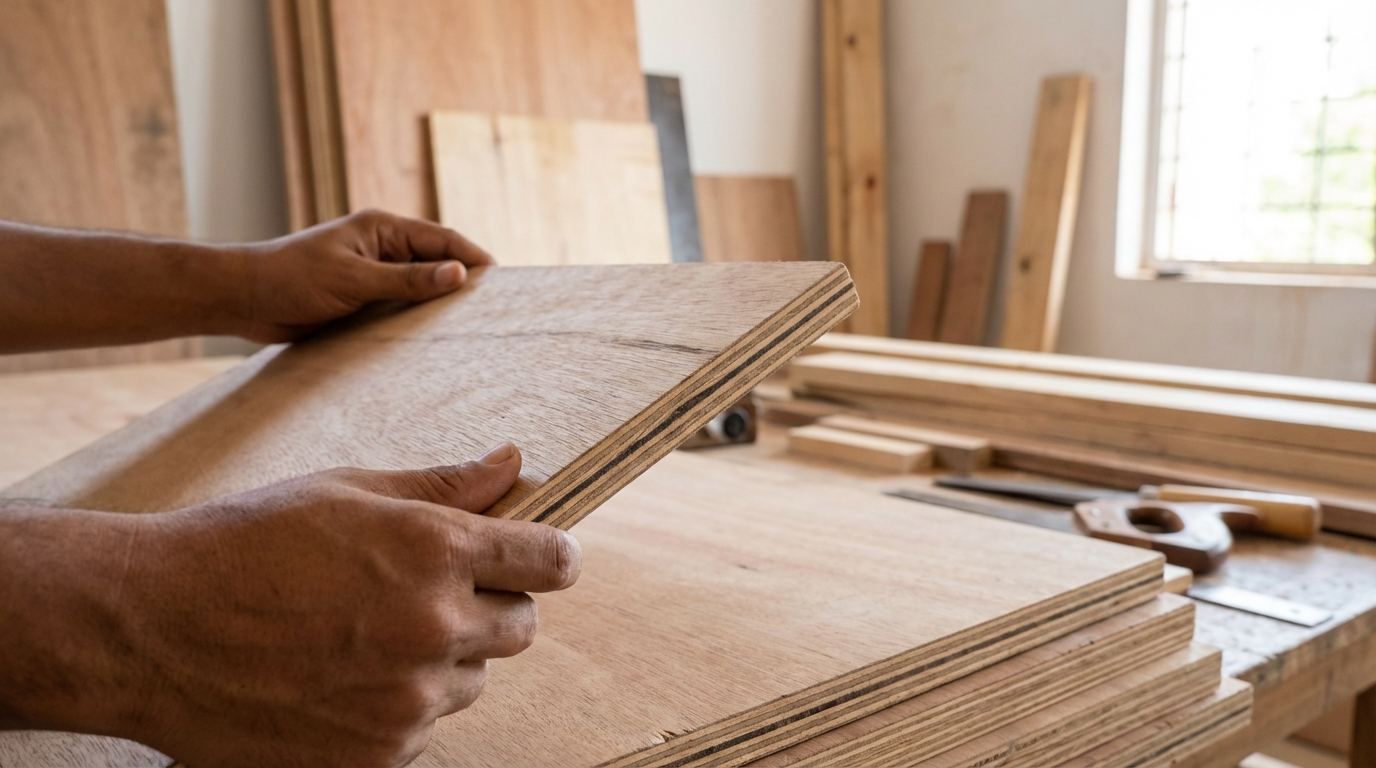
Ply board—often called plywood in technical terms—is an engineered wood panel made by gluing thin layers of wood veneer (called plies or veneers) with their grain directions alternating at 90 degrees. This cross-lamination gives the sheet strength in multiple directions, reduces warping, and improves screw-holding compared to solid timber of equal thickness.
In India, ply board is manufactured under Bureau of Indian Standards specifications. MR and BWR grades fall under IS 303, while BWP/Marine grade conforms to IS 710. The grade indicates the adhesive's water resistance, not the wood species or surface finish.
Where People Get Confused About Ply Board
- Confusing grade with quality: MR grade is not "low quality"—it simply uses moisture-resistant (urea-formaldehyde) glue unsuitable for wet areas. A premium MR sheet can outperform a cheap BWR sheet in dry conditions.
- Assuming "waterproof" means submersible forever: Even BWP/Marine grade can degrade if edges remain unsealed and water pools continuously. The boiling-water test certifies adhesive bond strength, not permanent submersion.
- Mixing up commercial and MR: "Commercial plywood" is often used loosely for MR grade, but some dealers sell uncertified sheets under this label—always ask for the IS 303 mark.
- Believing thicker is always stronger: A 19 mm sheet with voids in the core can be weaker than a dense 16 mm calibrated sheet. Core construction matters as much as thickness.
- Ignoring calibration: Non-calibrated sheets vary in thickness across the surface, causing uneven laminate application and edge-banding gaps—critical for modular furniture.
India-Specific Reality Check
India's climate diversity—from coastal Mumbai and Chennai to dry Rajasthan and humid Bengal—demands different ply board choices. Monsoon humidity can push indoor relative humidity above 80% for months, stressing MR-grade glue lines even indoors. Coastal cities add salt-laden air that accelerates surface degradation if protective laminates or veneers are absent.
How Does Monsoon Humidity Affect Ply Board Selection?
During monsoons, unsealed MR ply board absorbs atmospheric moisture, causing slight swelling along edges and potential delamination over years. BWR grade handles this better due to phenolic or melamine-fortified adhesives. For ground-floor kitchens or homes without air conditioning, BWR is the practical minimum. In hill stations with persistent dampness, consider BWP even for wardrobes. Always store sheets flat, off the ground, covered with tarpaulin—standing sheets against walls invites warping before installation even begins.
Storage and Handling Mistakes on Indian Sites
Contractors often leave ply board stacked outdoors or in partially roofed areas during construction. Even one rain exposure can swell edges permanently. Insist on indoor storage, inspect sheets upon delivery, and reject any with visible edge swelling or water stains. Mark rejected sheets immediately to prevent them from re-entering the pile.
Types of Ply Board: MR, BWR, BWP, and Marine Explained
MR Grade (Moisture Resistant) – IS 303
MR ply board uses urea-formaldehyde resin, offering resistance to indoor humidity but not direct water contact. It suits bedrooms, living rooms, study tables, false ceilings, and wall panelling in climate-controlled or dry-climate homes. MR is the most affordable grade and machines well, making it popular for budget interiors.
BWR Grade (Boiling Water Resistant) – IS 303
BWR ply board employs phenol-formaldehyde or melamine-fortified adhesive, surviving the boiling water test for several hours without delamination. It handles steam, occasional splashes, and high humidity—ideal for modular kitchens, dining area cabinets, bathroom vanities (dry zones), and utility rooms. BWR is the workhorse grade for most Indian homes.
BWP / Marine Grade – IS 710
BWP (Boiling Water Proof) or Marine grade uses superior phenolic resin and typically hardwood veneers (often Gurjan or equivalent). It withstands prolonged water exposure, making it suitable for under-sink cabinets, outdoor furniture under shade, and bathroom storage. Marine grade is also specified for boat interiors and industrial wet environments. Expect a 40–70% price premium over BWR.
Is There a Difference Between BWP and Marine Ply Board?
In practical Indian retail, "BWP" and "Marine" are used interchangeably for IS 710 certified sheets. Some manufacturers reserve "Marine" branding for their premium line with denser cores or better face veneers, but the adhesive standard remains IS 710. Always verify the IS mark rather than relying on marketing names. If the sheet lacks IS 710 certification, it is not genuinely marine grade regardless of the label.
Standard Sizes and Thicknesses Available in India
Ply board is typically sold in 8 ft × 4 ft (2440 mm × 1220 mm) sheets. Some manufacturers offer 7 ft × 4 ft or 6 ft × 4 ft variants, and metric sizes like 2440 mm × 1220 mm are standard for calibrated sheets meant for CNC machining.
Common Thicknesses and Where to Use Them
| Thickness | Typical Application | Grade Recommendation |
|---|---|---|
| 4–6 mm | Back panels, drawer bottoms, false ceiling backing | MR (dry), BWR (kitchen backs) |
| 8–9 mm | Partition backing, light shelving | MR or BWR |
| 12 mm | Shelves, loft flooring, internal partitions | BWR for kitchens, MR elsewhere |
| 16–18 mm | Carcass sides, wardrobe bodies, cabinet frames | BWR standard; BWP for wet zones |
| 19 mm | Heavy-duty shutters, worktops, stair treads | BWP/Marine for high-load or wet areas |
| 25 mm | Commercial counters, flooring substrates | BWP/Marine |
Why Does Calibrated Thickness Matter?
Calibrated ply board is sanded to a uniform thickness across the entire sheet—typically within ±0.2–0.3 mm tolerance. This uniformity is critical for modular furniture where panels must align flush, edge-banding must sit evenly, and CNC routers need consistent depth settings. Non-calibrated sheets can vary by 1–2 mm across the surface, causing visible steps at joints and uneven laminate adhesion. For high-end kitchens and wardrobes, always specify calibrated sheets even if they cost 10–15% more.
Price Range and Cost Drivers (India 2026)
Ply board prices vary significantly by grade, thickness, core species, brand positioning, and city. The ranges below are indicative for an 8 ft × 4 ft sheet and should be verified locally before budgeting.
Indicative Price Bands (Per 8×4 Sheet)
| Grade | 12 mm Range | 18 mm Range | Key Cost Drivers |
|---|---|---|---|
| MR (IS 303) | ₹1,400–₹2,800 | ₹2,200–₹4,000 | Core species, face veneer, calibration |
| BWR | ₹2,200–₹4,200 | ₹3,500–₹6,200 | Adhesive quality, hardwood vs softwood core |
| BWP/Marine (IS 710) | ₹3,400–₹6,000 | ₹5,200–₹9,500 | Dense hardwood core, premium adhesive, certification |
Prices in metro cities with large timber markets (Delhi, Bengaluru, Mumbai) tend toward the lower end due to competition. Remote areas add 10–20% for logistics. Branded sheets from established manufacturers command premiums but often offer better consistency.
How to Ask for a Quote (Checklist)
- Specify grade (MR/BWR/BWP) and IS code requirement
- State exact thickness in mm and whether calibrated
- Mention core species preference if any (eucalyptus, gurjan, poplar)
- Ask for per-sheet and per-square-foot rates
- Clarify GST inclusion, delivery charges, and minimum order quantity
- Request sample piece or cross-section photograph before bulk order
Mini Budget Example: 10 × 12 ft Modular Kitchen
A typical modular kitchen of this size requires approximately 12–15 sheets of 18 mm BWR for carcasses and shutters, plus 4–5 sheets of 6 mm BWR for backs. At mid-range pricing (₹4,500 per 18 mm sheet, ₹2,000 per 6 mm sheet), ply board cost alone lands between ₹60,000–₹80,000 before laminates, hardware, and labour. Adding BWP for under-sink and dishwasher zones increases cost by ₹8,000–₹12,000 but prevents the most common swelling failures.
How to Choose Ply Board in 5 Steps
Step 1: Map Moisture Exposure for Each Zone
Walk through your floor plan and classify each furniture location: dry (bedroom, living room), semi-wet (kitchen cabinets away from sink), wet (under-sink, bathroom vanity), or outdoor-under-shade. This mapping dictates grade selection—MR for dry, BWR for semi-wet, BWP for wet zones.
Step 2: Decide Thickness by Load and Span
Shelves spanning more than 60 cm under heavy loads (books, utensils) need 18 mm minimum. Carcass sides can use 16 mm if reinforced with backing. Shutters typically use 18–19 mm for rigidity. Back panels can drop to 6 mm if not structural.
Step 3: Specify Calibration for Modular Work
If your carpenter uses CNC routing or your design requires flush joints, insist on calibrated sheets. Non-calibrated boards create alignment headaches and laminate bubbles.
Step 4: Inspect Before Accepting Delivery
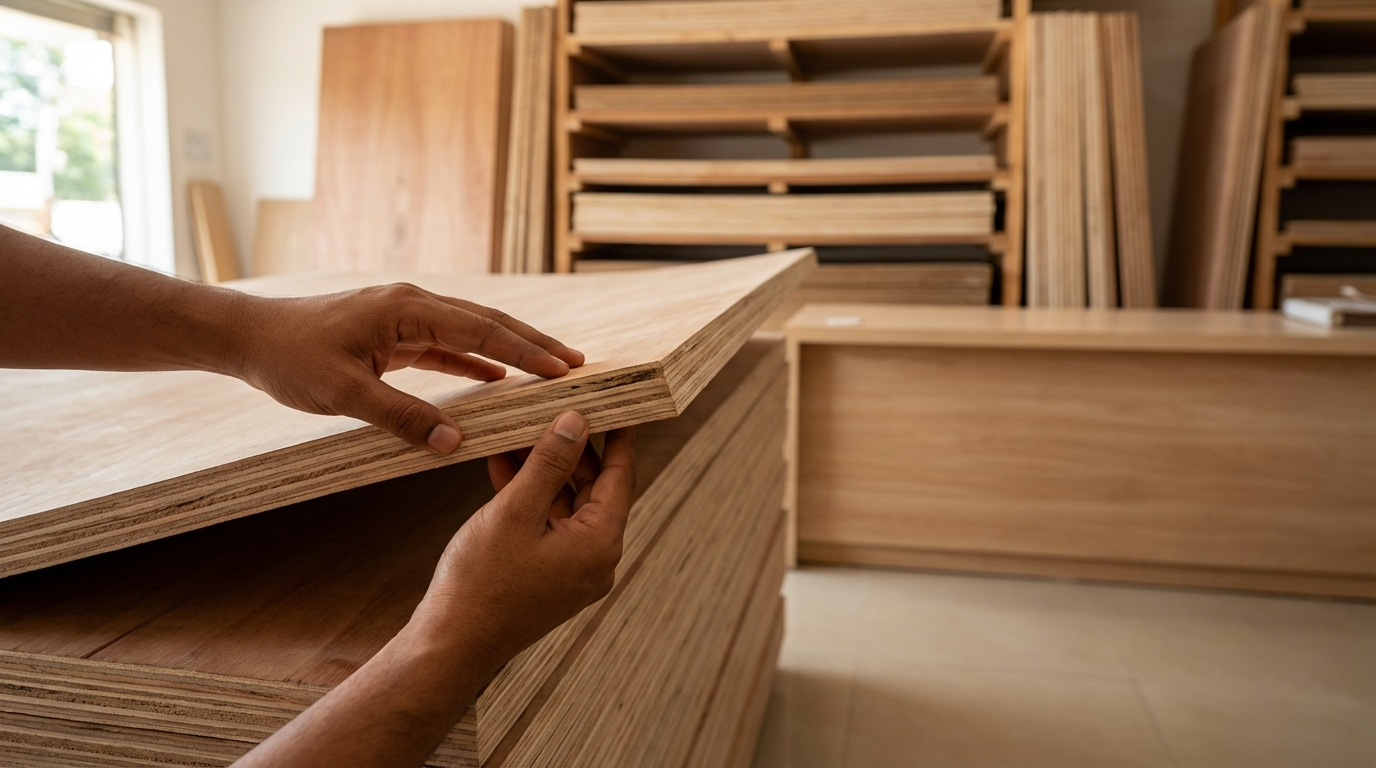
Check IS mark, thickness consistency (measure at four corners and centre), core gaps (tap and listen for hollow spots), and edge condition (no swelling, discoloration, or delamination). Reject defective sheets on the spot.
Step 5: Plan Edge Sealing and Finishing
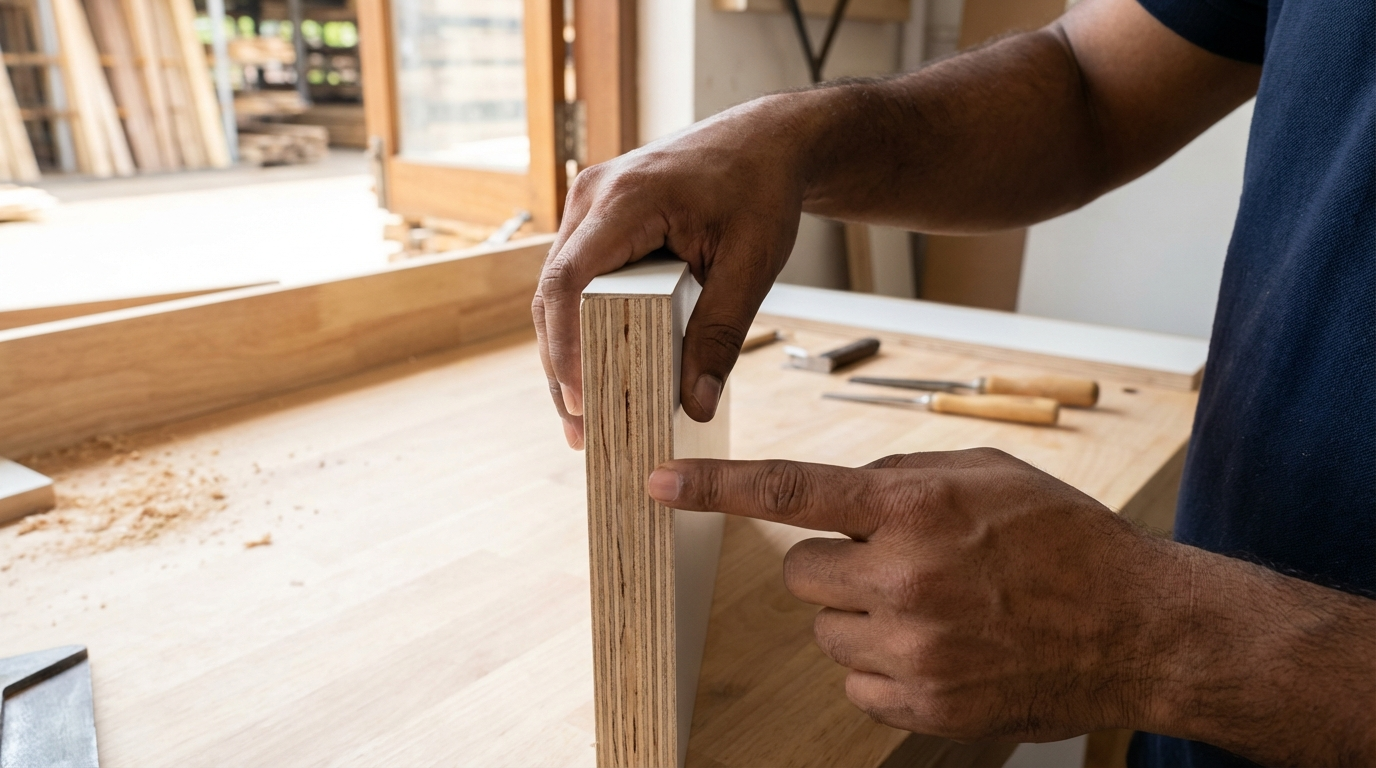
Even BWP ply board needs edge protection. Budget for edge-banding tape or PU sealant on all exposed edges. Unsealed edges are the primary entry point for moisture and the leading cause of premature failure.
Trade-offs and Limitations of Ply Board
- Surface finish: Ply board surfaces show grain patterns unsuitable for direct painting without veneer or laminate overlay. MDF offers smoother paintable surfaces.
- Weight: Hardwood-core ply board is heavier than MDF or particle board of equal thickness, affecting wall-mounted furniture and transport costs.
- Cost: BWP/Marine grade costs significantly more than MDF or particle board; for budget projects in dry areas, alternatives may suffice.
- Edge quality: Exposed ply edges reveal laminations and require finishing—unlike MDF which can be routed smoothly.
- Consistency: Non-branded or uncertified ply board varies widely in quality; careful sourcing is essential.
Common Buyer Mistakes and How to Avoid Them
Mistake 1: Choosing MR Grade for Kitchen Carcasses
Why it happens: MR is cheaper, and buyers assume laminate protection is enough. What to do instead: Use BWR minimum for all kitchen furniture; the adhesive matters more than the surface finish when humidity penetrates.
Mistake 2: Ignoring Core Quality While Chasing Low Prices
Why it happens: Dealers push "commercial" sheets without IS certification at attractive rates. What to do instead: Always verify IS 303 or IS 710 mark; ask for a cross-section sample to check core density and gap-free construction.
Mistake 3: Skipping Edge Sealing
Why it happens: Carpenters rush, or homeowners assume laminates cover edges. What to do instead: Specify edge-banding or PU sealant in your work order; inspect every exposed edge before final payment.
Mistake 4: Storing Sheets Outdoors During Construction
Why it happens: Space constraints or careless handling. What to do instead: Insist on indoor, flat, covered storage; reject sheets showing any moisture damage.
Mistake 5: Using Non-Calibrated Sheets for Modular Furniture
Why it happens: Calibrated sheets cost more and aren't always stocked. What to do instead: Order calibrated sheets in advance; the alignment and laminate finish justify the premium.
Mistake 6: Assuming All "Marine" Labels Are IS 710 Certified
Why it happens: Marketing terms mislead buyers. What to do instead: Check the physical IS 710 stamp on the sheet; if absent, it's not marine grade.
Mistake 7: Over-Specifying Grade for Dry Zones
Why it happens: Fear of failure leads to buying BWP for bedrooms. What to do instead: Match grade to actual moisture exposure; save budget for hardware or better finishes.
Mistake 8: Neglecting Acclimatisation Before Installation
Why it happens: Tight timelines. What to do instead: Store sheets in the installation room for 48–72 hours to equilibrate moisture content before cutting.
Failure Modes and Fixes
Edge Swelling
Symptom: Edges puff up, laminate lifts. Root cause: Unsealed edges absorbing moisture. Prevention: Apply edge-banding or PU sealant on all cuts. If already happening: Sand down swelling, apply wood filler, reseal; in severe cases, replace the affected panel.
Surface Delamination
Symptom: Top veneer peels away from core. Root cause: Poor adhesive (often fake BWR) or prolonged water pooling. Prevention: Buy certified sheets, avoid water accumulation. If already happening: Re-glue with PVA or contact adhesive, clamp overnight; prevent recurrence by sealing and improving drainage.
Core Voids Causing Screw Failure
Symptom: Screws spin without grip, hinges loosen. Root cause: Air pockets or gaps inside core layers. Prevention: Tap-test sheets before buying; choose reputed brands with dense cores. If already happening: Fill hole with epoxy filler, re-drill adjacent location, or use hinge repair plates.
Warping or Bowing
Symptom: Sheet curves along length or width. Root cause: Uneven moisture absorption (one side exposed, other sealed) or improper storage. Prevention: Store flat, balanced; seal both faces similarly. If already happening: Dampen concave side, weight flat, allow to dry slowly; severe warps require replacement.
Termite Infestation
Symptom: Powdery residue, tunnels in core. Root cause: Non-treated ply board or ground contact. Prevention: Buy borer-treated sheets, avoid ground contact, apply anti-termite treatment to installation area. If already happening: Professional pest control, replace affected panels, treat surrounding structure.
Laminate Bubbling Over Ply Board
Symptom: Air pockets under laminate surface. Root cause: Uneven ply surface (non-calibrated) or inadequate adhesive spread. Prevention: Use calibrated sheets, ensure uniform adhesive application. If already happening: Slit bubble, inject adhesive, press flat; large areas may need re-lamination.
Quality Checks You Can Do Without Lab Tests
Before Buying
- IS mark verification: Look for embossed or printed IS 303 or IS 710 on the sheet surface.
- Thickness measurement: Use a vernier caliper at corners and centre; variance beyond 0.5 mm indicates non-calibration.
- Tap test: Knock across the sheet; hollow sounds indicate core voids.
- Edge inspection: Check for gaps between plies, discoloration, or moisture stains.
- Weight comparison: Lift sheets of the same thickness from different batches; significantly lighter sheets may have inferior cores.
- Cross-section sample: Request a cut piece to examine core density and glue lines.
After Cutting
- Clean cut edges: Smooth edges without tearing indicate good bonding; ragged edges suggest weak glue lines.
- No burning smell: Excessive burning odour during cutting may indicate formaldehyde-heavy adhesive or poor resin quality.
- Screw test: Drive a screw into scrap; it should grip firmly without spinning.
After Installation
- Door/shutter alignment: Panels should sit flush; gaps indicate warping or poor cutting.
- Edge-band adhesion: Run a finger along edges; lifting or gaps need re-application.
- Hinge tightness: Screws should remain snug after repeated opening/closing.
Decision Framework: Conditions vs Recommended Options
| Condition | Recommended Ply Board | What to Verify |
|---|---|---|
| Dry interior (bedroom, living room) | MR 18 mm, calibrated | IS 303 mark, core density |
| Kitchen cabinets (not under-sink) | BWR 18 mm, calibrated | IS 303 BWR spec, edge sealing plan |
| Under-sink or dishwasher zone | BWP/Marine 18 mm | IS 710 mark, hardwood core |
| Coastal city or high-humidity area | BWP/Marine for all kitchen furniture | IS 710, borer treatment certificate |
| Bathroom vanity (dry zone) | BWR 18 mm with sealed edges | Edge-banding spec, ventilation provision |
| Outdoor furniture under shade | BWP/Marine 19 mm + exterior finish | IS 710, UV-resistant laminate or paint |
| Tight budget, dry zone only | MR 16 mm, reputed brand | IS 303, no core voids |
| Modular kitchen with CNC work | BWR calibrated 18 mm | Thickness tolerance ±0.3 mm |
Tips for Homeowners: Durability and Cleaning
Do
- Wipe spills immediately; even BWR panels suffer if water pools for hours.
- Use coasters under potted plants and water bottles on ply board surfaces.
- Maintain ventilation in closed cabinets to prevent condensation.
- Re-tighten loose hinges promptly to prevent screw-hole enlargement.
- Apply furniture polish or wax on exposed veneer surfaces annually.
Don't
- Use abrasive scrubbers on laminated ply surfaces—scratches trap moisture.
- Block cabinet ventilation holes with items or liners.
- Place hot pans directly on ply-laminate counters without trivets.
- Ignore early signs of edge swelling—address immediately.
Tips for Carpenters: Cutting, Edge Prep, and Fastening
- Blade selection: Use TCT (tungsten carbide tipped) blades with 60+ teeth for clean cuts on ply board; fewer teeth cause splintering.
- Support during cutting: Ensure full sheet support to prevent breakage and edge chipping.
- Edge prep: Sand cut edges lightly before edge-banding to improve adhesion.
- Pilot holes: Always drill pilot holes for screws near edges to prevent splitting.
- Hinge zones: Reinforce hinge mounting areas with hardwood inserts or metal plates for heavy doors.
- Handling: Carry sheets vertically with two people; dragging damages edges and faces.
- Acclimatisation: Store sheets in the installation room for 2–3 days before cutting to match ambient moisture.
Tips for Architects and Designers: Specs and Wet-Zone Detailing
- Specify IS codes in BOQ: Write "BWR ply board conforming to IS 303" or "Marine ply board conforming to IS 710" to avoid substitution.
- Indicate calibration tolerance: For high-end work, specify ±0.3 mm thickness tolerance.
- Wet-zone detailing: Raise base cabinets on aluminium legs or plinths; avoid direct floor contact. Specify stainless steel or aluminium edge profiles for sink cutouts.
- Ventilation design: Include ventilation grilles in tall units and below sinks to reduce trapped humidity.
- Finish logic: Match laminate or veneer thickness to substrate calibration; 1 mm laminate on non-calibrated ply telegraphs surface irregularities.
Tips for OEM and Modular Furniture Makers: QC and Reducing Complaints
- Incoming inspection: Sample-check every batch for thickness, weight, and tap-test before accepting delivery.
- Supplier audits: Visit mills periodically; consistent quality comes from process control, not just price negotiation.
- Cutting optimisation: Use nesting software to minimise waste and ensure consistent grain direction in visible panels.
- Edge-banding line QC: Check adhesion temperature and pressure settings; weak bonds cause field failures.
- Warranty clarity: Document grade and IS certification in customer handover; this protects against misuse claims.
- Moisture meters: Invest in pin-type moisture meters to verify sheet moisture content before processing.
FAQs
What is the difference between ply board and plywood?
In common Indian usage, "ply board" and "plywood" refer to the same product—layered veneer sheets bonded with adhesive. The term "ply board" is colloquial and often used interchangeably with plywood. Technically, plywood is the correct engineering term defined under IS 303 and IS 710 standards. When shopping, focus on the IS certification and grade (MR, BWR, BWP) rather than the name used by the dealer.
Can I use MR grade ply board in my kitchen?
MR grade is not recommended for kitchen carcasses because kitchens experience steam, splashes, and humidity fluctuations that exceed MR adhesive's tolerance. Over 3–5 years, MR sheets in kitchens often show edge swelling and delamination. BWR is the minimum grade for kitchen use, and BWP is advisable for under-sink and dishwasher-adjacent areas. If budget forces MR usage, restrict it to overhead cabinets far from water sources and ensure meticulous edge sealing.
How do I verify if a ply board is genuinely BWP or Marine grade?
Look for the IS 710 mark embossed or printed on the sheet surface—this is the only reliable indicator. Marketing labels like "Marine," "Waterproof," or "BWP" without IS 710 certification are not trustworthy. Additionally, request a cross-section sample: genuine marine-grade sheets typically have dense hardwood cores with tight glue lines and no visible gaps. If the dealer cannot provide IS 710 documentation, consider alternative suppliers.
What thickness of ply board should I use for wardrobe carcasses?
For wardrobe carcasses, 18 mm BWR or MR (depending on room humidity) is standard. Shelves spanning more than 60 cm or holding heavy items benefit from 18 mm over 16 mm to prevent sagging. Back panels can use 6 mm to reduce weight and cost. If the wardrobe is in a humid room or coastal area, upgrade to BWR for all components including the back panel.
Is calibrated ply board worth the extra cost?
Yes, for modular furniture, flush-joint designs, and CNC-routed components, calibration is essential. Calibrated sheets ensure uniform thickness across the surface, preventing laminate bubbling, edge-band gaps, and visible steps at panel joints. For loose furniture or rough carpentry, non-calibrated sheets may suffice, but for kitchen shutters and high-end wardrobes, the 10–15% premium on calibrated sheets prevents rework and improves final appearance.
How long does ply board furniture typically last in Indian conditions?
With appropriate grade selection, edge sealing, and maintenance, ply board furniture can last 15–25 years. MR grade in dry bedrooms easily lasts two decades. BWR in kitchens with proper sealing lasts 12–18 years before significant wear. BWP/Marine in wet zones or coastal areas can exceed 20 years if edges remain sealed and water pooling is prevented. Poor installation or grade mismatch shortens lifespan dramatically—some failures occur within 2–3 years.
Can ply board be used for bathroom cabinets?
Yes, but with precautions. Use BWR grade minimum for bathroom vanities in dry zones (away from direct splash). For shower-adjacent areas or very humid bathrooms, BWP/Marine grade is necessary. Elevate base cabinets on legs to avoid floor-water contact, ensure ventilation inside closed units, and seal all edges including hinge-screw holes. Even with these measures, avoid placing ply board in direct water paths—use stone or solid-surface counters around sinks.
What is the price difference between MR, BWR, and BWP ply board?
As a rough guide for 18 mm sheets, BWR typically costs 40–60% more than MR, and BWP/Marine costs 50–80% more than BWR. Actual prices vary by brand, core species, calibration, and city. For a mid-range project, expect MR at ₹2,500–₹3,500, BWR at ₹4,000–₹5,500, and BWP at ₹6,000–₹8,500 per 8×4 sheet. Always get multiple quotes and verify IS certification to ensure you're comparing equivalent quality.
How do I prevent termite damage in ply board furniture?
Buy ply board that is borer and termite treated—most reputed brands offer this as standard. Verify the treatment certificate or marking on the sheet. Additionally, treat the installation area (walls, flooring) with anti-termite chemicals during construction. Avoid ground contact for furniture; use metal or PVC legs. Regularly inspect for powdery residue or tunnels, especially in ground-floor rooms, and address infestations immediately with professional pest control.
Should I choose hardwood or softwood core ply board?
Hardwood cores (eucalyptus, gurjan) offer higher density, better screw-holding, and superior impact resistance—ideal for heavy-use furniture, kitchens, and doors. Softwood cores (poplar, some plantation species) are lighter, easier to machine, and cheaper, suitable for low-load interiors like false ceilings and light shelving. For kitchen carcasses and wardrobes, hardwood cores are generally preferable despite the higher cost.
Summary: Making the Right Ply Board Choice
Ply board remains the backbone of Indian interior furniture due to its strength, screw-holding capacity, and versatility. The key to long-lasting results lies in matching grade to moisture exposure, insisting on IS-certified sheets, verifying calibration for modular work, and sealing every exposed edge. Whether you're a homeowner planning a kitchen renovation, a carpenter executing daily projects, or an architect specifying materials for a large residential complex, understanding these fundamentals prevents costly failures and ensures furniture that serves well for decades.
Disclaimer: This content is provided for general informational purposes based on industry practices and publicly available information. Product specifications, standards, prices, and availability may vary by manufacturer, region, and time. Readers should independently verify details with manufacturers, dealers, or qualified professionals before making purchase or construction decisions.Want Plywood Suggestions?
Share a few details and a Duro BOIL specialist will suggest suitable brands and connect you to responsive dealers.