Ply Board Price: MR/BWR/BWP Rate + 8x4 Sheet Cost (Thickness-wise)
Get a ply board price guide with thickness-wise rate ranges, 8x4 sheet cost examples, and how to compare MR/BWR/BWP quotes confidently.
Quick Decision Summary
Best answer in one line: Ply board prices in India range from ₹35 to ₹150+ per square foot depending on grade (MR/BWR/BWP), thickness, core species, and city.
If you're in a hurry: For a standard 8×4 sheet, expect MR grade (18mm) to cost ₹1,800–₹3,200, BWR grade (18mm) around ₹3,200–₹5,500, and BWP/Marine grade (18mm) between ₹4,800–₹8,500. These ranges vary significantly by brand tier, core wood (poplar vs eucalyptus vs gurjan), calibration quality, and your city's logistics costs. Always get quotes specifying exact thickness, grade, and core type—vague quotes lead to mismatched expectations. Confirm IS marking and ask for a small sample piece before bulk orders.
- Choose this guide if: You need to understand what drives ply board rates, how to compare quotes across grades, and what questions to ask dealers before paying.
- Avoid this guide if: You're looking for exact brand-specific price lists (those change monthly and vary by dealer margin).
What Ply Board Price Actually Reflects
Ply board price is not just "cost of wood." It represents a combination of raw material quality, manufacturing precision, grade-level adhesive chemistry, and distribution costs. When you see two 18mm sheets—one at ₹2,400 and another at ₹5,800—the difference is rarely arbitrary. Understanding these drivers prevents overpaying for underwhelming quality or underbuying for critical applications.
Where People Get Confused About Ply Board Pricing
- Thickness vs. actual thickness: A sheet labeled "18mm" may measure 17.2mm or 18.5mm depending on calibration. Uncalibrated sheets cost less but create edge-banding and alignment problems.
- Grade vs. brand tier: "BWR" from a budget brand and "BWR" from a premium brand are not equivalent. The resin quality, boil-test performance, and core density differ significantly.
- Per-sheet vs. per-square-foot quoting: Some dealers quote per sheet, others per square foot. An 8×4 sheet is 32 square feet—always convert to per-sq-ft for accurate comparison.
- MR "waterproof" claims: MR grade is moisture-resistant, not waterproof. Dealers sometimes upsell MR as "waterproof" at BWR prices—a costly mistake for kitchen or bathroom use.
- Core species hidden in quotes: Poplar-core and gurjan-core boards at the same grade have different strength, weight, and longevity. Quotes often omit this detail.
Price Range and Cost Drivers (India)
The tables below provide indicative ranges. Actual prices depend on brand positioning, dealer margins, city logistics, order volume, and current timber/resin costs. Use these as benchmarks, not fixed rates.
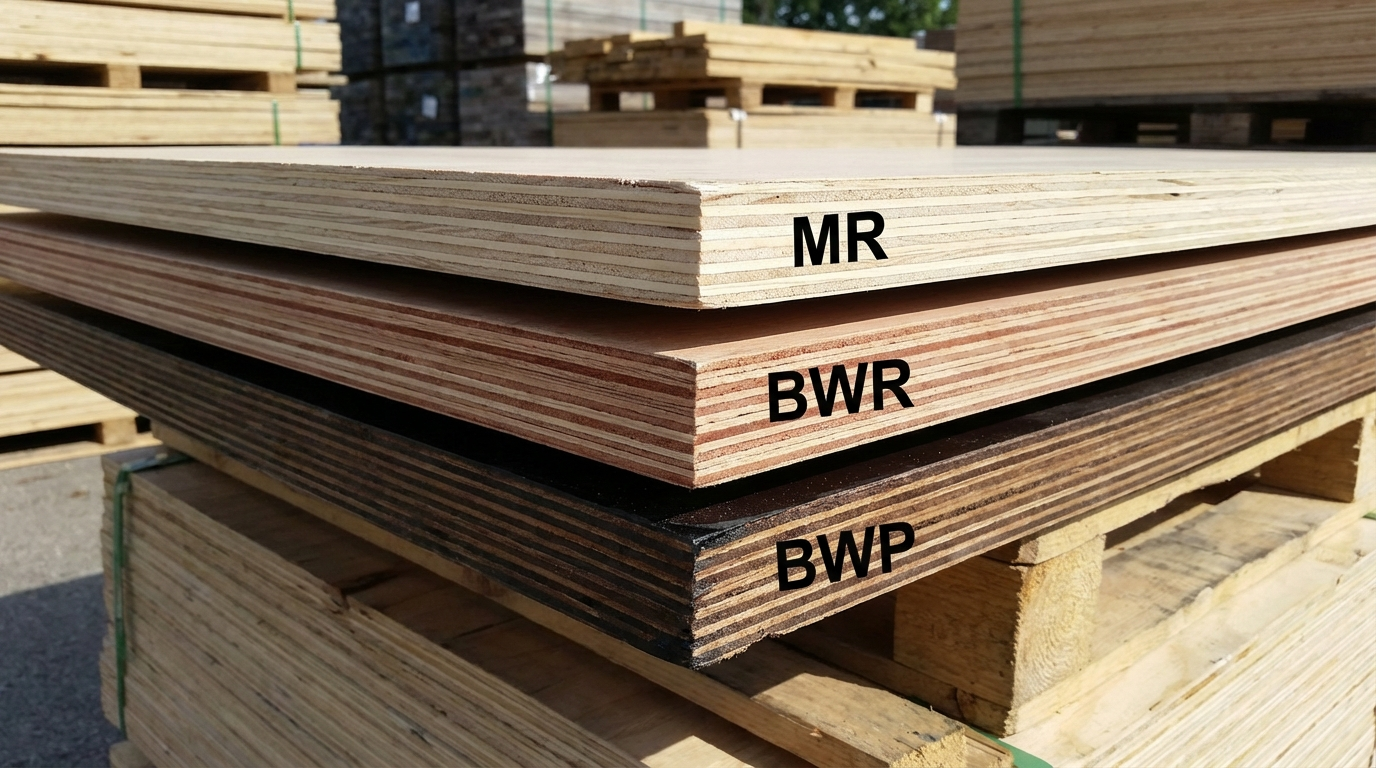
MR Grade (Moisture Resistant) – IS 303
| Thickness | Price Range (₹ per 8×4 sheet) | Per Sq Ft Approx |
|---|---|---|
| 6mm | ₹650–₹1,200 | ₹20–₹38 |
| 9mm | ₹950–₹1,600 | ₹30–₹50 |
| 12mm | ₹1,200–₹2,200 | ₹38–₹69 |
| 16mm | ₹1,500–₹2,800 | ₹47–₹88 |
| 18/19mm | ₹1,800–₹3,200 | ₹56–₹100 |
Best for: Bedroom furniture, study tables, wall paneling, false ceilings—anywhere moisture exposure is minimal and controlled.
BWR Grade (Boiling Water Resistant)
| Thickness | Price Range (₹ per 8×4 sheet) | Per Sq Ft Approx |
|---|---|---|
| 6mm | ₹1,100–₹1,800 | ₹34–₹56 |
| 9mm | ₹1,500–₹2,400 | ₹47–₹75 |
| 12mm | ₹2,000–₹3,500 | ₹63–₹109 |
| 16mm | ₹2,800–₹4,600 | ₹88–₹144 |
| 18/19mm | ₹3,200–₹5,500 | ₹100–₹172 |
Best for: Kitchen cabinets, bathroom vanities, dining area furniture, utility room storage—semi-wet zones with occasional water contact.
BWP/Marine Grade (Boiling Water Proof) – IS 710
| Thickness | Price Range (₹ per 8×4 sheet) | Per Sq Ft Approx |
|---|---|---|
| 6mm | ₹1,600–₹2,800 | ₹50–₹88 |
| 9mm | ₹2,200–₹3,800 | ₹69–₹119 |
| 12mm | ₹3,200–₹5,400 | ₹100–₹169 |
| 16mm | ₹4,200–₹7,000 | ₹131–₹219 |
| 18/19mm | ₹4,800–₹8,500 | ₹150–₹265 |
Best for: Under-sink cabinets, areas with direct water exposure, outdoor furniture under shade, coastal homes, and high-humidity commercial kitchens.
Why Does the Same Grade Have Such Wide Price Ranges?
The ₹1,800 vs. ₹3,200 gap for an 18mm MR sheet comes down to these factors:
- Core species: Poplar-core is lightest and cheapest; eucalyptus offers mid-range strength; gurjan/hardwood cores command premium pricing due to density and screw-holding capacity.
- Calibration: Calibrated sheets (uniform thickness within ±0.2mm tolerance) cost 15–25% more but eliminate edge-banding gaps and ensure modular fit.
- Face veneer quality: Smooth, defect-free face veneers suitable for natural polish or thin laminates add to cost.
- Brand tier: National brands with consistent QC and wider distribution cost more than regional or unbranded options.
- City logistics: Rates in metros like Mumbai or Delhi are often lower than tier-2/3 cities due to dealer competition and transport costs.
How Much Does an 8×4 Sheet Cost for Common Projects?
Here's a mini-budget example for a 10×10 ft modular kitchen with upper and lower cabinets:
- Estimated ply requirement: 12–15 sheets of 18mm (carcass) + 4–6 sheets of 6mm (back panels)
- If using BWR 18mm at ₹4,000/sheet: ₹48,000–₹60,000 for carcass alone
- If using BWP 18mm at ₹6,500/sheet: ₹78,000–₹97,500 for carcass
- Add 6mm backs (BWR at ₹1,400/sheet): ₹5,600–₹8,400
This excludes laminate, hardware, labor, and shutters. The grade choice alone creates a ₹30,000+ difference on a typical kitchen.
How to Ask for a Quote Without Getting Confused
When requesting quotes from dealers, specify these line items explicitly:
- Grade: MR / BWR / BWP (Marine)
- Thickness: Exact mm (e.g., 18mm calibrated)
- Core species: Poplar / Eucalyptus / Gurjan / Hardwood blend
- Sheet size: 8×4 ft or 8×3 ft
- IS marking: IS 303 or IS 710
- Quantity: Number of sheets
- Delivery: Inclusive or extra
A proper quote line looks like: "BWR Grade, 18mm calibrated, eucalyptus core, 8×4 ft, IS 303 marked, 15 sheets, delivery to [location]."
India-Specific Reality Check
Ply board performance in India isn't just about the sheet's lab rating—it's about how that sheet behaves under real conditions: monsoon humidity, coastal salt air, poor storage at dealer yards, and varying workmanship quality on site.
How Does Monsoon Humidity Affect Ply Board Selection?
During monsoon months, ambient humidity in cities like Mumbai, Kolkata, or Chennai can exceed 85%. MR-grade plywood in such environments absorbs moisture through exposed edges, leading to gradual swelling and delamination over 2–4 years. The solution isn't always upgrading to BWP—often, proper edge sealing with PU sealant or quality edge banding on BWR sheets performs adequately. However, for ground-floor homes or areas with water seepage history, BWP becomes necessary regardless of cost.
What Happens When Ply Boards Are Stored Poorly Before Delivery?
Many dealer yards store sheets outdoors under tarps or in semi-open sheds. Sheets absorb ground moisture, edges get damaged during handling, and face veneers develop stains. This pre-installation damage often goes unnoticed until furniture is made. Always inspect sheets upon delivery: check for warping (place sheet flat, sight along edges), edge chips, and moisture stains on face veneers. Reject sheets that don't lie flat or show visible damage.
Does Coastal Location Change Which Grade I Need?
Coastal cities (Mumbai, Chennai, Goa, Kochi, Visakhapatnam) have salt-laden air that accelerates metal corrosion and promotes fungal growth. For coastal homes, BWP/Marine grade is advisable even for bedroom furniture, not just wet zones. Additionally, use stainless steel or zinc-plated hardware—standard mild steel hinges and screws corrode within months, loosening joints and staining surfaces.
Two-Minute Comparison That Actually Helps
| Factor | MR Grade | BWR Grade | BWP/Marine Grade |
|---|---|---|---|
| Water resistance | Humidity only | Occasional water contact | Prolonged/direct water exposure |
| Typical adhesive | Urea formaldehyde | Phenol or melamine-fortified | Phenol formaldehyde |
| IS standard | IS 303 | IS 303 (BWR specification) | IS 710 |
| Boil test survival | Fails quickly | Survives 4–8 hours | Survives extended cycles |
| Price premium over MR | Baseline | 40–70% higher | 80–150% higher |
| Best applications | Bedrooms, study, dry storage | Kitchens, bathrooms, dining | Under-sink, outdoor, coastal |
| Edge sealing necessity | Important | Critical | Still recommended |
Decision rule: Choose based on the wettest condition the board will face in its lifetime, not average conditions. A kitchen cabinet near a sink splashes water daily—that's BWR minimum, BWP preferred. A bedroom wardrobe 10 feet from any water source is fine with MR.
Decision Framework: Which Ply Board for Which Condition?
| Condition / Scenario | Recommended Grade | What to Verify |
|---|---|---|
| Bedroom wardrobe (no AC, ground floor) | BWR 18mm | Edge sealing done, IS 303 mark, eucalyptus or better core |
| Bedroom wardrobe (AC room, upper floor) | MR 18mm | Calibrated thickness, face veneer quality for laminate finish |
| Kitchen base cabinets (near sink) | BWP 18mm | IS 710 mark, gurjan/hardwood core, PU edge sealing |
| Kitchen wall cabinets (away from sink) | BWR 18mm | Proper edge banding, moisture barrier finish on inside surfaces |
| Bathroom vanity | BWP 18mm | IS 710 mark, sealed bottom edge raised from floor contact |
| False ceiling (dry room) | MR 6mm or 9mm | Uniform thickness, no warping, face suitable for paint/veneer |
| Outdoor furniture (covered patio) | BWP 18/19mm | IS 710 mark, exterior-grade finish, stainless steel fasteners |
| Coastal home (all furniture) | BWP preferred | Fungal-resistant treatment, marine-grade hardware throughout |
| Tight budget, dry interior only | MR 18mm (economy brand) | Visual core inspection, reject if voids visible, seal all edges |
| Modular factory production | BWR calibrated 18mm | Batch consistency, thickness tolerance ±0.2mm, face uniformity |
Trade-offs and Limitations
No ply board grade is perfect for all situations. Understanding trade-offs helps you make informed compromises rather than discovering limitations after installation.
MR Grade Trade-offs
- Pro: Lowest cost, adequate for controlled dry environments.
- Con: Swells and delaminates if edges are exposed to repeated moisture; not suitable for ground floors in high-humidity cities without extra precautions.
BWR Grade Trade-offs
- Pro: Good balance of water resistance and cost; handles typical kitchen/bathroom humidity when edges are sealed.
- Con: Not designed for submersion or continuous water contact; still requires edge sealing; quality varies widely between brands.
BWP/Marine Grade Trade-offs
- Pro: Highest water resistance, best longevity in wet zones, suitable for coastal/outdoor applications.
- Con: Significantly more expensive (often 2x MR price); heavier (harder to handle); overkill for dry bedroom furniture where MR would suffice.
Calibrated vs. Uncalibrated Trade-offs
- Calibrated: Uniform thickness ensures modular fit and clean edge banding, but costs 15–25% more.
- Uncalibrated: Cheaper, but thickness variations (±1mm or more) create visible gaps at joints and edge-banding failures.
Common Buyer Mistakes and How to Avoid Them
Mistake 1: Comparing Prices Without Specifying Core Species
Why it happens: Dealers often quote the cheapest core (poplar) unless asked otherwise. Buyers compare these quotes to premium quotes without realizing the core difference.
What to do instead: Always ask, "What is the core species?" Compare poplar-to-poplar and gurjan-to-gurjan. A gurjan-core BWR sheet is stronger than a poplar-core BWP sheet in screw-holding capacity.
Mistake 2: Ignoring Calibration for Modular Furniture
Why it happens: Calibration adds cost, and traditional carpenters often work around thickness variations manually.
What to do instead: For modular kitchens or wardrobes with factory-cut components, insist on calibrated sheets. The edge-banding machine cannot adjust for 1mm thickness variations—gaps and peeling result.
Mistake 3: Using MR Grade in Kitchen Base Cabinets
Why it happens: Cost pressure. MR is 40–60% cheaper than BWR.
What to do instead: Use BWR minimum for all kitchen cabinets, BWP for base cabinets near sinks. The replacement cost of swollen MR cabinets after 2–3 years exceeds the initial savings.
Mistake 4: Not Inspecting Sheets Before Payment
Why it happens: Dealers deliver pre-wrapped bundles; buyers trust without checking.
What to do instead: Open and inspect at least 20% of sheets before accepting delivery. Check for warping (lay flat, sight along edge), edge damage, moisture stains, and IS marking on each sheet.
Mistake 5: Skipping Edge Sealing
Why it happens: Carpenters often skip sealing to save time; homeowners don't know to ask.
What to do instead: Specify in your work order: "All exposed and cut edges to be sealed with PU sealant or edge banding before laminate application." Pay for this explicitly if needed.
Mistake 6: Buying Based on Brand Alone Without Grade Verification
Why it happens: Premium brands have multiple product lines; their budget line may be MR while buyers assume all products are BWR.
What to do instead: Check IS marking on the physical sheet, not just the brand name. IS 303 indicates MR/BWR (check specification); IS 710 indicates Marine/BWP.
Mistake 7: Ordering Exact Quantity Without Wastage Buffer
Why it happens: To minimize cost.
What to do instead: Order 10–15% extra. Cutting patterns never achieve 100% utilization. Ordering single replacement sheets later costs more per sheet and delays work.
Mistake 8: Storing Ply Boards Flat on Ground
Why it happens: Convenience; workers stack sheets directly on floor.
What to do instead: Store on wooden battens (2–3 inches off ground) in a dry, covered area. Lay flat, not leaning, to prevent warping. Cover loosely to allow air circulation.
Failure Modes and Fixes
Failure 1: Edge Swelling After 1–2 Years
Symptom: Cabinet edges near sinks or floors bulge outward; laminate peels.
Root cause: MR or poorly sealed BWR used in wet zone; water ingress through unsealed edges.
Prevention: Use BWP for wet zones; seal all edges before laminate application.
Fix if already happening: Remove swollen section, let dry completely, apply wood filler, reseal, and re-laminate. For extensive damage, replace the panel.
Failure 2: Delamination (Layers Separating)
Symptom: Visible separation between plies, often at edges or corners.
Root cause: Substandard adhesive quality, or MR grade used in conditions beyond its rating.
Prevention: Buy from known brands with consistent QC; verify IS marking; use appropriate grade for conditions.
Fix if already happening: Inject wood adhesive into gaps, clamp firmly, let cure 24+ hours. Extensive delamination requires panel replacement.
Failure 3: Screw Stripping (Hinges/Handles Loosening)
Symptom: Screws spin freely; hinges sag; handles wobble.
Root cause: Low-density core (poplar or poor-quality softwood); screws placed in core gaps.
Prevention: Use eucalyptus or gurjan core for heavy hardware zones; pre-drill pilot holes; use hinge plates or reinforcement blocks.
Fix if already happening: Fill old screw holes with toothpicks + wood glue, let dry, re-drill. For repeated failure, add a hardwood reinforcement block behind the hinge zone.
Failure 4: Warping (Doors Not Closing Flat)
Symptom: Cabinet doors or panels bow outward/inward; visible gap at hinges.
Root cause: Uneven moisture absorption (one face exposed, other laminated); poor storage; single-sided lamination.
Prevention: Laminate or seal both faces of panels; store flat on battens before use; avoid leaning against walls.
Fix if already happening: Mild warp: apply counter-balancing laminate to opposite face. Severe warp: replace panel.
Failure 5: Surface Bubbling Under Laminate
Symptom: Bumps or bubbles appear on laminate surface months after installation.
Root cause: Moisture trapped between ply face and laminate; ply not acclimatized before lamination; poor adhesive application.
Prevention: Allow ply sheets to acclimatize to room conditions 48+ hours before lamination; ensure even adhesive spread; roll out air pockets during pressing.
Fix if already happening: Puncture bubble with pin, inject adhesive through syringe, press flat with roller, clamp overnight.
Failure 6: Fungal Growth / Mold Stains
Symptom: Black or green spots on surface or edges, musty smell.
Root cause: Persistent moisture, poor ventilation, organic debris accumulation near edges.
Prevention: Use BWP in wet zones; ensure ventilation behind cabinets; wipe spills immediately; apply anti-fungal treatment in coastal areas.
Fix if already happening: Clean with diluted bleach solution (1:10), dry thoroughly, apply anti-fungal sealant. If mold has penetrated plies, replace panel.
Quality Checks You Can Do Without Lab Tests
Before Buying (At Dealer)
- Sight check for warping: Lay sheet flat on ground. Crouch and sight along each edge—any bow or twist over 5mm per 8ft run is problematic.
- Core inspection: Ask to see a cut cross-section. Look for uniform veneer layers, minimal gaps between plies, no sawdust filling.
- Edge check: Run fingers along all four edges. Look for chips, voids, or delamination starting points.
- Weight test: Lift two sheets of the same grade/thickness. Significant weight difference indicates core density variation.
- IS mark verification: Look for stamped or printed IS 303 or IS 710 mark on the sheet (not just on the bundle wrapper). Absence is a red flag.
- Knock test: Knock on face with knuckles. Hollow sound in some areas indicates voids in core layers.
After Cutting (During Fabrication)
- Edge quality: Clean cuts should show uniform, tight layers. Gaps between veneers or crumbling core means poor glue penetration.
- Sawdust color: Uniform sawdust color is normal; mixed black/brown patches suggest inconsistent or recycled core material.
- Pilot hole check: Drill a pilot hole in edge. Screw should grip firmly. If it strips easily, core density is inadequate for heavy hardware.
- Flex test: Offcuts should resist flex proportional to thickness. Excessive bendiness in 18mm suggests low-density core.
After Installation (Ongoing)
- Door alignment: Check cabinet doors monthly for first 6 months. Sagging indicates hinge screw stripping; bowing indicates moisture or lamination issues.
- Edge inspection: Inspect edges near sinks, floors, and windows quarterly. Early swelling (edges feeling soft or bulging) is a warning.
- Laminate adhesion: Run palm across laminated surfaces. Any lifting corners or bubbling requires immediate attention before water enters.
Tips for Homeowners: Protecting Your Ply Board Investment
Do's
- Wipe water spills immediately, especially near cabinet edges and under sinks.
- Use silicone mats or trays under bottles and containers that may leak.
- Keep exhaust fans running in kitchen and bathroom to reduce humidity.
- Inspect under-sink areas monthly for pipe leaks or condensation.
- Keep 3–4 inches gap between bottom of floor-standing cabinets and wet areas if possible (use legs rather than full contact with floor).
Don'ts
- Don't use dripping wet mops directly against cabinet bases.
- Don't store wet umbrellas, raincoats, or shoes in plywood wardrobes without drying first.
- Don't block ventilation grilles in modular kitchen shutters.
- Don't ignore small chips or laminate peeling—these become water entry points.
- Don't place hot cookware directly on laminated ply surfaces (use trivets).
Tips for Carpenters: Cutting, Edge Prep, and Fastening
Cutting Best Practices
- Use sharp blades—dull blades cause edge splintering and create delamination starting points.
- Score laminate face with blade before full cut to prevent chipping.
- Support both sides of sheet during cutting to prevent sagging and uneven cuts.
Edge Preparation
- Sand cut edges lightly before edge banding to remove splinters and ensure adhesive contact.
- Apply PU sealant to all edges exposed to potential moisture (sink cabinets, bathroom furniture), even if edge banding is used.
- For visible edges, use matching edge tape or hardwood lipping—never leave raw plywood visible in finished work.
Fastening and Hardware Zones
- Drill pilot holes for all screws to prevent core splitting.
- For hinge zones in economy plywood, add a hardwood or higher-density ply backing block behind the hinge plate.
- Use cam locks and dowels where possible to reduce edge stress from screws.
- In marine/coastal projects, use only stainless steel or brass hardware—not standard mild steel.
Tips for Architects and Designers: Specifications and Detailing
Specification Clarity
- Specify grade (MR/BWR/BWP), thickness, core species, and calibration requirement explicitly in BOQ. Avoid vague terms like "good quality plywood."
- Include IS standard requirement: "IS 303 for MR/BWR, IS 710 for BWP/Marine"—this enables verification.
- For premium finishes requiring uniform surfaces, specify calibrated sheets with face veneer grade.
Wet Zone Detailing
- Detail edge sealing requirement in drawings—specify "PU sealant on all cut edges" for kitchen base cabinets.
- Show bottom panels raised on legs or plinths (not in direct floor contact) in wet zone elevations.
- Specify ventilation requirements for closed cabinets to prevent moisture accumulation.
Finish Compatibility
- For natural veneer finishes, specify face veneer grade matching the intended veneer adhesion requirements.
- For high-gloss laminates, specify calibrated sheets—uneven surfaces show through gloss finishes.
- For paint finishes, MR-grade is acceptable if in dry zones and properly primed.
Tips for OEM and Modular Furniture Manufacturers: QC and Repeatability
Incoming Material QC
- Establish thickness tolerance acceptance criteria (typically ±0.3mm for calibrated). Reject batches outside tolerance.
- Sample-test each batch: check 2–3 sheets for warping, edge integrity, and core uniformity before accepting delivery.
- Maintain supplier scorecards tracking defect rates, on-time delivery, and thickness consistency.
Production Consistency
- Standardize on calibrated sheets from consistent suppliers to reduce edge-banding and alignment issues.
- Pre-acclimatize sheets in production area (48+ hours) before cutting and lamination to reduce post-production warping.
- Document and enforce edge-sealing protocols for all wet-zone products.
Reducing Field Returns
- Most field complaints trace to edge swelling and hardware loosening. Invest in better edge sealing and reinforced hinge zones.
- Include customer care instructions with every delivery: wipe spills, maintain ventilation, report leaks immediately.
- Track warranty claims by product line and sheet supplier—patterns reveal incoming material issues.
FAQs
What is the difference between MR and BWR grade plywood pricing?
BWR-grade plywood typically costs 40–70% more than MR-grade of the same thickness and core species. This premium reflects the use of phenol-formaldehyde or melamine-fortified adhesives that resist boiling water exposure for several hours—compared to MR's urea-formaldehyde adhesive, which fails quickly under water exposure. For a typical 18mm 8×4 sheet, MR might cost ₹2,200 while equivalent BWR costs ₹3,800. The decision shouldn't be purely cost-driven: using MR in wet zones leads to replacement costs that exceed the initial savings within 2–4 years in most Indian humidity conditions.
Why does the same grade plywood vary so much in price between dealers?
Price variation for identical grade specifications arises from core species (poplar vs. gurjan can differ by 30–50%), brand tier (national vs. regional), calibration level, face veneer quality, and dealer margins. Additionally, freight costs create city-wise variation—a sheet might cost ₹500 less in Mumbai than in a tier-3 city 300km away. Always compare like-to-like: same grade, same core species, same thickness, same calibration level. Ask dealers to specify all these parameters when quoting to enable fair comparison.
Is BWP/Marine grade worth the extra cost for kitchen cabinets?
For base cabinets near sinks, absolutely yes. Under-sink cabinets face pipe condensation, leak risks, and splash exposure daily. BWP's ability to withstand continuous water contact means these cabinets last 8–12 years instead of the 3–5 years typical of BWR in the same location. For wall cabinets away from direct water, BWR with proper edge sealing is usually sufficient. The calculation is simple: if replacing a swollen cabinet costs ₹15,000 in labor and materials, paying ₹3,000 extra upfront for BWP is economical over the furniture's lifespan.
How do I verify if plywood is genuinely IS 303 or IS 710 marked?
Genuine IS marking is stamped, printed, or embossed on the individual sheet surface—not just on bundle packaging. Look for the ISI logo (the familiar "IS" mark with standards institution details) and the specific standard number (303 or 710). Sheets should also show the manufacturer's name and license number. If markings appear only on wrappers or dealers claim "IS quality" without showing sheet-level marking, treat the claim with skepticism. For large orders, request test certificates from the manufacturer's batch testing.
What core species should I choose for heavy-use furniture?
Gurjan and other tropical hardwood cores offer the highest density and screw-holding capacity—essential for wardrobes with heavy doors, kitchen cabinets with soft-close hinges, and furniture that will bear weight. Eucalyptus core provides a good mid-range balance of strength and cost. Poplar core, while lightest and cheapest, is best limited to light-duty applications like back panels, false ceilings, and storage in low-stress zones. For any panel that will hold heavy hinges or handles, prioritize eucalyptus or hardwood cores regardless of grade.
Can I use 12mm plywood instead of 18mm to save cost?
Only for specific low-stress applications. Shelves longer than 2 feet will sag under moderate weight if made from 12mm. Cabinet carcasses need 16–18mm for structural integrity and reliable screw-holding. Back panels can use 6–8mm. Using 12mm for cabinet sides to save ₹20–30 per square foot often results in wobbly furniture, sagging shelves, and hinge failures within 1–2 years. Calculate the cost of premature repair or replacement before committing to thinner panels for load-bearing applications.
How much extra should I order for wastage?
Order 10–15% extra beyond calculated requirement. Cutting patterns rarely achieve perfect utilization—irregular cabinet sizes, damaged sections, and cutting errors generate waste. Ordering exact quantities means waiting for additional sheets later (delays, higher per-sheet cost) or compromising on layout to avoid ordering more. For complex projects with many small components, 15% buffer is safer; for simple, large-panel projects, 10% may suffice. Leftover material has value for repairs, modifications, and small additions.
Does calibrated plywood justify the 15–25% premium?
For modular furniture with machine-cut components and factory edge-banding, calibrated sheets are nearly essential. Edge-banding machines cannot compensate for ±1mm thickness variation—resulting in visible gaps, poor adhesion, and peeling. Calibrated sheets (±0.2–0.3mm tolerance) ensure consistent results. For traditional carpentry with hand-applied edging and manual adjustments, skilled carpenters can work around variation, making calibration less critical. Evaluate based on your production method: machine-based = calibrated; hand-crafted = optional.
Why do some plywood sheets warp after delivery?
Warping occurs when one face absorbs moisture or dries faster than the other—common when sheets are stored leaning against walls, placed on damp floors, or exposed to rain during transport. Preventing warp requires storing sheets flat on raised battens in dry, covered areas, and laminating or sealing both faces before installation. If sheets arrive warped, mild cases may flatten under weight over time; severe warps indicate pre-existing quality issues or prolonged poor storage—consider rejecting such sheets before payment.
How can I compare ply board quotes fairly when dealers use different terms?
Create a standardized comparison template specifying: grade (MR/BWR/BWP), exact thickness in mm, core species, sheet size, IS marking standard, calibration level, and whether delivery is included. Send this template to all dealers with instructions to quote accordingly. When quotes arrive, verify each line item matches your specification. Quotes that omit core species or calibration details often assume the cheapest option—ask explicitly to avoid unpleasant surprises upon delivery. Convert all quotes to per-square-foot rates for direct comparison.
Is it okay to use plywood in bathrooms if I seal it properly?
BWP/Marine grade plywood can be used in bathroom vanities and cabinetry if all edges are sealed with PU sealant, the bottom panel is raised above floor level (legs or plinth), and ventilation is provided within closed cabinets. However, plywood is not suitable for direct wet zones like shower enclosures or areas with constant water contact—use tile, stone, or marine-grade WPC for these. For bathroom furniture, the combination of BWP grade, complete edge sealing, and raised installation provides acceptable durability, typically 8–12 years with proper maintenance.
What happens if I skip edge banding to save labor cost?
Exposed edges are the primary entry point for moisture in all plywood grades. Even BWP-grade plywood absorbs water through unsealed edges, leading to gradual swelling, delamination, and structural weakening. Skipping edge banding on visible edges also creates a raw, unfinished appearance. The cost of edge banding (₹3–8 per running foot) is trivial compared to panel replacement costs. For concealed edges (e.g., cabinet backs against walls), sealant application is acceptable; for all exposed and semi-exposed edges, proper edge banding or lipping is non-negotiable for durability.
Disclaimer: This content is provided for general informational purposes based on industry practices and publicly available information. Product specifications, standards, prices, and availability may vary by manufacturer, region, and time. Readers should independently verify details with manufacturers, dealers, or qualified professionals before making purchase or construction decisions.Want Plywood Suggestions?
Share a few details and a Duro BOIL specialist will suggest suitable brands and connect you to responsive dealers.