Plywood Sheet Price (8x4): Grade-wise Rates + 6mm to 25mm Price Table
A practical plywood sheet price guide with grade-wise and thickness-wise tables, 8x4 costing, and a checklist to compare MR/BWR/BWP/marine quotes.
Quick Decision Summary
Best answer in one line: Expect plywood sheet prices (8×4 ft) to range from ₹1,400 to ₹9,500+ depending on grade, thickness, core species, and city—always compare quotes with identical specs.
If you're in a hurry: For standard interior furniture, budget ₹2,800–4,200 for 18mm BWR-grade sheets in most metro cities. Kitchens and bathrooms need BWR minimum; wet zones and coastal areas require BWP or marine-grade (IS 710). Thickness drives cost almost as much as grade—6mm costs roughly 35–45% of 18mm in the same grade. Always confirm whether the quoted price includes GST, transport, and loading. Ask for the IS code, core species, and calibration status before comparing any two quotes.
- Choose this guide if: You need a structured way to compare plywood prices across grades, thicknesses, and vendors without getting confused by inconsistent quotes.
- Avoid this guide if: You're looking for exact prices from a specific brand—prices vary by dealer, city, and batch; this guide teaches you how to compare, not what to pay.
What "Plywood Sheet Price (8×4)" Actually Means
When people search for plywood sheet prices, they're typically looking for the cost of a standard 8 feet × 4 feet (approximately 2440mm × 1220mm) sheet. This is the most common commercial size in India, though actual dimensions may vary slightly by manufacturer. The price depends on multiple factors that are often not stated clearly in dealer quotes.
Where People Get Confused About Plywood Pricing
- Grade vs. thickness mismatch: A 6mm marine sheet may cost less than an 18mm MR sheet—grade alone doesn't determine price.
- IS code assumptions: Not all "BWR" plywood meets IS 303 BWR specifications; some dealers use the term loosely.
- Core species hidden: Poplar-core plywood costs significantly less than eucalyptus or hardwood-core—but this is rarely mentioned upfront.
- Calibrated vs. non-calibrated: Calibrated sheets (uniform thickness for machine work) cost 8–15% more but aren't always necessary.
- Per-sheet vs. per-square-foot pricing: Some dealers quote per sheet, others per square foot—always convert to the same unit.
- GST and transport exclusions: A quote of ₹3,200 might become ₹3,900+ after taxes and delivery.
India-Specific Reality Check for Plywood Pricing
Plywood prices in India vary dramatically based on geography, supply chains, and local demand patterns. Understanding these factors prevents you from overpaying or under-specifying.
Why Does Plywood Cost More in Some Cities?
Manufacturing hubs like Gujarat, Kerala, and parts of Uttar Pradesh typically have lower prices due to proximity to mills. Coastal cities like Chennai, Mumbai, and Kolkata see higher prices for marine-grade sheets due to demand. Tier-2 and Tier-3 cities often pay 5–12% more due to transport costs, but may have less price competition. North-eastern states and Himalayan regions face significant logistics premiums.
Monsoon and Storage Impact on Price
During monsoon months (June–September), prices may rise 3–8% due to production slowdowns and transport delays. Poorly stored plywood—especially in humid godowns—can warp or develop edge swelling before you even buy it. This doesn't change the quoted price but dramatically affects value. Always inspect sheets physically during monsoon purchases.
Price Range and Cost Drivers (India)
The following ranges reflect typical dealer prices in metro and semi-urban markets. Prices fluctuate based on raw material costs, fuel prices, and seasonal demand. Use these as benchmarks for comparison, not as exact figures.
Grade-wise Price Ranges (8×4 Sheet, 2024–2025 Indicative)
| Grade | 6mm Range (₹) | 12mm Range (₹) | 18/19mm Range (₹) | 25mm Range (₹) |
|---|---|---|---|---|
| MR (Commercial/IS 303) | 1,400–2,200 | 2,100–3,400 | 2,800–4,200 | 3,800–5,500 |
| BWR (IS 303 BWR spec) | 1,800–2,800 | 2,800–4,200 | 3,600–5,800 | 4,800–7,200 |
| BWP/Marine (IS 710) | 2,400–3,800 | 3,600–5,800 | 5,200–8,500 | 6,800–9,500+ |
| Fire-Retardant (IS 5509) | 3,200–4,800 | 4,500–6,500 | 6,200–9,200 | 7,800–11,000+ |
Note: Prices vary by 10–20% based on city, dealer margin, brand tier, and core species. Always ask for written quotes with full specifications.
What Makes One Sheet Cost More Than Another?
Understanding cost drivers helps you evaluate whether a higher quote is justified or simply overpriced:
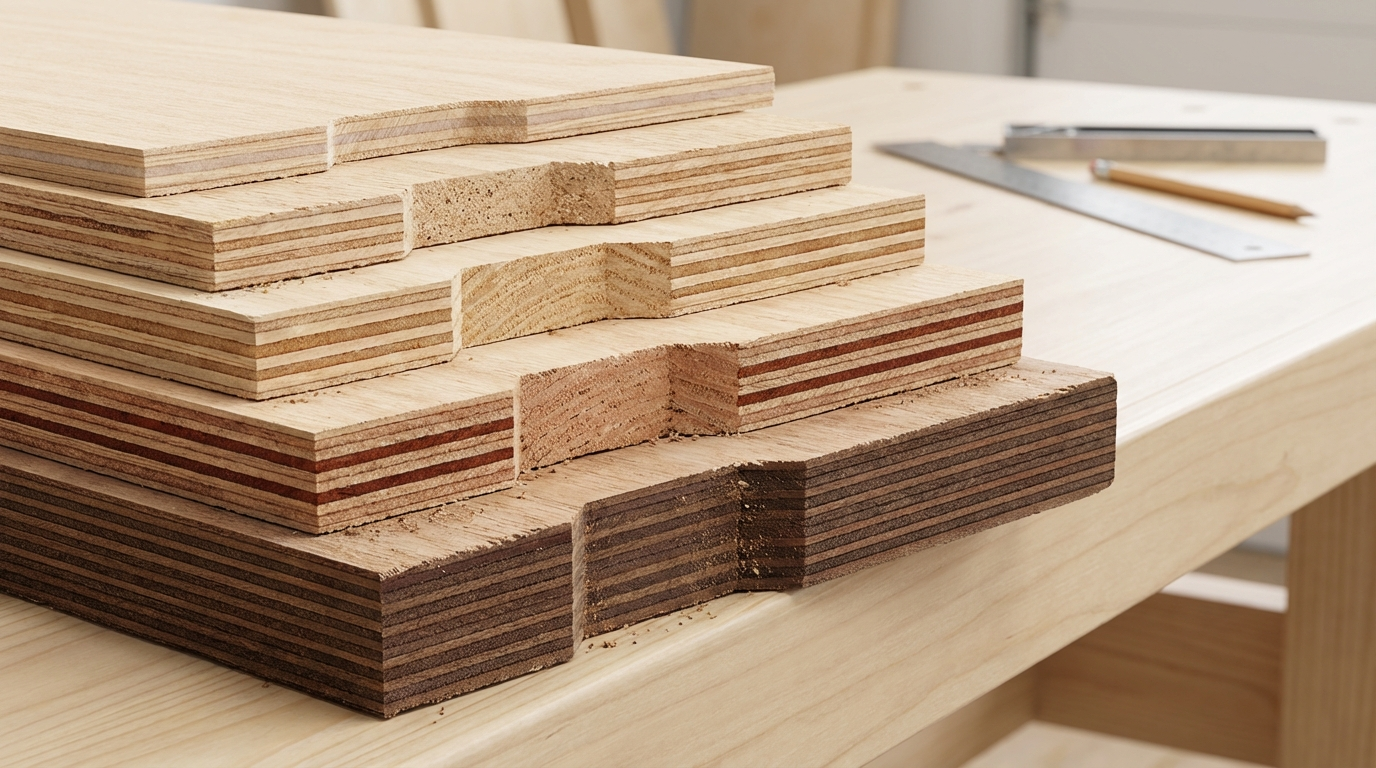
- Thickness: The single biggest cost factor—each 3mm increment adds 15–25% to the base price.
- Grade (adhesive type): BWP uses phenol formaldehyde (more expensive than urea formaldehyde in MR); marine uses premium PF with better veneers.
- Core species: Gurjan/hardwood cores cost 20–35% more than poplar; eucalyptus sits in between.
- Face veneer quality: Premium face veneers (minimal patches, uniform grain) add 8–15% to cost.
- Calibration: Sanded to uniform thickness tolerance adds 8–15%; essential for CNC work and modular kitchens.
- Termite/borer treatment: Chemical treatment adds 3–7% but extends lifespan significantly.
- Brand positioning: Established brands charge 15–30% premium over local mills for similar specifications.
- Logistics: Remote locations, upper-floor delivery, and small quantities increase per-sheet cost.
How Much Does a Typical Wardrobe Cost in Plywood?
For a standard 6ft × 7ft wardrobe with internal shelves and drawers, you might need approximately 4–5 sheets of 18mm (carcass and shelves), 1–2 sheets of 12mm (internal partitions), and 1 sheet of 6mm (back panels). Using BWR grade at mid-range prices:
- 18mm BWR: 5 sheets × ₹4,500 = ₹22,500
- 12mm BWR: 2 sheets × ₹3,500 = ₹7,000
- 6mm MR (back): 1 sheet × ₹1,800 = ₹1,800
- Plywood total: ₹31,300 (material only, excluding laminate, hardware, and labour)
This budget example helps you cross-check contractor quotes. If a quote seems unusually low, the plywood grade or thickness may have been quietly downgraded.
How to Ask for a Quote (Checklist)
When requesting plywood quotes, ensure the dealer specifies all of the following in writing:
- Exact size (8×4 ft or mm dimensions)
- Thickness (6/9/12/16/18/19/25mm)
- Grade with IS code (MR IS 303, BWR IS 303, BWP IS 710)
- Core species (poplar, eucalyptus, gurjan, other hardwood)
- Calibrated or non-calibrated
- Face veneer type (if specified)
- Termite/borer treatment included
- GST included or additional
- Transport/delivery charges
- Minimum order quantity for stated price
Without these details, you cannot compare two quotes meaningfully.
Thickness-wise Price Logic: 6mm to 25mm
Thickness selection depends on application, not just budget. Choosing the wrong thickness to save money often leads to structural failures or premature replacement.
What Thickness Should I Use for Different Applications?
| Application | Recommended Thickness | Grade Minimum | Notes |
|---|---|---|---|
| Back panels (wardrobes, cabinets) | 6mm | MR (dry), BWR (kitchen) | Secured in grooves; no structural load |
| Partition panels, wall cladding | 9–12mm | MR | Depends on span and fixing method |
| Cabinet carcass (sides, top, bottom) | 16–18mm | BWR | 18mm preferred for heavy loads |
| Wardrobe shelves | 18mm | BWR | Thicker for wide spans without support |
| Kitchen cabinets (base units) | 18–19mm | BWR/BWP | BWP for under-sink areas |
| Shutter/door fronts | 18–19mm | BWR/BWP | Calibrated preferred for laminate finish |
| Loft storage | 12–19mm | MR/BWR | Depends on load and span |
| Flooring/stair treads | 19–25mm | BWP/Marine | High-density core essential |
Why Does Thickness Affect Price So Dramatically?
Each additional veneer layer requires more raw material, more adhesive, and longer pressing time. A 25mm sheet uses roughly 4× the material of a 6mm sheet, but costs only 2.5–3× as much due to economies in processing. However, the jump from 12mm to 18mm (a 50% thickness increase) often results in 40–60% price increase because 18mm is the most demanded furniture thickness, keeping prices firm.
How to Compare MR/BWR/BWP/Marine Quotes
Grade comparison requires understanding what each grade actually resists, not just marketing claims.
Grade Comparison Table
| Feature | MR (Commercial) | BWR | BWP/Marine |
|---|---|---|---|
| Adhesive type | Urea formaldehyde | Phenol/melamine fortified | Phenol formaldehyde |
| Water resistance | Humidity only | Occasional water, steam | Prolonged/continuous water |
| IS standard | IS 303 (Type I) | IS 303 (BWR) | IS 710 |
| Boil test survival | Not required | ~8 hours | 72+ hours |
| Best applications | Bedrooms, study, dry storage | Kitchens, bathrooms (not under sink) | Under-sink, exterior, wet zones |
| Price premium over MR | — | +25–40% | +60–100% |
Is BWR Enough for My Kitchen?
BWR plywood handles typical kitchen humidity, steam from cooking, and occasional splashes adequately. However, areas with continuous water exposure—under sinks, near dishwashers, or in homes with frequent cooking spills—benefit from BWP grade. If you seal all exposed edges properly with PU sealant or edge banding, BWR performs well for most kitchen cabinets. Reserve marine-grade (IS 710) for sink base units, outdoor furniture, and coastal installations where salt air accelerates degradation.
Decision Framework: Which Grade and Thickness for Your Situation
| Your Situation | Recommended Grade | Thickness | What to Verify |
|---|---|---|---|
| Bedroom wardrobe, dry climate | MR | 18mm (carcass), 6mm (back) | IS 303 stamp, core density |
| Kitchen cabinets, typical use | BWR | 18mm | Boil test certificate, edge seal after cutting |
| Under-sink unit | BWP | 18mm | IS 710 stamp, no core gaps visible |
| Bathroom vanity (splashes) | BWR/BWP | 18mm | Edge sealing mandatory, confirm phenolic adhesive |
| Coastal home (salt air) | Marine (IS 710) | 18–19mm | Hardwood core, fungal treatment, proper finishing |
| Tight budget, bedroom furniture | MR | 16mm | Check core gaps, termite treatment |
| Modular kitchen (machine-cut) | BWR calibrated | 18mm | Thickness tolerance ±0.2mm, flat sheets |
| Children's room (high scratch/impact) | BWR | 18mm | Dense core, quality face veneer |
| Loft storage (light items) | MR | 12mm | Support spacing under 24 inches |
| Heavy storage loft | BWR | 18–19mm | Hardwood core, proper battens |
Trade-offs and Limitations
Every plywood grade involves trade-offs. Understanding these prevents disappointment and over-spending:
- MR plywood costs less but fails in humid environments—using it in kitchens to save money leads to swelling and delamination within 2–4 years.
- BWR plywood handles most residential applications but isn't truly waterproof—continuous water contact (leaks, flooding) will eventually cause damage.
- BWP/Marine plywood costs significantly more but offers diminishing returns in dry applications—you're paying for water resistance you won't use.
- Calibrated plywood ensures flush finishes but costs extra—unnecessary for painted furniture or when surface imperfections will be filled.
- Hardwood cores offer superior screw-holding and impact resistance but weigh more—relevant for wall-mounted cabinets and structural calculations.
- Fire-retardant plywood provides safety benefits but at premium prices—typically specified only for commercial or public buildings.
Common Buyer Mistakes and How to Avoid Them
Mistake 1: Comparing Prices Without Matching Specs
Why it happens: Dealers quote different grades, thicknesses, or core species, making the "cheaper" quote misleading.
What to do instead: Create a standard specification sheet and ask all dealers to quote against identical specs. Compare only when all variables match.
Mistake 2: Assuming All BWR Plywood Is the Same
Why it happens: "BWR" has become a generic marketing term; actual water resistance varies by manufacturer and adhesive quality.
What to do instead: Ask for IS 303 BWR certification. Request boil test documentation or check the IS stamp on sheets directly.
Mistake 3: Ignoring Core Quality to Save Money
Why it happens: Core species isn't visible after lamination, so buyers focus only on face veneer quality.
What to do instead: Inspect cut edges for gaps, overlaps, or voids. Tap the sheet—hollow sounds indicate poor core construction.
Mistake 4: Not Budgeting for Edge Sealing
Why it happens: Plywood quotes don't include edge banding or sealant costs; buyers assume cut edges are ready to use.
What to do instead: Add 3–5% to your plywood budget for edge banding material or PU sealant. Unsealed edges cause most moisture failures.
Mistake 5: Over-specifying Grade for Dry Areas
Why it happens: Fear of moisture damage leads to using BWP everywhere "just to be safe."
What to do instead: Use MR for bedrooms, studies, and dry storage. Reserve BWR for kitchens and bathrooms; BWP only for wet zones.
Mistake 6: Ignoring Transport and Handling Costs
Why it happens: Online or phone quotes rarely include delivery, stair carry, or waste from cutting.
What to do instead: Get delivered prices to your site. Add 8–12% for cutting waste in furniture projects.
Mistake 7: Buying from Humid Storage Conditions
Why it happens: Buyers don't inspect dealer storage, especially during monsoon when sheets absorb ambient moisture.
What to do instead: Visit the godown. Check for musty smell, visible warping, or condensation. Reject sheets with edge discoloration.
Mistake 8: Not Checking Batch Consistency
Why it happens: Multiple sheets ordered may come from different batches with varying thickness or quality.
What to do instead: Request sheets from a single batch for visible furniture. Stack and compare thickness at corners before accepting delivery.
Failure Modes and Fixes
Failure Mode 1: Edge Swelling After 6–12 Months
Symptom: Cabinet edges become soft, laminate peels, visible puffing at corners.
Likely cause: Unsealed edges absorbed moisture from air or spills.
Prevention: Apply edge banding or PU sealant to all cut edges immediately after cutting.
If already happening: Remove affected laminate, cut back to solid wood, apply waterproof filler, re-laminate, and seal properly.
Failure Mode 2: Delamination (Layers Separating)
Symptom: Bubbles under surface, layers peeling apart, soft spots in the sheet.
Likely cause: Low-quality adhesive, inadequate pressing, or grade mismatch with moisture exposure.
Prevention: Buy from reputable sources with IS certification. Match grade to application moisture level.
If already happening: Inject wood adhesive into gaps, clamp tightly, and allow 24-hour cure. Replace if structural integrity is compromised.
Failure Mode 3: Warping or Bowing
Symptom: Sheet curves along length or width; doors don't close flush.
Likely cause: Uneven moisture absorption, improper storage, unbalanced lamination (one side only).
Prevention: Store flat with supports every 2 feet. Laminate both faces for balance. Acclimatize before installation.
If already happening: Slight warps may flatten under load over weeks. Severe warps require replacement or cutting into smaller pieces.
Failure Mode 4: Screw Pullout
Symptom: Hinges loosen, shelves sag at bracket points, hardware falls out.
Likely cause: Low-density core, incorrect screw size, or screws placed in edge grain only.
Prevention: Use hardwood-core plywood for heavy hinges. Pre-drill pilot holes. Add mounting blocks in high-stress zones.
If already happening: Fill holes with toothpicks and wood glue. Relocate hardware slightly. Use wider screws or add backing plates.
Failure Mode 5: Surface Discoloration (Yellowing/Staining)
Symptom: Light-colored laminates show yellow patches; water stains appear on surface.
Likely cause: Low-quality face veneer reacting with adhesive or moisture penetration through laminate edges.
Prevention: Choose quality face veneers. Seal laminate edges with silicone in wet areas.
If already happening: Cannot be reversed. Replace affected shutters or re-laminate with proper edge sealing.
Failure Mode 6: Termite/Borer Damage
Symptom: Fine dust (frass) near furniture, hollow sounds, visible bore holes.
Likely cause: Untreated plywood or treatment wearing off after years.
Prevention: Use factory-treated plywood. Apply borer spray to cut edges during carpentry.
If already happening: Inject borer treatment into holes. If extensive, consult pest control before structural failure occurs.
Quality Checks You Can Do Without Lab Tests
Before Buying: At the Dealer
- Visual inspection: Check face veneer for patches, cracks, and grain consistency. Reject sheets with multiple large patches.
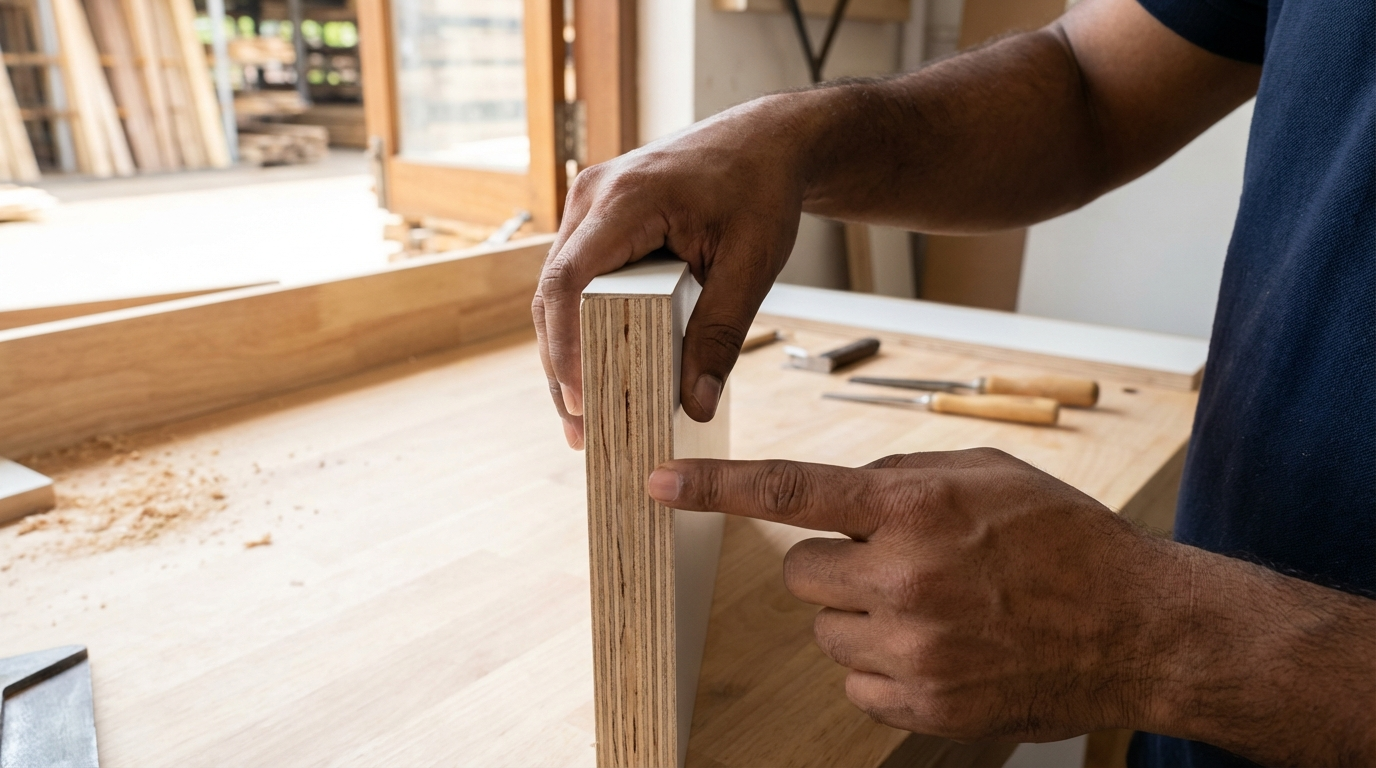
- Edge inspection: Look at core layers from the edge. Even, tight layers with no gaps indicate quality pressing.
- Weight test: Lift the sheet. Heavier sheets (for same thickness) typically have denser cores—better screw-holding.
- Tap test: Tap the surface at multiple points. Hollow sounds indicate voids in the core.
- Bend test: Flex a corner gently. Quality plywood resists; low-quality sheets flex easily or crackle.
- Smell test: Strong chemical or musty odor suggests poor adhesive curing or moisture damage.
- IS stamp check: Locate the IS stamp (IS 303 or IS 710). Absence doesn't confirm poor quality but presence indicates compliance testing.
After Cutting: At the Workshop
- Cut edge inspection: Clean cuts without splintering indicate proper core layering. Excessive tearout suggests poor veneer bonding.
- Thickness consistency: Measure with a digital caliper at multiple points. Variation over 0.5mm indicates non-calibrated sheets.
- Delamination check: Apply slight pressure to layers at cut edge. They should not separate or lift.
- Moisture meter reading: If available, check moisture content. Below 12% is ideal; above 15% indicates improper drying.
After Installation: Ongoing Quality
- Edge sealing verification: Run your finger along all cut edges—they should be sealed with edge band or sealant.
- Hardware tightness: After one week, check all screws and hinges. Loose hardware early indicates poor screw-holding.
- Alignment check: Doors should close flush without rubbing. Gaps should be consistent. Variations indicate warping beginning.
- Cleaning habits: Wipe spills immediately. Never leave wet cloth on surfaces. Use coasters under water vessels.
Tips for Homeowners
Durability and Cleaning Guidelines
- Do: Wipe surfaces with slightly damp cloth followed by dry cloth. Clean spills within minutes.
- Do: Use furniture polish (silicone-based) every 3–6 months on laminate surfaces.
- Do: Keep cabinet interiors ventilated—avoid storing damp items in closed spaces.
- Don't: Use abrasive cleaners, steel wool, or harsh chemicals on laminate surfaces.
- Don't: Place hot vessels directly on surfaces—use trivets even for "heat-resistant" laminates.
- Don't: Allow water to pool near sink edges or cabinet bases—check plumbing regularly for slow leaks.
Tips for Carpenters
Cutting, Edge Prep, and Fastening
- Cutting: Use sharp blades with high tooth count (80T for clean cuts). Score laminate surface before cutting to prevent chipping.
- Edge preparation: Sand cut edges lightly before edge banding. Remove dust completely before applying adhesive.
- Fastening zones: Pre-drill pilot holes, especially near edges. Maintain 10mm minimum edge distance for screws.
- Hinge areas: Add solid wood or plywood backing blocks for heavy doors. Reinforce with longer screws into backing.
- Handling: Carry sheets vertically with two people to prevent bending stress. Store flat with full support underneath.
- Acclimatization: Store plywood at installation site for 48–72 hours before cutting to match humidity levels.
Tips for Architects and Designers
Specification and Detailing Considerations
- Specification clarity: Always specify IS code, thickness, core species, and calibration requirement—not just "BWR plywood."
- Wet-zone detailing: Design 50mm plinth with waterproof material under kitchen/bathroom cabinets. Specify silicone bead at floor junction.
- Finish selection: Match finish durability to use—high-pressure laminate for heavy-use areas, membrane or PU paint for decorative pieces.
- Ventilation details: Include ventilation holes in shoe cabinets, wardrobe backs, and utility storage to prevent moisture buildup.
- Edge treatment specification: Specify edge banding type and minimum thickness. PVC edge band (1–2mm) for durability; ABS for sustainability.
Tips for OEM and Modular Manufacturers
Repeatability and Quality Control
- Incoming material QC: Check 10% of each batch for thickness tolerance, delamination, and core quality before accepting delivery.
- Calibrated plywood only: Use calibrated sheets for CNC routing and edge banding machines—non-calibrated creates inconsistent gaps.
- Batch documentation: Maintain records of supplier, batch number, and test results for warranty tracking and complaint resolution.
- Edge sealing protocol: Implement mandatory edge sealing at cutting stage, not only at assembly. Train operators on proper technique.
- Reducing returns: Most customer complaints stem from edge swelling, hardware failure, and finish defects. Address these at production stage.
FAQs
What is the current price of 18mm plywood per sheet in India?
Prices for 18mm 8×4 ft plywood sheets typically range from ₹2,800 to ₹8,500 depending on grade, core species, and brand positioning. MR-grade sheets start around ₹2,800–4,200, BWR-grade ranges from ₹3,600–5,800, and BWP/Marine-grade costs ₹5,200–8,500. These are indicative ranges; actual prices vary by city, dealer margins, and current raw material costs. Always request written quotes specifying all parameters including GST and delivery charges. Prices in manufacturing hubs like Gujarat tend to be 8–12% lower than in cities distant from production centers.
Is BWR plywood waterproof?
BWR (Boiling Water Resistant) plywood is highly water-resistant but not completely waterproof. It uses phenol or melamine-fortified adhesives that resist steam, humidity, and occasional water contact—making it suitable for kitchen cabinets and bathroom vanities where splashes occur but continuous water exposure doesn't. However, for areas with prolonged water contact (under sinks, near water tanks, outdoor furniture), BWP or Marine-grade plywood with IS 710 certification offers better protection. Even BWR plywood requires proper edge sealing to prevent moisture ingress through cut surfaces.
How do I calculate plywood required for a wardrobe?
To calculate plywood requirements, measure all surface areas: sides (2), top, bottom, shelves, back panel, and shutters. Add 10–15% for cutting waste and errors. For a typical 6ft wide × 7ft tall wardrobe: sides require approximately 2 sheets of 18mm (each piece 7ft × 2ft), top and bottom need portions of another sheet, shelves consume 1–2 sheets depending on configuration, and shutters require 1–2 sheets. Back panels use thinner 6mm plywood—usually 1 sheet. Total: approximately 5–6 sheets of 18mm and 1 sheet of 6mm for a standard wardrobe.
Why does the same thickness plywood cost differently at different shops?
Price variation occurs due to multiple hidden factors: core species (poplar vs. eucalyptus vs. hardwood), adhesive quality (basic vs. premium phenolic), face veneer grade (patched vs. select), calibration status, IS certification compliance, termite treatment inclusion, dealer margins, and location-based logistics costs. Additionally, some dealers quote ex-factory while others include transport. Always compare quotes with identical specifications in writing. A ₹500 difference per sheet may represent genuine quality difference or simply dealer margin—only spec-matched comparison reveals which.
Can I use MR plywood in kitchen cabinets to save money?
Using MR plywood in kitchens is a common cost-cutting approach that typically leads to regret within 2–4 years. MR-grade adhesives resist humidity but fail when exposed to cooking steam, splashes, and the elevated moisture levels common in Indian kitchens. Edge swelling, delamination, and surface bubbling occur progressively. If budget is extremely tight, use MR only for upper cabinets away from cooking zones, with BWR minimum for base units and areas near sinks or stoves. The 25–40% premium for BWR is recovered in extended furniture lifespan.
What does calibrated plywood mean and is it necessary?
Calibrated plywood is sanded to achieve uniform thickness across the entire sheet, typically within ±0.2mm tolerance. Standard plywood may vary by 0.5–1mm across the surface. Calibration matters for CNC-routed furniture, edge banding machines, and flush shutter alignment in modular kitchens. For hand-carpentry or painted furniture where minor surface variations can be filled, non-calibrated plywood works adequately. Calibrated sheets cost 8–15% more but save time in fitting and produce professional-grade results. For premium modular work, calibration is effectively mandatory.
How can I verify if plywood is genuinely BWR or BWP grade?
Verify grade through multiple methods: check for IS stamp physically printed on the sheet (IS 303 for MR/BWR, IS 710 for BWP/Marine), request test certificates from the manufacturer, and ask dealers about their source mill credentials. You can perform a basic field test by soaking a small cut piece in water for 24 hours—MR grade will show edge swelling, BWR will resist moderately, and BWP/Marine will show minimal change. However, this damages the piece so it's typically done only when quality is suspect. Buying from established brands with consistent QC reduces verification burden.
Should I buy plywood online or from local dealers?
Both channels have trade-offs. Local dealers allow physical inspection, immediate availability, and easier complaint resolution, but may have limited brand selection and inconsistent pricing. Online platforms offer price transparency and wider selection but prevent physical inspection before purchase and may have complex return processes for bulky items. For large orders, visit dealers to inspect samples first, then negotiate pricing (online prices serve as benchmarks). For small quantities or specific brands unavailable locally, online purchase with clear return policies works. Always verify seller credentials and read reviews focusing on delivery condition.
What is the difference between Marine plywood and BWP plywood?
Both terms are often used interchangeably, but technically, Marine plywood (IS 710 certified) uses superior hardwood veneers and specific adhesive formulations tested for marine environments including salt water exposure. BWP (Boiling Water Proof) indicates adhesive performance in fresh water conditions. In practice, IS 710 certified plywood meets both requirements and is suitable for boats, docks, and coastal construction. For typical residential applications with high moisture exposure (bathrooms, outdoor covered furniture), BWP-labeled plywood meeting IS 303 specifications works adequately. True marine applications require IS 710 certification specifically.
How much wastage should I budget when buying plywood?
Budget 8–12% wastage for typical furniture projects, increasing to 15–18% for complex designs with many angled cuts or curved elements. Standard 8×4 ft sheets don't always optimize for furniture dimensions—a 7ft wardrobe side piece leaves unusable strips. Experienced carpenters minimize waste through careful cutting layout, but some loss is inevitable. Additionally, budget for one spare sheet per major project to handle cutting errors, defective portions, or future repairs. This "waste" budget is often forgotten, causing mid-project cost escalation when additional sheets are needed.
Does plywood brand matter for quality?
Brand matters significantly for consistency rather than absolute quality. Established brands maintain quality control across batches, honor warranty claims more reliably, and provide documented specifications. However, local mills may produce equivalent or superior quality at lower prices—but with higher batch-to-batch variation and limited recourse for defects. For critical applications (kitchens, bathrooms, heavy-use furniture), branded plywood with IS certification reduces risk. For less critical uses (loft storage, backing panels), local mill plywood with physical inspection before purchase offers value. The brand premium (15–30%) buys consistency and accountability, not necessarily better materials.
Can I negotiate plywood prices with dealers?
Negotiation is standard practice in Indian plywood markets, with 5–15% discount possible depending on order quantity, payment terms, and relationship history. Strategies include: getting quotes from multiple dealers before negotiating, ordering multiple thickness requirements from single dealer for volume discount, paying cash for additional discount (where legal), and timing purchases during off-season (typically October–December). Wholesale markets offer better base prices than retail showrooms but require larger minimum orders. Avoid aggressive negotiation that pushes dealers toward substituting lower-grade products to meet your price—quality compromise costs more in repairs and replacement.
Disclaimer: This content is provided for general informational purposes based on industry practices and publicly available information. Product specifications, standards, prices, and availability may vary by manufacturer, region, and time. Readers should independently verify details with manufacturers, dealers, or qualified professionals before making purchase or construction decisions.Want Plywood Suggestions?
Share a few details and a Duro BOIL specialist will suggest suitable brands and connect you to responsive dealers.