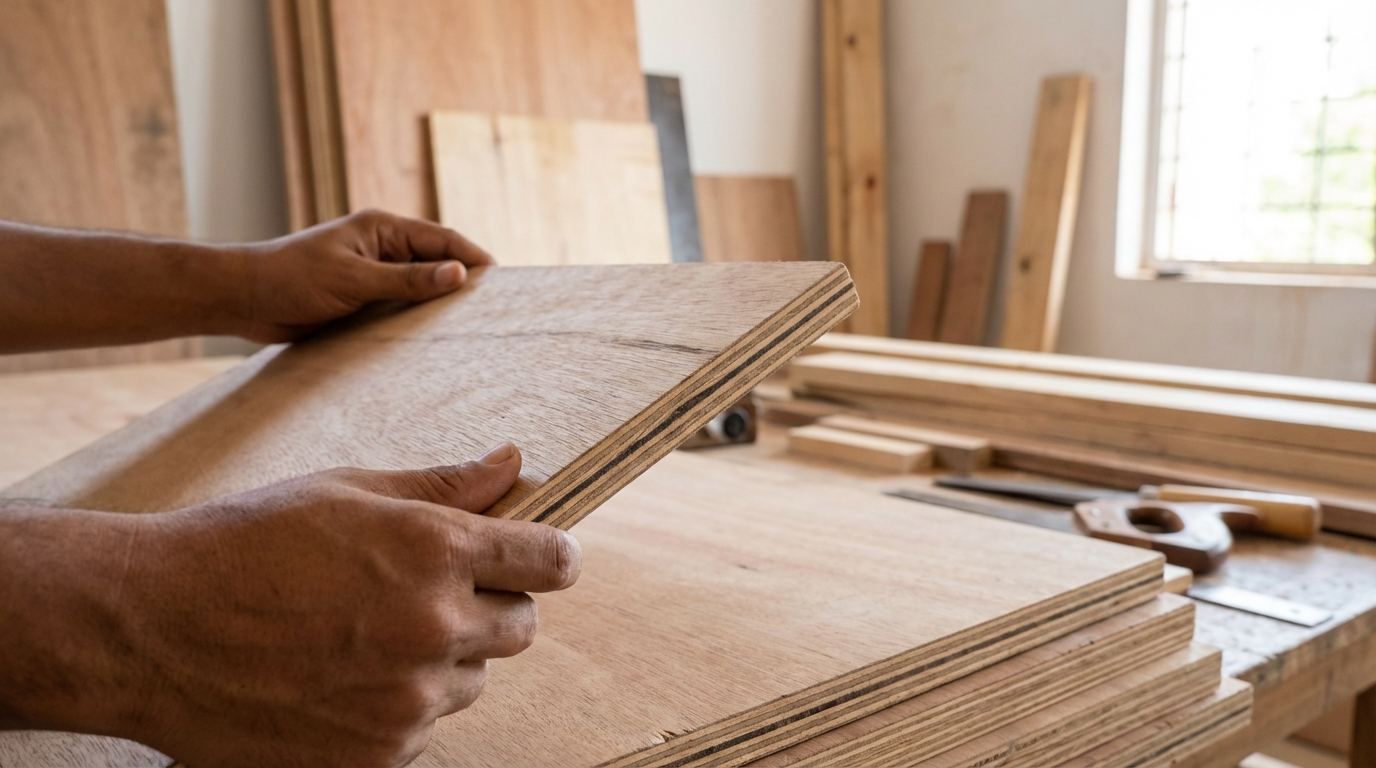
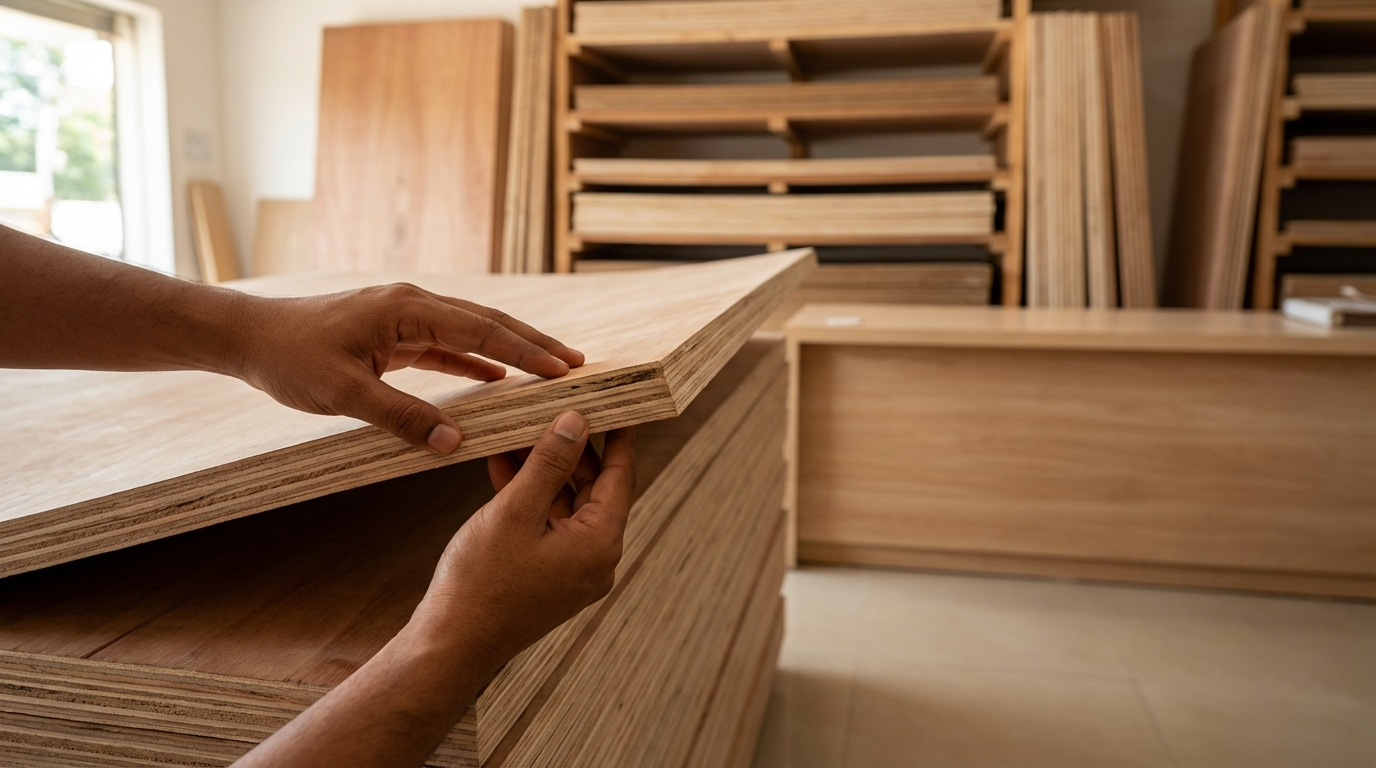
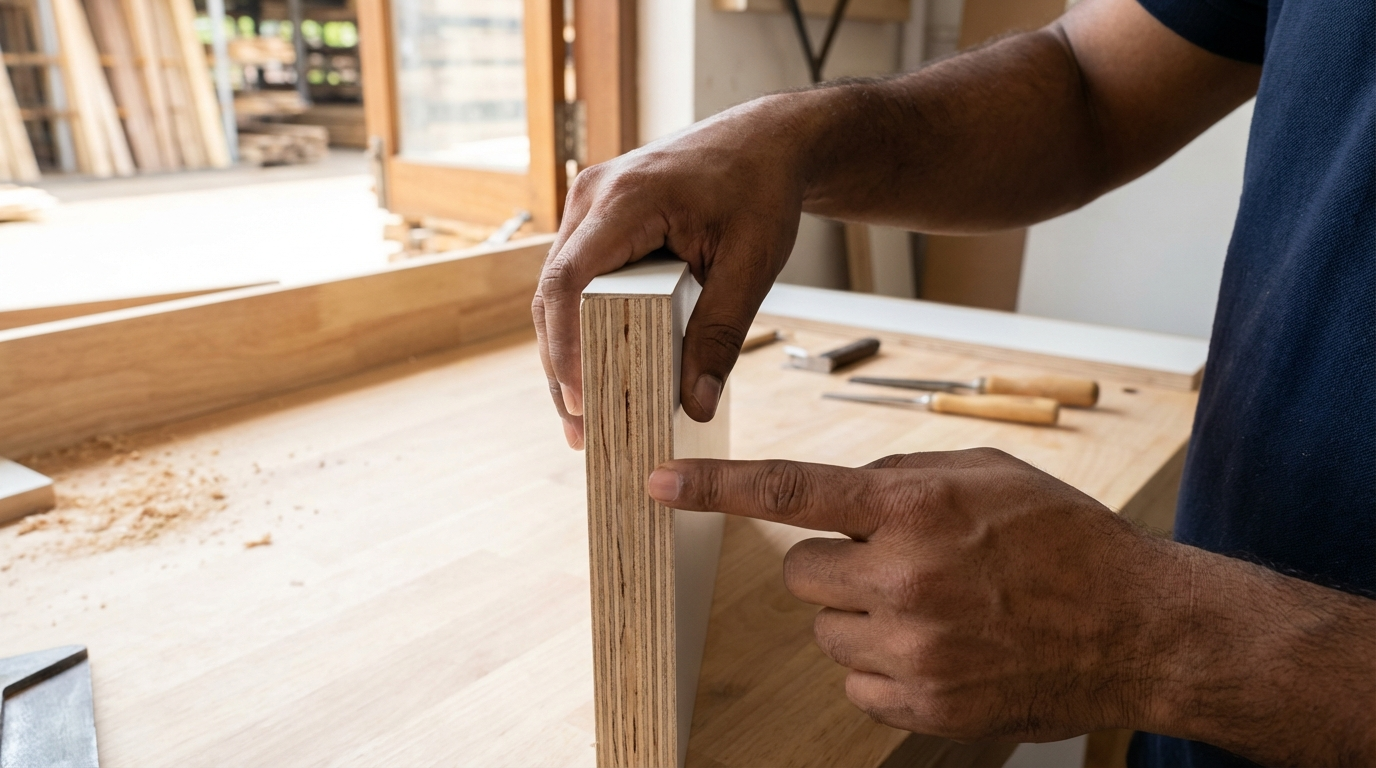
Waterproof Plywood Guide: BWP vs Marine vs BWR for Wet Areas
Complete waterproof plywood guide for India. Compare BWP, marine & BWR grades for kitchens, bathrooms & outdoor use with prices & brand recommendations.
Quick Buying Decision
Waterproof plywood is essential for any area in your home exposed to moisture, humidity, or water splashes. BWP plywood stands for Boiling Waterproof, and unlike regular boards, this one's actually made to last in moisture-heavy conditions. The right grade depends entirely on where you'll use it and how much water exposure it will face.
If you're in a hurry, here's the bottom line: For Indian kitchens, bathrooms, and coastal areas, BWP/Marine grade plywood (IS 710 certified) is your safest investment. It costs more upfront but prevents costly replacements within 3-5 years that MR grade would require in wet areas. According to duroboil.com's material experts, choosing the right waterproof grade at the start saves 40-60% in long-term furniture costs.
Quick Picks with Reasons
- Best for Kitchen: BWP Marine Grade (IS 710) – Handles cooking steam, sink splashes, and monsoon humidity without delamination
- Best for Bathroom: BWP Marine Grade (IS 710) – Withstands direct water contact near showers and washbasins
- Best Budget Option: BWR Grade (IS 303) – Suitable for kitchen upper cabinets and semi-wet areas with proper lamination
- Best Premium Option: Marine Grade with Gurjan core – Maximum durability for 25+ years in extreme conditions
How to Choose Waterproof Plywood: Step-by-Step
Step 1: Identify Your Application
The first step is understanding exactly where you'll use the plywood. Indian homes face unique moisture challenges that differ significantly from Western conditions.
Wet Areas (Direct Water Contact):
- Under-sink cabinets in kitchen
- Bathroom vanity units
- Kitchen trolley/trolley units
- Balcony furniture in coastal areas
- Washing area cabinets
High-Humidity Areas (Indirect Moisture):
- Kitchen wall cabinets
- Modular kitchen carcass
- Shoe racks near entrance
- Pooja room in humid climate zones
Moderate Humidity Areas:
- Bedroom wardrobes
- Living room TV units
- Study tables
- Office furniture
Step 2: Select the Right Grade/Type
According to the Indian grading system, plywood is classified under 3 categories: moisture resistant/water resistant or MR Grade; boiling water-resistant or BWR Grade plywood; and boiling water-proof grade or BWP Grade plywood.
Understanding the Grade Hierarchy:
The MR Grade Plywood is the Moisture-Resistant Plywood that is made to resist humidity in dampness. However, that doesn't mean that this particular grade in plywood is also waterproof. The MR Grade Plywood is made using urea-formaldehyde resin that can handle moisture on an external level, but not prolonged exposure to water.
BWR plywood is made from phenolic resins. As an exterior plywood grade, BWR plywood can be used indoors, outdoors and semi-outdoor purposes with humid conditions. BWR plywood's waterproofing characteristics come from A grade phenolic resins or phenol formaldehyde adhesive used in its manufacturing.
BWP (Boiling Waterproof) plywood — also known as Marine Plywood or 710 Grade Plywood — is made with the highest quality phenol-formaldehyde resin, making it completely waterproof, boil-proof, and durable under harsh conditions.
Step 3: Determine Correct Thickness
Thickness directly impacts strength, durability, and the ability to hold screws for hinges and hardware. Here's duroboil.com's recommended thickness guide for waterproof plywood applications:
| Application | Recommended Thickness | Why This Thickness |
|---|---|---|
| Kitchen base cabinets | 18mm-19mm | Heavy load bearing, multiple hinges |
| Kitchen wall cabinets | 16mm-18mm | Lighter loads but needs screw holding strength |
| Under-sink cabinet | 19mm BWP | Maximum water exposure, needs strongest grade |
| Bathroom vanity | 18mm-19mm BWP | Direct water splash, humidity |
| Wardrobe carcass | 18mm | Standard furniture application |
| Wardrobe shelves | 12mm-16mm | Internal shelving, moderate loads |
| Back panels | 6mm-9mm | Non-load bearing, covers back |
| Modular kitchen shutters | 16mm-18mm | Hinge mounting, daily use |
Step 4: Verify Quality Indicators
IS-710 is a grading acronym for plywood set by the Bureau of Indian Standards. The 'IS' means "Indian Standard," and the number "710" stands for the specific standard code for BWP plywood. To be designated as IS-710, the plywood must undergo thorough testing to assess whether it is water resistant, durable, and meets the overall quality specifications. If plywood is classified as "IS-710", it is an assurance of its suitability for applications in water-heavy settings.
Quality Checks at the Shop:
- BIS Certification Mark: All plywood displays clear ISI mark with IS:303 or IS:710 specification.
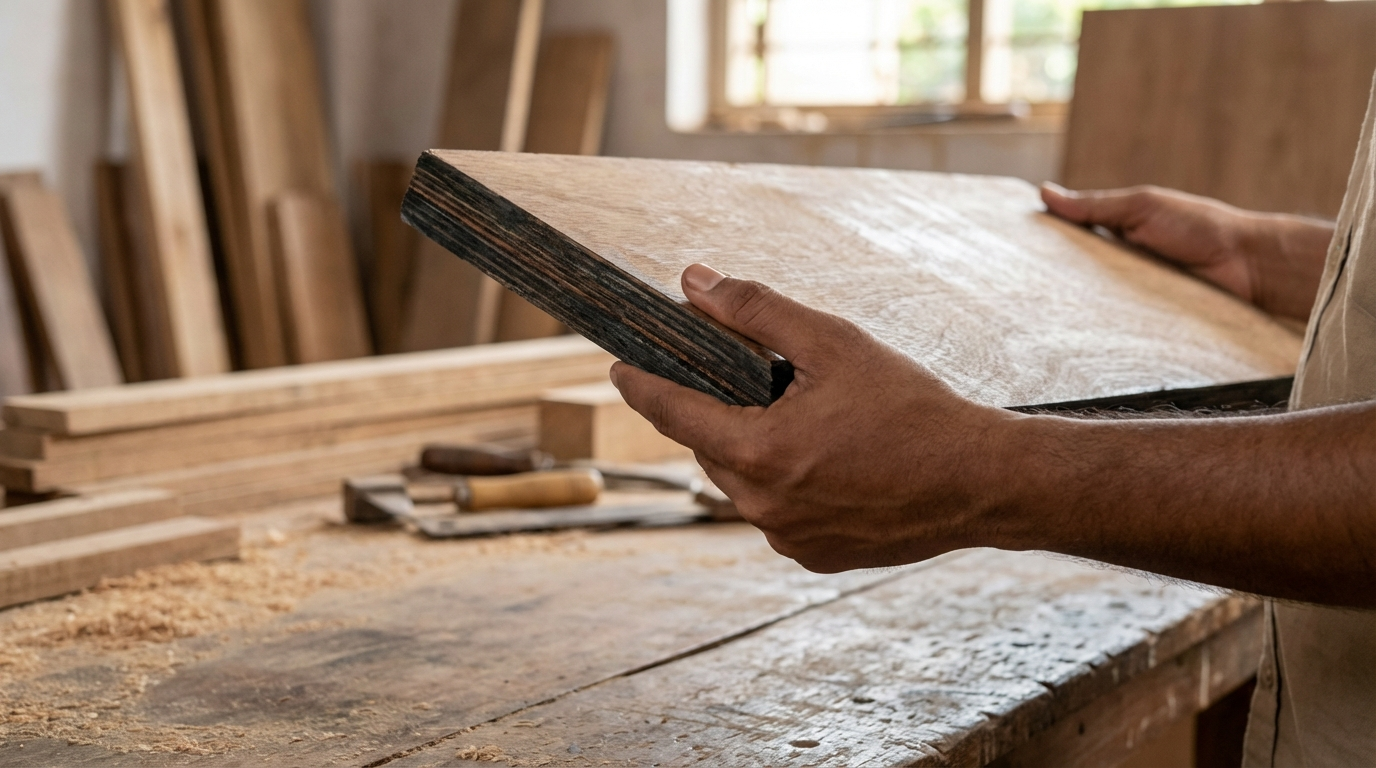
- Check edge uniformity – veneers should be tightly bonded without gaps
- Surface should be smooth without undulations or bumps
- No visible core gaps or voids when viewed from the side
- Brand name, thickness, and grade clearly printed on surface
Step 5: Compare and Get Quotes
Always get quotes from at least 3 dealers before purchasing. Ask for per-sheet price and calculate per-square-foot cost for accurate comparison. Request sample pieces to test at home if buying in bulk.
Decision Matrix: What to Buy for Each Situation
| Situation | Recommended Option | Why | Verify This |
|---|---|---|---|
| Modular kitchen (full) | BWP/Marine (IS 710) | Kitchen humidity during cooking reaches 75-85%, making BWP's superior water resistance essential for longevity. | IS 710 mark, phenol formaldehyde resin |
| Kitchen upper cabinets only | BWR (IS 303) | Less direct water exposure, cost saving possible | IS 303 mark, check brand warranty |
| Bathroom cabinets | BWP Marine Grade | Constant humidity, water splashes inevitable | 72-hour boil test certification |
| Coastal area (any room) | BWP Marine Grade | Salt air accelerates moisture damage | Termite/borer treatment certificate |
| North India (dry climate) | BWR for kitchen, MR for bedrooms | Lower ambient humidity | Grade matching application |
| South India (high humidity) | BWP for kitchen/bathroom, BWR for bedrooms | High humidity levels, 75-85% humidity during monsoon. | Full waterproofing certification |
| Budget modular kitchen | BWR with proper edge banding | Cost effective with proper protection | Quality edge banding, good laminate |
| Premium project | BWP Marine with Gurjan face | Best durability and finish | Hardwood core, face veneer quality |
BWP vs Marine vs BWR: Complete Comparison
Understanding the exact differences between these grades is crucial for making the right choice. Under Indian Standards, BWP plywood is classified as IS 710. In other words, the plywood is capable of withstanding 72 hours of boiling water.
| Parameter | MR Grade (IS 303) | BWR Grade (IS 303) | BWP/Marine (IS 710) | Best Choice |
|---|---|---|---|---|
| Full Form | Moisture Resistant | Boiling Water Resistant | Boiling Water Proof | - |
| Indian Standard | IS 303 | IS:303 | ISI:710 certification | - |
| Adhesive Used | Urea Formaldehyde | Phenol formaldehyde which is a synthetic plastic resin. | Phenol formaldehyde - tough waterproof adhesive | BWP |
| Water Resistance | Humidity only | Good – resists moisture | Boiling water-resistant (BWP) and can withstand continuous exposure to water for up to 72 hours without any damage. | BWP |
| Best For | Dry interiors | Semi-wet areas | The highest-grade plywood which is ideal for extreme moisture exposure. Designed to resist prolonged water exposure without delaminating. Often used in marine construction. | Application-specific |
| Lifespan | 8-12 years in dry areas | 12-18 years with care | 18-25+ years even in high-humidity areas. | BWP |
| Price Range (per sq ft) | ₹60 – ₹150 | ₹95 – ₹125 | ₹150 – ₹300 | Budget dependent |
| Kitchen Suitability | Not recommended | Upper cabinets only | All kitchen applications | BWP |
| Bathroom Suitability | Not suitable | With heavy protection only | Ideal | BWP |
| Outdoor Use | Not suitable | Limited | BWP plywood is better suited for the outdoors. It holds up well against rain, heat, and changing weather. | BWP |
| Termite Resistance | Basic treatment | Good treatment | BWP plywood is termite resistant since the core layer of the sheet is cemented with lots of different chemicals. | BWP |
What is BWP Plywood? (Detailed Explanation)
Boiling Water Proof plywood is an acronym for this type of plywood. The plywood is moisture-resistant; it can withstand changes in atmospheric conditions and is not susceptible to boiling. BWP-grade plywood does not suffer from any quality loss when exposed to water or moisture in furniture or cabinets.
How BWP Plywood is Made:
It's made using hardwood sheets pressed together with a tough waterproof adhesive (phenol formaldehyde). Because of this, it doesn't swell, peel, or fall apart even if it's exposed to water over time.
The manufacturing process involves:
- Selection of premium hardwood veneers (Gurjan, Eucalyptus, or similar)
- Treatment of veneers with preservatives for termite/borer resistance
- Application of phenol formaldehyde resin between layers
- Hot pressing at high temperature and pressure
- Calibration for uniform thickness
- Quality testing including boiling water immersion test
What is BWR Plywood? (Detailed Explanation)
BWR plywood or boiling water-resistant plywood, as the name suggests, is highly water-resistant plywood. It is completely waterproof and is widely used to make furniture for home, office as well as outdoors.
Plywood for general purposes shall be of the following two grades, depending upon the bond strength developed by the adhesive used for bonding the veneers: a) Boiling water resistant or BWR Grade, and b) Moisture resistant or MR Grade.
Key Difference from BWP: While BWR uses phenolic resins similar to BWP, the concentration and pressing parameters differ. BWR can resist moisture and humidity excellently but may show degradation under prolonged direct water exposure – something BWP handles without issues.
What is Marine Plywood?
Often referred to as Marine Grade Plywood, BWP is designed for long-term water immersion, making it the strongest and most waterproof grade in the market.
Marine plywood is considered the highest standard of waterproofing among the various grades of plywood. This plywood is also made for high-quality phenolic reasons, but is manufactured using superior hardwood veneers. It is designed for providing long-term durability in weight and high-humidity areas, including places of submersion. Another feature of marine plywood is that it is built to endure constant water exposure and resist delamination and even fungal attacks.
Is Marine Plywood the Same as BWP?
Is 710 the same as marine plywood? Yes, 710 refers to ISI marine-grade plywood, also called Boiling Waterproof plywood. In practical terms, all genuine IS 710 certified plywood is marine grade, though "marine plywood" is sometimes used loosely in the market.
Price Guide and Budget Planning
Prices can vary according to market demand, supply chain factors, and geography, with urban areas or regions having higher demand and higher prices.
Waterproof Plywood Price Ranges (2025-2026)
| Grade | Thickness | Price per Sq Ft (Approx.) | Price per 8x4 Sheet (Approx.) |
|---|---|---|---|
| MR Grade | 18-19mm | ₹50-80 | ₹1,600-2,560 |
| BWR Grade | 18-19mm | ₹75-110 | ₹2,400-3,520 |
| BWP/710 Grade | 18-19mm | ₹90 – ₹150 per square foot | ₹2,880-4,800 |
| Premium Marine | 18-19mm | ₹130-200 | ₹4,160-6,400 |
Premium BWP marine grade ranges from Rs. 1,402 to Rs. 2,252 per sheet. These prices are for standard branded plywood and can vary based on location and dealer.
Why Prices Vary Between Dealers
- Brand Premium: Well-known brands like CenturyPly and Greenply invest more in research, technology, and marketing, which is reflected in their premium pricing.
- Core Wood Type: Gurjan core costs more than poplar or eucalyptus
- Face Veneer Quality: Better face veneers command higher prices
- Certification Level: ISI marked products cost more but offer assurance
- Location: Metro cities typically have higher prices than tier-2 towns
- Quantity Discounts: Bulk purchases can reduce per-sheet cost by 5-15%
Budget Estimates for Common Projects
| Project | Plywood Needed (Approx.) | Recommended Grade | Budget Range (Plywood Only) |
|---|---|---|---|
| 10x8 ft Modular Kitchen | 8-10 sheets (8x4) | BWP/Marine | ₹25,000-45,000 |
| Bathroom Vanity Unit | 1-2 sheets | BWP Marine | ₹3,500-7,000 |
| 8x8 ft Wardrobe | 5-6 sheets | BWR/MR | ₹12,000-20,000 |
| TV Unit (6ft) | 2-3 sheets | MR/BWR | ₹4,000-8,000 |
Red Flags: When to Walk Away
Not all plywood sold as "waterproof" actually meets standards. Here are warning signs to watch for:
- No ISI Mark: ISI certifications are a guarantee of quality and adherence to Indian standards. Ignoring these certifications can lead to plywood that doesn't meet your project's requirements. Always look for the ISI mark to ensure you're getting plywood that meets the necessary standards.
- Unusually Low Prices: If BWP is being sold at MR prices, it's likely mislabeled or inferior quality
- Visible Core Gaps: Look at the edge – gaps between veneers indicate poor manufacturing
- Warped Sheets: Any visible bending or curvature suggests moisture exposure or poor storage
- Peeling Face Veneer: Edges showing separation indicate weak bonding
- No Brand Marking: Reputable manufacturers stamp brand, grade, and thickness on every sheet
- Reluctance to Provide Samples: Good dealers allow you to take small samples for testing
- "Same Quality, Different Name" Claims: Each grade has specific properties; there's no "equivalent" cheaper option
Common Buying Mistakes
Mistake 1: Using MR Plywood in Kitchens
Why it happens: MR is significantly cheaper, and some assume good lamination will protect it.
What goes wrong: MR plywood is moisture resistant to moderate humidity. Waterproof plywood, such as BWP or marine plywood, is recommended for areas with higher moisture levels.
What to do instead: Use minimum BWR for upper cabinets and BWP for base cabinets and sink areas.
Mistake 2: Ignoring Edge Protection
Why it happens: Focus on plywood grade while neglecting edge banding and lamination.
What goes wrong: Water enters through exposed edges, causing swelling despite using good plywood.
What to do instead: Always use quality edge banding and ensure complete lamination coverage.
Mistake 3: Confusing BWR with BWP
Why it happens: Often gimmicked as Boiling Water Proof BWR which stands for Boiling Water Resistant plywood is inferior to BWP but superior to MR.
What goes wrong: BWR in direct water exposure areas leads to early degradation.
What to do instead: Always check ISI marking – IS 303 is BWR, IS 710 is BWP/Marine.
Mistake 4: Buying Based on Price Alone
Why it happens: Budget constraints lead to choosing cheapest option available.
What goes wrong: While budget is an essential consideration, choosing plywood solely based on cost can lead to subpar results. Cheaper plywood might not offer the same level of durability, water resistance, or structural integrity as higher-quality options.
What to do instead: Calculate long-term value – replacing furniture in 5 years costs more than investing in quality now.
Mistake 5: Not Checking Core Wood Type
Why it happens: Focus on grade certification while ignoring the actual wood used.
What goes wrong: Softwood cores in humid environments perform worse than hardwood even with same grade.
What to do instead: Ask specifically about core material – Gurjan, Eucalyptus, and similar hardwoods are preferred.
Mistake 6: Skipping the Boil Test
Why it happens: Trust in brand name or dealer assurance.
What goes wrong: Counterfeit or substandard plywood fails in actual use.
What to do instead: Waterproof Test: Submerge a sample in boiling water for 72 hours to check for delamination.
Mistake 7: Neglecting Storage Before Installation
Why it happens: Plywood kept at site without protection during construction phase.
What goes wrong: Moisture absorption before installation compromises even quality plywood.
What to do instead: Store horizontally, off the ground, in a dry covered area.
Mistake 8: Wrong Thickness Selection
Why it happens: Using uniform thickness throughout to simplify ordering.
What goes wrong: Over-specification wastes money; under-specification causes structural issues.
What to do instead: For cabinetry and structural applications, plywood with a thickness of at least 18mm is recommended to ensure strength and durability.
Questions to Ask Your Dealer
Before finalizing your purchase, ask these questions and know what answers to expect:
- "What is the ISI certification number for this plywood?"
Good answer: IS 303 for BWR, IS 710 for BWP/Marine with visible marking on sheets
Red flag: Vague responses about "equivalent quality" or inability to show certification - "What adhesive is used – Phenol Formaldehyde or Urea Formaldehyde?"
Good answer: Phenol Formaldehyde for BWR/BWP grades
Red flag: Don't know or claims MR uses PF resin - "What is the core wood type?"
Good answer: Gurjan, Eucalyptus, or specific hardwood mention
Red flag: "Mixed hardwood" or no clear answer - "Can I get a small sample piece for testing?"
Good answer: Yes, here's a cutoff piece
Red flag: Refuses or says samples aren't available - "What warranty do you provide?"
Good answer: Manufacturer warranty with registration process
Red flag: Verbal assurance only, no documentation - "Do you have the test report or certification document?"
Good answer: Shows BIS license or recent test reports
Red flag: No documentation available - "What is the moisture content of these sheets?"
Good answer: 8-12% (standard for Indian conditions)
Red flag: Above 14% or unknown - "Is termite/borer treatment included?"
Good answer: Special treatment with warranty period mentioned.
Red flag: No treatment or vague claims - "What face veneer is used?"
Good answer: Specific mention – Okoume, Gurjan, or similar quality veneer
Red flag: "Standard face" with no specifics - "How should I store this plywood before installation?"
Good answer: Detailed guidance on horizontal storage, ventilation
Red flag: No care about post-sale handling
After Purchase: Transport and Storage
Transport Tips
- Ensure sheets are transported flat, not standing
- Protect from rain during transit – even waterproof plywood shouldn't absorb moisture before installation
- Check for damage immediately upon delivery
- Count sheets and verify grade markings match your order
Storage Requirements
- Store in dry, covered area away from direct sunlight
- Place sheets horizontally on wooden battens (not directly on floor)
- Maintain at least 6 inches clearance from walls
- Don't stack more than 20 sheets together
- Keep away from heat sources and open windows during monsoon
Acclimatization Period
Allow plywood to acclimatize to room conditions for 48-72 hours before cutting and installation. This is especially important during monsoon months when indoor and outdoor humidity levels differ significantly.
India-Specific Considerations
Monsoon Impact on Plywood Selection
With the formation of monsoon clouds and the first drops of rain hitting the ground, homeowners in India know that not only will the heat begin to dissipate, but it is also a time to be extra vigilant in taking care of their interiors. The constant humidity that one has to endure, in addition to the possibility of differential water levels entering your home, can wreak havoc on the aesthetic and longevity of your home. Swelling cabinets, door damage, and the potential for termite infestation become realities. This is where one realises the importance of choosing the proper plywood, particularly waterproof plywood.
Duroboil.com recommends these monsoon-specific guidelines:
- All furniture installed before monsoon should use minimum BWR grade
- Kitchen and bathroom work during monsoon season requires BWP only
- Maintain 1-inch gap between furniture and external walls
- Use moisture absorbers in closed cabinets
Regional Selection Guide
| Region | Climate Characteristics | Kitchen Grade | Bathroom Grade | Bedroom Grade |
|---|---|---|---|---|
| Coastal (Mumbai, Chennai, Kolkata) | High humidity year-round, salt air | BWP Marine | BWP Marine | BWR minimum |
| South India (Bangalore, Hyderabad) | Moderate-high humidity | BWP/BWR | BWP | MR/BWR |
| North India (Delhi, Jaipur) | Dry except monsoon | BWR/BWP | BWP | MR |
| Northeast (Guwahati, Shillong) | Very high rainfall, humidity | BWP Marine | BWP Marine | BWR |
| Western Ghats | Extreme monsoon rainfall | BWP Marine | BWP Marine | BWR |
Carpenter Preferences and Local Terminology
When discussing with your carpenter, be aware of common local terms:
- "710 ply" – Refers to IS 710 BWP/Marine grade
- "303 ply" – Refers to IS 303 (could be MR or BWR)
- "Commercial ply" – Usually means MR grade
- "Marine ply" – Should mean BWP/IS 710, but verify
- "Waterproof ply" – Can mean either BWR or BWP – always clarify
- "Gurjan ply" – Refers to core wood type, not waterproofing grade
Frequently Asked Questions
Is BWP plywood 100% waterproof?
BWP plywood offers complete waterproofing. The BWP plywood is made using high-quality phenolic resin that can withstand continuous water exposure. However, "waterproof" means resistant to water damage, not that it should be submerged permanently. BWP can handle accidental flooding, continuous humidity, and regular water splashes without degradation. For truly submerged applications like boat hulls, specialized marine plywood with additional treatments is used.
Can I use BWR plywood in kitchen instead of BWP?
Kitchen bathroom use BWR or BWP. All other rooms you can use 303 (hardwood commercial) or alternate commercial. BWR can work for kitchen upper cabinets and areas with indirect water exposure. However, for under-sink areas, near dishwashers, and base cabinets, BWP is strongly recommended. In high-humidity regions or coastal areas, BWP throughout the kitchen is the safer choice.
What is the difference between 710 and 303 grade plywood?
As per Indian standards IS 303 plywood specification stands for Moisture resistant and Boiling Water Resistant grades of plywood. IS 710 specification, on the other hand, stands for marine-grade plywood. IS 710 (BWP) offers superior waterproofing with undiluted phenol formaldehyde resin and can withstand 72 hours of boiling water. IS 303 BWR offers good water resistance but not the same level of protection as 710 grade.
How long does waterproof plywood last?
Plyneer 710 plywood undergoes lab-tested boiling water immersion to ensure it meets the ISI 710 standard, delivering durability that lasts 25–30+ years. BWP marine grade typically lasts 18-25+ years even in high-humidity areas, while BWR lasts 12-18 years with proper care. MR grade may need replacement in 8-12 years in dry conditions and much sooner in humid environments.
Is marine plywood and BWP plywood the same?
In the Indian market, the terms are often used interchangeably. BWP stands for weather and boil proof. BWP Plywood is considered to be an exterior grade or marine grade. True marine plywood meets IS 710 standards and is BWP grade. However, some sellers may label BWR as "marine" loosely, so always verify IS 710 certification for genuine marine-grade plywood.
What thickness of waterproof plywood is best for kitchen cabinets?
For cabinetry and structural applications, plywood with a thickness of at least 18mm is recommended to ensure strength and durability. For modular kitchen base cabinets and sink areas, 18-19mm BWP is recommended. Wall cabinets can use 16-18mm depending on load requirements. Shelves can be 12-16mm, and back panels typically use 6mm.
Can waterproof plywood be used for bathroom flooring?
Plywood is not recommended for bathroom flooring regardless of grade. Bathroom floors need vitrified tiles, ceramic tiles, or specialized waterproof flooring materials. However, BWP plywood can be used for bathroom cabinets, vanity units, and wall paneling with proper lamination and edge protection.
How do I identify genuine BWP plywood?
Check for ISI Mark: Original plywood should have ISI 710 certification for authenticity. Waterproof Test: Submerge a sample in boiling water for 72 hours to check for delamination. Look for Branding and Labels: Reputed brands print their logo and specifications on every sheet. Check the Surface: The surface should be smooth and free from cracks or warping. Additionally, ask for test certificates and warranty documentation from the dealer.
Why is BWP plywood more expensive than BWR?
710-grade plywood is costlier than 303-grade plywood. This is because of the superior quality of glue and wood used in the former. BWP uses higher concentration of phenol formaldehyde resin, undergoes more rigorous pressing parameters, and typically uses better quality core veneers. The extended warranty and longer lifespan justify the premium.
Is termite treatment necessary for waterproof plywood?
Besides water, monsoon is also the season for the borers and termites to double up fast. That is because this is the ultimate time when they have access to moisture in the right quantity and hence thrive at their own convenience. While quality BWP plywood includes termite treatment, it's still recommended to verify termite/borer warranty. Sainik 710 assures 10 years of warranty from borer & termite. Always check that your chosen plywood has documented termite protection.
Note: This is independent editorial content. Duroboil.com is not affiliated with any plywood brand mentioned in this guide. Prices and specifications mentioned are indicative and may vary by location and time. Always verify current prices and certifications with authorized dealers before purchase.
Disclaimer: This content is provided for general informational purposes based on industry practices and publicly available information. Product specifications, standards, prices, and availability may vary by manufacturer, region, and time. Readers should independently verify details with manufacturers, dealers, or qualified professionals before making purchase or construction decisions.Want Plywood Suggestions?
Share a few details and a Duro BOIL specialist will suggest suitable brands and connect you to responsive dealers.