Waterproof Plywood Price: MR vs BWR vs BWP vs Marine (8x4 + per Sq Ft)
Waterproof plywood price ranges by grade and thickness, with 8x4 sheet cost examples. Compare BWR, BWP and marine pricing and choose the right grade.
Quick Decision Summary
Best answer in one line: Waterproof plywood prices in India range from ₹45–₹180 per square foot depending on grade, with BWR being most cost-effective for kitchens and BWP/Marine essential only for continuous water exposure.
If you're in a hurry: For standard kitchen cabinets and bathroom vanities, BWR grade (₹55–₹90 per sq ft for 18mm) handles moisture well and costs 30–40% less than marine grade. Reserve BWP or IS 710 marine plywood (₹85–₹150+ per sq ft) for sink base units, outdoor furniture under shade, or coastal homes. MR grade is not waterproof—it's moisture-resistant and suitable only for dry interiors. Always confirm grade by checking the resin type (phenolic for BWR/BWP) and request boil test certificates from reputable dealers.
- Choose BWR if: You need water resistance for kitchens, bathrooms (not wet zones), or humid climates at reasonable cost
- Choose BWP/Marine if: Application involves direct water contact, submersion risk, or exterior exposure
- Avoid MR grade if: Any moisture exposure is expected—it will delaminate within months
What "Waterproof Plywood" Actually Means in India
The term "waterproof plywood" is used loosely in Indian markets, creating significant confusion. Technically, no plywood is permanently waterproof—all grades have limitations. What varies is the adhesive system, core construction, and duration the panel can withstand water exposure before failing.
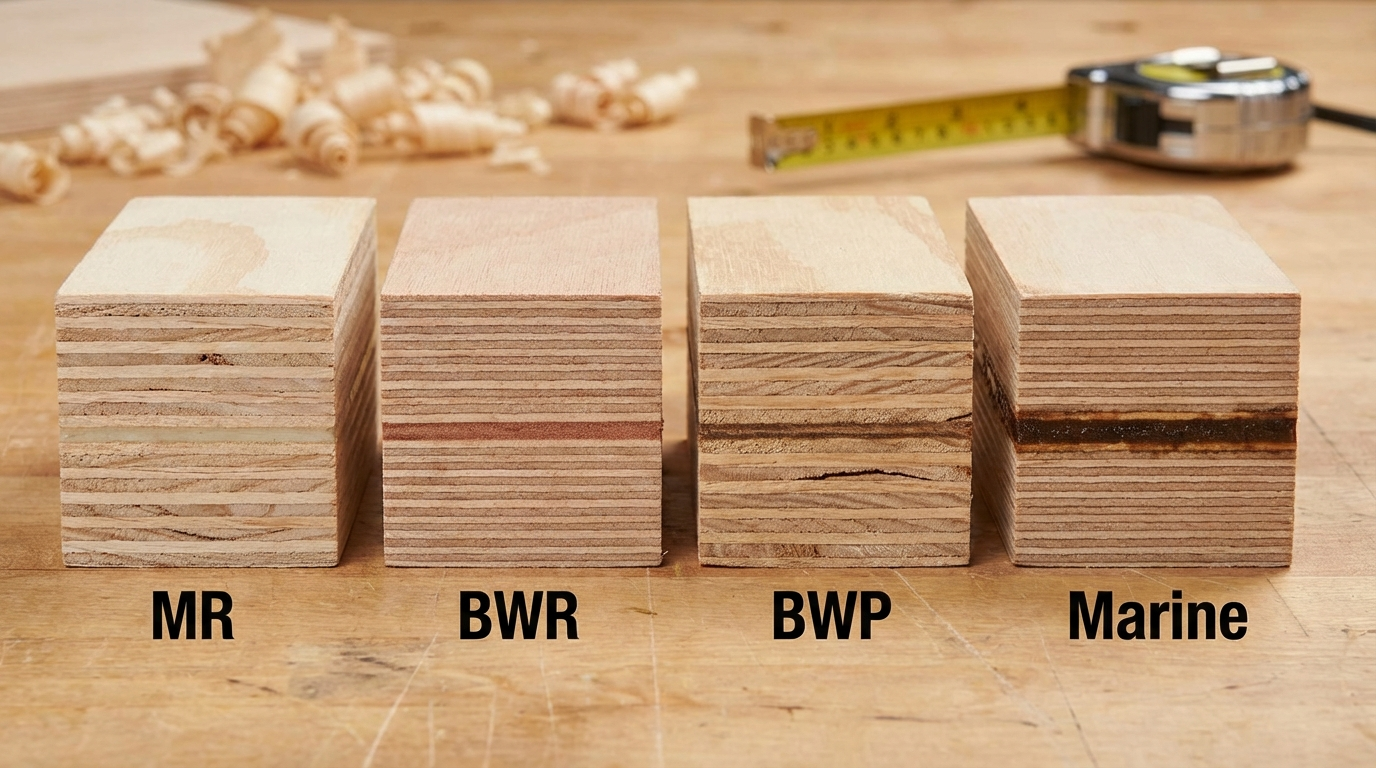
Indian plywood grades follow Bureau of Indian Standards classifications. MR (Moisture Resistant) uses urea-formaldehyde resin suitable only for humidity, not water. BWR (Boiling Water Resistant) uses phenol-formaldehyde or melamine-fortified resin that survives steam and occasional splashes. BWP (Boiling Water Proof) and Marine grade (IS 710) use high-grade phenolic resin with denser cores, designed for prolonged water contact.
Where People Get Confused About Waterproof Grades
- MR is not waterproof: Despite dealer claims, MR grade swells and delaminates with direct water contact within weeks
- BWR and BWP sound similar but differ significantly: BWR handles occasional exposure; BWP handles continuous submersion
- "Marine" doesn't always mean IS 710: Many manufacturers use "marine" as marketing; actual IS 710 certification requires specific testing
- Thickness doesn't equal water resistance: A thick MR sheet fails faster than thin BWP in wet conditions
- Calibrated plywood isn't a water-resistance grade: Calibration refers to thickness uniformity, not moisture performance
- Price alone doesn't indicate grade: Some dealers sell MR at BWR prices; always verify resin type
Price Range and Cost Drivers (India)
Waterproof plywood pricing varies significantly based on grade, thickness, core species, and regional factors. The ranges below represent typical market rates in 2025–2026, though actual prices fluctuate by 15–25% based on location, brand tier, and market conditions.
How Much Does an 8x4 Sheet of Waterproof Plywood Cost?
| Grade | Thickness | Per Sq Ft Range (₹) | 8x4 Sheet Range (₹) | Best For |
|---|---|---|---|---|
| MR (Commercial) | 18–19mm | 45–70 | 1,450–2,250 | Dry interiors only |
| BWR | 12mm | 48–75 | 1,550–2,400 | Kitchen backs, light-duty |
| BWR | 18–19mm | 55–90 | 1,750–2,900 | Kitchen carcass, vanities |
| BWP | 12mm | 65–100 | 2,100–3,200 | Bathroom cabinets |
| BWP | 18–19mm | 85–130 | 2,700–4,200 | Wet zones, under-sink |
| Marine (IS 710) | 12mm | 90–130 | 2,900–4,200 | Exterior, high-moisture |
| Marine (IS 710) | 18–19mm | 110–180 | 3,500–5,800 | Boats, coastal, submersion |
Note: Prices vary by city—Mumbai and Bengaluru typically run 10–15% higher than tier-2 cities. Hardwood core (Gurjan) costs 20–30% more than eucalyptus or poplar core.
What Drives the Price Difference Between Grades?
Several factors create the price gap between waterproof plywood grades:
- Resin system: Phenol-formaldehyde (BWR/BWP) costs more than urea-formaldehyde (MR) due to raw material and curing requirements
- Core species: Gurjan/hardwood cores add ₹15–30 per sq ft over poplar; eucalyptus falls in between
- Veneer quality: Premium face veneers with minimal patches increase cost by ₹8–15 per sq ft
- Calibration: Calibrated sheets (uniform thickness) cost ₹5–12 more per sq ft but reduce fitting issues
- Certification: IS 710 certified marine plywood requires third-party testing, adding to cost
- Brand premium: Established brands charge 15–25% more for warranty backing and quality consistency
How to Ask for a Waterproof Plywood Quote
When requesting quotes, specify these details to get accurate, comparable prices:
- Grade required (BWR/BWP/Marine with IS 710)
- Thickness (in mm, not approximate)
- Core species preference (hardwood/eucalyptus/poplar)
- Calibrated or standard
- Quantity in number of sheets
- Delivery location (logistics affect final price significantly)
- Whether boil test certificate is required
Sample Budget: 10x12 Kitchen Using BWR Plywood
For a typical 10x12 feet modular kitchen with base units, wall units, and tall unit:
- Carcass (18mm BWR): Approximately 12–15 sheets × ₹2,200 average = ₹26,400–33,000
- Back panels (6mm BWR): 4–5 sheets × ₹900 average = ₹3,600–4,500
- Under-sink upgrade to BWP (18mm): 1 sheet × ₹3,500 = ₹3,500
- Wastage (8–12%): Add ₹3,000–4,000
- Total plywood estimate: ₹36,500–45,000
This excludes shutters, hardware, laminates, and labour. Confirm local rates before budgeting.
Two-Minute Comparison That Actually Helps
Rather than memorizing specifications, focus on matching the grade to your specific conditions. The table below simplifies selection based on real-world scenarios.
| Your Situation | Recommended Grade | Why This Works | What to Verify |
|---|---|---|---|
| Bedroom wardrobe, study table | MR (Commercial) | No water exposure; saves cost | Check for termite treatment |
| Kitchen wall units (away from sink) | BWR | Handles cooking steam, humidity | Phenolic resin, not UF |
| Kitchen base units (near sink) | BWR or BWP | Occasional splashes, pipe leaks | Seal all edges with PU |
| Under-sink cabinet | BWP or Marine | High leak risk, condensation | IS 710 cert for marine |
| Bathroom vanity (dry zone) | BWR | Humidity but no direct water | Laminate both faces |
| Bathroom cabinet (wet zone) | BWP or Marine | Water splashes inevitable | Edge band + bottom sealing |
| Balcony storage (covered) | BWP | Rain spray, humidity extremes | Paint/seal all surfaces |
| Coastal home (any application) | Marine (IS 710) | Salt air accelerates degradation | Hardwood core essential |
| Outdoor furniture (shaded) | Marine (IS 710) | Weather exposure, temperature swings | Full surface sealing mandatory |
Is BWR Plywood Enough for Kitchen Cabinets?
For most Indian kitchens, BWR plywood handles the job well when installed correctly. The key conditions: edges must be sealed with PU sealant or edge banding, laminate should cover both faces of shutters, and the under-sink area should use BWP as a targeted upgrade. BWR fails in kitchens primarily due to unsealed edges absorbing water from cleaning, not because the grade itself is inadequate. If your kitchen experiences frequent flooding or you're in a high-humidity coastal area, upgrading entirely to BWP makes sense. Otherwise, BWR with proper edge treatment offers the best cost-to-performance ratio.
India-Specific Reality Check
Plywood performance in India faces challenges that specifications alone don't address. Understanding these realities helps you select and install waterproof plywood correctly.
Monsoon and Coastal Humidity Impact
During monsoon, ambient humidity in coastal cities like Mumbai, Chennai, and Kolkata can exceed 85% for months. Even "waterproof" grades absorb atmospheric moisture through unsealed edges and exposed surfaces. This causes subtle swelling that makes shutter alignment problematic and can trigger early delamination in lower grades. In coastal areas, salt-laden air accelerates adhesive breakdown—marine grade with hardwood core becomes necessary even for indoor furniture.
Storage and Handling Realities
Plywood often sits in dealer godowns or construction sites without proper protection. Sheets stacked on damp floors or exposed to rain during transport begin degrading before installation. Always inspect sheets for existing water damage (wavy edges, soft spots, musty smell) before accepting delivery. Reject any sheet that shows edge swelling or delamination at corners—these defects worsen rapidly after installation.
How Does Poor Storage Affect Even Premium Waterproof Plywood?
Even IS 710 marine plywood loses performance if stored improperly before installation. Water absorption through unsealed edges begins immediately upon exposure. Once moisture enters the core, it cannot be fully removed—the damage is permanent. When purchasing, ask about storage conditions and reject sheets from open-air yards during monsoon. At site, store sheets flat on wooden battens in covered areas, never directly on concrete floors which retain moisture.
Workmanship Variables
The gap between plywood potential and actual performance often comes down to installation. Common issues include: carpenters using the wrong screws (too short, no pilot holes), skipping edge sealing to save time, applying laminate without proper adhesive coverage, and forcing misaligned shutters instead of adjusting hinges. Specify these requirements in writing and inspect during installation, not after completion.
Trade-offs and Limitations
Every waterproof plywood grade involves compromises. Understanding these helps set realistic expectations.
MR Grade Limitations
- Delaminates within weeks of water contact
- Edge swelling occurs even with high humidity
- Not suitable for any kitchen or bathroom application
- Lower screw-holding than BWR/BWP in humid conditions
BWR Grade Trade-offs
- Handles humidity well but fails under standing water
- Requires edge sealing—without it, performs like MR grade
- Poplar-core BWR has lower density and screw retention
- Not suitable for outdoor or submersion applications
BWP/Marine Grade Limitations
- Significantly higher cost (40–80% more than BWR)
- Heavier weight makes handling and installation harder
- Still requires edge sealing for maximum longevity
- Overkill for dry interior applications—wasted investment
- Hardwood core versions are increasingly expensive due to supply constraints
Why Doesn't "Waterproof" Mean Permanent Water Exposure?
Even IS 710 marine plywood is designed to resist water, not be submerged indefinitely. The phenolic adhesive prevents delamination, but the wood veneers themselves absorb water over time. Without protective coatings (paint, laminate, or marine varnish), the surface degrades even if layers remain bonded. For boat hulls or water tanks, additional waterproofing layers are mandatory—the plywood provides structural stability while coatings provide the actual waterproofing barrier.
Common Buyer Mistakes and How to Avoid Them
Mistake 1: Buying Based on Grade Name Alone
Why it happens: Dealers verbally claim "BWR" or "marine" without documentation. Buyers trust the label.
What to do instead: Request the test certificate showing boil test results. Check for ISI mark with licence number. Verify resin type is phenolic, not urea-based.
Mistake 2: Specifying MR Grade for Kitchen Backs
Why it happens: Kitchen backs seem "dry" and MR costs less. Contractors suggest it to reduce quotes.
What to do instead: Kitchen backs face humidity from cooking, cleaning splashes, and wall condensation. Use minimum BWR grade even for back panels.
Mistake 3: Skipping Edge Sealing
Why it happens: Edge banding or PU sealing adds time and cost. Carpenters skip it unless specifically required.
What to do instead: Include edge treatment in the scope of work with payment tied to verification. Unsealed edges are the primary failure point for all grades.
Mistake 4: Assuming All Marine Plywood is IS 710 Certified
Why it happens: "Marine" is used as a marketing term. Many products lack actual certification.
What to do instead: Ask specifically for IS 710 compliance certificate. Check the ISI mark on the sheet itself. Generic "marine grade" claims without certification are unreliable.
Mistake 5: Over-specifying for Dry Areas
Why it happens: Fear of failure leads to using BWP/marine everywhere "just in case."
What to do instead: Use MR for wardrobes, study units, and bedroom furniture where no moisture exposure occurs. Reserve premium grades for genuinely wet or humid zones. This can save 25–35% on material costs.
Mistake 6: Ignoring Core Species
Why it happens: Focus stays on grade (BWR/BWP) while ignoring whether core is hardwood, eucalyptus, or poplar.
What to do instead: For heavy-use cabinets with soft-close hinges, specify hardwood or eucalyptus core. Poplar-core sheets have lower screw retention and impact resistance regardless of water-resistance grade.
Mistake 7: Not Accounting for Wastage
Why it happens: Buyers calculate exact area needed without considering cutting waste.
What to do instead: Add 10–15% wastage for standard layouts, 15–20% for complex designs with angles or curves. Running short mid-project forces buying from different batches with colour/thickness variation.
Mistake 8: Accepting Damaged Sheets to Avoid Delays
Why it happens: Project timelines pressure acceptance of slightly damaged or water-exposed sheets.
What to do instead: Reject any sheet with edge swelling, soft spots, or visible delamination. These defects accelerate after installation. Short-term delay is better than premature replacement.
Failure Modes and Fixes
Failure: Edge Swelling After 6–12 Months
Symptom: Shutters don't close properly; visible puffiness at edges.
Root cause: Unsealed edges absorbed moisture from cleaning or humidity.
Prevention: Apply PU sealant or edge banding to all cut edges before installation.
Fix if already happening: Sand swollen areas, apply wood hardener, seal with PU, and re-laminate if surface is damaged. Severe cases require panel replacement.
Failure: Delamination at Hinge Zones
Symptom: Layers separating near hinge screws; hinges pulling out.
Root cause: Low-density core couldn't handle hinge stress, or pilot holes weren't drilled.
Prevention: Use hardwood-core plywood for shutter edges. Always drill pilot holes. Consider hinge reinforcement plates.
Fix if already happening: Fill damaged area with wood filler mixed with sawdust. Re-drill in adjacent area. For severe damage, attach a backing plate and relocate hinges.
Failure: Surface Bubbling Under Laminate
Symptom: Laminate lifts or bubbles in patches.
Root cause: Moisture trapped under laminate due to poor adhesive coverage or plywood absorbed water before lamination.
Prevention: Ensure plywood is stored in dry conditions. Apply adhesive uniformly with proper open time. Use pressure during bonding.
Fix if already happening: Small bubbles can be slit, injected with adhesive, and pressed flat. Large areas require laminate removal and reapplication.
Failure: Warping of Full Panels
Symptom: Flat panels develop curves or twists.
Root cause: One face absorbed more moisture than the other (laminate on one side only, or uneven humidity exposure).
Prevention: Laminate or seal both faces of panels. Store sheets flat with even support.
Fix if already happening: Mild warping can be corrected by moistening the concave side and applying weight. Severe warping requires panel replacement.
Failure: Fungal Growth in Wet Areas
Symptom: Dark spots, musty smell, visible mould.
Root cause: Continuous moisture exposure without adequate ventilation or sealing.
Prevention: Use BWP/Marine grade with anti-fungal treatment for bathroom cabinets. Ensure ventilation gaps at bottom of cabinets.
Fix if already happening: Clean with anti-fungal solution. Apply mould-resistant sealant. If penetration is deep, replacement is necessary.
Failure: Under-Sink Cabinet Collapse
Symptom: Bottom panel soft, sagging, or breaking through.
Root cause: MR or low-quality BWR used in high-risk zone; slow leak went unnoticed.
Prevention: Always use BWP or marine grade under sink. Install leak detector or make daily visual checks a habit.
Fix if already happening: Replace bottom panel entirely with BWP grade. Add aluminium channel at panel edges for protection. Fix any plumbing leaks before reinstalling.
Quality Checks You Can Do Without Lab Tests
Before Buying: Visual and Physical Inspection
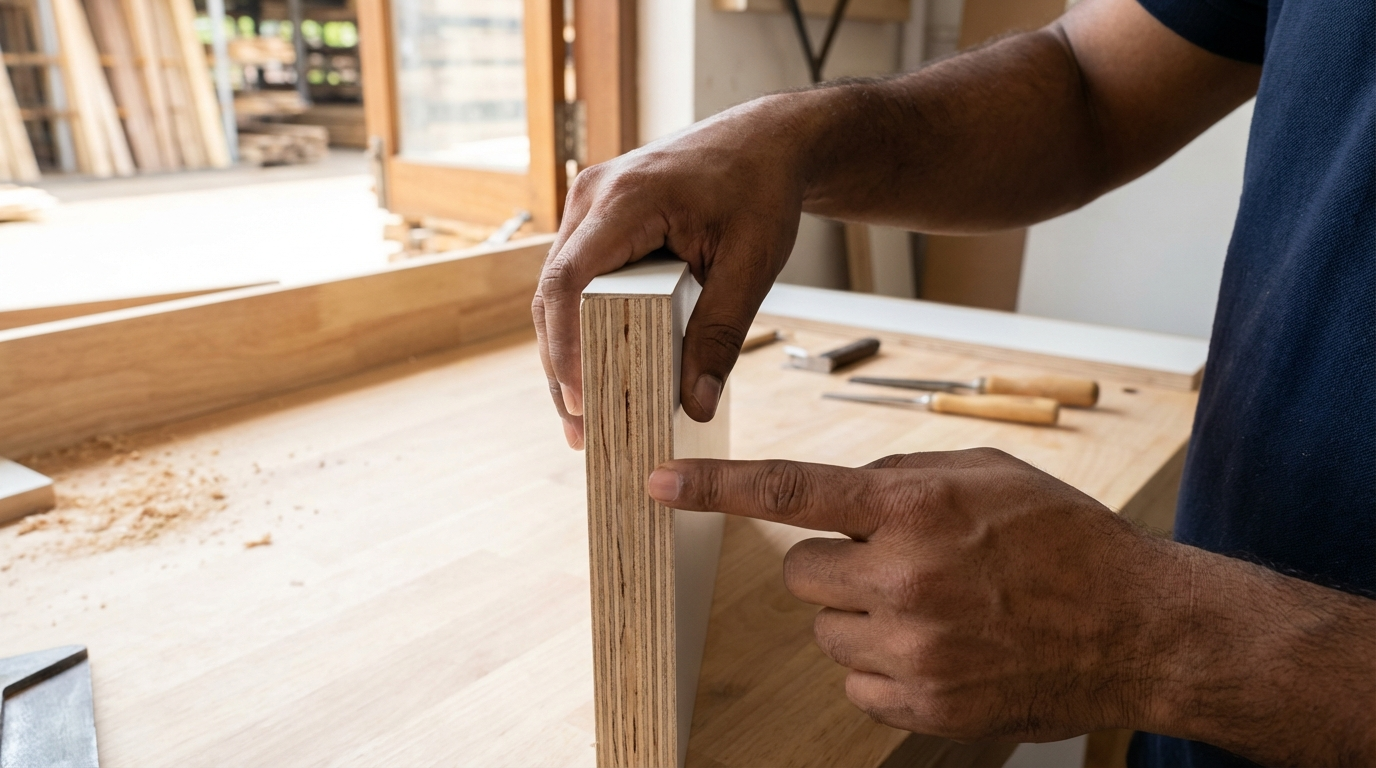
- Edge inspection: Look at sheet edges for gaps between layers, voids in core, or uneven glue lines
- Tap test: Knock on the surface—hollow sounds indicate internal voids or delamination
- Weight check: Heavier sheets typically indicate denser core; compare similar-thickness sheets
- Smell test: Musty or sour smell suggests moisture damage or fungal growth
- Flex test: Gently flex a sheet corner—excessive flexibility suggests weak glue bond
- Surface flatness: Sight along the surface for warping or waviness
- ISI mark verification: Check for ISI mark with licence number; counterfeit marks often have blurry printing or incorrect formatting
What Questions Should You Ask the Dealer?
Prepare these questions before purchasing waterproof plywood:
- What resin system is used—phenolic or urea-formaldehyde?
- Is this sheet IS 710 certified? Can I see the test certificate?
- What is the core species—hardwood, eucalyptus, or poplar?
- Where has this batch been stored? For how long?
- What is the return policy for defective sheets?
- Is this calibrated or standard thickness?
After Cutting: Workmanship Cues
- Clean cut edge: Quality plywood cuts cleanly without excessive splintering
- Core visibility: Uniform layers without gaps, overlaps, or foreign material
- Screw holding: Test screws should hold firmly without stripping; weak holding suggests low-density core
- Laminate adhesion: After lamination, check edges for any lifting or poor bond
After Installation: Ongoing Verification
- Check shutter alignment monthly for the first year—swelling shows as misalignment first
- Inspect under-sink areas weekly for any moisture or leaks
- Wipe spills immediately; don't let water stand on surfaces
- Ensure adequate ventilation in bathroom cabinets—leave 10mm gap at bottom
- Re-apply PU sealant to cut edges if laminate chips expose raw plywood
Tips for Homeowners
Durability and Maintenance Do's
- Wipe down kitchen cabinets weekly with a damp (not wet) cloth
- Use coasters under potted plants on plywood furniture
- Ensure bathroom exhaust fans run during and after showers
- Check under sinks monthly for slow leaks—early detection prevents major damage
- Maintain air conditioning to control indoor humidity during monsoon
Maintenance Don'ts
- Don't flood-wash cabinet interiors—use damp cloth only
- Don't store wet utensils directly on plywood shelves without drying
- Don't ignore small chips in laminate—seal immediately with matching edge band
- Don't place hot vessels directly on laminated plywood surfaces
- Don't block ventilation gaps under bathroom vanities
Tips for Carpenters and Contractors
Cutting and Edge Preparation
- Use sharp TCT blades for clean cuts; dull blades cause splintering and delamination
- Cut with good face down on table saws, good face up on circular saws
- Apply masking tape along cut lines to reduce chip-out on laminated surfaces
- Sand all cut edges before sealing; rough edges absorb more sealant without proper penetration
Fastening and Hinge Zones
- Always drill pilot holes—plywood layers can split without pre-drilling
- Use screws at least 2.5x the thickness of the material being fastened
- For hinges on shutters, reinforce edge with hardwood strip or use cup hinges with backing plates
- Avoid screwing too close to edges—maintain minimum 15mm from panel edge
Handling and Storage at Site
- Store sheets flat on timber battens, never on concrete floors
- Keep protected from rain even for short periods
- Acclimatize plywood to site conditions for 48–72 hours before cutting
- Stack sheets of same size together; mixed stacking causes warping
Tips for Architects and Interior Designers
Specification Writing
- Specify grade (BWR/BWP/Marine IS 710), thickness, core species, and calibration requirement
- Include edge treatment specification—type of sealant or edge band
- Specify laminate application on both faces for panels in variable humidity zones
- Call out under-sink and wet-zone requirements separately with higher grade
Detailing for Wet Zones
- Design ventilation gaps (10–15mm) at bottom of bathroom and kitchen base units
- Specify aluminium channels at bottom edges of sink cabinets
- Show waterproofing membrane turn-up detail where cabinets meet tiled walls
- Avoid designing storage that traps moisture—ensure air circulation paths
Finish Selection Logic
- High-pressure laminates (HPL) offer better moisture resistance than low-pressure (LPL)
- Acrylic and PU finishes require BWP substrate in wet areas
- Membrane/PVC finishes are inherently moisture-resistant but ensure substrate quality matches
- Natural veneer finishes on plywood need additional sealing in humid environments
Tips for Modular Furniture Manufacturers and OEMs
Incoming Quality Control
- Establish receiving inspection protocol—check batch certificates, dimensions, moisture content
- Reject batches showing any edge swelling, delamination, or inconsistent thickness
- Maintain vendor qualification based on consistent quality, not just price
- Store incoming material in controlled humidity conditions
Process Checkpoints to Reduce Returns
- Verify edge sealing completion before lamination
- Check laminate bond quality with sample destructive tests from each batch
- Ensure all hardware mounting points have pilot holes
- Photograph completed units before dispatch for warranty reference
Customer Communication
- Document grade and core species in customer quotations and invoices
- Provide written care instructions covering cleaning, ventilation, and leak prevention
- Set realistic expectations—explain that "waterproof" means water-resistant, not submersion-proof
- Include moisture-related failures in warranty exclusions if caused by improper use
Decision Framework: Which Grade for Your Situation
| Condition/Scenario | Recommended Grade | What to Verify Before Buying |
|---|---|---|
| Dry interior (bedroom, living room) | MR (Commercial) | Termite treatment, ISI mark |
| Kitchen carcass (wall units) | BWR | Phenolic resin, calibrated thickness |
| Kitchen carcass (base units) | BWR with sealed edges | Edge banding included in scope |
| Under-sink cabinet | BWP or Marine | IS 710 certificate for marine |
| Bathroom vanity (dry zone) | BWR | Both-face lamination specified |
| Bathroom cabinet (wet zone) | BWP or Marine | Ventilation gap in design |
| Coastal location (any use) | Marine (IS 710) | Hardwood core, full sealing |
| Outdoor furniture (shaded) | Marine (IS 710) | Marine varnish/paint finish planned |
| Heavy-use (soft-close, frequent opening) | BWR/BWP with hardwood core | Core species confirmed |
| Tight budget, minimal moisture | MR | Not for any kitchen/bath use |
| Modular kitchen (full) | BWR carcass, BWP under sink | Calibrated for consistent fitting |
| Commercial kitchen/washroom | Marine (IS 710) | FR treatment if fire code applies |
FAQs
What is the difference between BWR and BWP plywood?
BWR (Boiling Water Resistant) plywood uses phenol-formaldehyde resin and handles humidity and occasional water splashes well—suitable for most kitchen applications when edges are sealed. BWP (Boiling Water Proof) plywood uses higher-grade phenolic bonding and denser core construction, designed for continuous water exposure like under-sink cabinets, bathroom wet zones, and exterior furniture. BWR is adequate for 80% of residential kitchen needs; BWP is necessary only where direct, repeated water contact is expected. Price difference is typically 30–50%, so use BWP selectively rather than throughout.
Is marine plywood really necessary for kitchens?
For most residential kitchens, marine plywood is unnecessary and adds avoidable cost. BWR grade with proper edge sealing handles kitchen humidity and occasional splashes effectively. Marine plywood (IS 710) makes sense only in specific scenarios: under-sink cabinets where leak risk is high, homes in coastal areas where salt air accelerates degradation, or commercial kitchens with heavy wash-down cleaning. Using marine grade throughout a kitchen typically increases plywood cost by 40–60% without proportional benefit. Target upgrades to high-risk zones instead of blanket specification.
How long does waterproof plywood last in a bathroom?
Longevity depends on grade, installation quality, and maintenance rather than the plywood alone. BWP or marine grade plywood in a bathroom typically lasts 12–18 years with proper installation—meaning sealed edges, both-face lamination, and ventilation gaps at cabinet bottoms. BWR grade in dry zones (vanity tops away from shower spray) can last 10–15 years. Failures usually occur at edges and bottom panels first, often within 3–5 years if unsealed. The biggest longevity factor is preventing moisture accumulation through ventilation and prompt leak repair.
Can I use MR plywood for kitchen backs if I seal the edges?
This approach is risky and not recommended. MR grade uses urea-formaldehyde resin that degrades with humidity exposure even when edges are sealed. Kitchen backs face cooking steam, wall condensation, and cleaning moisture that penetrate over time. While edge sealing helps, MR grade simply isn't designed for this environment. The cost saving (typically ₹500–800 per sheet compared to BWR) isn't worth the replacement cost when delamination occurs within 2–4 years. Use minimum BWR grade for all kitchen components including backs.
What thickness of waterproof plywood should I use for kitchen cabinets?
Standard practice uses 18mm or 19mm BWR/BWP plywood for carcass sides, shelves, and base panels. This thickness provides adequate screw-holding strength for hinges and handles while resisting flex under load. Back panels typically use 6mm or 8mm of the same grade—not MR regardless of cost savings. For drawer bottoms, 12mm works well. Shutters typically use 18mm with laminate on both sides. If using heavy stone countertops, ensure base supports are 19mm minimum. Calibrated plywood in these thicknesses ensures consistent fitting for modular construction.
How can I verify if plywood is really BWR or BWP grade?
Visual inspection has limits, but several checks help. First, request the boil test certificate from the manufacturer—reputable brands provide these. Second, check for the ISI mark with licence number; verify this number against BIS records if uncertain. Third, examine the edge—phenolic bonding (BWR/BWP) shows a darker glue line compared to the lighter urea-formaldehyde (MR) glue line. Fourth, ask the dealer about resin type and get it in writing on the invoice. For high-value projects, purchase a single sheet first and conduct your own boil test—submerge a sample in boiling water for 6–8 hours and check for delamination.
Why is marine plywood priced so much higher than BWR?
The price premium reflects several factors. Marine plywood (IS 710) requires denser hardwood veneers with minimal defects—these raw materials cost more and have limited supply. The phenolic resin system is higher grade with stricter quality control. Manufacturing involves more pressing cycles and longer curing times. Third-party testing for IS 710 certification adds cost. Core construction has tighter standards for void-free layup. Finally, market perception allows premium pricing. Whether this premium is justified depends on your application—for interior kitchens, BWR typically delivers adequate performance at significantly lower cost.
Should I use calibrated waterproof plywood for modular kitchen?
Calibrated plywood significantly improves fit and finish in modular kitchens and is worth the 8–15% premium in most cases. Calibration ensures uniform thickness (typically ±0.3mm tolerance versus ±1mm for standard), which means shutters align consistently, edge banding adheres better, and CNC-cut components fit precisely. For modular manufacturers using automated machinery, calibrated sheets reduce rework and waste. For hand-built kitchens, the benefit is less pronounced but still noticeable in shutter alignment. If budget is tight, prioritize calibration for shutters and external visible components while using standard tolerance for internal carcass parts.
What happens if I use wrong grade plywood in wet areas?
Using MR grade in wet areas leads to predictable failure progression. Initially, edges absorb moisture and swell, causing shutters to stick or not close properly. Within 6–12 months, surface bubbling appears under laminate as trapped moisture expands. Delamination follows—layers separate and panel strength drops dramatically. In severe cases, fungal growth occurs within the core. Repair typically isn't viable; full replacement becomes necessary. The replacement cost including labour and disruption typically exceeds the initial savings from using MR instead of BWR or BWP by 3–5 times. Prevention is dramatically cheaper than correction.
Is waterproof plywood suitable for exterior furniture?
Even marine-grade plywood requires additional protection for exterior use. The "waterproof" designation means the adhesive system resists water, but the wood veneers themselves absorb moisture and degrade with sun exposure. For outdoor furniture, marine plywood provides the structural substrate, but you must apply exterior-grade paint, marine varnish, or weather-resistant coating on all surfaces including edges. Recoating is needed every 2–3 years depending on exposure. Even with protection, outdoor plywood furniture has limited life compared to solid teak or treated hardwood. Consider marine plywood for covered/shaded outdoor areas rather than fully exposed locations.
How do I calculate waterproof plywood quantity for a kitchen?
Start with a detailed cabinet drawing showing all panels with dimensions. Calculate total square footage by listing each panel (sides, tops, bottoms, shelves, backs, shutters) with length × width. Sum all panels and convert to 8×4 sheet count (32 square feet per sheet). Add wastage: 10–12% for simple rectangular layouts, 15–18% for L-shaped or complex designs. Round up to whole sheets. For example, a 100 sq ft total requirement with 15% wastage equals 115 sq ft, or approximately 4 sheets (128 sq ft available). Always buy complete sheets—partial requirements from different batches may have colour or thickness variations.
Can waterproof plywood be used for false ceiling in bathroom?
BWR or BWP plywood can be used for bathroom false ceilings in dry zones (not directly above shower or bathtub). However, this requires proper ventilation above the ceiling to prevent moisture accumulation, exhaust fan capacity adequate for the bathroom size, and primer and moisture-resistant paint on both faces. A simpler approach for bathroom ceilings is moisture-resistant gypsum board or PVC panels, which handle humidity better without the weight and edge-sealing requirements of plywood. If plywood is specified for design reasons (curved sections or complex shapes), use BWP grade with all surfaces sealed before and after installation.
Disclaimer: This content is provided for general informational purposes based on industry practices and publicly available information. Product specifications, standards, prices, and availability may vary by manufacturer, region, and time. Readers should independently verify details with manufacturers, dealers, or qualified professionals before making purchase or construction decisions.Want Plywood Suggestions?
Share a few details and a Duro BOIL specialist will suggest suitable brands and connect you to responsive dealers.