Blockboard Explained: When to Use Blockboard vs Plywood (Doors, Partitions, Shelves)
Blockboard explained with real use-cases (doors, partitions, shelves). Compare blockboard vs plywood on strength, warping, screw holding and price.
Quick Decision Summary
Best one-line answer: Use blockboard for long, stable surfaces like doors and partitions; use plywood when you need superior screw-holding and cross-grain strength.
If you're in a hurry: Blockboard excels in applications requiring length and dimensional stability—flush doors, tall partitions, and wide tabletops—because its solid wood strip core resists bending and warping over spans. Plywood performs better where edge-screwing, heavy loading on shelves, or moisture resistance matters. For doors, blockboard is typically the first choice. For kitchen cabinets and shelving with adjustable fittings, plywood usually wins. Your decision should hinge on the specific load pattern, fixing method, and whether edges will be exposed or concealed.
- Choose blockboard if: You're building flush doors, tall partitions, or long conference tables where span stability matters most.
- Avoid blockboard if: You need to drive screws into edges, require high moisture resistance, or are building shelves with heavy point loads.
What Blockboard Actually Means (And Why It's Different From Plywood)
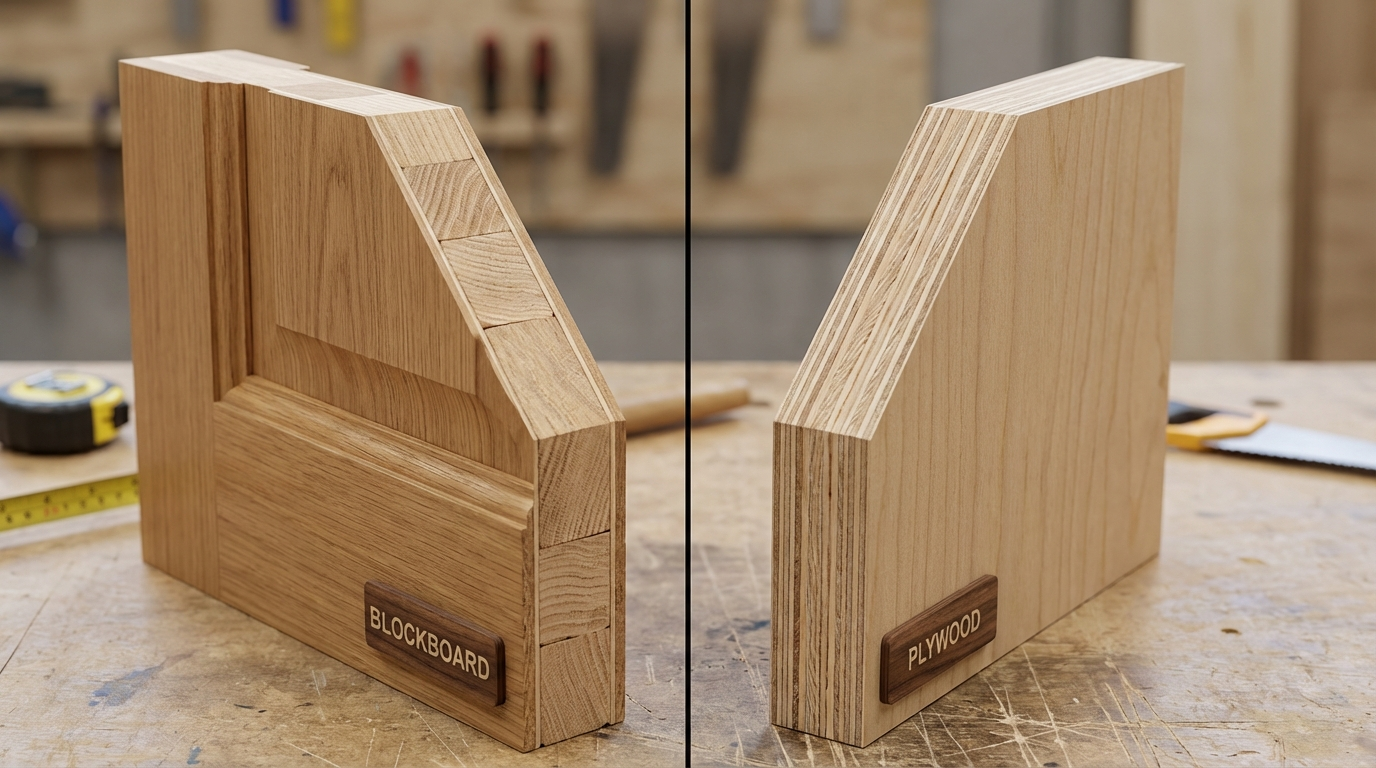
Blockboard is an engineered wood panel with a core made of solid softwood strips (typically 25–30mm wide) placed edge-to-edge, sandwiched between face veneers on both sides. This strip-core construction creates excellent lengthwise rigidity, making blockboard naturally suited for applications where long spans must stay flat without sagging.
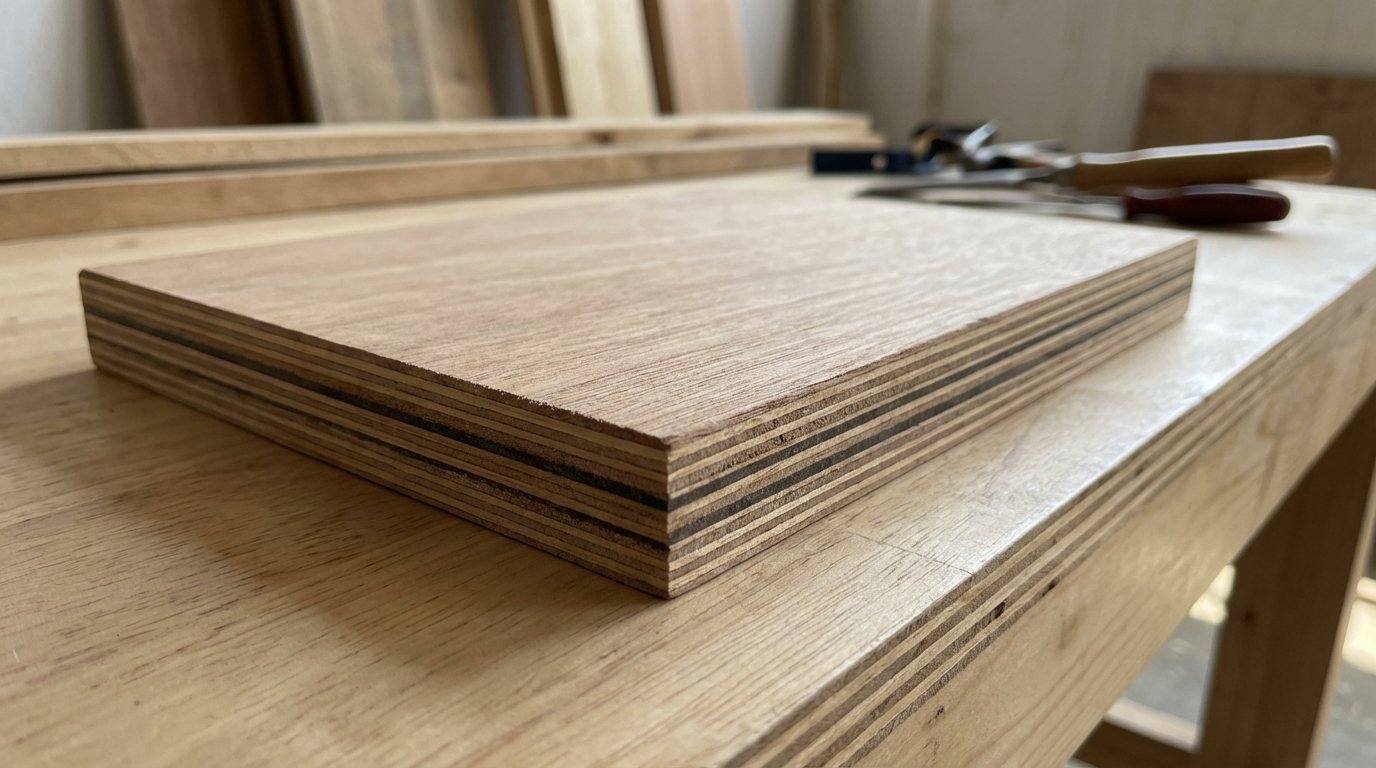
Plywood, by contrast, is built from multiple thin veneer layers glued with grains alternating at right angles. This cross-laminated construction gives plywood multi-directional strength and better screw-holding on all faces and edges.
Where People Get Confused About Blockboard
- Assuming blockboard is just "thick plywood": The internal construction is fundamentally different—strips versus cross-laminated veneers.
- Thinking blockboard holds edge screws well: Screws driven into the narrow edge often hit gaps between strips, resulting in weak grip.
- Believing all blockboard is waterproof: Standard blockboard uses MR-grade adhesive; BWR or marine-grade blockboard costs significantly more and is less common.
- Expecting uniform density throughout: Strip cores can vary in wood quality; some batches have softer strips that compress unevenly.
- Confusing "commercial blockboard" with "commercial plywood": Despite similar naming, their performance characteristics differ substantially.
India-Specific Reality Check
Climate and site conditions across India create real differences in how blockboard and plywood perform. Understanding these helps you specify correctly and avoid callbacks.
Monsoon and Coastal Humidity Factors
In cities like Mumbai, Chennai, Kochi, and Kolkata, humidity regularly exceeds 80% for months. Standard MR-grade blockboard can absorb moisture through unsealed edges, causing strip cores to swell unevenly. Plywood's cross-grain construction handles humidity cycling better, though neither material is immune without proper edge sealing. Coastal environments also accelerate fungal growth in gaps between blockboard strips if the panel gets damp.
Storage and Handling on Indian Sites
Blockboard panels stored flat on uneven ground or leaned against walls at steep angles can develop permanent warps faster than plywood. The strip core, being directional, offers less resistance to twisting. On typical Indian construction sites where materials sit for weeks before installation, plywood generally tolerates rough handling better. Always insist on stacking blockboard horizontally on flat bearers, protected from direct sun and rain.
Carpenter Workflow Considerations
Most Indian carpenters are highly familiar with plywood cutting and fixing patterns. Blockboard requires awareness of grain direction for optimal results—cutting across the strip direction works fine, but ripping lengthwise through strip joints can create rough edges. Edge banding on blockboard needs extra attention because the strip pattern can telegraph through thin laminates if core quality is inconsistent.
Two-Minute Comparison That Actually Helps
| Property | Blockboard | Plywood |
|---|---|---|
| Core construction | Solid wood strips (edge-to-edge) | Cross-laminated veneer layers |
| Best for long spans | Excellent—resists sag over length | Good, but may need support beyond 900mm |
| Screw-holding (face) | Good if screw hits solid strip | Very good across entire surface |
| Screw-holding (edge) | Poor—gaps between strips | Good with proper pilot holes |
| Weight | Lighter per sq ft at same thickness | Heavier, denser construction |
| Moisture resistance | MR standard; BWR less common | MR, BWR, BWP/Marine all available |
| Warping tendency | Low lengthwise, moderate widthwise | Low in all directions (cross-grain) |
| Typical use | Flush doors, partitions, table tops | Cabinets, shelves, shutters, wet zones |
| Price (comparable thickness) | Often 10–20% lower than equivalent plywood | Higher, especially for BWR/BWP grades |
When Should You Choose Based on Conditions?
If your application involves long horizontal or vertical surfaces that must stay flat without intermediate support—like a 7-foot door shutter or a 10-foot partition panel—blockboard's strip core provides natural rigidity. If you need to drive screws into edges (like cabinet box construction) or require reliable moisture performance (kitchen base units), plywood is the safer choice. For tabletops where the edge will be lipped with solid wood, blockboard works well because edge-screw weakness becomes irrelevant.
Doors: Why Blockboard Dominates This Application
Flush doors in Indian homes are overwhelmingly made with blockboard cores, and this isn't arbitrary. Understanding why helps you specify correctly.
What Makes Blockboard Ideal for Door Shutters?
A standard door shutter spans 6.5 to 7.5 feet vertically and hangs from hinges on one edge. The primary structural demand is resisting lengthwise bending—a load pattern that perfectly suits blockboard's strip-core strength. Additionally, doors need to remain flat over years of opening and closing cycles, and blockboard's directional rigidity delivers this better than most alternatives at comparable cost.
Door faces typically receive veneer, laminate, or paint—all of which bond well to blockboard's face veneer. Since hinge screws go into the edge (a blockboard weakness), experienced carpenters reinforce hinge zones with solid wood blocks or use longer screws that pass through into a secondary frame. Lock mortising follows similar logic—cut the pocket carefully and reinforce if needed.
Can Plywood Be Used for Doors Instead?
Yes, but it's less common for standard flush doors because plywood of equivalent rigidity tends to be heavier and more expensive. Plywood doors make sense in specific situations: bathroom doors needing BWR/BWP grade, heavy-duty commercial doors requiring superior screw-holding for closers and panic hardware, or fire-rated door assemblies where plywood-based cores meet certification requirements.
Partitions: Choosing Between Blockboard and Plywood
Internal partitions in offices, homes, and commercial spaces often span large areas with minimal framing. Material choice affects both structural performance and long-term appearance.
When Does Blockboard Work Well for Partitions?
For tall, wide partition panels that span between floor and ceiling with limited intermediate framing, blockboard's lengthwise rigidity prevents bowing. Typical applications include office cabin walls, wardrobe back panels (when visible), and room dividers. The lighter weight also reduces load on framing and simplifies handling during installation.
When Should You Prefer Plywood for Partitions?
If the partition needs to support shelving brackets, hooks, or wall-mounted fixtures, plywood's superior screw-holding becomes critical. Bathroom partitions or partitions in humid zones benefit from BWR plywood. Where fire rating matters, specific plywood constructions may meet requirements more easily than blockboard.
Shelves: Where Plywood Usually Wins
Shelving involves point loads, edge-mounted brackets, and often adjustable fittings—all conditions that favour plywood over blockboard.
Why Is Blockboard Risky for Shelves?
Shelf brackets typically screw into shelf edges. Blockboard's strip core creates unpredictable edge-screw grip—some screws hit solid wood, others find gaps. Under load, weak screws pull out, causing shelf failure. Additionally, heavy point loads (like stacks of books concentrated in one spot) can compress softer strips in low-quality blockboard, creating visible dips over time.
What Makes Plywood Better for Shelving?
Plywood's cross-laminated construction provides consistent screw-holding across the entire edge. For adjustable shelving systems using shelf pins or cam locks, plywood grips the fittings reliably. If shelves span more than 600–700mm without support, 18mm plywood combined with edge lipping or a metal channel underneath prevents sag better than blockboard of similar thickness.
Price Range and Cost Drivers (India)
Prices vary significantly by region, brand, core quality, and current timber costs. Use these ranges as directional guidance, not fixed benchmarks.
Typical Price Ranges for 19mm Thickness (per sq ft)
- Commercial blockboard (MR grade): Typically ₹45–70
- Commercial plywood (MR grade): Typically ₹55–85
- BWR plywood: Typically ₹75–120
- BWR blockboard: Less commonly stocked; expect 15–25% premium over MR blockboard
- BWP/Marine plywood: Typically ₹110–180
What Drives These Cost Differences?
Blockboard costs less primarily because the strip core uses lower-grade softwood compared to the hardwood veneers in quality plywood. Face veneer species affects price—teak-faced panels cost substantially more than plantation hardwood faces. Calibrated panels (sanded to uniform thickness) command premiums over uncalibrated stock. City-level variation exists: metros with established plywood markets may offer competitive rates, while remote locations add logistics costs.
How to Ask for a Quote
- Specify exact thickness needed (18mm, 19mm—these differ)
- State grade requirement (MR, BWR, BWP)
- Mention face veneer preference if any
- Ask whether price includes delivery and unloading
- Confirm quantity pricing versus single-sheet rates
- Request to see sample pieces before bulk purchase
Decision Framework: Matching Conditions to Material Choice
| Your Situation | Recommended Choice | What to Verify |
|---|---|---|
| Flush door for bedroom/living room | Blockboard (MR grade) | Core strip density; face veneer bond; request hinge zone reinforcement |
| Bathroom door | BWR plywood or BWR blockboard | Grade marking; edge sealing plan |
| Modular kitchen cabinet boxes | BWR plywood | Edge-screw grip test; calibration for modular fit |
| Long conference table top | Blockboard with solid wood lipping | Core flatness; lipping species match |
| Bookshelves with heavy loads | 18mm BWR plywood | Span-to-thickness ratio; edge support method |
| Office partition (7+ feet tall) | Blockboard (if no fixtures) | Straightness; storage conditions before install |
| Partition with wall-mounted TV/shelves | Plywood | Screw-holding test; backing frame adequacy |
| Coastal home furniture | BWP/Marine plywood | IS 710 grade marking; termite treatment |
| Tight budget, dry interior wardrobe | Commercial blockboard with plywood for shelves | Face bond quality; avoid for adjustable shelf systems |
Trade-offs and Limitations
Every material involves compromises. Knowing these upfront prevents disappointment.
Blockboard Trade-offs
- Poor edge performance: Screws into edges are unreliable; requires reinforcement or design workarounds.
- Limited moisture-resistant options: BWR and marine-grade blockboard exist but are harder to source and costlier.
- Variable core quality: Strip density and wood species vary between manufacturers and batches.
- Directional strength: Strong along strip direction, weaker across—requires orientation awareness during design.
Plywood Trade-offs
- Higher cost at equivalent performance: Quality plywood costs more than blockboard for similar thickness.
- Heavier panels: Increases handling difficulty and structural load on framing.
- Core voids in cheap plywood: Low-quality plywood can have gaps that weaken screw-holding and cause delamination.
- Overkill for simple spans: Using plywood where blockboard suffices wastes budget without functional benefit.
Common Buyer Mistakes and How to Avoid Them
Mistake 1: Using Blockboard for Kitchen Cabinet Boxes
Why it happens: Blockboard is cheaper, and buyers assume "wood is wood."
What to do instead: Use BWR plywood for cabinet boxes where hinges, drawer slides, and shelf pins need reliable screw-holding. Reserve blockboard for shutter faces if lipped properly.
Mistake 2: Ignoring Grain Direction in Blockboard
Why it happens: Carpenters accustomed to plywood cut blockboard without checking strip orientation.
What to do instead: Mark strip direction before cutting; orient strips vertically in door shutters for maximum rigidity.
Mistake 3: Skipping Edge Sealing
Why it happens: Time pressure on site; assumption that laminate covers everything.
What to do instead: Seal all exposed blockboard and plywood edges with edge band, primer, or PU sealer—especially in humid regions.
Mistake 4: Buying Based on Price Alone
Why it happens: Budget constraints push decisions toward cheapest available option.
What to do instead: Check core quality (tap test, visual inspection of cut edges) before purchasing. A slightly more expensive panel with consistent core saves rework costs.
Mistake 5: Using MR Grade in Wet Zones
Why it happens: MR and BWR look identical; grade markings are missed or ignored.
What to do instead: Verify grade stamp. For kitchens and bathrooms, insist on BWR minimum. For sink cabinets and bathroom floors, consider BWP.
Mistake 6: Overloading Blockboard Shelves
Why it happens: Initial performance seems fine; degradation happens gradually.
What to do instead: Use plywood for load-bearing shelves, or limit blockboard shelf spans to under 450mm with support underneath.
Mistake 7: Not Accounting for Storage Damage
Why it happens: Panels delivered early sit on site exposed to elements.
What to do instead: Time delivery close to installation. Store flat on level bearers, protected from rain and direct sun.
Mistake 8: Assuming All Blockboard Is Equal
Why it happens: Buyers don't inspect core quality or compare brands.
What to do instead: Request a sample cut to inspect strip density, gap frequency, and face veneer adhesion before bulk purchase.
Failure Modes and Fixes
Failure: Door Shutter Warping
Symptom: Door doesn't close flush; visible twist or bow.
Likely cause: Uneven moisture absorption, poor storage before installation, or using plywood instead of blockboard for tall shutters.
Prevention: Use quality blockboard with sealed edges; store properly; ensure uniform finishing on both faces.
If already happening: Minor warps can sometimes be corrected by adding weight and moisture to the concave side. Severe warps usually require replacement.
Failure: Hinge Screws Pulling Out
Symptom: Hinge becomes loose; door sags.
Likely cause: Screws hit gaps between blockboard strips.
Prevention: Use longer screws; pre-drill and fill with wood filler; install solid wood reinforcement blocks at hinge locations.
If already happening: Fill stripped holes with wooden dowels and glue, re-drill, or relocate hinge slightly to hit solid material.
Failure: Shelf Sagging
Symptom: Visible dip in middle of shelf; worsens over time.
Likely cause: Blockboard used for wide span; point loads on soft strips; insufficient thickness.
Prevention: Use plywood for shelves over 500mm span; increase thickness or add edge stiffener.
If already happening: Add support underneath or replace with appropriate material.
Failure: Edge Delamination
Symptom: Face veneer peeling at edges; visible separation.
Likely cause: Moisture entry through unsealed edges; poor initial glue bond.
Prevention: Seal edges before installation; buy from reputable sources with quality adhesive.
If already happening: Trim damaged portion; re-glue and clamp; seal properly.
Failure: Laminate Telegraphing Core Pattern
Symptom: Strip pattern visible through laminate surface.
Likely cause: Uneven core density in blockboard; thin laminate used.
Prevention: Use calibrated blockboard; apply thicker laminate or add intermediate layer.
If already happening: Cosmetic issue—live with it or re-laminate with thicker material.
Failure: Fungal Growth in Core
Symptom: Musty smell; visible mold at edges; soft spots.
Likely cause: Prolonged moisture exposure in MR-grade material.
Prevention: Use appropriate grade for location; seal edges; ensure ventilation in enclosed spaces.
If already happening: Severe cases require replacement. Mild surface mold can be treated, but core damage is usually irreversible.
Quality Checks You Can Do Without Lab Tests
Before Buying
- Visual inspection: Look at cut edges (if sample available) for gap frequency in blockboard strips or voids in plywood core.
- Tap test: Knock on panel surface—hollow sounds indicate voids or poor bonding.
- Flex test: Gently flex a corner—excessive flexibility suggests thin face veneers or weak core.
- Weight comparison: Heavier panels at same thickness often (not always) indicate denser core.
- Grade marking check: Look for ISI mark and grade stamp (MR, BWR, BWP).
- Ask questions: Core species, adhesive type, whether calibrated, storage duration at dealer.
After Cutting
- Edge examination: Clean, consistent layers indicate good manufacturing. Irregular gaps or loose strips are red flags.
- Dust quality: Fine, uniform sawdust suggests dense material. Chunky or stringy dust indicates inconsistent density.
- Face veneer adhesion: Press firmly near cut edge—veneer should not lift or bubble.
After Installation
- Check alignment: Doors should hang plumb with even gaps. Shelves should be level.
- Verify edge sealing: All exposed edges should be banded or sealed.
- Test hardware grip: Hinges and handles should feel solid; no wobble.
- Establish cleaning habits: Wipe spills promptly; avoid wet mopping near panel edges.
Tips for Homeowners
Your primary concerns are durability, maintenance, and value for money. Here's how to protect your investment.
Durability Considerations
- For doors, blockboard with proper edge treatment lasts decades in dry areas.
- For kitchen and bathroom furniture, insist on BWR plywood minimum—it's worth the modest extra cost.
- Avoid placing heavy items on blockboard shelves; use plywood or add support.
Cleaning Do's and Don'ts
- Do: Wipe surfaces with slightly damp cloth, then dry immediately.
- Don't: Use excess water near edges or joints.
- Do: Clean spills promptly, especially on horizontal surfaces.
- Don't: Use abrasive cleaners that damage laminate or veneer finish.
- Do: Ensure ventilation in enclosed cabinets to prevent moisture buildup.
Tips for Carpenters
Execution quality determines whether material performs as expected. These practices prevent callbacks.
Cutting Blockboard
- Mark strip direction before cutting—orient for maximum rigidity in final application.
- Use sharp blades; dull blades tear face veneer and chip strips.
- Support panel fully during cutting to prevent breakout at exit edge.
Edge Preparation
- Sand blockboard edges lightly before edge banding to remove loose fibres.
- Apply edge band with sufficient heat and pressure for permanent adhesion.
- For painted edges, seal with primer before final coat.
Fastening and Hinge Zones
- Pre-drill all screw holes in blockboard to prevent splitting.
- At hinge locations, use longer screws that reach through to opposite face veneer.
- For heavy doors, consider installing solid wood blocks at hinge positions.
- Avoid driving screws into blockboard edges whenever possible; redesign joint if needed.
Handling and Storage
- Carry panels vertically with two people—horizontal carrying causes flex damage.
- Stack flat on level bearers, not leaning against walls.
- Protect from rain, direct sun, and ground moisture.
Tips for Architects and Designers
Specification accuracy and detail coordination prevent site problems.
Specifying Material Grade
- Call out grade explicitly: "19mm BWR plywood IS 303" or "19mm commercial blockboard IS 1659."
- For wet zones, specify BWR minimum; for sink cabinets, consider BWP.
- Note face veneer species if visible finish is intended.
Detailing for Performance
- Design joints to avoid edge-screwing into blockboard—use corner blocks, dowels, or cam fittings instead.
- Show edge sealing requirement on drawings—don't assume contractors will do it automatically.
- For doors, detail hinge reinforcement zones in section drawings.
Wet Zone Precautions
- Specify raised plinth for base units to isolate from floor moisture.
- Call for waterproof membrane under sink cutouts.
- Detail ventilation strategy for enclosed bathroom vanities.
Finish Logic
- Match substrate to finish requirements: calibrated panels for high-pressure laminate; quality blockboard for veneer.
- Specify laminate thickness adequate to mask substrate irregularities.
Tips for OEM and Modular Furniture Manufacturers
Consistency and quality control determine repeat business and complaint rates.
Material Selection for Repeatability
- Standardise on calibrated panels—thickness consistency eliminates fitting problems across production runs.
- Test each batch: sample cut, edge inspection, screw-holding test before production commitment.
- Maintain supplier relationships that prioritise consistency over lowest cost.
QC Checkpoints
- Incoming inspection: Verify grade marking, measure thickness at multiple points, inspect surface defects.
- Post-cutting: Check for delamination, edge quality, dimensional accuracy.
- Assembly: Test hardware grip, verify alignment, confirm edge sealing completion.
- Pre-dispatch: Final inspection for cosmetic defects, hardware function, packaging adequacy.
Reducing Returns and Complaints
- Never use blockboard for components requiring edge-screw joints unless reinforced.
- Include care instructions with delivered products—especially regarding moisture exposure.
- Photograph and document material batches for traceability if issues arise.
FAQs
Is blockboard stronger than plywood?
Blockboard offers superior lengthwise rigidity, making it better for long spans like doors and partitions where bending resistance matters. However, plywood provides better multi-directional strength due to its cross-laminated construction. For applications involving edge-screwing, point loads, or multi-directional stress—like cabinet boxes and shelving—plywood typically performs better. "Stronger" depends entirely on what type of load and stress the material will face in your specific application.
Can blockboard be used for kitchen cabinets?
Blockboard is generally not recommended for kitchen cabinet boxes because the primary construction method involves screwing into panel edges for joints and hardware mounting. Blockboard's strip core creates inconsistent edge-screw grip. However, blockboard can work for cabinet shutter faces (doors) when edges are lipped with solid wood or edge band. For the cabinet box itself—sides, bottom, and shelves—BWR plywood is the safer choice in kitchen environments.
What is the price difference between blockboard and plywood?
At comparable thickness, commercial blockboard typically costs 10–20% less than commercial plywood in most Indian markets. This gap widens when comparing MR blockboard to BWR plywood—BWR typically costs 30–50% more than MR blockboard. However, using blockboard where plywood is needed (like shelving) often results in replacement costs that exceed any initial savings. Factor in application suitability, not just purchase price.
How do I check blockboard quality before buying?
Request a cut sample or inspect existing cut edges at the dealer. Look for consistent strip width and density with minimal gaps between strips. Tap the panel surface—hollow sounds indicate voids or poor face-to-core bonding. Check the face veneer adhesion by pressing firmly near edges. Verify grade marking (IS 1659 for blockboard). Ask about core species and storage duration. Reputable dealers allow inspection; those who don't may be hiding quality issues.
Why do doors use blockboard instead of plywood?
Flush doors span 6.5 to 7.5 feet vertically and must resist bending while remaining flat over years of use. Blockboard's strip core provides excellent lengthwise rigidity at lower weight and cost than equivalent plywood. Door faces receive veneer or laminate that bonds well to blockboard. The main weakness—poor edge-screw holding—is addressed by reinforcing hinge zones with solid wood blocks. This combination of rigidity, weight, cost, and workable solutions for weak points makes blockboard the standard choice.
Can blockboard be used in bathrooms?
Standard MR-grade blockboard is not suitable for bathrooms due to high humidity and potential water contact. BWR-grade blockboard exists but is less commonly stocked and costlier than BWR plywood. If you must use blockboard in a bathroom (perhaps for a vanity shutter), ensure BWR grade, seal all edges thoroughly, and ensure adequate ventilation. For cabinet boxes in bathrooms, BWR or BWP plywood is strongly recommended over any blockboard grade.
How long does blockboard furniture last?
In appropriate applications with proper construction and maintenance, blockboard furniture can last 15–25 years or more. Flush doors made with quality blockboard routinely last decades in Indian homes. Lifespan depends heavily on grade selection (MR vs BWR), edge sealing quality, environmental conditions (humidity, temperature swings), and usage patterns. Blockboard used in inappropriate applications—like wet zones without BWR grade or shelves with heavy loads—may fail within a few years.
What thickness of blockboard is best for doors?
For residential flush doors, 19mm (sometimes marketed as 3/4 inch) blockboard is standard and sufficient for most applications. Main entrance doors or doors requiring extra sound insulation may use 25mm thickness. For internal passage doors with lighter usage, 16mm can work but offers less rigidity. Always match thickness to door size—taller or wider doors benefit from thicker material to prevent warping over the larger span.
Is marine plywood better than blockboard for all uses?
Marine plywood (BWP/IS 710 grade) offers superior moisture resistance but costs significantly more than blockboard. For dry interior doors, partitions, and tabletops, marine plywood is overkill—you're paying for water resistance you don't need. Marine plywood makes sense for bathroom vanities, outdoor furniture, or coastal environments where moisture exposure is continuous. For applications where blockboard's strengths align with requirements, it remains the more cost-effective choice.
How do I prevent blockboard doors from warping?
Warping occurs when moisture content differs between the two faces, causing uneven expansion. Prevention involves using quality blockboard with consistent core density, sealing all edges before installation, applying identical finish (veneer, laminate, or paint) to both faces, and ensuring proper storage before installation. Avoid exposing one face to humidity while the other remains dry. If installing in a humid region, allow the panel to acclimatise to site conditions for a few days before final fixing.
Can I use screws on blockboard edges?
Edge-screwing into blockboard is unreliable because screws may hit gaps between strips rather than solid wood. If edge-screwing is unavoidable, use longer screws that pass entirely through the panel, pre-drill pilot holes, and apply wood glue. Better alternatives include using corner blocks, wooden dowels with glue, or cam-and-dowel fittings that don't rely on edge grip. For structural joints, redesign to screw into panel faces rather than edges wherever possible.
What is calibrated blockboard and when is it needed?
Calibrated blockboard is sanded to precise, uniform thickness with tight tolerance (typically ±0.3mm). Standard blockboard may vary by 1–2mm across a single panel. Calibration matters when using high-pressure laminate (uneven substrate telegraphs through), assembling modular furniture requiring precise fits, or when edge alignment is critical. Calibrated panels cost more but reduce finishing problems and assembly gaps. For painted or veneered applications with generous tolerances, standard blockboard may suffice.
Disclaimer: This content is provided for general informational purposes based on industry practices and publicly available information. Product specifications, standards, prices, and availability may vary by manufacturer, region, and time. Readers should independently verify details with manufacturers, dealers, or qualified professionals before making purchase or construction decisions.Want Plywood Suggestions?
Share a few details and a Duro BOIL specialist will suggest suitable brands and connect you to responsive dealers.