Duroboil vs Greenply Plywood: BWP/BWR Quality Checklist + Price/Value Comparison
Compare Duroboil vs Greenply plywood with a practical checklist: grade, core, glue line, certification, warranty, and how to judge value beyond price.
Quick Decision Summary
Best one-line answer: Compare Duroboil and Greenply plywood by verifying grade certification, core density, glue line quality, and edge behaviour—not brand reputation alone.
If you're in a hurry: Both Duroboil and Greenply are established plywood brands in India with BWR and BWP offerings. The smarter approach is to stop comparing brand names and start comparing sheets. Check the IS mark (IS 303 for BWR, IS 710 for BWP), inspect the core for gaps, tap for hollow sounds, verify calibration tolerance, and confirm edge-sealing recommendations. Price differences of ₹5–15 per square foot often reflect core species, face veneer quality, and regional logistics—not necessarily performance. Your final value depends on what survives your site conditions, not what the label promises.
- Choose either brand if: The specific sheet passes your visual and tap tests, carries verifiable IS certification, and the dealer provides clear return/replacement terms.
- Avoid purchasing if: You cannot inspect the core cross-section, the seller refuses to show certification, or the price is suspiciously below regional averages for that grade.
Note: This page is independent informational content and is not affiliated with any manufacturer.
If You're Searching for Duroboil or Greenply, Here's What People Usually Mean
When users search for "Duroboil vs Greenply," they typically want to know which brand offers better value for kitchen cabinets, bathroom vanities, or modular furniture. The underlying questions are usually: Which one lasts longer in humid conditions? Which has better screw-holding? Is the price difference justified? And can I trust the grade printed on the sheet?
Most searchers are homeowners finalising kitchen or wardrobe plywood, contractors comparing quotations from different suppliers, or carpenters who have worked with one brand and want to evaluate switching. The confusion stems from marketing claims that sound similar—both brands advertise waterproof grades, termite treatment, and calibration. What people actually need is a method to verify these claims on the specific batch they're buying, not a blanket brand verdict.
Why Brand-Level Comparisons Often Mislead Buyers
Plywood quality varies by batch, factory, core species sourced that season, and storage conditions at the dealer's warehouse. A "good" brand can deliver a poor sheet if stored in a humid godown for months. Conversely, a lesser-known brand with fresh stock and proper certification can outperform. Your comparison should focus on the sheet in front of you, using the checklist approach below, rather than assuming one brand is universally superior.
How to Compare Duroboil-Type Options to Greenply-Type Alternatives (Without Guesswork)
Instead of debating brand reputations, use condition-based comparison. This means evaluating plywood based on your specific application, humidity exposure, load requirements, and finish expectations.
Condition-Based Comparison Framework
| Your Condition | What to Compare | What to Verify at Purchase |
|---|---|---|
| High-moisture zone (under sink, bathroom) | BWP/Marine grade (IS 710 certified) | Ask for boil test certificate; inspect glue line for gaps after cross-section cut |
| General kitchen cabinets | BWR grade (IS 303 certified) | Tap test for hollow sounds; confirm phenolic resin bonding |
| Bedroom wardrobes (dry zone) | MR or BWR grade | Check face veneer smoothness; verify calibration tolerance |
| Heavy-use shelves (books, appliances) | Hardwood core (Gurjan/Eucalyptus) | Weigh the sheet; heavier typically indicates denser core |
| Coastal or high-humidity city | BWP with termite/borer treatment | Request treatment certificate; smell for chemical treatment presence |
| Tight budget but decent durability | BWR with Eucalyptus core | Compare thickness-adjusted price per square foot across brands |
| Modular factory production | Calibrated sheets with ±0.3mm tolerance | Measure with vernier at multiple points; reject sheets with visible thickness variation |
What BWP and BWR Grades Actually Mean
BWR stands for Boiling Water Resistant—plywood that withstands exposure to boiling water for a specified duration without delamination. It uses phenolic or melamine-fortified resin and suits kitchens, dining areas, and semi-wet zones. BWP (Boiling Water Proof) or Marine grade, certified under IS 710, handles prolonged water exposure and is meant for under-sink cabinets, bathrooms, and outdoor furniture under shade.
Where People Get Confused
- Assuming BWR is waterproof: BWR resists steam and occasional splashes but will fail if submerged or constantly wet. Only BWP/Marine handles prolonged water contact.
- Believing all IS 710 sheets are identical: IS 710 sets minimum standards, but core species, ply count, and face veneer quality vary between manufacturers and batches.
- Ignoring edge sealing: Even BWP plywood absorbs moisture through exposed edges. Without edge banding or PU sealing, the grade advantage diminishes rapidly.
- Thinking higher price guarantees better quality: Premium pricing sometimes reflects brand positioning, dealer margin, or logistics cost—not necessarily denser cores or better bonding.
- Confusing calibration with grade: Calibrated plywood refers to uniform thickness for machine-edge work—it's independent of moisture resistance grade. You can have calibrated MR or calibrated BWP.
India-Specific Reality Check
How Does Monsoon Humidity Affect Plywood Selection?
During monsoons, indoor humidity in many Indian cities exceeds 75–85%. Plywood absorbs airborne moisture even without direct water contact. In Mumbai, Chennai, Kolkata, and coastal Karnataka, even bedroom wardrobes can swell if MR grade is used without proper sealing. The practical rule: in cities with four or more high-humidity months, default to BWR for all cabinets and reserve MR only for ceiling work or wall paneling in air-conditioned spaces. For wet zones, BWP is non-negotiable regardless of city.
Storage and Handling Realities
Plywood delivered from dealer godowns may have been stored for months in semi-open conditions. Sheets near the bottom of stacks absorb ground moisture; sheets exposed to rain during transport may already show early swelling at edges. Always inspect the batch date if stamped, check edges for discolouration or soft spots, and request sheets from the middle of the stack rather than the bottom.
Workmanship Gaps That Amplify Plywood Failures
Many plywood complaints trace back to installation errors rather than material defects. Carpenters who skip edge sealing, use incorrect screw sizes, or fail to leave expansion gaps create conditions where even BWP fails. When comparing brands, factor in whether you have access to skilled carpenters who understand moisture management—this affects which grade you actually need.
Two-Minute Comparison That Actually Helps
| Parameter | Duroboil (General Observation) | Greenply (General Observation) | What Actually Matters |
|---|---|---|---|
| Grade Range | MR, BWR, BWP/Marine | MR, BWR, BWP/Marine | Verify IS mark on specific sheet, not brand catalog |
| Core Species | Varies by product line | Varies by product line | Ask explicitly; hardwood (Gurjan) > softwood (Poplar) for heavy loads |
| Calibration | Available in premium lines | Available in premium lines | Measure with vernier; ±0.3mm is acceptable for modular work |
| Termite Treatment | Claimed in most grades | Claimed in most grades | Request treatment certificate; check for chemical odour |
| Price Positioning | Mid to premium | Mid to premium | Compare per-square-foot cost at same thickness and grade |
| Dealer Network | Regional strength varies | Wider national presence | Choose based on local availability and return policy |
| Face Veneer Quality | Varies by batch | Varies by batch | Inspect for patches, overlaps, and sanding smoothness |
Choose Based on Conditions, Not Brand Loyalty
If both brands are available locally at similar prices, your decision should hinge on which dealer offers better return terms, which batch shows superior core density on inspection, and which sheet has more recent manufacturing stamps. In regions where one brand has stronger dealer networks, after-sales support may tip the balance.
Price Range and Cost Drivers (India)
Plywood prices fluctuate by city, season, thickness, grade, core species, and dealer margin. Use these indicative ranges for 8×4 feet sheets as a starting point, then confirm locally.
Indicative Price Ranges (2024-2025)
| Grade | Thickness | Approximate Range (₹ per sheet) |
|---|---|---|
| MR (Commercial) | 18-19mm | ₹2,400 – ₹3,800 |
| BWR | 18-19mm | ₹3,800 – ₹5,800 |
| BWP/Marine (IS 710) | 18-19mm | ₹5,500 – ₹8,800 |
| Calibrated BWR | 18-19mm | ₹4,200 – ₹6,500 |
What Drives the Price Difference?
- Core species: Gurjan/hardwood cores cost more than Eucalyptus or Poplar cores.
- Ply count: More plies at the same thickness usually means better stability and higher cost.
- Face veneer quality: Premium face veneers with minimal patches add ₹200–500 per sheet.
- Calibration: Calibrated sheets cost ₹300–600 more due to additional sanding process.
- City and logistics: Prices in metros may be lower due to dealer competition; remote areas add transport cost.
- Dealer margin: Same sheet can vary ₹500–1,000 between dealers in the same city.
How to Ask for a Quote (Checklist)
- Specify grade (MR/BWR/BWP) and IS standard (IS 303 or IS 710)
- State thickness in millimetres (not "three-quarter inch")
- Ask for core species explicitly
- Confirm whether price includes GST
- Clarify delivery charges and minimum order
- Request batch date or manufacturing month
- Ask about return/replacement policy for defective sheets
Mini Budget Example: 10×10 Kitchen
For a typical 10×10 foot modular kitchen with wall and base cabinets, you might need approximately 12–15 sheets of 18mm plywood for carcass and shutters. At BWR grade (mid-range ₹4,500 per sheet), material cost lands around ₹54,000–₹67,500. Upgrading to BWP for under-sink and base units (4 sheets at ₹7,000) adds roughly ₹10,000. Calibrated sheets for shutter fronts may add another ₹3,000–5,000. Total plywood budget: approximately ₹67,000–₹85,000 before labour, hardware, and laminates.
Trade-offs and Limitations
What Are the Honest Trade-offs When Choosing Between Brands?
No plywood brand delivers perfectly consistent quality across all factories, all seasons, and all dealer storage conditions. Accepting this reality helps you focus on verifiable parameters rather than marketing claims. Duroboil may excel in certain regional markets with fresher stock and better dealer training, while Greenply's wider distribution network may offer easier replacement access in other regions. Neither brand eliminates the need for on-site inspection.
- Higher-priced sheets aren't always better: Sometimes you're paying for brand premium, not material quality.
- BWP doesn't mean maintenance-free: Even marine grade requires edge sealing and proper ventilation.
- Calibration tolerance varies: Even "calibrated" sheets may have ±0.5mm variation at edges—measure before CNC work.
- Termite treatment effectiveness varies: Treatment depth and chemical concentration differ; retreatment may be needed after cutting.
- Warranty claims are difficult: Most warranties exclude installation errors, which are hard to distinguish from material defects.
Common Buyer Mistakes and How to Avoid Them
Mistake 1: Choosing Based on Brand Reputation Alone
Why it happens: Marketing creates brand recall; people assume famous brands are always superior. What to do instead: Inspect the actual sheet, verify certification, and compare thickness-adjusted prices across available options.
Mistake 2: Skipping Core Inspection
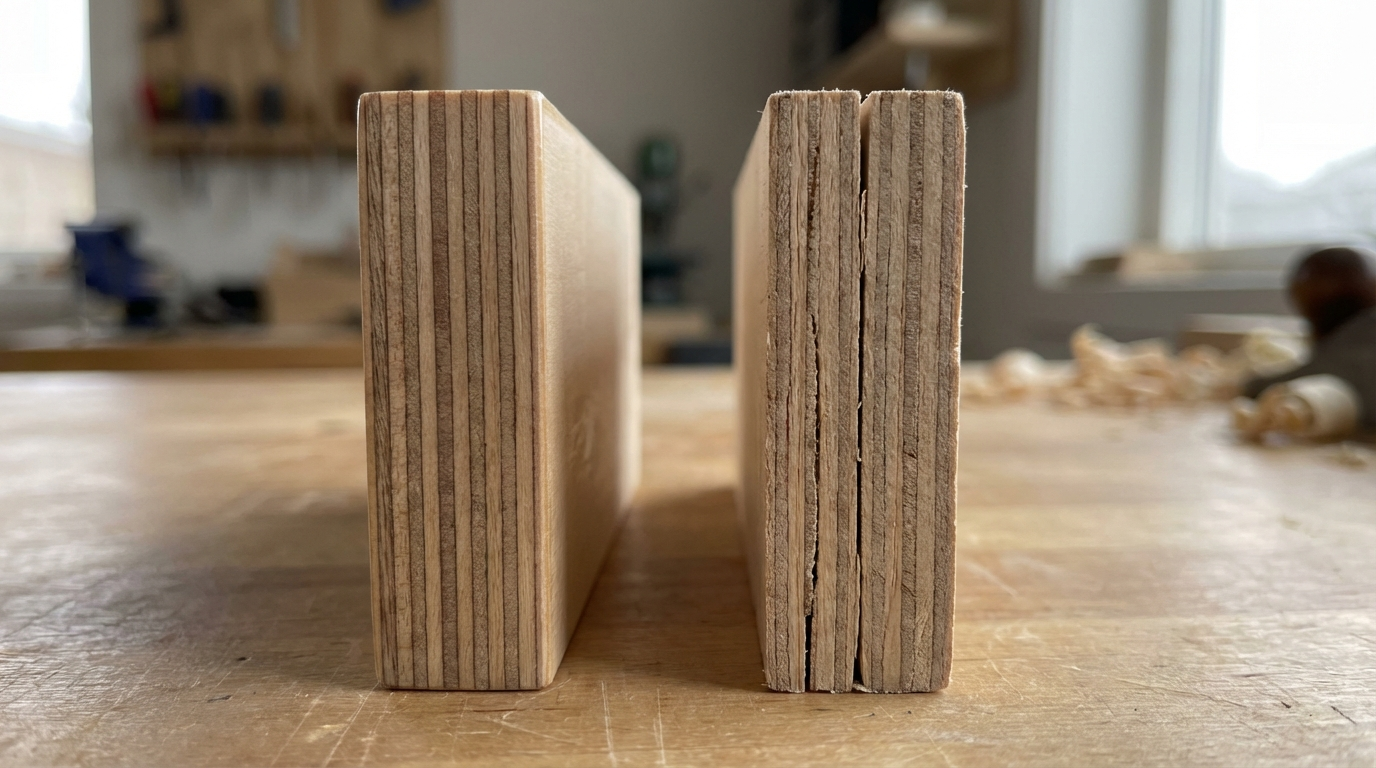
Why it happens: Buyers trust the face veneer appearance. What to do instead: Ask the dealer to cut a small section or show a cross-section sample; look for gaps, overlaps, and inconsistent ply thickness.
Mistake 3: Using MR Grade in Kitchens
Why it happens: MR is cheaper, and some dealers push it as "moisture resistant." What to do instead: Use minimum BWR for all kitchen cabinets; use BWP for under-sink and wet zones.
Mistake 4: Ignoring Edge Sealing Requirements
Why it happens: Carpenters skip edge banding to save time and cost. What to do instead: Insist on PU sealing or edge banding for all exposed edges, especially in kitchens and bathrooms.
Mistake 5: Not Checking Batch Dates
Why it happens: Buyers assume all stock is fresh. What to do instead: Look for manufacturing stamps; avoid sheets older than 6 months, especially in humid regions.
Mistake 6: Comparing Prices Without Matching Specifications
Why it happens: Dealers quote different grades, thicknesses, or core types. What to do instead: Create a spec sheet (grade, thickness, core species, calibration) and get quotes for identical specs.
Mistake 7: Trusting Verbal Warranty Claims
Why it happens: Dealers make verbal promises to close sales. What to do instead: Get warranty terms in writing; understand what's actually covered and exclusion clauses.
Mistake 8: Ordering Exact Quantities Without Wastage Buffer
Why it happens: Buyers calculate precise requirements to minimize cost. What to do instead: Add 8–12% buffer for cutting waste, defects discovered during fabrication, and future repairs.
Failure Modes and Fixes
Failure Mode 1: Edge Swelling Within First Monsoon
Symptom: Edges become soft, laminate peels, doors don't close properly. Root cause: Exposed edges absorbed moisture; inadequate sealing. Prevention: Seal all cut edges with PU or edge band before installation. If already happening: Sand affected areas, apply wood hardener, re-seal, and improve ventilation.
Failure Mode 2: Delamination in Under-Sink Cabinets
Symptom: Plies separate, bubbling visible on surface. Root cause: Wrong grade used (MR/BWR instead of BWP) or persistent water leakage. Prevention: Use BWP grade; fix plumbing leaks immediately; add drip trays. If already happening: Replace affected panels; upgrade to BWP; seal thoroughly.
Failure Mode 3: Warping of Large Shutters
Symptom: Doors bow outward or inward, don't align with carcass. Root cause: Uneven moisture absorption; single-side lamination; inadequate core density. Prevention: Use both-side lamination; ensure balanced veneer on both faces; use hardwood core for large shutters. If already happening: Add counter-laminates; install additional hinges; replace if severe.
Failure Mode 4: Screw Pull-Out in Hinge Zones
Symptom: Hinges become loose, doors sag. Root cause: Softwood core or low-density plywood; screws too short; repeated stress. Prevention: Use hardwood core plywood for doors; use longer screws; pre-drill pilot holes. If already happening: Fill holes with wood filler + toothpicks; relocate hinges slightly; add backup plates.
Failure Mode 5: Surface Scratches and Finish Damage
Symptom: Visible scratches, laminate wearing off. Root cause: Low-quality laminate; abrasive cleaning; heavy object impact. Prevention: Use scratch-resistant laminates; clean with soft cloth only; add protective padding in high-use areas. If already happening: Use scratch-repair markers; replace laminate if extensive; upgrade to higher-grade finish.
Failure Mode 6: Termite Damage Despite Treatment Claims
Symptom: Small holes, powdery residue, hollow sounds when tapped. Root cause: Treatment was superficial; re-cutting exposed untreated core; environment conducive to termites. Prevention: Apply local termite treatment after all cuts; maintain dry environment; periodic inspection. If already happening: Professional pest treatment; replace severely damaged sections; seal all exposed surfaces.
Quality Checks You Can Do Without Lab Tests
Before Buying: Visual and Physical Checks
- Weight test: Heavier sheets at the same thickness typically indicate denser cores. Lift multiple sheets and compare.
- Tap test: Knock on the surface. Hollow, drum-like sounds suggest voids in the core; solid sounds indicate good density.
- Edge inspection: Look at the cross-section for gaps between plies, uneven ply thickness, or visible voids.
- Surface smoothness: Run your palm across the face. Catch any roughness, patches, or undulations that affect laminate adhesion.
- Smell test: Fresh plywood has a mild wood smell. Strong chemical odour may indicate recent treatment (good) or formaldehyde issues (verify compliance).
- Flatness check: Place sheet on flat surface; check for bow, cup, or twist. Reject sheets with visible warping.
- IS mark verification: Look for IS 303 (MR/BWR) or IS 710 (BWP/Marine) stamp with licence number. Absence doesn't mean fake, but presence adds credibility.
After Cutting: Workmanship Cues
- Clean cut edges: Good plywood cuts cleanly without excessive splintering or ply separation.
- Core consistency: Freshly cut cross-section should show uniform ply thickness and consistent glue lines.
- Screw test: Drive a test screw near the edge (50mm in). Good plywood holds without splitting; poor core cracks or allows pull-through.
After Installation: Ongoing Checks
- Door alignment: Check monthly during first monsoon. Misalignment suggests moisture absorption.
- Edge condition: Inspect sealed edges quarterly. Re-seal if any gaps appear.
- Hinge tightness: Tighten screws every 6 months; note if holes are enlarging.
Tips for Homeowners: Durability and Maintenance
Do's
- Wipe spills immediately; don't let water sit on surfaces
- Use coasters and mats under wet items
- Ensure adequate ventilation in kitchens and bathrooms
- Clean with damp (not wet) soft cloth
- Check under-sink areas monthly for leaks
- Keep silica gel packets in wardrobes during monsoon
Don'ts
- Don't use abrasive scrubbers on laminated surfaces
- Don't hang wet towels directly on plywood surfaces
- Don't ignore early signs of swelling or soft edges
- Don't place hot vessels directly on plywood without trivets
- Don't block ventilation gaps in modular furniture
Tips for Carpenters: Fabrication Best Practices
Cutting and Edge Preparation
- Use sharp, fine-toothed blades to minimize splintering
- Score laminate side first when cutting laminated sheets
- Seal all cut edges within 24 hours, especially in humid conditions
- Allow sheets to acclimatize on-site for 48 hours before cutting
Fastening and Hinge Zones
- Pre-drill pilot holes for screws near edges (within 25mm)
- Use cup hinges rated for the door weight; add third hinge for doors over 1200mm height
- Reinforce hinge zones with hardwood blocks for heavy doors
- Avoid driving screws into core gaps—relocate if resistance is poor
Handling and Storage
- Store sheets flat on level supports; never lean against walls for extended periods
- Keep away from direct ground contact and moisture sources
- Cover with tarpaulin if storing outdoors temporarily
- Rotate stock: use older sheets first
Tips for Architects and Designers: Specification Guidance
Specifying Correctly
- State grade (IS 303 BWR or IS 710 BWP), thickness, core species, and calibration requirement explicitly
- Specify edge treatment: PU seal, edge band type, and colour
- Include tolerance requirements for modular/CNC work (±0.3mm recommended)
- Note termite treatment requirements and certificate demand
Wet-Zone Detailing
- Elevate base cabinets on legs (minimum 100mm) rather than placing directly on floor
- Specify drip grooves under countertops
- Mandate waterproof membrane under sink cutouts
- Require silicone sealing at wall-cabinet junctions
Finish Logic
- High-gloss laminates show scratches more; specify matte for high-traffic areas
- Veneer finishes require controlled humidity; avoid in bathrooms
- Specify laminate thickness: 0.8mm for verticals, 1mm for horizontals
Tips for OEM and Modular Manufacturers: Quality Control
Incoming Material QC
- Measure thickness at five points per sheet; reject if variation exceeds ±0.5mm
- Conduct batch-wise tap tests; document and compare
- Maintain approved supplier list with quality scorecards
- Photograph and document defects for supplier feedback
Production QC Checkpoints
- Verify edge sealing before dispatch
- Check hinge hole alignment with jig
- Test drawer slides and door alignment before packing
- Include installation instructions with every shipment
Reducing Returns and Complaints
- Train installation teams on edge sealing and adjustment
- Provide customer care cards with maintenance tips
- Conduct 30-day post-installation check calls
- Document common complaint patterns; address at source
FAQs
Is Duroboil plywood better than Greenply for kitchen cabinets?
Neither brand is universally better—quality depends on the specific sheet, batch, and storage conditions. For kitchen cabinets, what matters is using the correct grade (BWR minimum, BWP for under-sink), verifying IS certification, and ensuring proper edge sealing. Both brands offer suitable grades. Your decision should factor in local dealer reliability, return policies, and the specific sheet's core density and glue line quality upon inspection. Ask to see a cross-section before purchasing, and compare thickness-adjusted prices for identical specifications.
What is the price difference between Duroboil and Greenply BWR plywood?
Price differences typically range from ₹200–800 per 18mm 8×4 sheet, depending on region, dealer margin, and specific product line. Greenply's wider distribution may mean more competitive pricing in metros, while Duroboil may offer better rates where it has stronger regional presence. The price gap often reflects core species (hardwood vs softwood), calibration, and face veneer quality rather than brand premium alone. Always compare like-for-like specifications and factor in delivery charges and return policies when evaluating total cost.
How do I verify if plywood is genuinely BWP or Marine grade?
Look for the IS 710 certification stamp on the sheet along with the manufacturer's licence number. Request the dealer to show the boil test certificate for that batch. As a practical test, examine the cross-section for consistent glue lines without gaps—marine grade should show uniform resin penetration. The sheet should feel heavy for its size (indicating dense core) and produce a solid sound when tapped. If the dealer cannot provide certification documentation, consider alternative suppliers regardless of brand name.
Can I use BWR plywood for bathroom vanity units?
BWR can work for bathroom vanities in dry zones (away from direct water contact) if edges are properly sealed and ventilation is adequate. However, for areas near the sink, shower zone, or anywhere with frequent water exposure, BWP/Marine grade is strongly recommended. Even with BWP, seal all cut edges with PU sealant and ensure the vanity has ventilation provisions. In coastal cities or high-humidity regions, default to BWP for all bathroom furniture regardless of direct water exposure.
Why does plywood swell even after buying waterproof grade?
Swelling usually occurs through exposed edges, not the face. Even BWP plywood absorbs moisture through unsealed cut edges. Common causes include: carpenter skipping edge banding, inadequate PU sealing, plumbing leaks beneath cabinets, or storing plywood in humid conditions before installation. The grade rating assumes proper installation and sealing. If swelling occurs, identify the moisture source, improve ventilation, seal all exposed edges, and consider replacing severely damaged sections with properly sealed new panels.
How do I choose between hardwood and softwood core plywood?
Hardwood cores (Gurjan, Eucalyptus) offer better screw-holding, higher density, and greater load-bearing capacity—ideal for kitchen cabinets, wardrobes with heavy doors, and furniture with frequent hinge stress. Softwood cores (Poplar) are lighter and cheaper but may not hold screws as well near edges and can dent more easily. For shelves bearing heavy loads (books, appliances), hardwood cores are worth the premium. For ceiling work, wall paneling, or light-use furniture, softwood cores can reduce cost without significant performance compromise.
What does calibrated plywood mean, and is it worth the extra cost?
Calibrated plywood has been sanded to achieve uniform thickness across the entire sheet, typically within ±0.3mm tolerance. This is essential for modular furniture with machine-edge banding, CNC-cut components, and installations requiring precise flush alignment. For hand-crafted furniture or non-modular work, calibration may be less critical. The extra cost (typically ₹300–600 per sheet) is justified for modular kitchens, factory-produced furniture, and applications where edge-banding gaps are unacceptable. Measure with a vernier caliper at multiple points before purchasing.
How long does plywood furniture typically last in Indian conditions?
With proper grade selection, installation, and maintenance, plywood furniture can last 15–25 years in Indian conditions. BWR-grade wardrobes in dry, well-ventilated bedrooms often exceed 20 years. Kitchen cabinets face more stress and may need component replacement (hinges, edge bands) after 8–12 years. Lifespan depends heavily on edge sealing quality, humidity management, usage intensity, and original material quality. Cheap plywood with poor core density or inadequate sealing may fail within 3–5 years, especially in coastal or monsoon-heavy regions.
Should I trust warranty claims when comparing plywood brands?
Warranty claims require scrutiny. Most plywood warranties exclude damage from "improper installation," which can be interpreted broadly. Read the fine print for exclusion clauses, claim procedures, and what's actually covered. Verbal promises from dealers carry no weight—get terms in writing. In practice, pursuing warranty claims for plywood is difficult because proving material defect versus installation error is contentious. Focus more on verifiable quality indicators (certification, core inspection, dealer reputation) than warranty duration when making purchase decisions.
Is it necessary to apply termite treatment after cutting plywood?
Factory termite treatment typically penetrates only a few millimeters from the surface. When you cut plywood, the freshly exposed core may be untreated. In termite-prone areas, applying local termite treatment (brush-on borate solution or spray treatment) to all cut edges and surfaces before sealing is advisable. This is especially important for ground-floor installations, old buildings with termite history, and furniture in contact with walls. The additional cost and effort are minimal compared to potential termite damage repair.
How do I compare plywood from different dealers fairly?
Create a specification sheet listing: grade (IS standard), thickness (mm), core species, calibration requirement, face veneer quality expectation, and quantity needed. Send identical specs to multiple dealers and request itemised quotes including GST and delivery. Ask each dealer about batch dates, return policies, and whether you can inspect sheets before acceptance. Compare total delivered cost, not just per-sheet price. Visit physical stores to inspect sample cross-sections. Document dealer responsiveness and transparency—this indicates after-sales support quality.
What should I check when plywood is delivered to my site?
Upon delivery, verify sheet count and dimensions against your order. Inspect edges for damage, swelling, or discolouration. Check face veneers for scratches, patches, or moisture stains. Conduct random tap tests for hollow sounds. Measure thickness at multiple points on a few sheets. Look for IS certification stamps and batch information. Photograph any defects immediately and report to the dealer within 24 hours. Store sheets flat on level supports, off the ground, and covered until fabrication begins. Reject sheets showing obvious warping or delamination.
Disclaimer: This content is provided for general informational purposes based on industry practices and publicly available information. Product specifications, standards, prices, and availability may vary by manufacturer, region, and time. Readers should independently verify details with manufacturers, dealers, or qualified professionals before making purchase or construction decisions.Want Plywood Suggestions?
Share a few details and a Duro BOIL specialist will suggest suitable brands and connect you to responsive dealers.