Engineered Wood vs MDF: Which is Better for Your Furniture?
Compare engineered wood vs MDF boards. Learn about durability, cost, water resistance, and best uses to make the right choice for your furniture.

Quick Verdict
MDF is better for indoor furniture requiring smooth painted finishes, while engineered wood (plywood) is superior for structural applications, moisture-prone areas, and long-term durability. Choose MDF for budget-friendly decorative pieces and wardrobe shutters; choose plywood for kitchen cabinets, bathroom furniture, and load-bearing shelves.
The confusion between engineered wood and MDF exists because MDF is technically a type of engineered wood. However, in Indian markets, "engineered wood" typically refers to plywood and similar layered products, while MDF is sold as a distinct category. This comparison guide from duroboil.com clarifies the practical differences to help you make the right furniture choice.
- Choose MDF if: You need smooth surfaces for painting, working on a tight budget, or creating decorative mouldings
- Choose Plywood (Engineered Wood) if: You need moisture resistance, screw-holding strength, or structural durability
- Either works if: You're building dry-area furniture with laminate finishing and moderate load requirements
Complete Comparison Table
This comprehensive table covers all critical factors Indian homeowners and carpenters consider when choosing between MDF and engineered wood products.
| Factor | MDF (Medium Density Fibreboard) | Engineered Wood (Plywood) | Winner |
|---|---|---|---|
| Composition | Wood fibres bonded with resin under heat/pressure | Thin wood veneers glued in cross-grain layers | Plywood (natural structure) |
| Moisture Resistance | Poor; swells and deteriorates quickly | Good to excellent (BWR/BWP grades) | Plywood |
| Screw Holding | Weak; screws loosen over time | Excellent; holds screws firmly | Plywood |
| Surface Smoothness | Very smooth, uniform surface | May have grain patterns, knots | MDF |
| Paint Finish Quality | Excellent; no grain showing through | Good; may need more preparation | MDF |
| Weight (19mm sheet) | Heavy (38-42 kg per 8x4 sheet) | Medium (28-35 kg per 8x4 sheet) | Plywood |
| Load Bearing Capacity | Low to moderate | High | Plywood |
| Machining Ease | Excellent; clean cuts, no splintering | Good; may splinter at edges | MDF |
| Price (per sq ft) | ₹25-60 | ₹45-150 (depending on grade) | MDF (more affordable) |
| Termite Resistance | Moderate (treated variants available) | Good (quality brands offer guarantees) | Plywood |
| Lifespan | 10-15 years with proper care | 20-30+ years for quality plywood | Plywood |
| Repair Possibility | Difficult; damage often permanent | Easier; can be patched and refinished | Plywood |
What is MDF (Medium Density Fibreboard)?
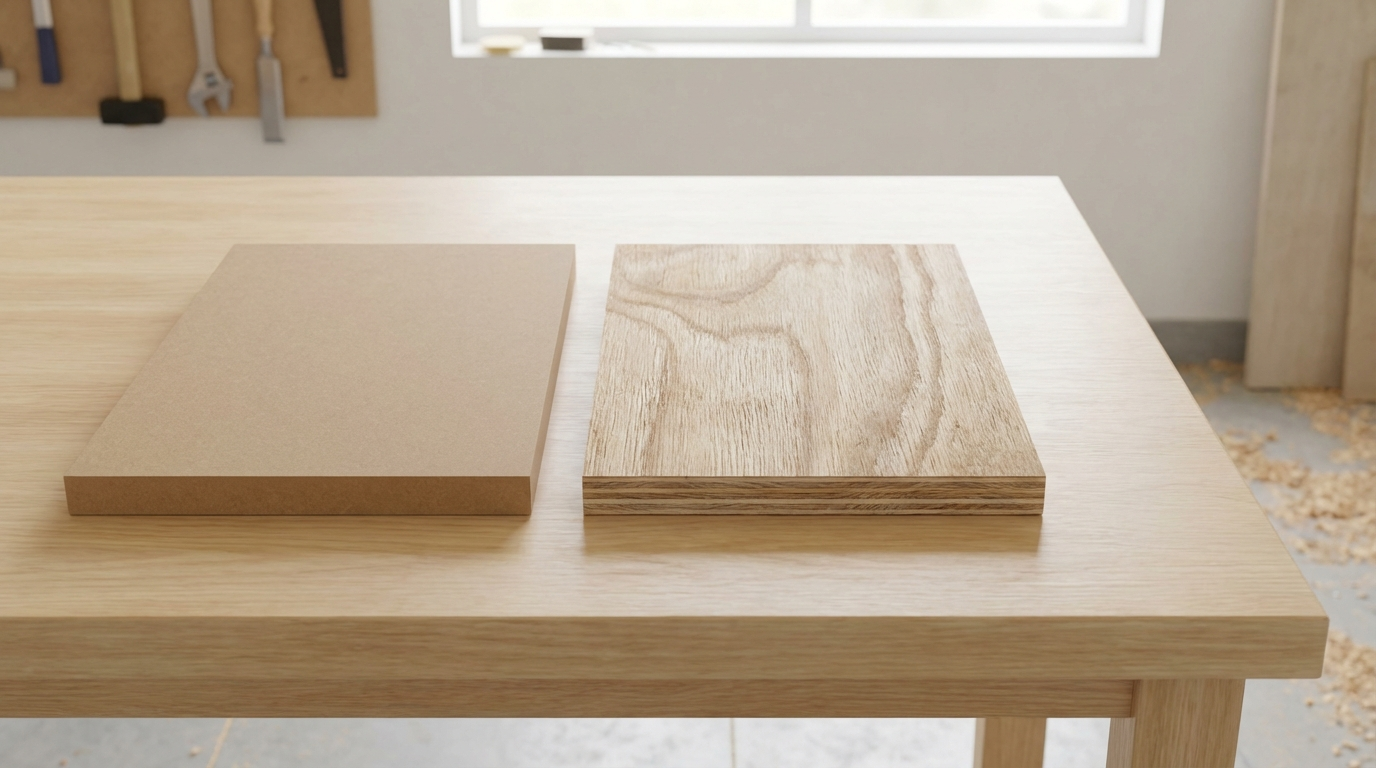
MDF is an engineered wood product manufactured by breaking down hardwood and softwood residuals into fine fibres, combining them with wax and resin binder, and forming panels under high temperature and pressure. The result is a dense, uniform board with no grain pattern or knots.
The manufacturing process creates a homogeneous material that machines exceptionally well. Unlike natural wood or plywood, MDF has identical properties in all directions, making it predictable to work with. Indian MDF manufacturers typically produce boards conforming to IS 12406 standards.
MDF density typically ranges from 600-800 kg/m³, placing it between particleboard (lower density) and HDF/HDHMR (higher density). Standard MDF thickness options available in Indian markets include 2.5mm, 3mm, 6mm, 9mm, 12mm, 18mm, and 25mm in the standard 8x4 feet sheet size.
Types of MDF Available in India
- Plain MDF: Raw board requiring lamination or painting; most economical option
- Pre-laminated MDF: Factory-applied laminate finish; ready for edge banding and assembly
- Moisture Resistant MDF (MR-MDF): Green-coloured core with added moisture resistance; suitable for slightly humid areas
- Fire Retardant MDF: Treated for fire resistance; used in commercial applications
- HDHMR (High Density High Moisture Resistant): Premium variant with superior moisture and screw-holding properties
What is Engineered Wood (Plywood)?
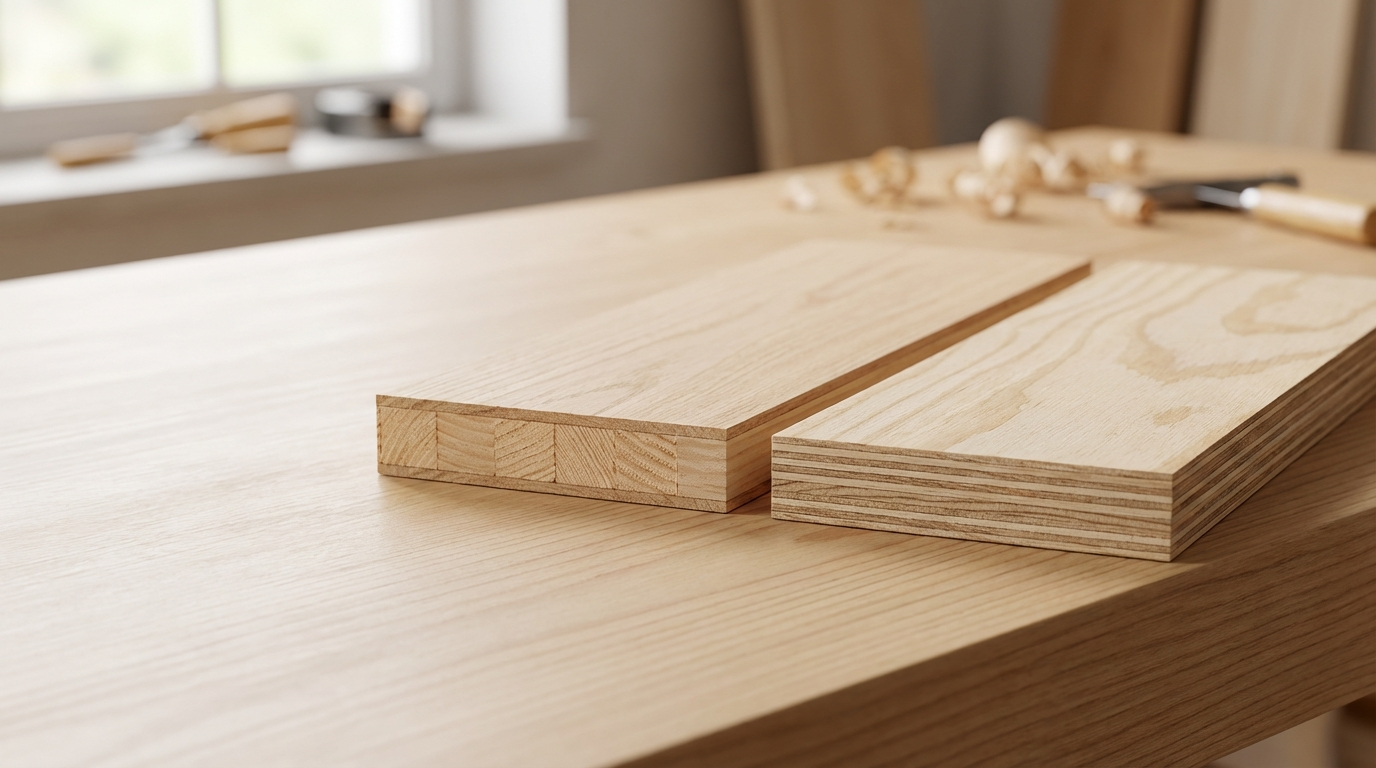
Plywood is the most common engineered wood product, made by gluing thin layers of wood veneer (called plies) together with their grain directions alternating at 90 degrees. This cross-laminated construction gives plywood exceptional strength and dimensional stability compared to solid wood.
According to duroboil.com's material research, plywood's layered structure distributes stress evenly, preventing the warping, cracking, and splitting common in solid timber. The number of plies typically ranges from 3 to 13, with more layers generally indicating higher strength and stability.
Indian plywood is manufactured according to BIS standards, primarily IS 303 (MR Grade) for interior use and IS 710 (BWR/BWP Grade) for moisture-exposed areas. Core materials commonly include gurjan, eucalyptus, poplar, and hardwood combinations.
Types of Plywood/Engineered Wood in India
- MR Grade Plywood (IS 303): Moisture resistant for interior dry areas; most common for bedroom furniture
- BWR Grade Plywood (IS 710): Boiling Water Resistant; suitable for kitchens and areas with occasional moisture
- BWP/Marine Grade Plywood: Boiling Water Proof; ideal for bathrooms, outdoor use, and coastal areas
- Commercial Plywood: Basic interior grade; budget option for temporary or low-use applications
- Calibrated Plywood: Machine-sanded for uniform thickness; preferred for modular furniture
- Flexible Plywood: Thin, bendable sheets for curved furniture applications
Detailed Comparison
Moisture and Water Resistance
Standard MDF has poor moisture resistance and will swell, warp, and eventually disintegrate when exposed to water or high humidity. Even moisture-resistant MDF variants cannot match plywood's water handling capabilities. This is the single most important factor for Indian conditions, where humidity levels regularly exceed 70-80% during monsoons.
BWR and BWP grade plywood can withstand prolonged moisture exposure, making them essential for kitchen cabinets, bathroom vanities, and furniture in coastal regions. Quality BWR plywood can handle boiling water immersion for up to 72 hours without delamination, a test that would destroy any MDF product within minutes.
Winner: Plywood — For Indian climate conditions with monsoon humidity and occasional water exposure, plywood is significantly more reliable.
Strength and Load-Bearing Capacity
Plywood's cross-laminated veneer structure provides superior tensile and bending strength compared to MDF's compressed fibre composition. A 19mm plywood shelf can support substantially heavier loads without sagging compared to the same thickness MDF.
MDF tends to sag over time under sustained loads, particularly for unsupported spans exceeding 60cm. This makes MDF unsuitable for bookshelf horizontals, kitchen base cabinets, and any application requiring structural integrity under weight.
Winner: Plywood — For wardrobes with heavy clothing, kitchen storage, and bookshelves, plywood's superior strength is essential.
Screw Holding and Hardware Attachment
MDF's uniform fibre composition lacks the grain structure that allows wood to grip screws firmly. Repeated opening and closing of hinged doors often loosens screws in MDF, requiring larger screws, anchors, or relocation of hardware.
Plywood's layered veneer structure holds screws securely, even after repeated use. This is particularly important for kitchen cabinets with soft-close hinges, wardrobe doors that open multiple times daily, and furniture requiring adjustable shelving.
Winner: Plywood — For furniture with hinges, handles, and adjustable components, plywood provides reliable long-term hardware retention.
Surface Quality and Finishing
MDF excels in surface smoothness, providing a perfectly uniform substrate for paint finishes. Its lack of grain pattern means painted MDF surfaces don't show wood texture through the finish, making it ideal for contemporary lacquered furniture.
Plywood surfaces may show grain patterns, face veneer imperfections, or filler patches that can telegraph through thin paint coats. However, with proper preparation and quality face veneers, plywood can achieve excellent painted finishes.
Winner: MDF — For furniture requiring flawless painted or lacquered finishes, MDF provides superior results with less preparation.
Machining and Working Properties
MDF cuts cleanly without splintering, making it excellent for CNC routing, intricate moulding profiles, and detailed decorative work. Carpenters appreciate its predictable behaviour and the clean edges it produces.
Plywood can splinter at edges during cutting, particularly with dull blades or improper technique. However, quality plywood with good face veneers machines well with appropriate tools and techniques.
Winner: MDF — For detailed work, router profiles, and applications requiring clean edges without lamination, MDF is easier to work with.
Cost Comparison
MDF offers significant cost savings compared to quality plywood, making it attractive for budget-conscious projects. The price difference can be substantial, particularly when comparing standard MDF to BWR or BWP grade plywood.
| Product Type | Price Range (₹ per sq ft) | 8x4 Sheet Cost (Approx.) |
|---|---|---|
| Plain MDF (18mm) | ₹28-45 | ₹900-1,450 |
| Pre-laminated MDF (18mm) | ₹45-70 | ₹1,450-2,250 |
| MR Grade Plywood (18mm) | ₹55-90 | ₹1,750-2,900 |
| BWR Grade Plywood (18mm) | ₹75-120 | ₹2,400-3,850 |
| BWP/Marine Plywood (18mm) | ₹100-160 | ₹3,200-5,150 |
Winner: MDF — For budget-focused projects where moisture exposure isn't a concern, MDF delivers better value per rupee.
Application-Based Recommendations
The best material choice depends heavily on where and how the furniture will be used. This decision table from duroboil.com helps match applications to optimal materials.
| Application | Better Option | Why | Caution |
|---|---|---|---|
| Modular Kitchen Carcass | BWR Plywood | Moisture resistance, load capacity, screw holding | Don't use MDF near sink or cooking areas |
| Kitchen Shutters/Doors | HDHMR/MDF with membrane | Smooth finish for membrane/lacquer, cost-effective | Use moisture-resistant variant only |
| Wardrobe Carcass | MR Plywood | Strength for hanging clothes, long-term durability | Ensure proper ventilation inside |
| Wardrobe Shutters | MDF/Pre-laminated MDF | Smooth surface for laminates, lower cost | Use quality hinges with proper pilot holes |
| Bathroom Vanity | BWP Plywood | Water resistance essential | Never use MDF in bathrooms |
| TV Unit | Either (MR Plywood preferred) | Both work for dry living room conditions | Consider load of TV and equipment |
| Study Table | MR Plywood | Screw holding for drawers, durability | MDF acceptable for budget options |
| Bookshelves | Plywood | Load-bearing for heavy books | MDF shelves will sag over time |
| Decorative Mouldings | MDF | Easy routing, smooth painted finish | Not for exterior or wet areas |
| False Ceiling | MDF (thin sheets) | Lightweight, smooth, paintable | Ensure no water leak risk above |
India-Specific Considerations
Monsoon and Humidity Impact
Indian monsoons create challenging conditions for interior materials. Relative humidity can exceed 85% in coastal cities like Mumbai, Chennai, and Kolkata for months at a time. MDF absorbs atmospheric moisture even without direct water contact, leading to swelling, warping, and edge deterioration.
For homes in high-humidity regions, plywood is the safer choice for all furniture carcasses. MDF can be used for shutters and decorative elements if properly sealed and laminated on all surfaces including edges.
Regional Variations
- Coastal Areas (Mumbai, Chennai, Kochi): BWR or BWP plywood strongly recommended; avoid standard MDF
- North India (Delhi, Punjab, Rajasthan): Dry climate allows more MDF use; MR plywood sufficient for most applications
- Hill Stations: Temperature variations cause expansion/contraction; plywood handles this better
- Metro Cities: Full range of quality options available; choose based on application
Carpenter and Contractor Preferences
Many Indian carpenters prefer plywood because of its familiar working properties and reliable screw-holding. However, modular furniture manufacturers increasingly use pre-laminated MDF and HDHMR for shutters due to factory-finished surfaces and lower costs.
When working with local carpenters, discuss material choices beforehand. Some may lack experience with MDF's requirements for pilot holes, proper hardware, and edge sealing.
Common Myths Busted
Myth 1: "MDF is Stronger Because It's Denser"
Reality: Higher density doesn't equal higher strength. MDF's uniform fibre structure lacks the tensile strength of plywood's cross-laminated veneers. MDF is stiffer but more brittle and prone to breaking under impact or sustained loads.
Myth 2: "Plywood Always Has Voids and Defects"
Reality: Quality plywood from reputable brands with proper BIS certification has minimal defects. Voids and patches are issues with low-grade commercial plywood, not with properly manufactured MR, BWR, or BWP grades.
Myth 3: "Moisture-Resistant MDF Can Replace Plywood in Kitchens"
Reality: Even MR-MDF cannot match BWR plywood's moisture resistance. MR-MDF handles higher humidity air, but will still fail if exposed to actual water or steam over time. For kitchen carcasses, plywood remains the professional choice.
Myth 4: "MDF Contains Dangerous Chemicals"
Reality: Both MDF and plywood use formaldehyde-based adhesives. Modern E1 and E0 grade products meet international emission standards and are safe for residential use. Look for low-emission certifications when purchasing either material.
Myth 5: "Plywood and MDF Have the Same Lifespan"
Reality: Quality plywood furniture can last 25-30 years or more with proper care. MDF furniture typically shows wear within 10-15 years, particularly at hardware points, edges, and high-use areas.
Using Both Materials Together
Smart furniture design often combines plywood and MDF to optimise cost, performance, and aesthetics. This hybrid approach leverages each material's strengths while minimising weaknesses.
Recommended Hybrid Approach
- Carcass (box structure): BWR plywood for strength, moisture resistance, and hardware retention
- Shutters and doors: Pre-laminated MDF or HDHMR for smooth finish and cost savings
- Shelves: Plywood for load-bearing; MDF acceptable for light decorative items only
- Back panels: Thin MDF (6mm) for cost efficiency where strength isn't critical
- Drawer components: Plywood for sides and base; MDF acceptable for fronts
Cost Optimisation Strategy
A typical wardrobe using hybrid construction costs 15-25% less than all-plywood construction while maintaining structural integrity. The savings come from using MDF for visible surfaces (shutters) where its smooth finish is an advantage, while retaining plywood for structural components.
Quality Verification Tips
How to Check MDF Quality
- Look for uniform colour throughout the cross-section
- Check edges for crumbling or loose fibres
- Ensure consistent thickness across the sheet
- Verify ISI marking (IS 12406) for quality assurance
- Ask about formaldehyde emission class (E1 or E0 preferred)
How to Check Plywood Quality
- Examine core layers for gaps, voids, or overlapping
- Check face veneer for patches, repairs, or defects
- Verify BIS certification (IS 303 or IS 710 marking)
- Test weight — quality plywood feels substantial for its size
- Look for brand marking and warranty information
Frequently Asked Questions
Is MDF a type of engineered wood?
Yes, MDF is technically a type of engineered wood since it's manufactured from wood fibres rather than cut from logs. However, in Indian market terminology, "engineered wood" typically refers to plywood and similar layered products, while MDF is categorised separately. Both are engineered wood products, but they have distinctly different properties and applications.
Which is more durable: MDF or plywood?
Plywood is significantly more durable than MDF for most furniture applications. Quality plywood can last 25-30 years with proper care, while MDF typically shows wear within 10-15 years. Plywood's superior durability comes from its layered veneer construction, better moisture resistance, and stronger screw-holding capacity that prevents hardware loosening over time.
Can MDF be used in kitchens?
MDF should be used cautiously in kitchens and only for specific components. Pre-laminated MDF or HDHMR can work for kitchen shutters and decorative panels if properly sealed. However, MDF should never be used for kitchen carcasses, especially near sinks, dishwashers, or cooking areas where moisture exposure is likely. BWR grade plywood remains the recommended choice for kitchen cabinet construction.
Why does MDF swell near water?
MDF swells because its compressed wood fibre structure absorbs water rapidly. Unlike plywood's solid veneer layers, MDF's fibres act like a sponge, drawing in moisture and expanding. Once swollen, MDF rarely returns to its original dimensions and often becomes permanently damaged. This makes MDF unsuitable for bathrooms, outdoor use, or any area with regular water exposure.
Is plywood more expensive than MDF?
Yes, plywood generally costs 50-100% more than equivalent thickness MDF. Standard 18mm MDF costs approximately ₹28-45 per square foot, while MR grade plywood costs ₹55-90 per square foot. BWR and BWP plywood costs even more at ₹75-160 per square foot. However, plywood's longer lifespan often makes it more cost-effective over time.
Which material is better for wardrobe construction?
A hybrid approach works best for wardrobes. Use MR grade plywood for the carcass (sides, top, bottom, shelves) to ensure structural strength and reliable hardware retention. Pre-laminated MDF works well for shutter doors where smooth finishes are desired. This combination provides durability where it matters while optimising costs on visible surfaces.
Can MDF hold screws properly?
MDF has poor screw-holding capacity compared to plywood. Screws in MDF often loosen over time, especially with repeated use of hinged doors or drawers. To improve screw retention in MDF, always pre-drill pilot holes, use coarse-thread screws, and consider hardware specifically designed for MDF. For critical connections, plywood or HDHMR is more reliable.
Which material is better for CNC cutting and routing?
MDF is superior for CNC machining and detailed router work. Its uniform fibre composition cuts cleanly without splintering or grain tear-out. MDF produces crisp edges on intricate designs, moulding profiles, and decorative patterns. Plywood can also be CNC machined but may show some edge splintering, particularly on cross-grain cuts.
Is MDF safe for home furniture?
Modern MDF manufactured to E1 or E0 emission standards is considered safe for residential furniture. Both MDF and plywood contain formaldehyde-based adhesives, but quality products from reputable manufacturers meet international safety standards. Look for low-emission certifications and ensure proper ventilation in newly furnished rooms during the initial off-gassing period.
How do I choose between MDF and plywood for my project?
Base your decision on three key factors: moisture exposure, load requirements, and finish needs. Choose plywood for kitchens, bathrooms, heavy storage, and long-term furniture. Choose MDF for dry-area decorative elements, painted finishes, and budget-focused projects. Many successful furniture designs combine both materials strategically, using plywood for structure and MDF for visible surfaces requiring smooth finishes.
Disclaimer: This content is provided for general informational purposes based on industry practices and publicly available information. Product specifications, standards, prices, and availability may vary by manufacturer, region, and time. Readers should independently verify details with manufacturers, dealers, or qualified professionals before making purchase or construction decisions.
Want Plywood Suggestions?
Share a few details and a Duro BOIL specialist will suggest suitable brands and connect you to responsive dealers.