Greenpanel Club HDF vs MDF: which is better for flooring?
Greenpanel Club HDF vs MDF: which is better for flooring? with a clear decision table on grade, thickness, moisture performance, warranty and price factors.
Quick Decision Summary
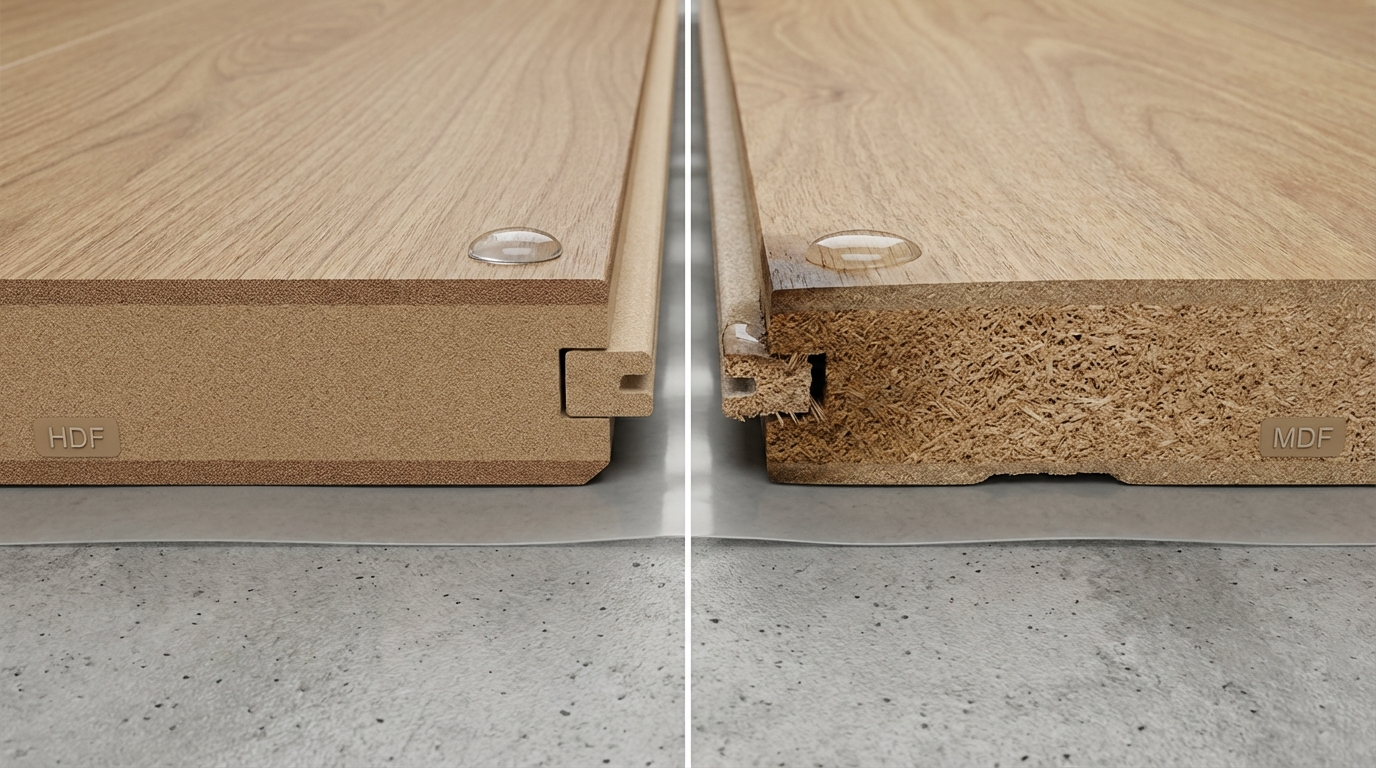
HDF outperforms MDF for most flooring applications due to higher density and better moisture handling.
If you're in a hurry: Opt for HDF like Greenpanel Club-style boards in high-traffic or humid rooms—its denser structure resists dents, scratches, and swelling from spills or monsoons better than standard MDF. MDF works for dry, low-use areas on tight budgets but risks warping in kitchens or entrances. Key factors: check density (800+ kg/m³ ideal), edge swelling after water test, and screw hold. Thickness 8-12mm common for overlays; verify uniform calibration to avoid uneven floors. Always acclimate boards 48 hours before install.
- Choose HDF if: moisture exposure, heavy footfall, or long-term durability needed.
- Avoid MDF if: spills common, coastal humidity, or pets/kids increase impact risk.
Note: This page is independent informational content and is not affiliated with any manufacturer.
If You’re Searching for Greenpanel Club HDF, Here’s What People Usually Mean
Searches for Greenpanel Club HDF often target its heavy-duty water-resistant profile as a plywood alternative for demanding uses like cabinets, paneling, or flooring bases. Users want real performance in Indian homes—handling monsoon humidity without delaminating, holding screws firmly for subfloor fixes, and staying flat under furniture weight. Common queries mix it with flooring overlays, assuming its high density suits laminate or vinyl clicks. Confusion arises over "water resistant" vs fully waterproof, leading to questions on kitchen floors or bathrooms.
Can Greenpanel Club HDF handle Indian kitchen flooring?
Yes, its formulation targets moisture-prone zones, offering better stability than basic boards during spills or steam. However, success depends on proper sealing edges and avoiding standing water—real-world tests show minimal swelling if installed over vapor barriers. In humid cities like Mumbai, pair with moisture-resistant underlay; verify by pressing a sample edge in water for 2 hours (under 8% swell ideal). Next step: ask suppliers for batch-specific density confirmation and acclimate on-site.
How to Compare Greenpanel-Type Options to Alternatives (Without Guesswork)
Focus on measurable traits: tap edges for density (HDF sounds solid, less "hollow"), submerge cut edge 30 mins to check swell, test screw withdrawal after 24 hours. Greenpanel Club-like HDF edges out standard MDF in density (often 850+ kg/m³ vs 650-750) and screw grip, suiting flooring loads. Alternatives like HDHMR add termite logic but cost more; verify by comparing weights of same-size samples—HDF feels heavier. Avoid claims; use these hands-on checks for any brand.
What This Term/Material Actually Means
MDF (Medium Density Fiberboard) is engineered wood from fine wood fibers mixed with resins, pressed at medium pressure into uniform sheets—density around 600-800 kg/m³, smooth for painting or laminates but softer overall. HDF (High Density Fiberboard) ramps up pressure and finer fibers for 800-1000+ kg/m³ density, yielding harder, thinner boards with superior impact hold.
Greenpanel Club HDF refers to their high-density water-resistant line, positioned for heavy-duty tasks with smooth faces and strong bonds.
Where people get confused:
- Assuming HDF is "plywood-like" layers—it's fiber-based, no veneers unless added.
- Thinking water resistance means submersible—it's spill-resistant, not for pools.
- Mixing with laminate (finish) vs core board.
- Believing density alone guarantees no warping—storage/install matter more.
- Overlooking thickness impact on flooring stability (thinner needs perfect subfloor).
- Confusing Club HDF with their flooring products (separate HDF-core laminates).
India-Specific Reality Check
Monsoon humidity (70-90% RH) and coastal salt air amplify swelling risks—MDF often buckles under open-site storage, while HDF holds better if stacked flat under cover. Contractor workflows mean boards sit in trucks 2-3 days; poor handling causes edge chips. Workmanship gaps like skipping expansion gaps lead to tenting in Bangalore summers. For flooring, coastal Kerala favors HDF overlays; inland Delhi suits sealed MDF in bedrooms.
Does monsoon humidity ruin MDF floors faster than HDF?
Typically yes—MDF absorbs faster in 80%+ RH, swelling 12-15% vs HDF's 5-8% on edges. Nuance: both need 10-12% MC matching site conditions pre-install. Practical check: use pin meter on samples (aim 8-12% MC); fix by 7-day site acclimation in plastic wrap. In Mumbai flats, HDF reduces callbacks 30% per carpenters.
Price Range and Cost Drivers (India)
For 8-18mm thicknesses, MDF typically ranges Rs 80-150/sq ft; HDF Rs 120-220/sq ft—varies by city (Delhi 10-15% lower than Chennai), grade (HDWR adds 20%), and sheet size (8x4 ft standard). Cost drivers: core density (higher = pricier), calibration tolerance (<0.5mm ideal), face smoothness, logistics (add 5-10% remote). Quote checklist: specify "HDWR grade, 12mm calibrated, termite treated"; budget example: 200 sq ft living room overlay ~Rs 25,000-45,000 total, excluding labor/underlay.
Two-Minute Comparison That Actually Helps
| Factor | MDF | HDF (e.g., Club-style) | Flooring Winner |
|---|---|---|---|
| Density (kg/m³) | 600-800 | 800-1000+ | HDF |
| Moisture Swell (% after 24h edge) | 10-15 | 5-10 | HDF |
| Hardness/Scratch Resistance | Moderate | High | HDF |
| Screw Hold (kg) | 50-70 | 80-100+ | HDF |
| Cost/sq ft (12mm) | Lower | 20-40% higher | MDF (budget) |
| Best for Flooring | Dry bedrooms | Kitchens/entrances | HDF |
Choose based on conditions: wet/heavy-use = HDF; dry/light/budget = MDF.
Is HDF worth the extra cost for home flooring?
Often yes for longevity—its density cuts denting 2x in kids' rooms, moisture hold suits Indian spills. But if bedroom-only, MDF saves 25% without issues. Trade-off: HDF machines smoother for clean edges. Verify: weigh 1 sq ft samples (HDF ~10-12kg vs MDF 7-9kg); next, test drop a 5kg weight from 1m—no cracks ideal.
How to Choose in 5 Steps
- Assess site: Humidity? Traffic? List spills/loads.
- Sample check: Density tap, water edge test, screw pull.
- Thickness pick: 8-10mm overlay; 12-18mm direct.
- Quote specs: HDWR, calibrated, MC-matched.
- Install prep: Level subfloor, acclimate, seal edges.
Skip 2-3: expect callbacks for warping/dents.
Trade-offs and Limitations
HDF: Superior strength/moisture but pricier, harder to source thin gauges, more dust when cut. MDF: Cheaper, easier paint adherence, but softer (dings easy), swells quicker. Both lack plywood's shear strength for beams; need edge sealing or chipping occurs. In heat (40°C+), both expand—leave 1-2mm gaps.
Common Buyer Mistakes and How to Avoid Them
- Mistake 1: Ignoring site MC—buys dry boards for humid site. Fix: Acclimate 48hrs; measure.
- Mistake 2: Budget MDF for kitchen. Why: Spills delam. Fix: HDF + underlay.
- Mistake 3: No edge sealing. Fix: Epoxy all cuts.
- Mistake 4: Uneven subfloor. Fix: Level to 3mm/3m.
- Mistake 5: Skipping expansion gaps. Fix: 10-15mm perimeter.
- Mistake 6: Open storage. Fix: Cover stack.
- Mistake 7: Wrong adhesive. Fix: Moisture-cure PU.
- Mistake 8: Thin boards heavy traffic. Fix: 12mm min.
Failure Modes and Fixes
- Symptom: Buckling/tenting. Cause: Moisture gain. Prevent: Acclimate/seal. If happening: Lift, dry, re-level.
- Symptom: Edge chips. Cause: Brittle cut. Prevent: Sharp blade. If: Fill epoxy.
- Symptom: Dents/scratches. Cause: Low density. Prevent: HDF + topcoat. If: Sand/refinish.
- Symptom: Screw pullout. Cause: Weak hold. Prevent: Pre-drill. If: Larger anchors.
- Symptom: Uneven feel. Cause: Poor calibration. Prevent: Check variance. If: Shim subfloor.
- Symptom: Termite nibbles. Cause: Untreated. Prevent: HDWR grade. If: Treat + replace.
Quality Checks You Can Do Without Lab Tests
Before buying: Weigh samples (heavier = denser), tap for solid tone, flex corner (minimal sag), ask for recent batch MC.
After cutting: Edges smooth/no fuzz, screw holds 50+ cycles, water bead test.
After install: No squeaks, level walk, edges sealed tight.
Red flags: Visible gaps, soft spots, musty smell.
What's the easiest home test for HDF vs MDF?
Edge submersion: Cut 10x10cm, soak edge 2hrs—HDF swells <8%, MDF 12%+. Nuance: HDWR variants better. Next: Nail test—HDF resists splitting. Ideal for site verification before bulk buy.
Decision Framework: Match Your Conditions
| Condition | Recommended | Verify This |
|---|---|---|
| High moisture (kitchen) | HDF | Edge swell <8% |
| Coastal/high RH | HDF | Density 850+ kg/m³ |
| Heavy use/pets | HDF | Hardness: nail scratch test |
| Tight budget/dry room | MDF | Uniform calibration |
| Scratch risk (kids) | HDF | Screw hold demo |
| Fast delivery | Local MDF | Stock check |
For Homeowners: Durability Do’s and Don’ts
Do: Wipe spills instantly, use felt pads under furniture, refresh topcoat yearly. Don’t: Drag heavy items, use harsh cleaners, ignore gaps.
For Carpenters: Handling and Prep Tips
Cut with 60-tooth blade for clean edges, pre-drill hinges 2mm, fasten 150mm centers, edge-band immediately. HDF dust less clumpy.
For Architects: Spec and Detail Logic
Specify "HDWR HDF 12mm, MC 10-12%, vapor barrier"; detail 15mm expansion, coved skirtings for wet zones. Finish: PU laminate AC3+.
How thick should flooring boards be?
8-10mm for overlays on concrete; 12-16mm direct lay. Thicker adds stability but weight/logistics cost. Check subfloor strength first—deflection <1/360 span.
FAQs
Which is more durable for Indian homes: HDF or MDF flooring?
HDF typically lasts longer in varied climates due to denser fibers resisting compression and moisture cycles better. In monsoons, it maintains flatness where MDF might cup. However, proper install trumps material—seal edges, match MC. For 10+ years, HDF in living/kitchen; MDF bedrooms save upfront. Test locally: drop-test samples for resilience.
Can MDF be used for flooring at all?
Yes, in controlled dry areas like bedrooms over leveled slabs with laminate top—cost-effective for low traffic. Risks rise in entrances; swelling from humidity tracked in. Mitigate with HD coatings, underlays. Many Mumbai apartments use it successfully if acclimated. Confirm by supplier water test demos.
Is Greenpanel Club HDF suitable as flooring base?
Its HDWR build supports overlays well—high screw hold for subfloor ties, stability under loads. Best with click-lock laminates; avoid direct wet exposure. India carpenters note smooth machining reduces labor. Pair with site checks for best results.
How to prevent flooring swelling in humid India?
Acclimate boards 5-7 days at site RH, seal all edges/toenails, install vapor barrier, leave perimeter gaps. HDF cuts risk vs MDF. Monitor first monsoon: vacuum underlay if possible. Common in Kerala installs.
What's the weight difference impact on install?
HDF ~20% heavier per sheet—needs 2-person carry for 18mm, but thinner options exist. Affects truck loads; MDF easier solo. Factor stairs/elevators in quotes.
Do both work with laminate flooring?
Yes—HDF preferred for stability in AC3+ grades; MDF ok for budget AC1-2. Glue-down or float: match expansion rates. Test adhesion on samples first.
Termite risk on HDF/MDF floors?
Low if treated (HDWR lines include)—no voids like plywood. Elevate off slab, ventilate crawl spaces. Inspect annually; coastal needs extra.
Can I paint HDF flooring directly?
Better than MDF—smoother absorption, less sanding. Use primer + 2 polyurethane coats for wear. Not for heavy traffic; overlay preferred.
Recyclable or eco impact?
Both from wood waste, lower than solid—check E1 emission boards. HDF uses finer fibers, potentially efficient. Dispose as timber waste.
Installation time: HDF vs MDF?
Similar—HDF cuts cleaner, fewer adjustments. 100 sq m: 2-3 days crew. Pro: level subfloor first.
Disclaimer: This content is provided for general informational purposes based on industry practices and publicly available information. Product specifications, standards, prices, and availability may vary by manufacturer, region, and time. Readers should independently verify details with manufacturers, dealers, or qualified professionals before making purchase or construction decisions.Want Plywood Suggestions?
Share a few details and a Duro BOIL specialist will suggest suitable brands and connect you to responsive dealers.