Greenpanel vs Greenply MDF: which is better for shutters?
Greenpanel vs Greenply MDF: which is better for shutters? with a clear decision table on grade, thickness, moisture performance, warranty and price factors.
Quick Decision Summary
Neither Greenpanel nor Greenply MDF is always better for shutters—pick based on density needs and local moisture tests.
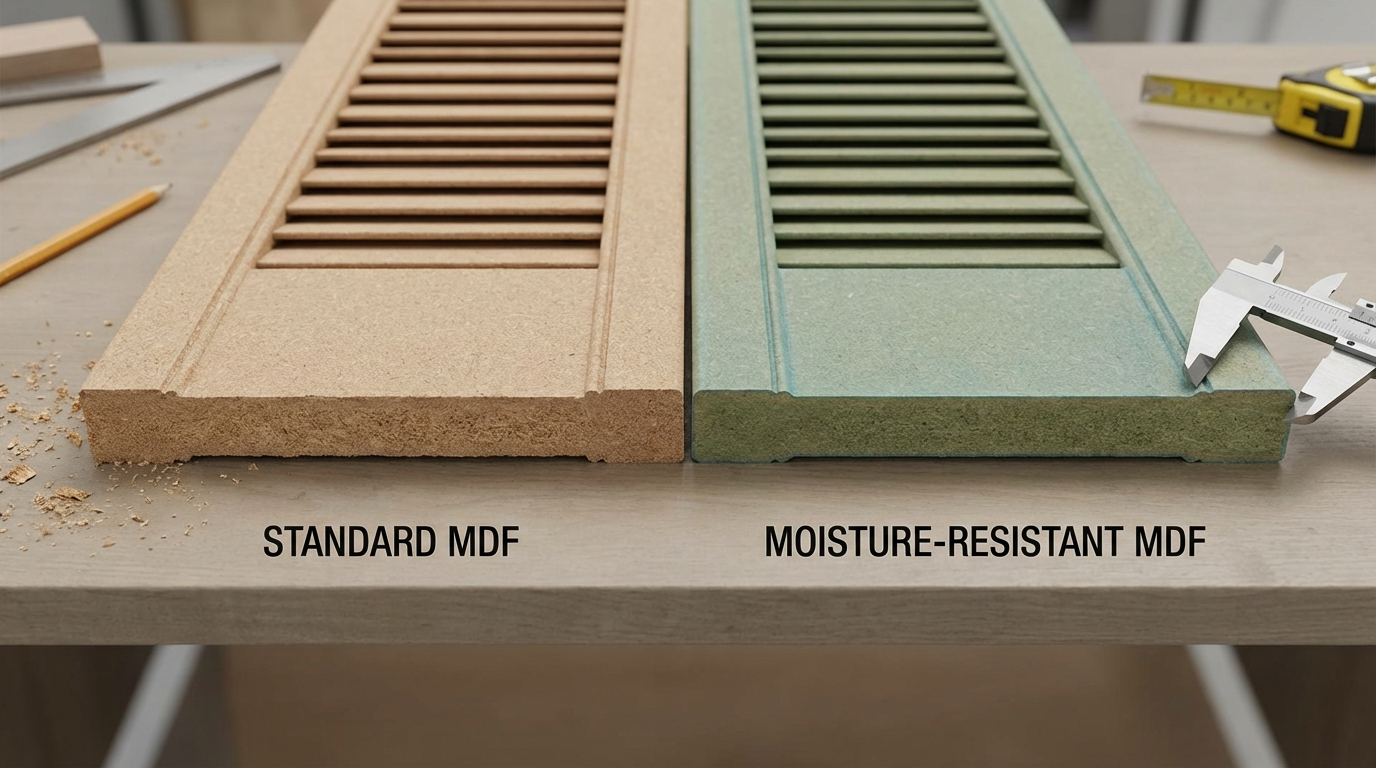
If you're in a hurry: For kitchen or bathroom shutters in humid Indian homes, prioritize high-density moisture-resistant (HDMR/HDWR) variants from either brand, as standard MDF risks swelling. Greenply's HDHMR often suits heavy-use cabinets with better screw-holding, while Greenpanel's HDWR handles steam-prone zones well. Always verify board density (over 800 kg/m³ ideal) and edge-seal samples. Expect 16-18mm thickness; costs vary by city but factor in 10-20% logistics premium in coastal areas. Test a sample overnight in water—minimal swelling wins.
- Choose Greenply HDHMR if: Shutters face daily heavy loads or frequent screwing.
- Choose Greenpanel HDWR if: High steam/humidity like coastal kitchens.
- Avoid standard MDF if: Any splash exposure without lamination.
Note: This page is independent informational content and is not affiliated with any manufacturer.
If You’re Searching for Greenpanel or Greenply, Here’s What People Usually Mean
Queries like "Greenpanel vs Greenply MDF for shutters" typically come from modular kitchen buyers in India eyeing cabinet doors that withstand humidity without warping. People confuse standard MDF with moisture-resistant upgrades (HDHMR/HDWR), assuming all are equal. They want boards that mill smoothly for clean laminate edges, hold hinges firmly, and resist termites in monsoon-stored godowns. Often, the real decision is between their high-density lines for bathrooms vs interiors, plus local dealer stock for quick installs.
How to Compare Greenpanel-Type Options to Alternatives (Without Guesswork)
Compare by soaking a small edge piece in water for 2 hours—minimal expansion favors moisture grades. Check density via tap test (dense rings deeper) and screw pull-out (HDHMR holds 20-30% tighter). For shutters, both brands' HD variants work if calibrated evenly; skip if core feels spongy. Alternatives like blockboard add strength but rougher finishes; verify batch uniformity at site by measuring thicknesses across sheets.
What This Term/Material Actually Means
MDF (Medium Density Fiberboard) for shutters means engineered wood from wood fibers glued under pressure, offering smooth surfaces ideal for laminate-veneer finishes in Indian modular cabinets. For shutters, focus on HDHMR/HDWR grades (high-density, moisture-resistant) that mimic plywood durability but cut cleaner. Thicknesses like 16-18mm suit standard frames; not structural like plywood.
Where people get confused:
- Assuming all MDF is waterproof—only HD grades resist splashes.
- Thinking density equals plywood strength—screws pull easier in thin cores.
- Mixing with particleboard—uniform fibers make MDF better for milling.
- Ignoring calibration—uneven thickness warps laminated shutters.
- Overlooking lamination needs—raw MDF absorbs moisture pre-finish.
India-Specific Reality Check
In monsoon-heavy regions like Mumbai or Kerala, unlaminated MDF swells 10-15% faster during godown storage; coastal salt air accelerates delam. Contractor workflows demand pre-cut calibration to avoid site warping. Workmanship gaps like poor edge-sealing cause 30% shutter failures in humid homes—always seal exposed cuts with 2-3 epoxy coats.
Is Greenpanel MDF good for kitchen shutters?
Greenpanel's Exterior/HDWR MDF performs well for kitchen shutters if high-humidity rated, thanks to dense fibers resisting steam swells. Ideal for modular setups with laminate overlays. Nuance: Best in ventilated zones; pair with PVC edges in direct-splash areas. Next step: Tap edges for solidity; request density sheet (aim 800+ kg/m³) and soak-test a sample—under 5% swell confirms fit.
Is Greenply MDF suitable for bathroom shutters?
Greenply HDHMR excels in bathrooms for its screw-holding in humid swings, minimizing hinge sag. Handles occasional wipes but not submersion. Conditions: Seal all cuts; avoid if ventilation poor. Verify by pressing core—no give under thumb; compare local batches as coastal variants harden differently.
Two-Minute Comparison That Actually Helps
| Feature | Greenpanel HDWR/Ext Grade | Greenply HDHMR 710 |
|---|---|---|
| Density Profile | High (uniform for milling) | High (stronger screw hold) |
| Moisture Handling | Good for steam zones | Good for load + humidity |
| Thickness Options for Shutters | 16-18mm common | 12-18mm flexible |
| Typical Price Range (18mm/sqft) | Rs 90-140 (city-varies) | Rs 100-150 (density premium) |
| Best for Shutters If... | Coastal/splash | Heavy cabinets |
Price Range and Cost Drivers (India)
For 16-18mm HDHMR/HDWR MDF shutters, expect Rs 85-160 per sq ft—lower in inland hubs like Indore, 20% higher in Mumbai due to logistics. Drivers: Thickness (+30% for 18mm), density grade (+15-25%), calibration/finish (+10%). Quote checklist: Specify "HD moisture-resistant, 800+ kg/m³ density, calibrated ±0.2mm"; add 5% for edge-banding. Mini example: 20 sqm kitchen shutters ~Rs 25,000-40,000 material, varies by batch.
Which MDF thickness for shutters?
16mm suffices for light bedroom shutters; 18mm for kitchens to prevent sag. Thicker adds weight/stress on hinges. Check: Frame compatibility—too thick jams tracks. Practical: Measure site clearances; test bend a sample horizontally.
How to Choose in 5 Steps
- Assess exposure: Splash (HDWR) vs dry (standard)? Coastal adds 20% moisture risk.
- Verify density: Weigh sample (heavy=good); thumb-press core.
- Test moisture: Soak edge 2hrs—minimal warp passes.
- Check calibration: Micrometer thicknesses—even ±0.2mm.
- Confirm finish fit: Smooth face for laminate; quote sealed edges. Skip=warping post-install.
Decision Framework: Match Your Shutters to Conditions
| Condition | Recommended | Verify This |
|---|---|---|
| Wet kitchen (steam/splashes) | Greenpanel HDWR or equiv | 24hr soak <8% swell |
| Coastal humidity | HDHMR like Greenply | Density >850kg/m³ |
| Heavy-use cabinets | Greenply HDHMR | Screw pull test firm |
| Tight budget interiors | Standard MR MDF | Calibrated even |
| High scratch risk | Laminate-ready HD | Smooth sanded face |
| Fast delivery needed | Local stock HD variant | Batch uniformity |
Trade-offs and Limitations
MDF shutters finish smoother than plywood but swell faster if unsealed; HD grades mitigate but cost 20% more. Great for clean lines, poor for load-bearing without frames. Limitations: Edge fragility (needs banding), termite risk in poor storage, harder to repair vs plywood.
What are the disadvantages of MDF shutters?
MDF edges chip easily during handling; moisture penetrates unsealed cuts, causing delam in monsoons. Less screw strength than plywood for heavy hinges. Next: Always band edges; reinforce with battens for 20kg+ loads.
Tips for Homeowners
Clean with dry microfiber—avoid wet wipes to prevent swelling. Do: Seal scratches immediately. Don't: Store cleaners nearby.
Tips for Carpenters
Cut with fine blade; pre-drill hinges 5mm from edge. Seal cuts same day; fasten in density core zones.
Tips for Architects
Spec "HDMR 18mm, ±0.2mm cal, edge-seal"; detail 2mm PVC banding. Wet-zone: Vent slots.
Common Buyer Mistakes and How to Avoid Them
- Buying standard MDF for kitchens: Swells in humidity. Instead: Demand HD grade cert sheet.
- Ignoring thickness uniformity: Warps post-lam. Measure 4 corners.
- No edge-sealing: Absorbs spills. Apply epoxy on-site.
- Cheap laminates: Peels fast. Match PU grade.
- Overloading hinges: MDF crumbles. Use 4 hinges/door.
- Godown storage neglect: Warps pre-install. Cover stacks.
- No density check: Weak hold. Tap/weigh samples.
- Metro pricing blind: 25% markup. Compare inland dealers.
- Skipping soak test: Fails later. Do 24hr edge dip.
Failure Modes and Fixes
- Symptom: Swelling edges. Cause: Moisture ingress. Prevent: Seal all cuts. Fix: Sand + re-lam.
- Sagging shutters. Cause: Thin/low density. Prevent: 18mm HD. Fix: Reinforce battens.
- Hinge pull-out. Cause: Soft core. Prevent: Pre-drill. Fix: Epoxy + new hinge.
- Laminate bubbling. Cause: Poor adhesion. Prevent: Sand smooth. Fix: Heat gun + press.
- Chipping corners. Cause: Handling. Prevent: Band edges. Fix: Filler + repaint.
- Termite tracks. Cause: Damp storage. Prevent: Elevate stacks. Fix: Treat + replace.
- Color fade. Cause: UV/steam. Prevent: UV lam. Fix: Overlay new skin.
Quality Checks You Can Do Without Lab Tests
Before buying: Tap for deep tone (density); flex corner—no sag; measure thickness even. Ask: "HDMR grade? Recent batch?" Red flag: Visible fibers, soft press.
After cutting: Edges smooth? Core uniform? Soak test scrap.
After install: Level alignment; wipe-test no dark spots; hinge torque firm.
Does MDF swell in humidity?
Standard MDF does in Indian monsoons (10-20% expansion); HD grades limit to 5-8%. Conditions: Unsealed worse. Check: Humidity chamber mimic with damp cloth overnight.
FAQs
Which is better for shutters: Greenpanel or Greenply MDF?
Both HD variants work well; Greenply HDHMR for load-heavy, Greenpanel HDWR for wetter zones. Local availability tips scale—density and even calibration matter more than brand. Test samples side-by-side for your site's humidity; factor carpenter familiarity to cut errors.
Can I use regular MDF for kitchen shutters?
Regular MDF risks swelling from steam/spills in Indian kitchens; opt for HDMR instead. It holds laminates better too. Always seal and ventilate; if budget tight, limit to wall cabinets away from sinks.
What thickness MDF for cabinet shutters?
16mm for light use, 18mm standard for kitchens to avoid flex. Thicker suits heavy drawers but adds weight. Match frame slots; test balance on hinges before full commit.
How to prevent MDF shutters from warping?
Seal edges with epoxy/PVC, use HD grades, store flat pre-install. Monsoon tip: Acclimatize 48hrs site. Poor frames amplify—ensure square assembly.
Is HDHMR better than regular MDF for bathrooms?
Yes, denser fibers resist humidity swells 2x better, ideal for vanity shutters. Still seal cuts; pair with exhaust fans. Verify by core hardness.
What laminate for MDF shutters?
0.8mm thick PU finish for durability; matte resists fingerprints. Match density—thin on HD only. Test adhesion on sample first.
Greenpanel vs Greenply price for 18mm MDF?
Ranges overlap at Rs 90-150/sqft; density/region drives variance. Quote multiples; negotiate bulk with sealing included.
Best MDF for modular kitchen shutters in India?
HDMR/HDWR from stocked brands; prioritize local tests over name. Coastal: Extra sealing. Ensures low callbacks.
Does Greenply MDF have good screw holding?
HDHMR does, outperforming standard; great for hinges. Pre-drill always; test pull on scrap for confidence.
Disclaimer: This content is provided for general informational purposes based on industry practices and publicly available information. Product specifications, standards, prices, and availability may vary by manufacturer, region, and time. Readers should independently verify details with manufacturers, dealers, or qualified professionals before making purchase or construction decisions.Want Plywood Suggestions?
Share a few details and a Duro BOIL specialist will suggest suitable brands and connect you to responsive dealers.