HDMR Sheet Explained: Meaning, Uses, Pros/Cons & Alternatives
Understand HDMR sheets—what they are, where they’re used, key specs to check, and how they compare to HDHMR, MDF and plywood for interiors.
Quick Decision Summary
HDMR (High-Density Moisture Resistant) sheets are high-density wood-fiber boards engineered with specialized resins to resist humidity and moisture better than standard interior boards.
If you’re in a hurry: HDMR is the middle-ground solution for Indian homes. It is denser and more moisture-resistant than standard MDF but typically less expensive and more uniform than premium BWP plywood. While it handles ambient kitchen humidity well, it isn't "waterproof" for submerged conditions. It is perfect for wardrobes, TV units, and kitchen shutters where you want a glass-like paint or laminate finish without the waviness often seen on hand-crafted plywood surfaces.
- Choose this if: You want a seamless, high-gloss or matte paint finish, are on a medium budget, and need better moisture resistance than basic fiberboards for semi-wet areas.
- Avoid this if: You are building structures prone to direct, heavy water flooding, or if your carpenter is only trained in traditional plywood joinery without the right screws.
What This Term Actually Means
In the Indian timber market, HDMR refers to wood fibers that have been compressed at a much higher pressure (density) compared to Medium Density Fiberboard (MDF). During the manufacturing process, moisture-resistant (MR) resins are infused into the fiber matrix. This creates a board that doesn't swell as easily when exposed to the humid Indian monsoon climate.
Where people get confused about HDMR
- The "High Density" Myth: Many assume high density equals unbreakable. While more impact-resistant than MDF, it can still chip at the edges if handled roughly during transport.
- HDMR vs. HDHMR: In many local markets, these terms are used interchangeably. Technically, "HDHMR" (High Density High Moisture Resistance) is often just a branding evolution of HDMR, though some manufacturers claim higher resin content for the "High" variant.
- Waterproof vs. Water Resistant: This is the biggest trap. HDMR is water-resistant (it resists swelling from vapor); it is not "marine grade" waterproof. It should not be used for rooftop sheds or external garden furniture.
- The Green Core Misconception: Many buyers think if the board's internal core is green, it is automatically authentic HDMR. In reality, the green color is just a pigment added by manufacturers. Always verify density and brand reputation rather than just the color.
- Screw Holding: There is a common belief that fiberboards cannot hold screws. While true for low-grade MDF, high-quality HDMR holds screws well, provided you use "full-threaded" CSK screws rather than the standard nails used for plywood.
India-Specific Reality Check
India’s climate presents a unique challenge for engineered wood. In coastal cities like Mumbai, Chennai, or Kolkata, the relative humidity can stay above 80% for months. In North India, extreme temperature swings cause materials to expand and contract. HDMR handles these "ambient" shifts better than basic MDF because its high density leaves less room for moisture to penetrate the internal fibers.
However, the biggest risk in India isn't the weather—it's the plumbing. Most HDMR failures occur not because of the board quality, but because of undetected slow leaks in kitchen sinks or bathroom wall seepages. On Indian construction sites, boards are often stored flat on damp floors; this is a recipe for edge swelling before the product is even installed. Always ensure boards are stacked on a raised wooden platform (runners) at the site.
Two-Minute Comparison That Actually Helps
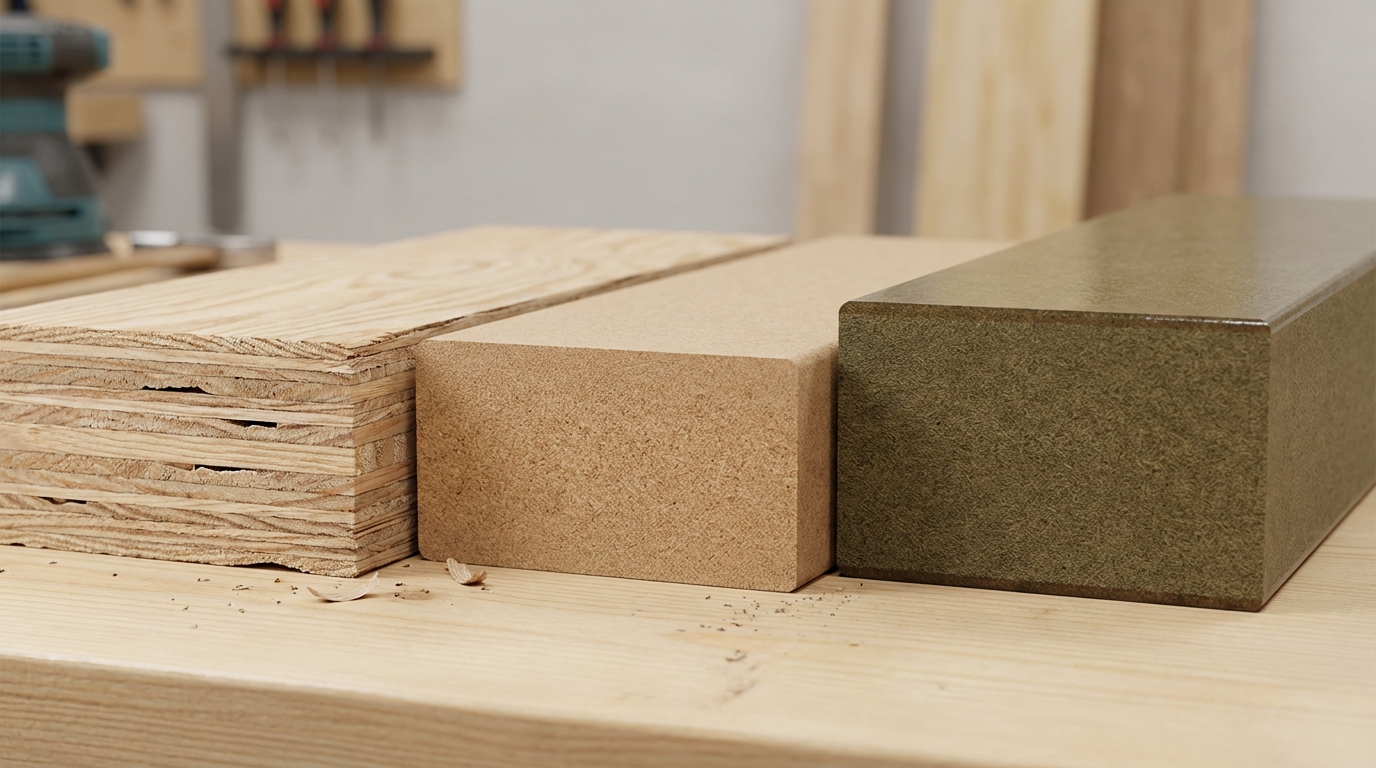
| Feature | Standard MDF | HDMR Sheet | BWR/BWP Plywood |
|---|---|---|---|
| Density | Low to Medium | High (>800 kg/m³) | Varies (Medium) |
| Moisture Resistance | Poor (Swells easily) | Good (Resists humidity) | Excellent (Resists water) | Surface Finish | Very Smooth | Superior (Glass-like) | Grainy (May telegraph) |
| Primary Use Case | Low-cost dry furniture | Kitchens, Vanities, Units | Main Carcass, Wet zones |
| Cost Factor | Economical | Mid-Range | Premium |
Price Range and Cost Drivers (India)
HDMR pricing is generally more stable than plywood but varies based on thickness and the specific resin-to-fiber ratio. Typically, prices are quoted per square foot. While we cannot provide a live quote, here is the logic behind the cost:
- Thickness: Common sizes are 3mm, 5.5mm, 8mm, 12mm, 16mm, and 18mm. The 18mm board is the standard for shutters and carcasses.
- Density Grade: Boards with a density of 850kg/m³ and above command a 15-20% premium over lower-density "commercial" fiberboards.
- City Variation: Prices in port cities (where timber is imported) might differ from inland manufacturing hubs due to logistics and state-wise GST implementation.
- Wastage: Unlike plywood, HDMR is incredibly uniform. This reduces wastage during CNC cutting, often making the overall project cost lower even if the per-sheet price is similar to mid-grade plywood.
How to ask for a quote:
When speaking to a dealer, ask: "What is the density of the 18mm board in kg/cm³ and is it pigment-dyed or core-integrated?" This shows you understand the technicals and prevents them from quoting for low-grade MDF.
How to Choose in 5 Steps
- The Weight Test: Lift a corner of the sheet. Authentic HDMR is significantly heavier than MDF. An 18mm full sheet should feel roughly as heavy as a high-quality hardwood plywood sheet.
- The Surface Scratch: Try to dent the surface with a fingernail. High-density boards should be resistant to superficial indentations compared to standard boards.
- Check the Edges: Look at the cut side. The fibers should look tightly packed with no visible air gaps or "fluffy" layers. A fuzzy edge indicates lower density.
- Verify the Application: Use HDMR for shutters, decorative wall panels, and wardrobes. For the "wet" carcass under a kitchen sink, consider BWP plywood or WPC as a safer long-term bet.
- Match the Hardware: Ensure your contractor is using specialized wood screws. Standard wire nails will eventually loosen in fiber-based boards.
Trade-offs and Limitations
- Joinery Constraints: You cannot use traditional "mortise and tenon" joinery effectively with HDMR. It is designed for butt-joints with screws or cam-locks.
- Weight Burden: Because it is very dense, large doors made of HDMR can be heavy. You must use high-quality, branded hinges (usually 3 hinges for a standard wardrobe door) to prevent sagging.
- Edge Banding is Mandatory: Unlike plywood, which can sometimes be painted on the edge, HDMR edges are porous. They must be sealed with PVC edge-banding tape using hot-melt glue to prevent moisture entry.
Common Buyer Mistakes and How to Avoid Them
- Mistake: Using it for outdoor signage. HDMR is for interiors. Direct sunlight and rain will cause delamination over time. Fix: Use ACP or WPC for outdoors.
- Mistake: Relying on the green color. Some local brands add green dye to standard MDF. Fix: Check the weight and density specs, not the color.
- Mistake: Using standard nails. Nails don't grip fibers well. Fix: Always use threaded screws.
- Mistake: Skipping the edge band. Homeowners often leave the top/bottom edges of shutters unsealed. Fix: Ensure all 4 sides are edge-banded.
- Mistake: Buying based on "Cheapest Rate". Low-grade HDMR has high formaldehyde emission. Fix: Ask for E1 or E0 grade boards for better air quality.
- Mistake: Mixing with low-quality laminate. A stable board needs a stable finish. Fix: Use 1mm laminates for a balanced pull.
- Mistake: Forgetting the balancer. If you laminate one side, the board will bend. Fix: Always laminate both sides.
- Mistake: Using it in high-seepage bathrooms. Fix: Address the wall seepage before installation.
Failure Modes and Fixes
| Symptom | Root Cause | Prevention | The Fix |
|---|---|---|---|
| Hinges coming loose | Over-tightening or wrong screws | Use pilot holes and CSK screws | Fill hole with wood filler/epoxy and re-drill |
| Edge Swelling | Water exposure on unsealed edges | Mandatory 4-side edge banding | Sand down the swell (if minor) and reseal immediately |
| Board Warping | Single-side lamination | Laminate both sides (balancing) | Difficult to fix; may require replacement with a balanced board |
| Fuzzy Paint Finish | Poor sanding of the fibers | Use a dedicated primer/sealer for HDMR | Sand with fine-grit (320+) and re-prime |
| Mushrooming | Driving screws without pilot holes | Always drill a pilot hole first | Chisel away the raised fiber and sand level |
Quality Checks You Can Do Without Lab Tests
Before Buying: Visual & Physical
Check the surface for "pitting" or small holes. A high-quality HDMR sheet should be as smooth as a sheet of paper. Rub the edge of the board with your thumb; if the fibers come off easily like dust, it's low density. Ask the dealer for a small sample and soak it in a glass of water for 2 hours. A good board will show negligible thickness increase (usually under 5-8%).
After Cutting: Workmanship Cues
Observe the "burn marks." If the saw blade is sharp but the board shows excessive burning, it indicates very high resin content (which is good for moisture resistance but requires slower cutting). The cut edge should be sharp and crisp, not crumbly.
After Installation: The "Knock" Test
Tap the center of a fixed panel. A high-density board will produce a dull, solid sound. A hollow or tinny sound might suggest the board is thinner than specified or of lower density. Check that all hardware is flush—screws should be countersunk perfectly without cracking the surrounding surface.
Decision Framework: When to Use HDMR?
| If the Condition is... | Recommended Material | What to Verify |
|---|---|---|
| High Humidity (Kitchen/Coastal) | HDMR / HDHMR | Check for E1 emission grade |
| Direct Water Contact (Sink Area) | BWP Plywood or WPC | IS 710 Certification |
| Budget Wardrobes (Dry Room) | Standard MDF / Particle Board | Edge sealing quality |
| High-Gloss PU Paint Finish | HDMR | Surface density and smoothness |
| Heavy Load Bearing (Bookshelves) | Plywood / Blockboard | Core gap quality |
Tips for Homeowners
Focus on "balanced construction." If you are choosing HDMR for your kitchen shutters, don't skimp on the finish. A high-quality 1mm laminate or a factory-finished PU paint will protect the HDMR core for a decade. For cleaning, never use a soaking wet cloth; a slightly damp microfiber cloth is all you need to maintain the surface.
Tips for Carpenters
Always use a 2.5mm or 3mm pilot hole before driving an 8-gauge screw into HDMR. Because the material is so dense, a screw without a pilot hole will cause the board to "mushroom" or split near the edges. Also, ensure your circular saw blades have a higher tooth count (TCT blades) for a cleaner finish on fiberboards.
FAQs
Is HDMR termite proof?
Most HDMR boards are chemically treated during the resin infusion process to resist termites and bores. However, they are not "termite-proof" in the same way some high-end chemically treated plywood is. If your home has a severe, active termite infestation coming from the soil, they can eventually chew through almost any cellulose-based material. Termite resistance in HDMR is generally sufficient for modern apartments with routine pest control.
Can we use HDMR for bathroom doors?
It is generally not recommended to use HDMR for the main bathroom door if it is likely to be splashed with water daily (especially in small Indian bathrooms). For the internal side of a bathroom door, WPC (Wood Polymer Composite) or high-grade BWP plywood are safer choices. However, for a dry vanity unit inside a large bathroom, HDMR works perfectly well as long as the edges are sealed professionally.
Which is better, HDMR or Plywood?
"Better" depends on the application. For a perfectly flat, wave-free finish (like a mirror-finish kitchen), HDMR is superior because plywood has natural grains and "telegraphing" issues. For structural load-bearing, such as a large bed frame or long bookshelves, plywood is better because it has cross-laminated strength. Many modern Indian designers use a hybrid approach: plywood for the internal carcasses and HDMR for the external shutters.
Is HDMR more expensive than MDF?
Yes, HDMR is more expensive than standard MDF, often by 25% to 40%. This is because it uses higher-quality resins and significantly more wood fiber compressed into the same volume. While it costs more upfront, the "cost per year of life" is much lower than MDF in Indian weather conditions, as it doesn't need to be replaced after a single humid monsoon season.
Does HDMR emit a bad smell?
New HDMR can have a slight chemical odor due to the resins used. To ensure safety, always look for boards that are certified as E1 or E0 grade. These have low formaldehyde emissions, ensuring that the air quality inside your bedrooms remains safe for children and the elderly. Proper ventilation for 48 hours after installation usually clears any lingering "new furniture" smell.
How can I identify original HDMR?
Identification starts with weight; it shouldn't feel light like cheap packaging wood. Second, look for brand markings and density specifications printed on the back of the sheet. Most reputable manufacturers will print "HDMR" and the density (e.g., 850kg/m³) directly on the board. Finally, check the core—it should be uniform in color and texture throughout the thickness of the board.
Can I paint directly on HDMR sheets?
Yes, HDMR is one of the best surfaces for painting. However, you cannot just apply a topcoat. You must first sand the surface lightly, apply a specialized MDF/HDMR primer to seal the fibers, sand again, and then apply your PU or Duco paint. Because HDMR is so smooth, it requires less paint than plywood to achieve a high-quality finish, which can save money on labor and material.
What is the life of HDMR furniture?
In a well-maintained home with no major plumbing leaks, HDMR furniture can easily last 10 to 15 years. The lifespan is largely determined by how well the edges were sealed during installation. If moisture is kept out of the core, the material remains stable and doesn't lose its shape or strength over time.
Disclaimer: This content is provided for general informational purposes based on industry practices and publicly available information. Product specifications, standards, prices, and availability may vary by manufacturer, region, and time. Readers should independently verify details with manufacturers, dealers, or qualified professionals before making purchase or construction decisions.Want Plywood Suggestions?
Share a few details and a Duro BOIL specialist will suggest suitable brands and connect you to responsive dealers.