HDMR Sheet Full Form: Meaning, Density & Where It Fits in Interiors
HDMR sheet full form and meaning explained in simple terms—plus density range, typical sizes, and how to pick the right board for interiors.
Quick Decision Summary
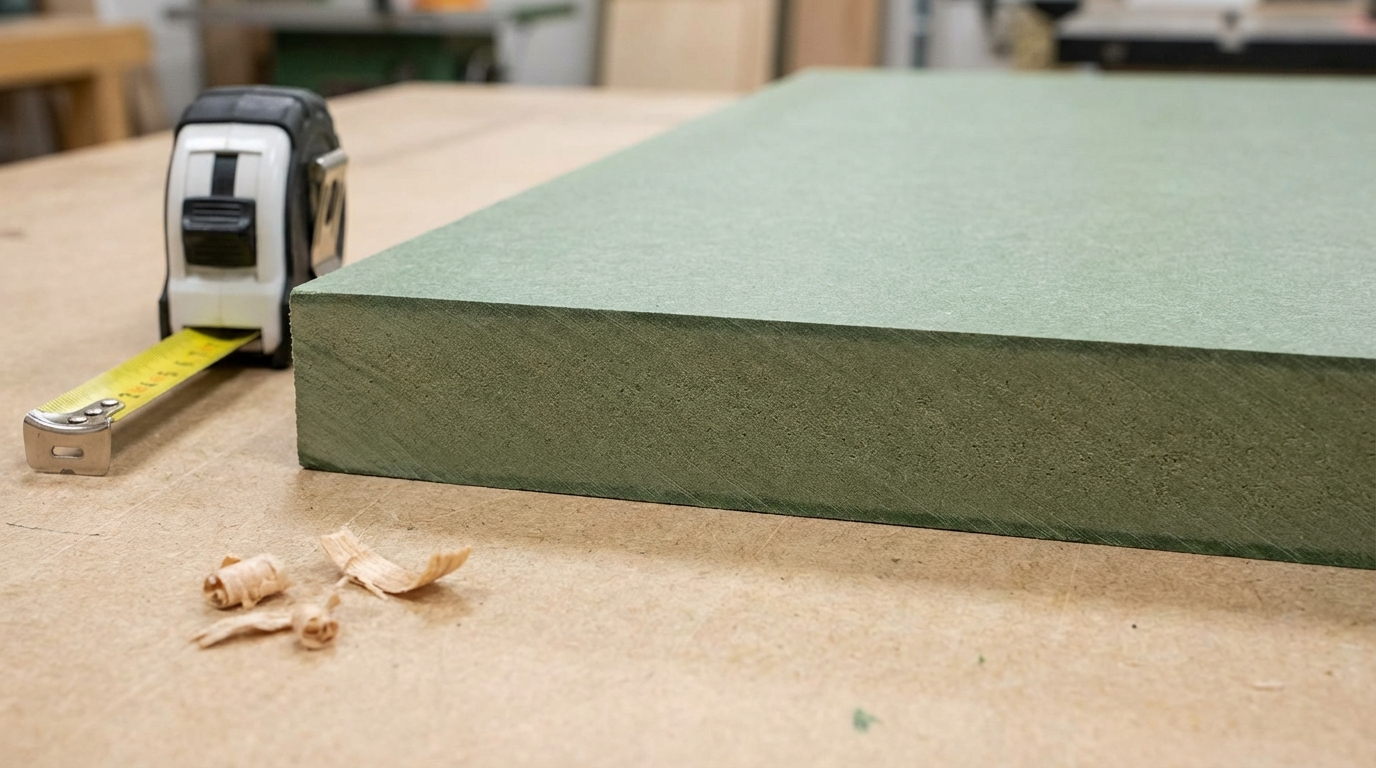
Best answer in one line: HDMR stands for High-Density Moisture Resistant board—a dense engineered panel that handles humidity better than standard MDF while offering smooth surfaces for laminates and paint.
If you're in a hurry: HDMR boards typically range from 800–900 kg/m³ density, making them harder and more screw-holding than regular MDF. They work well for wardrobe shutters, modular kitchen carcasses in drier zones, and TV unit backs. However, they are not waterproof—prolonged water contact will still cause swelling. For wet areas like under-sink cabinets or bathroom vanities, you need BWP plywood or marine-grade options instead. Always check edge sealing and confirm the density specification before purchase.
- Choose HDMR if: You need smooth, paint-ready surfaces for wardrobes, study tables, or bedroom furniture in climate-controlled or dry interiors.
- Avoid HDMR if: Your application involves direct water exposure, coastal humidity without AC, outdoor furniture, or structural load-bearing requirements.
What HDMR Actually Means—Full Form and Core Definition
HDMR expands to High-Density Moisture Resistant board. It belongs to the MDF (Medium Density Fibreboard) family but sits at the higher end of the density spectrum with added moisture-inhibiting resins. The manufacturing process involves breaking down wood fibres, mixing them with synthetic resins and wax, then pressing them under high heat and pressure to form uniform panels.
The "moisture resistant" part refers to the type of resin used during bonding—typically melamine-urea-formaldehyde (MUF) rather than standard urea-formaldehyde. This improves resistance to humidity and occasional dampness but does not make the board waterproof. Think of it as humidity tolerance, not water immunity.
Where People Get Confused About HDMR
Several misconceptions circulate among buyers and even some carpenters regarding HDMR sheets. Understanding these prevents costly mistakes:
- Confusion 1: HDMR equals waterproof. It does not. The "MR" indicates moisture resistance, meaning it tolerates humid air better than standard MDF. Submerging it or exposing cut edges to standing water will cause swelling within hours.
- Confusion 2: HDMR and HDF are the same thing. HDF (High-Density Fibreboard) is a separate category with even higher density (typically 900+ kg/m³) used primarily for laminate flooring cores. HDMR is specifically formulated for furniture applications with added moisture resistance.
- Confusion 3: All branded "HDMR" boards have identical density. Density varies between manufacturers and even product lines. Some boards labelled HDMR may be closer to 750 kg/m³, while premium versions exceed 850 kg/m³. Always ask for the specific density rating.
- Confusion 4: HDMR can replace plywood everywhere. HDMR excels at smooth finishes but lacks plywood's cross-grain strength for structural applications, hinge zones under heavy doors, or areas requiring repeated screw insertion.
- Confusion 5: Thicker HDMR is always stronger. Thickness adds rigidity but not necessarily strength in screw-holding or impact resistance. A poorly bonded 18mm sheet may perform worse than a well-made 12mm panel.
India-Specific Reality Check
Selecting engineered boards in India requires accounting for climate extremes, storage conditions, and on-site handling that differ significantly from controlled factory environments.
How Does Monsoon Humidity Affect HDMR Performance?
During monsoon months, relative humidity in many Indian cities exceeds 80–90% for weeks. HDMR boards stored in poorly ventilated godowns or brought to partially constructed sites absorb ambient moisture through exposed edges and faces. This causes dimensional changes—typically 1–3% expansion—before the board even reaches the carpenter's workshop. If installed in this swollen state and the environment later dries out, gaps appear at joints.
Practical prevention: Store HDMR sheets flat on battens in covered, ventilated spaces for 48–72 hours before cutting. Avoid delivery during heavy rain. If sheets feel heavier than expected or show slight waviness, let them acclimatise before processing.
Coastal Versus Inland: Does Location Change the Choice?
Coastal cities like Mumbai, Chennai, and Kochi experience salt-laden air that accelerates moisture absorption and can degrade surface finishes faster. HDMR in coastal homes without air conditioning may show edge swelling within 2–3 monsoon cycles even in "dry" rooms like bedrooms. Inland cities with drier winters (Delhi, Jaipur, Ahmedabad) are more forgiving, though summer humidity spikes still matter.
Decision rule: In coastal locations, limit HDMR to AC-controlled rooms or upgrade to BWR plywood for carcasses. Use HDMR only for shutter faces where edges can be fully sealed with PVC edge bands and laminate.
Site Storage and Contractor Handling Realities
On most Indian construction sites, material storage is an afterthought. Boards often lean against walls, get rained on during transport, or sit in direct sunlight. HDMR is more sensitive to these conditions than plywood because its uniform fibre structure absorbs moisture evenly—leading to full-sheet warping rather than localised damage.
What to do: Specify in your work order that HDMR sheets must be delivered in wrapped bundles and stored horizontally. Reject visibly warped or edge-damaged sheets on arrival. Budget for 5–8% wastage to account for damaged pieces rather than forcing carpenters to use compromised material.
Density Range and Why It Matters for Your Project
Density is the single most important specification for HDMR because it determines hardness, screw-holding capacity, and resistance to surface dents. Understanding the numbers helps you ask the right questions at the dealer.
What Density Numbers Should You Look For?
HDMR boards typically fall in the 800–900 kg/m³ range. Here is how density affects practical performance:
| Density Range | Typical Applications | Screw-Holding | Surface Hardness |
|---|---|---|---|
| 750–800 kg/m³ | Budget wardrobes, back panels, internal partitions | Moderate—requires pilot holes | Prone to dents from impacts |
| 800–850 kg/m³ | Standard furniture shutters, study tables, TV units | Good—holds standard hinges well | Resists light scratches |
| 850–900 kg/m³ | Premium modular furniture, heavy-use drawers, commercial fitouts | Excellent—suitable for soft-close hardware | Handles moderate impacts |
Verification method: Ask the dealer for the technical data sheet showing density. If unavailable, weigh a sample piece and calculate: a standard 8×4 feet sheet at 18mm thickness and 850 kg/m³ density should weigh approximately 45–48 kg. Significantly lighter sheets indicate lower density.
Typical Sizes and Thickness Options Available in India
HDMR sheets in the Indian market follow standard dimensions, though availability varies by city and dealer stock.
What Sheet Sizes Can You Expect?
The most common size is 8 feet × 4 feet (2440mm × 1220mm). Some manufacturers offer 7 feet × 4 feet and 6 feet × 4 feet for specific furniture applications, reducing wastage for shorter cabinets. Oversize sheets (9×4 or 10×4) are rare in HDMR and typically available only on bulk orders.
Which Thickness Works for Which Application?
- 6mm: Back panels for wardrobes, drawer bottoms, internal partitions where rigidity is not critical.
- 8–9mm: TV unit backs, modular kitchen back panels, false ceiling underlays.
- 12mm: Shelves with light loads, internal vertical partitions, small shutter faces.
- 16–18mm: Wardrobe shutters, kitchen shutters, drawer fronts, study table tops, TV unit fronts—most furniture applications use this range.
- 25mm: Heavy tabletops, commercial counters, display units requiring substantial rigidity.
Practical note: 18mm is the workhorse thickness for most residential furniture. If your carpenter suggests 12mm for shutter faces to save cost, understand that thinner shutters flex more over time and feel less premium when opened.
How to Compare HDMR Against Other Board Options
Buyers often struggle to choose between HDMR, standard MDF, HDF, plywood, and particle board. This comparison focuses on conditions rather than vague "quality" claims.
Two-Minute Comparison That Actually Helps
| Condition | Best Option | Why |
|---|---|---|
| Smooth paint/lacquer finish needed | HDMR or MDF | Uniform fibre surface takes paint evenly without grain show-through |
| Humid room without AC | BWR plywood | Cross-grain construction resists warping better than fibre boards |
| Under-sink cabinet or wet zone | BWP/Marine plywood | HDMR will swell; plywood handles water exposure far better |
| Heavy hinge load (tall shutters) | Plywood | HDMR screw-holding in edge zones is weaker than plywood's cross-plies |
| Laminate-finished shutters | HDMR | Flat surface ensures laminate adhesion without undulations |
| Budget-constrained, dry room | Standard MDF or particle board | Adequate if edges sealed and humidity controlled |
| Flooring underlay | HDF | Higher density handles foot traffic and point loads |
Is HDMR Better Than Plywood for Wardrobes?
This depends on the specific wardrobe components. For shutter faces that need a perfectly smooth laminate or paint finish, HDMR outperforms plywood—no veneer grain telegraphs through. For the carcass (sides, top, bottom, shelves), plywood offers better screw-holding at edges and greater tolerance for humidity variations. A hybrid approach—plywood carcass with HDMR shutters—often delivers the best balance of durability and aesthetics.
Trade-offs and Limitations
HDMR is not a universal solution. Understanding its weaknesses helps you deploy it correctly and avoid failures.
- Edge vulnerability: Cut edges expose the fibre core, which absorbs moisture rapidly. Without proper edge banding, swelling begins within weeks in humid environments.
- Limited screw re-insertion: Unlike plywood, HDMR does not hold screws well when removed and reinserted in the same hole. Hardware adjustments become problematic.
- No structural strength: HDMR cannot be used for load-bearing frames, door frames, or any application requiring tensile strength across the grain.
- Weight: High-density boards are heavy. An 18mm 8×4 sheet weighs 45–50 kg, making handling difficult for single carpenters and increasing transport costs.
- Machining requirements: HDMR generates fine dust during cutting that clogs standard saw blades faster. Carbide-tipped blades and dust extraction are recommended.
- Surface damage visibility: Deep scratches or dents on HDMR are harder to repair than on solid wood because the uniform colour does not hide imperfections.
Common Buyer Mistakes and How to Avoid Them
These errors occur repeatedly in Indian furniture projects. Learning from others' experiences saves money and frustration.
Mistake 1: Assuming All HDMR Brands Are Equal
Why it happens: Buyers treat HDMR as a commodity and choose based on price alone. Dealers may substitute lower-density boards labelled similarly.
What to do instead: Request density specifications in writing. Weigh sample sheets if possible. Stick with consistent suppliers once you verify quality.
Mistake 2: Using HDMR for Kitchen Sink Cabinets
Why it happens: The "moisture resistant" label misleads buyers into thinking it handles water exposure.
What to do instead: Use BWP plywood or marine plywood for under-sink zones. HDMR can be used for upper kitchen cabinets away from water sources.
Mistake 3: Skipping Edge Banding to Save Cost
Why it happens: Edge banding adds labour time and material cost. Carpenters sometimes skip it on back edges or internal partitions.
What to do instead: Insist on edge banding all exposed cuts, including back edges visible when doors open. PVC edge bands cost little but prevent major failures.
Mistake 4: Accepting Delivery Without Inspection
Why it happens: Sheets arrive wrapped, and buyers trust the label without checking individual pieces.
What to do instead: Unwrap and inspect at least 20% of sheets on delivery. Check for warping, edge damage, surface scratches, and thickness consistency.
Mistake 5: Storing Sheets Vertically or Outdoors
Why it happens: Space constraints on site lead to improper storage.
What to do instead: Store flat on level supports, covered and ventilated. Even one night of rain exposure can compromise an entire stack.
Mistake 6: Using Furniture Screws Without Pilot Holes
Why it happens: Carpenters accustomed to plywood drive screws directly.
What to do instead: Always drill pilot holes slightly smaller than screw diameter. This prevents surface cracking and improves holding strength.
Mistake 7: Ignoring Acclimatisation Time
Why it happens: Tight project timelines push immediate cutting after delivery.
What to do instead: Allow 48–72 hours for sheets to acclimatise to site humidity before cutting and installation.
Mistake 8: Choosing HDMR for Coastal Homes Without AC
Why it happens: Buyers hear "moisture resistant" and assume it suits all environments.
What to do instead: In non-AC coastal rooms, prefer plywood carcasses. Use HDMR only for laminated shutters with fully sealed edges.
Failure Modes and Fixes
Understanding how HDMR fails helps you prevent problems or address them if they occur.
Failure 1: Edge Swelling
Symptom: Edges expand, laminate lifts, visible puffiness along cuts.
Root cause: Unsealed edges absorbing ambient or spilled moisture.
Prevention: Apply PVC edge banding on all cuts, including hidden edges. Use waterproof edge band adhesive.
If already happening: Trim swollen portions, dry thoroughly, re-edge with waterproof sealant. In severe cases, replace the affected panel.
Failure 2: Surface Delamination
Symptom: Laminate or veneer peeling away from HDMR substrate.
Root cause: Poor adhesive application, contaminated surface during lamination, or moisture ingress from back side.
Prevention: Ensure surface is dust-free before lamination. Use appropriate adhesive for laminate type. Seal back surfaces in humid environments.
If already happening: Remove loose laminate, sand surface, reapply with fresh adhesive and pressure.
Failure 3: Hinge Screw Pull-Out
Symptom: Hinges loosen, shutter doors sag or misalign.
Root cause: HDMR edge has lower screw-holding than plywood. Repeated opening/closing stresses the screws.
Prevention: Use longer screws with pilot holes. For heavy shutters, install plywood hinge blocks bonded to HDMR.
If already happening: Fill stripped holes with wood filler mixed with sawdust, let cure, redrill pilot holes. For repeated failures, add hinge blocks.
Failure 4: Full-Sheet Warping
Symptom: Entire panel bows or twists, doors do not close flat.
Root cause: Uneven moisture absorption (one side laminated, other exposed), improper storage, or uneven pressing during manufacture.
Prevention: Store flat, laminate both faces or seal the back, acclimatise before installation.
If already happening: Minor warps may self-correct with balanced humidity. Severe warps require replacement.
Failure 5: Surface Scratches and Dents
Symptom: Visible marks on painted or lacquered HDMR surfaces.
Root cause: Inadequate surface hardness for the application, or lack of protective finish.
Prevention: Use higher-density HDMR (850+ kg/m³) for high-traffic surfaces. Apply quality primer and topcoat.
If already happening: Light scratches can be touched up with matching paint. Deep dents require filling with automotive-grade filler, sanding, and repainting.
Failure 6: Bacterial/Fungal Growth
Symptom: Musty smell, discoloration, visible mould on edges or back.
Root cause: Prolonged moisture exposure in poorly ventilated spaces.
Prevention: Ensure ventilation behind cabinets, avoid using HDMR in bathrooms without exhaust, seal all surfaces.
If already happening: Clean with diluted bleach solution, dry completely, apply anti-fungal sealant. Replace if structural integrity is compromised.
Quality Checks You Can Do Without Lab Tests
These practical checks help you verify HDMR quality at the dealer, during cutting, and after installation.
Before Buying: Dealer-Level Checks
- Weight test: Pick up a corner of an 18mm 8×4 sheet. It should feel heavy (45–50 kg total). Unusually light sheets indicate lower density.
- Surface inspection: Run your palm across the face. It should be uniformly smooth without bumps, depressions, or rough patches.
- Edge inspection: Look at cut edges for uniform colour and fibre distribution. Dark streaks or voids indicate manufacturing defects.
- Flatness check: Lay the sheet on a flat surface. Gaps under the middle or corners indicate warping—reject such sheets.
- Thickness verification: Use a calliper or ruler at multiple points. Thickness should vary by no more than 0.3mm across the sheet.
After Cutting: Workmanship Cues
- Clean cuts: Well-bonded HDMR cuts cleanly without excessive chipping. Excessive edge crumbling suggests poor resin distribution.
- Dust colour: Cutting dust should be uniform light brown. Dark patches in dust indicate inconsistent raw material.
- Screw test: Drive a test screw with pilot hole into a scrap piece. It should hold firmly without the surrounding area cracking.
After Installation: Ongoing Checks
- Door alignment: Check shutter gaps weekly for the first month. Increasing gaps indicate moisture loss; decreasing gaps indicate absorption.
- Edge condition: Inspect edge bands monthly in kitchens. Lifting or discoloration signals moisture ingress—address immediately.
- Surface feel: Lacquered or laminated surfaces should remain smooth. Developing roughness suggests substrate movement.
Decision Framework: Matching Conditions to Choices
Use this table to quickly determine whether HDMR suits your specific situation and what to verify.
| Your Condition | Recommendation | What to Verify |
|---|---|---|
| AC-controlled bedroom or study | HDMR suitable for carcass and shutters | Density ≥800 kg/m³, all edges banded |
| Non-AC room in coastal city | Plywood carcass, HDMR shutters only if fully sealed | Laminate on both faces, PVC edge band with waterproof adhesive |
| Kitchen upper cabinets | HDMR acceptable away from steam/water sources | Distance from cooktop, ventilation above cabinets |
| Kitchen under-sink or near tap | Avoid HDMR—use BWP plywood | N/A |
| Bathroom vanity | Avoid HDMR—use marine plywood with laminate | N/A |
| Heavy wardrobe doors (>600mm width) | HDMR with plywood hinge blocks or full plywood shutter | Hinge block bonding quality, screw length |
| Commercial retail display | HDMR suitable if climate-controlled | Density ≥850 kg/m³ for durability, impact resistance |
| Budget-constrained dry interior | Standard MDF may suffice; HDMR if humidity fluctuates | Edge sealing critical regardless of choice |
Tips for Homeowners: Durability and Maintenance
Once HDMR furniture is installed, proper care extends its life significantly.
Do This
- Wipe spills immediately—do not let water sit on surfaces or pool near edges.
- Use coasters under wet glasses and hot cups to prevent surface damage.
- Ensure adequate ventilation behind wardrobes and cabinets to prevent moisture buildup.
- Run AC or dehumidifier during monsoon in coastal homes to control ambient humidity.
- Clean with slightly damp cloth followed by dry cloth—never soak the surface.
Avoid This
- Do not use abrasive cleaners or scrubbing pads on laminated HDMR surfaces.
- Avoid placing HDMR furniture directly against exterior walls prone to seepage.
- Do not hang heavy objects on HDMR panels without proper wall-mounted support.
- Avoid drilling new holes near existing ones—HDMR does not tolerate clustered fasteners well.
Tips for Carpenters: Cutting, Fastening, and Handling
Working with HDMR requires adjustments from plywood techniques.
Cutting Best Practices
- Use carbide-tipped saw blades with high tooth count (80+ teeth for clean edges).
- Score the laminate face before cutting to prevent chipping if using circular saw.
- Support the sheet fully during cutting—unsupported sections can crack.
- Wear dust masks—HDMR dust is fine and irritates airways.
Edge Preparation and Banding
- Sand cut edges lightly to remove loose fibres before applying edge band.
- Use hot-melt or waterproof adhesive for PVC edge bands—avoid contact cement in humid areas.
- Trim edge band flush with sharp trimmer; rough edges trap moisture.
Fastening and Hinge Zones
- Always drill pilot holes 2mm smaller than screw shank diameter.
- For hinges on heavy doors, consider 35mm cup hinges with longer screws or add plywood hinge blocks.
- Avoid placing screws within 15mm of edges—HDMR edge material is weaker.
- Use confirmat screws with coarse threads for better holding in HDMR.
Handling on Site
- Carry sheets vertically by two people to avoid bending stress.
- Do not drag sheets across floors—surface scratches are difficult to repair.
- Stack horizontally on level supports; never lean at angles for extended periods.
Tips for Architects and Interior Designers: Specifications and Detailing
Clear specifications prevent site confusion and ensure client satisfaction.
How to Specify HDMR Correctly
- State density requirement: "HDMR, minimum density 850 kg/m³" rather than just "HDMR".
- Specify thickness for each application: carcass, shutters, backs separately.
- Include edge treatment: "All exposed edges to receive 2mm PVC edge band with hot-melt adhesive".
- Note laminate or paint finish separately with surface preparation requirements.
Wet-Zone Precautions
- Avoid specifying HDMR for any cabinet within 300mm of water sources.
- For borderline areas (upper kitchen cabinets), require back-face sealing with primer or laminate.
- In bathrooms, use only for mirrors or wall-mounted shelves with sealed edges—not for vanities.
Finish Logic
- HDMR takes paint and lacquer finishes better than plywood due to absence of grain.
- For high-gloss lacquer, specify sanding sealer and multiple topcoats—HDMR absorbs finish unevenly otherwise.
- Veneer finishes require careful adhesive selection; test adhesion before full application.
Tips for OEM and Modular Furniture Manufacturers: Quality Control and Repeatability
Consistency matters when producing furniture at scale.
QC Checkpoints
- Incoming inspection: verify density by weighing sample sheets from each lot.
- Thickness verification: measure at 5 points per sheet; reject lots with >0.5mm variation.
- Moisture content check: use a moisture meter; accept sheets only at 8–12% MC.
- Surface quality: inspect under angled light to detect subtle depressions or bumps.
Reducing Returns and Complaints
- Edge band 100% of cuts, including internal partitions—customers notice swelling first at hidden edges.
- Include care instructions with delivered furniture—most complaints stem from user mishandling.
- Use consistent suppliers; switching brands between batches causes colour and density mismatches.
- Test hardware compatibility with each new HDMR batch—screw pull-out force varies.
FAQs
What is the full form of HDMR in furniture terminology?
HDMR stands for High-Density Moisture Resistant board. It refers to engineered fibreboard manufactured at higher density than standard MDF, with added moisture-inhibiting resins. The term distinguishes it from regular MDF (which lacks enhanced moisture resistance) and from HDF (which is denser but typically used for flooring rather than furniture). Understanding this distinction helps you match the right board to your application—HDMR for furniture in moderately humid environments, HDF for flooring, and standard MDF for completely dry interiors.
Is HDMR waterproof or only moisture resistant?
HDMR is moisture resistant, not waterproof. The difference is crucial: moisture resistance means the board tolerates humid air and brief dampness without immediate damage. Waterproof means it can handle prolonged water contact or submersion. HDMR will swell and degrade if edges remain wet for hours or if standing water pools on surfaces. For truly wet environments like bathroom vanities or under-sink cabinets, you need BWP plywood or marine-grade materials instead. The "MR" in HDMR indicates tolerance for humidity fluctuations, not immunity to water.
What density range qualifies as HDMR?
HDMR boards typically range from 800 to 900 kg/m³. Boards below 800 kg/m³ are closer to standard MDF and may not deliver the screw-holding and surface hardness expected from HDMR. Premium HDMR exceeds 850 kg/m³ and offers noticeably better performance for heavy-use applications. Always ask your dealer for the specific density—do not assume all boards labelled HDMR meet the same standard. Weighing a sample sheet provides a practical verification method when technical data sheets are unavailable.
Can HDMR be used for kitchen cabinets?
HDMR can be used for kitchen upper cabinets and shutter faces if they are away from direct water and steam exposure. It is not suitable for under-sink units, areas adjacent to taps, or zones directly above cooking ranges where steam accumulates. For these applications, BWR or BWP plywood is more appropriate. Even for acceptable kitchen applications, all HDMR edges must be sealed with PVC edge bands using waterproof adhesive. Monitor edge condition regularly and address any lifting immediately to prevent moisture ingress.
How does HDMR compare to plywood for wardrobes?
HDMR and plywood each have advantages for wardrobe construction. HDMR provides perfectly smooth surfaces ideal for laminate or painted finishes without visible wood grain. Plywood offers superior screw-holding at edges, better tolerance for humidity variations, and greater strength for structural elements. Many experienced furniture makers use a hybrid approach: plywood for the carcass (sides, shelves, partitions) and HDMR for shutter faces. This combines plywood's structural reliability with HDMR's superior finish quality.
What thickness of HDMR should I use for wardrobe shutters?
Most wardrobe shutters use 16–18mm HDMR. The 18mm thickness is standard for a substantial feel and adequate rigidity for typical door widths up to 450–500mm. For wider shutters or sliding doors, 18mm is recommended to prevent flexing. Thinner options like 12mm may seem cost-effective but result in doors that feel flimsy and may warp more easily over time. Back panels can use 6–8mm HDMR since they do not bear loads or undergo frequent handling.
Why do HDMR edges swell even when the board is labelled moisture resistant?
The "moisture resistant" property applies to the bonded core under normal humidity conditions, not to exposed cut edges. When you cut HDMR, the exposed fibre core has direct contact with air moisture. Without edge banding, these fibres absorb water vapour continuously, especially during monsoon or in coastal environments. Swelling begins at edges and progresses inward. This is why edge sealing is mandatory—not optional—for all HDMR furniture, regardless of room type. Even "dry" rooms experience humidity fluctuations that affect unsealed edges.
How should HDMR sheets be stored before use?
Store HDMR sheets flat on level supports in a covered, ventilated space. Sheets should not touch the ground directly—use wooden battens or pallets to allow air circulation underneath. Avoid vertical leaning for extended periods as this causes warping. Keep sheets away from rain, direct sunlight, and areas with extreme temperature variations. Allow delivered sheets to acclimatise for 48–72 hours before cutting, especially if they have been transported over long distances or through varying climate zones.
What is the price range for HDMR boards in India?
HDMR prices in India typically range from ₹45 to ₹75 per square foot for 18mm thickness, depending on brand, density, finish, and city. Lower-density boards and lesser-known brands fall at the lower end, while premium brands with certified density above 850 kg/m³ command higher prices. Pre-laminated HDMR costs more than raw boards. Prices also vary significantly between metros and smaller cities due to logistics costs. Always compare on a per-square-foot basis at the same thickness to ensure fair comparison between dealers.
Can HDMR be painted directly without primer?
While HDMR accepts paint better than plywood, skipping primer is not recommended. The fibre surface absorbs paint unevenly, leading to patchy colour and visible texture differences after drying. Proper finishing requires sanding sealer or primer coat, light sanding, and then topcoats. For high-gloss lacquer finishes, multiple primer and sanding cycles may be needed. Cutting corners on surface preparation results in finishes that look acceptable initially but show defects within months as the underlying surface telegraphs through.
Is HDMR suitable for commercial office furniture?
HDMR works well for commercial office furniture in climate-controlled environments. Its smooth surface suits professional aesthetics, and higher-density variants handle the wear of office use. However, for high-traffic areas like reception desks or heavily used workstations, verify that the HDMR density exceeds 850 kg/m³ for adequate impact resistance. Edge protection is particularly important in commercial settings where furniture faces rougher handling than residential applications. Consider plywood cores for drawer runners and frequently accessed storage units.
What should I ask the dealer before buying HDMR?
Request specific information rather than accepting generic assurances. Ask for the density specification in kg/m³, the resin type used (MUF for true moisture resistance), and thickness tolerance. Ask whether the sheets are calibrated (uniform thickness) or standard. Request the technical data sheet if available, or at minimum the manufacturer name and product line. Verify storage conditions at the dealer—boards stored in open yards or leaning against walls may already be compromised. Finally, ask about return policies for visibly defective sheets.
Disclaimer: This content is provided for general informational purposes based on industry practices and publicly available information. Product specifications, standards, prices, and availability may vary by manufacturer, region, and time. Readers should independently verify details with manufacturers, dealers, or qualified professionals before making purchase or construction decisions.Want Plywood Suggestions?
Share a few details and a Duro BOIL specialist will suggest suitable brands and connect you to responsive dealers.