MDF Board Sizes: Standard Dimensions and How to Choose
Find standard MDF board sizes available in India. Learn about dimensions, thickness options, and how to choose the right size for your furniture project.
Quick Answer
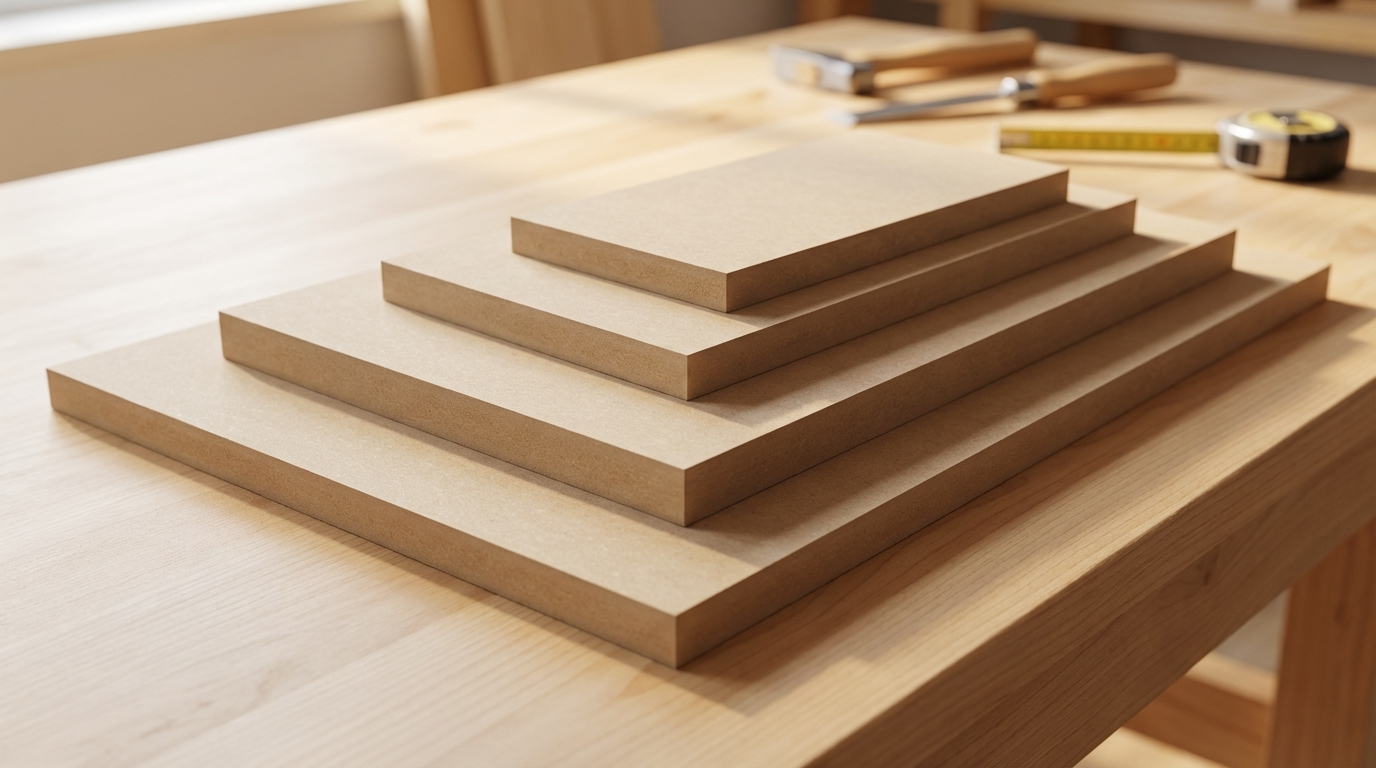
MDF board standard size in India is 8 feet × 4 feet (2440mm × 1220mm) with thickness ranging from 2mm to 30mm.
In simple terms, MDF boards come in large rectangular sheets—imagine a single board covering most of your wall. The 8×4 feet size is universal across India, making it easy for carpenters to plan cuts efficiently. Thickness matters more than length or width for most furniture projects. Thicker boards (18mm) go into wardrobes and cabinets, while thinner ones (6-8mm) work for decorative panels. Choosing the right size means less wastage, lower costs, and better-looking furniture.
- Standard sheet size: 8 feet × 4 feet (2440mm × 1220mm) available across all major brands
- Common thickness options: 3mm, 6mm, 9mm, 12mm, 18mm, and 25mm
- Density range: 690-850 kg/m³ depending on grade and thickness
- Pre-laminated sheets: Available in same sizes with decorative finish already applied
- Regional availability: Consistent sizing across metros and tier-2 cities in India
What Exactly Are MDF Board Sizes?
MDF—Medium Density Fibreboard—is an engineered wood product made by breaking down hardwood and softwood residues into fine fibres. These fibres are combined with wax and resin binders, then formed into panels using high temperature and pressure.
Think of it like making a thick chapati from finely ground flour—the result is smooth, consistent, and free from the grains you'd see in natural wood. This uniformity is precisely why MDF sizes remain so predictable across manufacturers.
The manufacturing process at facilities across India follows IS 12406 standards, which specify not just quality parameters but also standardised dimensions. This standardisation benefits everyone: manufacturers optimise production, dealers manage inventory efficiently, and carpenters plan their cuts without surprises.
Why do MDF boards come in 8×4 feet specifically?
The 8×4 feet dimension isn't arbitrary—it aligns with global manufacturing standards and practical construction needs. A standard room height of 9-10 feet means an 8-foot board covers most wall applications vertically. The 4-foot width allows two boards to cover typical wardrobe widths efficiently.
According to research from the ICFRE-Institute of Wood Science and Technology, Indian MDF manufacturers have harmonised their specifications with international standards including ISO 16895 and BS EN 622-5, ensuring size consistency whether you buy from Greenpanel, Greenply, or regional suppliers [springer.com].
Types of MDF Boards and Their Standard Sizes in India
All MDF variants in India typically come in the standard 8×4 feet sheet size. The real variation lies in thickness, density, and special treatments. Understanding these categories helps you select the right board for specific applications.
Interior Grade MDF
Designed for dry indoor environments like living rooms and bedrooms. Features standard moisture resistance suitable for normal Indian humidity levels but not wet areas.
Exterior Grade MDF (Moisture Resistant)
Manufactured with water-resistant resins for areas with higher humidity exposure. Suitable for kitchens and areas near windows where occasional moisture contact occurs.
HDF/HDHMR (High-Density Options)
Denser boards (840-850 kg/m³) offering superior strength and moisture performance. Ideal for heavy-use applications and modular kitchen carcasses [greenpanel.com].
Pre-Laminated MDF
Factory-finished boards with decorative surface already applied. Saves time and ensures consistent finish quality.
| Type | Best For | Moisture Resistance | Price Range (per sq ft) |
|---|---|---|---|
| Interior Grade MDF | Wardrobes, TV units, shelves | Standard | ₹10-₹60 |
| Exterior Grade MDF | Kitchen cabinets, bathroom vanities | Enhanced | ₹20-₹80 |
| HDF/Club Grade | Heavy-duty furniture, flooring substrate | High | ₹40-₹120 |
| Pre-Laminated MDF | Ready-to-use furniture panels | Varies by base | ₹50-₹150 |
Which size and type is best for kitchen applications?
For kitchen carcasses and cabinets, use exterior grade or HDHMR boards in 18mm thickness. The 8×4 sheet efficiently yields standard 600mm deep base units with minimal wastage. For kitchen shutters, 18mm pre-laminated exterior grade MDF reduces finishing time while ensuring moisture tolerance near sinks and cooking areas.
Which type works for wardrobes and bedrooms?
Interior grade MDF in 18mm thickness serves most wardrobe applications well. Bedrooms typically have lower humidity, making standard MDF cost-effective. For wardrobe backs and bottoms, 6mm or 9mm sheets reduce weight without compromising function. Pre-laminated options in 18mm work excellently for visible surfaces.
Key Properties and Size Specifications
Understanding MDF specifications helps you communicate effectively with carpenters and dealers. Here's what the numbers actually mean for your furniture project.
| Specification | Standard Values | What It Means for You |
|---|---|---|
| Sheet Size (L × W) | 2440mm × 1220mm (8ft × 4ft) | Universal size across brands |
| Thickness Range | 2mm to 30mm | Choose based on application strength needs |
| Common Thicknesses | 3, 6, 9, 12, 18, 25mm | Most dealers stock these readily |
| Density (Interior) | 690-760 kg/m³ | Affects weight and screw holding |
| Density (Club/HDF) | 815-850 kg/m³ | Heavier but stronger |
| Moisture Content | 5-10% | Pre-conditioned for Indian climate |
| Thickness Swelling (24hr) | 7-15% (varies by grade) | Lower is better for humid areas |
How to interpret thickness for different furniture parts
2-4mm: Backing panels, drawer bottoms, lightweight decorative elements
6-9mm: Wall panelling, wardrobe backs, partition infills
12mm: Shelves with light loads, decorative panels
18mm: Most furniture carcasses, wardrobe sides, cabinet frames—the workhorse thickness
25mm: Heavy-duty shelving, table tops, applications requiring extra rigidity
Where People Get Confused About MDF Sizes
Several misconceptions about MDF sizing lead to purchasing mistakes and project delays. Let's address the most common ones.
Misconception 1: "Thicker MDF is always better"
Thicker boards add unnecessary weight and cost. A 25mm wardrobe side offers no practical advantage over 18mm but increases material costs and makes installation harder.
Misconception 2: "All 18mm MDF is the same"
An 18mm interior grade board differs significantly from 18mm exterior grade in moisture performance. The thickness matches, but the resin system doesn't. Always verify grade, not just thickness.
Misconception 3: "Custom sizes are readily available"
MDF manufacturers produce only standard 8×4 sheets. Custom dimensions mean cutting from standard sheets, with potential wastage costs passed to you.
Misconception 4: "Pre-laminated MDF comes in more size options"
Pre-laminated boards follow the same 8×4 standard. The lamination adds minimal thickness (0.5-1mm per side) but doesn't change base dimensions [greenply.com].
Misconception 5: "Nominal and actual sizes match exactly"
Slight variations exist. An 18mm board might measure 17.5-18.5mm. This matters when planning tight-tolerance furniture assemblies.
Misconception 6: "MDF sizing is same as plywood sizing"
While both come in 8×4 sheets, plywood thickness nomenclature differs. A "19mm" plywood sheet often corresponds to 18mm MDF applications.
Advantages and Limitations of Standard MDF Sizes
Advantages
Universal availability: The 8×4 standard means any dealer in India stocks compatible products. No hunting for special sizes.
Efficient cutting optimization: Standard dimensions allow software-based cutting plans that minimize wastage across multiple furniture pieces.
Consistent quality across thickness: Unlike plywood where thicker boards may have different core qualities, MDF maintains uniform density throughout any given grade.
Smooth machining surface: The homogeneous composition allows clean cuts regardless of direction—no grain orientation to consider.
Easy lamination and painting: Uniform surface accepts finishes evenly without the pre-treatment solid wood requires.
Range of thickness options: From 2mm decorative panels to 30mm structural components, one material system covers diverse applications.
Cost-effective for large panels: Large unbroken surfaces (table tops, wall panels) cost less in MDF than equivalent solid wood or veneered options.
Limitations
Heavy weight: An 18mm 8×4 sheet weighs approximately 45-50kg. Transportation and handling require adequate labour—factor this into project costs.
Edge vulnerability: Cut edges absorb moisture faster than faces. All exposed edges need proper sealing or banding, especially in humid climates.
Limited screw holding on edges: Screws driven into MDF edges hold less securely than face screws. Use appropriate fastening techniques or edge reinforcement.
No structural load capacity: MDF works for furniture, not load-bearing construction. Long unsupported spans will sag over time.
Requires proper storage: Flat storage away from moisture is essential. Boards stored vertically or in damp conditions warp irreversibly.
Best Applications in Indian Homes
Living Room
TV units, display shelves, and wall panelling in 18mm interior grade. For accent walls, 6-9mm pre-laminated sheets offer cost-effective large-surface coverage. Consider climate—coastal cities should upgrade to exterior grade even for living areas.
Bedroom
Wardrobe carcasses in 18mm, backs in 6mm. Headboards work well in 12-18mm with fabric or laminate finish. Study tables need 25mm tops for rigidity.
Kitchen
Use only exterior grade or HDHMR. Base cabinets need 18mm carcasses. Under-sink areas require additional sealing regardless of MDF grade. Wall units can use 16mm to reduce weight on wall mounting.
Bathroom
Only HDHMR/BWR-equivalent MDF for vanity units, positioned away from direct water splash. Even moisture-resistant grades shouldn't contact standing water. Consider WPC alternatives for high-moisture zones.
Home Office
Desks and storage in 18mm interior grade. Cable management cutouts in MDF require edge sealing to prevent moisture ingress from AC condensation.
How to Check MDF Quality (Without Lab Tests)
You can't test IS 12406 parameters at a dealer shop, but these checks help identify quality issues:
Surface smoothness: Run your palm across both faces. Quality MDF feels uniformly smooth with no rough patches or embedded particles.
Edge density: Look at the cut edge. The colour should be consistent from surface to core. Dark spots or voids indicate manufacturing defects.
Thickness consistency: Measure at multiple points using a calliper. Variations beyond ±0.5mm suggest poor quality control.
Weight check: Heavier boards of the same grade indicate better density. Compare similar products by feel.
Smell test: Strong chemical odour indicates high formaldehyde content. CARB P2 certified boards have noticeably lower emissions [bricknbolt.com].
Questions to ask your dealer: Request grade specification (interior/exterior), IS marking if applicable, and manufacturer name. Established brands provide consistent quality.
Red flags: Unusually low prices, reluctance to disclose manufacturer, boards stored in damp conditions, visible warping in stacked sheets.
Care and Maintenance Tips
Daily care: Wipe with dry or slightly damp cloth. Avoid wet mopping MDF surfaces. For laminated MDF, mild soap solution works for stubborn marks.
Preventive measures: Use coasters under glasses, especially on painted MDF. Place mats under hot vessels. Ensure adequate ventilation in rooms with extensive MDF furniture.
What damages MDF: Standing water (even 10 minutes), steam exposure, abrasive cleaners, direct sunlight causing laminate warping, and excessive humidity over extended periods.
Edge protection: Check edge banding periodically. Peeling edges allow moisture entry—reapply with iron-on edge tape or contact carpenter for repairs.
Handling scratches: Light scratches on laminated MDF can be masked with colour-matched markers. Deep scratches reaching the core need professional refinishing.
Frequently Asked Questions
Is MDF waterproof?
No standard MDF is truly waterproof. Even exterior grade MDF resists moisture but shouldn't contact standing water. The thickness swelling test shows 7-15% expansion after 24-hour water immersion—significantly more than marine plywood. For wet areas, use HDHMR grades with proper sealing, but understand limitations. Never install any MDF where prolonged water contact is possible, such as outdoor furniture or bathroom flooring.
Is MDF termite proof?
Yes, MDF is inherently termite resistant. The manufacturing process—combining wood fibres with synthetic resins at high temperature—creates a material termites cannot digest like natural wood. The chemical binders also deter insect attack. However, this doesn't mean zero pest risk. In extreme infestations, termites may tunnel through MDF to reach other food sources. Store MDF furniture away from known termite zones as precaution.
How long does MDF furniture last?
Well-maintained MDF furniture lasts 10-15 years in typical Indian homes. Lifespan depends heavily on grade selection, installation quality, and exposure conditions. Kitchen cabinets in exterior grade MDF typically serve 8-12 years. Bedroom wardrobes in quality interior grade can exceed 15 years. Moisture damage is the primary failure mode—proper edge sealing and humidity control extend life significantly.
Can MDF be used in kitchen cabinets?
Yes, with appropriate grade selection. Use exterior grade or HDHMR for kitchen carcasses and shutters. Ensure all edges are sealed with PVC edge banding. Position MDF away from direct steam from cooktops. Under-sink cabinets need waterproof lining regardless of MDF grade. Many modular kitchen manufacturers successfully use HDHMR for frames with marine plywood or stainless steel in high-moisture zones [dorbypanels.com].
MDF vs plywood—which is better?
Neither is universally better—each excels in specific applications. MDF provides smoother surfaces for painting and lamination, consistent thickness, and no grain-related warping. Plywood offers superior moisture resistance, better screw holding on edges, and higher load capacity. Choose MDF for wardrobes, decorative panels, and painted furniture. Choose plywood for kitchen carcasses in humid regions, outdoor-adjacent furniture, and load-bearing shelves.
What is the cost of MDF boards?
Standard interior grade MDF costs ₹10-60 per square foot depending on thickness. Exterior grade runs ₹20-80 per square foot. Pre-laminated options range ₹50-150 per square foot based on laminate quality and design. For an 8×4 sheet (32 sq ft), expect approximately ₹800-2,500 for plain boards and ₹1,600-5,000 for pre-laminated sheets. Prices vary by region—confirm with local dealers before budgeting.
Where to buy good quality MDF in India?
Purchase from authorised distributors of established manufacturers like Greenpanel, Greenply, Century, or Action Tesa. Major cities have dedicated plywood and panel markets—Kirti Nagar in Delhi, Hindmata in Mumbai. For smaller quantities, reputable hardware stores stock branded options. Online platforms offer doorstep delivery but verify seller ratings. Always request brand name and grade documentation—avoid unbranded sheets regardless of price.
How to identify good quality MDF?
Quality MDF shows uniform colour throughout the cross-section—no dark spots or voids. Surface feels consistently smooth without rough patches. Weight feels substantial for declared thickness. Edges appear dense without visible layering. Manufacturer branding and grade marking should be visible. Request IS 12406 compliance documentation for projects requiring certification. The smell should be mild—strong chemical odour indicates high formaldehyde emissions.
What thickness MDF is best for wardrobe shutters?
18mm MDF is standard for wardrobe shutters in India. This thickness provides adequate rigidity for typical 600mm wide doors without excessive weight. For extra-wide shutters (beyond 700mm), consider 25mm or add internal support rails. Thinner options (12mm) work for small compartment doors but may warp over time. Always use pre-laminated or properly finished boards—raw MDF shutters attract dust and stain easily.
Can MDF edges be exposed without banding?
Technically yes, but not recommended in Indian conditions. Exposed MDF edges absorb moisture rapidly—even normal humidity causes gradual swelling. For painted furniture, edges need at least primer and paint. For laminated pieces, PVC or ABS edge banding is essential. Some premium finishing options include solid wood lipping for visible edges. Budget projects can use iron-on edge tape available at hardware stores for DIY application.
Disclaimer: This content is provided for general informational purposes based on industry practices and publicly available information. Product specifications, standards, prices, and availability may vary by manufacturer, region, and time. Readers should independently verify details with manufacturers, dealers, or qualified professionals before making purchase or construction decisions.Want Plywood Suggestions?
Share a few details and a Duro BOIL specialist will suggest suitable brands and connect you to responsive dealers.