MDF Board Thickness Guide: Choosing the Right Thickness
Understand MDF board thickness options from 2mm to 30mm. Learn which thickness works best for furniture, doors, wall panels, and decorative uses.
Quick Answer
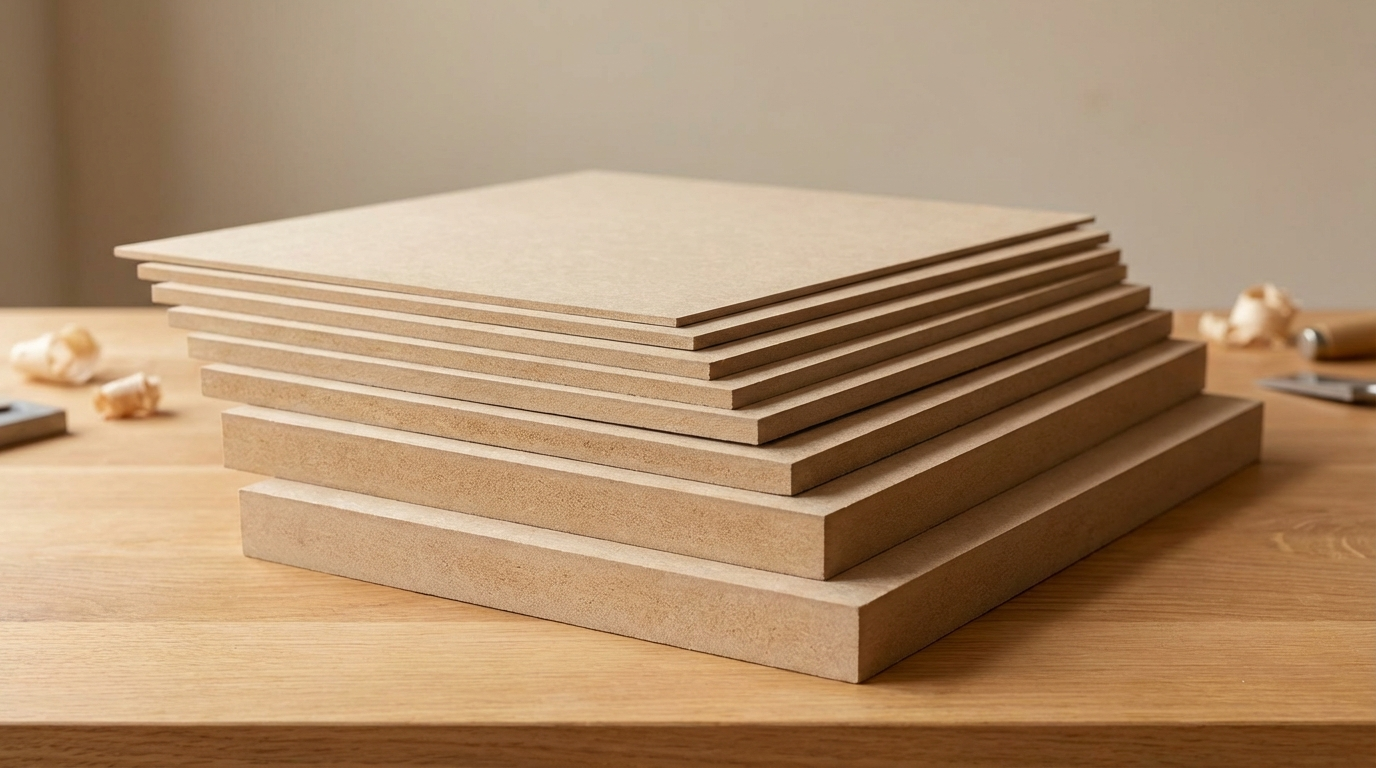
MDF board thickness ranges from 2mm to 30mm, with each thickness suited to specific furniture and interior applications.
In simple terms, think of MDF thickness like choosing the right chapati rolling pin thickness for different tasks. A thin 3mm MDF works perfectly for wardrobe back panels where you need lightweight coverage, while an 18mm board provides the sturdy backbone for your modular kitchen cabinets. The thickness you choose directly affects how much weight the board can handle, how well it holds screws, and whether it will sag over time. Most Indian homes use 8mm to 18mm MDF for everyday furniture, with thicker options reserved for heavy-duty applications like commercial countertops.
- Available range: 2mm to 30mm in the Indian market
- Most popular thicknesses: 8mm, 12mm, 16mm, and 18mm for furniture
- Standard sheet size: 8×4 feet (2440mm × 1220mm)
- Thicker boards cost more but provide better screw holding and load-bearing capacity
- Application determines thickness: decorative panels need thin, structural components need thick
What Exactly is MDF Board Thickness?
MDF (Medium Density Fibreboard) thickness refers to the measurement from one flat surface to the other, typically expressed in millimetres. Unlike plywood where you count layers, MDF has a homogeneous structure throughout—the same density from surface to core.
MDF is manufactured by breaking down hardwood or softwood residuals into fine wood fibres. These fibres are combined with wax and resin binders, then formed into panels using high temperature and pressure. The manufacturing process allows precise control over the final thickness, which is why MDF boards have tighter thickness tolerances compared to natural wood products.
For Indian homeowners, understanding MDF thickness matters because it directly impacts furniture durability, installation costs, and long-term performance. A carpenter using incorrect thickness means either unnecessarily heavy furniture or premature sagging and failure.
Why does MDF thickness matter for your furniture?
The thickness of MDF determines three critical factors: load-bearing capacity, screw-holding strength, and resistance to bending. A 6mm MDF panel might work beautifully as a decorative wall panel but would fail miserably as a bookshelf supporting heavy volumes.
Thicker MDF also machines better for edge profiles, accepts deeper routing for decorative patterns, and provides a more substantial feel to finished furniture. In Indian homes where furniture often gets moved around during festivals and cleaning, thicker MDF in structural components prevents damage during handling.
Types of MDF Thickness Available in India
Indian manufacturers and importers offer MDF in a comprehensive range of thicknesses. Here's what you'll typically find at plywood dealers across the country:
Ultra-thin MDF (2mm to 3mm): Used primarily for furniture backing panels, drawer bottoms, and craft projects. These sheets are flexible and lightweight, making them easy to handle but unsuitable for any load-bearing application. According to [demeterdeco.com](https://www.demeterdeco.com/news/the-ultimate-guide-to-mdf-sheets-from-thickness-and-craft-to-flawless-finishes/), this thickness is popular for laser cutting and CNC engraving work.
Thin MDF (4mm to 6mm): Ideal for cabinet door panels inserted into frames, decorative overlays, and partition wall cladding. Offers more rigidity than ultra-thin options while maintaining manageable weight.
Medium MDF (8mm to 12mm): The workhorse thickness for most furniture applications. Used for shelving with moderate loads, drawer sides, partition walls, and cabinet components where some structural integrity is needed.
Standard MDF (16mm to 18mm): The most commonly used thickness for modular furniture, kitchen cabinets, wardrobes, and shelving systems. Provides excellent screw holding and load-bearing capacity for residential applications.
Heavy-duty MDF (22mm to 30mm): Reserved for tabletops, workbenches, commercial fixtures, and applications requiring maximum strength and minimal deflection.
| Thickness Range | Best Applications | Load Capacity | Typical Price Range (per sq ft) |
|---|---|---|---|
| 2mm - 3mm | Back panels, crafts, drawer bottoms | Non-structural only | ₹15 - ₹25 |
| 4mm - 6mm | Door panels, decorative overlays | Light decorative | ₹25 - ₹40 |
| 8mm - 12mm | Shelving, drawer sides, partitions | Moderate | ₹40 - ₹65 |
| 16mm - 18mm | Cabinets, wardrobes, furniture frames | Standard residential | ₹65 - ₹95 |
| 22mm - 30mm | Tabletops, commercial fixtures | Heavy-duty | ₹95 - ₹150 |
Which thickness is best for kitchen cabinets?
For kitchen cabinet carcasses (the box structure), 16mm to 18mm MDF works best, preferably in moisture-resistant grade. This thickness provides adequate screw-holding strength for hinges and drawer slides while supporting the weight of utensils and provisions. As noted by [greenply.com](https://www.greenply.com/blogs/mdf-board-everything-you-need-to-know-before-buying), exterior-grade or HDMR (High Density Moisture Resistant) MDF should be used in humidity-prone areas.
For kitchen shutter fronts, 18mm MDF is standard, allowing sufficient depth for decorative routing and profile cutting. Thinner 8mm panels work for internal shelves where heavy items won't be stored.
Which thickness works for wardrobes and bedrooms?
Bedroom furniture typically uses 18mm MDF for the main structure and 8mm to 12mm for internal components. Wardrobe sides and top panels need 18mm for structural integrity, while internal shelves can use 12mm if spans are short (under 60cm without support).
For wardrobe shutters, 18mm provides a solid feel and prevents warping over years of use. Drawer fronts also benefit from 18mm thickness for a premium appearance and durability.
Key Properties and Specifications
Understanding MDF specifications helps you verify quality and ensure you're getting appropriate material for your project:
| Specification | Typical Value | What It Means for You |
|---|---|---|
| Density | 650-800 kg/m³ | Higher density = better screw holding |
| Standard Sheet Size | 8×4 ft (2440×1220mm) | Plan cutting layout for minimal waste |
| Thickness Tolerance | ±0.2mm to ±0.3mm | Consistent fit during assembly |
| Surface Finish | Smooth both sides | Ready for paint or laminate |
| Internal Bond Strength | 0.55-0.70 N/mm² | Resistance to delamination |
| Moisture Content | 5-8% | Lower = more stable dimensions |
According to [kyzo.in](https://kyzo.in/blogs/trends-insights/choosing-perfect-mdf-thickness), the thickness tolerance of MDF is typically much tighter than plywood, which allows for better precision in CNC cutting and modern furniture manufacturing.
Where People Get Confused
Confusion 1: "Thicker is always better"
Not necessarily. Using 25mm MDF for wardrobe back panels wastes money and adds unnecessary weight. Match thickness to application requirements—thicker isn't automatically superior.
Confusion 2: "MDF thickness equals plywood thickness in strength"
An 18mm MDF board doesn't match 18mm plywood in load-bearing or screw-holding strength. MDF edges are particularly vulnerable. If comparing for structural applications, MDF typically needs to be thicker than equivalent plywood.
Confusion 3: "All MDF of same thickness performs identically"
Grade matters significantly. Interior-grade 18mm MDF will fail in bathroom conditions where moisture-resistant 18mm MDF survives. Always specify grade alongside thickness.
Confusion 4: "Nominal thickness equals actual thickness"
Manufacturers sometimes list nominal sizes. An "18mm" board might actually measure 17.5mm. For precision joinery, verify actual thickness before design finalisation.
Confusion 5: "Edge thickness doesn't matter for laminated MDF"
Even pre-laminated MDF exposes raw edges during cutting. Thicker boards require wider edge banding. Plan edge treatment based on actual board thickness.
Advantages and Limitations
Advantages of MDF Boards:
- Consistent thickness: Manufactured tolerances are much tighter than natural wood, ensuring predictable assembly
- Smooth surface: No grain or knots means perfect paint finishes without extensive preparation
- Excellent machinability: Routes, drills, and cuts cleanly in all directions without splintering
- Cost-effective: Generally 20-40% cheaper than equivalent plywood for interior applications
- Dimensional stability: Doesn't expand/contract as much as solid wood with humidity changes
- Available in many thicknesses: Wide range from 2mm to 30mm suits diverse applications
- Accepts all finishes: Paint, laminate, veneer, and lacquer all adhere excellently
Limitations and Workarounds:
- Moisture sensitivity: Standard MDF swells when wet. Workaround: Use moisture-resistant grade in humid areas and seal all edges.
- Weight: MDF is heavier than plywood of equivalent thickness. Workaround: Use lighter-weight MDF variants or reduce thickness where possible.
- Edge weakness: Screws near edges can cause splitting. Workaround: Pre-drill holes and maintain minimum edge distances.
- Not for structural use: Cannot replace plywood in load-bearing applications. Workaround: Combine with plywood or metal reinforcement for structural needs.
- Dust during cutting: Fine particles require proper dust collection. Workaround: Use masks and proper workshop ventilation.
Best Applications in Indian Homes
Living Room: 8mm MDF works well for TV unit back panels and decorative wall cladding. Use 18mm for shelving and display cabinets. Wall-mounted floating shelves need minimum 18mm thickness with proper wall bracket support.
Bedroom: Wardrobe carcasses typically use 18mm MDF throughout, with 3mm back panels. Bed headboards can use 12mm to 18mm depending on design complexity. Dressing tables benefit from 18mm tops to prevent sagging.
Kitchen: Use only moisture-resistant MDF minimum 16mm thick. Cabinet carcasses need 18mm, while interior shelves can be 12mm for short spans. According to [tacon-wood.com](https://tacon-wood.com/how-to-choose-the-right-mdf-thickness-for-furniture-and-cabinets/), drawer bottoms typically use 6mm to 9mm MDF.
Study/Office: Bookshelves require careful thickness planning—18mm for spans under 80cm, or 25mm for wider spans. Computer tables need 18mm minimum for the top surface.
Climate Considerations: In coastal cities like Mumbai, Chennai, or Kolkata, moisture-resistant MDF is essential even in bedrooms due to high humidity. In drier regions like Delhi or Rajasthan, standard interior-grade MDF performs adequately for bedroom furniture.
How to Check Quality (Without Lab Tests)
Visual Inspection Points:
- Surface smoothness: Run your hand across the board—it should feel uniformly smooth with no rough patches or fibre clumps
- Edge density: Look at the cut edge; it should appear compact and uniform, not porous or "punky" (soft)
- Colour consistency: Uniform light tan colour indicates proper manufacturing; dark spots suggest quality issues
- Flatness: Sight along the board edge; any warping or bowing indicates storage or manufacturing problems
- Thickness uniformity: Measure at multiple points with a calliper; variation should be under 0.3mm
- Corner integrity: Corners should be sharp and intact, not crumbled or damaged
Questions to Ask Your Dealer:
- What is the actual (not nominal) thickness?
- Is this interior-grade or moisture-resistant?
- Which brand/manufacturer made this board?
- What is the density specification?
- How long has this stock been in storage?
Red Flags to Avoid:
- Boards stored outdoors or in damp conditions
- Visible swelling on edges
- Musty smell indicating moisture absorption
- Significantly cheaper than market rate (may be inferior grade)
- Dealer unable to provide brand information
Care and Maintenance Tips
Daily Care:
- Wipe spills immediately—MDF edges are particularly vulnerable
- Use coasters under glasses and cups on MDF surfaces
- Avoid dragging heavy objects across MDF furniture tops
- Keep MDF furniture away from direct water sources
Cleaning Methods:
- Dust with dry microfibre cloth regularly
- For stubborn marks, use slightly damp cloth followed immediately by dry wiping
- Never use soaking wet cloth or pour water directly
- Avoid abrasive cleaners that can damage laminate or paint finish
What Damages MDF:
- Water pooling: Causes irreversible swelling, especially at edges. Prevention: seal all exposed edges during manufacturing
- High humidity: Prolonged exposure leads to gradual deterioration. Prevention: use moisture-resistant grade in humid areas
- Excessive heat: Can damage laminate and cause warping. Prevention: keep away from direct heat sources
- Heavy impact: Creates dents and chips. Prevention: handle with care during moving
Frequently Asked Questions
Is MDF board waterproof?
Standard MDF is not waterproof—it absorbs moisture and swells when exposed to water. However, moisture-resistant (MR) and high-density moisture-resistant (HDMR) variants offer significantly better water resistance. Even these shouldn't be submerged but can handle humid bathroom or kitchen conditions. For any MDF application, sealing exposed edges with primer, paint, or edge banding dramatically improves moisture resistance. Never use standard interior-grade MDF in wet areas.
Is MDF board termite proof?
Most branded MDF boards sold in India come with borer and termite-resistant treatment during manufacturing. The resin binders used make MDF less attractive to termites compared to natural wood. However, this protection isn't absolute—in severe termite-prone areas, additional chemical treatment of furniture may be advisable. Check with your dealer for specific termite-resistance certification. Keeping furniture dry also helps, as termites are attracted to moisture-damaged wood products.
How long does MDF furniture last?
Well-made MDF furniture in appropriate conditions typically lasts 10-15 years or more. Lifespan depends heavily on usage, environment, and quality of manufacturing. Kitchen cabinets see more stress and moisture than bedroom wardrobes, so expect shorter life in kitchens. Using correct thickness for each application, proper edge sealing, and avoiding moisture exposure significantly extends service life. Premium-grade MDF with quality hardware can match plywood furniture longevity in dry interior conditions.
Can MDF be used in kitchen cabinets?
Yes, but only moisture-resistant grades like HDMR or exterior-grade MDF should be used. Standard MDF will deteriorate rapidly in kitchen humidity. Use minimum 16mm-18mm thickness for cabinet carcasses to ensure adequate screw holding for hinges and drawer mechanisms. All edges must be properly sealed with laminate, paint, or edge banding. Under-sink cabinets need extra protection as they're most vulnerable to water damage. Many successful modular kitchens use MDF with proper grade selection.
MDF vs plywood—which is better for furniture?
Neither is universally better—each has strengths. MDF provides smoother surfaces, better paint finish, consistent thickness, and lower cost. Plywood offers superior strength, better moisture resistance, and stronger screw holding. For painted furniture, decorative panels, and carved shutters, MDF excels. For structural components, drawer boxes, and humid conditions, plywood performs better. Many quality furniture pieces combine both—plywood for carcasses and MDF for doors and panels—leveraging each material's strengths.
What is the cost of MDF board per square foot?
MDF prices in India typically range from ₹15-150 per square foot depending on thickness, grade, and brand. Thin 3mm interior-grade costs around ₹15-25 per sq ft, while 18mm moisture-resistant boards range ₹75-95 per sq ft. Pre-laminated MDF costs additionally based on laminate quality. Prices vary significantly between cities and dealers. Regional brands cost less than national brands like Greenply or Action Tesa. Always compare prices for equivalent specifications—grade matters as much as thickness.
Where can I buy MDF board in India?
MDF boards are available at plywood dealers and building material shops in most Indian cities. Major brands have authorised dealer networks—check manufacturer websites for locations. Online platforms like Amazon, Flipkart, and specialty sites like Khidki Homes ([khidkihomes.com](https://khidkihomes.com/blogs/know-your-materials/how-to-choose-the-right-mdf-board-thickness-for-your-project)) offer delivery in major metros. For bulk purchases, contact manufacturers or distributors directly. Local dealers often provide cutting services, which online purchases may not include.
How do I identify good quality MDF?
Quality MDF shows uniform tan colour without dark spots, smooth surface without fibre lumps, compact dense edges (not porous), and consistent thickness throughout the sheet. Good MDF feels heavy for its size—light boards indicate lower density and weaker performance. Check for flat storage without warping. Branded products from reputed manufacturers (Greenply, Action Tesa, Merino, etc.) generally maintain consistent quality. Ask dealers for test certificates if purchasing large quantities for commercial projects.
What thickness MDF should I use for shelves?
Shelf thickness depends on span length and expected load. For bookshelves under 60cm span, 12mm MDF usually suffices. Spans of 60-80cm need 18mm minimum. For spans over 80cm, use 22-25mm or add centre supports. Kitchen storage shelves with heavy utensils need 18mm regardless of span. As [tacon-wood.com](https://tacon-wood.com/how-to-choose-the-right-mdf-thickness-for-furniture-and-cabinets/) notes, decorative display shelves with light items can use thinner 12mm boards even for longer spans since load is minimal.
Disclaimer: This content is provided for general informational purposes based on industry practices and publicly available information. Product specifications, standards, prices, and availability may vary by manufacturer, region, and time. Readers should independently verify details with manufacturers, dealers, or qualified professionals before making purchase or construction decisions.Want Plywood Suggestions?
Share a few details and a Duro BOIL specialist will suggest suitable brands and connect you to responsive dealers.