MDF density explained: what to ask for and why
Learn mdf density in simple terms with examples, verification tips, and a quick checklist so you choose the right board for Indian conditions.
Quick Decision Summary
Aim for 700-850 kg/m³ MDF density for most Indian furniture and cabinetry to balance strength, machinability, and humidity resistance.
If you're in a hurry: Higher density MDF (750+ kg/m³, often labeled HDHMR) holds screws better and resists sagging in humid conditions, ideal for kitchens and wardrobes. Lower density (under 650 kg/m³) suits lightweight shelves but risks crumbling edges during heavy use. Always verify density via supplier test certificate or simple weight check—divide sheet weight by volume. In monsoon-prone areas, pair with moisture-resistant grades. This prevents common failures like particle fallout after a year.
- Choose 750+ kg/m³ if: high-traffic areas, screw-heavy assemblies, coastal/monsoon exposure.
- Avoid under 650 kg/m³ if: load-bearing shelves, frequent door slams, poor storage before install.
What This Term/Material Actually Means
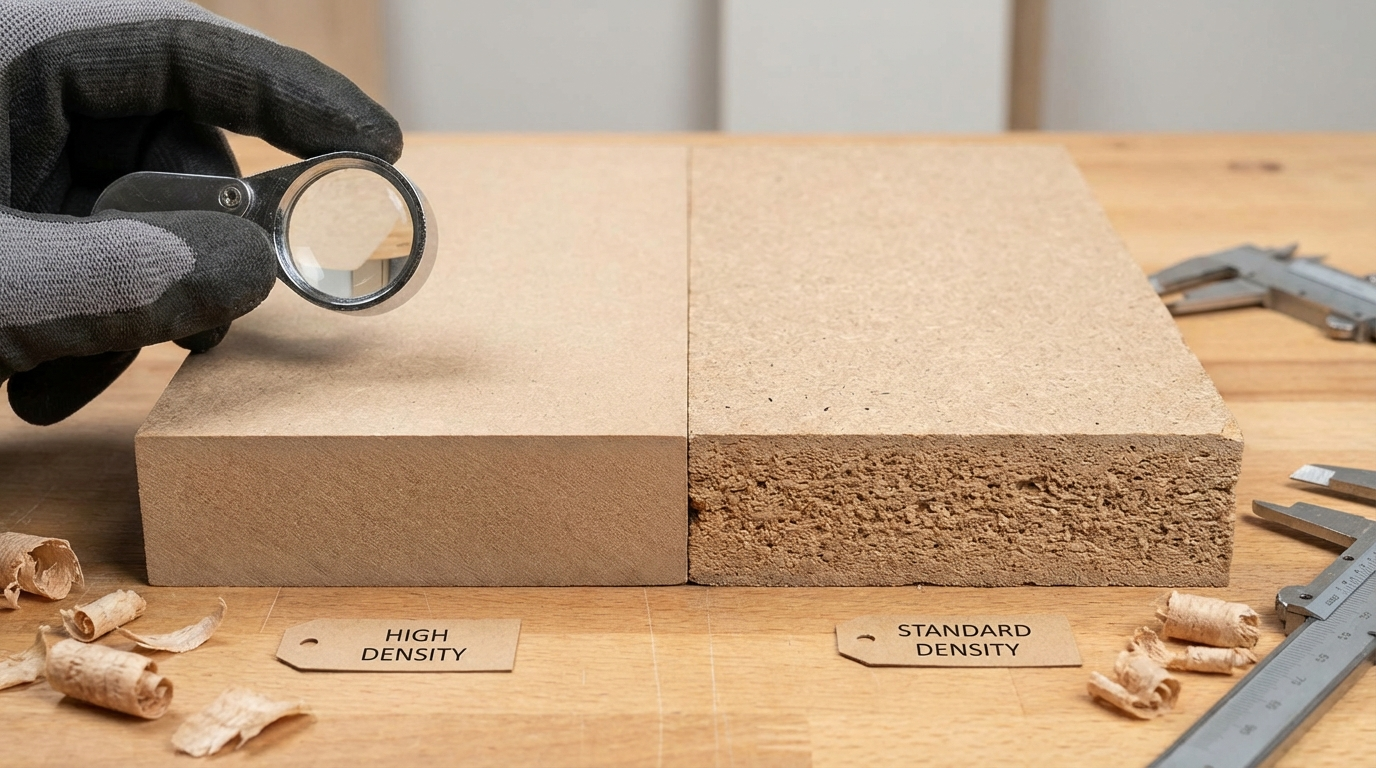
MDF, or Medium Density Fiberboard, is engineered from wood fibers mixed with resins and pressed into sheets. Density measures mass per cubic volume (kg/m³), determining hardness, weight, and performance. Standard ranges: low (<650 kg/m³, soft/light), regular (650-750 kg/m³, versatile), high (750-900+ kg/m³, rigid/durable).
Where people get confused:
- Assuming "MDF" means one density—varies by manufacturer and grade.
- Mixing with particleboard (larger chips, lower density typically).
- Thinking higher density always resists water—needs separate MR treatment.
- Overlooking that density affects screw hold (higher = tighter grip).
- Believing thickness alone dictates strength—density is the real driver.
- Confusing HDHMR (high-density moisture-resistant MDF) with plain high-density.
What counts as high-density MDF?
High-density MDF starts at 750 kg/m³, often reaching 850+ for premium grades like HDHMR. This level provides superior surface hardness for laminates and edge banding, plus better screw retention for hardware. In practice, it machines cleanly without tear-out but weighs more, suiting modular kitchens over flimsy partitions. Verify by asking for a density report; lighter-feeling boards signal lower specs. For Indian wardrobes, this prevents handle pull-outs during daily use—next, check resin type for added moisture protection.
Does higher MDF density mean better quality overall?
Not always—higher density boosts strength and finish but increases cost and machining effort. Ideal for heavy-use furniture; overkill for decorative panels. Balance with your project: coastal homes need 800+ for humidity, while dry interiors manage 700 kg/m³. Test by pressing a nail—resistance indicates density. Trade-off: heavier boards raise transport costs in multi-story sites. Start by matching density to load, then layer on finishes.
India-Specific Reality Check
Monsoon humidity (70-90% RH) and coastal salt air accelerate MDF swelling if density is low or storage poor. Unprotected sheets in godowns absorb moisture, leading to core breakdown during cutting. Contractor workflows often expose boards to site dust/rain, amplifying risks. Higher density resists this better but demands sealed edges post-cut. In cities like Mumbai or Chennai, opt for 750+ kg/m³; inland Delhi suits 650-750. Always insist on covered transport and on-site acclimation for 48 hours.
How does monsoon affect low vs high density MDF?
Low-density MDF (<650 kg/m³) swells 10-15% faster in 80%+ RH, causing laminate bubbles and screw loosening. High-density holds shape under similar exposure due to tighter fiber packing. Real scenario: Bangalore rains warp kitchen cabinets yearly if under-specced. Prevention: store vertically, use dehumidifiers pre-install. Check post-monsoon by tapping edges—hollow sound means failure starting. Upgrade to HDHMR for longevity, verifying density on arrival.
Price Range and Cost Drivers (India)
Expect ₹40-120 per sq ft for 18mm MDF, varying by density: low (₹40-60), regular (₹60-85), high/HDHMR (₹85-120). Thickness adds 20-30% per mm increment.
Key drivers: density grade, moisture resistance, surface finish (pre-laminated vs raw), sheet size calibration, city logistics (Mumbai 15-20% over inland), and batch quality. Bulk orders drop 10-15%.
How to ask for a quote:
- Specify density (e.g., "minimum 750 kg/m³").
- Thickness + size (18x8 ft standard).
- MR grade if humid area.
- Delivery + stacking fees.
- Request density test sheet.
Mini example: 100 sq ft kitchen cabinetry at 800 kg/m³ ~₹10,000-15,000 total, plus ₹2,000 logistics.
How to Choose in 5 Steps
- Match density to use: Shelves >30kg? Go 750+. Partitions? 650+ suffices.
- Assess site conditions: Humidity >70% RH? HDHMR minimum.
- Verify supplier claims: Demand weight/density cert; weigh a sample sheet.
- Test machinability: Cut a scrap—clean edges mean good density.
- Plan edge treatment: Higher density needs less filler but prime sealing mandatory.
Skipping step 3 leads to delamination in 6-12 months.
Which MDF density for wardrobes in humid cities?
Choose 750-850 kg/m³ HDHMR for wardrobes in humid cities like Kolkata—resists rail sagging and door warp. Lower densities buckle under clothes weight post-monsoon. Nuance: pair with laminated finishes for dust resistance. Next step: ask carpenter to check screw hold on sample (5+ cycles without strip). This setup lasts 8-10 years vs 3-5 for cheap boards. Confirm local quotes include transport to avoid surprises.
Two-Minute Comparison That Actually Helps
| Density Range | Best For | Screw Hold | Humidity Tolerance | Machinability |
|---|---|---|---|---|
| <650 kg/m³ | Light panels, decor | Poor (strips easy) | Low | Easy but dusty |
| 650-750 kg/m³ | General furniture | Moderate | Medium (with MR) | Good balance |
| 750+ kg/m³ | Kitchens, heavy shelves | Excellent | High | Firmer tooling needed |
Pick by conditions: wet zones/high load = high density.
Trade-offs and Limitations
Higher density: stronger but 20-30% costlier, heavier (site handling strain), harder to cut/nail. Lower: affordable/light but prone to dents, poor hardware grip. All MDF hates direct water—edges swell without sealing. Not structural like plywood; limit spans to 60cm. Fire rating low unless treated.
Can too-high density MDF cause problems?
Yes—over 900 kg/m³ resists machining, dulls tools faster, and adds unnecessary weight for non-load items. In India, this hikes carpenter time by 15-20%, inflating bills. Ideal sweet spot: 750-850 for most. If using, opt for sharp CNC bits. Check by trial cut: excessive resistance signals overkill. Downgrade for budget partitions to save without risk.
Common Buyer Mistakes and How to Avoid Them
- Buying by thickness alone: Why: Thicker low-density sags. Do: Specify density first.
- Ignoring storage norms: Why: Site exposure warps. Do: Insist on plastic wrapping.
- Skipping density verification: Why: Verbal claims mislead. Do: Weigh sample (formula: density = weight / (L x W x T)).
- No edge sealing plan: Why: Humidity ingress. Do: Prime all cuts day-of.
- Overlooking screw zones: Why: Hardware fails. Do: Test hold on scraps.
- Choosing cheapest quote: Why: Low density hidden. Do: Compare density specs across 3 suppliers.
- Forgetting acclimation: Why: Expansion mismatch. Do: Site-condition 48hrs.
- Assuming all HDHMR equal: Why: Density varies. Do: Get cert above 750 kg/m³.
Failure Modes and Fixes
- Symptom: Edge crumbling. Cause: Low density + rough handling. Prevent: 700+ kg/m³. Fix: Edge band immediately.
- Symptom: Laminate bubbles. Cause: Moisture in core. Prevent: MR grade + sealing. Fix: Re-laminate affected area.
- Symptom: Screw stripping. Cause: Undersized density. Prevent: Pre-drill + test. Fix: Use inserts.
- Symptom: Surface dents easy. Cause: Soft face. Prevent: High density. Fix: Filler + sand.
- Symptom: Sagging shelves. Cause: Span too long/low density. Prevent: Supports every 50cm. Fix: Reinforce underneath.
- Symptom: Swell post-monsoon. Cause: Poor storage. Prevent: Vertical stack covered. Fix: Dry out, assess warp.
Quality Checks You Can Do Without Lab Tests
Before buying:
- Weigh a known-size sheet: >35kg for 18mm 8x4 ft signals 700+ kg/m³.
- Press thumbnail: High density resists dent.
- Ask: "Density cert? Resin type?" Red flag: Vague answers.
After cutting: Clean edges, no fiber pull-out, even dust.
After install: Tap for hollows, check alignment, wipe-test moisture beads.
Decision Framework: Match Conditions to Density
| Project Conditions | Recommended Density | What to Verify |
|---|---|---|
| Coastal/high humidity | 750-850+ kg/m³ HDHMR | MR cert, edge sealing plan |
| Heavy load shelves | 750+ kg/m³ | Screw hold test on sample |
| Kitchen cabinets | 700-800 kg/m³ | Surface hardness, calibration |
| Tight budget partitions | 650-700 kg/m³ | No core gaps, weight check |
| High scratch risk (kids/pets) | 750+ kg/m³ | Face quality, laminate compat |
| Fast site delivery | Any, but regular 700 | Stock availability, no warp |
Advice for Homeowners: Durability Do's and Don'ts
Do: Wipe spills instantly, use coasters, check hinges yearly. Don't: Drag cleaners, overload top shelves, expose to steam. High-density choice simplifies maintenance—surfaces clean easily without scratches. Budget tip: Invest in sealing for 10-year life. Inspect quarterly for loose screws, tightening prevents bigger issues.
Tips for Carpenters: Handling and Prep
Pre-cut acclimate boards. Use 9mm pilot holes for screws in high-density. Edge-band within hours. Sharp 60-tooth blade prevents tear-out. High density cuts slower—budget extra time. Test fastenings on scraps to dial torque.
Guidance for Architects: Spec Writing
Specify "min 750 kg/m³ density, MR grade, IS-compliant resin." Detail edge returns, hinge reinforcements. For wet zones, add vapour barriers. Drawings should note density zones by exposure. This cuts callbacks 30%.
OEM/Modular Makers: QC for Repeatability
Batch-test density weekly via weigh-scale. Standardise tooling for density range. Track returns by density—low performers signal supplier switch. Automate edge priming to slash waste.
FAQs
Is 18mm MDF always medium density?
No—18mm refers to thickness; density is independent (500-900 kg/m³ possible). Many cheap 18mm boards hit only 600 kg/m³, suiting light use but failing under weight. For Indian modular kitchens, demand 750+ to avoid sagging drawers. Verify by supplier data sheet or simple calculation. This ensures longevity amid humidity swings, preventing costly replacements after 2 years.
How to calculate MDF density yourself?
Weigh the full sheet, measure dimensions precisely (e.g., 2440x1220x18mm), compute volume in m³, then density = weight(kg) / volume. Example: 40kg sheet ~720 kg/m³. Do this on-site for accuracy. Low results flag poor quality. Always cross-check multiple sheets per batch to catch variations.
What's HDHMR and how does density fit?
HDHMR combines high density (750+ kg/m³) with moisture-resistant resins, ideal for humid India. Density provides core strength; resins block water. Use for bathrooms/ kitchens. Confirm both specs—density alone without MR fails fast. Test: soak edge scrap 24hrs, minimal swell good sign.
Low density MDF vs plywood: when to pick each?
Low-density MDF for smooth paint finishes/curves; plywood for structural/load-bearing. MDF cheaper for cabinets but needs sealing. In dry areas, MDF wins on cost; wet zones, BWR plywood. Trade-off: MDF machines easier. Assess by project span and exposure.
Does MDF density affect painting?
Yes—higher density gives smoother, dent-resistant surface post-paint. Low density shows sanding marks easily. Prime all types, but high-density needs less filler. For wardrobes, 750+ ensures pro finish. Test small area first for adhesion.
Why does some MDF feel heavier?
Heavier feel signals higher density from tighter fiber compression, boosting durability. 800+ kg/m³ common in premium boards. Lighter ones (<650) compromise strength. Use feel + weigh for quick check. Matches better performance in daily use.
Can I use low-density MDF outdoors?
Avoid—swells/delaminates in 1-2 months. Even high-density needs shelter/coating. Indoor only, with sealing. For verandas, switch to marine plywood. Reality check: India rains destroy untreated MDF fast.
How much does density impact cost?
Each 100 kg/m³ jump adds 15-25% to price due to more resin/fibers. High-density justifies for longevity, saving rework. Factor thickness too. Get quotes specifying density to compare apples-to-apples.
Disclaimer: This content is provided for general informational purposes based on industry practices and publicly available information. Product specifications, standards, prices, and availability may vary by manufacturer, region, and time. Readers should independently verify details with manufacturers, dealers, or qualified professionals before making purchase or construction decisions.Want Plywood Suggestions?
Share a few details and a Duro BOIL specialist will suggest suitable brands and connect you to responsive dealers.