MDF Full Form: Meaning, Grades, Density & Where MDF Is (and Isn’t) Suitable
MDF full form and meaning, with grades, density, and use-cases. Learn where MDF is a great fit (and where plywood/HDHMR is safer).
Quick Decision Summary
Best answer in one line: MDF means Medium Density Fibreboard—an engineered wood panel best for dry interiors, paintwork, and intricate routing, but unsuitable for moisture-prone or load-bearing applications.
If you're in a hurry: MDF is made by compressing wood fibres with resin under heat and pressure, creating a smooth, uniform panel ideal for wardrobes, TV units, wall panels, and decorative mouldings in climate-controlled spaces. It machines beautifully and accepts paint without grain show-through. However, MDF swells irreversibly when wet, holds screws poorly at edges, and lacks structural strength. For kitchens, bathrooms, or humid coastal homes, HDHMR or marine-grade plywood is safer. Always confirm density grade (standard, HDF, or moisture-resistant variants) before purchase, and never install raw MDF in any area exposed to water splashes or prolonged humidity.
- Choose MDF if: you need flawless painted finishes, intricate CNC routing, affordable dry-zone furniture, or laminated modular panels in air-conditioned interiors.
- Avoid MDF if: your project involves wet zones, structural shelving, outdoor exposure, coastal humidity without AC, or heavy screw-based assembly at panel edges.
What MDF Actually Means and Why It Matters
MDF stands for Medium Density Fibreboard. The "medium density" refers to its weight per cubic metre, typically ranging from 600 to 800 kg/m³, placing it between low-density fibreboard (particle board) and high-density fibreboard (HDF). Manufacturing involves breaking down hardwood or softwood residuals into fine fibres, combining them with synthetic resin (usually urea-formaldehyde or melamine-urea-formaldehyde), then pressing the mixture under controlled heat and pressure. The result is a homogeneous panel with no grain direction, knots, or voids—characteristics that make it fundamentally different from plywood or solid wood.
Because fibres are uniformly distributed, MDF machines exceptionally well. Routers create crisp profiles, edges sand smooth without splintering, and paint adheres evenly without visible wood grain. These properties explain why MDF dominates applications like speaker cabinets, decorative mouldings, shutter panels, and pre-laminated furniture carcasses across India.
Where People Get Confused About MDF
- MDF is waterproof: Standard MDF absorbs moisture rapidly and swells permanently. Even "moisture-resistant" MDF (green-core MR-MDF) only tolerates humidity—it is not waterproof.
- MDF and particle board are the same: Particle board uses wood chips bonded with resin; MDF uses fine fibres. MDF is denser, smoother, and machines better, but particle board is cheaper and lighter.
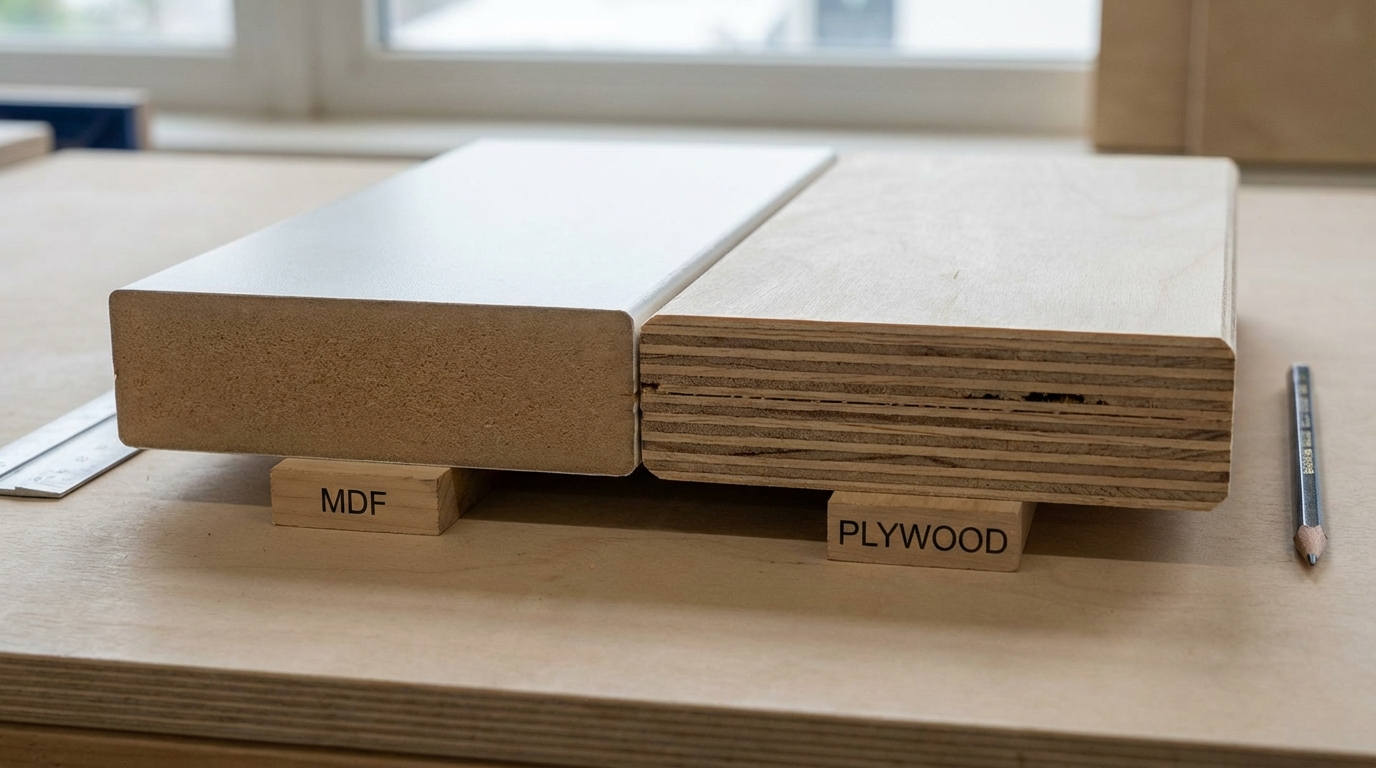
- MDF can replace plywood everywhere: Plywood's cross-laminated veneers provide structural strength and screw-holding power MDF cannot match. Plywood handles moisture better and works in load-bearing applications.
- All MDF grades are identical: Density, resin type, and additives vary. Interior-grade, moisture-resistant, fire-retardant, and exterior-grade MDF serve different purposes and price points.
- HDHMR is just expensive MDF: High Density High Moisture Resistant boards use different resin systems and higher compression, offering meaningfully better screw-holding and humidity tolerance than standard MDF.
India-Specific Reality Check
India's climate diversity creates challenges that generic MDF guides ignore. Understanding local conditions prevents costly failures.
Monsoon and Coastal Humidity
Standard MDF in Mumbai, Chennai, Kolkata, or Kerala faces 70–90% relative humidity for months. Without air conditioning running consistently, panels absorb ambient moisture, edges swell, laminate lifts, and hinges loosen. Coastal salt air accelerates degradation further. In such regions, even "MR-MDF" struggles unless installed in fully climate-controlled rooms. HDHMR or BWR plywood becomes the safer default for furniture expected to last beyond five monsoons.
Storage and Handling Realities
MDF panels often sit in open dealer yards or partially covered godowns before reaching your site. Panels stacked improperly absorb ground moisture or warp from uneven support. Always inspect panels on delivery—reject any showing edge swelling, surface bubbling, or visible warping. Store flat on level supports, off the ground, in covered areas until installation.
Workmanship Variables
Indian carpentry practices vary widely. Edge-banding quality, screw pilot-hole discipline, and sealing of cut edges differ between organised modular factories and site carpenters. MDF's edge weakness becomes critical here: screws driven without pilot holes split the panel; unprotected edges absorb moisture from cleaning or spills. Specify edge-banding and surface sealing explicitly in your work order, and inspect execution before final payment.
MDF Grades and Density Explained
Not all MDF is created equal. Grades differ by density, resin system, and intended environment.
| Grade/Type | Typical Density | Key Characteristics | Best Applications |
|---|---|---|---|
| Standard Interior MDF | 650–750 kg/m³ | Smooth, uniform, affordable; poor moisture resistance | Dry-zone furniture, wall panels, decorative mouldings |
| MR-MDF (Moisture Resistant) | 700–780 kg/m³ | Green-dyed core; tolerates humidity, not water | Humid interiors with AC, wardrobes in semi-dry zones |
| HDF (High Density Fibreboard) | 800–1000 kg/m³ | Harder surface, better screw-holding, thinner panels | Laminate flooring backing, door skins, thin panels |
| HDHMR (High Density High Moisture Resistant) | 850–950 kg/m³ | Enhanced resin system; better edge strength and humidity tolerance | Kitchen carcasses, bathroom vanities (with sealing), modular units |
| Fire-Retardant MDF | 700–800 kg/m³ | Treated with fire-inhibiting chemicals | Commercial interiors, public buildings, safety-critical zones |
| Exterior-Grade MDF | 750–850 kg/m³ | Phenolic resin; weather-resistant but not common in India | Signage, exterior cladding (rarely used residentially) |
How Does MDF Density Affect Performance?
Higher density means tighter fibre packing, which improves screw-holding capacity, surface hardness, and resistance to denting. However, denser boards are heavier, harder on cutting tools, and more expensive. For wardrobe carcasses where hinges bear repeated stress, higher-density variants (HDHMR or HDF) reduce hinge-pullout risk. For decorative wall panels with minimal hardware, standard MDF suffices and saves cost. Match density to application demands rather than defaulting to the cheapest or most expensive option.
Where MDF Excels: Ideal Applications
Is MDF Good for Wardrobes and TV Units?
In air-conditioned bedrooms or living rooms away from water sources, MDF-based wardrobes and TV units perform well. The smooth surface accepts high-quality paint finishes or pre-laminated sheets without telegraphing grain patterns. CNC-machined shutter profiles create contemporary aesthetics difficult to achieve with plywood. However, ensure hinges mount into reinforced zones or use cam-and-dowel systems rather than edge screws. Specify edge-banding on all exposed edges to prevent moisture ingress from humid air or cleaning wipes.
Can MDF Be Used for Wall Panelling and Mouldings?
MDF is the preferred substrate for decorative wall panels, wainscoting, cornices, and architectural mouldings throughout India. Routers carve intricate profiles cleanly, and painted finishes look factory-perfect. Because wall panels bear no structural load and remain dry, MDF's limitations rarely cause problems. The key precaution: avoid installing MDF panelling on walls prone to seepage or in bathrooms—even behind-the-toilet accent walls risk moisture damage over time.
Why Do Speaker Cabinets Use MDF?
Acoustic applications favour MDF because its uniform density eliminates resonance variations caused by grain patterns or voids. The material dampens vibrations consistently, improving sound quality. Home theatre enthusiasts and audio professionals specify MDF for speaker enclosures, amplifier housings, and acoustic panels. Plywood's variable density layers create unpredictable acoustic behaviour, making it less desirable for critical audio work.
Where MDF Fails: Applications to Avoid
Should You Use MDF in Kitchens?
Standard MDF in kitchens is a recipe for failure. Sink splashes, steam from cooking, and cleaning water expose carcasses to moisture daily. Within one or two monsoon seasons, edges swell, laminate delaminates, and hinges loosen. Even MR-MDF struggles unless the kitchen is fully air-conditioned and splashes are meticulously wiped immediately. For Indian kitchens, HDHMR with proper edge sealing or BWR/BWP plywood remains safer. If budget forces MDF use, restrict it to upper wall units away from the sink and hob, seal all edges with PU sealant, and accept reduced lifespan.
Can MDF Handle Bathroom Vanities?
Bathrooms present the harshest moisture environment in a home. Constant humidity, water splashes, and poor ventilation in many Indian bathrooms destroy standard MDF within months. Even HDHMR requires meticulous sealing of all surfaces, edges, and cutouts—and still carries risk. Marine plywood (IS 710-compliant) or WPC boards are fundamentally better choices for bathroom furniture. If clients insist on MDF aesthetics, use HDHMR with factory-applied waterproof laminate, seal every edge and cutout with marine-grade sealant, and install exhaust ventilation.
Is MDF Suitable for Outdoor Furniture?
Never. MDF lacks the structural integrity and weather resistance for outdoor use. Rain, dew, and UV exposure degrade it rapidly. Even covered balconies in humid cities expose MDF to moisture levels it cannot tolerate. For outdoor furniture, use treated solid wood, marine plywood, WPC, or HDPE alternatives designed for exterior conditions.
Trade-offs and Limitations
Understanding MDF's inherent weaknesses prevents misapplication and disappointment.
- Moisture sensitivity: Irreversible swelling when wet; no practical repair once water damage occurs.
- Poor screw-holding at edges: Screws driven into panel edges strip easily; hinges and hardware require reinforcement zones or alternative fastening systems.
- Weight: MDF is heavier than equivalent-thickness plywood, increasing shipping costs and installation effort for large panels.
- Dust hazard: Cutting MDF generates fine dust containing formaldehyde; proper respiratory protection and dust extraction are essential during fabrication.
- Limited structural capacity: MDF cannot span distances or bear loads like plywood; unsupported shelves sag over time.
- Formaldehyde emissions: Standard MDF releases formaldehyde, a respiratory irritant. E0 or E1 emission-rated panels reduce but do not eliminate this concern. Ensure adequate ventilation in newly furnished rooms.
Common Buyer Mistakes and How to Avoid Them
Mistake 1: Choosing MDF for Wet Zones Based on Price
Why it happens: MDF costs less than marine plywood or HDHMR, tempting budget-conscious buyers. What to do instead: Calculate total cost including potential replacement within 3–5 years. Paying more upfront for appropriate materials typically costs less over a decade.
Mistake 2: Ignoring Edge Protection
Why it happens: Carpenters skip edge-banding to save time; buyers don't specify it. What to do instead: Include edge-banding specification in every work order. Inspect edges before accepting delivery or final installation.
Mistake 3: Assuming "Waterproof MDF" Exists
Why it happens: Marketing terms mislead; dealers oversell MR-MDF capabilities. What to do instead: Ask specifically about resin type, grade certification, and intended exposure level. No MDF is truly waterproof.
Mistake 4: Over-Tightening Screws
Why it happens: Installers treat MDF like solid wood. What to do instead: Use pilot holes slightly smaller than screw diameter. Tighten until snug, then stop—over-torquing strips the fibres.
Mistake 5: Storing Panels Improperly Before Use
Why it happens: Panels left in open areas absorb moisture or warp. What to do instead: Store flat, off the ground, in covered dry areas. Use within two weeks of delivery during monsoon season.
Mistake 6: Skipping Acclimatisation
Why it happens: Rushed schedules. What to do instead: Let panels sit in the installation room for 48–72 hours before cutting, allowing moisture content to equilibrate.
Mistake 7: Using Standard MDF for Heavy Shelving
Why it happens: Underestimating load or span requirements. What to do instead: For shelves exceeding 600mm span with books or heavy items, use plywood or add mid-span supports. MDF shelves sag predictably.
Mistake 8: Neglecting Formaldehyde Concerns
Why it happens: Buyers focus on price and finish, ignoring indoor air quality. What to do instead: Specify E0 or E1 emission-rated MDF for bedrooms and children's rooms. Ventilate newly furnished spaces for at least two weeks.
Failure Modes and Fixes
Edge Swelling After Cleaning
Symptom: Edges become soft, puffy, and discoloured after a few months. Likely cause: Unsealed edges absorbed moisture from wet cleaning cloths. Prevention: Edge-band all exposed edges; wipe with damp (not wet) cloths and dry immediately. If already happening: Minor swelling is irreversible. Sand lightly, apply wood filler, repaint, and seal edges with PU sealant to slow further damage.
Hinge Screws Pulling Out
Symptom: Cabinet doors sag or detach at hinges. Likely cause: Screws driven into low-density edge zones without reinforcement. Prevention: Use hinge mounting plates, longer screws with pilot holes, or dowel-based hardware systems. If already happening: Fill stripped holes with wood glue and toothpicks, let cure, re-drill pilot holes, and reinstall with larger-diameter screws.
Surface Bubbling Under Laminate
Symptom: Laminate lifts or bubbles appear on panel faces. Likely cause: Moisture ingress from unsealed edges or poor-quality adhesive application. Prevention: Specify factory-laminated panels with sealed edges; verify adhesive quality. If already happening: Small bubbles can sometimes be slit, injected with adhesive, and pressed flat. Large delamination requires panel replacement.
Persistent Chemical Odour
Symptom: Strong smell weeks after installation. Likely cause: High formaldehyde emission from standard-grade MDF in poorly ventilated space. Prevention: Specify E0/E1 rated panels; ensure room ventilation. If already happening: Increase ventilation, use air purifiers, and seal all exposed MDF surfaces with low-VOC sealant to reduce off-gassing.
Shelf Sagging Under Load
Symptom: Horizontal panels bow downward over months. Likely cause: Span too long for MDF thickness and load. Prevention: Limit unsupported spans to 450–600mm for typical loads; use thicker panels or mid-span supports. If already happening: Add vertical dividers or brackets to reduce span; replace severely bowed shelves with plywood.
Cut Edges Fraying During Routing
Symptom: CNC or router work produces rough, fuzzy edges. Likely cause: Dull tooling, incorrect feed speed, or low-quality MDF with inconsistent density. Prevention: Use sharp carbide tooling, optimise feed rates, source consistent-quality panels. If already happening: Sand edges smooth, apply wood filler if needed, and prime before painting.
Quality Checks You Can Do Without Lab Tests
Before Buying
- Visual edge inspection: Look for uniform colour and density across the edge. Visible voids, uneven fibre distribution, or colour variations indicate inconsistent manufacturing.
- Surface check: Run your hand across the face—it should feel uniformly smooth without rough patches or depressions.
- Weight comparison: Lift panels of the same thickness from different stacks. Significantly lighter panels may have lower density or moisture loss.
- Smell test: Strong chemical odour suggests high formaldehyde emission. Well-cured, quality MDF has minimal smell.
- Ask for grade documentation: Reputable dealers provide density specifications and emission ratings. Evasive answers suggest generic, ungraded stock.
After Cutting
- Edge cleanness: A sharp saw should produce clean, non-fuzzy edges. Excessive fuzz indicates either dull tooling or low-quality MDF.
- Core consistency: Cut edges should show uniform fibre distribution without visible layers, voids, or inclusions.
- Dimensional accuracy: Measure cut pieces against specifications. Poorly manufactured MDF may have thickness variations affecting fit.
After Installation
- Edge-band adhesion: Gently try to peel edge-banding at corners. Properly bonded edges resist peeling.
- Hardware tightness: Check hinges and handles after one week of use. Loosening indicates either poor installation or inadequate screw-holding.
- Surface finish uniformity: Painted or laminated surfaces should show no bubbles, lifting, or colour inconsistency under angled light.
Decision Framework: What to Use Based on Conditions
| Condition/Scenario | Recommended Material | What to Verify |
|---|---|---|
| Dry bedroom wardrobe, AC room | Standard MDF or MR-MDF | Edge-banding quality, hinge reinforcement |
| Living room TV unit, minimal humidity | Standard MDF with laminate | Laminate adhesion, cable cutout sealing |
| Kitchen carcass near sink | HDHMR or BWR plywood | All edges sealed, splash-zone protection |
| Bathroom vanity | Marine plywood or WPC | IS 710 compliance for plywood, edge sealing |
| Coastal city, non-AC home | BWR plywood minimum | Resin type, storage conditions before delivery |
| Heavy bookshelf, long spans | Plywood with reinforcement | Thickness adequate for span, mid-supports |
| Decorative wall panel, dry zone | Standard MDF | Smooth surface, E1 emission rating |
| Commercial interior, fire safety required | Fire-retardant MDF | Fire rating certification, installation compliance |
| Children's room furniture | E0-rated MDF or plywood | Emission certification, rounded edges |
Tips for Homeowners
Durability and Cleaning Guidelines
- Use damp (not wet) microfibre cloths for cleaning; dry immediately.
- Never pour water directly on MDF surfaces or allow spills to sit.
- Avoid abrasive cleaners that damage laminate or paint finishes.
- Keep furniture away from windows where rain splash can reach.
- Run exhaust fans in adjacent kitchens and bathrooms to reduce ambient humidity.
- Inspect edges annually; reseal any exposed areas showing wear.
Tips for Carpenters and Fabricators
Cutting and Edge Preparation
- Use sharp carbide-tipped blades; dull tools cause fuzzy edges and excessive dust.
- Support large panels fully during cutting to prevent breakage.
- Pre-drill all screw holes; avoid driving screws within 25mm of panel edges without reinforcement.
- Apply edge-banding immediately after cutting to prevent moisture absorption.
- Wear proper respiratory protection—MDF dust is hazardous.
- Store cut pieces flat and protected until installation.
Hardware Installation Zones
- Reinforce hinge zones with hardwood inserts or mounting plates.
- Use cam-and-dowel systems for carcass assembly rather than edge screws.
- Apply wood glue in addition to mechanical fasteners for permanent joints.
Tips for Architects and Designers
Specification and Detailing
- Specify MDF grade, density, and emission rating explicitly in tender documents.
- Detail edge-banding requirements and sealing protocols for wet-adjacent zones.
- Avoid specifying MDF for any application within 1.5 metres of water sources unless HDHMR with full sealing is acceptable.
- Consider acoustic MDF for home theatre and studio applications.
- Specify factory-laminated panels where site finishing quality is uncertain.
Tips for Modular Furniture Manufacturers
Quality Control and Reducing Returns
- Incoming inspection: reject panels with edge swelling, surface defects, or inconsistent density.
- Standardise edge-banding process with consistent adhesive application and temperature.
- Test screw-holding on sample pieces from each batch.
- Seal all cutouts (hinge cups, cable holes) before shipping.
- Include care instructions with every installation; educated customers file fewer complaints.
- Track failure modes by batch to identify supplier quality variations.
MDF vs Plywood vs HDHMR: Quick Comparison
| Parameter | Standard MDF | Plywood (BWR/BWP) | HDHMR |
|---|---|---|---|
| Surface smoothness | Excellent | Good (depends on face veneer) | Very good |
| Moisture resistance | Poor | Good to excellent | Good |
| Screw-holding (edges) | Poor | Good | Moderate to good |
| Structural strength | Low | High | Moderate |
| Routing/CNC suitability | Excellent | Limited | Very good |
| Paint finish quality | Excellent | Moderate | Very good |
| Typical cost | Lower | Higher | Moderate to higher |
| Best use case | Dry interiors, decorative work | Structural, wet zones | Kitchen carcasses, humid interiors |
Price Range and Cost Drivers in India
MDF pricing varies significantly based on grade, thickness, brand, and location. Expect the following approximate ranges (confirm locally as prices fluctuate):
- Standard interior MDF: ₹25–45 per square foot (18mm thickness)
- MR-MDF (moisture resistant): ₹35–55 per square foot (18mm)
- HDHMR: ₹55–85 per square foot (18mm)
- Pre-laminated MDF: ₹45–80 per square foot depending on laminate quality
- Fire-retardant MDF: ₹60–100 per square foot
What Drives MDF Costs?
- Thickness: Thicker panels cost proportionally more.
- Density grade: Higher density means more raw material and processing.
- Resin system: Moisture-resistant and fire-retardant formulations add cost.
- Emission rating: E0-rated (low formaldehyde) panels command premiums.
- Brand reputation: Established manufacturers charge more but offer consistency.
- City and logistics: Transport costs vary; metros typically have competitive pricing.
- Wastage factor: Standard panel sizes may not optimise for your design, increasing effective cost.
How to Ask for a Quote
Specify these items to get comparable quotes:
- Panel dimensions and thickness
- Grade (standard, MR, HDHMR, fire-retardant)
- Emission rating (E0, E1, E2)
- Pre-laminated or raw
- Quantity (full sheets vs cut-to-size)
- Delivery location and timeline
FAQs
What does MDF stand for and what is it made of?
MDF stands for Medium Density Fibreboard. It is manufactured by breaking down hardwood or softwood residuals into fine wood fibres, mixing them with synthetic resin binders (typically urea-formaldehyde or melamine-urea-formaldehyde), and pressing the combination under heat and pressure into flat panels. The resulting board has no grain direction, knots, or natural wood defects, creating a uniform, smooth substrate ideal for painting, laminating, and precision machining. Density typically ranges from 650 to 800 kg/m³ for standard grades, with higher-density variants available for specific applications.
Is MDF safe for home use given formaldehyde concerns?
Standard MDF releases formaldehyde, a volatile organic compound that can irritate respiratory systems, particularly in poorly ventilated spaces. However, emission levels vary by grade. E0 and E1 rated panels meet stringent emission limits and are considered safe for residential use when installed in adequately ventilated rooms. For bedrooms, children's rooms, or spaces with limited airflow, specify low-emission grades explicitly. Allow newly furnished rooms to ventilate for at least two weeks before regular occupancy. Sealing all exposed MDF surfaces with paint or laminate also reduces emission rates.
Can I use MDF for kitchen cabinets?
Standard MDF is unsuitable for kitchen cabinets due to moisture sensitivity from cooking steam, sink splashes, and cleaning water. However, HDHMR (High Density High Moisture Resistant) boards with properly sealed edges and surfaces can work in kitchens, particularly for upper wall units away from direct water exposure. For base units near sinks, BWR or marine-grade plywood remains safer. If using HDHMR, ensure all cutouts, edges, and backs are sealed with waterproof edge-banding and sealant. Accept that even HDHMR has limitations compared to plywood in consistently wet environments.
What is the difference between MDF and HDF?
HDF (High Density Fibreboard) is manufactured similarly to MDF but with higher compression, resulting in density typically above 800 kg/m³. This makes HDF harder, thinner for equivalent strength, and better at holding screws. HDF is commonly used as backing for laminate flooring, thin door skins, and applications requiring high surface hardness in limited thickness. MDF offers better machinability for decorative profiling and is available in thicker panels for furniture carcasses. Choose based on application: HDF for thin, hard surfaces; MDF for thicker, routed decorative work.
How do I prevent MDF from swelling?
Prevention starts with material selection—use MR-MDF or HDHMR in any space with humidity concerns. Apply edge-banding to all exposed edges immediately after cutting. Seal all surfaces with primer and paint or quality laminate. Avoid installing MDF in direct water zones or unventilated humid spaces. During use, clean with damp (not wet) cloths and dry immediately. Fix any water leaks promptly. In coastal or monsoon-heavy regions, consider alternatives like plywood for critical applications where swelling would cause functional failure.
Why do screws strip out of MDF edges?
MDF edges lack the cross-grain structure that gives plywood screw-holding strength. The fibres compress easily under screw pressure, especially without pilot holes. To improve holding: always drill pilot holes slightly smaller than screw diameter; use coarse-thread screws designed for particleboard/MDF; avoid placing screws closer than 25mm from edges; apply wood glue in joints for permanent connections; consider cam-and-dowel systems or insert nuts for frequently disassembled furniture; reinforce hinge zones with hardwood blocks or metal mounting plates.
Is MDF better than plywood for painted furniture?
For painted finishes, MDF typically outperforms plywood. Its uniform density and lack of grain pattern mean paint applies evenly without visible wood texture showing through. Routed profiles remain crisp and consistent. Plywood, with its veneer face, may show grain telegraph through paint and requires more preparation. However, plywood offers structural advantages MDF cannot match—better screw-holding, moisture resistance, and spanning capability. For purely decorative painted pieces in dry environments, MDF excels. For furniture requiring structural integrity, moisture exposure, or heavy hardware, plywood painted carefully may be the better compromise.
What thickness of MDF should I use for wardrobes?
Wardrobe carcasses typically use 18mm MDF for sides, tops, and bottoms, providing adequate rigidity when properly assembled. Shelves may use 18mm for spans up to 600mm; longer spans require thicker material or mid-supports to prevent sagging. Backs can use 6mm or 8mm MDF if the wardrobe is secured to the wall. Shutter panels (doors) commonly use 18mm for flat designs or 12mm for framed constructions. Always verify that chosen thickness suits your design loads and spans—books and heavy items require more support than clothing.
How long does MDF furniture typically last?
Lifespan depends heavily on environment, quality, and maintenance. In dry, air-conditioned interiors with proper edge sealing and gentle cleaning, MDF furniture can last 10–15 years or more. In humid environments without climate control, standard MDF may show significant degradation within 3–5 years. Coastal homes without consistent AC may see failures even sooner. HDHMR and quality MR-MDF extend lifespan in challenging conditions but cannot match plywood's durability in wet zones. Regular inspection, prompt repair of edge damage, and avoiding water exposure maximise MDF furniture longevity.
Can MDF be used for exterior applications?
Standard MDF is completely unsuitable for exterior use. Rain, dew, UV exposure, and temperature cycling degrade it rapidly. Exterior-grade MDF exists, manufactured with phenolic resins for weather resistance, but is uncommon in Indian residential applications and expensive. For outdoor furniture, signage, or cladding, alternatives like treated solid wood, marine plywood, WPC (wood-plastic composite), or HDPE boards provide far better performance. Even covered balconies in humid cities expose MDF to unacceptable moisture levels. Reserve MDF for protected interior applications only.
What is the difference between MR-MDF and HDHMR?
MR-MDF (Moisture Resistant MDF) uses modified resin systems to improve humidity tolerance compared to standard MDF—often identified by green-dyed cores. It handles humid air better but still fails with direct water contact. HDHMR (High Density High Moisture Resistant) combines higher density with enhanced moisture-resistant resins, offering better screw-holding at edges and greater tolerance for humid environments. HDHMR is the preferred choice for kitchen carcasses and humid-zone furniture where MDF aesthetics are desired. Neither is waterproof; both require edge sealing and cannot substitute for marine plywood in wet zones.
How do I identify good quality MDF at a dealer?
Inspect panel edges for uniform colour and density without visible voids or variations. Surface should feel consistently smooth across the entire panel. Compare weights of same-thickness panels—significantly lighter panels may indicate lower density or moisture loss. Minimal chemical smell suggests well-cured, quality manufacturing. Ask dealers for grade documentation showing density specifications and emission ratings. Reputable brands provide this information; evasive responses suggest ungraded generic stock. Purchase from established dealers with proper storage facilities—panels stored in open yards likely absorbed moisture and may warp or swell after installation.
Disclaimer: This content is provided for general informational purposes based on industry practices and publicly available information. Product specifications, standards, prices, and availability may vary by manufacturer, region, and time. Readers should independently verify details with manufacturers, dealers, or qualified professionals before making purchase or construction decisions.Want Plywood Suggestions?
Share a few details and a Duro BOIL specialist will suggest suitable brands and connect you to responsive dealers.