MDF Full Form: What Does MDF Stand For in Wood Industry?
MDF stands for Medium Density Fibreboard. Learn the full form, meaning, how it's different from other boards, and why it's called medium density.
Quick Answer
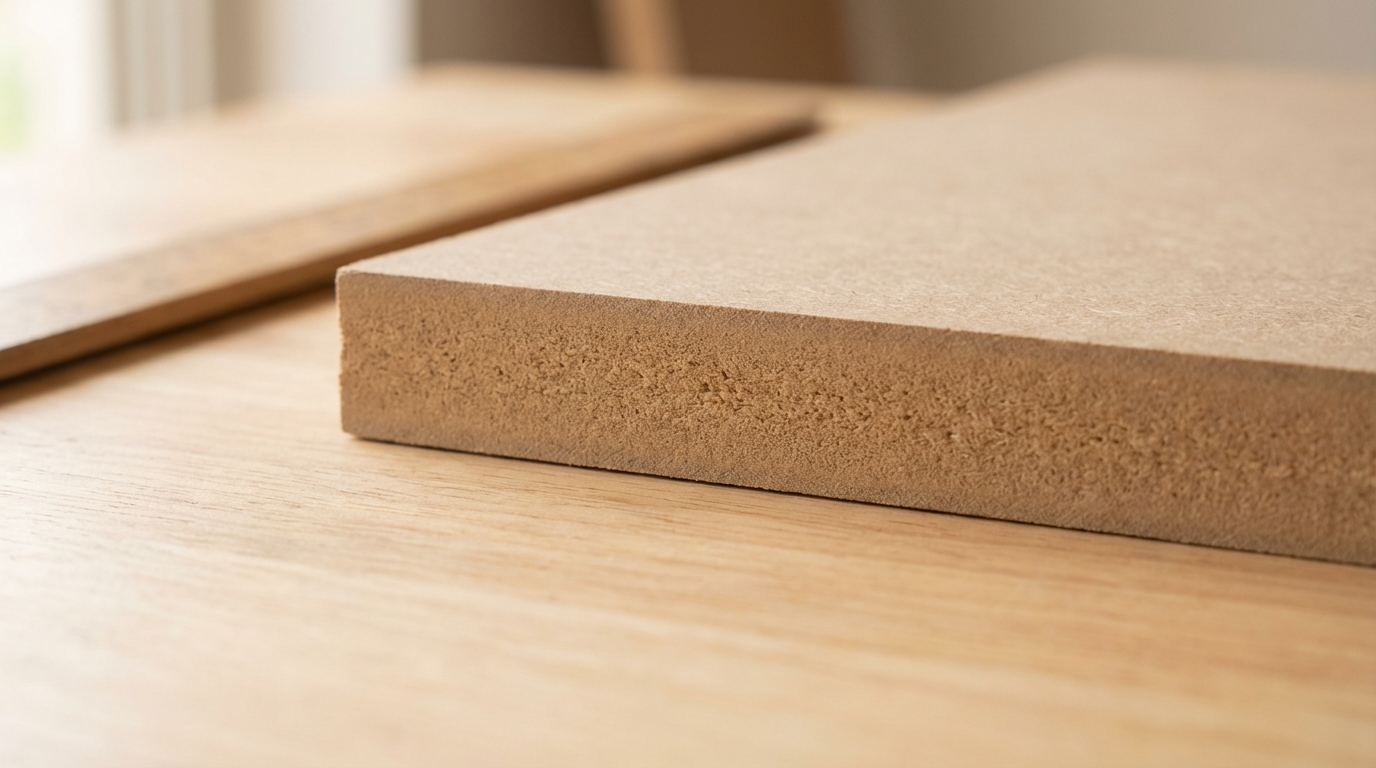
MDF stands for Medium Density Fibreboard – an engineered wood panel made from compressed wood fibres.
In simple terms, MDF is like the bread of the wood panel world – it's made by taking wood scraps and sawdust, breaking them down into tiny fibres, mixing them with resin glue, and then pressing everything together under heat and pressure. What comes out is a smooth, flat board that's consistent throughout, without any knots or grain patterns. It's become incredibly popular in Indian homes for furniture, modular kitchens, and decorative panels because it offers a smooth surface that's perfect for painting and laminating.
- Full Form: Medium Density Fibreboard (also spelled Fiberboard in American English)
- Density Range: 600-800 kg/m³, which falls between particle board and hardboard
- Standard Size in India: 8 feet × 4 feet sheets in various thicknesses
- Primary Use: Interior furniture, wall panelling, modular kitchens, and decorative applications
- Key Advantage: Extremely smooth surface ideal for paint and laminate finishing
What Exactly is MDF?
Medium Density Fibreboard is an engineered wood product that has transformed how furniture is made in India over the past two decades. Unlike plywood which uses thin wood layers, or solid wood which comes directly from trees, MDF is manufactured by processing wood into its smallest components – fibres.
Think of it this way: if solid wood is like a whole apple, and plywood is like an apple cut into slices, then MDF is like apple sauce – completely broken down and reformed into something new. This gives MDF some unique properties that natural wood simply cannot offer.
How is MDF manufactured?
The manufacturing process involves several key steps that determine the board's final quality:
Step 1 – Wood Collection: Manufacturing begins with wood residuals like sawdust, wood chips, and shavings. In India, eucalyptus and poplar are commonly used raw materials due to their availability and fast growth rates.
Step 2 – Defibration: The wood pieces are steamed and mechanically broken down into individual wood fibres using a defibrator machine. This is what differentiates MDF from particle board, which uses larger wood particles.
Step 3 – Resin Mixing: The fibres are blended with synthetic resin (usually urea-formaldehyde or melamine-urea-formaldehyde) and wax. The resin acts as the binding agent that holds everything together.
Step 4 – Mat Formation: The fibre-resin mixture is spread into a continuous mat on a conveyor belt, ensuring uniform thickness and density.
Step 5 – Hot Pressing: The mat is compressed under high pressure (typically 150-200 kg/cm²) and temperature (160-200°C). This activates the resin and bonds the fibres permanently.
Step 6 – Finishing: The boards are cooled, trimmed to size, and sanded to achieve the characteristic smooth surface.
What does MDF stand for? Full form explained
The full form of MDF is Medium Density Fibreboard. Each word in this name has specific meaning:
Medium: Refers to the density of the board, which typically falls between 600-800 kg/m³. This is higher than particle board (low density) but lower than hardboard or HDF (high density).
Density: The mass per unit volume, which directly affects the board's strength, machinability, and surface quality.
Fibreboard: Indicates that the board is made from wood fibres (not particles, chips, or veneers) that are bonded together.
The term originated in the 1960s when the product was first developed in the United States. It arrived in India during the 1990s and has since become a staple in the furniture and interior industry.
Types of MDF Available in India
The Indian market offers several MDF variants, each designed for specific applications and environments. Understanding these types helps you make the right choice for your project.
Standard MDF (Plain MDF)
The most common type, suitable for dry interior applications. It's economical and works well for furniture in living rooms, bedrooms, and offices where moisture exposure is minimal.
Moisture Resistant MDF (MR MDF)
Contains special resins that provide moderate protection against humidity. Suitable for areas with occasional moisture exposure but not direct water contact. Often identified by a green core in some brands.
HDHMR (High Density High Moisture Resistant)
A premium variant combining higher density with superior moisture resistance. Increasingly popular for kitchen cabinets in Indian homes where humidity levels fluctuate significantly.
Fire Retardant MDF
Treated with fire-resistant chemicals to slow flame spread. Used in commercial spaces, hospitals, and areas where fire safety compliance is required.
Pre-laminated MDF
Factory-finished with decorative laminate, available in various colours and textures. Saves time and ensures consistent finish quality.
Exterior Grade MDF
Manufactured with waterproof resins for applications with higher moisture exposure. More expensive but essential for certain applications.
| Type | Best For | Moisture Resistance | Price Range (per sq ft) |
|---|---|---|---|
| Standard MDF | Dry interior furniture, wall panels | Low | ₹15-40 |
| MR MDF | Living rooms, bedrooms with AC | Moderate | ₹25-55 |
| HDHMR | Kitchen cabinets, bathroom vanities | High | ₹45-80 |
| Fire Retardant MDF | Commercial spaces, hospitals | Varies | ₹50-90 |
| Pre-laminated MDF | Quick furniture, shelving | Depends on base | ₹55-150 |
| Exterior Grade | Covered outdoor areas | Very High | ₹60-120 |
Note: Prices vary by region, brand, and market conditions. Confirm current rates with local dealers.
Which type is best for kitchen and bathroom?
For kitchen cabinets in Indian conditions, HDHMR is typically the recommended choice. Indian kitchens face unique challenges – steam from pressure cookers, water splashes near sinks, and monsoon humidity that can exceed 80% in coastal areas.
Standard MDF will swell and deteriorate quickly in such environments. HDHMR's higher density and moisture-resistant properties provide better protection, though the edges should still be sealed properly with PVC edge banding.
For bathrooms, even HDHMR has limitations. If you must use MDF-based products in bathroom vanities, ensure they're placed away from direct water contact and the room has adequate ventilation. Many interior designers in humid cities like Mumbai and Chennai prefer marine plywood for bathroom furniture instead.
Which type works for wardrobes and bedrooms?
Bedroom wardrobes offer the ideal application for MDF because moisture exposure is typically limited. Standard MDF or MR MDF works well for wardrobe carcasses and shutters in most Indian homes.
If your home is air-conditioned, standard MDF is usually sufficient. In non-AC rooms in humid regions, upgrading to MR MDF provides additional peace of mind. The smooth surface of MDF makes it perfect for painted wardrobes or those finished with decorative laminates.
Key Properties and Specifications
Understanding MDF specifications helps you choose the right product and communicate effectively with carpenters and suppliers.
| Property | Typical Range | What It Means for You |
|---|---|---|
| Density | 600-800 kg/m³ | Higher density = stronger board, better screw holding |
| Thickness Options | 3mm to 30mm | Choose based on application; 18mm common for furniture |
| Standard Sheet Size | 8' × 4' (2440 × 1220 mm) | Plan cuts to minimize wastage |
| Internal Bond Strength | 0.55-0.75 N/mm² | Affects how well edges hold during machining |
| Surface Smoothness | Very high | Excellent for painting without extensive preparation |
| Modulus of Rupture | 20-30 N/mm² | Indicates bending strength; important for shelves |
Common thickness options and their uses
- 3mm-6mm: Back panels, drawer bottoms, decorative panelling
- 9mm-12mm: Shelving, partition panels, light furniture
- 16mm-18mm: Most furniture carcasses, wardrobe shutters, cabinet doors
- 25mm-30mm: Heavy-duty applications, thick door panels, tabletops
Where People Get Confused
Several misconceptions about MDF circulate among homeowners and even some contractors. Let's address the most common ones:
Misconception 1: "MDF is waterproof"
Reality: Standard MDF is highly susceptible to water damage. Even moisture-resistant variants aren't waterproof – they simply resist humidity better than standard MDF. Direct water contact will damage any MDF over time.
Misconception 2: "MDF and particle board are the same thing"
Reality: They're different products. MDF uses fine wood fibres while particle board uses larger wood particles. MDF is denser, stronger, and has a smoother surface. The confusion arises because both are engineered wood products.
Misconception 3: "MDF is stronger than plywood"
Reality: For most structural applications, plywood is stronger than MDF of equivalent thickness. MDF's strength lies in its smooth surface and machinability, not raw structural strength.
Misconception 4: "All MDF contains dangerous chemicals"
Reality: While MDF does contain formaldehyde-based resins, reputable manufacturers now offer low-emission variants (E1 or E0 grade) that meet international safety standards. Look for CARB P2 compliant products for indoor use.
Misconception 5: "MDF can be used for outdoor furniture"
Reality: MDF, including exterior grades, is not suitable for direct outdoor exposure. It's meant for covered areas at most. For outdoor furniture, use treated solid wood or WPC alternatives.
Misconception 6: "Painted MDF looks exactly like wood"
Reality: Painted MDF has a perfectly smooth finish without wood grain. If you want a wood-grain appearance, you'll need to apply a wood veneer or use techniques like faux finishing.
Advantages and Limitations
Advantages of MDF
1. Exceptionally Smooth Surface: Unlike plywood or solid wood, MDF has no knots, grain patterns, or surface irregularities. This makes it ideal for painted finishes and lamination.
2. Excellent Machinability: MDF can be cut, routed, and shaped easily without splintering. Intricate CNC designs and decorative patterns are achievable without edge chipping.
3. Dimensional Consistency: Every sheet is uniform in thickness and density throughout. This predictability makes it easier for carpenters to work with and ensures consistent results.
4. Cost-Effective: Generally less expensive than solid wood or high-grade plywood for comparable furniture applications, especially when a painted finish is desired.
5. No Natural Defects: Since it's manufactured, MDF doesn't have the knots, voids, or grain variations that can affect solid wood furniture appearance.
6. Takes Paint Beautifully: After proper priming, MDF accepts paint evenly and provides a furniture-quality finish that's difficult to achieve with other materials.
7. Environmental Consideration: Made from wood residuals and fast-growing plantation timber, reducing demand for old-growth forests.
Limitations of MDF
1. Water Sensitivity: Standard MDF swells and deteriorates when exposed to water. Workaround: Use moisture-resistant grades and ensure proper edge sealing.
2. Weight: MDF is heavier than plywood of equivalent size, making large panels difficult to handle. Workaround: Plan for adequate support in wall-mounted applications.
3. Edge Brittleness: Edges can chip during handling and don't hold screws as well as plywood. Workaround: Use proper edge banding and pre-drill screw holes.
4. Dust Generation: Cutting MDF produces fine dust that can be harmful if inhaled. Workaround: Ensure proper ventilation during fabrication and use dust masks.
5. Not Structural: MDF lacks the strength for load-bearing applications. Workaround: Use appropriate thickness and support structures for shelving.
Best Applications in Indian Homes
MDF works exceptionally well in specific applications while being unsuitable for others. Here's a room-by-room guide:
Living Room
Recommended: TV unit shutters, decorative wall panels, display cabinet doors, skirting, ceiling mouldings
Avoid: Floor-standing furniture bases in homes prone to water seepage
Bedroom
Recommended: Wardrobe shutters, headboard panels, dressing table tops (with proper finish), decorative panelling
Avoid: In houses without waterproofing in coastal/high-humidity areas
Kitchen
Recommended: Upper cabinet shutters (HDHMR), decorative panels away from direct heat/water, breakfast counter fronts
Avoid: Under-sink cabinets (prefer marine plywood), areas directly behind gas stoves
Study/Home Office
Recommended: Bookshelf backs and sides, desk surfaces (with laminate), wall-mounted storage shutters
Avoid: Floor-level storage in ground-floor rooms
Children's Room
Recommended: Study table surfaces, painted furniture fronts, wall panels
Note: Ensure low-formaldehyde emission grades are used for children's spaces
How to Check Quality (Without Lab Tests)
When purchasing MDF, these visual and tactile checks help assess quality:
1. Surface Inspection: Run your hand across the surface. It should feel uniformly smooth without bumps, depressions, or rough patches. Any surface irregularity indicates poor manufacturing.
2. Edge Examination: Look at the cut edge of the board. Quality MDF shows uniform colour and density throughout. Visible layers, voids, or colour variations suggest inconsistent pressing.
3. Weight Assessment: Lift the board and compare with others. Significantly lighter boards may have lower density, affecting strength and screw-holding capacity.
4. Flex Test: Gently flex a sample piece. Quality MDF should feel rigid and spring back. Excessive flexibility or any cracking sound indicates poor bonding.
5. Thickness Consistency: Measure thickness at multiple points using a vernier calliper if possible. Variations exceeding 0.3mm indicate quality issues.
Questions to ask your dealer
- What is the density of this MDF board?
- Is this standard, MR, or HDHMR grade?
- What is the formaldehyde emission class (E0, E1, E2)?
- Can you provide a test certificate or quality document?
- How should edges be treated for my specific application?
Care and Maintenance Tips
Daily Care:
- Wipe surfaces with a dry or slightly damp cloth
- Avoid placing wet items directly on MDF surfaces
- Use coasters and placemats to prevent moisture rings
Cleaning Methods:
- Use mild soap solution for stubborn marks
- Avoid harsh chemicals, abrasives, or excessive water
- Dry immediately after any wet cleaning
What Damages MDF:
- Standing water – even small amounts left for extended periods
- High humidity without ventilation
- Direct heat exposure (from appliances or sunlight)
- Impact damage to edges and corners
Frequently Asked Questions
Is MDF waterproof?
No, standard MDF is not waterproof and will swell when exposed to water. Even moisture-resistant (MR) and HDHMR variants are water-resistant, not waterproof. They can handle humidity better but will still suffer damage from direct water contact. For areas with water exposure, proper sealing with waterproof finishes is essential, and even then, prolonged contact should be avoided. In Indian bathrooms or outdoor applications, consider marine plywood or WPC as alternatives.
Is MDF termite proof?
MDF generally offers better resistance to termites compared to solid wood because the manufacturing process and synthetic resins make it less appealing to insects. However, it's not completely termite-proof. Some manufacturers add borer and termite-resistant chemicals during production. If termite resistance is a concern in your area, specifically ask for termite-treated MDF and check the product specifications. Annual inspections and preventive treatments around your home remain important.
How long does MDF furniture last?
Well-maintained MDF furniture in appropriate conditions can last 10-15 years or more. Lifespan depends heavily on the environment – dry, air-conditioned spaces extend life significantly. Poor quality MDF or installation in humid conditions without proper finishing may show deterioration within 3-5 years. Quality of hinges, handles, and assembly also affects longevity. Regular maintenance and keeping MDF away from moisture sources are crucial for maximum lifespan.
Can MDF be used in kitchen?
Yes, MDF can be used in kitchens, but with important considerations. Use only HDHMR grade for kitchen cabinets, not standard MDF. Ensure all edges are properly sealed with PVC edge banding. Avoid using MDF for under-sink cabinets where water exposure is likely. Keep MDF surfaces away from direct steam sources like above the gas stove. Many modern Indian modular kitchens successfully use HDHMR with proper precautions and regular maintenance.
MDF vs plywood – which is better?
Neither is universally "better" – each has ideal applications. MDF excels for painted furniture, decorative panels, and CNC-cut designs due to its smooth surface and machinability. Plywood is stronger, lighter, handles moisture better, and holds screws more securely – making it preferred for structural components, kitchen carcasses, and humid environments. Many quality furniture pieces use both: plywood for carcasses and structural elements, MDF for painted shutters and decorative parts.
What is the cost of MDF?
MDF prices in India typically range from ₹15-120 per square foot depending on type, thickness, and brand. Standard MDF (18mm) usually costs ₹25-40/sq ft. Moisture-resistant MDF ranges ₹35-55/sq ft. HDHMR is priced at ₹50-80/sq ft. Pre-laminated options add ₹15-50/sq ft to base prices. Prices vary significantly by region, with metro cities generally having more competitive rates due to dealer density. Always compare multiple suppliers before purchasing.
Where to buy MDF in India?
MDF is available through plywood dealers, hardware stores, and building material suppliers across India. Major metropolitan areas have dedicated markets like Kirti Nagar in Delhi or Hindmata in Mumbai. Many national brands also offer online purchasing through their websites or e-commerce platforms. For large projects, contact brand distributors directly for better rates. Always purchase from authorised dealers to ensure genuine products and access to any quality guarantees.
How to identify good quality MDF?
Quality MDF has uniform density visible at cut edges, consistent colour throughout the board, and an exceptionally smooth surface free of bumps or depressions. The board should feel heavy for its size (indicating proper density). Bend a sample piece gently – quality MDF feels rigid and doesn't produce cracking sounds. Ask for the density specification (should be 680-750 kg/m³ for standard MDF). Request test certificates from reputable brands, and avoid boards with visible voids or layering at edges.
Can MDF be painted directly?
MDF can be painted, but direct painting without primer is not recommended. The surface absorbs paint unevenly, and edges absorb even more aggressively. Always apply a quality primer first – shellac-based or MDF-specific primers work best. Sand lightly between coats. For edges, apply multiple thin primer coats as they're more porous. With proper preparation, painted MDF achieves a superior furniture-grade finish that's difficult to replicate on solid wood or plywood due to their grain patterns.
Disclaimer: This content is provided for general informational purposes based on industry practices and publicly available information. Product specifications, standards, prices, and availability may vary by manufacturer, region, and time. Readers should independently verify details with manufacturers, dealers, or qualified professionals before making purchase or construction decisions.Want Plywood Suggestions?
Share a few details and a Duro BOIL specialist will suggest suitable brands and connect you to responsive dealers.