MDF vs particle board for wardrobes: weight, screws & cost
MDF vs particle board for wardrobes: weight, screws & cost with a clear decision table on grade, thickness, moisture performance, warranty and price factors.
Quick Decision Summary
MDF outperforms particle board for wardrobes in screw holding and overall strength, but particle board wins on lighter weight and lower cost.
If you're in a hurry: Opt for MDF (16-18mm thickness) in humid or heavy-use wardrobes for reliable screw grip and less sagging under clothes weight. Particle board suits dry, low-budget, lightweight setups like kids' rooms where cost savings matter more than longevity. Both need edge sealing and lamination to combat Indian monsoon swelling—verify density (MDF 700+ kg/m³) and glue quality on-site. Expect 20-50% higher cost for MDF, but fewer repairs long-term.
- Choose MDF if: Wardrobe holds heavy loads, needs frequent adjustments, or faces humidity.
- Choose particle board if: Budget under tight control, light contents only, or temporary setup.
- Avoid both if: High-moisture zones without moisture-resistant grades.
What MDF and Particle Board Actually Mean
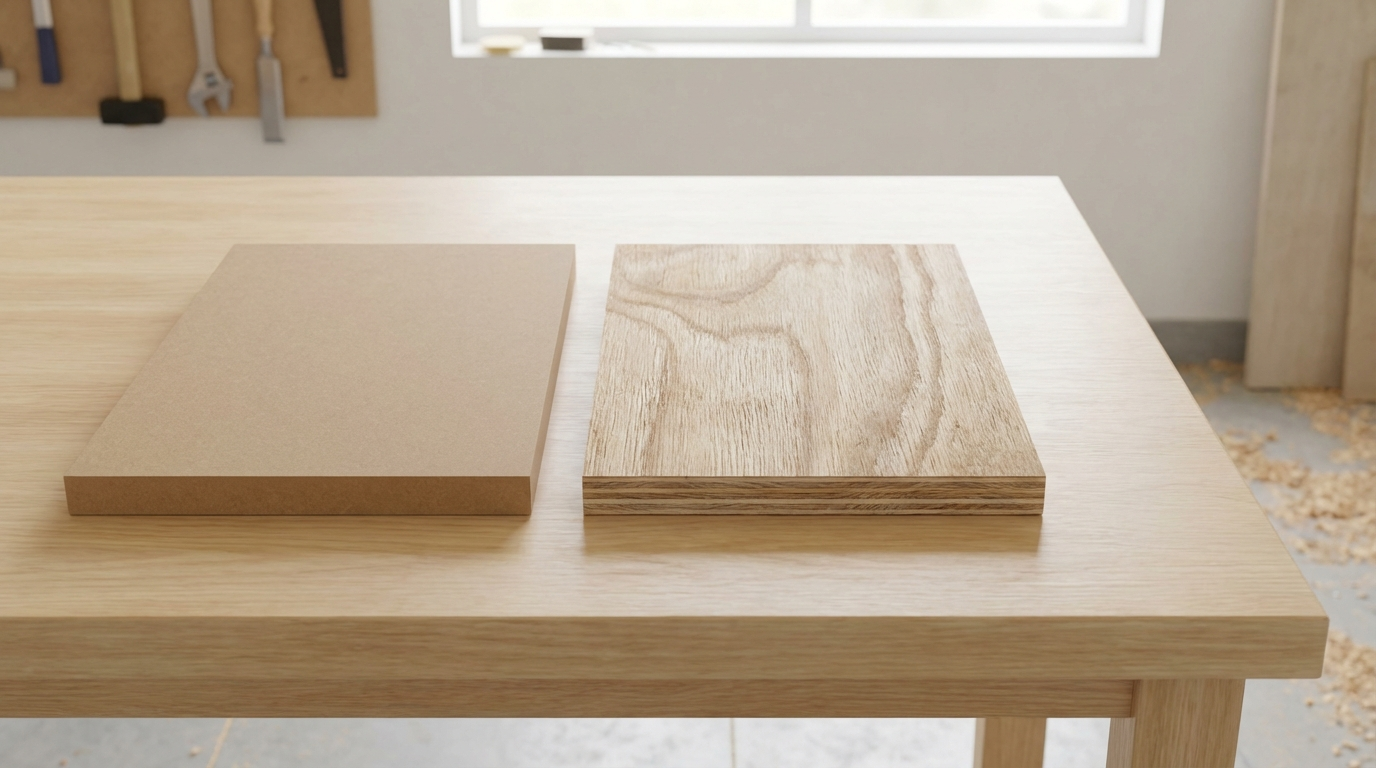
MDF (Medium Density Fiberboard) is engineered wood from fine wood fibers mixed with resins, pressed under heat and pressure into dense, smooth sheets ideal for laminated wardrobes. Particle board (also called chipboard) uses larger wood chips and particles bonded similarly but at lower density, resulting in coarser texture better for basic shelving.
Where people get confused:
- Thinking they're the same—particle board is chunkier and weaker.
- Assuming both are waterproof—neither resists moisture without special grades or sealing.
- Believing particle board is always cheaper to install—it often needs thicker sheets to compensate for weakness.
- Overlooking weight impact—MDF's density adds heft to full-height wardrobes.
- Ignoring screw differences—many expect uniform performance, but edges behave differently.
- Confusing with plywood—both lack plywood's layered strength for heavy spans.
India-Specific Reality Check
In monsoon-heavy regions like Mumbai or coastal Kerala, both materials swell if edges stay exposed—particle board more so due to lower density. Inland dry areas like Delhi favor particle board's lightness. Poor site storage (direct rain, godown dampness) leads to glue failure before installation. Contractor workflows often skip edge banding, causing 6-12 month delamination. Termite risk low in both (resins deter eating), but cracks invite infestation. Always demand pre-laminated sheets for wardrobes.
Which holds screws better in wardrobes: MDF or particle board?
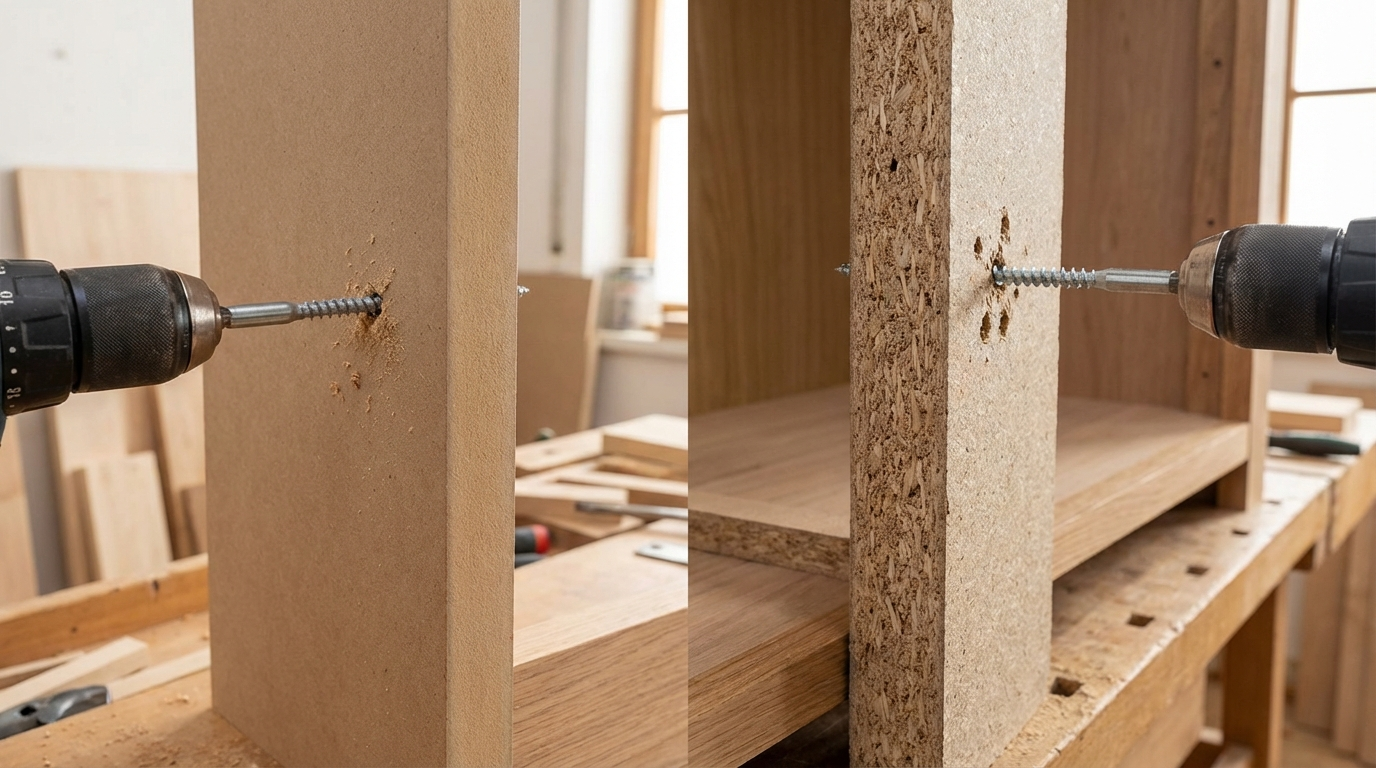
MDF typically holds screws 20-40% better than particle board due to higher density, making it ideal for adjustable shelves and heavy hinges in wardrobes. Particle board works for light screws but strips edges easily under repeated use. Nuance: Both need pilot holes; over-tightening ruins either. Next step: Test a sample—drive a 1.5" wood screw into the edge, pull out after 24 hours. If it grips without crumbling, it's viable.
Is MDF much heavier than particle board for wardrobe panels?
Yes, MDF weighs about 30-50% more per sheet (e.g., 18mm MDF ~40-50 kg/sheet vs particle ~25-35 kg), noticeable in tall wardrobes needing wall anchors. Lighter particle eases handling for carpenters. Condition: Weight matters less for floor-standing units. Check: Weigh sample sheets or calculate total (height x width x thickness x density).
Price Range and Cost Drivers (India)
Particle board typically ranges ₹30-₹80 per sq ft (8-19mm), MDF ₹60-₹140 per sq ft—varies by city (20-30% higher in metros), thickness, density grade, and pre-lamination. Add 10-20% for logistics/wastage in wardrobes.
Cost drivers:
- Thickness (18mm+ for spans).
- Moisture grade (MR adds 15%).
- Face finish (prelam saves labor).
- Batch quality (calibrated edges reduce trimming loss).
How to ask for a quote: "18mm MR MDF/particle, prelam both sides, calibrated, for 20 sqm wardrobe—include delivery."
Mini example: 8x6 ft wardrobe (~25 sqm material) on particle board: budget ₹1,000-2,000 base; MDF doubles it but halves rework costs.
Two-Minute Comparison That Actually Helps
| Factor | MDF | Particle Board |
|---|---|---|
| Weight (18mm sheet) | Heavier (40-50kg) | Lighter (25-35kg) |
| Screw Holding | Better (dense fibers) | Weaker (crumbles edges) |
| Cost per sq ft | ₹60-140 | ₹30-80 |
| Moisture Resistance | Fair (sealed) | Poor (swells fast) |
| Surface Finish | Smooth (paint/lam ready) | Coarse (needs thick lam) |
| Wardrobe Use | Heavy shelves/doors | Light backs/panels |
Choose based on: Heavy-use/humid = MDF; Budget/light = particle.
Can particle board handle wardrobe weight like MDF?
Particle board manages light loads (under 20kg/shelf) but sags over time on longer spans—MDF supports 30-50kg reliably. In India, overloaded wardrobes (winter clothes) expose this. Verify: Ask for span rating or load-test sample shelf.
How to Choose in 5 Steps
- Assess site: Humidity? Heavy clothes? → Moisture grade essential.
- Spec thickness: 18mm min for shelves; test screw grip.
- Budget check: Particle for <₹100/sqft total; MDF for durability.
- Verify samples: Tap for solidity, weigh for density.
- Seal plan: Prelam + edge tape mandatory, or skip both.
Skip steps? Expect sagging or swelling in year 1.
Trade-offs and Limitations
MDF: Stronger but heavier install, pricier, dustier cutting. Particle: Cheap/light but weak screws, rough finish needs extra work. Both: Poor raw moisture resistance, edge fragility, no match for plywood in wet zones.
Common Buyer Mistakes and How to Avoid Them
- Mistake 1: Picking thinnest sheets—happens in budget rush. Instead: Min 16mm shelves.
- Mistake 2: Skipping lamination—assumes factory finish. Do: Insist prelam.
- Mistake 3: Ignoring density—cheap import fails. Check: >650kg/m³ stamp.
- Mistake 4: No edge sealing—monsoon hits. Tape all cuts.
- Mistake 5: Overloading light particle—family storage. Limit or upgrade.
- Mistake 6: Blind quotes—vague specs. List thickness/grade.
- Mistake 7: Dry storage only—godown damp. Cover stacks.
- Mistake 8: No screw test—assumes all equal. Sample first.
- Mistake 9: Metro pricing inland—logistics hike. Local supplier.
Failure Modes and Fixes
- Symptom: Shelf sag. Cause: Thin span/particle. Prevent: 18mm MDF, supports <80cm. Fix: Reinforce brackets.
- Symptom: Screw pull-out. Cause: Edge overdrive. Prevent: Pilot holes. Fix: Wood plugs + rescrew.
- Symptom: Edge swell. Cause: Moisture ingress. Prevent: Seal tape. Fix: Sand/refinish.
- Symptom: Lam delam. Cause: Poor glue. Prevent: Hot-press verify. Fix: Replace panel.
- Symptom: Cracks at joints. Cause: Weight flex. Prevent: Dowels/screws combo. Fix: Clamp/glue.
- Symptom: Surface scratches deep. Cause: Soft face. Prevent: Lam topcoat. Fix: Polish light.
- Symptom: Odor release. Cause: Cheap resins. Prevent: Low-formaldehyde grade. Fix: Ventilate.
Quality Checks You Can Do Without Lab Tests
Before buying: Tap sheet (solid thud = dense); flex corner (no bow); check edges (smooth, no gaps); smell (no strong chemical).
After cutting: Screw test edges; sand face (uniform dust); measure thickness consistency.
After install: Load test shelves 24hrs; check alignment; wipe edges for water beading.
Red flags: Visible chips, warping in stack, uneven color.
Decision Framework: Wardrobe Conditions
| Condition | Recommended | Verify |
|---|---|---|
| Humid/coastal | MDF MR grade | Edge seal test |
| Heavy load (50kg+) | MDF 18mm | Screw pull test |
| Tight budget | Particle prelam | Density stamp |
| Scratch-prone kids | MDF laminated | Surface scratch test |
| Fast install | Particle light | Calibrated edges |
| Wall-mounted | Particle 16mm | Weight per sheet |
Tips for Homeowners
Durability: Laminate all, avoid water wipes (dust only). Don't overload top shelves. Check quarterly for loose screws.
Tips for Carpenters
Cutting: Sharp blade, vacuum dust (MDF finer). Fastening: Pilot 70% depth. Hinges: Reinforce particle edges with blocks.
Tips for Architects
Specs: Detail MR grade, edge banding. Wet zones: Avoid both, spec plywood. Finishes: Matte lam for fingerprints.
Tips for Modular Makers
QC: Batch density checks, screw cycle tests. Reduce returns: Pre-seal samples shown to clients.
FAQs
Which is best for Indian wardrobes: MDF or particle board?
MDF suits most Indian wardrobes for superior strength and finish in humid homes, holding up to daily use better. Particle board fits ultra-budget or dry light-duty setups but risks faster wear. Consider local climate—monsoon areas need sealed MDF. Always pair with quality hardware; test samples for your load. Long-term, MDF cuts maintenance despite upfront cost.
Does weight difference matter for wardrobe installation?
Yes, particle board's lightness simplifies handling for tall units, reducing carpenter strain and wall anchor needs. MDF's heft demands sturdy frames. In apartments, lighter wins for solo lifts. Balance with strength—MDF prevents sags. Calculate total: Multiply panels by density for safe hoisting.
How does screw performance affect wardrobe longevity?
Poor screw hold leads to loose shelves/doors over time, especially adjustable ones. MDF grips tighter for 2-3x cycles before stripping. Use confirmat screws in particle with inserts. India tip: Humidity loosens faster—recheck yearly. Strong hold means fewer callbacks.
Are there moisture-resistant versions for both?
Yes, MR (moisture resistant) grades use better resins, but neither is waterproof—seal edges religiously. Particle MR still swells more. For bathrooms, upgrade to HDF or plywood. Test: Splash water, check after 1hr. Varies by brand/batch; confirm supplier specs.
What's the real cost difference for a full wardrobe?
Particle saves 30-50% on material (e.g., full wardrobe base ₹10k-20k vs MDF ₹15k-35k), but add labor for thicker sheets. City variation huge—Tier 2 cheaper. Factor wastage (10%) and future fixes. Quote fully laminated for fair compare.
Can termites attack MDF or particle board wardrobes?
Rarely, as resins aren't edible, but cracks from swelling invite them. Seal gaps, use termite barriers in walls. Coastal India higher risk—inspect annually. Prevention beats cure; both safer than untreated wood.
Is particle board good for wardrobe backs?
Yes, 3-6mm particle suffices for backs—light, cheap, nails easily. Avoid for visible/shelves. Saves 10-15% total cost without compromising. Ensure straightness to prevent bowing.
Should I laminate both materials the same way?
MDF takes thinner lams smoothly; particle needs thicker to hide texture. Both benefit from PVC edge bands. Pro tip: Hot-press lam for humidity hold. Poor lam leads to peeling in AC-dry rooms.
How to test screw holding at the supplier?
Request offcut: Drill pilot, insert #8 screw, torque by hand, then pull with pliers. Clean pullout = good. Compare edge vs face. Do for multiple spots—avoid hollow cores.
What's better for rented apartments: MDF or particle?
Particle—lighter, cheaper, easier dismantle. MDF if keeping long-term. Both portable; prioritize pre-fab for quick shifts. Seal well for storage between moves.
Disclaimer: This content is provided for general informational purposes based on industry practices and publicly available information. Product specifications, standards, prices, and availability may vary by manufacturer, region, and time. Readers should independently verify details with manufacturers, dealers, or qualified professionals before making purchase or construction decisions.Want Plywood Suggestions?
Share a few details and a Duro BOIL specialist will suggest suitable brands and connect you to responsive dealers.