MDF vs Plywood vs Particle Board: Differences & Uses
MDF vs plywood vs particle board – compare their strength, moisture resistance, and cost to see which material is best suited for your furniture or cabinets.
Quick Decision Summary
Plywood for strength and moisture-prone areas; MDF for smooth painted finishes; particle board for budget light-duty projects.
If you're in a hurry: Pick plywood for load-bearing furniture or humid kitchens/bathrooms in India—its layered veneers resist warping better during monsoons. MDF suits cabinets with laminate or paint needing flawless edges, but seal it well against spills. Particle board works for basic shelves or backs if weight is low and budget tight, though it swells easily in damp storage yards. Always check core uniformity and edge integrity on-site before buying.
- Choose plywood if: heavy loads, moisture exposure, or long-term durability needed.
- Choose MDF if: smooth surfaces for painting/laminating, precise cutting, or affordable uniformity.
- Choose particle board if: tight budgets, non-structural uses, and dry indoor storage.
- Avoid particle board if: any dampness or screws involved; it crumbles fast.
- Avoid MDF if: direct water contact or heavy hardware; edges swell.
- Avoid plywood if: ultra-smooth finishes required; visible grain needs extra work.
Two-Minute Comparison That Actually Helps
| Aspect | MDF | Plywood | Particle Board |
|---|---|---|---|
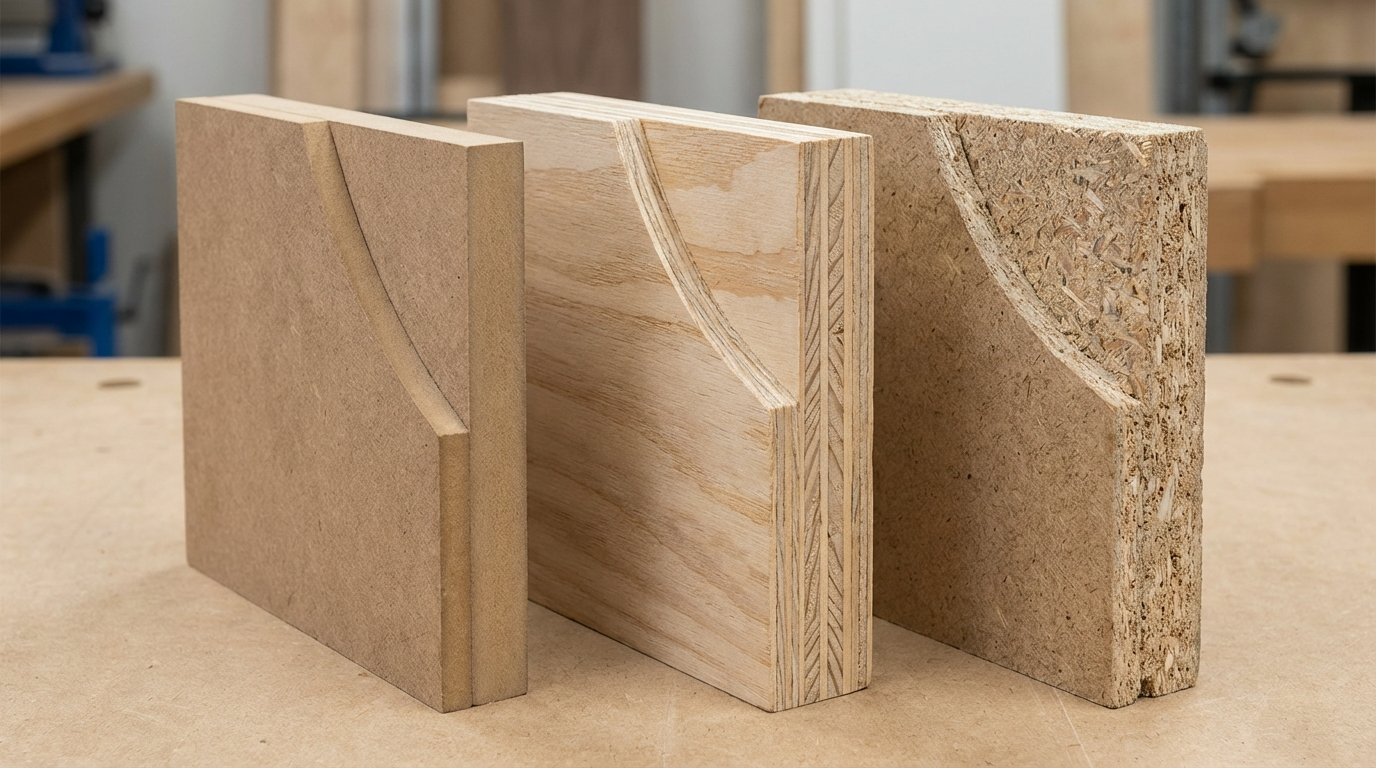
| Composition | Wood fibers + resin, uniformly pressed | Thin wood veneers glued cross-grain | Wood chips/particles + resin, low-pressure |
| Strength (load/screws) | Medium; good shear but poor screw hold without inserts | High; excellent bending and screw retention | Low; crumbles under weight or repeated screws |
| Moisture Resistance | Fair (sealable but swells at edges) | Good (BWR/BWP grades for wet areas) | Poor (absorbs fast, delaminates) |
| Surface Finish | Ultra-smooth, ideal for paint/laminate | Grainy; needs veneer or foil | Rough; requires thick overlay |
| Cost Relative | Medium | Highest | Lowest |
| Best For | Cabinets, moldings (dry interiors) | Furniture frames, doors (humid zones) | Back panels, light shelves |
Use this for wet vs. dry decisions: plywood wins in kitchens; MDF for bedrooms; particle board only for hidden, dry spots. Verify by tapping for hollow sounds (bad core) and checking edge swelling after a water drop test.
Which is Stronger: MDF or Plywood?
Plywood is typically stronger for structural uses due to its cross-layered veneers distributing stress evenly—ideal for shelves holding heavy kitchenware or beds in Indian homes. MDF offers uniform density but fails faster under repeated screw insertions or bending loads without pilot holes and inserts. Particle board lags far behind, often sagging within months. Consider your load: under 10kg per shelf? MDF suffices. Heavier? Insist on plywood. Test strength by pressing firmly on sample edges at the dealer yard; flexing reveals weak cores. For coastal areas, prioritize BWR-grade plywood to counter humidity weakening.
Is Particle Board the Same as MDF?
No, particle board uses larger wood chips pressed at lower density, making it cheaper but weaker and rougher than MDF's fine fibers. People often confuse them as "both cheap boards," but particle board absorbs moisture twice as fast, leading to quicker failures in humid godowns. MDF machines smoother for edges. If buying for wardrobes, ask for density specs verbally—over 650 kg/m³ leans MDF-like. Next step: compare weights of same-size samples; heavier usually means better resin bonding. Avoid particle board for anything screwed; use it only for flat-pack backs.
What MDF, Plywood, and Particle Board Actually Mean
MDF (Medium Density Fiberboard) is engineered from exploded wood fibers mixed with resin, compressed into dense, uniform sheets—perfect for seamless laminates without grain telegraphing.
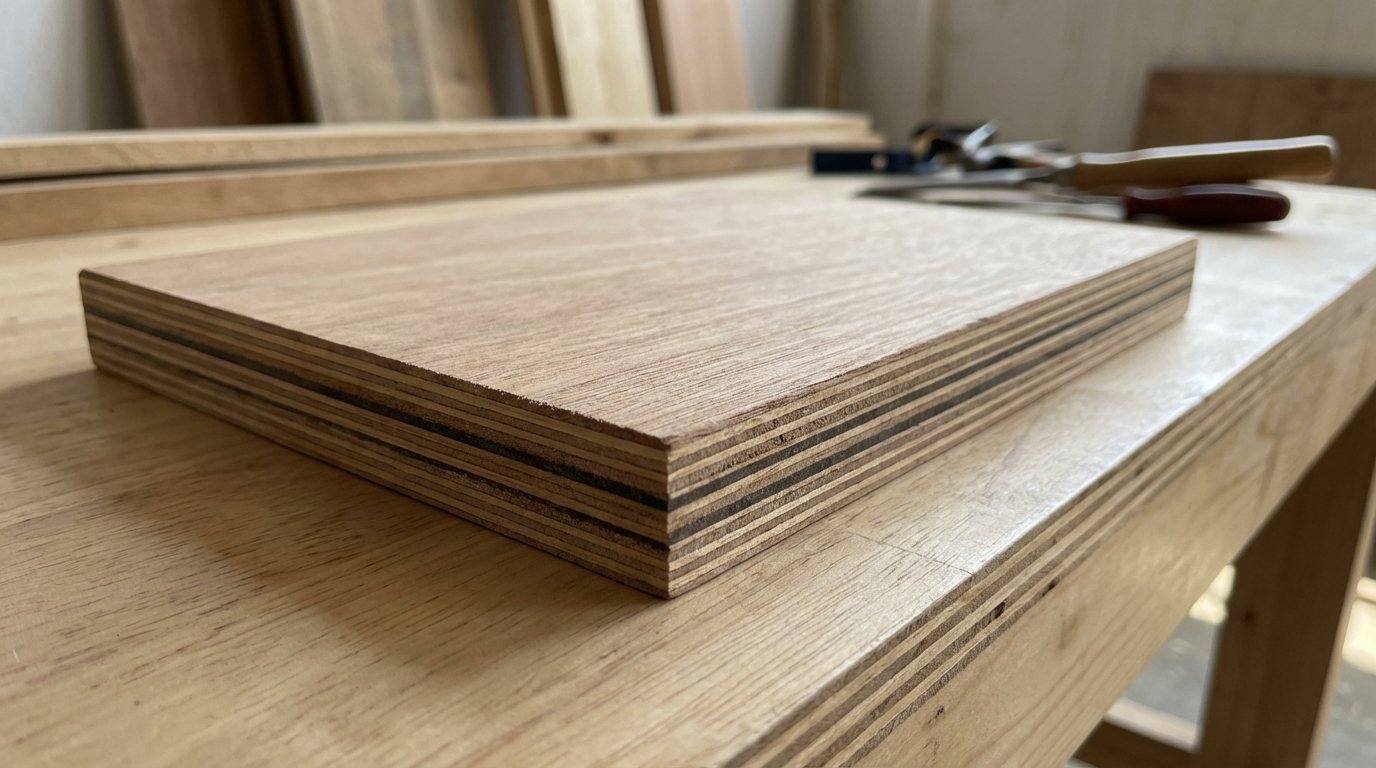
Plywood stacks thin wood veneers at right angles, glued under heat/pressure for balanced strength; grades like MR (interior dry), BWR (boiling water resistant), or BWP (marine-grade) define moisture tolerance.
Particle board (aka chipboard) grinds waste wood into particles, binds with urea-formaldehyde, and presses loosely—economical but inconsistent.
Where People Get Confused
- Thinking all "boards" screw equally—MDF/particle need inserts; plywood doesn't.
- Assuming cheaper means thinner—density and glue lines matter more.
- Mixing "MDF" with waterproof claims—needs edge sealing everywhere.
- Believing particle board suits kitchens—swells in steam instantly.
- Overlooking plywood grades—MR fails in bathrooms; BWP costs more but lasts.
- Confusing surface smoothness with core strength—paintable MDF hides weak innards.
India-Specific Reality Check
In monsoon-heavy India, particle board stored in open yards delaminates before use; MDF edges wick humidity causing cabinet swelling in coastal kitchens. Plywood's cross-grains fare best but check for core gaps from poor kiln-drying. Contractor workflows favor plywood for site cutting as it holds screws post-transport jostling. Always stack horizontally under cover; uncoated particle/MDF warps 2x faster in 80% RH. For Mumbai/Chennai homes, verify BWR minimum; Delhi dry interiors tolerate MR/MDF.
Price Range and Cost Drivers (India)
Expect particle board at the lowest end (often under mid-range plywood quotes), MDF mid-tier, plywood highest—varying 20-50% by city (metros pricier due to logistics). Thickness drives 40% of cost: 18mm doubles thin sheets.
Why Does Plywood Cost More Than MDF?
Plywood's veneers and glue lines (especially phenolic in BWP) raise costs over MDF's simple fiber press; add calibration for flatness. Regional factors: Northeast plywood cheaper at source, but transport to South hikes it. Quote checklist: specify thickness, grade (MR/BWR), face veneer quality, calibrated/non-calibrated, quantity discount. Example: 100 sq ft 18mm BWR kitchen cabinets might run higher than MDF equivalent due to moisture spec. Confirm locally—ask "per sheet landed cost including stacking."
How to Choose in 5 Steps
- Assess exposure: Wet (kitchen/bath)? Plywood. Dry painted? MDF.
- Check load: Heavy shelves? Tap sample for solid thud (plywood).
- Feel edges: Smooth/no crumble? Good for MDF/particle.
- Ask grade: "BWR calibrated?" for plywood; density for boards.
- Test water drop: No swelling in 30 mins? Proceed; else upgrade.
Skip moisture check and face mid-monsoon swelling—ruins new furniture.
Which Material for Your Project? Decision Framework
| Condition | Recommended | Verify This |
|---|---|---|
| High moisture (kitchen/bath) | Plywood (BWR+) | Glue line test: no separation when pried |
| Coastal humidity | Plywood (BWP) | Core dryness: no musty smell |
| Heavy use/load | Plywood | Screw hold: twists without stripping |
| Tight budget, dry interior | Particle board | No visible gaps in chips |
| Smooth paint/laminate | MDF | Uniform density: consistent weight |
| High scratch risk | MDF (laminated) | Edge seal: no fuzz after sanding |
| Fast delivery needed | MDF/Particle | Stock availability on-site |
Trade-offs and Limitations
- MDF: Smooth but edge-swells; heavy for size.
- Plywood: Strong but grain shows; costlier cuts waste.
- Particle: Cheap but brittle; poor resandability.
All emit low formaldehyde initially—ventilate new installs. Plywood termite-prone if untreated; boards less so but rot faster.
Common Buyer Mistakes and How to Avoid Them
- Mistake: Buying particle board for wardrobes. Why: Screws pull out. Fix: Use plywood frames.
- Mistake: Ignoring plywood grade. Why: MR fails in humidity. Fix: Specify BWR.
- Mistake: Skipping edge sealing on MDF. Why: Spills wick in. Fix: Apply wax pre-install.
- Mistake: Overloading MDF shelves. Why: Permanent sag. Fix: Add brackets.
- Mistake: Storing boards vertically. Why: Warping. Fix: Flat stack with spacers.
- Mistake: No pilot holes in boards. Why: Cracking. Fix: Drill 80% depth.
- Mistake: Cheap laminates on particle. Why: Peels fast. Fix: Match quality.
- Mistake: Assuming uniformity. Why: Batch variance. Fix: Inspect full stack.
Failure Modes and Fixes
- Symptom: Swelling edges. Cause: Moisture ingress. Prevent: Seal all cuts. If happening: Sand + reseal.
- Symptom: Screw holes enlarge. Cause: Low density. Prevent: Use inserts. If: Toothpick + glue fill.
- Symptom: Sagging shelves. Cause: Undersized span. Prevent: 60cm max without support. If: Add cleats.
- Symptom: Delamination. Cause: Poor glue. Prevent: Steam test sample. If: Clamp + epoxy.
- Symptom: Visible core gaps. Cause: Factory voids. Prevent: Shine light through edge. If: Fill + sand.
- Symptom: Laminate bubbles. Cause: Heat/uneven press. Prevent: Pro installation. If: Slit + heat gun.
Quality Checks You Can Do Without Lab Tests
Before Buying
- Tap center/edge: uniform thud, no hollow.
- Water drop on cut edge: no darkening in 10 mins.
- Weight sample: heavier = denser.
- Ask: "Resin type? Calibration tolerance?"
- Red flag: Chips falling from edge.
After Cutting
- Screw test: no crumble.
- Sand edge: smooth, no fuzz.
After Install
- Check alignment: no gaps.
- Seal edges fully.
- Clean spills immediately.
Tips for Homeowners
Focus on easy-clean surfaces: laminate MDF for kitchens, avoid particle near water. Don't overload—use plywood for TV units. Wipe spills dry; ventilate post-install to off-gas. Budget extra 10% for sealing kits.
Tips for Carpenters
Cut MDF with fine blade to avoid tear-out; pre-drill particle always. For plywood, align grain for aesthetics. Handle plywood vertically only short-term; edge-band boards immediately post-cut to prevent swelling during site delays.
Tips for Architects
Spec plywood BWR for wet zones, MDF HD for moldings. Detail edge returns; note 1-2% swell allowance in humid areas. Prioritize calibrated sheets for modular fits.
FAQs
Can MDF Be Used for Kitchen Cabinets?
Yes, HDHMR (high-density moisture-resistant MDF) works for cabinets if edges are sealed and not directly wet—common in urban Indian kitchens for smooth laminates. It machines precisely, reducing carpenter errors. However, in steam-heavy cooking or monsoons, opt for BWR plywood to avoid edge swelling over years. Next: inspect density by weight, apply polyurethane seal, and add back vents for airflow. Avoid if budget allows plywood for screw-heavy doors.
Is Plywood Better Than MDF for Furniture?
Plywood excels for furniture frames needing screw retention and warp resistance, especially beds/tables in humid homes—its layers flex without breaking. MDF suits painted panels but sags under sustained loads. Trade-off: plywood grain requires veneering. Choose based on use: heavy-duty? Plywood. Decorative? MDF. Verify by bending sample; stiffest wins. In India, factor transport—plywood stacks flatter.
Why Does Particle Board Swell?
Particle board's coarse particles and urea glue absorb water rapidly, expanding 10-20% in humidity—worst in open storage or bathrooms. Unlike denser MDF, it doesn't recover. Prevent by keeping dry, using only indoors dry. If swelling starts, dry slowly but replace sections. Better: upgrade to MDF for semi-wet, plywood for risk zones. Check by drop test pre-buy.
Which Holds Nails/Screws Best?
Plywood grips screws longest due to layered fibers; MDF/particle strip after 2-3 uses without inserts. For cabinets, plywood doors last 10+ years. Fix: use wood plugs or anchors in boards. Test: screw into sample edge multiple times. India tip: coastal salt air weakens all—rust-proof hardware essential.
Is MDF Termite-Resistant?
MDF resists termites better than solid wood (no grain paths), but untreated particle does too—both vulnerable if damp attracts them. Plywood needs chemical treatment. Treat all with oil post-install. Inspect: powdery dust? Infestation. Prevention: elevate off floors, ventilate.
Can You Paint Particle Board?
Yes, but rough texture needs filler/sanding first—less ideal than MDF's smoothness. Prime twice to block moisture. Fades faster in humid rooms. Alternative: laminate. Step: degrease, sand 180-grit, primer, topcoat. Avoid high-traffic; chips expose core.
What's the Difference Between MR and BWR Plywood?
MR (moisture resistant) for dry interiors; BWR (boiling water resistant) survives humidity/boils—essential for Indian bathrooms/kitchens. BWR glue stronger, costlier. Verify: ask for grade cert visually (stamps). Mistake: using MR wet—delams fast.
Is Particle Board Eco-Friendly?
Often uses waste wood, but high glue (formaldehyde) offsets—ventilate new pieces. Plywood sustainable if plantation-sourced. MDF fibers efficient. Choose low-emission labeled; air out 72 hours. India: check for recycled content verbally.
Which for Wardrobe Shutters?
MDF with laminate for smooth, lightweight shutters; plywood for heavy-duty with better screw hold. Avoid particle—sags. Seal edges always. For humid bedrooms, BWR plywood. Test swing: no flex.
Disclaimer: This content is provided for general informational purposes based on industry practices and publicly available information. Product specifications, standards, prices, and availability may vary by manufacturer, region, and time. Readers should independently verify details with manufacturers, dealers, or qualified professionals before making purchase or construction decisions.Want Plywood Suggestions?
Share a few details and a Duro BOIL specialist will suggest suitable brands and connect you to responsive dealers.