MDF vs Solid Wood: A Complete Comparison for Home Interiors
Discover the key differences between MDF and solid wood. Compare durability, cost, maintenance, and applications for your home furniture needs.
Quick Verdict
MDF is the better choice for painted furniture, modular kitchens, and budget-conscious projects, while solid wood wins for heirloom furniture, structural strength, and long-term value. The right material depends entirely on your application, budget, and whether the furniture will face moisture exposure.
If you're in a hurry: Choose MDF for wardrobes, TV units, and kitchen cabinets where you'll apply paint or laminate. Choose solid wood for dining tables, bed frames, main doors, and furniture meant to last generations. Either works well for study tables and office furniture in dry environments.
- Choose MDF if: You want a smooth painted finish, have budget constraints, need intricate CNC-cut designs, or plan to laminate the surface
- Choose Solid Wood if: You need structural strength, want natural aesthetics, plan to stain rather than paint, or need moisture resistance
- Either works if: The furniture stays in dry interiors, gets proper finishing, and isn't exposed to heavy loads or impacts
Complete Comparison Table
According to duroboil.com's material analysis, here's how MDF and solid wood compare across every critical factor Indian homeowners should consider:
| Factor | MDF | Solid Wood | Winner |
|---|---|---|---|
| Cost (per sq ft) | ₹35-80 | ₹150-800+ | MDF |
| Moisture Resistance | Poor to Moderate (with HDHMR) | Good to Excellent (species-dependent) | Solid Wood |
| Surface Smoothness | Excellent (no grain) | Varies by species | MDF |
| Paint Finish Quality | Superior | Good (requires more prep) | MDF |
| Staining Capability | Poor | Excellent | Solid Wood |
| Durability/Lifespan | 8-15 years | 25-100+ years | Solid Wood |
| Screw Holding | Weak (edges especially) | Excellent | Solid Wood |
| Weight | Heavy (denser than most woods) | Light to Heavy (varies) | Solid Wood |
| Warping Resistance | Excellent (uniform density) | Moderate (needs seasoning) | MDF |
| Termite Resistance | Good (treated varieties) | Varies (teak excellent, others poor) | Depends on species |
| Repairability | Difficult | Easy | Solid Wood |
| Environmental Impact | Uses recycled fibers, but contains resins | Renewable if sustainably sourced | Tie |
| Availability in India | Excellent (all cities) | Good (varies by species) | MDF |
| Customization Options | Excellent (CNC, routing) | Good (requires skilled carpenter) | MDF |
| Resale Value Addition | Low | High | Solid Wood |
What is MDF?
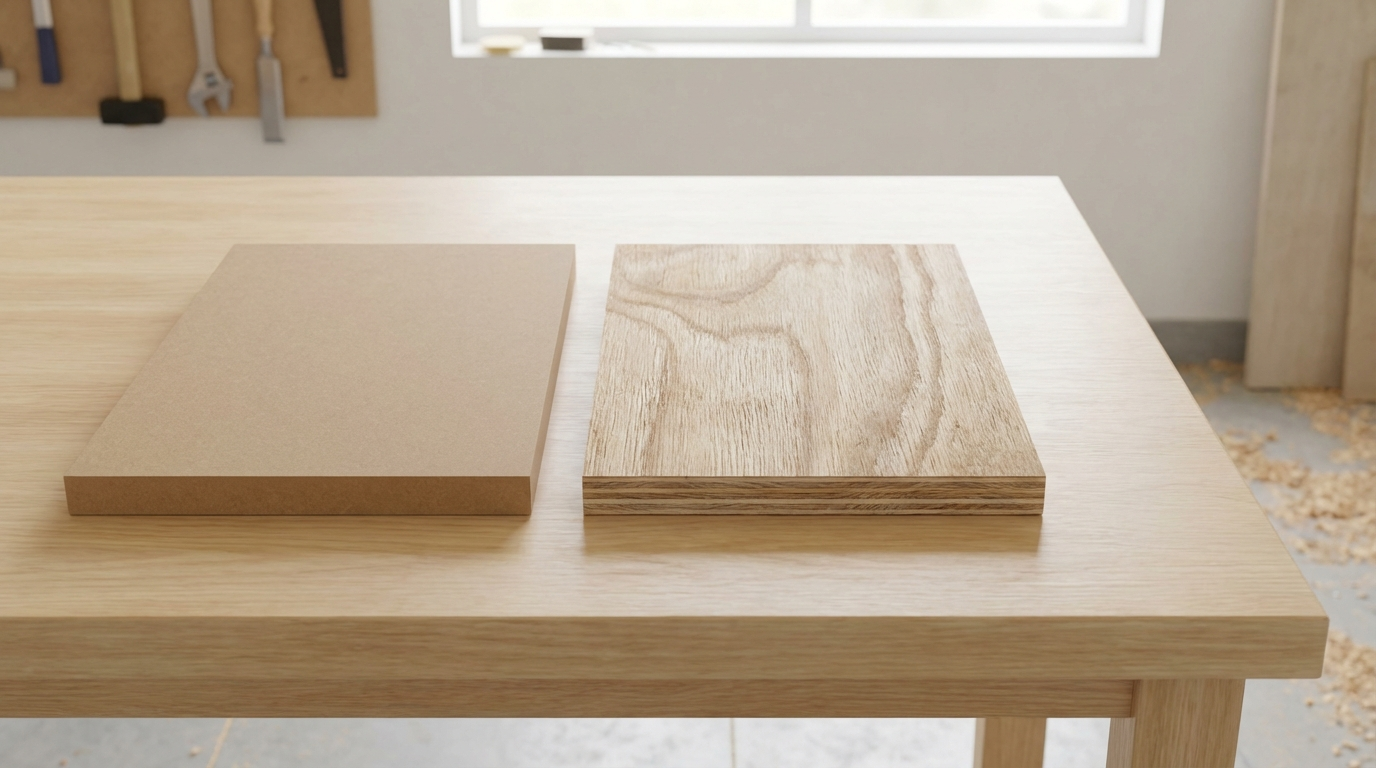
MDF (Medium Density Fiberboard) is an engineered wood product made by breaking down hardwood and softwood residuals into fine fibers, combining them with wax and resin binders, and forming panels under high temperature and pressure. The result is a dense, uniform board with no visible wood grain.
The manufacturing process creates a homogeneous material where every part of the board has identical properties. This uniformity is MDF's greatest strength for furniture applications—there are no knots, grain variations, or weak spots that could affect the final finish.
In India, MDF is manufactured by major brands and is widely available in standard 8x4 feet sheets. Thickness options typically range from 2.5mm to 30mm, with 18mm being most common for furniture carcasses and 12mm for back panels and lighter applications.
Types of MDF Available in India
- Plain MDF: Standard interior-grade board for dry applications
- Pre-laminated MDF: Factory-finished with decorative surfaces, ready to use
- Moisture Resistant MDF (MR Grade): Treated for better humidity tolerance
- HDHMR (High Density High Moisture Resistant): Premium grade for kitchen and bathroom applications
- Fire Retardant MDF: Treated for fire resistance in commercial applications
- CARB P2 Certified MDF: Low formaldehyde emission boards for health-conscious buyers
What is Solid Wood?
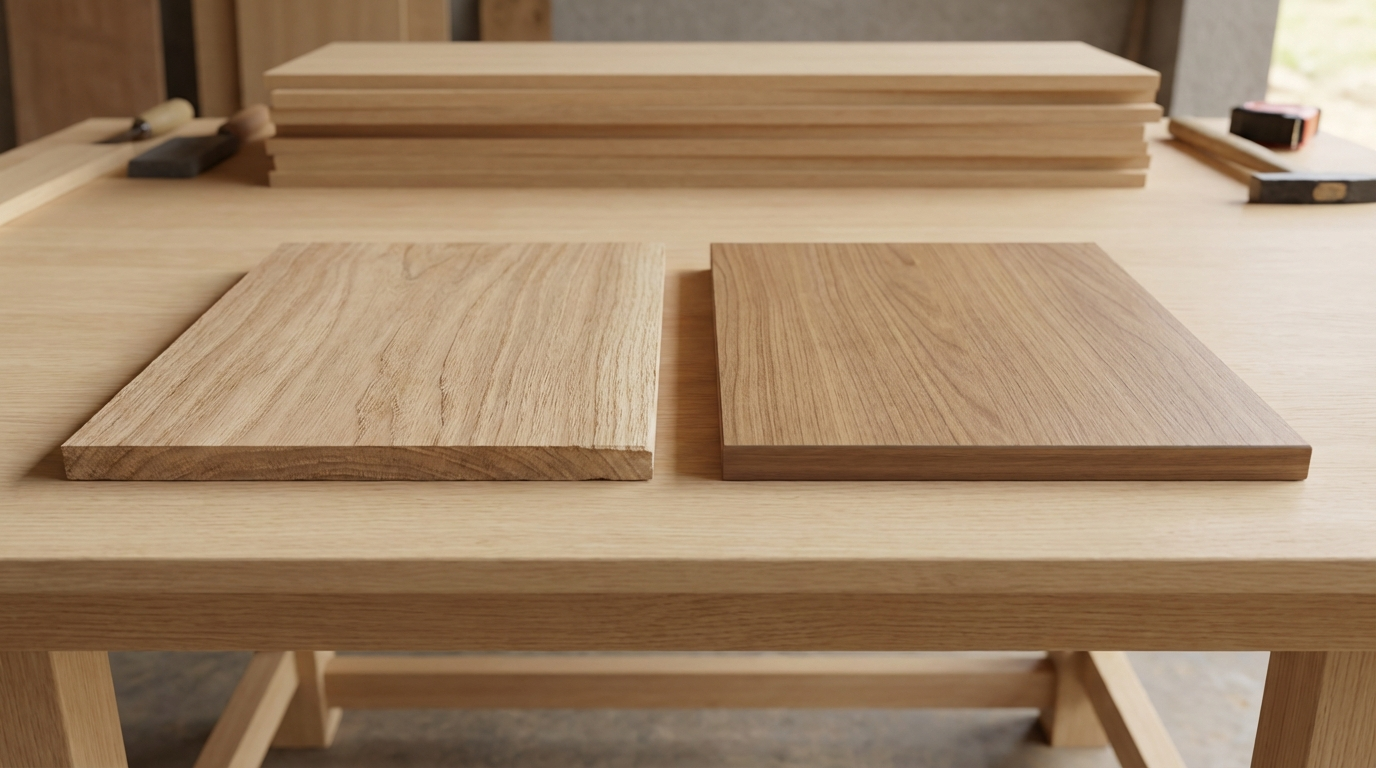
Solid wood refers to lumber cut directly from trees and processed into planks or boards, retaining the natural cellular structure, grain patterns, and characteristics of the original tree species. Unlike engineered products, solid wood is entirely natural with no synthetic binders or adhesives in the material itself.
Each piece of solid wood is unique, displaying the growth rings, grain patterns, and natural variations that developed over decades of tree growth. This natural beauty is why solid wood commands premium prices and remains the preferred choice for high-end furniture.
In India, commonly used solid woods include teak (sagwan), sheesham (Indian rosewood), mango wood, rubber wood, sal, deodar, and various imported species. The choice of species dramatically affects durability, appearance, workability, and cost.
Popular Solid Wood Types in Indian Furniture
| Wood Type | Characteristics | Best Applications | Price Range (per cu ft) |
|---|---|---|---|
| Teak (Sagwan) | Extremely durable, natural oils, termite resistant | Main doors, outdoor furniture, bed frames | ₹3,000-6,000 |
| Sheesham (Rosewood) | Beautiful grain, very hard, heavy | Dining tables, display units, carved furniture | ₹2,000-4,000 |
| Mango Wood | Sustainable, moderate hardness, attractive grain | Casual furniture, shelving, decorative pieces | ₹800-1,500 |
| Rubber Wood | Eco-friendly, light color, easy to work | Budget furniture, children's furniture | ₹600-1,200 |
| Sal Wood | Very hard, durable, heavy | Structural applications, doors, windows | ₹1,500-2,500 |
Detailed Comparison
Moisture and Water Resistance
Standard MDF absorbs moisture rapidly and swells irreversibly, making it unsuitable for humid environments without proper treatment. When MDF absorbs water, the fibers expand and the board loses structural integrity permanently—it cannot be dried and restored to original condition.
Solid wood, while also affected by moisture, handles humidity changes far better. Wood expands and contracts with humidity cycles but returns to near-original dimensions when dried. Species like teak contain natural oils that provide inherent water resistance.
For Indian kitchens and bathrooms, standard MDF is not recommended. HDHMR (High Density High Moisture Resistant) boards perform better but still cannot match the moisture handling of teak or other naturally resistant woods. According to [dorbypanels.com](https://www.dorbypanels.com/en-countryregion/blogs/updates/mdf-vs-plywood-vs-particle-board-which-one-really-works-best-in-indian-homes), the tropical Indian climate requires careful consideration of moisture resistance when choosing materials.
Winner: Solid Wood — Natural wood handles moisture cycles better and can often be restored after water exposure, while MDF damage is typically permanent.
Strength and Durability
Solid wood outperforms MDF in structural strength by a significant margin, with hardwoods like teak being 3-4 times stronger than standard MDF in bending and impact resistance.
MDF's weakness becomes apparent at edges and in screw-holding capacity. The dense but uniform fiber structure doesn't grip fasteners well, and edges are prone to crumbling under impact. Heavy shelves in MDF bookcases often sag over time, and door hinges may loosen.
Solid wood's natural grain structure provides excellent fastener holding and edge durability. A well-made solid wood piece can last generations—many Indian families possess teak furniture that has served three or four generations with minimal maintenance.
Winner: Solid Wood — Superior structural strength, better screw retention, and dramatically longer lifespan make solid wood the clear choice for durability.
Surface Quality and Finishing
MDF's perfectly smooth, grain-free surface makes it the superior choice for painted finishes, requiring minimal preparation to achieve a flawless result.
For paint applications, MDF cannot be beaten. There's no grain to telegraph through the paint, no filler needed for knots, and the uniform surface ensures consistent color absorption. This is why most modular kitchen manufacturers prefer MDF or pre-laminated MDF for their products.
However, MDF cannot be stained to show natural wood beauty—there's no grain to enhance. If you want the warmth and character of natural wood showing through a clear or stained finish, solid wood is the only option. As noted by [spoken.io](https://www.spoken.io/blog/mdf-vs-real-wood-making-the-right-choice-for-your-home), wood showcases unique grain patterns and colors that MDF simply cannot replicate.
Winner: MDF for painted finishes; Solid Wood for stained or natural finishes — The application determines the winner in this category.
Working and Machining
MDF machines beautifully with power tools, allowing intricate CNC-cut designs, detailed routing, and sharp profiles impossible to achieve consistently with solid wood.
MDF's uniform density means cutters don't encounter varying resistance from grain direction or density changes. This makes it ideal for decorative wall panels, intricate cabinet door designs, and detailed moldings that would be extremely expensive in solid wood.
Solid wood requires more skill to work with. Grain direction affects cutting, and different species behave differently. However, experienced carpenters can create hand-carved details and joinery that showcase craftsmanship in ways mass-produced MDF furniture cannot match.
Winner: MDF for machine precision; Solid Wood for artisanal craftsmanship — Modern Indian furniture production favors MDF's consistency, while traditional craftwork celebrates solid wood.
Cost Comparison
MDF costs approximately 60-80% less than equivalent solid hardwood, making it the go-to material for budget-conscious furniture projects in India.
A typical 18mm MDF sheet (8x4 feet) costs ₹2,500-4,500 depending on grade and brand. The same coverage in solid teak would cost ₹15,000-25,000 or more. Even budget solid woods like rubber wood cost 2-3 times more than MDF.
However, the total project cost calculation should include lifespan. A ₹50,000 MDF wardrobe lasting 12 years works out to ₹4,167 per year. A ₹150,000 solid wood wardrobe lasting 40+ years costs ₹3,750 per year—actually cheaper in the long run. As highlighted by [sylvanply.com](https://sylvanply.com/public/blog_details/mdf-vs-plywood-india), while MDF is generally more affordable, high-quality solid wood is an investment that lasts longer.
| Item | MDF Cost Estimate | Solid Wood Cost Estimate |
|---|---|---|
| Full Kitchen (Modular) | ₹1.5-3.5 lakhs | ₹4-10 lakhs |
| 6-Door Wardrobe | ₹45,000-80,000 | ₹1.5-3 lakhs |
| Queen Bed Frame | ₹25,000-45,000 | ₹60,000-1.5 lakhs |
| Dining Table (6-seater) | ₹20,000-40,000 | ₹50,000-1.5 lakhs |
| TV Unit (Wall-mounted) | ₹15,000-35,000 | ₹40,000-80,000 |
Winner: MDF for upfront cost; Solid Wood for long-term value — Budget determines the winner, but total cost of ownership often favors solid wood.
Application-Based Recommendations
Duroboil.com recommends choosing your material based on the specific application rather than making a blanket decision for all furniture:
| Application | Better Option | Why | Caution |
|---|---|---|---|
| Modular Kitchen Cabinets | HDHMR/MDF | Cost-effective, consistent finish, easy lamination | Use HDHMR near sink, never standard MDF |
| Wardrobe Carcass | MDF | Budget-friendly, smooth for laminate, no warping | Consider plywood for heavy loads |
| Dining Table Top | Solid Wood | Withstands daily use, can be refinished, prestige | Ensure proper seasoning |
| Bed Frame | Solid Wood | Structural strength, joint durability, longevity | Check for termite treatment |
| TV Unit | MDF | Easy CNC detailing, budget-friendly, modern look | Ensure proper wall mounting support |
| Study Table | Either | Depends on budget and aesthetic preference | MDF edges need sealing |
| Main Door | Solid Wood | Security, durability, weather resistance | Teak or sal recommended |
| Interior Doors | MDF Core | Cost-effective, stable, paintable | Not for bathroom doors |
| Bathroom Vanity | Solid Wood (Teak) | Natural moisture resistance | MDF will fail in humid bathrooms |
| Decorative Wall Panels | MDF | Easy CNC cutting, consistent patterns | Keep away from water sources |
| Bookshelves (Heavy Books) | Solid Wood | Better load-bearing, no sagging | MDF shelves need closer supports |
| Children's Furniture | Either | MDF for budget, wood for durability | Check CARB P2 certification for MDF |
India-Specific Considerations
India's diverse climate zones and unique household conditions require careful material selection that generic international advice often overlooks.
Monsoon and Humidity Impact
During Indian monsoons, relative humidity often exceeds 85% for weeks at a stretch in coastal and eastern regions. Standard MDF can absorb moisture from the air itself, leading to swelling and edge deterioration even without direct water contact. Solid wood performs better but may show expansion—allow 2-3mm gaps in solid wood installations for seasonal movement.
Termite Considerations
Termites affect both materials differently. MDF's resin content provides some protection, and most quality MDF in India comes pre-treated. Solid wood varies dramatically—teak is naturally termite-resistant while rubber wood and mango wood are highly susceptible without treatment. Always verify termite treatment regardless of material choice.
Regional Availability
MDF is consistently available across India through organized retail and brand dealer networks. Solid wood availability varies—teak is easier to find in Maharashtra and Karnataka, sheesham in North India, and rubber wood in South India. Import woods are primarily available in metro cities.
Carpenter Skill Levels
Local carpenters in smaller towns are often more experienced with solid wood than with MDF. MDF requires different techniques—specialized cutters, edge banding machines, and proper sealing. If working with village carpenters, solid wood might actually yield better results despite being more technically demanding.
Common Myths Busted
Myth 1: "MDF is just cheap, low-quality material"
Reality: Quality MDF from reputable manufacturers is a precision-engineered product. It's chosen for high-end applications like speaker cabinets specifically because of its consistent density and acoustic properties. The key is selecting the right grade for your application.
Myth 2: "Solid wood always means better quality"
Reality: Poorly seasoned or low-grade solid wood will crack, warp, and fail faster than quality MDF. The species, seasoning, and source matter enormously. Cheap "solid wood" furniture from unknown sources often performs worse than quality MDF alternatives.
Myth 3: "MDF contains dangerous chemicals"
Reality: While MDF does contain formaldehyde-based resins, modern CARB P2 and E1 certified boards have emissions well within safe limits. Once sealed with laminate or paint, emissions are negligible. According to [greenply.com](https://www.greenply.com/blogs/mdf-board-everything-you-need-to-know-before-buying), CARB P2 certified MDF offers low formaldehyde emission levels suitable for residential use.
Myth 4: "Solid wood furniture is maintenance-free"
Reality: Solid wood requires regular oiling, polishing, and protection from moisture and sunlight. Neglected solid wood furniture will crack, lose finish, and deteriorate. MDF furniture with laminate finish actually requires less ongoing maintenance.
Myth 5: "You can waterproof MDF with paint"
Reality: Paint provides a moisture barrier but doesn't make MDF waterproof. Any chip or scratch allows moisture entry, and the edges remain vulnerable. For wet areas, even painted MDF is not a reliable long-term solution.
Using Both Together
Smart furniture design often combines MDF and solid wood to optimize cost, performance, and aesthetics. This hybrid approach is increasingly common in quality Indian furniture manufacturing.
Effective Combination Strategies
- Solid wood frame + MDF panels: Use solid wood for structural frames (which need screw-holding strength) and MDF for large panels (which need stability and paint-ability)
- Solid wood legs + MDF tops: Dining tables with solid wood legs and laminated MDF tops offer durability where needed and cost savings on large surfaces
- MDF carcass + solid wood doors: Wardrobes with MDF boxes and solid wood or veneer doors combine economy with premium appearance
- Solid wood edges + MDF centers: Solid wood edge banding on MDF panels provides impact resistance where it matters most
Cost Optimization Example
A 6x4 feet wardrobe using 100% solid sheesham might cost ₹2.5 lakhs. The same design using MDF carcass with solid sheesham doors and drawer fronts might cost ₹1.2 lakhs—saving 50% while maintaining the premium visible appearance.
Quality Verification Tips
How to Check MDF Quality
- Density test: Quality MDF feels heavy and solid; lightweight MDF is low density and weak
- Edge inspection: Check cut edges for uniform color and density throughout thickness
- Surface smoothness: Run your hand across the surface; quality MDF should feel perfectly smooth
- Brand verification: Buy from authorized dealers and check for ISI marking or brand certification
- Grade confirmation: Ensure you're getting the grade you paid for (plain, MR, HDHMR)
How to Check Solid Wood Quality
- Seasoning check: Tap the wood—well-seasoned wood produces a clear ringing sound; wet wood sounds dull
- Weight assessment: Each species has characteristic weight; unusually light wood may indicate poor quality or different species
- Grain inspection: Look for straight, consistent grain; too many knots indicate lower grade
- Moisture meter: Request moisture content check; properly seasoned wood should be 8-12% moisture
- Source verification: Ask about wood origin; prefer plantation wood over forest wood for ethical sourcing
Maintenance Guidelines
MDF Furniture Care
- Wipe spills immediately—never let water sit on MDF surfaces
- Use coasters and placemats to prevent moisture rings
- Clean with slightly damp cloth, then dry immediately
- Avoid placing MDF furniture in direct sunlight (laminate may peel)
- Check edges periodically for peeling or swelling
- Re-seal any chips or scratches promptly to prevent moisture entry
Solid Wood Furniture Care
- Dust regularly with soft, dry cloth
- Apply furniture polish or oil every 3-6 months
- Keep away from direct sunlight to prevent fading
- Maintain consistent room humidity if possible
- Address scratches with matching wood polish or wax
- Refinish every 5-10 years for high-use pieces
Frequently Asked Questions
Is MDF stronger than solid wood?
No, solid wood is significantly stronger than MDF in structural applications. MDF's uniform density provides stability against warping but offers poor screw-holding capacity and impact resistance compared to solid hardwoods. For load-bearing applications like bed frames, shelving supports, or door frames, solid wood is the superior choice. MDF's strength lies in its consistency and resistance to warping, not in structural load-bearing capacity.
Can MDF be used in Indian kitchens?
Standard MDF should not be used in Indian kitchens due to moisture from cooking, washing, and monsoon humidity. However, HDHMR (High Density High Moisture Resistant) boards are specifically designed for kitchen applications and perform well when properly installed. Even with HDHMR, areas near sinks should have additional waterproofing, and all edges must be properly sealed. For areas with direct water exposure, marine plywood or WPC boards are safer choices.
How long does MDF furniture last compared to solid wood?
Well-maintained MDF furniture typically lasts 8-15 years in Indian conditions, while quality solid wood furniture can last 25-100+ years with proper care. The lifespan difference is most noticeable in high-use items like dining tables and bed frames. MDF degradation is usually irreversible (swelling, edge deterioration), while solid wood can often be repaired and refinished multiple times, extending its useful life significantly.
Why do modular kitchen companies use MDF instead of solid wood?
Modular kitchen manufacturers prefer MDF for several practical reasons: consistent dimensions allow precise factory manufacturing, smooth surfaces take laminate and paint perfectly, it doesn't warp like solid wood in large panels, and it's significantly more cost-effective. The key is using appropriate grades—quality manufacturers use HDHMR or moisture-resistant MDF for kitchen carcasses, not standard interior-grade MDF.
Is MDF furniture safe for health?
Modern MDF with CARB P2 or E1 certification has formaldehyde emissions well within safe limits established by international health standards. Once sealed with laminate, veneer, or paint, emissions are negligible in normal use. Concerns are more relevant during manufacturing and cutting (use proper ventilation) than in finished furniture. For extra caution, especially in children's rooms, look specifically for "zero emission" or CARB P2 certified MDF products.
Can MDF be repaired if damaged?
MDF is difficult to repair compared to solid wood. Small surface scratches can be filled and touched up, but structural damage, water swelling, or edge deterioration typically cannot be fully restored. Once MDF absorbs moisture and swells, the damage is permanent—the board cannot be dried back to original dimensions. This is a significant disadvantage compared to solid wood, which can often be sanded, refinished, and restored even after significant damage.
Which is better for wardrobes: MDF or solid wood?
For wardrobe carcasses (the box structure), MDF or plywood is actually preferred over solid wood because large solid wood panels tend to warp over time. For wardrobe doors and visible surfaces, solid wood or quality veneer provides better aesthetics and durability. The ideal wardrobe combines MDF/plywood carcass with solid wood or veneered doors—this offers the best balance of stability, durability, and appearance at a reasonable cost.
Does solid wood furniture add more resale value to homes?
Yes, solid wood furniture, especially in premium species like teak and sheesham, adds significantly to perceived home value. Quality solid wood pieces are often listed separately in home sales and can appreciate over time if well-maintained. MDF furniture is generally not considered an asset and may actually need replacement before resale. For rental properties, MDF's lower cost may be more practical, but for owned homes, solid wood is the better long-term investment.
How can I tell if furniture is MDF or solid wood?
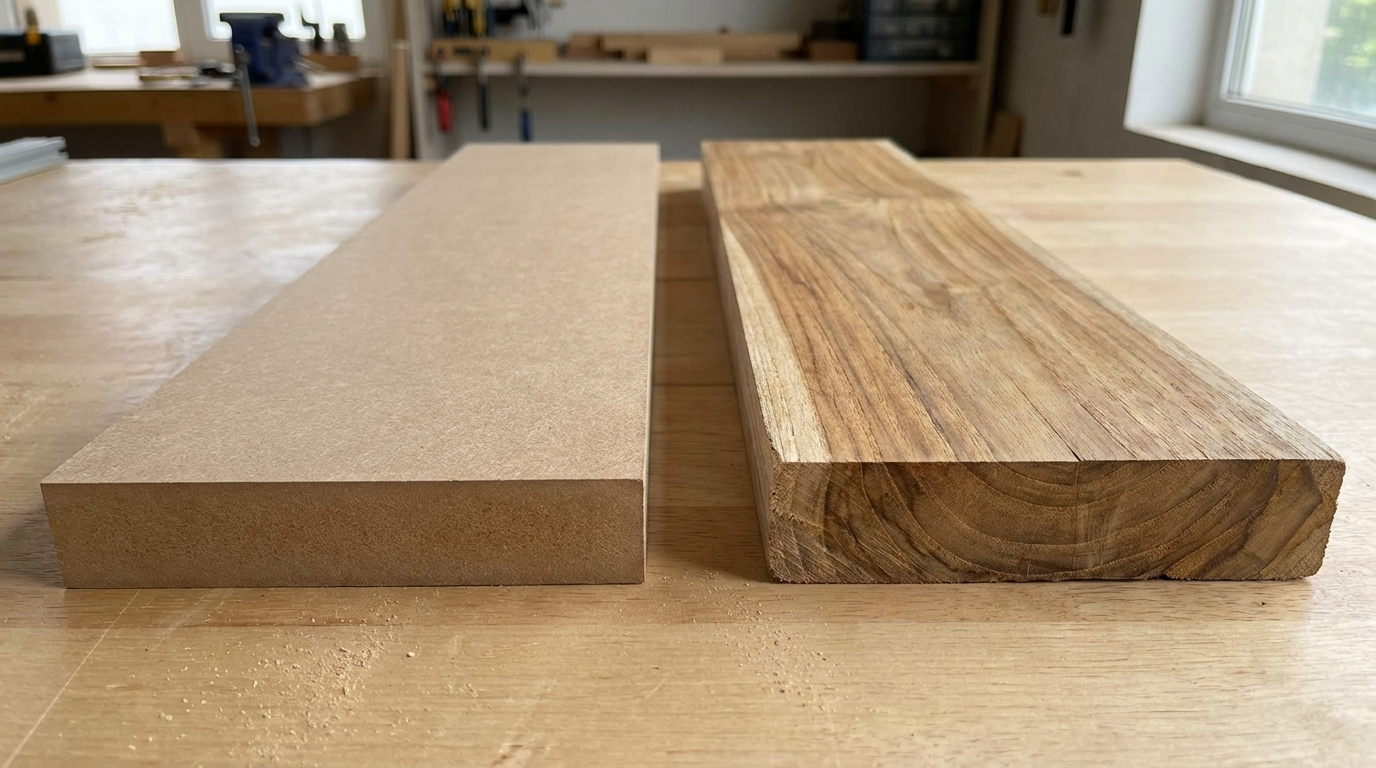
Check the edges and undersides—solid wood shows grain patterns continuing through the material, while MDF has a uniform, brownish cross-section with no visible grain. Weight is another indicator; solid wood furniture is often lighter than MDF of similar size (MDF is surprisingly heavy). Sound also differs—knock on the surface; solid wood produces a resonant sound while MDF sounds more muted and dull. Finally, MDF furniture usually has laminate or paint covering all surfaces, while solid wood may have clear finishes showing natural grain.
What should I choose for bedroom furniture in humid coastal areas?
In coastal areas with year-round high humidity, solid teak is the gold standard for bedroom furniture. Its natural oils provide excellent moisture resistance without relying on chemical treatments. If budget is constrained, rubber wood with proper treatment or HDHMR with quality laminate are alternatives. Standard MDF should be avoided in coastal areas—even "moisture resistant" grades may not withstand 80-90% humidity experienced during monsoons. Ensure proper ventilation in bedrooms and use silica gel or dehumidifiers during peak monsoon months regardless of furniture material.
Note: This is independent editorial content. Duroboil.com is not affiliated with any specific MDF or solid wood brand. All prices and specifications mentioned are approximate ranges based on market research and may vary by location, dealer, and time of purchase. Always verify specifications with authorized dealers before making purchase decisions.
Disclaimer: This content is provided for general informational purposes based on industry practices and publicly available information. Product specifications, standards, prices, and availability may vary by manufacturer, region, and time. Readers should independently verify details with manufacturers, dealers, or qualified professionals before making purchase or construction decisions.
Want Plywood Suggestions?
Share a few details and a Duro BOIL specialist will suggest suitable brands and connect you to responsive dealers.