Moisture content in plywood/MDF: why it matters in India
Learn moisture content plywood mdf in simple terms with examples, verification tips, and a quick checklist so you choose the right board for Indian conditions.
Quick Decision Summary
Target plywood or MDF with 8-12% moisture content to minimize swelling and delamination risks in India's variable humidity.
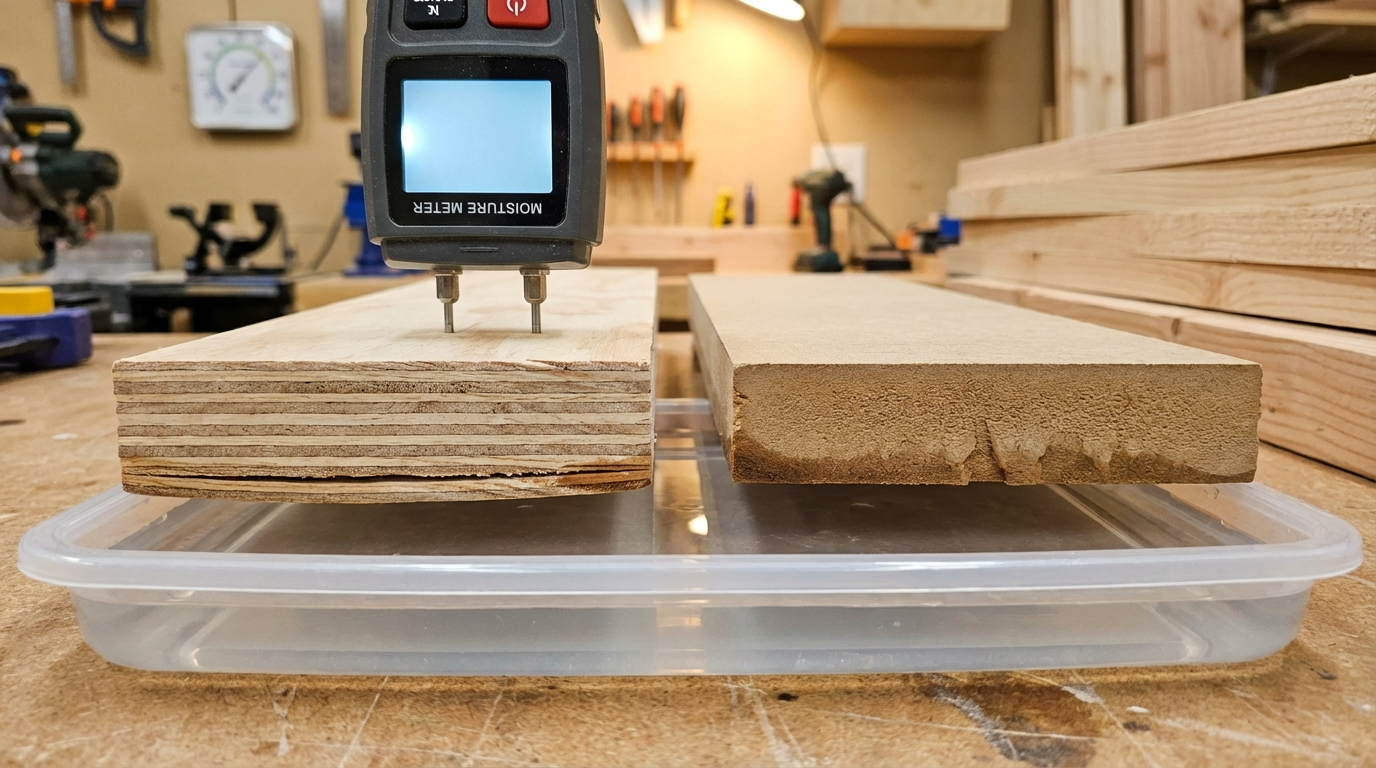
If you're in a hurry: Moisture content measures water trapped in wood fibers during manufacturing. Too high (above 14%) causes expansion in monsoons, leading to warped doors or peeling laminates. Too low (under 6%) risks cracking in dry AC rooms. Always verify with a pinless meter at purchase—reject anything over 12% for humid areas. Pair with moisture-resistant grades like BWR for kitchens or bathrooms. Store flat, off-ground, under cover until installation.
- Choose 8-12% if: interior walls, coastal cities, monsoon-prone regions, or laminate finishes.
- Avoid above 14% if: high-humidity zones, flush doors, or tight carpentry fits.
What Moisture Content Actually Means in Plywood and MDF
Moisture content is the percentage of water by weight in the board's wood layers or fibers. Plywood builds it from veneers glued under heat and pressure; MDF presses wood particles with resins. Factories dry wood to a stable level before bonding—ideally matching local climate equilibrium.
Where people get confused: Many think "dry" means zero water (it doesn't—wood naturally holds 8-12%). Others assume sealed packaging keeps it perfect forever (humidity seeps in). Some mix it with "waterproof rating" (that's glue line strength, not initial dryness). Bulk storage myths ignore stacking pressure causing migration. And visual "feel" tests fail—boards feel dry but meter 18% inside.
What is acceptable moisture content for plywood in India?
Typically 8-12% suits most interiors, balancing stability without brittleness. Coastal or monsoon areas lean toward 8-10% to buffer high ambient humidity (70-90%). Interior dry zones allow up to 12%. This range prevents dimensional changes over 1-2% during seasonal shifts. Nuance: Particleboards like MDF tolerate slightly higher (10-14%) due to denser structure, but verify against your site's average RH. Next step: Rent a digital moisture meter (₹500/day locally) and test multiple sheets—average three readings per board.
Why does moisture content differ between plywood and MDF?
Plywood's layered veneers dry unevenly if cores are damp, hitting 10-14% post-pressing. MDF's uniform fibers absorb resins better, stabilizing at 8-12%, but swells more if exposed early. Plywood handles minor fluctuations via cross-grains; MDF expands isotropically. In India, both start similar but plywood edges win in wet zones. Check: Tap test—dull thud signals high MC in MDF cores. Practical move: Prioritize calibrated plywood for furniture; HDHMR variant for MDF in kitchens.
India-Specific Reality Check
Monsoons push indoor RH to 85%+, pulling moisture into boards—8% MC swells 20% more than equilibrium-dried stock. Coastal salt air accelerates mold on damp cores. Godowns stack sheets wet-side-up, migrating water downward. Contractor sites leave cut edges exposed overnight. AC villas drop RH to 40%, cracking low-MC boards. Workmanship skips edge-sealing, amplifying risks.
How does monsoon humidity affect plywood moisture content?
Ambient 80% RH equalizes boards to 15-18% MC in weeks, causing 2-4mm swelling per 18mm sheet. Glue lines soften, risking delam in 6-12 months. Coastal variants worsen with salt crystals. Nuance: BWP grades resist better but costlier; MR fails faster unsealed. Prevention: Acclimatize indoors 48 hours pre-cut, seal edges with putty. Test post-monsoon: Measure door gaps—if over 2mm wider, MC spiked.
How to Choose in 5 Steps
- Assess site conditions: Coastal? Monsoon belt? AC-heavy? Map RH averages (apps show local data).
- Match board type: Plywood for strength; MDF for smooth paint. BWR/BWP over MR for wet zones.
- Meter on-site: Pinless meter across face/core/edge—reject >12% or >2% variance.
- Check storage: Flat stacks, no ground contact, recent delivery (under 2 weeks).
- Test sample: Wet a scrap overnight; minimal warp (<1mm) passes.
Skip steps? Expect callbacks for bulging cabinets or sticky drawers.
Can you check moisture content without a meter?
Basic checks: Weight a sheet (heavier signals damp); tap for resonance (dull = wet core); check for surface tackiness or musty smell. Cut a sample—soggy sawdust inside fails. Limitations: Misses 2-3% variances. In India godowns, insist on supplier meter demo. Next: Buy your own (calibrate weekly). Combine with glue-line test: Press nails into edge; easy push = weak bond from high MC.
Decision Framework: Match Conditions to Moisture Choices
| Site Condition | Target MC Range | Board Type + Verify |
|---|---|---|
| Coastal/high monsoon (RH 75%+) | 6-10% | BWP plywood or HDHMR; meter <2% variance, edge-seal ready |
| Urban interiors (RH 50-70%) | 8-12% | BWR plywood/MDF; flat storage, no core gaps |
| AC villas (RH <45%) | 10-14% | MR grade; test for cracking post-install |
| Heavy use kitchens | 8-10% | Moisture-resistant; laminate face, sealed edges |
| Tight budget/dry zones | 10-12% | Standard MR; recent batch, visual dry |
| Fast project timelines | 8-12% | Pre-acclimatized stock; supplier guarantees meter pass |
Trade-offs and Limitations
- Lower MC (6-8%) resists swelling but cracks easier in dry spells—ideal coastal, risky deserts.
- Higher MC (12-14%) cheaper/easier to source but demands perfect sealing.
- MDF smoother for paint but swells 1.5x plywood if MC spikes.
- Premium low-MC boards add 15-25% cost for marginal gains in mild climates.
- All boards equilibrate eventually—focus on grades over MC alone.
Does low moisture content make plywood stronger?
Not directly—strength ties to glue/resin quality, but low MC prevents hydrolysis weakening bonds over time. Boards under 8% feel rigid but splinter if over-dried. In India AC homes, 10%+ avoids splits. Trade-off: Factory low-MC needs humid storage en route. Verify: Flex test a sample—minimal sag good. Step: Spec "factory-dried to 8-12%" in orders.
Common Buyer Mistakes and How to Avoid Them
- Mistake: Buying by "feel"—boards seem dry but hold 16% inside. Avoid: Always meter; train carpenters.
- Mistake: Ignoring storage—godown floor stacks wick ground moisture. Avoid: Inspect pallets; demand covered delivery.
- Mistake: No acclimatization—cut/install direct from truck. Avoid: 72 hours indoors first.
- Mistake: Skipping edge-seal on MDF. Avoid: Prime all cuts Day 1.
- Mistake: Coastal use of MR grade. Avoid: Upgrade to BWR min.
- Mistake: Bulk buy old stock. Avoid: Check manufacture date (<3 months).
- Mistake: No post-install checks. Avoid: Measure gaps monthly first year.
- Mistake: Assuming laminate blocks moisture. Avoid: Seal substrate edges too.
Failure Modes and Fixes
- Symptom: Bulging face veneer. Cause: MC >15% pre-install. Prevent: Meter + BWR. Fix: Sand, re-laminate.
- Symptom: Delamination layers. Cause: Core MC migration. Prevent: Seal edges. Fix: Clamp, epoxy reglue.
- Symptom: Warped doors. Cause: Uneven MC + humidity. Prevent: Balance both sides. Fix: Plane edges, rehang.
- Symptom: Mold spots. Cause: >18% MC sustained. Prevent: Ventilate storage. Fix: Sand out, antifungal primer.
- Symptom: Cracked paint. Cause: MC drop >5%. Prevent: Acclimate. Fix: Fill, repaint.
- Symptom: Loose screws. Cause: Swollen fibers. Prevent: Pilot holes. Fix: Epoxy + redrill.
Quality Checks You Can Do Without Lab Tests
Before buying: Meter face/back/core; uniform color, no soft spots; recent batch stamp.
After cutting: Sawdust dryness; edge straightness; no steam smell.
After install: Door swing smooth; no gap changes post-rain; tap test resonance.
Red flags: Weight variance >5% in stack, surface sweat in AC, carpenter complaints on nailing.
How do you measure moisture content accurately?
Use pinless meter (₹1,500-3,000)—scan 10cm grid, average. Calibrate on dry wood daily. Avoid pins (damage surface). India tip: Test in godown shade, not sun. Nuance: MDF needs deeper probe mode. Step: Reject if edge 3%+ higher than face. Track site history for repeat buys.
Tips for Homeowners
- Do: Wipe spills instantly, use exhaust fans, check cabinets seasonally.
- Don't: Store cleaners inside, ignore monsoon leaks, overload shelves.
- Budget extra 10% for sealing materials.
- Cut in dry zone; tape edges immediately; acclimate 48hrs.
- Use coarse screws in wet areas; avoid over-sanding faces.
- Flag high-MC to client early.
- Spec "MC 8-12% verified"; detail edge returns in wet zones.
- Layer with membranes; ventilate designs.
- Include acclimatization clause in BOQ.
Tips for Carpenters
Tips for Architects
FAQs
Is 14% moisture content safe for plywood?
Often marginal for dry interiors but risky in humid India—expect minor swelling during rains. Better for temporary partitions. Nuance: Pair with strong glue lines and sealing. Verify: Wet test scrap; under 1.5mm swell passes. Long-term, equilibrates but weakens bonds faster. Homeowners note: Monitor first monsoon. Contractors: Avoid for fitted furniture; opt lower for callbacks.
Why does MDF swell more than plywood?
Denser fibers absorb water uniformly, expanding 15-20% vs plywood's cross-grain restraint (8-10%). High MC accelerates. India reality: Kitchen sinks hit MDF hard. Prevent: HDHMR variant, full sealing. If swelling starts, dry room + fans recover mild cases. Architects spec plywood frames inside MDF for hybrids.
How long to acclimatize plywood in India?
48-72 hours in install room—matches RH, cuts post-fit issues 70%. Skip in dry zones. Stack vertical if space tight. Nuance: Coastal needs extra day. Check: Remeter post-acclimation. Carpenters: Log readings for disputes.
Does moisture content affect price?
Indirectly—low-MC premium grades (BWR/BWP) cost 20-40% more due to drying processes. Standard MR cheaper but higher risk. Varies by thickness/city. Quote tip: Specify MC + grade. Bulk buys average down.
Can high moisture content be fixed post-purchase?
Partially—dry in ventilated space 1-2 weeks, but uneven drying warps. Seal before. Severe: Discard cores. Prevention trumps. Homeowners: Ventilation over dehumidifiers.
What MC for marine plywood?
Typically 6-10%—extra drying for boil-proof glue. Overkill dry interiors. Verify: Boil test scrap (no delam). Coastal must-have.
Does packaging preserve low moisture?
Short-term (2-4 weeks); plastic tears expose. India transport humidity penetrates. Open stacks only. Check seals on arrival.
Is moisture content same as water resistance?
No—MC is initial dryness; resistance is glue/finish endurance. Low MC + poor glue fails fast. Test both.
How does temperature affect plywood moisture?
Hot-dry shrinks (cracks); humid-heat swells. India swings demand buffer MC. Store 20-30°C.
Disclaimer: This content is provided for general informational purposes based on industry practices and publicly available information. Product specifications, standards, prices, and availability may vary by manufacturer, region, and time. Readers should independently verify details with manufacturers, dealers, or qualified professionals before making purchase or construction decisions.Want Plywood Suggestions?
Share a few details and a Duro BOIL specialist will suggest suitable brands and connect you to responsive dealers.