MR plywood vs BWR plywood: where each fails
MR plywood vs BWR plywood: where each fails with a clear decision table on grade, thickness, moisture performance, warranty and price factors. Made for Indian
Quick Decision Summary
MR suits fully dry interiors on tight budgets; BWR handles humidity better but costs more and still fails under prolonged wetness.
If you’re in a hurry: Pick MR plywood for bedrooms, wardrobes, or false ceilings where moisture stays below 20-25%—it’s lighter on the wallet but delaminates fast in humid spots. Switch to BWR for kitchens, bathrooms, or coastal homes with monsoon exposure, as it resists boiling-level humidity without instant failure. Neither works for direct water submersion like shower walls; always verify glue line strength and core gaps on-site. Factor in thickness (6-18mm) and face veneer quality for your project—dry zones save 20-30% vs humid-rated options.
- Choose MR if: budget-limited, fully enclosed dry rooms, light furniture, quick carpentry jobs.
- Avoid MR if: kitchens/bathrooms, coastal/monsoon areas, heavy steam exposure.
- Choose BWR if: moderate humidity, cabinets near cooking zones, India’s humid belts.
- Avoid BWR if: direct water contact, ultra-tight budgets, or oversized sheets needing max strength.
What This Term/Material Actually Means
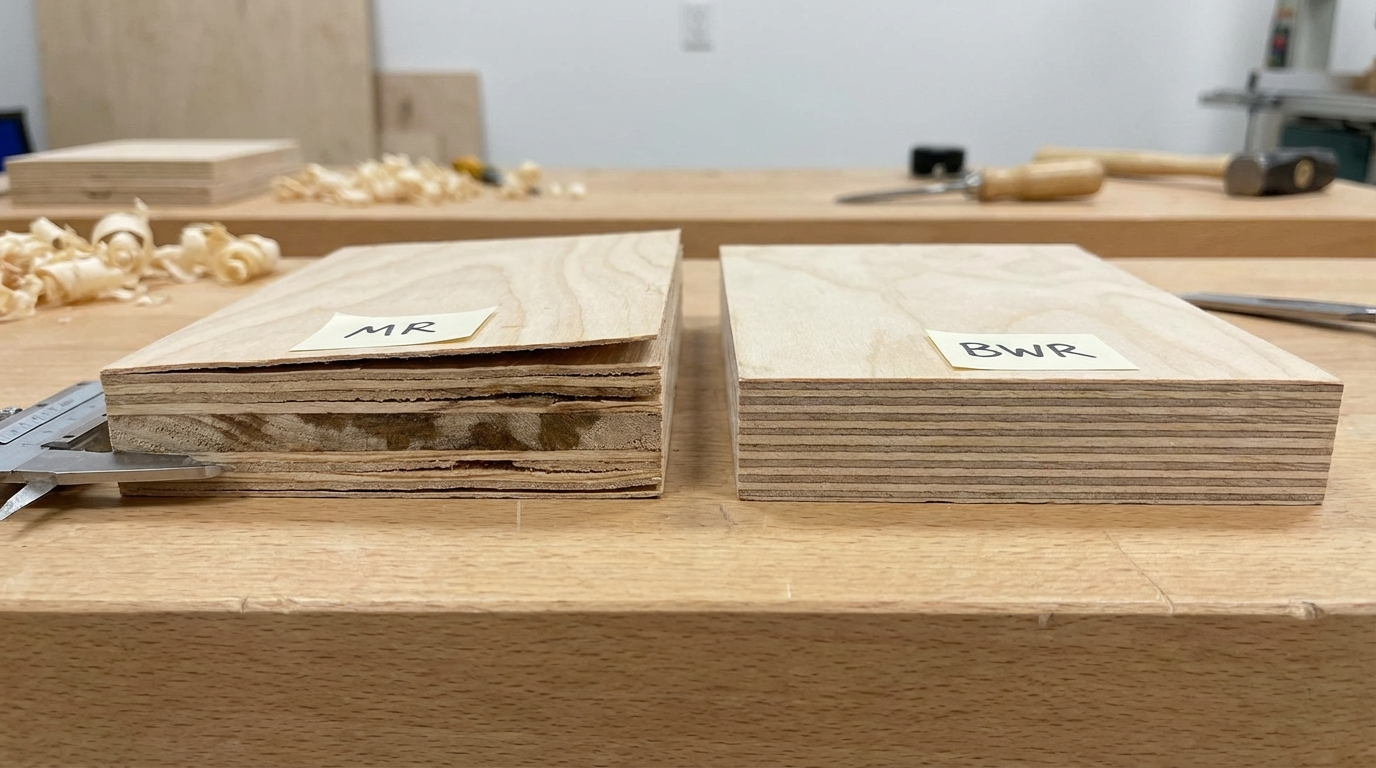
MR plywood uses moisture-resistant adhesives like urea-formaldehyde, designed for indoor dry conditions. It holds up in low-humidity environments but weakens when exposed to sustained dampness, leading to glue line separation.
BWR plywood employs boiling water-resistant glues, typically phenolic-based, for better performance in humid settings. It withstands short-term high moisture without immediate delamination but isn't fully waterproof.
Where People Get Confused on MR vs BWR
- Thinking MR means "some moisture OK anywhere"—it fails quickly in kitchens.
- Assuming BWR = waterproof like marine grade—it's not for immersion.
- Believing thickness alone fixes moisture issues—glue type dominates.
- Overlooking core material differences—MR often has more poplar, prone to gaps.
- Ignoring face/back veneer role—thin veneers crack first in humidity.
India-Specific Reality Check
In India's monsoon-heavy regions or coastal belts like Mumbai or Chennai, unacclimatized plywood absorbs ambient 70-90% humidity during storage, causing even BWR to swell if not sealed promptly. Contractors often stack sheets outdoors, accelerating MR failures via edge moisture wicking.
Workmanship realities amplify risks: poor edge taping lets steam from Indian cooking infiltrate cabinets. Hot-humid cycles in Bangalore or Kolkata test glue lines yearly—MR warps in 6-12 months there, while BWR lasts 2-3 years with care.
Does Monsoon Storage Ruin Both Grades?
Monsoon stacking without covers leads to core softening in MR within weeks, as urea glue hydrolyzes. BWR resists better but develops surface mold if ventilation lacks. Acclimatize 48-72 hours in install room, elevate stacks, and cover with tarps—reduces failure by 50% in humid India. Check edges for fuzziness pre-cut; reject if soft.
Two-Minute Comparison That Actually Helps
| Factor | MR Plywood | BWR Plywood |
|---|---|---|
| Moisture Tolerance | Low (dry interiors only) | Medium (humid zones OK) |
| Typical Use | Bedrooms, ceilings | Kitchens, bathrooms |
| Glue Strength | Urea-based, humidity-sensitive | Phenolic, boil-resistant |
| Weight/Handling | Lighter, easier for carpenters | Heavier, sturdier |
| Failure Trigger | Steam/humidity exposure | Prolonged immersion |
Use this for wet vs dry decisions: MR in air-conditioned spaces, BWR where doors open to balconies.
Price Range and Cost Drivers (India)
MR typically ranges lower due to basic glue—expect variations by city, with thinner 6mm sheets cheaper than 18mm. BWR adds 20-40% premium for resilient adhesives.
Cost drivers: thickness (6-25mm), core quality (hardwood vs poplar), face veneer thickness/grade, calibration flatness, regional logistics (North India lower than South), batch uniformity. Metro quotes fluctuate 10-15% yearly.
How to Ask for a Quote (Checklist)
- Specify grade (MR/BWR), thickness, sheet size (8x4 ft standard).
- Mention face/back veneer (0.6-1.2mm, teak/biru).
- Ask for calibrated/non-warped stock.
- Confirm local humidity adjustment.
- Request per sq ft landed cost + wastage allowance.
How to Choose in 5 Steps
- Assess room humidity: Dry (bedroom)? MR. Humid (kitchen)? BWR.
- Check project load: Light shelves? Either. Heavy cabinets? BWR.
- Inspect samples: Tap for glue echo, flex for core gaps.
- Match thickness to span: 12mm+ for spans over 2 ft.
- Plan sealing: Edges must be taped pre-install.
Skip steps 1-2, and moisture failures spike 3x in India homes.
Is BWR Always Better Than MR?
BWR outperforms MR in 80% of humid Indian uses but overkill—and costlier—for dry zones, wasting budget on unused resilience. Evaluate exposure first: if ambient RH stays under 50%, MR saves without risk. Verify by room steam test (kettle near sample overnight). Next, prioritize BWR only for zones with direct humidity paths like exhaust-lacking kitchens.
Decision Framework Table
| Condition | Recommended Grade | What to Verify |
|---|---|---|
| Dry bedroom/wardrobe | MR | Smooth face, no core gaps, light tap echo |
| Kitchen cabinets | BWR | Edge hardness, veneer adhesion post-flex |
| Coastal/monsoon home | BWR | Calibration flatness, batch humidity test |
| Tight budget project | MR (dry only) | Local quote vs 20% premium avoidance |
| Heavy steam (bath vanity) | BWR min | Glue line resistance via nail test |
| Fast delivery needed | MR (stocked more) | Availability in 6-12mm |
Trade-offs and Limitations
MR trades cost for moisture vulnerability—ideal dry but risky elsewhere. BWR offers durability at higher price/weight, limiting portability for small jobs. Both lack full waterproofing; pair with laminates/sealants for longevity.
Common Buyer Mistakes and How to Avoid Them
- Mistake: Using MR in kitchens—"it's cheap." Why: Steam delams. Fix: Humidity map rooms first.
- Mistake: Ignoring storage—"site is covered." Why: Monsoon leaks. Fix: Acclimatize 72 hrs.
- Mistake: Thinnest sheet for load-bearing. Why: Sags. Fix: Span-thickness chart.
- Mistake: No edge sealing. Why: Wicking fails grade. Fix: Tape all cuts.
- Mistake: Face-only focus. Why: Back delams unseen. Fix: Inspect both veneers.
- Mistake: Bulk buy without sample. Why: Batch variance. Fix: Test one sheet.
- Mistake: Skipping calibration check. Why: Uneven laminate. Fix: Ruler on edges.
- Mistake: Coastal MR use. Why: Salt humidity kills. Fix: BWR + ventilation.
Failure Modes and Fixes
- Symptom: Bubbling edges. Cause: Moisture ingress. Prevent: Seal cuts. If happening: Sand + epoxy refinish.
- Symptom: Delamination layers. Cause: Weak glue/humidity. Prevent: Grade match. If happening: Clamp + adhesive reglue.
- Symptom: Warping bow. Cause: Uneven drying. Prevent: Acclimatize. If happening: Wet opposite side to balance.
- Symptom: Core gaps cracking. Cause: Poor filling. Prevent: Tap test pre-buy. If happening: Filler + sand.
- Symptom: Veneer peel. Cause: Thin overlay. Prevent: 1mm+ check. If happening: Iron + glue.
- Symptom: Sagging shelves. Cause: Thin/unsupported. Prevent: 18mm+ spans. If happening: Add cleats.
Quality Checks You Can Do Without Lab Tests
Pre-buy: Tap sheet—hollow echo means gaps. Flex corner—cracks signal weak core. Check calibration with straightedge.
Post-cut: Nail glue zones—no splitting. Sand edges—smooth resistance good.
Post-install: Wipe moisture test— no swelling in 24 hrs.
Can You Spot Fake Grade Claims On-Site?
Grade faking happens via relabeling—test by soaking edge scrap 30 mins: MR softens fast, BWR stays firm. Ask for glue sample smear (sticky = urea). Next, compare weight: BWR denser. Red flag: unusually low price in humid cities.
For Homeowners: Durability Do’s and Don’ts
Do ventilate cabinets, wipe spills instantly, use SS hardware. Don’t direct hose-clean or store wet mops nearby—MR fails in months, BWR in years. Annual check edges for lift.
For Carpenters: Handling and Prep Tips
Cut with fine blade, tape edges immediately, fasten 6-8mm from edges. Hinge zones: pre-drill to avoid splits in humid stock.
For Architects: Spec and Detail Advice
Spec BWR for RH>50% zones, detail edge returns/seals. Note wet-zone backups like HDHMR alternatives.
FAQs
Which is cheaper, MR or BWR plywood?
MR typically costs less across thicknesses due to simpler glue and core, often 20-40% below BWR in Indian markets. However, factor total project: MR's early failure in humidity means replacement costs erase savings. Get quotes specifying your city, thickness, and veneer—North India leans cheaper via local hardwood. Always compare landed sq ft rates including transport.
Can MR plywood handle Indian kitchens?
MR struggles in steam-heavy Indian kitchens, delaminating within 6-12 months from cooking vapors. Opt for BWR or seal MR heavily, but even then, ventilation is key. Test site humidity first—if over 60%, upgrade. Homeowners report MR cabinets bubbling near gas stoves fastest.
What thickness for MR/BWR shelves?
Start 12mm for spans under 2ft, 18mm+ for longer/heavier loads—both grades follow this, but BWR's sturdier core reduces sag risk. Verify flatness pre-cut; thin sheets warp easier in humid storage. Contractors favor 18mm BWR for cabinets to minimize callbacks.
Does BWR plywood need extra sealing?
Yes, even BWR benefits from edge sealing against wicking in monsoons—tape or putty all cuts. Exposed backs demand full lamination. Without, humidity penetrates cores over time, shortening life despite grade. Coastal users double-seal for salt air.
MR vs BWR for wardrobes: which wins?
MR suffices for enclosed wardrobes in dry climates, saving budget without moisture paths. BWR if balcony-adjacent or humid regions—prevents door swelling mismatches. Check internal RH with hygrometer; under 50%? MR. Wardrobe carpenters note MR's lighter weight eases install.
How long does each last in humid India?
MR: 2-5 years in moderate humidity with care; BWR: 5-10 years. Varies by sealing, ventilation, usage—monsoon neglect halves both. Annual inspections catch early delam, extending via fixes. Real-user feedback highlights BWR's edge in Tier-2 cities.
Is there a hybrid MR-BWR option?
No true hybrid, but upgraded MR with phenolic traces mimics entry BWR—verify via soak test. Stick to labeled grades for predictability. Contractors blend via sealing protocols, but specs demand clarity to avoid disputes.
What if I mix MR and BWR in one project?
Possible for zoned use—MR dry areas, BWR wet—but match thicknesses/veneers for uniform look/fastening. Risk: differential swelling misaligns joints. Label zones clearly for maintenance; architects recommend full BWR for simplicity in humid homes.
Coastal homes: MR or BWR mandatory?
BWR strongly preferred—salt-laden humidity overwhelms MR fast. Even BWR needs robust sealing/ventilation. Goa/Kerala users confirm MR failures in 1 year vs BWR's 4+. Verify supplier's coastal stock acclimatization.
Can I paint MR/BWR directly?
Yes, after sanding/sealing—both take emulsion well, but BWR's denser surface holds better long-term. Prime edges first to block moisture. Avoid in high-traffic; laminate preferred for scratch resistance in Indian homes.
Disclaimer: This content is provided for general informational purposes based on industry practices and publicly available information. Product specifications, standards, prices, and availability may vary by manufacturer, region, and time. Readers should independently verify details with manufacturers, dealers, or qualified professionals before making purchase or construction decisions.Want Plywood Suggestions?
Share a few details and a Duro BOIL specialist will suggest suitable brands and connect you to responsive dealers.