Pre-laminated MDF vs plain MDF: finish, durability, repairs
Pre-laminated MDF vs plain MDF: finish, durability, repairs with a clear decision table on grade, thickness, moisture performance, warranty and price factors.
Quick Decision Summary
Pre-laminated MDF wins for speed and factory finish in dry interiors; plain MDF suits custom finishes and repairs in humid zones.
If you're in a hurry: Opt for pre-laminated MDF when you need instant usability with a uniform surface for cabinets or wardrobes, saving 20-30% on labor. Choose plain MDF for painting, veneering, or heavy customization where edge sealing matters most, especially in monsoon-prone areas. Key decider: exposure to moisture and your finishing timeline. Always verify core density and edge uniformity on-site.
- Choose pre-laminated if: Project deadline is tight, dry indoor use, minimal custom edges.
- Choose plain if: Budget for labor, need paint/veneer match, high moisture risk or frequent repairs.
- Avoid pre-laminated if: Coastal humidity or exposed edges without sealing.
- Avoid plain if: No skilled carpenter for finishing, low tolerance for dust/swelling during prep.
What This Term/Material Actually Means
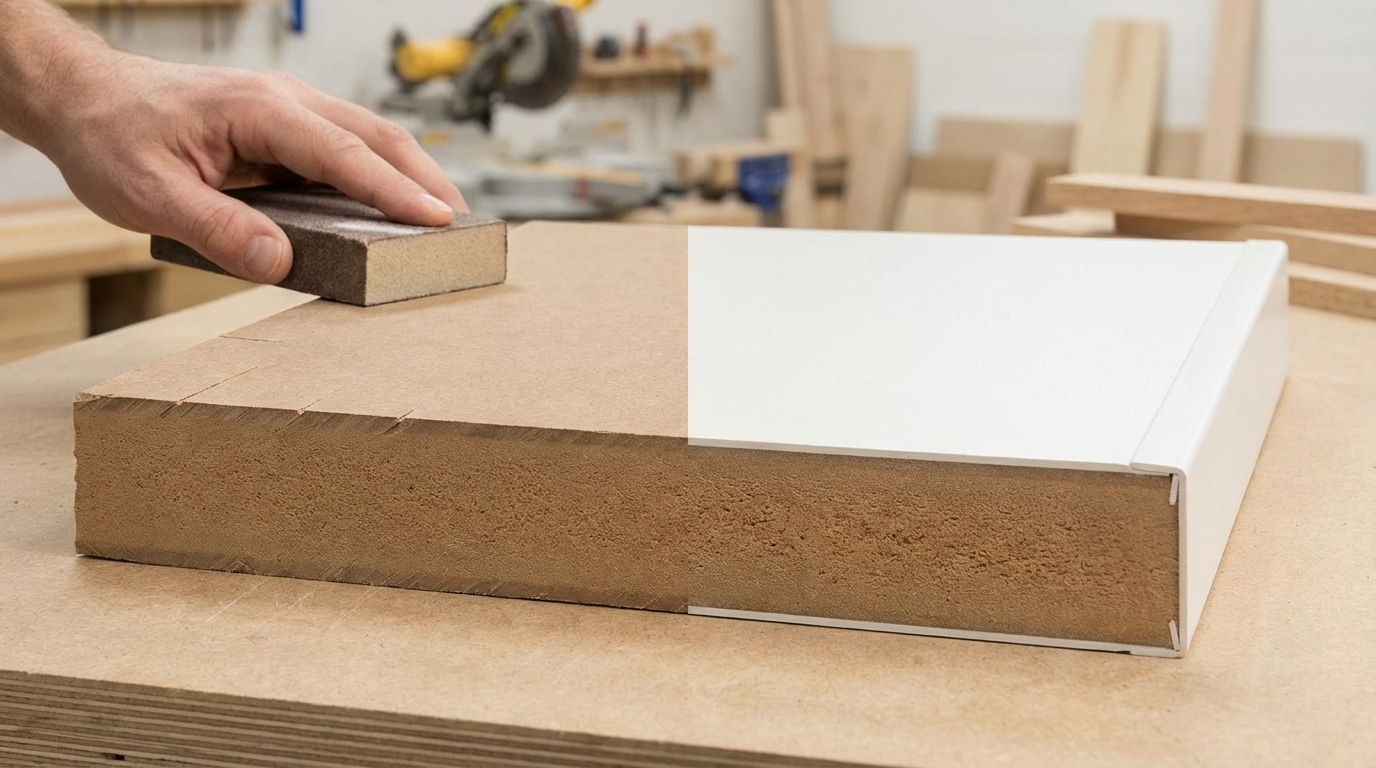
Plain MDF is medium-density fiberboard in its raw form—smooth, uniform panels made from wood fibers bonded under pressure, ready for any finish like laminate, veneer, paint, or polish. Pre-laminated MDF has decorative laminate sheets factory-bonded to one or both faces, delivering a ready-to-install surface with patterns like wood grain or plain colors.
Where people get confused:
- Thinking pre-laminated is "waterproof"—it's only surface-resistant; edges remain vulnerable.
- Assuming plain MDF is weaker—actually uniform density makes it stable if sealed properly.
- Believing pre-lam can't be cut— it can, but exposes raw edges needing tape/sealant.
- Mixing it with particleboard— MDF has finer fibers for smoother sanding/machining.
- Overlooking thickness grades— both come in 3-25mm, but 16-18mm common for furniture.
- Confusing BWR/BWP grades— mostly for plywood; MDF uses moisture-resistant (MR) variants.
Which MDF type is best for wardrobes in Indian homes?
Pre-laminated MDF often suits wardrobes for its dust-free install and glossy finish matching modern aesthetics. However, in humid bedrooms, plain MR-grade MDF with site-applied laminate edges out due to better sealing control. Check for 700-850 kg/m³ density to prevent sagging. Next step: Tap edges for solid feel, ask supplier for recent batch moisture content under 12%.
India-Specific Reality Check
In monsoon-heavy regions like Mumbai or Kerala, plain MDF demands immediate edge priming to combat 80-90% humidity swelling, while pre-laminated risks delamination if stored stacked without spacers. Coastal sites amplify termite risks—both need borate treatment. Contractor workflows favor pre-lam for faster handover, but carpenters prefer plain for precise polishing amid power cuts delaying factory boards.
Storage tip: Elevate off ground, cover loosely; poor godown handling causes warping before purchase.
Does humidity affect pre-laminated MDF more than plain?
Yes, pre-laminated MDF's glue lines can bubble in 70%+ RH if edges aren't taped, unlike plain MDF which absorbs treatments evenly. In Indian interiors, use both with PVA sealant on cuts. Verify by pressing a wet cloth overnight—no swelling means good MR grade. Practical step: For kitchens, pair with HDHMR cores and stainless hardware.
Two-Minute Comparison That Actually Helps
| Factor | Pre-Laminated MDF | Plain MDF |
|---|---|---|
| Finish | Factory-applied, uniform, low dust | Customizable (paint/veneer), needs labor |
| Durability (Dry Use) | High scratch/abrasion resistance | Good if sealed; prone to dents pre-finish |
| Moisture Performance | Surface ok, edges weak | Better with site sealing/treatment |
| Repairs | Hard to match laminate; patch kits messy | Easy sand/paint; blends seamlessly |
| Thickness Options | Common 6-18mm | Full range 3-25mm |
| Install Speed | Fast (cut + edge tape) | Slower (finish + dry time) |
Price Range and Cost Drivers (India)
Plain MDF typically ranges Rs 40-90 per sq ft (16-18mm), pre-laminated Rs 70-150 per sq ft, varying by city (higher in metros), brand grade, and sheet size (8x4 ft standard). Cost drivers: core density, laminate quality (0.6-1mm thick), calibration flatness, transport from factory.
- Mini budget example: 50 sq ft kitchen cabinet—plain MDF + laminate labor: Rs 5,000-8,000 total; pre-lam direct: Rs 6,000-10,000.
How to ask for quote: Specify "MR grade, 18mm, calibrated, recent batch, FOB price incl. GST, delivery to [city]" + request edge samples.
What drives the price gap between pre-lam and plain MDF?
Factory lamination adds 30-50% cost from adhesive, press time, and waste control. Plain saves on this but adds carpenter fees (Rs 20-40/sq ft). In tier-2 cities, logistics inflate pre-lam more. Always compare total project cost: factor 10-15% wastage. Step: Get 3 quotes with specs; haggle on volume discounts for 50+ sheets.
How to Choose in 5 Steps
- Assess exposure: Dry bedroom? Pre-lam. Kitchen/bathroom? Plain MR + seal.
- Check timeline/budget: Rush job under Rs 100/sq ft total? Pre-lam.
- Inspect samples: Weigh for density, tap for voids, scratch test face.
- Plan edges/finishing: Many cuts? Ensure edge banding stock matches.
- Verify supplier batch: Ask storage duration, humidity log; reject warped stock.
Skip step 3, risk delam or sagging shelves.
Can I use pre-laminated MDF for kitchen cabinets?
Yes, if edges are banded and paired with SS hardware, handling steam splashes in dry zones. Avoid in wet coastal kitchens without HDHMR upgrade. Nuance: Laminate wears faster near gas stoves. Check: Rub acetone on sample—no melting. Next: Specify 1mm thick laminate, seal joints with silicone.
Tips for Homeowners: Durability and Cleaning
- Do: Wipe pre-lam with microfiber + mild soap; plain painted surfaces same.
- Don't: Abrasive cleaners on laminate—use wood polish instead.
- Durability hack: Add felt pads under drawers to cut scratches 50%.
Tips for Carpenters: Cutting and Handling
- Cut pre-lam with fine blade (80-tooth), tape lines first.
- Plain: Sand 180-grit before finish; fasten 40-50mm from edges.
- Hinge zones: Pre-drill to avoid splits; reinforce with cleats.
Tips for Architects: Spec Writing
- Detail: "MR MDF, 18mm ±0.5mm thick, pre-lam both sides, 0.8mm thick."
- Wet zones: "Edge band all exposed cuts, silicone seal junctions."
- Finish logic: Match RAL colors for plain; specify gloss level for pre-lam.
Decision Framework: Match Your Project Conditions
| Condition | Recommended | Verify This |
|---|---|---|
| Wet zone (kitchen) | Plain MR MDF + site laminate | Core doesn't swell in water test |
| Coastal humidity | Plain with borate treatment | Uniform density, no voids |
| Heavy use (kids/pets) | Pre-laminated HD grade | Scratch-resistant laminate sample |
| Tight budget | Plain + local carpenter | Total cost incl. labor < Rs 90/sq ft |
| High scratch risk | Pre-laminated textured | Finger rub test: no easy marks |
| Fast delivery | Pre-laminated stock | Lead time < 3 days, flat sheets |
Trade-offs and Limitations
Pre-laminated: Zero labor upfront but inflexible for curves/radius work; edge exposure limits moisture zones. Plain: Versatile but generates dust, delays from drying; inconsistent carpenter finish raises callbacks. Both sag under point loads without frames; not structural like plywood.
Is pre-laminated MDF easier to repair than plain?
No, plain MDF repairs seamlessly by sanding and repainting to match surroundings. Pre-lam patches rarely blend due to texture mismatch. For scratches, use color-matched fillers on plain. Condition: Minor dents ok on both if caught early. Step: Stock repair kit with matching paint/laminate scraps from install.
Common Buyer Mistakes and How to Avoid Them
- Mistake: Buying cheapest without density check. Why: Low-grade sags. Fix: Weigh sample (min 25kg for 18mm 8x4).
- Mistake: Ignoring edge prep on pre-lam. Why: Swells in humidity. Fix: Budget for banding tape.
- Mistake: Storing flat on ground. Why: Moisture wicks up. Fix: Vertical racks.
- Mistake: No MR spec in humid areas. Why: Delam fast. Fix: Ask "moisture content <10%?"
- Mistake: Overlooking calibration. Why: Uneven cabinets. Fix: Check with straight edge.
- Mistake: Skipping frame for shelves. Why: Bends. Fix: Add MS supports.
- Mistake: Wrong blade for cutting. Why: Chipping. Fix: Carbide-tipped fine-tooth.
- Mistake: Direct wall contact. Why: Damp transfer. Fix: Wall putty barrier.
How long does pre-laminated MDF last in Indian homes?
Typically 8-15 years in dry AC rooms with light use; halves in kitchens without sealing. Factors: Laminate grade, cleaning habits, humidity control. Plain lasts similar if well-finished. Prevent early wear: Annual polish, no wet mops. Check yearly: Tap for hollow sounds signaling delam.
Failure Modes and Fixes
- Symptom: Surface bubbling. Cause: Moisture ingress. Prevent: Edge seal. Fix: Dry, sand, re-lam patch.
- Symptom: Edge swelling. Cause: Untaped cuts. Prevent: Band immediately. Fix: Trim + seal.
- Symptom: Sagging shelves. Cause: Low density. Prevent: Frame supports. Fix: Add cleats underneath.
- Symptom: Laminate peeling. Cause: Poor glue. Prevent: Scratch test buy. Fix: Heat gun + new sheet.
- Symptom: Chipping on cuts. Cause: Dull blade. Prevent: Fine blade. Fix: Filler + sand.
- Symptom: Fading color. Cause: Direct sun. Prevent: Curtains. Fix: Overlay film.
Which is better for moisture-prone areas: pre-lam or plain MDF?
Plain MDF edges out with custom hydrophobic coatings tailored to monsoons. Pre-lam works if all edges banded thickly. Test: Submerge sample edge 30min—no warp. In practice, combine: Pre-lam face, plain core sealed. Next: Spec HDHMR for baths.
Quality Checks You Can Do Without Lab Tests
Before buying:
- Tap sheet: Uniform thud, no hollows.
- Scratch face with key: Minimal mark.
- Check flatness: Ruler along surface.
- Ask: "Batch date? Storage RH?"
After cutting: Edges smooth, no fiber pull-out; glue line even.
Post-install: Level alignment, no gaps at joints; clean with dry cloth first week.
FAQs
Can pre-laminated MDF be painted over?
Possible but tricky—roughen surface with 220-grit sandpaper for adhesion, then prime. Results often uneven vs plain MDF's smooth base. In humid India, paint seals better long-term. Avoid if pattern shows through. Test on scrap: Apply enamel, check 48hr dry adhesion by scratching.
Is plain MDF cheaper to repair?
Yes, sanding dents and repainting blends invisibly, costing Rs 100-300 spot vs pre-lam's Rs 500+ sheet match. Labor 1hr vs 4hr. Common in multi-use homes. Stock matching paints early; practice on offcuts for carpenter confidence amid site dust.
Does pre-laminated MDF need edge banding?
Always, as raw edges absorb moisture fast, causing swelling/delam in 3-6 months monsoon exposure. Use PVC/ABC tape matching color/thickness. Press with roller post-cut. Skip risks callbacks; budget 10% extra sheet cost for it.
What's the standard thickness for both?
16mm and 18mm dominate furniture; 6-12mm for partitions, 25mm shelves. Thicker resists sag but hikes weight/cost 20-30%. Verify ±0.5mm tolerance for flush fits. Thinner suits modular but needs frames.
Can I use plain MDF outdoors?
No, even MR grade fails UV/rain in 6 months. Indoors only, with sealing. For semi-exterior, switch to BWP plywood. Protect balcony storage with covers.
How to store MDF sheets on-site?
Vertical, spaced 10cm apart, off concrete floor on pallets, covered from rain/dust. Horizontal ok short-term with stickers. Poor storage warps 20% sheets; check before cutting.
Disclaimer: This content is provided for general informational purposes based on industry practices and publicly available information. Product specifications, standards, prices, and availability may vary by manufacturer, region, and time. Readers should independently verify details with manufacturers, dealers, or qualified professionals before making purchase or construction decisions.Want Plywood Suggestions?
Share a few details and a Duro BOIL specialist will suggest suitable brands and connect you to responsive dealers.