Types of MDF Board: A Complete Classification Guide
Explore all types of MDF boards including plain MDF, moisture resistant, fire retardant, and pre-laminated. Find the right type for your project.
Quick Answer
MDF board is an engineered wood panel made from compressed wood fibres bonded with resin.
In simple terms, think of MDF as the "processed flour" of wood products. Just like wheat grains are ground into fine flour for making rotis, wood is broken down into tiny fibres and reformed into smooth, uniform boards. This gives MDF a consistent texture throughout—no knots, no grain patterns, no surprises. It's why carpenters love it for furniture that needs intricate designs, smooth paint finishes, or decorative mouldings. Unlike natural wood or plywood, every part of an MDF sheet behaves the same way when you cut, drill, or shape it.
- Full form: Medium Density Fibreboard (density typically 650-850 kg/m³)
- Made from: Wood fibres (usually pine or eucalyptus) + synthetic resin + wax
- Standard size in India: 8×4 feet (2440×1220 mm)
- Thickness range: 2mm to 30mm commonly available
- Best known for: Ultra-smooth surface ideal for painting and lamination
What Exactly is MDF Board?
MDF, or Medium Density Fibreboard, is an engineered wood product created by breaking down hardwood or softwood residuals into fine fibres, combining them with wax and resin binders, then forming panels under high temperature and pressure. The result is a dense, smooth board with no visible wood grain.
In the Indian market, MDF has become increasingly popular over the past two decades. Major manufacturers produce MDF using plantation timber like eucalyptus and pine, making it a more sustainable alternative to harvesting natural hardwood forests. The manufacturing process involves defibrillating wood chips using steam, blending the resulting fibres with urea-formaldehyde or melamine-formaldehyde resins, and pressing the mixture into sheets.
What makes MDF matter for your home interiors is its exceptional machinability. Unlike plywood which can splinter along edges, or natural wood which has unpredictable grain, MDF cuts cleanly in any direction. This property makes it ideal for CNC-routed designs, detailed jali patterns, and furniture components that need precise dimensions.
What does MDF stand for? Full form explained
MDF stands for Medium Density Fibreboard. The "medium density" refers to its position between hardboard (HDF/High Density Fibreboard at 800-1200 kg/m³) and particle board (lower density at 500-700 kg/m³).
The term originated in the United States during the 1960s when the product was first commercially developed. In India, MDF sometimes gets confused with "wood board" or "compressed board"—but these are informal terms. When purchasing, always confirm you're getting actual MDF and not particle board, as the two have significantly different properties and prices.
Types of MDF Board Available in India
The Indian market offers several MDF variants, each designed for specific applications and environmental conditions. Understanding these types helps you choose the right board for your project and budget.
Plain MDF (Standard Grade)
The most common and affordable type, plain MDF is suitable for interior applications in dry areas. It has a smooth, uniform surface ready for painting, veneering, or lamination. Ideal for wardrobes, TV units, and decorative panels in bedrooms and living rooms where moisture exposure is minimal.
Moisture Resistant MDF (MR Grade)
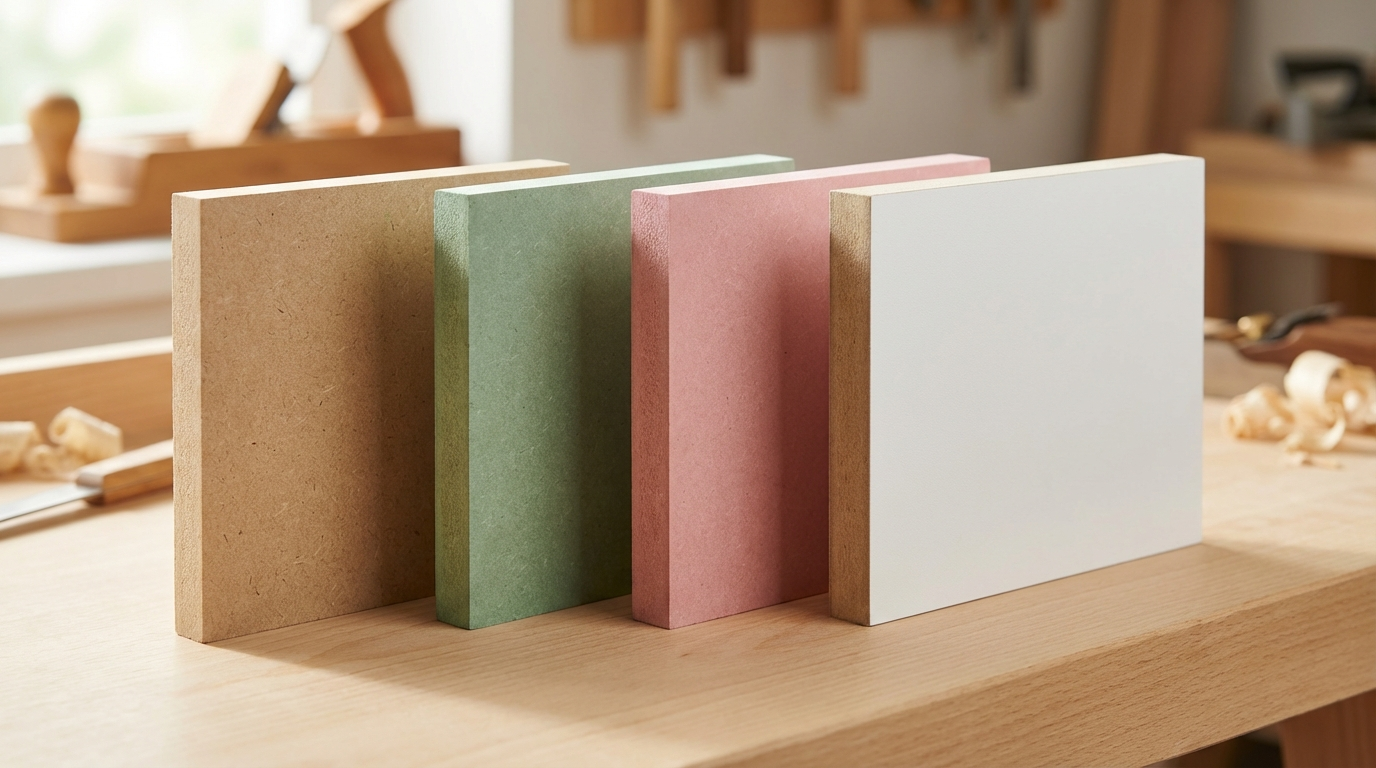
Manufactured with moisture-resistant resins, MR MDF can withstand higher humidity levels than standard MDF. Often identified by a green core tint, this grade works well in kitchens (away from direct water contact) and areas with air conditioning that creates humidity fluctuations. However, it is not waterproof—prolonged water exposure will still cause damage.
HDHMR (High Density High Moisture Resistant)
A premium variant popular in India, HDHMR combines higher density (750-850 kg/m³) with enhanced moisture resistance. Many Indian brands market HDHMR as a superior alternative to BWR plywood for kitchen cabinets. It holds screws better than standard MDF and resists humidity common in Indian monsoon conditions.
Fire Retardant MDF (FR Grade)
Treated with fire-retardant chemicals during manufacturing, FR MDF slows flame spread and is required by building codes in commercial spaces, hotels, hospitals, and public buildings. While more expensive, it's essential for compliance with fire safety regulations.
Pre-laminated MDF
Factory-finished with melamine paper or decorative laminates, pre-laminated MDF eliminates the need for separate lamination work. Available in wood grains, solid colours, and textured finishes, it's popular for ready-to-assemble furniture and quick installation projects.
UV Coated MDF
Features a high-gloss or matte UV-cured coating applied in factory conditions. The finish is more durable than regular paint and provides a mirror-like shine popular in modern modular kitchens and contemporary wardrobes.
| Type | Best For | Moisture Resistance | Price Range (per sq ft) |
|---|---|---|---|
| Plain MDF | Dry interior furniture | Low | ₹25-45 |
| MR Grade MDF | Humid areas, AC rooms | Moderate | ₹35-55 |
| HDHMR | Kitchen cabinets, bathrooms | High | ₹50-80 |
| Fire Retardant | Commercial, public buildings | Low-Moderate | ₹60-100 |
| Pre-laminated | Quick furniture, shelving | Varies by base | ₹45-90 |
| UV Coated | Modern kitchens, wardrobes | Moderate-High | ₹70-150 |
Which type is best for kitchen and bathroom?
For kitchen cabinets, HDHMR is typically the recommended choice in Indian conditions. The combination of high density and moisture resistance handles the steam, occasional splashes, and humidity fluctuations common in Indian cooking environments. For areas directly around the sink or near water sources, ensure all edges are properly sealed with edge banding.
For bathrooms, exercise caution with any MDF product. While HDHMR can handle humidity, direct water contact should be avoided. Consider MDF only for vanity units placed away from shower areas, with proper sealing of all surfaces and edges. For shower enclosures or areas with direct water exposure, WPC or marine plywood are safer alternatives.
Which type works for wardrobes and bedrooms?
Standard plain MDF or MR grade works excellently for bedroom wardrobes across most Indian cities. The smooth surface takes paint and veneer beautifully, allowing for seamless finishes that plywood cannot match. For coastal cities or areas with high humidity (Chennai, Mumbai, Kolkata), prefer MR grade even for bedroom applications.
Pre-laminated MDF is increasingly popular for wardrobe interiors—shelves, drawer components, and internal partitions—where the factory finish reduces labour costs and installation time.
Key Properties and Specifications
Understanding MDF specifications helps you verify quality and choose the right product for structural requirements.
| Property | Standard MDF | MR/HDHMR Grade | What It Means |
|---|---|---|---|
| Density | 650-750 kg/m³ | 750-850 kg/m³ | Higher density = better screw holding |
| Thickness options | 2mm to 30mm | 3mm to 25mm | 18mm most common for furniture |
| Standard sheet size | 8×4 ft, 7×4 ft | 8×4 ft | Plan cuts to minimise waste |
| Internal bond strength | 0.55-0.65 N/mm² | 0.65-0.80 N/mm² | Resistance to layer separation |
| Swelling (24hr water) | 12-15% | 5-8% | Lower = better moisture handling |
| Formaldehyde emission | E1 or E2 class | E0 or E1 class | E0 = lowest emission, safest |
For most residential furniture, 18mm thickness is standard for carcasses and shutters. Shelves spanning more than 60cm without support should use 25mm to prevent sagging. Thinner 8-12mm boards work well for back panels and drawer bottoms.
Where People Get Confused
Several misconceptions about MDF circulate among homeowners and even some contractors. Here's what you need to know:
Misconception 1: "MDF is waterproof"
Even HDHMR or MR grade MDF is moisture resistant, not waterproof. Prolonged water contact will cause swelling and permanent damage. The moisture resistance helps with humidity and minor splashes, not submersion or continuous wetness.
Misconception 2: "MDF and particle board are the same"
They're entirely different products. MDF uses fine wood fibres for a smooth, dense board. Particle board uses wood chips and has visible particles, lower density, and weaker screw-holding capacity. MDF costs more but performs significantly better.
Misconception 3: "MDF cannot hold screws properly"
This applies mainly to thin or low-density boards. Quality 18mm MDF with proper pilot holes holds screws adequately for furniture. HDHMR grade has even better fastener retention, comparable to commercial plywood.
Misconception 4: "All MDF releases harmful chemicals"
Modern E0 and E1 grade MDF has significantly reduced formaldehyde emissions, meeting international safety standards. Ask for emission certificates when purchasing, especially for children's rooms or spaces with limited ventilation.
Misconception 5: "MDF is always inferior to plywood"
Each material has strengths. MDF excels at painted finishes, detailed profiles, and cost-effective furniture. Plywood is better for structural applications, outdoor use, and where higher load-bearing capacity is needed. The "better" choice depends entirely on application.
Misconception 6: "Green coloured MDF is always moisture resistant"
While many manufacturers use green dye to indicate MR grade, this isn't universal or regulated. Always check product specifications and brand certification rather than relying on colour alone.
Advantages and Limitations
Advantages
- Smooth, uniform surface: No knots, grain variations, or surface irregularities—perfect for paint, lacquer, and laminate application
- Excellent machinability: Cuts cleanly without splintering, ideal for CNC routing, detailed profiles, and decorative patterns
- Cost-effective: Generally 20-40% cheaper than equivalent plywood grades for interior applications
- Consistent quality: Factory-manufactured product with uniform properties throughout the sheet
- Environmentally sustainable: Made from wood residues and plantation timber, reducing pressure on natural forests
- Design flexibility: Can be shaped into curves, grooves, and intricate designs that plywood cannot achieve
- Termite resistant: The resin content and manufacturing process make MDF unattractive to termites
- No delamination: Unlike plywood, MDF has no layers to separate over time
Limitations
- Moisture sensitivity: Even MR grades swell with prolonged water exposure. Workaround: seal all edges and surfaces, avoid use in wet areas
- Weight: Heavier than equivalent plywood, making wall-mounted applications more challenging. Workaround: use appropriate wall anchors and support systems
- Edge fragility: Edges can chip if not handled carefully. Workaround: apply edge banding on all exposed edges
- Lower structural strength: Not suitable for load-bearing applications or spans requiring high bending strength. Workaround: use plywood for shelves over 60cm without support
- Dust during cutting: Produces fine dust requiring proper safety equipment. Workaround: ensure carpenter uses dust masks and workshop ventilation
Best Applications in Indian Homes
Living Room: TV units, display shelves, wall panelling, and decorative jali screens. MDF's smooth surface creates flawless painted finishes that enhance modern interiors.
Bedroom: Wardrobe shutters, headboards, side tables, and dressing units. Pre-laminated MDF reduces costs for wardrobe interiors while maintaining aesthetic appeal.
Kitchen: HDHMR grade for cabinet shutters and carcasses (away from direct water). The smooth surface works well with membrane finishes, acrylic, and PU coating popular in modular kitchens.
Study/Office: Desks, bookshelves, and storage units where painted or veneered finishes are preferred over natural wood grain.
Pooja Room: Decorative mandap panels, CNC-cut screens, and ornamental elements that benefit from MDF's ability to hold intricate details.
Avoid using MDF for: Outdoor furniture, bathroom wet areas, shoe racks near entrances (rain exposure), and balcony furniture—even with moisture-resistant grades.
How to Check Quality (Without Lab Tests)
Visual inspection:
- Check surface for smoothness—run your hand across; there should be no bumps or depressions
- Examine edges for uniformity—the fibre should be consistent without visible layers or voids
- Look for consistent colour throughout the thickness when viewing the edge
- Check sheet flatness—place on flat surface and look for warping or bowing
- Inspect for any surface damage, chips, or scratches from storage/handling
Questions to ask your dealer:
- What is the density specification? (Should be at least 700 kg/m³ for furniture-grade)
- What emission class is this? (E1 or E0 preferred for home use)
- Is this IS-certified? (Look for IS 12406 compliance)
- What is the swelling percentage as per test reports?
Red flags to avoid:
- Unusually low prices compared to market rates (may indicate inferior density)
- Visible particles in the surface (may be particle board sold as MDF)
- Strong chemical odour (indicates high formaldehyde emission)
- Dealer cannot provide technical specifications or certificates
Care and Maintenance Tips
Daily care:
- Wipe surfaces with dry or slightly damp cloth
- Clean spills immediately—don't let liquids sit on the surface
- Use coasters under glasses and hot pads under heated items
- Avoid dragging objects across surfaces to prevent scratches
Cleaning methods:
- For routine cleaning, use a soft microfibre cloth
- For stubborn marks, use mild soap solution and dry immediately
- Never use abrasive cleaners, steel wool, or harsh chemicals
- For laminated MDF, glass cleaners work well for streak-free finish
What damages MDF (and prevention):
- Standing water: wipe immediately and ensure room has proper ventilation
- High humidity: use dehumidifiers in monsoon, ensure adequate air circulation
- Direct sunlight: causes fading; use curtains or UV-protective coatings
- Impact damage: MDF dents more easily than plywood; handle with care during moving
Frequently Asked Questions
Is MDF board waterproof?
No, MDF is not waterproof. Even moisture-resistant variants like HDHMR are designed to handle humidity and minor splashes, not direct water contact or submersion. Water exposure causes MDF to swell irreversibly. For wet areas, always seal all surfaces and edges with appropriate primers and paints. If waterproofing is critical, consider WPC or marine-grade plywood instead. For kitchen cabinets, HDHMR with proper edge sealing handles typical cooking humidity but keep it away from direct sink splashes.
Is MDF board termite proof?
MDF is naturally resistant to termites due to its manufacturing process. The high temperature pressing, resin content, and lack of natural wood grain structure make it unattractive to termites. However, "resistant" doesn't mean "immune"—in severe termite infestation areas, no wood product is completely safe. For added protection, ensure the MDF has borer and termite treatment certification. Store furniture away from walls in termite-prone buildings and address any existing infestations in your home's structure.
How long does MDF furniture last?
Quality MDF furniture in dry, indoor conditions typically lasts 10-15 years with proper care. Lifespan depends significantly on the grade used, finish quality, and environmental conditions. HDHMR grade in well-ventilated homes can last longer. Factors that reduce lifespan include moisture exposure, poor edge sealing, heavy loads on thin boards, and physical impact. Furniture with good edge banding, quality finishes, and appropriate grade for the location will serve you well for many years.
Can MDF be used in kitchen cabinets?
Yes, MDF—particularly HDHMR grade—is widely used for modular kitchen cabinets in India. Its smooth surface works excellently with membrane, acrylic, and PU finishes popular in modern kitchens. Choose 18mm HDHMR for carcasses and shutters, ensure proper edge banding on all exposed edges, and avoid installation directly adjacent to gas stoves or under constant water exposure. Many premium modular kitchen brands use HDHMR as their standard material with excellent results.
MDF vs plywood: which is better for furniture?
Neither is universally "better"—each excels in different applications. Choose MDF when you need smooth painted finishes, intricate CNC designs, cost-effective furniture, or consistent surfaces for lamination. Choose plywood when you need higher structural strength, moisture resistance (BWR/Marine grade), screw-holding in thin boards, or outdoor/semi-outdoor applications. For most wardrobe shutters and decorative panels, MDF offers better value. For kitchen carcasses and structural components, many prefer BWR plywood.
What is the cost of MDF board in India?
MDF prices vary by type, thickness, and brand. As of current market conditions, expect approximately: Plain MDF ₹25-45 per sq ft, MR grade ₹35-55 per sq ft, HDHMR ₹50-80 per sq ft, and pre-laminated MDF ₹45-90 per sq ft for 18mm thickness. Premium UV-coated options range ₹70-150 per sq ft. Prices fluctuate based on location, purchase volume, and market conditions. Always compare multiple dealers and verify specifications match the price quoted.
Where to buy quality MDF board?
Purchase MDF from authorised dealers of established brands to ensure quality and warranty coverage. Major plywood and panel dealers in your city typically stock multiple MDF brands. Building material markets in metro cities offer competitive prices but verify authenticity. For specific brands, check manufacturer websites for authorised dealer locators. Avoid unknown sellers offering significantly below-market prices. Request test certificates and warranty documentation with your purchase.
How to identify good quality MDF?
Quality MDF shows uniform density throughout the cross-section with no visible layers or voids. The surface should be perfectly smooth without bumps or depressions. Good quality boards have consistent colour and no strong chemical odour. Check for IS 12406 certification or equivalent standards compliance. Ask for density specification (minimum 700 kg/m³ for furniture grade) and emission class (E1 or E0). Reputable brands provide technical data sheets—request these before purchase. Weight is also an indicator; quality MDF feels dense and heavy for its size.
Disclaimer: This content is provided for general informational purposes based on industry practices and publicly available information. Product specifications, standards, prices, and availability may vary by manufacturer, region, and time. Readers should independently verify details with manufacturers, dealers, or qualified professionals before making purchase or construction decisions.Want Plywood Suggestions?
Share a few details and a Duro BOIL specialist will suggest suitable brands and connect you to responsive dealers.