What is MDF Board? Complete Guide to Medium Density Fibreboard
Learn what MDF (Medium Density Fibreboard) is, how it's made, and why it's popular for furniture. Discover types, benefits, and best applications.
Quick Answer
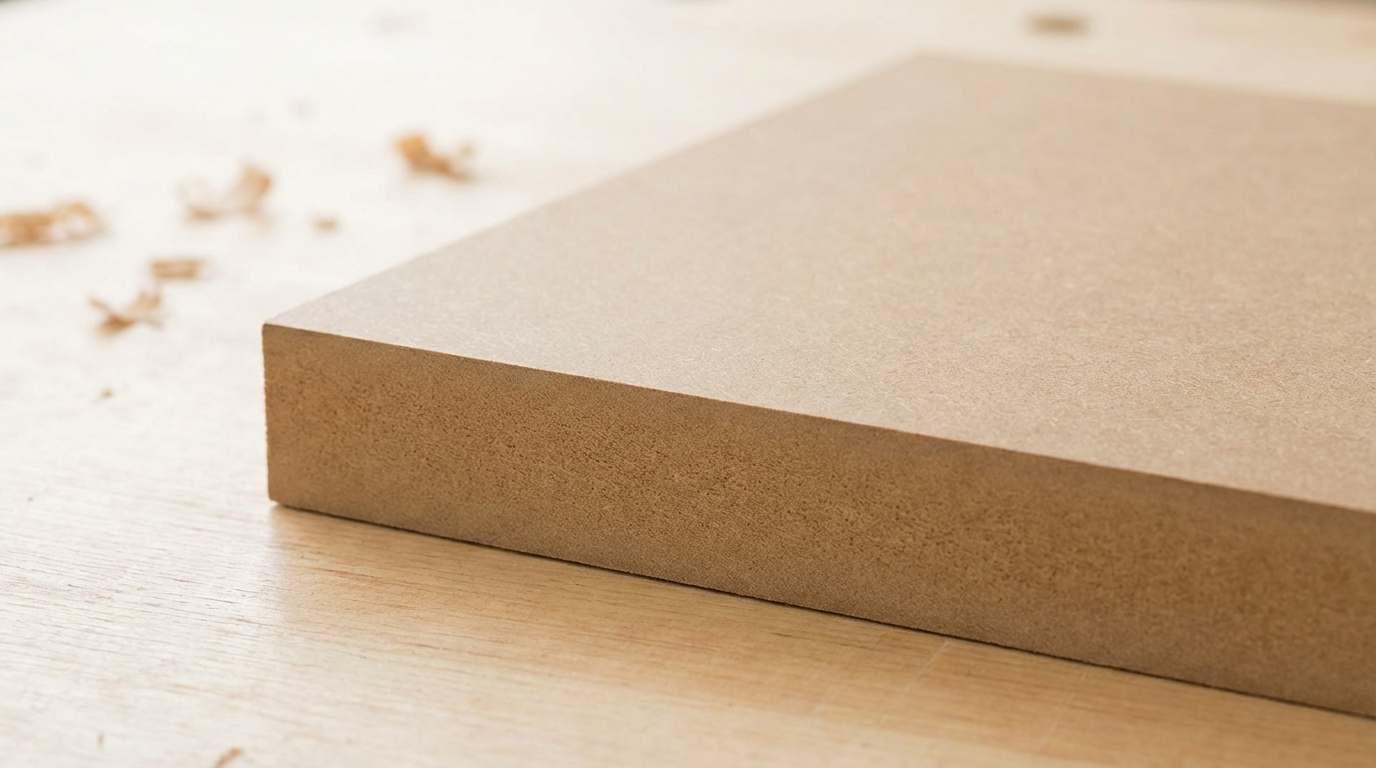
MDF (Medium Density Fibreboard) is an engineered wood panel made from wood fibres bonded together with resin under heat and pressure.
In simple terms, think of MDF as a refined version of sawdust transformed into smooth, flat sheets. When furniture makers work with solid wood, they generate a lot of wood waste—shavings, dust, and small particles. MDF manufacturers collect these wood residues, break them down into fine fibres, mix them with special glue, and press everything together under tremendous heat and pressure. The result is a dense, uniform board with an incredibly smooth surface that's perfect for painting and laminating. It's become the go-to material for affordable furniture, modular kitchens, and interior work across India.
- Composition: 82% wood fibres + 9% resin binder + 8% water + 1% wax
- Density range: 600-800 kg/m³ (hence "medium density")
- Surface quality: Extremely smooth, no knots or grain patterns
- Standard sheet size in India: 8 ft × 4 ft (2440 × 1220 mm)
- Common thicknesses: 6mm, 9mm, 12mm, 18mm, 25mm
What Exactly is MDF Board?
MDF is an engineered wood product that has revolutionised furniture manufacturing in India over the past two decades. Unlike plywood, which uses thin wood veneers glued in layers, MDF uses wood fibres that are completely broken down and reconstituted into a homogeneous panel.
The manufacturing process begins with collecting wood residuals—typically from eucalyptus, rubber wood, or plantation timber common in India. These wood pieces are fed into a machine called a defibrator that uses steam and mechanical action to separate the wood into individual fibres. The fibres are then dried and blended with urea-formaldehyde or melamine-formaldehyde resin along with a small amount of wax for moisture resistance.
This mixture is spread into a mat and fed into a hot press where temperatures around 200-240°C and pressure of 20-30 kg/cm² transform the loose fibres into a solid panel. The heat cures the resin, binding everything permanently. Finally, the panels are cooled, trimmed to size, and sanded to achieve that characteristic smooth surface.
For Indian homeowners, MDF matters because it offers a cost-effective solution for modern furniture needs. When you want clean, contemporary designs without the premium price of solid wood or marine plywood, MDF provides an excellent middle ground—especially for interior applications that won't face direct water exposure.
What does MDF stand for? Full form explained
MDF stands for Medium Density Fibreboard. The name directly describes what it is: a fibreboard (board made from wood fibres) with medium density. Wood-based panels are classified by their density—particle board is low density (under 600 kg/m³), MDF is medium density (600-800 kg/m³), and HDF (High Density Fibreboard) exceeds 800 kg/m³.
The term originated in the United States in the 1960s when the product was first developed commercially. In India, you might also hear it called simply "fibreboard" or occasionally confused with "sunmica" (which is actually just a laminate brand name). Some local markets also refer to it as "MDF ply"—technically incorrect, as it's not plywood, but the name has stuck in everyday conversation.
Types of MDF Board Available in India
The Indian market offers several MDF variants, each designed for specific applications. Understanding these differences helps you choose the right product for your project.
Standard MDF (Interior Grade): The most common type, suitable for general furniture work in dry areas. It has a smooth surface ideal for painting or laminating and costs the least among MDF variants.
Moisture Resistant MDF (MR MDF): Manufactured with moisture-resistant resins, this variant handles humidity better than standard MDF. However, it's not waterproof—think of it as resistant to occasional moisture, not continuous water exposure.
High Density MDF (HDF/HDHMR): With density exceeding 800 kg/m³, HDF offers superior strength and better moisture handling. HDHMR (High Density High Moisture Resistant) combines both properties, making it popular for kitchen cabinets in India.
Fire Retardant MDF: Treated with fire-resistant chemicals during manufacturing. Required in commercial buildings and increasingly specified for high-rise residential projects as per fire safety norms.
Pre-laminated MDF: Standard MDF with factory-applied decorative laminate on one or both sides. Saves time and ensures consistent finish quality.
Veneered MDF: MDF with real wood veneer bonded to the surface. Offers the look of solid wood at lower cost and without warping issues.
| Type | Best For | Moisture Resistance | Price Range (per sq ft) |
|---|---|---|---|
| Standard MDF | Living room furniture, decorative panels | Low | ₹25-45 |
| MR MDF | Bedroom wardrobes, general interiors | Moderate | ₹35-55 |
| HDF/HDHMR | Kitchen cabinets, bathroom vanities | High | ₹55-90 |
| Fire Retardant MDF | Commercial spaces, high-rise apartments | Varies | ₹60-100 |
| Pre-laminated MDF | Quick furniture, shelving | Depends on base | ₹45-80 |
Which type is best for kitchen and bathroom?
For kitchens, HDHMR is currently the preferred choice among Indian interior designers and carpenters. Its high density provides structural strength for heavy utensils and appliances, while enhanced moisture resistance handles the humid environment near sinks and cooking areas.
Standard MDF should never be used in kitchens—even one water spill can cause irreversible swelling. MR MDF is acceptable for upper kitchen cabinets (away from the sink), but for base units and areas near water sources, HDHMR is worth the extra investment.
For bathrooms, even HDHMR has limitations. It works for vanity cabinets that don't receive direct water splash, but the cabinet design must include proper ventilation and edge sealing. Many designers recommend marine plywood for bathroom furniture due to its superior water resistance.
Which type works for wardrobes and bedrooms?
Bedroom wardrobes typically perform well with MR MDF, especially in cities with moderate humidity. The moisture-resistant variant handles the occasional dampness from monsoon air or air conditioning condensation without issues.
For wardrobe shutters and external surfaces that will be painted or laminated, standard MDF works perfectly if your home stays dry year-round. However, in coastal cities like Mumbai, Chennai, or Kolkata, upgrading to MR MDF for all bedroom furniture is advisable due to higher ambient humidity.
The interior partitions and shelves of wardrobes can use standard MDF even in humid regions since they're protected from direct moisture exposure.
Key Properties and Specifications
Understanding MDF specifications helps you communicate better with carpenters and ensure you're getting quality material.
| Property | Standard MDF | HDHMR |
|---|---|---|
| Density | 650-750 kg/m³ | 800-900 kg/m³ |
| Available Thicknesses | 3mm, 6mm, 9mm, 12mm, 18mm, 25mm | 8mm, 12mm, 18mm, 25mm |
| Standard Sheet Size | 8×4 ft, 7×4 ft, 6×4 ft | 8×4 ft, 7×4 ft |
| Internal Bond Strength | 0.55-0.65 N/mm² | 0.80-1.00 N/mm² |
| Screw Holding (face) | 1100-1200 N | 1300-1500 N |
| Moisture Content | 5-8% | 4-7% |
Density determines how well the board holds screws and handles load. Higher density means better structural performance but also more weight—important when designing wall-mounted units.
Internal bond strength measures how well the fibres hold together. Low internal bond leads to delamination and surface peeling when exposed to stress or humidity.
Thickness selection depends on application: 6-9mm for back panels and drawer bottoms, 12mm for shelves with light loads, 18mm for most furniture carcasses and shutters, 25mm for heavy-duty applications like kitchen countertop support.
Where People Get Confused
Misconception 1: "MDF is waterproof"
No MDF variant is truly waterproof. Even HDHMR only resists moisture—it cannot tolerate continuous water contact. The confusion arises from marketing terms like "water-resistant" being interpreted as waterproof.
Misconception 2: "MDF and particle board are the same"
They're different products. Particle board uses wood chips and particles; MDF uses wood fibres. MDF is denser, smoother, and stronger. Particle board is cheaper but less durable.
Misconception 3: "MDF is stronger than plywood"
MDF excels in compressive strength and surface smoothness but loses to plywood in tensile strength, screw holding (on edges), and moisture resistance. Each has its place.
Misconception 4: "Any carpenter can work with MDF"
MDF requires different techniques than solid wood. Edge screwing needs pre-drilling, and cutting generates fine dust requiring proper masks. Not all traditional carpenters have adapted to these requirements.
Misconception 5: "MDF releases harmful chemicals forever"
While MDF contains formaldehyde in its resin, emissions drop significantly after the first few weeks. Quality branded products meeting E1 or E0 emission standards release minimal formaldehyde once installed and finished.
Misconception 6: "Pre-laminated MDF doesn't need edge banding"
Pre-laminated surfaces are protected, but cut edges remain raw MDF. Without edge banding, these exposed edges absorb moisture and look unfinished. Edge treatment is always necessary.
Advantages and Limitations
Advantages:
- Smooth, uniform surface: No knots, grain patterns, or voids—perfect for painted finishes and laminates
- Cost-effective: Typically 30-50% cheaper than equivalent grade plywood for interior work
- Consistent quality: Factory manufacturing ensures uniform density throughout the sheet
- Easy machining: Cuts cleanly, routs beautifully for decorative profiles, and sands to a flawless finish
- Environmental consideration: Made from wood waste that would otherwise be discarded
- No warping: Unlike solid wood, MDF doesn't warp with temperature changes
- Takes paint excellently: The dense surface requires less primer and produces smooth painted finishes
- Ideal for CNC work: Modern furniture manufacturing relies heavily on MDF for CNC-cut components
Limitations:
- Water vulnerability: Even short water exposure causes irreversible swelling. Workaround: Always seal edges and use appropriate grade for the location
- Weight: Heavier than plywood of equivalent thickness. Workaround: Use lighter grades for wall-mounted items or design with additional support
- Edge weakness: Screws driven into edges tend to split the material. Workaround: Always pre-drill, use proper hardware, or employ joinery methods
- Dust hazard: Cutting produces very fine dust. Workaround: Work outdoors or use dust extraction; always wear appropriate masks
- Limited structural use: Not suitable for load-bearing applications or external use
Best Applications in Indian Homes
Living Room: TV units, display shelves, wall panelling, and false ceiling work. MDF's smooth surface allows for contemporary designs with clean lines. Standard MDF works well here since living rooms typically remain dry.
Bedroom: Wardrobe shutters, bed headboards, study tables, and dressing units. MR MDF is recommended for wardrobes in coastal and humid regions. The smooth finish allows for both painted and laminated aesthetics.
Kitchen: HDHMR for base and wall cabinet carcasses and shutters. Avoid MDF for areas directly exposed to water (sink surroundings, near dishwasher outlet). The inside of cabinets should have laminated or painted surfaces.
Home Office: Desks, bookshelves, and storage units. Standard or MR MDF works perfectly. The material machines well for cable management holes and built-in organisers.
Children's Room: Beds, study tables, and storage. Choose low-emission MDF (E1 or E0 grade) for children's furniture. The smooth surface is easy to clean and safe without splinters.
Avoid MDF in: Bathrooms (except well-ventilated vanity areas), outdoor furniture, flooring in wet areas, and any structural or load-bearing applications.
How to Check Quality (Without Lab Tests)
Visual inspection points:
- Surface smoothness: Run your hand across the surface. Quality MDF feels uniformly smooth with no rough patches or undulations
- Edge examination: Look at the cut edge. Consistent colour and density throughout indicates good quality. Visible layers or voids suggest manufacturing issues
- Weight test: Lift the sheet. Good MDF feels dense and heavy for its thickness. Unusually light sheets may have lower density
- Bend test: Slightly flex a thin sheet (6-9mm). It should bend uniformly without cracking sounds. Crackling indicates weak internal bonding
- Smell check: Fresh MDF has a mild woody-chemical smell. Excessively pungent odour suggests high formaldehyde content
- Corner inspection: Examine corners for chips or damage. Quality boards maintain sharp, clean corners during handling
Questions to ask dealers:
- What is the emission class (E0, E1, E2)?
- Is this product IS 12406 certified?
- What is the density rating?
- Where was it manufactured?
- What warranty or replacement policy applies?
Red flags to avoid: Unusually low prices, no brand markings on sheets, dealers unable to provide technical specifications, visible moisture damage in storage area, sheets stored directly on concrete floors.
Care and Maintenance Tips
Daily care dos and don'ts:
- Wipe spills immediately with a dry cloth—never let water sit on MDF surfaces
- Use coasters under glasses and mats under planters
- Don't drag heavy objects across MDF surfaces—lift and place instead
- Keep MDF furniture away from direct sunlight to prevent laminate fading
- Ensure adequate ventilation in rooms with MDF furniture to prevent humidity buildup
Cleaning methods:
For laminated MDF surfaces, use a slightly damp (not wet) cloth followed immediately by a dry wipe. Mild soap solution works for stubborn stains—avoid abrasive cleaners that can scratch laminates.
For painted MDF, dust regularly with a soft cloth. Use mild soap and water sparingly, ensuring the surface dries quickly. Touch up paint chips promptly to prevent moisture entry.
What damages MDF (and prevention):
- Water: Even small amounts cause swelling. Prevention: Proper sealing, edge banding, and immediate spill cleanup
- Humidity: Extended exposure to high humidity softens MDF. Prevention: Use MR or HDHMR grades; ensure room ventilation
- Heat: Placing hot vessels directly damages laminated surfaces. Prevention: Use heat pads; keep MDF away from cooking areas
- Heavy impact: MDF edges and corners chip easily. Prevention: Install edge protectors; handle furniture carefully during moving
Frequently Asked Questions
Is MDF board waterproof?
No MDF board is truly waterproof. Standard MDF absorbs water readily and swells irreversibly. Moisture Resistant (MR) MDF handles humidity better but still cannot withstand direct water contact. HDHMR offers the best moisture performance among MDF variants but remains unsuitable for outdoor use or areas with continuous water exposure. For wet areas, marine plywood or WPC boards are better alternatives. If using MDF near moisture sources, ensure all edges are sealed with edge banding and the surface is properly laminated or painted.
Is MDF board termite proof?
Standard MDF offers some natural resistance to termites because the resin used in manufacturing is somewhat unpalatable to insects. However, this isn't complete termite-proofing. In areas with high termite activity, especially in older buildings or ground-floor homes, additional precautions are advisable. Some manufacturers offer boron-treated MDF with enhanced termite and borer resistance. For peace of mind, ensure your home has proper anti-termite treatment, and consider termite-resistant plywood for furniture in vulnerable locations.
How long does MDF furniture last?
Well-made MDF furniture in appropriate environments typically lasts 10-15 years with proper care. The lifespan depends heavily on usage conditions—MDF wardrobes in air-conditioned bedrooms often outlast kitchen cabinets exposed to moisture and heat. Quality of manufacturing matters too: properly edge-banded, well-finished furniture lasts longer than budget work with exposed edges. Coastal and humid climates reduce lifespan unless moisture-resistant grades are used. Regular maintenance, avoiding water exposure, and prompt repair of any damage extend furniture life significantly.
Can MDF board be used in kitchen?
Yes, but with important considerations. Standard MDF should never be used in kitchens. HDHMR (High Density High Moisture Resistant) is the appropriate choice for kitchen cabinets. Even with HDHMR, design carefully: ensure proper edge sealing, use quality laminates, maintain ventilation inside cabinets, and install splash guards near sinks. Avoid MDF directly below the sink or near the dishwasher outlet. Many successful modular kitchens in India use HDHMR—the key is proper material selection and installation rather than avoiding MDF entirely.
MDF vs plywood - which is better for furniture?
Neither is universally "better"—they serve different purposes. MDF offers superior surface smoothness, consistent quality, and lower cost—ideal for painted furniture, CNC-machined pieces, and contemporary designs. Plywood provides better screw holding on edges, higher moisture resistance, and greater structural strength—better for bathroom furniture, heavy-duty shelving, and exterior-grade work. For modular kitchens, HDHMR (dense MDF) competes well with commercial plywood. Many furniture makers use both: plywood for carcasses and MDF for shutters requiring paint finish. Your choice depends on application, budget, and finish requirements.
What is the cost of MDF board in India?
MDF prices vary by type, thickness, and brand. Standard MDF typically costs ₹25-45 per square foot for common thicknesses (12-18mm). MR MDF ranges from ₹35-55 per square foot. HDHMR costs ₹55-90 per square foot depending on brand and specifications. Pre-laminated MDF with decorative surfaces costs ₹45-80 per square foot. Prices fluctuate based on raw material costs, regional availability, and brand positioning. Note that these are approximate retail ranges—project quantities often receive better pricing. Always compare quality alongside price, as cheaper MDF may have lower density and poorer performance.
Where can I buy quality MDF board?
Quality MDF is available through multiple channels in India. Authorised distributors of major brands offer genuine products with proper documentation—ask for IS 12406 certification. Building material markets in major cities stock various brands and grades. Large hardware retailers and home improvement stores provide branded options with better after-sales support. Online platforms increasingly offer MDF delivery, though inspect sheets upon arrival. For project quantities, contact manufacturers' regional offices for dealer recommendations. Avoid unmarked sheets from unknown sources—the price savings rarely justify quality compromise.
How to identify good quality MDF board?
Quality MDF shows consistent density when you examine the edge—uniform colour without visible layers or voids. The surface feels smooth without rough patches or undulations. The sheet maintains straight, clean corners without chips. When lifted, quality MDF feels appropriately heavy for its thickness—suspiciously light sheets indicate lower density. Check for brand markings and certification stamps on the sheet. Ask the dealer for technical specifications and test certificates. Good MDF has a mild smell, not an overwhelmingly pungent chemical odour. Finally, purchase from authorised dealers of established brands who can provide warranty documentation.
Disclaimer: This content is provided for general informational purposes based on industry practices and publicly available information. Product specifications, standards, prices, and availability may vary by manufacturer, region, and time. Readers should independently verify details with manufacturers, dealers, or qualified professionals before making purchase or construction decisions.Want Plywood Suggestions?
Share a few details and a Duro BOIL specialist will suggest suitable brands and connect you to responsive dealers.