WPC Full Form: Meaning, Composition & Where It’s Better Than Plywood
WPC full form, meaning, and how it’s made. Understand where WPC performs better than plywood, and when plywood is still the smarter choice.
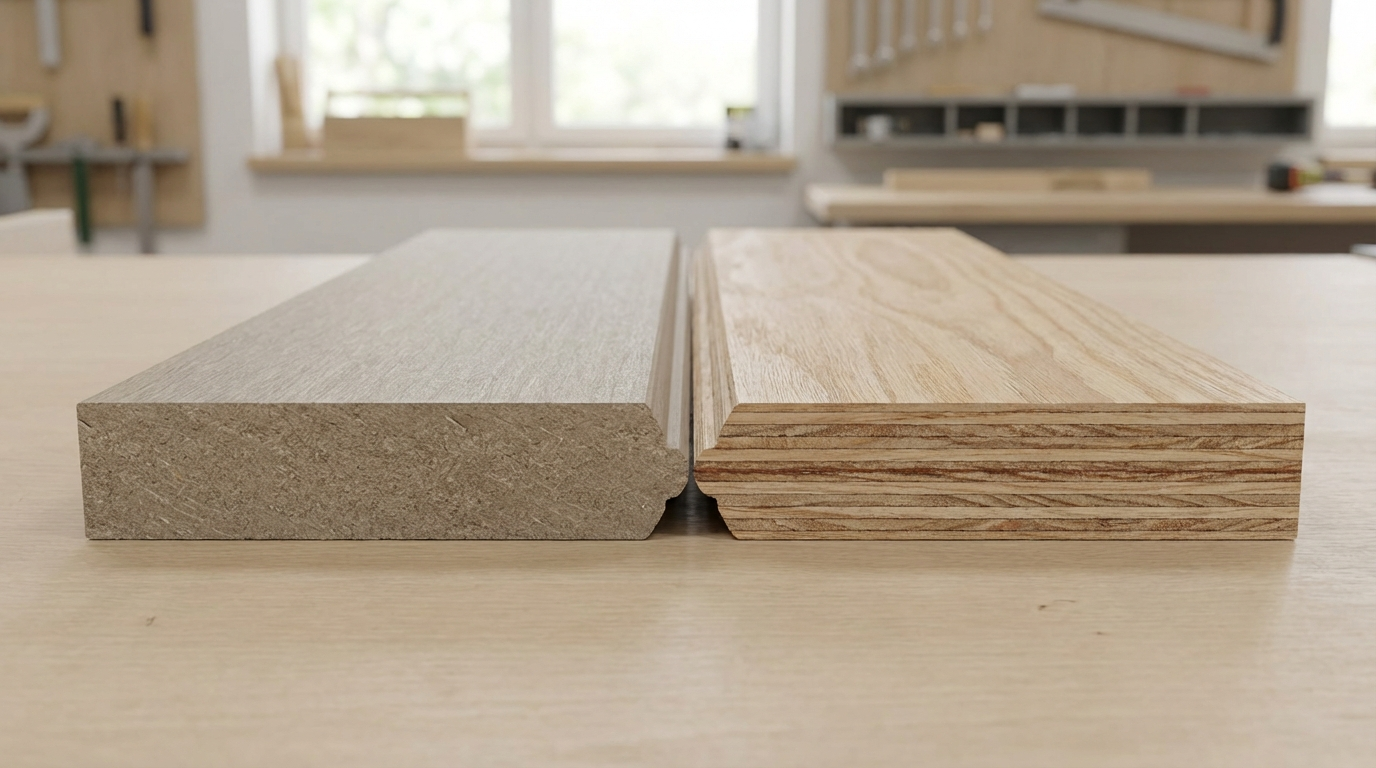
Quick Decision Summary
WPC stands for Wood Plastic Composite—a hybrid material made of wood fibers and thermoplastics designed specifically for areas where water exposure ruins traditional wood products.
If you are looking for a material for bathroom cabinets, outdoor deckings, or kitchen sink areas, WPC is often the superior choice because it is 100% waterproof and termite-proof. Use it in "wet zones" where even high-quality plywood might eventually swell. However, if you are building heavy-load shelving or large living room wardrobes, plywood remains better due to its higher structural strength and better screw-holding capacity. WPC can "creep" or sag over time if not supported correctly by a skilled carpenter.
- Choose this if: You are building in high-moisture areas (bathrooms, under-sink areas, coastal balconies) or need a 100% termite-proof solution.
- Avoid this if: You are creating long-span shelves, load-bearing structures, or prefer a premium natural wood-grain finish that requires staining.
What This Term Actually Means: Understanding WPC Composition
WPC stands for Wood Plastic Composite. It is an engineered material created by mixing ground wood particles (sawdust or wood flour) with heated thermoplastic resins (usually PVC, PE, or PP) along with stabilizers and foaming agents. The mixture is extruded into solid sheets or hollow profiles. In the Indian market, it is often referred to as "WPC boards" or "WPC sheets," and is frequently confused with PVC boards, though WPC contains actual wood fibers which provide slightly better stiffness than pure plastic boards.
Where people get confused: 5 Common Misunderstandings
- Confusing WPC with PVC: While they look similar, PVC boards contain no wood flour. WPC is generally heavier, denser, and more rigid than pure PVC foam boards.
- Thinking it works like Plywood: People often assume WPC can handle the same weight as BWR plywood. In reality, WPC has lower tensile strength and can sag under heavy weight if not supported.
- The "Fireproof" Myth: WPC is often marketed as fireproof. It is generally fire-retardant (it won't easily catch flame), but because it contains plastic, it will melt and release smoke when exposed to high heat.
- Screw-holding expectations: Carpenters often use standard wood screws and find they slip. WPC requires specific pilot holes and sometimes "coarse-thread" screws or specialized adhesives for a permanent bond.
- Heat sensitivity: Many users don't realize that WPC expands and contracts with temperature more than plywood does, which can lead to warping if used in direct, harsh sunlight without proper gauging.
India-Specific Reality Check: The Monsoon and Coastal Context
In India, the primary reason for WPC’s massive growth is the combination of extreme humidity (Monsoons) and the prevalent termite threat. In coastal cities like Mumbai, Chennai, or Kolkata, plywood in ground-floor kitchens often fails within 5–7 years due to rising dampness. WPC solves this "bottom-up" moisture problem entirely. However, the Indian "site-work" reality is that most local carpenters are trained on wood, not composites. WPC requires different cutting speeds and specific adhesives (like cyanoacrylate or specialized WPC glues) rather than standard PVA glues (white glue), which simply do not bond with the plastic content in WPC.
Two-Minute Comparison: WPC vs. Plywood
| Feature | WPC (Wood Plastic Composite) | Plywood (BWP/BWR Grade) |
|---|---|---|
| Water Resistance | 100% Waterproof. Can be submerged. | Water-resistant (BWR) or Boiling Water Proof (BWP). |
| Termite Resistance | Naturally termite and borer proof. | Requires chemical treatment to stay resistant. |
| Weight Bearing | Moderate. May sag over long spans. | High. Excellent for heavy load shelving. |
| Installation | Needs special screws/glues; heat sensitive. | Standard carpentry tools and white glue. |
| Surface Finish | Smooth, ready to paint or laminate. | Requires sanding/lamination for a finish. |
| Veneer/Laminate Bond | Requires specialized primers/adhesives. | Excellent bond with standard adhesives. |
Is WPC better than plywood for modular kitchens?
WPC is better than plywood specifically for the "carcass" or framework of the kitchen cabinets located directly under the sink or near the floor where water mopping occurs. In these "wet zones," plywood is prone to delamination and mold growth over time. However, for the overhead cabinets or the shutters (doors), plywood is often preferred because it is lighter and holds hinges more securely over thousands of opening and closing cycles. A hybrid approach—WPC for the bottom and plywood for the top—is often the most cost-effective and durable strategy for Indian homes.
Can WPC boards be used for outdoor furniture?
Yes, WPC is an excellent choice for outdoor applications like garden benches, fencing, and wall cladding because it does not rot when exposed to rain. However, the "India factor" involves high UV exposure. You must verify that the WPC board is UV-stabilized; otherwise, the plastic component can become brittle and the color may fade over two or three summers. For outdoor use, solid WPC profiles are generally better than the foam-core boards used for indoor furniture. Always ask for exterior-grade specifications when buying for balconies or terraces.
How does WPC handle heat and fire in Indian kitchens?
WPC is generally classified as a self-extinguishing material, meaning it won't contribute significantly to the spread of a fire compared to dry wood. However, since it contains thermoplastics (like PVC), it can soften or deform if placed too close to a high-heat source, such as a gas stove or an oven vent, without an air gap. High-quality WPC boards are designed to be "Class A" fire-rated, but at a site level, you should always maintain a minimum 4-6 inch gap between the heat source and the composite panel to prevent warping or melting of the plastic resins.
Price Range and Cost Drivers (India)
WPC is typically priced per square foot or by the total weight of the sheet (density). In most Indian markets, WPC is slightly more expensive than commercial MR-grade plywood but comparable to high-end BWP (Boiling Water Proof) marine plywood.
- Density: This is the biggest cost driver. Higher density (0.50 to 0.60 g/cm³) boards are more expensive but hold screws better. Lightweight boards are cheaper but brittle.
- Thickness: Common thicknesses include 5mm, 12mm, 15mm, and 18mm. Prices scale with the volume of material used.
- Color/Finish: Standard cream or white boards are cheapest. Pre-colored or "wood-finish" boards carry a premium.
- Brand and Logistics: Prices vary by 10-15% between major cities and Tier-2 towns due to transport costs of these heavy sheets.
Quick Quote Checklist: When asking for a rate, specify the density (e.g., "I need 18mm WPC with 0.55 density"), as a "cheap" quote usually means a low-density board that will fail during screw installation.
Trade-offs and Limitations
- Bending and Sagging: Unlike wood fibers that are long and interconnected, WPC uses wood flour. This means it lacks "flexural strength." If you put heavy books on a long WPC shelf, it will eventually bow downwards (creep).
- Lower Screw Retentivity: If a screw is over-tightened in WPC, the hole "strips" more easily than in plywood. Once a hinge comes loose, it is harder to fix in the same spot.
- Choosing by price over density: Low-density WPC is basically hard foam and won't hold furniture together. Always check the weight of the sheet.
- Using standard PVA glue: Carpenters often use "Fevicol" style glue for laminates on WPC. It will peel off. Use specialized WPC adhesives or "pro" grade cyanoacrylates.
- No pilot holes: Driving a screw directly into WPC can crack the edge. Always drill a pilot hole first.
- Ignoring the UV rating: Using indoor-grade WPC for a sunny balcony furniture set will lead to cracking within a year.
- Over-spanning: Using WPC for 4-foot wide shelves without vertical support. Keep spans under 2.5 feet for heavy loads.
- Poor edge finishing: WPC edges can be sharp or show "air bubbles" if low quality. Use PVC edge banding with heat-melt glue.
- Painting without primer: Applying paint directly to WPC often leads to flaking. Use a plastic-compatible primer first.
- Mixing grades: Using low-density boards for hinges and high-density for panels. Hinges always need the highest density available.
- The Weight Test: Pick up a corner of the board. An 18mm high-density WPC sheet should feel significantly heavier than a standard plywood sheet of the same size. If it feels light, the density is too low for furniture.
- The Nail/Screw Test: Take a small sample piece. Drive a screw into the side (the thickness). If the board splits or the screw pulls out with a light tug, the density is poor.
- The Scratch Test: Try to dent the surface with your thumbnail. A good WPC board should be relatively hard and resistant to easy indentation.
- The "Core" Look: Look at the cut cross-section. It should look uniform and solid. If you see large air pockets or a very "crumbly" texture, it is a low-quality foam board.
Common Buyer Mistakes and How to Avoid Them
Failure Modes and Fixes
| Symptom | Root Cause | Prevention | Fix |
|---|---|---|---|
| Hinges becoming loose | Screw hole stripped due to low density or over-tightening. | Use 0.55+ density boards and pilot holes. | Fill hole with epoxy putty and re-drill, or use "through-bolts." |
| Wavy surface/warping | Heat exposure or lack of structural support. | Maintain air gaps near appliances; use metal stiffeners. | Very difficult to fix; requires structural reinforcement. |
| Laminate peeling off | Wrong adhesive used on plastic surface. | Use WPC-specific primers or solvent-based glues. | Peel back, sand the WPC surface, and re-apply with contact cement. |
| Cracking at edges | Screws placed too close to the edge without pre-drilling. | Maintain a 2-inch distance from corners; always pre-drill. | Use cyanoacrylate glue (super glue) to seal the crack. |
| Sagging shelves | Weight exceeds the material's structural limit. | Add a vertical partition or a metal "L" angle support. | Add a support baton underneath the shelf. |
Quality Checks You Can Do Without Lab Tests
Decision Framework: When to Use What
| Project Condition | Recommended Material | What to Verify |
|---|---|---|
| Bathroom Vanity / Under-Sink | WPC (High Density) | Ensure 100% waterproof adhesive is used for laminates. |
| Bedroom Wardrobe (Internal) | Plywood (MR or BWR) | Check for IS 303 or IS 710 certification. |
| Kitchen Shutters (External) | Plywood or HDHMR | Check for moisture resistance and hinge strength. |
| Coastal/High Humidity Area | WPC or Marine Plywood | WPC is better for termite-prone ground floors. |
| Bookshelves / Heavy Storage | Plywood | Use 18mm thickness to prevent sagging. |
FAQs
Is WPC more expensive than plywood?
Generally, WPC is more expensive than basic MR-grade (commercial) plywood but sits in a similar price bracket to high-quality BWP (Boiling Water Proof) marine plywood. The long-term cost of WPC is often lower in high-moisture areas because it does not require periodic termite treatments or replacement due to water rot. However, for a standard dry bedroom, plywood remains the more economical choice for large-scale furniture like beds and wardrobes.
Can we use normal carpenter tools on WPC?
Yes, WPC can be cut, sawn, and drilled using standard woodworking tools. However, because it contains plastic, the friction from cutting can sometimes melt the edges if the blade is dull or the speed is too high. Carpenters should use sharp, fine-toothed blades and avoid "forcing" the tool through the material. Traditional hand planes also work, but the shavings will be plastic-like rather than wooden curls.
Is WPC 100% termite proof?
WPC is inherently termite-proof because its composition is a mix of plastic and fine wood flour encapsulated in resin. Termites cannot digest the plastic material, and there are no large wood fibers for them to tunnel through. Unlike plywood, which requires chemical treatment to resist termites, WPC's resistance is a fundamental property of the material itself, making it one of the safest choices for termite-prone regions in India.
Can WPC boards be painted or polished?
WPC boards can be painted using PU (Polyurethane) or Duco paints, but the surface preparation is critical. Because the surface is non-porous and slightly "oily" due to the plastic content, you must sand the surface with fine-grit sandpaper and apply a plastic-compatible primer before painting. Traditional wood polish (like French polish) does not work on WPC because it cannot soak into the material like it does with natural wood.
What is the life of WPC furniture?
In indoor environments, particularly in wet areas like bathrooms, WPC furniture can easily last 15–20 years or more because it is immune to water damage and biological decay. The only factors that "age" WPC are mechanical wear (hinges coming loose) or structural sagging if the design was poor. For outdoor use, the lifespan depends heavily on UV protection, but 10 years is a typical expectation for high-quality exterior-grade composite profiles.
How do I fix a laminate to a WPC board?
This is where most site mistakes happen. Standard white wood glue (PVA) will often fail over time. To fix a laminate to WPC, it is recommended to use "contact adhesive" (like rubber-based yellow glues) or specialized WPC-to-laminate primers. Some manufacturers offer "pre-sanded" WPC boards which provide a better mechanical "key" for the glue to grab onto, which is highly recommended for kitchen shutters.
Is WPC eco-friendly?
WPC is considered more eco-friendly than solid wood because it often uses recycled wood waste (sawdust) and can be made with recycled plastics. Furthermore, WPC boards are 100% recyclable themselves—old off-cuts can be ground down and extruded into new boards. By replacing wood in high-moisture areas, it also reduces the demand for virgin timber, though the presence of plastic means it is not biodegradable like pure wood.
Does WPC have a bad smell?
New WPC boards may have a slight "plastic" or "burnt" odor immediately after being cut due to the friction heating the resin. However, high-quality WPC is low in VOCs (Volatile Organic Compounds) and the smell dissipates very quickly after installation. Unlike cheap plywood, which can emit formaldehyde fumes for months, WPC is generally considered a safer material for indoor air quality in modern homes.
Disclaimer: This content is provided for general informational purposes based on industry practices and publicly available information. Product specifications, standards, prices, and availability may vary by manufacturer, region, and time. Readers should independently verify details with manufacturers, dealers, or qualified professionals before making purchase or construction decisions.Want Plywood Suggestions?
Share a few details and a Duro BOIL specialist will suggest suitable brands and connect you to responsive dealers.
Related reads
View all
Types of Veneer: Natural, Engineered & Reconstituted - Complete Guide
All types of veneer explained - natural, engineered & reconstituted. Learn cut types, wood species, prices & applications for furniture and interiors.
Read insight
Door Fitting & Installation Guide: Step-by-Step with Measurements
Complete door fitting guide with step-by-step installation process. Learn hinge positions, gap tolerances, tools required & common mistakes to avoid.
Read insight
BWP Plywood Meaning: IS 710 Explained with Grades & Prices (2026)
BWP plywood meaning explained - Boiling Water Proof grade per IS 710. Learn 72-hour test, BWP vs BWR difference, prices & when to use marine plywood.
Read insight